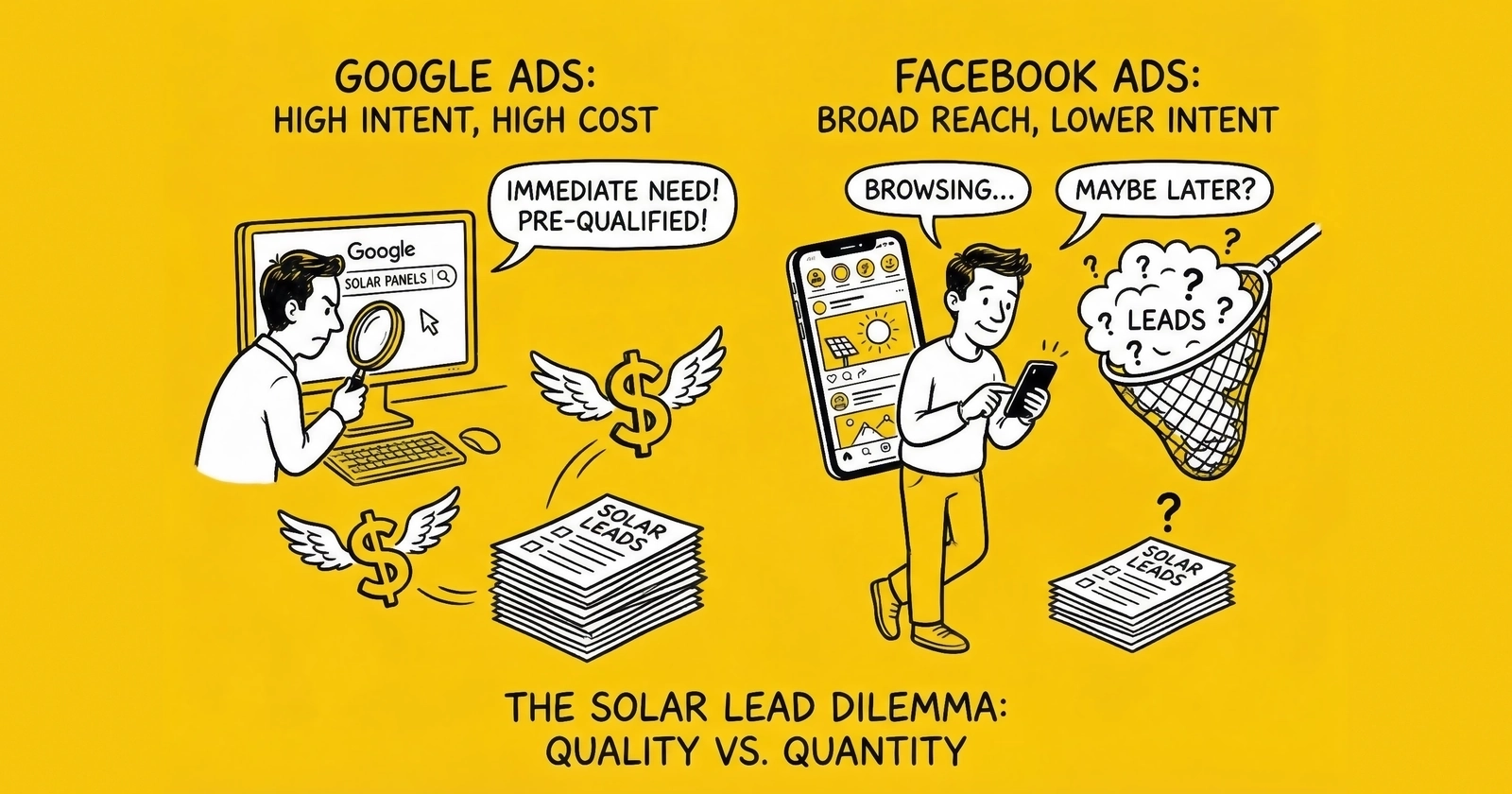
A data-driven analysis of the two dominant paid channels for solar lead generation. Which platform delivers better ROI when exclusive leads sell for $150+ and quality determines whether your operation survives the post-ITC market?
The solar lead generator’s budget allocation question has no universal answer. Google captures homeowners actively searching “solar panel installers near me” – explicit intent that justifies premium CPCs. Facebook reaches homeowners through targeting before they even know they want solar – implicit intent that requires creative excellence to convert.
Both channels work. Both channels fail. The difference is whether you understand each platform’s economics deeply enough to extract profit where competitors find only losses.
Solar lead generation in 2025 operates under pressure that makes channel selection critical. The residential market contracted 12% in 2024. California volumes dropped 41% after NEM 3.0 reduced export compensation by 75%. The federal Investment Tax Credit expires for residential installations after December 31, 2025, eliminating the 30% incentive that drove a decade of growth. Lead generators who master channel optimization will survive the transition. Those who guess will discover their margins vanished while they wondered what happened.
This comprehensive comparison provides the framework for Google vs. Facebook budget allocation in solar lead generation: CPL benchmarks, quality differentials, creative requirements, targeting strategies, compliance considerations, and budget allocation models that adapt to your specific geography and buyer relationships.
The Fundamental Difference: Intent vs. Targeting
Before diving into benchmarks and tactics, understand the core difference between these platforms. This distinction shapes every optimization decision.
Google: Capturing Explicit Intent
When a homeowner types “solar installers in Phoenix” into Google, they have already decided they want information about solar. Something triggered their search – a high electricity bill, a neighbor’s installation, an article about rising rates, or simply accumulated awareness that solar might make sense. The decision to investigate has been made. Your job is to be present when they are ready to act.
Google Ads captures this explicit intent through keyword targeting. You bid on the search terms that indicate solar interest. When users search those terms, your ads compete in an auction. Winners appear above organic results. You pay when users click.
The intent signal is powerful. A search for “compare solar quotes” reveals more purchase intent than any demographic profile could. The user told you exactly what they want. No inference required.
The limitation: intent-based advertising reaches only users who have already entered the consideration phase. You cannot reach homeowners who would benefit from solar but have not yet realized it. The addressable market is smaller, though more qualified.
Facebook: Creating Interest Through Targeting
Facebook advertising works differently. You do not bid on search terms because users are not searching – they are scrolling through content from friends, family, and followed pages. Your ads interrupt this experience, attempting to capture attention and create interest where none existed moments before.
Instead of intent signals, Facebook uses targeting signals: demographics (age, income, location), interests (environmental causes, home improvement), behaviors (recent homeownership, solar research sites visited), and lookalike modeling (users similar to your existing customers).
The creative carries enormous weight. Your ad must stop the scroll, communicate value, and prompt action – all within 2-3 seconds before the user scrolls past. The same targeting with different creative can produce 5x performance variation. Platform expertise matters less than creative excellence.
The advantage: you can reach homeowners who would benefit from solar before they know they want it. The addressable market is enormous – every homeowner with suitable roof and sufficient electricity usage. The qualification challenge is converting that broad reach into genuine purchase intent.
CPL Benchmarks: What Each Platform Actually Costs
Solar lead CPL varies dramatically by platform, geography, lead type, and verification level. National averages obscure the geographic variation that determines profitability. These benchmarks provide directional guidance; your actual costs will vary based on execution quality and market conditions.
Google Ads Solar CPL
Google Ads solar lead costs have risen substantially as competition intensified. Current benchmarks for residential solar:
| Lead Type | CPL Range | Notes |
|---|---|---|
| Exclusive, form-verified | $110-220 | Premium markets (CA, NY, MA) at high end |
| Exclusive, basic | $80-150 | Lower verification, higher return rates |
| Shared (2-3 buyers) | $45-85 | Per-buyer pricing |
| Set appointments | $180-280 | Verified scheduled time with homeowner |
Geographic variation is extreme:
| State Tier | Example States | Google Ads CPL |
|---|---|---|
| Tier 1 | California, Massachusetts, New York | $150-220+ |
| Tier 2 | Texas, Florida, New Jersey | $100-160 |
| Tier 3 | Nevada, Illinois, Virginia | $70-110 |
| Tier 4 | Midwest states | $50-80 |
The keyword cost structure reveals intent value:
| Keyword Type | Average CPC | Conversion Rate | Effective CPL |
|---|---|---|---|
| ”solar quotes” | $8-15 | 6-8% | $100-250 |
| ”solar installers near me” | $10-18 | 7-10% | $100-180 |
| ”solar panel cost” | $5-10 | 3-5% | $100-200 |
| ”how much is solar” | $3-6 | 2-4% | $75-150 |
Note that lower CPCs do not always mean lower CPL. The “how much is solar” query captures earlier-stage research with lower conversion rates. The math sometimes favors paying $15 per click for 10% conversion over $5 per click for 3% conversion.
Facebook Ads Solar CPL
Facebook solar lead costs run lower than Google but with significant quality trade-offs:
| Lead Type | CPL Range | Notes |
|---|---|---|
| Lead Ads (native form) | $25-55 | Pre-filled forms, highest volume, lowest quality |
| Landing page conversion | $45-90 | Higher friction, better quality |
| Higher Intent forms | $35-65 | Native forms with review step |
| Retargeting leads | $20-40 | Warm audiences, quality comparable to LP |
The Facebook CPL advantage over Google appears significant – often 40-60% lower raw CPL. But as we will examine, downstream quality differences frequently eliminate this advantage when measured as cost per qualified lead or cost per customer.
The CPL Math That Actually Matters
Raw CPL comparisons miss the point. Solar lead economics depend on what happens after the form submission:
Google Ads Example (Tier 2 Market):
- CPL: $130
- Contact rate: 65%
- Qualified rate after contact: 55%
- Effective cost per qualified lead: $363
- Close rate: 10%
- Cost per sale: $1,300
Facebook Lead Ads Example (Same Market):
- CPL: $45
- Contact rate: 35%
- Qualified rate after contact: 30%
- Effective cost per qualified lead: $428
- Close rate: 6%
- Cost per sale: $2,500
Despite 65% lower raw CPL, Facebook delivers sales at nearly 2x the cost. This pattern repeats across most solar markets, though the magnitude varies by execution quality and audience sophistication.
Those who optimize only for CPL systematically overspend on low-quality leads. Those who track downstream conversion discover that platform selection depends on total funnel economics, not form completion cost.
Lead Quality: The Defining Difference
The quality gap between Google and Facebook solar leads deserves detailed examination because it determines actual campaign profitability. Understanding why this gap exists enables optimization strategies that can narrow (but not eliminate) the differential.
Why Google Produces Higher Quality
Explicit intent filtering. Users who type “solar installation quote” have self-selected into the consideration phase. They have already concluded that solar might make sense for their situation. The search itself represents a qualification step that occurs before your ad even appears.
Active engagement requirement. Clicking a search ad, loading a landing page, and completing a form requires sustained attention and deliberate action. Users who complete this journey demonstrate the engagement level that predicts downstream conversion.
Higher friction filters. The Google-to-landing-page-to-form path takes 30-60 seconds minimum. Each step loses casual browsers. The leads who emerge have demonstrated patience and genuine interest.
Research mode mentality. Search engine users are in information-gathering mode, actively comparing options. This mindset aligns with the solar sales process, which requires evaluation and decision-making.
Why Facebook Produces Lower Quality
Passive discovery. Facebook users are not searching for solar. They are scrolling through social content. Your ad interrupts their entertainment. Even interested users may not be in decision-making mode.
Pre-filled form friction. Facebook Lead Ads pre-populate name, email, and phone from profile data. Users can submit without typing, without conscious engagement. Some submit accidentally. Others submit from curiosity without purchase intent.
Outdated profile data. Facebook profile information can be years old. Phone numbers users no longer own. Email addresses they never check. The pre-filled data looks valid but does not reach actual humans.
Lower commitment threshold. The ease of submission does not filter. Users who will not answer their phones can submit as easily as serious buyers.
Scroll-and-forget behavior. Users who submit while scrolling may not remember doing so hours later when your sales team calls. The connection between ad and follow-up weakens.
Quantifying the Quality Gap for Solar
| Quality Metric | Google Ads | Facebook Lead Ads | Facebook to Landing Page |
|---|---|---|---|
| Phone valid and active | 90-95% | 70-80% | 85-92% |
| Contact rate (first attempt) | 55-70% | 25-40% | 40-55% |
| Contact rate (3 attempts) | 75-85% | 45-60% | 60-75% |
| Meets basic qualification | 60-75% | 30-45% | 45-60% |
| Converts to appointment | 25-35% | 10-20% | 18-28% |
| Converts to sale | 8-15% | 3-6% | 5-9% |
These ranges reflect typical performance. Your results will vary based on targeting, creative, form design, and sales process. But the pattern holds: Google produces higher quality, and Facebook to landing page outperforms Facebook Lead Ads.
Solar-Specific Quality Factors
Solar leads have qualification requirements that amplify quality differences:
Homeownership verification. Renters cannot authorize solar installation. Self-reported ownership on forms is unreliable. Google traffic from intent searches correlates with homeownership (why would renters search for solar quotes?). Facebook targeting can reach renters despite demographic filtering.
Property suitability. Roof age, orientation, shading, and structural condition determine installation viability. Intent-based searchers have often already assessed basic suitability. Interruption-based discovery reaches homeowners who have not considered whether their property works for solar.
Electric bill qualification. The economic case for solar depends on current electricity costs. Homeowners with $150+ monthly bills have strong motivation. Those with $75 bills have marginal economics. Intent searches correlate with bill awareness; interruption advertising does not.
Credit qualification. Solar financing typically requires FICO scores above 650. Intent searches skew toward qualified buyers who have researched financing. Facebook targeting cannot filter by credit score.
Timeline appropriateness. Serious solar buyers have installation timelines – often aligned with tax credit deadlines, roof replacements, or electricity rate increases. Interruption-discovered prospects may have no timeline urgency.
Channel Comparison: Deep Dive
Beyond CPL and quality, Google and Facebook differ in targeting capabilities, creative requirements, scaling dynamics, and optimization levers. Understanding these differences enables strategic channel allocation.
Targeting Capabilities
Google Ads Targeting
Google’s targeting architecture builds from keywords as its foundation. You select exact match, phrase match, or broad match terms that capture search intent. Geographic targeting layers precision at the state, city, ZIP code, or radius level. Device targeting separates mobile from desktop and tablet traffic, enabling bid adjustments where conversion patterns differ. Time-of-day scheduling concentrates budget during hours when homeowners research solar decisions – typically evenings and weekends.
Beyond keywords, audience overlays add demographic signals, in-market indicators, and affinity categories without abandoning intent-based selection. Remarketing lists enable re-engagement with past visitors. Customer match uploads your email and phone lists to target existing prospects or build similar audiences.
The keyword foundation provides intent-based targeting that no demographic profile can match. Layering audience signals refines further. You cannot target “people who want solar” explicitly, but you can target “people searching for solar quotes” – effectively the same result.
Facebook Ads Targeting
Facebook constructs audiences from inferential signals rather than explicit intent. Demographics filter by age, income, education level, and homeownership status. Interest targeting reaches users who engage with environmental causes, home improvement content, or technology topics. Behavioral signals identify recent movers, recent home purchasers, or users who have visited solar research sites.
Life event targeting captures homeowners at transition moments – new home purchases trigger receptivity to improvement investments. Custom audiences retarget website visitors, video viewers, or engagement audiences. Lookalike modeling finds users similar to your customers across Facebook’s billions of profiles. Advantage+ automation increasingly handles audience selection algorithmically, often outperforming manual targeting.
Facebook’s targeting enables reaching homeowners before they search, potentially capturing demand earlier in the journey. But every targeting signal is inferential. You guess that homeowners interested in environmental causes might want solar. You do not know they want solar.
The targeting advantage favors Google for precision and Facebook for reach. Google finds people who want solar now. Facebook finds people who might want solar if educated properly.
Creative Requirements
Google Ads Creative
Google Search campaigns rely primarily on text. Responsive Search Ads accept up to 15 headlines of 30 characters each and 4 descriptions of 90 characters each, with Google’s algorithm selecting optimal combinations. Visual elements remain limited in Search campaigns, though Display and YouTube campaigns add image and video requirements.
Message match between ad copy and landing page content critically affects Quality Score and conversion. The creative skill on Google is copywriting – compelling headlines, clear value propositions, strong calls to action, all within tight character constraints.
Facebook Ads Creative
Facebook operates as a visual-first environment. Images require minimum 1080x1080 resolution, videos typically run 15-60 seconds, and carousel formats combine multiple frames. Primary text truncates after 125 characters on mobile, headlines display only 25 characters before cut-off, and descriptions often disappear entirely.
The image or video thumbnail determines whether users pause or scroll past. Investment in creative production directly correlates with performance. Extensive testing proves essential – expect to run 10 or more variations per campaign. The same targeting with different creative produces 5x performance variation.
The creative advantage follows skillsets. Google favors copywriting skill while Facebook favors visual production capability. Operators with strong copywriters excel on Google. Operators with video production or design capability excel on Facebook.
Scaling Dynamics
Google Ads Scaling
Google scales to the limits of search demand. The volume of “solar quotes Phoenix” searches is fixed – you cannot manufacture more queries than homeowners organically generate. Increasing impression share means bidding against yourself, pushing CPCs higher for marginal volume. Expansion to broader keywords adds volume but reduces quality as you capture earlier-stage researchers.
Geographic expansion works where you have buyer relationships to monetize leads in new territories. But the fundamental ceiling remains search demand. In solar, this demand is substantial but not unlimited.
Facebook Ads Scaling
Facebook offers nearly unlimited scale in theory – every homeowner could see your ads. Billions of users populate the audience pool. In practice, creative fatigue limits sustainable volume, requiring fresh creative every 2-4 weeks as performance degrades on overexposed assets. Audience saturation constrains smaller markets where qualified homeowner pools exhaust quickly. Budget scaling affects auction dynamics, with efficiency declining as spend increases.
Lookalike audience expansion reaches further from your seed audiences, reducing precision as the algorithm stretches to find similar users. Scaling requires continuous creative production and audience testing, not just budget increases.
The scaling advantage depends on your goal. Facebook wins for raw volume potential. Google wins for sustainable quality at scale. Facebook can generate more leads; Google generates more qualified leads.
Optimization Levers
Google Ads Optimization
Google optimization follows a systematic, data-driven approach. Keyword additions expand reach while negative keywords eliminate wasted spend on irrelevant queries. Bid adjustments refine targeting by device, location, and time of day – increasing bids where conversion rates justify premium and reducing where economics fail.
Quality Score improvement through landing page optimization and ad relevance directly reduces CPCs. Match type refinement balances volume against intent precision. Audience overlay testing identifies demographic or behavioral segments that convert at higher rates. Campaign structure optimization groups keywords and ads for tighter relevance matching.
Search term reports reveal actual user queries, showing exactly what triggered your ads. Quality Score metrics identify improvement opportunities with specific factors flagged. The platform provides clear signals about what works, enabling methodical improvement.
Facebook Ads Optimization
Facebook optimization centers on creative testing as the primary lever. The audience algorithm has become increasingly automated through Advantage+, reducing manual audience selection’s importance. Your primary lever is what users see, not who sees it.
Audience testing and exclusion refine targeting around creative winners. Placement optimization shifts budget toward feeds, stories, or reels based on performance. Bid strategy adjustment and campaign budget optimization balance volume against efficiency. Learning phase management ensures campaigns gather sufficient data before algorithmic optimization kicks in.
Testing volume matters enormously – expect 80% of creative variations to underperform. The winners justify the testing investment.
The optimization advantage follows platform architecture. Google enables structured, methodical improvement. Facebook requires creative iteration at volume. Google operators improve through analysis. Facebook operators improve through testing velocity.
Geographic Considerations for Solar
Solar’s 8.5x geographic pricing variation – from $1,929 customer value in California to $225 in North Dakota – fundamentally affects channel selection. Platform economics differ by state tier.
Tier 1 Markets (CA, MA, NY, HI)
In premium markets, Google Ads commands CPCs of $12-25 for core keywords, producing CPL of $150-220 or higher. Competition is intense, but Google remains essential for capturing high-intent traffic. Facebook Ads runs CPL of $40-75, though the quality gap is significant – high competition filters serious buyers toward Google while Facebook captures more casual interest.
Google’s cost is justified by quality in these markets. Customer values of $1,500-2,000 per sale support expensive lead acquisition. Facebook works as a supporting channel for retargeting and brand awareness but struggles to match Google quality for cold prospecting.
Tier 2 Markets (TX, FL, AZ, NJ, CO)
The mid-tier markets present the most balanced platform comparison. Google Ads CPCs run $8-15 for core keywords, delivering CPL of $100-160 in moderate to high competition. Facebook Ads achieves CPL of $30-55 with a moderate quality gap – less competition and lower consumer sophistication narrow the differential.
Customer values of $800-1,400 per sale justify both channels. Testing reveals which performs better in your specific territories. The recommendation is to run both channels and allocate based on your actual market data rather than industry benchmarks.
Tier 3 Markets (NV, IL, VA, GA, NC, SC)
Developing markets show smaller quality gaps between channels. Google Ads CPCs of $5-10 produce CPL of $70-110 in moderate competition – viable but requiring close quality monitoring. Facebook Ads delivers CPL of $25-45, with the quality gap smaller because both platforms attract less sophisticated audiences.
Customer sophistication is lower on both platforms in these markets. Facebook’s cost advantage may translate to better total economics. Test aggressively here, as Facebook may perform comparably to Google.
Tier 4-5 Markets (Midwest, Mountain, Plains)
In emerging solar markets, search volume is insufficient for scale. Google Ads CPCs of $3-7 produce CPL of $50-80 in low competition, but minimal search volume limits viability as a primary channel. Facebook Ads achieves CPL of $15-30 with a smaller quality gap.
Facebook reach enables finding the limited pool of qualified homeowners in these territories. It may be the only viable paid channel. The quality gap matters less when both channels produce marginal quality – the challenge is finding any qualified homeowners, not selecting between quality tiers.
California’s Special Case
California’s NEM 3.0 transition changed everything. Export compensation dropped 75%. Payback periods extended from 5-6 years to 14-15 years without storage. Residential installations dropped 40% in 2024. Yet battery attachment rates soared to 79%, and the value proposition shifted from grid export to energy independence and backup power.
On Google Ads, the keyword strategy must shift to capture this new reality. Searches for “solar panels California” now capture discouraged researchers processing negative information. Searches for “solar battery storage” capture the new demand driver. CPL has actually decreased as advertisers exited the state, creating opportunity for storage-focused operators.
On Facebook Ads, creative must lead with storage and backup benefits rather than electricity savings. Targeting homeowners in wildfire-prone areas emphasizes backup power value – a compelling proposition after repeated utility shutoffs. Competition has decreased as advertisers reduced California spend, and quality may improve as only serious buyers remain in the market.
Both channels require storage qualification focus. A solar-only California lead has limited value. A solar-plus-storage lead remains premium.
Budget Allocation Models
Given the analysis above, how should you allocate budget between Google and Facebook? The answer depends on your operation’s specific characteristics.
Model 1: Quality-First Allocation
For operations selling exclusive leads at $150+ to quality-focused buyers:
| Channel | Budget Allocation | Purpose |
|---|---|---|
| Google Search | 70% | Core acquisition |
| Facebook Retargeting | 15% | Convert warm visitors |
| Facebook Prospecting | 10% | Brand awareness, lookalike testing |
| Testing Reserve | 5% | New audience/creative experiments |
This model prioritizes lead quality over volume. It suits operations where buyer relationships depend on close rates and customer satisfaction.
Model 2: Volume-Balanced Allocation
For operations selling shared leads or serving high-volume buyers:
| Channel | Budget Allocation | Purpose |
|---|---|---|
| Google Search | 50% | High-intent capture |
| Facebook Landing Page | 25% | Quality volume supplement |
| Facebook Lead Ads | 15% | Volume at lower CPL |
| Testing Reserve | 10% | Channel experiments |
This model balances quality and volume. It suits operations where buyers accept lower quality for lower prices.
Model 3: Market-Stage Allocation
For operations entering new markets or testing viability:
| Channel | Budget Allocation | Purpose |
|---|---|---|
| Facebook Lead Ads | 40% | Fast validation of demand |
| Google Search | 35% | Quality baseline establishment |
| Facebook Landing Page | 15% | Quality comparison testing |
| Testing Reserve | 10% | Audience refinement |
This model prioritizes learning speed. Facebook’s faster feedback loops enable quick market validation before significant Google investment.
Model 4: Post-ITC Allocation
For operations preparing for the post-December 2025 market without federal tax credits:
| Channel | Budget Allocation | Purpose |
|---|---|---|
| Google Search (storage-focused) | 60% | Capture serious buyers |
| Facebook Retargeting | 20% | Nurture longer consideration |
| Facebook Prospecting | 15% | Educate on non-ITC value |
| Testing Reserve | 5% | Commercial solar testing |
The post-ITC market will contract 30-50%. Quality will matter more as margins compress. Google’s intent-based targeting will outperform Facebook’s interruption model when buyers need convincing on pure economics rather than tax incentive capture.
Dynamic Allocation Based on Performance
The smartest operators do not set static allocations. They measure cost per qualified lead (CPQL) and cost per sale (CPS) by channel weekly, shifting budget toward whichever channel delivers better downstream economics that week.
The weekly allocation framework starts with calculating CPQL and CPS for each channel, then comparing results to target thresholds. When Channel A outperforms threshold while Channel B underperforms, shift 10-20% of B’s budget to A. Cap any single channel at 80% of total budget for diversification protection – platform policy changes, account suspensions, and algorithm updates can devastate over-concentrated operations. Maintain a minimum 10% testing budget regardless of performance to discover emerging opportunities.
This dynamic approach captures short-term opportunities while preventing over-dependence on any single platform.
Optimization Strategies by Platform
Whichever allocation model you choose, platform-specific optimization determines actual performance.
Google Ads Optimization for Solar
Keyword Strategy
Focus on high-intent keywords with specific modifiers that signal purchase consideration. Geographic intent terms like “solar installers [city]” capture local shoppers. Action intent terms like “solar panel quotes” indicate readiness to receive proposals. Comparison intent terms like “compare solar costs” reveal active evaluation. Price-focused research terms like “how much does solar installation cost” attract buyers gathering decision information.
Avoid broad informational keywords that attract researchers without purchase intent. Terms like “how do solar panels work” indicate educational browsing with low conversion potential. Early consideration terms like “are solar panels worth it” capture users far from purchase decisions.
Build comprehensive negative keyword lists to eliminate wasted spend. Exclude jobs-related terms (solar installer jobs, solar sales jobs), DIY terms (DIY solar, solar kits), informational modifiers (how to, what is, guide), and commercial or utility scale terms if you target residential installations. A well-built negative keyword list prevents 15-25% of wasted clicks.
Campaign Structure
Separate campaigns by geography at the state or region level to match buyer pricing variations. Separate by intent tier, keeping high-intent quote terms apart from research terms with different bid strategies. Separate by device because mobile and desktop convert at different rates. Separate by match type, keeping exact match campaigns distinct from phrase and broad match campaigns. This structure enables granular bid management and budget control.
Quality Score Focus
Solar keywords often have Quality Score issues due to competitive landing pages and advertiser congestion. Improve Quality Score through dedicated landing pages per keyword theme – a page for “solar quotes” and another for “solar installation cost.” Achieve fast load times under 3 seconds. Prioritize mobile optimization since 60% or more of traffic arrives on mobile devices. Include keyword terms in ad copy for relevance matching. Write clear calls to action that match your ad promises.
A Quality Score improvement from 5 to 7 reduces CPC by approximately 20%.
Bidding Strategy
Start with manual CPC or Maximize Clicks to gather conversion data during the learning phase. Switch to Target CPA after accumulating 30 or more conversions monthly, giving the algorithm sufficient signal to optimize. Set targets based on your quality-adjusted economics, not raw CPL – a $200 target CPL makes sense if those leads convert to sales at profitable rates. Import offline conversions (closed sales) to enable optimization toward actual customers rather than form submissions.
Facebook Ads Optimization for Solar
Audience Strategy
Layer multiple targeting signals for precision rather than relying on single criteria. Combine homeownership as a demographic filter with home improvement interest as a behavioral signal. Add environmental consciousness as an interest layer. Filter by income level ($75,000 or above) to reach homeowners who can afford solar investments. Target the 35-65 age range for primary homeowners. Build lookalike audiences from your best customers – those who closed, not just those who submitted forms.
Test Advantage+ audiences with creative variation. The algorithm often finds converting audiences that manual targeting misses, especially as Facebook reduces granular targeting options.
Exclusions matter as much as inclusions. Exclude renters if identifiable through platform signals. Exclude recent form submitters to prevent wasted impressions on already-captured prospects. Exclude current customers to avoid annoying completed sales. Exclude low-intent engagers who watched less than 25% of your videos – they showed interest but not enough to warrant premium retargeting.
Creative Strategy
Solar Facebook creative must accomplish three things in 2-3 seconds: stop the scroll, communicate value, and create urgency.
Scroll-stopping elements include before/after solar installation images showing transformation, drone footage of solar rooftops providing visual impact, electricity bill comparisons with dramatic numbers, and savings calculations in bold text that communicate value instantly.
Value communication requires leading with the benefit – save $X monthly, eliminate electric bills entirely. Include social proof through neighbor installations and local customer counts. Display credibility signals like years in business and total installations completed.
Urgency creation drives action. Reference the tax credit deadline with messaging like “Federal credit expires December 31.” Create scarcity through limited availability statements such as “Only X installations available this month.” Warn about rising rates with copy like “Utility rates up 15% this year.”
Plan to test 10 or more creative variations per campaign. Expect 80% to underperform. The winners justify the testing investment.
Form Strategy for Lead Ads
Use Higher Intent form format with a review step before submission. Add at least one qualifying question such as “What is your average monthly electricity bill?” or “When are you looking to install solar?” or “Do you own your home?” These questions reduce volume 15-25% but improve quality 30-40% – a trade-off that benefits downstream economics.
Customize the thank you screen to set response time expectations (“We’ll call within 5 minutes”), include a click-to-call button for immediate engagement, and offer immediate value through a solar savings calculator link. The thank you screen shapes lead expectations and improves contact rates.
Landing Page Strategy
When driving traffic to landing pages instead of Lead Ads, prioritize mobile-first design since 80% or more of traffic arrives on mobile devices. Ensure above-fold form visibility so users see the conversion opportunity immediately. Achieve sub-3-second load time to prevent abandonment. Use progressive forms that collect basic information first and qualification details second. Position trust signals near the form including testimonials and installer ratings.
Landing page campaigns run 40-60% higher CPL but produce 50-80% better quality. For premium markets, this trade-off favors landing pages.
Compliance Considerations
TCPA compliance affects both platforms but creates different challenges for each.
TCPA Fundamentals for Solar Leads
The Telephone Consumer Protection Act requires Prior Express Written Consent (PEWC) before making telemarketing calls to cell phones using automated technology. Valid PEWC requires a written agreement signed by the person called, clear authorization identifying the seller making calls, disclosure that calls will use automated technology, the specific phone number authorized for contact, and a statement that consent is not required for purchase. Missing any element creates litigation exposure.
Google Ads Compliance
Landing pages receiving Google traffic provide complete control over consent language. You design the form, write the disclosures, and document everything.
Best practices include placing clear consent language above the submit button, providing seller identification that lists all buyers who may call, capturing TrustedForm or Jornaya certificates for each submission, validating phone numbers against litigator databases before delivery, and implementing SMS verification of phone ownership for high-value leads.
The risk level is lower on Google because you control the consent experience completely.
Facebook Lead Ads Compliance
Native Lead Ads present documentation challenges that increase legal risk.
Seller identification limitations constrain disclosure options. Facebook’s form format limits disclosure customization, making it difficult to list multiple potential buyers in the consent language within character constraints.
Documentation gaps weaken litigation defense. Unlike landing pages with TrustedForm recordings, native forms provide limited evidence of what the user actually saw. If challenged in litigation, proving consent requires demonstrating form configuration – less comprehensive than session recordings that capture the entire user journey.
Pre-filled phone concerns create ownership questions. Pre-filled phone numbers may be outdated. The person who owns that number may not be the person who submitted the form, creating potential TCPA exposure.
Best practices for Lead Ads include customizing the privacy policy field with consent language, adding a consent confirmation question, validating phone numbers against litigator lists before buyer delivery, documenting form configuration with screenshots, and considering landing page routing for high-risk states like Florida and California.
The risk level is higher on Facebook because platform constraints limit consent documentation.
State-Specific Considerations
Some states have enhanced telemarketing requirements beyond federal TCPA. Florida features enhanced restrictions and an aggressive litigation environment – use landing pages with comprehensive documentation. California has state-specific consent requirements making landing pages preferred. Washington imposes strict calling time restrictions that require compliance regardless of lead source.
For high-risk states, the compliance advantage of landing pages over Lead Ads may outweigh CPL differences.
Measuring True ROI
Raw CPL comparison misleads. True ROI requires tracking through the complete funnel.
Essential Metrics by Platform
Acquisition metrics establish the foundation: cost per click (CPC), click-through rate (CTR), form conversion rate, and cost per lead (CPL). These metrics reveal platform efficiency but not business impact.
Quality metrics bridge acquisition and outcomes: contact rate on first attempt, contact rate across total attempts, qualification rate after contact, and appointment set rate. These metrics reveal lead quality differences that raw CPL obscures.
Outcome metrics determine actual profitability: appointment show rate, close rate, cost per sale, and revenue per lead. Only outcome metrics reveal whether lower CPL translates to better economics or merely higher volume of low-quality leads.
Tracking Implementation
For Google Ads, capture the GCLID on form submission and store it with the lead record in your CRM. Import closed sales as offline conversions to feed the algorithm data on actual customers, not just form completions. Enable Enhanced Conversions for additional matching when email or phone data improves attribution.
For Facebook Ads, capture the FBCLID on landing page submissions and store it with each lead record. Import CRM outcomes through the Conversions API rather than relying on pixel events. Configure offline conversion events for optimization so the algorithm learns from sales, not just leads.
Server-side tracking is essential for accurate measurement. Browser restrictions and ad blockers eliminate 20-40% of conversion data. Server-side implementation recovers this signal, enabling accurate channel comparison.
Attribution Challenges
Solar’s consideration cycle – often 30-90 days from initial interest to closed sale – creates attribution complexity. A homeowner might see a Facebook ad in January, search Google in February, submit a form through a Google ad, then close the sale in March. Which channel gets credit?
Use 90-day attribution windows to capture the full consideration cycle. Compare first-touch and last-touch attribution to understand channel roles. Accept that channels influence each other – Facebook awareness enables Google conversion. Focus on overall portfolio ROAS rather than individual channel attribution, which often proves impossible to determine with certainty.
Reporting Cadence
Weekly reporting covers CPL, contact rate, and qualification rate by channel to identify short-term performance shifts that warrant investigation. Monthly reporting adds cost per sale, ROAS, and quality trends to inform budget allocation adjustments. Quarterly reporting provides full funnel analysis, geographic comparison, and creative performance review for strategic planning updates.
Frequently Asked Questions
Which platform has lower CPL for solar leads – Google or Facebook?
Facebook Lead Ads typically produce CPL 40-60% lower than Google Ads. Facebook Lead Ads average $25-55 CPL for solar, while Google Search averages $110-220 for exclusive leads. However, lower CPL does not mean lower cost per sale. Facebook leads contact at 25-40% rates versus Google’s 55-70%, and qualify at roughly half the rate. When measured as cost per qualified lead or cost per sale, Google often outperforms despite higher raw CPL.
What is a good cost per lead for solar on Google Ads?
Good CPL depends on your geography and lead type. In Tier 1 markets (California, Massachusetts, New York), expect $150-220+ for exclusive leads. In Tier 2 markets (Texas, Florida, Arizona), target $100-160. In Tier 3 markets, $70-110 is achievable. The key metric is cost per qualified lead, which should stay under $400 in most markets to maintain profitable unit economics at typical 8-15% close rates.
What is a good cost per lead for solar on Facebook?
Facebook Lead Ads should generate solar leads at $25-55 CPL in most markets. Landing page campaigns run higher at $45-90 but produce better quality. Higher Intent forms with qualifying questions typically cost $35-65 but improve downstream conversion significantly. If your CPL exceeds these ranges, examine creative quality and audience targeting before increasing budget.
Should I use Facebook Lead Ads or landing pages for solar?
Landing pages produce higher quality leads (50-80% better downstream conversion) but at 40-60% higher CPL. Use Lead Ads for volume-focused operations, retargeting campaigns, and market testing. Use landing pages for premium lead sales, high-value markets, and TCPA compliance requirements. Many successful operations use both: Lead Ads for cold prospecting and landing pages for warm retargeting.
How do I improve solar lead quality from Facebook?
Five tactics improve Facebook solar lead quality: (1) Use Higher Intent form format with review step before submission. (2) Add qualifying questions – monthly electricity bill, homeownership status, installation timeline. (3) Build lookalike audiences from closed sales, not form submitters. (4) Exclude low-intent audiences and previous non-converters. (5) Drive traffic to landing pages instead of native forms for your highest-quality campaigns.
How should I split budget between Google and Facebook for solar leads?
Quality-first operations allocate 70% to Google, 15% to Facebook retargeting, 15% to testing. Volume-balanced operations allocate 50% to Google, 35% to Facebook, 15% to testing. Market testing operations allocate 40% to Facebook Lead Ads for fast validation, 40% to Google for quality baseline, 20% to testing. Adjust based on your actual cost per qualified lead data – shift budget toward whichever channel delivers better downstream economics.
Does geographic location affect which platform works better for solar?
Significantly. In Tier 1 markets (California, Massachusetts, New York) with high customer values, Google’s quality advantage justifies its cost premium. In Tier 3-4 markets with lower competition and less sophisticated consumers, the quality gap narrows and Facebook’s cost advantage may translate to better total economics. Test both channels in each market rather than applying blanket assumptions.
How do I track lead quality by platform?
Capture platform click IDs (GCLID for Google, FBCLID for Facebook) on form submission. Store these IDs with each lead record in your CRM. Track contact rate, qualification rate, appointment rate, and close rate by platform. Import closed sales back to each platform as offline conversions. Compare cost per qualified lead and cost per sale, not just cost per lead.
What creative works best for solar on Facebook?
Stop-the-scroll visuals: before/after installation images, drone footage of solar rooftops, bold savings numbers. Value communication: lead with benefits (monthly savings, eliminated bills), include social proof (local customer counts, neighbor testimonials), show credibility (years in business, installation count). Urgency drivers: tax credit deadlines, limited availability, rising electricity rates. Test 10+ variations per campaign – expect 80% to underperform.
How does the ITC expiration affect Google vs. Facebook for solar?
The federal tax credit expiration after December 31, 2025 will contract the residential solar market 30-50%. As margins compress, quality matters more. Google’s intent-based targeting will likely outperform Facebook’s interruption model when buyers need convincing on pure economics rather than tax incentive urgency. Expect Google to capture higher share of a smaller market, while Facebook becomes more valuable for longer-term education and storage-focused messaging.
Should I focus on storage leads instead of solar-only leads?
In markets affected by net metering reductions (California, Arizona, and potentially others), yes. Battery storage attachment rates reached 79% in California after NEM 3.0. The value proposition shifted from grid export to self-consumption and backup power. Both Google and Facebook campaigns should qualify for storage interest. A solar-plus-storage lead in affected markets is worth significantly more than a solar-only lead. Adjust your keyword strategy and creative messaging accordingly.
Key Takeaways
-
Google captures intent; Facebook creates interest. Google reaches homeowners actively searching for solar quotes – explicit purchase intent worth premium CPCs. Facebook reaches homeowners through targeting before they know they want solar – implicit intent requiring creative excellence to convert.
-
Facebook CPL runs 40-60% lower, but Google cost per sale often wins. Facebook Lead Ads average $25-55 CPL versus Google’s $110-220. But Facebook contact rates (25-40%) and qualification rates (30-45%) trail Google’s (55-70% and 60-75% respectively). When measured as cost per qualified lead or cost per sale, Google frequently outperforms.
-
Geographic tier determines platform economics. In Tier 1 markets (California, Massachusetts) with high customer values, Google’s quality advantage justifies its cost. In Tier 3-4 markets with lower competition, the quality gap narrows and Facebook’s cost advantage may deliver better total economics.
-
Landing pages outperform Lead Ads on quality by 50-80%. Native Lead Ads reduce friction and CPL but capture passive submissions, outdated data, and accidental clicks. Landing pages filter through friction, producing leads that contact, qualify, and close at significantly higher rates.
-
Creative drives Facebook performance; keywords drive Google performance. The same Facebook targeting with different creative produces 5x performance variation. The same Google budget on different keywords produces similar variation. Match your optimization investment to each platform’s primary lever.
-
TCPA compliance favors landing pages. Native Lead Ads limit consent documentation and seller identification. Landing pages enable complete control over disclosure language, TrustedForm certification, and litigator suppression. For high-risk operations, the compliance advantage may outweigh CPL differences.
-
Budget allocation should be dynamic. Track cost per qualified lead and cost per sale weekly by channel. Shift budget toward whichever channel delivers better downstream economics. Maintain diversification (cap any channel at 80%) and testing budget (minimum 10%) regardless of performance.
-
The post-ITC market will favor quality over volume. After the federal tax credit expires in December 2025, the residential market will contract 30-50% and margins will compress. Google’s intent-based approach will likely capture higher share of a smaller, more quality-focused market.
Sources
- SEIA Solar Market Research Data - Industry installation data including residential market contraction statistics
- CPUC Net Energy Metering - California NEM 3.0 policy details and export compensation changes
- EnergySage: Local Electricity Costs - State-by-state electricity rate data affecting solar economics
- Google Ads - Official platform for search advertising and lead generation
- Meta Business Help Center - Facebook/Meta advertising platform documentation
- FCC Telephone Consumer Protection Act - Federal TCPA compliance requirements for telemarketing calls
Market data reflects conditions as of late 2024 through 2025. Platform costs, policies, and performance benchmarks change continuously. Test extensively in your specific markets before making significant budget commitments. Consult TCPA counsel before scaling lead generation operations.