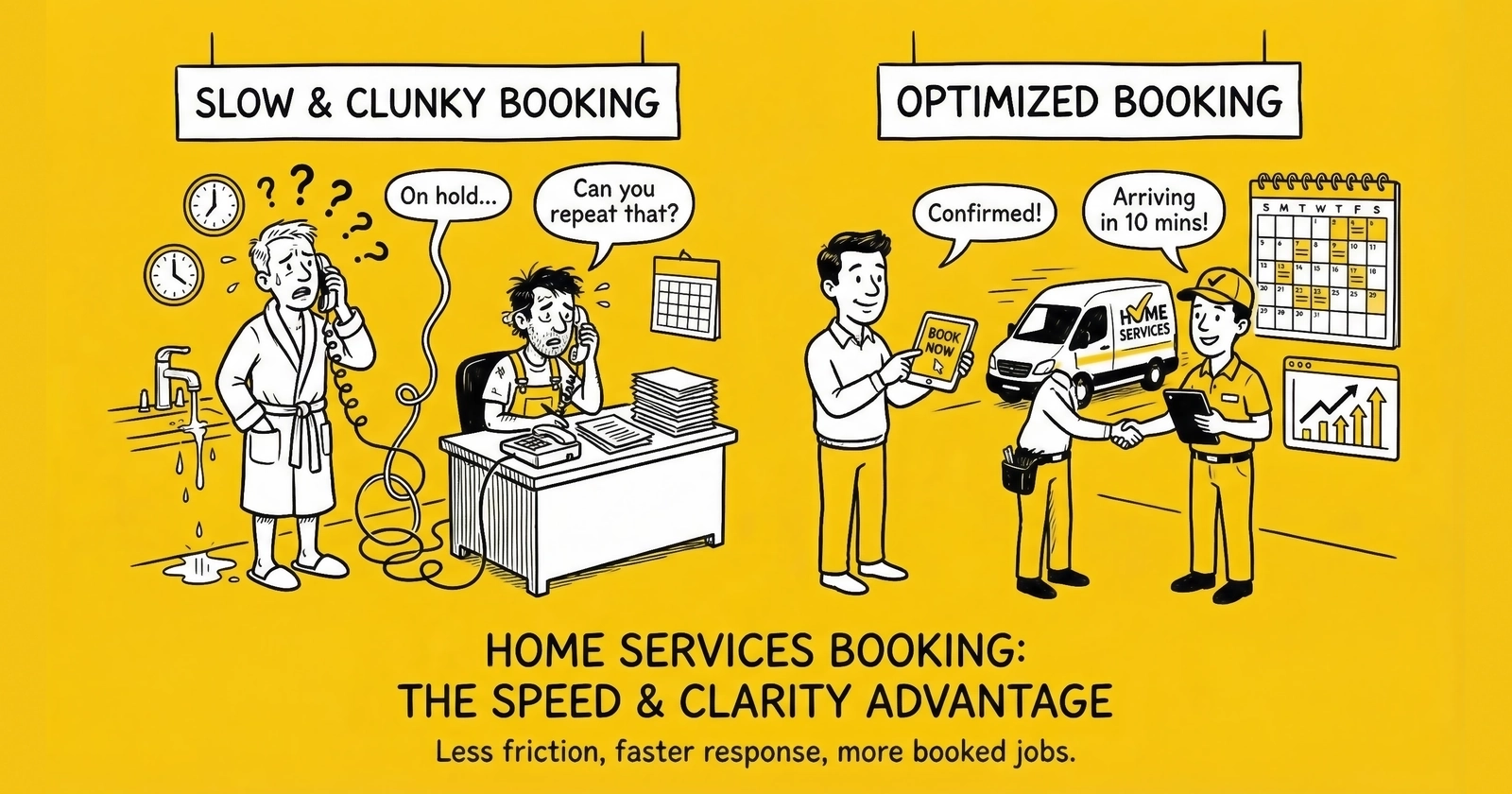
The difference between profitable and failing home services lead operations rarely comes down to lead cost. It comes down to what happens in the 47 seconds after a lead arrives.
Home services lead generation operates on a brutal truth that most practitioners learn too late: the booking rate determines profitability more than the cost per lead.
A $60 exclusive HVAC lead that books at 25% yields a cost per acquisition of $240. A $35 shared lead that books at 8% yields a cost per acquisition of $437. The “cheaper” lead costs nearly twice as much when measured through to revenue.
This guide provides the complete operational framework for home services booking rate optimization. From speed-to-contact infrastructure that captures first-mover advantage, through lead qualification methods that separate urgent callers from price-shoppers, to the nurturing sequences that recover leads your competitors abandon after two calls.
The home services industry generates over $600 billion annually in the United States, with lead generation representing the primary customer acquisition channel for independent contractors and regional service companies. HVAC, plumbing, electrical, roofing, and pest control leads command $30-150 per exclusive lead depending on service type, urgency, and geography. Those who dominate this market understand that lead cost is merely the entry fee. The booking rate is where margin is made or lost.
The Booking Rate Imperative
Booking rate measures the percentage of leads that convert to scheduled service appointments. A 20% booking rate means that 20 of every 100 leads result in a technician visiting a property. This metric sits at the center of home services lead economics, yet most practitioners cannot tell you their booking rate with any precision.
Why Booking Rate Matters More Than CPL
Consider two scenarios that play out daily in home services lead operations.
In the first scenario, an operator pursues low-cost leads at $40 each but achieves only a 10% booking rate. This translates to $400 per booked appointment. With an average service ticket of $350, this operator loses $50 on every booked appointment before overhead even enters the calculation.
In the second scenario, an operator pays premium prices of $70 per lead but books at 25%. The cost per booked appointment drops to $280. Against the same $350 average ticket, this operator earns $70 margin per booked appointment before overhead.
The operator chasing cheap leads loses money on every job. The operator paying premium prices for quality leads builds a sustainable business.
This dynamic explains why sophisticated home services lead generators obsess over booking rate optimization while their competitors obsess over negotiating lead prices down by $5. Both activities consume time. Only one builds enterprise value.
Industry Booking Rate Benchmarks
Booking rates vary significantly by lead type, vertical, and contractor execution quality. These benchmarks represent data aggregated from lead distribution platforms and contractor networks as of 2024-2025:
| Lead Type | Typical Booking Rate | Top Performer Rate |
|---|---|---|
| Exclusive (emergency) | 25-40% | 45-55% |
| Exclusive (standard) | 15-25% | 30-40% |
| Shared (2-3 buyers) | 8-15% | 18-25% |
| Shared (4+ buyers) | 5-10% | 12-18% |
| Live transfer | 35-55% | 60-70% |
| Scheduled appointment | 30-50% | 55-65% |
| Aged (30+ days) | 3-8% | 10-15% |
The gap between “typical” and “top performer” reveals opportunity. A contractor moving from 15% to 30% booking rate on exclusive leads doubles the value of every lead they purchase. No amount of lead price negotiation delivers equivalent impact.
The Compounding Effect of Small Improvements
Booking rate improvements compound across lead volume. Consider a contractor purchasing 200 leads monthly at $50 per lead:
| Booking Rate | Booked Jobs | Cost per Job | Monthly Lead Spend |
|---|---|---|---|
| 15% | 30 | $333 | $10,000 |
| 20% | 40 | $250 | $10,000 |
| 25% | 50 | $200 | $10,000 |
| 30% | 60 | $167 | $10,000 |
Moving from 15% to 25% booking rate generates 20 additional booked jobs monthly from identical lead spend. At an average ticket of $400 with 30% profit margin, those 20 jobs represent $2,400 in additional monthly profit. Annualized, that is $28,800 in incremental profit from operational improvement alone.
This math explains why top-performing contractors can outbid competitors for leads, still profit, and gradually capture market share. Their booking rate efficiency creates pricing power that compounds over time.
Speed-to-Contact: The Primary Conversion Driver
Research consistently demonstrates that response time is the single most important factor in lead conversion. A study by Lead Connect found that 78% of customers buy from the first responder. In home services, where homeowners often contact multiple contractors simultaneously, first-mover advantage is decisive.
Response Time Benchmarks
The relationship between response time and booking rate follows a decay curve that should alarm any operator checking leads hourly rather than in real-time:
| Response Time | Relative Booking Rate |
|---|---|
| Under 5 minutes | Baseline (100%) |
| 5-30 minutes | 70-80% of baseline |
| 30-60 minutes | 40-50% of baseline |
| 1-2 hours | 20-30% of baseline |
| Same day (2+ hours) | 10-20% of baseline |
| Next day | 5-10% of baseline |
A contractor who responds in 5 minutes books at 3-5x the rate of a contractor who waits an hour. The math is not subtle. Speed is the single highest-leverage optimization available.
Building Speed-to-Contact Infrastructure
Speed-to-contact does not happen by accident. It requires deliberate infrastructure investment across three critical areas.
Real-Time Notification Systems
Leads must trigger immediate alerts across multiple channels. Push notifications to dispatcher smartphones and tablets serve as the primary alert mechanism. SMS alerts provide backup when app notifications fail. Desktop pop-ups reach office staff during business hours, while audio alerts enable after-hours monitoring. Email serves strictly as an archival record – never as the primary notification channel.
Lead delivery via API or real-time webhook enables this infrastructure. Batch email delivery of leads – still common among smaller companies – guarantees lost bookings.
Staffing for Immediate Response
Someone must answer the phone and call leads within minutes of arrival. This requires dedicated intake staff during peak hours, typically 8 AM to 7 PM local time, along with an on-call dispatcher for emergency leads after hours. Staff need the authority to schedule appointments without manager approval and must have scripts and pricing information for immediate quoting. Clear handoff procedures ensure coverage when the primary responder is unavailable.
For smaller contractors, this often means the owner handles lead calls personally during business hours and has a system for after-hours coverage. Growth requires transitioning to dedicated intake staff.
Automated First-Touch
While human response is optimal, automated acknowledgment captures the homeowner’s attention during the critical window. An immediate SMS saying “Thank you for contacting [Company]. A specialist will call you within 5 minutes” establishes engagement. An automated email with company information, reviews, and service overview provides credibility. A calendar link for self-scheduling captures scheduling even if the initial call is missed.
Automated touchpoints do not replace human follow-up. They establish presence and reduce perceived wait time while staff prepare the return call.
Measuring and Improving Response Time
Response time optimization requires measurement at the individual lead level. The key metrics to track include time from lead receipt to first call attempt, time from lead receipt to successful contact, percentage of leads called within 5 minutes, percentage of leads called within 30 minutes, and contact rate by response time bucket.
Response time analysis commonly reveals specific operational problems. Leads arriving after 5 PM often show 3x longer response times, indicating an after-hours coverage gap. Certain lead sources may exhibit delayed delivery due to API configuration issues. Specific staff members with consistently slower response times represent training opportunities. Weekend leads that go unanswered until Monday expose capacity planning failures.
Weekly reporting on response time metrics, with accountability for improvement, creates the pressure that drives operational change.
Lead Qualification: Separating Buyers from Browsers
Not all leads have equal purchase intent. A homeowner whose AC failed during a 100-degree heat wave has different urgency than a homeowner casually considering system replacement next year. Qualification identifies which leads merit immediate, intensive pursuit and which require different handling.
The Qualification Framework
Effective qualification assesses four dimensions in the first contact.
Urgency
The first dimension examines the immediacy of the problem. Is there a current issue affecting comfort or safety? When did the problem start, and how severely is it affecting the household? Has temporary repair been attempted? High-urgency leads involving system failures, safety issues, or extreme discomfort convert at 2-3x the rate of convenience leads where the system is making noise, efficiency is declining, or the homeowner is merely considering an upgrade.
Timeline
The second dimension addresses when the homeowner wants service. Immediate needs – today, tomorrow, or this week – differ fundamentally from leads planning for “someday.” Determining availability for immediate dispatch helps separate genuine urgency from casual inquiry. Immediate timeline leads deserve priority resource allocation while “someday” leads enter nurture sequences.
Decision Authority
The third dimension identifies who controls the decision. Is this person the homeowner? If not, what is their relationship – tenant, property manager, or family member? Who else will be involved in the decision, and is that decision-maker available for the appointment? Leads where the decision-maker is unclear or unavailable require additional qualification steps before scheduling.
Budget Awareness
The fourth dimension gauges financial readiness. Have they received other quotes? Do they have a budget range in mind, and are they aware of typical service costs? Are financing options relevant to their situation? Budget-qualified leads with realistic expectations book and complete at higher rates than leads shocked by pricing.
Implementing Qualification in First-Call Scripts
The first call must accomplish qualification without feeling like an interrogation. Effective scripts weave qualification into natural conversation.
Opening
The opening statement might be: “Hi, this is [Name] from [Company]. I’m calling about your AC issue. I want to make sure I get the right technician out to you quickly – can I ask a few questions about what’s happening?” This establishes service orientation while obtaining permission to qualify.
Discovery Sequence
The discovery sequence progresses through key questions. “What’s going on with your system?” reveals urgency and problem type. “When did you first notice this?” establishes timeline and severity progression. “Are you the homeowner?” confirms decision authority. “Have you had service on this system before?” uncovers history and relationship opportunity. “What’s your schedule looking like for the next couple days?” confirms availability and urgency. Each question provides information for routing while advancing toward booking.
Qualification Outcomes
Based on qualification, leads route to different handling. High-urgency leads with high authority and immediate timelines receive priority booking with senior technician dispatch. Medium-urgency leads that are qualified but have flexible timelines receive standard booking at the next available appointment. Low-urgency leads who are still researching with extended timelines enter nurture sequences with scheduled follow-up. Leads involving non-decision-makers, budget disconnects, or geographic mismatches receive graceful exits with referrals when appropriate.
Forcing low-qualification leads into immediate booking creates appointment cancellations and wasted technician time. Proper routing improves both booking rate and completion rate.
Pre-Qualification Before Human Contact
For lead generators and distributors, pre-qualification before delivery improves buyer satisfaction and booking rates.
Form-Based Pre-Qualification
Multi-step forms can capture qualification data at lead creation. Key fields include property type (single-family, multi-family, or commercial), homeowner or renter status, service needed (repair, replacement, or maintenance), urgency level (emergency, soon, or planning), and preferred appointment window. This data enables intelligent routing and sets buyer expectations before the first call.
IVR Pre-Qualification
For call-based leads, Interactive Voice Response systems capture qualification before live connection. Prompts such as “Press 1 for emergency service, press 2 for scheduled service,” “Please enter your zip code,” and “Is this for your primary residence? Press 1 for yes, 2 for no” gather essential information before consuming agent time. IVR qualification reduces live agent time and ensures callers meet buyer criteria before consuming resources.
Follow-Up Sequences: Recovering the Majority of Leads
The hard truth of home services lead generation: most leads do not answer the first call. Voicemail, busy signals, and unanswered rings characterize more leads than successful first-call connections. Those who build follow-up sequences capture leads their competitors abandon.
The Multi-Touch Follow-Up Framework
Industry data consistently shows that 40-60% of leads require multiple contact attempts before reaching the homeowner. A single call and abandonment strategy leaves half of lead value on the table.
Day 1: Maximum Intensity
The first day represents the highest-conversion window. Stack multiple touchpoints by calling within 5 minutes of lead receipt, sending an SMS immediately after any failed call attempt, making a second call 2-4 hours after the initial attempt at a different time of day, sending an email at end of business day with company overview and reviews, and making a third call in the evening between 6-8 PM local time.
Three call attempts on day 1 dramatically outperforms single-attempt strategies. The homeowner who was in a meeting, driving, or otherwise occupied often becomes available within hours.
Day 2: Continued Pursuit
Persistence within the 48-hour window captures late responders. Make a fourth call in the morning, opposite the time of day from Day 1 attempts. Send a mid-day SMS check-in with a brief message. Make a fifth call in the evening if morning was unsuccessful.
Day 2 follow-up still captures quality leads. The urgency that generated the lead inquiry typically persists beyond the first 24 hours.
Days 3-7: Declining Frequency
As time passes, return on additional attempts declines. A sixth call on Day 3 with varied timing maintains presence. A seventh call on Day 5 with “final attempt” messaging creates urgency. An email on Day 7 saying “We’re still here if you need us” leaves the door open. Beyond day 7, leads shift from active pursuit to nurture sequence.
Long-Term Nurture: Seasonal Reactivation
Leads that never connected or expressed “not right now” responses still have lifetime value. Monthly or seasonal nurture captures future need through monthly email newsletters with tips and seasonal reminders, seasonal campaigns asking “Is your AC ready for summer?”, special offers during shoulder seasons when capacity allows, and anniversary follow-up noting “It’s been a year since you inquired about…”
Nurture sequences convert at low rates per touch but accumulate meaningful volume over time. A 1% monthly conversion rate on a 1,000-lead nurture database generates 10 booked appointments monthly from “dead” leads.
SMS and Email Integration
Modern follow-up sequences integrate multiple channels for maximum reach.
SMS Best Practices for Home Services
Effective SMS requires discipline. Keep messages under 160 characters for single-message delivery. Identify your company in every message and include a clear call-to-action. Respect opt-out requests immediately and limit to 3-4 SMS per lead in the initial sequence.
A typical sequence progresses as follows. The immediate message reads: “Hi, this is [Company]. We received your request for [service]. I’ll call you in the next few minutes. - [Name]” After a failed call: “[Company] here. Sorry I missed you. Call us at [number] or reply with a good time to chat about your [service] needs.” On day 2: “Still having [issue]? We have appointments available today. Reply YES to schedule or call [number].”
Email Best Practices for Home Services
Email serves a different function than SMS and call. Subject lines should reference the specific service inquiry. Include reviews and trust badges covering licensing, insurance, and guarantees. Feature a prominent phone number and scheduling link. Keep copy scannable with clear next-step calls-to-action. Personalize with the homeowner’s name and service type.
Email captures homeowners who prefer asynchronous communication and serves as a reference document they can review before making a decision.
Technology for Follow-Up Automation
Manual follow-up breaks down at scale. Automation ensures every lead receives consistent treatment regardless of staff workload.
CRM-Based Sequences
Customer relationship management systems with workflow automation trigger follow-up based on lead status. A new lead triggers an immediate first-call task. Failed contact triggers SMS and reschedules the next call. Voicemail left triggers an email send. Contact made but not booked triggers the nurture sequence.
Popular options include ServiceTitan, Housecall Pro, and Jobber for home services, or general-purpose CRMs like HubSpot and Salesforce with custom configuration.
Dedicated Drip Tools
Specialized drip marketing tools manage email and SMS sequences. Email automation platforms include Mailchimp, ActiveCampaign, and Klaviyo. Text sequences run through Podium, Birdeye, or specialized SMS platforms. Integrated platforms combine both channels.
The specific tool matters less than consistent implementation. Any modern automation platform can execute a well-designed follow-up sequence.
Scripting and Training: Converting Contact to Commitment
Reaching the homeowner is only half the battle. What happens in that conversation determines whether contact becomes commitment.
The Psychology of Home Services Bookings
Homeowners making service decisions face uncertainty and anxiety. They do not know whether the problem is minor or serious. They cannot evaluate contractor quality before service. They have heard horror stories about home services scams and feel vulnerable allowing strangers into their homes. They worry about being oversold unnecessary repairs.
Effective scripts address these anxieties while advancing toward booking.
Opening Script Elements
The first 15 seconds establish credibility and set the conversation direction.
Identity Establishment
The call begins: “Hi, this is [Name] from [Company]. I’m calling about the [service] request you submitted. Do you have a couple minutes?” This confirms legitimacy (not a spam call), establishes context, and obtains permission to proceed.
Empathy Expression
Following identification, express understanding: “I understand your AC stopped cooling – that’s miserable, especially in this heat. Let’s get you taken care of.” Acknowledging the problem and expressing understanding builds rapport before any selling begins.
Control Statement
Then set expectations: “I’m going to ask a few quick questions so I can get the right technician out to you with the right parts. Then we’ll find a time that works for your schedule.” This establishes the conversation flow and confirms that the caller is guiding the process toward a solution.
Discovery Questions
Discovery accomplishes multiple objectives: gathering information for proper service, qualifying the lead, and building the relationship that closes the booking.
Problem Understanding
Begin with open-ended questions about the issue: “Can you tell me what’s happening with your [system]?” followed by “When did you first notice this?” then “Is it affecting the whole house or specific areas?” and “Have you noticed anything else unusual?” These questions diagnose the situation while demonstrating expertise and genuine interest.
Property Information
Transition to property details: “What type of property is this – single family home, townhouse, condo?” then “Approximately when was it built?” followed by “Do you know the approximate age of your current [system]?” and “How large is your home, roughly?” This information affects pricing, parts requirements, and technician assignment.
Scheduling Information
Advance toward commitment with scheduling questions: “What’s your schedule looking like this week?” then “Are mornings or afternoons generally better for you?” and “Will someone be home during the appointment, or do we need to coordinate access?” Moving to scheduling questions signals progression toward booking.
Handling Objections
Every sales conversation encounters resistance. The key is validating concerns while advancing toward the next step.
”I want to get a few quotes”
Respond: “Absolutely, that makes sense for a big decision. A lot of our customers do the same. We offer free estimates, and I can get someone out [timeframe] so you have our quote to compare. What time works for you?” This validates the concern, then pivots to the low-risk next step of getting on their list of quotes.
”How much will it cost?”
Respond: “I wish I could give you an exact number over the phone, but it depends on what the technician finds. Our diagnostic fee is [$X], which applies to the repair if you decide to move forward. Most [service type] repairs run between [$X and $Y]. Would you like to schedule the diagnostic?” Providing a range explains why precise pricing requires diagnosis while offering a concrete path forward.
”I need to talk to my spouse/partner”
Respond: “Of course. Is [spouse] available now? Sometimes it’s helpful to have everyone on the same page. … If not, when would be a good time for all of you, and I can call back?” This attempts to include the decision-maker immediately, or schedules a callback when they are available.
”Now isn’t a good time”
Respond: “I understand. When would be better to call you back? … [Schedule callback] In the meantime, I’ll send you some information about our company so you can see why homeowners in [area] trust us.” Never let “not now” become “never.” Secure the callback and send reinforcing materials.
Closing for the Booking
After discovery and objection handling, closing is often straightforward. Three techniques work consistently.
The Assumptive Close
Say: “Based on what you’ve described, I have [technician] available [tomorrow morning] or [day after tomorrow afternoon]. Which works better for you?” Present limited options rather than open-ended scheduling. Two choices are easier than unlimited options.
The Confirmation Close
Once selected: “Great, I’ve got you down for [day, time]. [Technician] will arrive between [window]. He’ll call when he’s 30 minutes out. Is [phone number] the best number to reach you?” Confirming details reinforces the commitment and gathers information for dispatch.
The Trust Close
End with reassurance: “[Technician] has been with us for [X years] and specializes in [service type]. You’re in good hands. You’ll receive a confirmation email shortly, and we’ll see you [day].” This positive statement reinforces the decision and reduces cancellation likelihood.
Training for Consistency
Scripts are only effective if consistently executed. Training programs should incorporate four essential components.
Role playing through weekly practice sessions allows staff to work through common scenarios. Realistic practice builds confidence and reveals training gaps before they cost bookings.
Call recording review enables managers to listen to successful and unsuccessful calls, identifying what works and what fails. Use specific examples for coaching rather than abstract guidance.
Objection handling libraries document effective responses to common objections. New staff should have resources to reference when facing resistance rather than improvising under pressure.
Metric accountability through individual booking rates by staff member identifies top performers whose techniques should be studied and underperformers who need coaching.
Lead Source Quality: Paying for Leads That Book
Booking rate optimization is not purely about operational execution. Lead source selection determines the quality of opportunities your team receives.
Evaluating Lead Sources by Booking Rate
Track booking rate by lead source with the same rigor applied to cost per lead:
| Source | CPL | Booking Rate | Cost per Booking | Verdict |
|---|---|---|---|---|
| Source A | $45 | 22% | $205 | Strong performer |
| Source B | $30 | 10% | $300 | Expensive despite low CPL |
| Source C | $70 | 30% | $233 | Premium CPL justified |
| Source D | $50 | 8% | $625 | Terminate immediately |
Source D in this example should be paused immediately despite costing less than Source C. Cost per booking is the relevant metric, not cost per lead.
Shared Lead Dynamics
Shared leads (sold to multiple contractors) inherently book at lower rates because the homeowner is contacted by 3-5 competing contractors. First-mover advantage becomes critical.
Winning on Shared Leads
Success on shared leads requires extreme execution. Response must come in under 3 minutes – not the 5-minute standard for exclusive leads. Call from a local area code rather than toll-free or out-of-area numbers. Send SMS simultaneously with the call attempt. Craft voicemails optimized for callback rather than generic messages. Maintain follow-up intensity that exceeds competitor effort.
Contractors who cannot implement extreme speed-to-contact on shared leads should pay the premium for exclusive leads rather than wasting money on leads they will rarely book.
Marketplace Platform Considerations
Lead marketplace platforms like Angi (HomeAdvisor), Thumbtack, and Google Local Services each have distinct dynamics.
Angi/HomeAdvisor
Angi leads are typically shared with 3-4 contractors, making first-to-call advantage substantial. Review quantity and quality affect lead flow significantly. Booking rate benchmarks run 10-15% for typical performers and 20%+ for top performers.
Google Local Services Ads
The “Google Guaranteed” badge builds trust that differentiates from standard search ads. The pay-per-lead model (rather than pay-per-click) aligns incentives with performance. Higher intent than traditional search ads translates to booking rate benchmarks of 15-25% typical, with 30%+ for top performers.
Thumbtack
Thumbtack’s quote-based model means you pay to send a quote, not per lead received. Homeowners receive multiple quotes by design, creating competition. The model works better for considered purchases than emergencies. Booking rate benchmarks run 8-15% typical, with 20%+ for top performers.
Yelp for Business
Yelp performs strongest in urban markets with established review culture. Advertising products enhance visibility for paying contractors. Quality reviews drive organic lead flow beyond paid placement. Booking rate benchmarks run 12-18% typical, with 25%+ for top performers.
Platform-specific optimization – response time, profile optimization, review management – directly affects booking rate within each channel.
Direct Lead Generation Advantages
Leads generated through your own marketing typically book at higher rates than third-party leads.
First-party leads carry inherent advantages that translate to higher booking rates. They face no competition because they are exclusive by definition. Brand familiarity from marketing touchpoints creates trust before the first call. Higher intent characterizes leads who sought you specifically rather than submitting to a marketplace. Better data quality results from capture on your own forms. Consent documentation under your control simplifies compliance.
Booking rates for first-party leads often exceed third-party exclusive leads by 30-50%. The investment in building owned lead generation through SEO, local marketing, and referral programs compounds over time as you reduce dependence on lead vendors.
Conversion Analytics: Measuring What Matters
You cannot improve what you do not measure. Comprehensive analytics reveal optimization opportunities invisible to operators tracking only lead volume and cost.
The Full Conversion Funnel
Track conversion at each stage to understand where value is created and lost.
Lead to Contact
The first stage measures reachability. What percentage of leads receive a call within 5 minutes? What percentage are reached on the first attempt? What is the overall contact rate within 48 hours? Industry benchmark: 50-70% contact rate within 48 hours with proper follow-up sequences.
Contact to Booking
The second stage measures sales effectiveness. Of leads contacted, what percentage book appointments? How does booking rate vary by lead source, time of day, and staff member? What are the primary reasons for non-booking? Industry benchmark: 40-60% booking rate among contacted leads.
Booking to Completion
The third stage measures fulfillment. What percentage of booked appointments are completed? What is the cancellation rate? What is the no-show rate? What is the reschedule rate? Industry benchmark: 80-90% completion rate among booked appointments.
Completion to Revenue
The final stage measures monetization. What is the average ticket on completed appointments? What percentage of service calls result in upsells? What is the closing rate on quoted replacements?
Tracking the full funnel reveals where leads leak and where investment delivers returns.
Segmented Analysis
Aggregate metrics hide actionable insights. Segment booking rate analysis across multiple dimensions to reveal specific optimization opportunities.
Analyze by lead source to determine which sources book at the highest rates and allocate budget toward high-booking sources. Examine by service type to understand whether AC repair leads book differently than water heater leads, then adjust qualification and follow-up accordingly. Study time of day patterns to learn whether morning leads book better than evening leads and staff appropriately. Review day of week performance to determine whether Monday leads outperform Friday leads and adjust lead purchasing patterns. Investigate geography to identify zip codes with higher booking rates and focus marketing on those areas. Track individual staff member performance to identify which CSRs book at the highest rates, then learn from top performers and coach underperformers.
Segmented analysis reveals specific optimization opportunities that aggregate reporting obscures.
Attribution and ROI Tracking
Connect leads through to revenue for true ROI calculation.
Lead tagging ensures every lead carries source attribution through the entire funnel. When a job is completed, you should be able to trace it back to the original lead source.
Revenue attribution connects completed job revenue to lead sources. An $8,000 HVAC replacement attributed back to a $70 exclusive lead reveals the true ROI of that source – information invisible without proper tracking.
Lifetime value analysis recognizes that customers acquired through leads may generate repeat service, maintenance contracts, and referrals. Include downstream value in source evaluation rather than looking only at the first transaction.
Regular reporting on source-level booking rates and ROI enables continuous optimization. Weekly cadence catches problems quickly. Monthly or quarterly reporting is too slow to catch problems before they become expensive.
Technology Stack for Booking Rate Optimization
The right technology infrastructure enables speed, consistency, and measurement. Under-investment in technology caps booking rate potential.
Essential Components
CRM / Field Service Management
The central system manages leads, scheduling, dispatch, and job tracking. Core capabilities include lead intake and status tracking, automated follow-up triggering, appointment scheduling and technician dispatch, job completion and revenue tracking, and reporting and analytics.
Home services-specific platforms like ServiceTitan, Housecall Pro, and Jobber include integrated field service features. General CRMs like HubSpot and Salesforce require customization but offer flexibility for complex operations.
Lead Distribution / Routing
For operations buying from multiple sources or operating as lead distributors, dedicated routing technology becomes essential. Required capabilities include real-time lead ingestion via API/webhook, routing logic for geography, service type, and capacity, delivery confirmation and tracking, and source-level analytics. Platforms like boberdoo, LeadsPedia, and Phonexa serve this function.
Communication Infrastructure
Multi-channel communication requires integrated tools. VoIP phone systems with call tracking and recording capture conversation data. SMS platforms with automation capability enable text sequences. Email marketing with drip sequence support manages longer-term nurture. A unified inbox consolidates conversations across channels.
Integration between communication tools and CRM enables consistent tracking and follow-up automation.
Analytics and Reporting
Data infrastructure powers optimization. Dashboard visualization of key metrics provides at-a-glance performance monitoring. Drill-down capability by segment enables investigation of anomalies. Alerting on metric changes catches problems early. Export capability supports deeper analysis.
Many CRMs include native reporting. Power users often supplement with business intelligence tools like Tableau, Power BI, or Google Data Studio.
Integration Requirements
Technology value multiplies with integration. Siloed systems create data gaps and manual workarounds.
Leads should flow automatically from all sources into the CRM with source attribution intact. Call, SMS, and email activity should log automatically in the CRM without manual entry. Booked appointments should flow to dispatch and scheduling without re-entry. Revenue data should attribute back to original lead source automatically.
The goal is a single system of record where every lead’s journey from source through revenue is visible and analyzable.
Common Mistakes and How to Avoid Them
Operators make predictable mistakes that suppress booking rates. Recognizing and avoiding these patterns accelerates improvement.
Mistake 1: Optimizing for CPL Instead of CPA
Chasing the cheapest leads ignores the conversion reality that cheap leads often book poorly. Shift focus from cost per lead to cost per acquisition (booked appointment or completed job). Calculate CPA for every lead source and eliminate sources where CPA exceeds acceptable thresholds regardless of CPL.
Mistake 2: Single-Attempt Contact Strategy
Calling once and moving on abandons half of potential bookings. Most leads require multiple attempts to reach. Implement minimum 5-touch sequences over 48-72 hours before moving leads to nurture.
Mistake 3: No Speed-to-Contact Infrastructure
Checking leads hourly or relying on email delivery guarantees lost bookings. The fix requires real-time lead delivery, push notifications, and dedicated intake staff during business hours.
Mistake 4: Generic Scripts That Fail to Qualify
CSRs who book every lead regardless of qualification create appointment cancellations and wasted technician time. Train on qualification frameworks and route low-qualification leads to nurture rather than forcing immediate booking.
Mistake 5: No Measurement of Individual Performance
Without individual accountability, underperformers hide in aggregate metrics. Track booking rate by CSR, coach underperformers, and learn from top performers.
Mistake 6: Abandoning Leads After Initial Non-Booking
Leads who said “not right now” often become customers later. Failing to nurture abandons future revenue. All non-booked leads should enter nurture sequences, and seasonal campaigns should reactivate dormant leads.
Mistake 7: Ignoring Completion Rate
Booking is not the finish line. Appointments that cancel or no-show waste the effort that generated the booking. Confirmation sequences with reminder calls and SMS reduce cancellation. Analyzing no-show patterns enables prevention.
Frequently Asked Questions
Q: What is a good booking rate for home services leads?
A: Booking rate benchmarks vary by lead type. Exclusive standard leads typically book at 15-25%, with top performers reaching 30-40%. Exclusive emergency leads book at 25-40%, with peaks during extreme weather. Shared leads (2-3 buyers) book at 8-15%, while heavily shared leads (4+ buyers) book at 5-10%. Live transfers and scheduled appointments book at 35-55%. The most important comparison is your current rate versus your potential. Moving from 15% to 25% doubles the value of every lead you purchase. Focus on closing the gap between your current performance and top-performer benchmarks for your lead mix.
Q: How quickly should we respond to home services leads?
A: The optimal response is under 5 minutes from lead receipt. Research shows that leads contacted within 5 minutes book at 3-5x the rate of leads contacted after an hour. For shared leads where multiple contractors compete, sub-3-minute response is the target. For exclusive emergency leads, the homeowner expects near-immediate contact. Build infrastructure (real-time notifications, dedicated intake staff, automated first-touch) to hit these targets consistently. Track percentage of leads called within 5 minutes as a key performance indicator.
Q: How many times should we attempt to contact a lead before giving up?
A: A minimum of 5-7 contact attempts over 48-72 hours represents industry best practice. Day 1 should include 3 attempts at different times plus SMS and email. Days 2-3 should include 2-3 additional attempts. After the initial intensive period, leads should enter nurture sequences rather than being abandoned. Leads that never connected still have value; seasonal campaigns can reactivate leads months later. Those who make one call and move on leave significant revenue on the table.
Q: Should we buy exclusive leads or shared leads?
A: The answer depends on your speed-to-contact capability and booking rate execution. Shared leads cost 40-60% less than exclusive leads but book at roughly half the rate. If your operation cannot respond within 3 minutes and execute intensive follow-up, the first-mover advantage on shared leads goes to competitors, making the apparent cost savings illusory. For most home services contractors, exclusive leads deliver better ROI despite higher CPL. The exception is operations with dedicated real-time response infrastructure that can consistently win the speed race on shared leads.
Q: How do we improve booking rate on leads from Angi/HomeAdvisor?
A: Angi/HomeAdvisor leads are typically shared with 3-4 contractors, making speed critical. Key optimization tactics include: responding within 2-3 minutes of lead delivery (set up real-time notifications); using a local area code for outbound calls; sending simultaneous SMS with initial call attempt; leaving a compelling voicemail that drives callback; building an Angi profile with strong reviews (50+ reviews with 4.5+ star average significantly affects response rates); and implementing intensive follow-up over 48 hours for leads not reached initially. Contractors who optimize these factors can achieve 18-25% booking rates compared to the 10-15% platform average.
Q: What should our CSRs say when homeowners want to get multiple quotes?
A: Validate the decision, then pivot to the low-risk next step. Effective response: “Absolutely, that makes sense for a big decision. A lot of our customers do the same. We offer free estimates, and I can get someone out [timeframe] so you have our quote to compare. What time works for you?” This response acknowledges the homeowner’s reasonable approach while positioning your estimate as part of their comparison process rather than an alternative to it. Never argue against quote-shopping; it signals desperation and erodes trust.
Q: How do we handle leads that book but then cancel?
A: Cancellation prevention starts with confirmation sequences: reminder call or SMS the day before, and morning-of reminder for afternoon appointments. When cancellations occur, immediate rescheduling attempt is essential – the need that generated the original inquiry typically still exists. Track cancellation rate by lead source; if certain sources cancel at elevated rates, the lead quality may be poor (price-shoppers, low-intent inquiries). Also examine internal patterns; if certain CSRs have high cancellation rates, qualification may be inadequate. Target overall cancellation rate below 10-15%.
Q: Should we use different approaches for emergency vs. scheduled service leads?
A: Yes, emergency and scheduled leads require distinct handling. Emergency leads demand extreme speed (sub-5-minute response), abbreviated qualification (the problem is self-evident), immediate availability confirmation, and simplified booking process. Scheduled leads allow more thorough qualification, educational conversation about options, relationship-building for potential upsells, and flexible scheduling to optimize technician routing. Scripts, follow-up sequences, and staffing should differentiate between lead types. Emergency leads during extreme weather may warrant after-hours response capability that scheduled leads do not require.
Q: How do we know if our lead sources are delivering quality leads?
A: Quality manifests in booking rate, completion rate, and revenue per lead – not just contact rate or validation pass rate. Track each source on: booking rate (percentage converting to scheduled appointments); completion rate (percentage of bookings completed); average ticket (revenue per completed job); customer acquisition cost (lead cost divided by completed jobs); and return on lead spend (revenue divided by lead cost). Sources with high lead volume but poor downstream metrics should be paused or renegotiated. Provide feedback to lead sources on quality issues; reputable sources will work to improve.
Q: What technology do we need to optimize booking rates?
A: Essential technology includes: CRM or field service management platform (ServiceTitan, Housecall Pro, Jobber, or general CRM with customization); real-time lead delivery via API/webhook; push notification infrastructure for mobile alerts; VoIP phone system with call tracking and recording; SMS platform with automation capability; email marketing with drip sequence support. Integration between these systems is critical – leads should flow automatically from source to CRM, calls should log automatically, and revenue should attribute back to source without manual entry. The specific tools matter less than the integration and consistent use.
Q: How do we train CSRs to improve their individual booking rates?
A: Effective training combines multiple approaches: script development (documented opening, discovery, objection handling, and closing sequences); role playing (weekly practice sessions on common scenarios); call recording review (analyze successful and unsuccessful calls for patterns); shadowing (new CSRs observe top performers before taking calls); coaching (managers review calls and provide specific feedback); and metric accountability (individual booking rates visible with performance expectations). Top performers should be identified and their techniques documented. Underperformers need coaching plans with improvement timelines. Persistent underperformance should lead to role changes; CSR quality directly affects revenue.
Key Takeaways
-
Booking rate determines home services lead profitability more than cost per lead. A $60 lead booking at 25% outperforms a $35 lead booking at 8%. Calculate cost per acquisition, not just cost per lead.
-
Speed-to-contact is the primary conversion driver. Leads contacted within 5 minutes book at 3-5x the rate of leads contacted after an hour. Build infrastructure for real-time notification and immediate response.
-
Multi-touch follow-up sequences capture leads that would otherwise be lost. Most leads require 5-7 contact attempts over 48-72 hours. Practitioners who call once and move on abandon half of their potential bookings.
-
Qualification separates urgent buyers from casual browsers. Not all leads merit equal pursuit. Route high-urgency, high-authority leads to priority handling and low-intent leads to nurture sequences.
-
Script and training consistency drives booking rate improvement. What CSRs say matters as much as how fast they call. Document effective approaches and train systematically.
-
Lead source quality varies dramatically. Track booking rate by source and eliminate sources with poor downstream metrics regardless of CPL.
-
Technology infrastructure enables everything else. Real-time delivery, push notifications, CRM automation, and integrated analytics are requirements, not luxuries.
-
Measure individual performance with accountability. Without visibility into CSR-level booking rates, underperformers hide and top-performer techniques go unidentified.
Conclusion
Booking rate optimization is the highest-leverage investment available to home services lead operations. The math is straightforward: improving booking rate from 15% to 25% doubles the value of every lead without changing lead spend. Understanding the fundamentals of how the lead economy works provides essential context for optimization efforts.
The path to improvement follows a clear sequence. First, build speed-to-contact infrastructure that ensures leads receive contact within 5 minutes. Second, implement multi-touch follow-up sequences that persist for 48-72 hours rather than abandoning after one call. Third, train CSRs on qualification, scripting, and objection handling that converts contact to commitment. Fourth, track metrics at the source and individual level to identify optimization opportunities. Fifth, continuously refine based on data.
Those who dominate home services lead generation understand that lead acquisition is merely table stakes. The competitive advantage – the margin expansion, the pricing power, the sustainable growth – comes from what happens after the lead arrives. Every percentage point of booking rate improvement compounds across lead volume, creating the economic engine that funds further growth.
The gap between average and top-performer booking rates represents significant unrealized value. Closing that gap is not a matter of luck or market conditions. It is a matter of operational discipline, technology investment, and relentless focus on the metrics that actually matter.
The leads are the same. The difference is what you do with them.
Sources
- Harvard Business Review: The Short Life of Online Sales Leads - Original research on lead response time showing 78% of customers buy from the first responder
- InsideSales.com Lead Response Research - Industry studies on speed-to-contact impact, documenting 391% conversion improvement for 1-minute response
- Salesforce Resources - CRM and sales process benchmarks for lead management and follow-up cadence optimization
- HubSpot Marketing Statistics - Digital marketing and lead conversion benchmarks across industries
- ServiceTitan Industry Blog - Home services operational benchmarks including booking rates, technician utilization, and revenue per lead
- NAHB Remodeling Market Research - National Association of Home Builders data on home improvement spending and contractor demand
Statistics and benchmarks current as of 2024-2025. Individual results vary based on market, vertical, and execution quality.