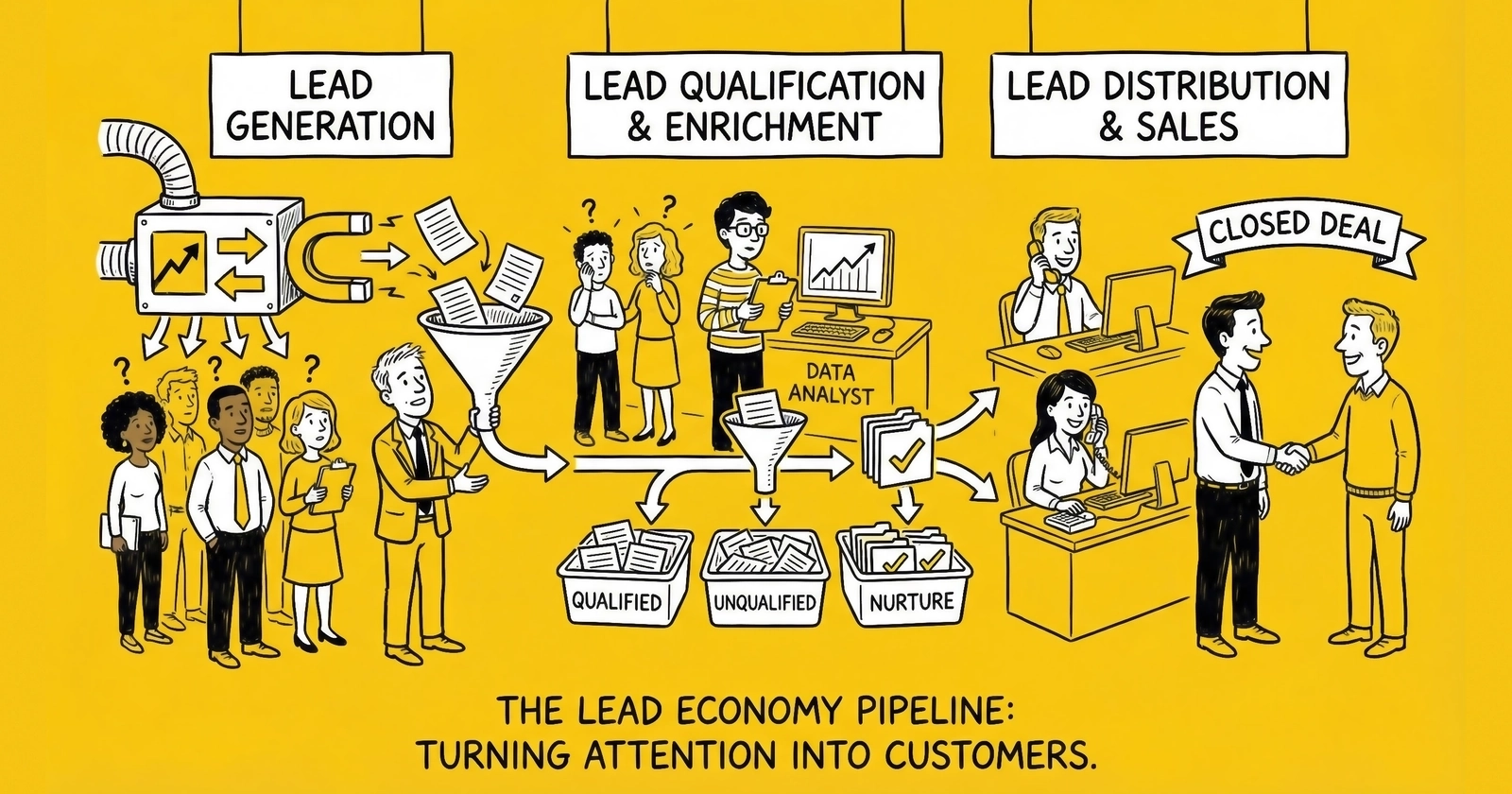
The invisible marketplace where consumer intent becomes a tradeable asset – and understanding it determines whether you profit or get outmaneuvered.
Introduction: The Marketplace You Never Knew Existed
Somewhere on the internet right now, a consumer is filling out a form.
She needs car insurance after moving to a new state. He is curious about solar panels after seeing a utility bill that made his eyes water. They are finally ready to refinance the mortgage after years of watching rates.
They enter their name. Phone number. Email. Click “Get My Quotes.”
In the next 200 milliseconds – before the thank-you page finishes loading – their information has been transmitted to an auction system, evaluated by a dozen buyers, bid on in real-time, sold to the highest bidder, and delivered to a sales agent’s screen 1,500 miles away.
The consumer thinks they requested information from a comparison website. What actually happened is they became a product. Their intent – packaged with their permission and contact data – just traded on a marketplace they never knew existed.
This is the lead economy: a multi-billion dollar industry operating behind every insurance quote, mortgage comparison, and solar estimate you have ever requested online. Understanding how it works separates the operators who build profitable businesses from those who wonder where their money went.
What Is the Lead Economy?
The lead economy is the ecosystem where consumer intent becomes a tradeable asset class. It encompasses the companies, technologies, and transactions involved in capturing, validating, distributing, and monetizing leads across industries from insurance to solar to legal services.
The Lead as a Tradeable Asset
A lead is not contact information. Contact information is a commodity – you can buy lists of names and phone numbers for pennies per record. That is not what moves billions of dollars annually.
A lead is consumer intent, captured at the moment of expression, packaged with permission to make contact, and sold within a time window where that intent still has commercial value.
The distinction matters because intent is both valuable and perishable. A person actively shopping for a product is worth far more than a name on a list. Insurance carriers, mortgage lenders, and solar installers will pay substantial premiums to speak with someone who just raised their hand.
But intent decays rapidly. A consumer who fills out a solar quote form at 2 PM is highly motivated. By 6 PM, they have cooled off. By tomorrow, they have forgotten why it seemed urgent. By next week, they have either bought from someone else or moved on entirely.
This perishability creates the economics that drive the entire industry. Leads lose approximately 50% of their value within 48 hours without contact – and the steepest drop occurs in the first hour.
What Makes a Lead Valuable?
A proper lead contains four elements that must travel together:
Intent: The consumer has demonstrated active interest in a product or service by taking an action – submitting a form, calling a number, or requesting information.
Permission: The consumer has granted explicit consent to be contacted – what regulations call Prior Express Written Consent (PEWC) in the telemarketing context. Without valid consent, the contact data is legally radioactive.
Data: The consumer’s contact information and qualifying attributes. Phone number, email, address, plus vertical-specific fields: vehicle year/make/model for auto insurance, loan amount and property value for mortgages, electric bill and roof type for solar.
Timing: The timestamp of when intent was expressed. A lead captured 30 seconds ago is worth multiples of one captured 30 hours ago.
When these four elements combine, you have a tradeable asset that commands premium prices. Remove any element and value collapses.
How Big Is the Lead Generation Industry?
The lead generation industry represents a significant and growing segment of the digital economy, though exact sizing varies based on how the market is defined.
Market Size Estimates
Multiple research firms publish lead generation market estimates, with figures varying based on methodology and scope:
- Core lead generation market: $5-10 billion in 2024, projected to reach $15-32 billion by 2031-2035
- Lead generation software and solutions: $5.11 billion in 2024, projected to reach $12.37 billion by 2033 at a 10.32% compound annual growth rate
- Platform transaction value: Major platforms process billions in annual transaction value, with MediaAlpha alone exceeding $1.5 billion in 2024
The wide range in estimates reflects different definitions of what counts as “lead generation.” Some analyses focus narrowly on lead generation software. Others encompass the entire performance marketing ecosystem including the value of leads traded.
Geographic Distribution
North America dominates global lead generation, capturing approximately 40% of market value. The concentration reflects both the scale of U.S. consumer markets and the sophistication of American performance marketing infrastructure.
Asia-Pacific represents the fastest-growing region, with 12%+ compound annual growth rates. Digital transformation across India, Southeast Asia, and developed Asian markets drives expansion.
Europe represents a significant but more constrained market, with GDPR and stricter data regulations limiting some practices common in the U.S.
Industry Density
More than 21,000 lead generation businesses operate in the United States according to industry analysis. This figure includes companies across all tiers – from solo affiliates running traffic campaigns to enterprise platforms processing billions in annual value.
The industry structure follows a power law. A handful of major players (MediaAlpha, EverQuote, QuinStreet, LendingTree) dominate public visibility and process significant volume. Beneath them, thousands of mid-size operators run profitable businesses without public profile. And beneath those, tens of thousands of small operations, affiliates, and niche specialists make up the long tail.
How Money Flows Through the Lead Economy
Understanding the value chain reveals where margins exist, where they compress, and where opportunities hide.
The Three-Tier Marketplace Structure
The lead economy operates as a three-tier marketplace, each tier adding value and capturing margin:
Tier 1: Lead Generators (Publishers, Affiliates) These players sit at the top of the supply chain. They create the raw material – consumer intent packaged as contact information with consent documentation. Publishers own media properties that attract consumers. Affiliates buy advertising and direct traffic to landing pages. Both create leads from raw traffic.
Tier 2: Aggregators and Distributors (Brokers, Networks, Exchanges) Between generators and buyers sits a layer of intermediaries who aggregate supply, route leads to appropriate buyers, and add value through quality filtering, compliance verification, and market making. Brokers buy leads and resell them, taking inventory risk. Networks connect parties without taking title. Exchanges run real-time auctions.
Tier 3: Lead Buyers (Carriers, Lenders, Installers) At the bottom of the supply chain sit the businesses that actually want to acquire customers. Insurance carriers, mortgage lenders, solar installers, and law firms convert leads into applications, policies, installations, and retained clients. Their willingness to pay sets the entire market’s economics.
Following the Dollar
Money flows backward through the ecosystem:
- Buyer pays distributor: $70 for an auto insurance lead
- Distributor pays generator: $55 for the same lead
- Generator pays traffic source: $5 per click, needing 11 clicks to generate that lead
Each tier captures margin for the value it provides:
- Generators earn 87%+ gross margins on traffic arbitrage (though net margins after platform costs, validation, and returns compress significantly)
- Distributors earn 15-30% gross margins on the buy-sell spread
- Buyers calculate returns based on conversion rates and customer lifetime value
The Distribution Economics Reality
newcomers often hear about “30-40% gross margins” in lead brokerage and assume the business prints money. The reality is more nuanced.
Gross margin on a lead – the spread between purchase price and sale price – typically ranges from 25-40%. On a $55 purchase with $70 sale, that is $15 or 27% gross.
Net margin after operational realities rarely exceeds 15-18%. Here is what erodes the spread:
- Return rates: Industry average runs 8-15%
- Float cost: You pay publishers in 15 days. Buyers pay you in 45 days.
- Duplicate leakage: 2-3% of volume
- Bad debt: 1-2% of receivables
- Processing costs: Payment processing, validation services, platform fees
The 60-day float rule governs lead brokerage economics: you need approximately 60 days of working capital to operate safely. Undercapitalization kills more lead generation businesses than competition does.
The Major Players in the Lead Economy
Public Company Benchmarks
Several publicly traded companies provide visibility into industry scale and performance:
MediaAlpha (MAX): Reported $864.7 million in revenue for 2024, representing 123% year-over-year growth. Transaction value through their platform exceeded $1.5 billion. MediaAlpha operates primarily in insurance lead distribution, with strong positions in auto and health insurance.
EverQuote (EVER): Generated $500.2 million in 2024 revenue, up 74% year-over-year. Their auto insurance vertical alone produced $446.1 million, growing 96% year-over-year.
QuinStreet (QNST): Reported $613.5 million in revenue for fiscal year 2024. QuinStreet operates across multiple verticals including education, financial services, and home services.
LendingTree (TREE): Generated $672.5 million in 2023 revenue across more than 500 lender partners. LendingTree’s diversification across mortgage, personal loans, insurance, and credit cards provides insight into multi-vertical economics.
On the Buyer Side
Progressive Insurance spent $3.5 billion on advertising in 2024 – a record that grew 186.8% year-over-year. This single carrier’s advertising budget exceeds the entire revenue of most lead generation companies, illustrating the scale of demand that drives the lead economy.
Major insurance carriers collectively spend billions acquiring customers, creating the liquidity that makes lead generation viable.
Technology Providers
The modern lead economy runs on software:
Lead Distribution Platforms (boberdoo, LeadsPedia, Phonexa, CAKE) manage lead flow from sources to buyers, handling routing logic, pricing, delivery, and reconciliation.
Consent Verification Services (TrustedForm, Jornaya) create certificates documenting lead capture events – what the consumer saw, what they agreed to, when they clicked submit.
Validation Services (Neustar, Melissa, Ekata) verify phone numbers, email addresses, and physical addresses are real and active.
Lead Pricing Dynamics: What Determines Lead Value?
Lead prices vary dramatically based on measurable characteristics.
CPL Benchmarks by Vertical
| Vertical | CPL Range | Typical Range | Premium Tier |
|---|---|---|---|
| Auto Insurance | $5-150 | $25-75 | $100+ |
| Medicare | $30-150 | $50-100 | $120+ |
| Mortgage | $12-200+ | $50-100 | $150+ |
| Solar | $20-300 | $75-150 | $200+ |
| Legal (PI) | $100-3,000+ | $200-500 | $800+ |
| Home Services | $15-230 | $40-100 | $150+ |
Primary Value Drivers
Recency: Value decays approximately 50% every 24-48 hours for most verticals. A lead captured this morning is worth multiples of one captured last week.
Exclusivity: Exclusive leads (sold to one buyer) command 2-3x the price of shared leads (sold to multiple buyers). Buyers pay the premium because they do not compete for the same prospect’s attention.
Qualification depth: A lead with credit score, income, property value, and timeline data is worth more than a lead with just name and phone number.
Geography: California solar leads command premiums that would be absurd in North Dakota. Customer acquisition cost in California averages $1,929 per closed sale versus approximately $225 in North Dakota – an 8.5x spread.
The Ping/Post Auction Model
Modern lead exchanges use the ping/post model for real-time price discovery. A publisher “pings” the exchange with partial lead data – enough for buyers to make bid decisions but not enough to contact the consumer. Multiple buyers respond with bids. The publisher then “posts” the full lead data to the winning bidder and receives payment.
This model reveals the true market-clearing price for each individual lead based on its characteristics and current demand.
Information Asymmetry and Arbitrage: How Operators Profit
The lead economy runs on information asymmetry – gaps in knowledge that create profit opportunities.
Three Types of Asymmetry
Source quality asymmetry: Generators know their true lead quality. Buyers discover it only after conversion attempts. This gap creates disputes, return policies, and the entire compliance infrastructure.
Buyer demand asymmetry: Buyers know what they will pay for specific lead types. Generators price based on incomplete demand signals. Ping/post systems exist largely to close this gap through real-time price discovery.
Regulatory knowledge asymmetry: sophisticated practitioners understand compliance requirements. Unsophisticated ones do not. The gap creates risk arbitrage – some operators undercut prices by accepting risks others will not touch.
The Arbitrage Equation
Lead generation profitability reduces to a simple formula:
Profit = (CPL Sold) - (Traffic Cost / Conversion Rate) - (Operational Costs)
The leverage points become clear:
- Lower traffic cost through better targeting and bidding
- Higher conversion rate through landing page optimization
- Lower operational costs through scale and automation
- Higher sale price through quality and buyer relationships
A 2-percentage-point improvement in landing page conversion can transform the entire economic model. At $4.66 CPC with 5% conversion, your cost per lead is $93.20. At 7% conversion, it drops to $66.57 – a $26 swing on identical traffic spend.
Geographic and Temporal Arbitrage
smart practitioners exploit geographic price differences. Traffic costs and lead values vary dramatically by location, creating opportunities for those who optimize routing.
Temporal arbitrage also exists. Lead prices fluctuate by day of week, time of day, and season. Insurance leads spike during enrollment periods. Solar leads peak in spring. Understanding these cycles enables strategic buying and selling.
Why This Industry Exists: Solving the Customer Acquisition Problem
The lead economy is not an accident. It exists because it solves fundamental problems more efficiently than alternatives.
The Customer Acquisition Cost Challenge
Every business that sells to consumers faces the same challenge: finding buyers costs money.
A solar company could run its own Facebook ads, manage its own landing pages, optimize its own conversion funnels, and handle its own lead validation. But that requires marketing expertise, technology infrastructure, compliance knowledge, and continuous optimization. For most companies, that is not their core competency.
Or they could buy leads from specialists who do nothing but generate high-intent solar prospects all day, every day, and have built the expertise and infrastructure to do it efficiently.
The lead economy exists because specialization creates efficiency gains that exceed the cost of intermediation.
Risk Transfer and Capital Efficiency
The lead economy also facilitates efficient risk allocation.
Lead generators take traffic risk: they spend money on ads without guarantee of profitable conversion.
Lead buyers take conversion risk: they pay for leads without guarantee of sales.
By separating these risks, each party can deploy capital according to their expertise. A generator skilled at traffic arbitrage can concentrate on what they know. A buyer skilled at sales conversion can focus on their strength.
The Matching Problem at Scale
Consumers who want insurance quotes do not know which of thousands of carriers would best serve their specific situation. Carriers cannot efficiently find the specific consumers who need their products in their service areas.
The lead economy solves this matching problem at scale. It aggregates consumer intent from millions of touchpoints and routes it to the buyers best positioned to serve each specific consumer.
The Permission Economy
Finally, the lead economy exists within a broader shift toward permission-based marketing.
Consumers are increasingly difficult to reach through traditional advertising. Ad blockers, streaming services, spam filters, and call blocking have made interruption marketing progressively less effective. Regulatory frameworks like TCPA make unsolicited contact increasingly risky.
Lead generation flips the model. Instead of interrupting consumers who did not ask to hear from you, you capture consumers who explicitly requested contact. The permission is the product.
Where the Lead Economy Is Heading: 2025-2030 Trends
Regulatory Intensification
TCPA litigation continues to grow. The average settlement reached $6.6 million, with approximately 80% of cases being class actions. The FCC’s December 2023 one-to-one consent rule was vacated by the 11th Circuit Court in January 2025, but the regulatory direction remains clear: consent requirements are tightening.
State-level enforcement has increased significantly. Florida, Oklahoma, Washington, and other states have enacted “mini-TCPA” laws with their own requirements. Multi-state campaigns must navigate a patchwork of varying regulations.
AI-Native Operations
AI is transforming every tier of the lead economy:
- 84% of B2B companies now use AI in lead generation
- Companies using AI report 50% increases in lead generation efficiency
- AI-powered qualification calls verify needs before human handoff
- Generative AI creates content and optimizes advertising at unprecedented scale
AI-native lead generators may achieve cost structures impossible for traditional operators.
Privacy-First Approaches
With cookie blocking affecting 30%+ of users and privacy regulations expanding, operators are shifting toward:
- First-party data strategies
- Transparent consent mechanisms
- Server-side tracking implementations
- Zero-party data collection (information consumers voluntarily provide)
Consolidation Continues
Over 100 M&A transactions since 2016 have reshaped the landscape. Private equity finds lead generation businesses attractive: recurring revenue characteristics, technology leverage potential, and high cash flow margins.
Expect continued consolidation as scale advantages increase and smaller players struggle with compliance costs.
Vertical Integration
Some players are pursuing vertical integration. Publishers build their own distribution platforms. Brokers acquire traffic assets. Technology providers add managed services.
Those who thrive in 2025-2030 will be those who understand these shifts and position accordingly.
Frequently Asked Questions
1. What exactly is a lead in the lead generation industry?
A lead is consumer intent captured with permission and contact data – not just contact information. It represents a person who has actively expressed interest in a product or service, granted consent to be contacted, and provided qualifying information. The combination of fresh intent, valid permission, and rich data creates commercial value.
2. How big is the lead generation market?
The lead generation market is estimated at $5-10 billion in 2024, with projections reaching $15-32 billion by 2031-2035 depending on how the market is defined. More than 21,000 lead generation businesses operate in the United States alone.
3. How do lead generation companies make money?
Lead generation companies profit from the spread between traffic acquisition costs and lead sale prices. A company might pay $5 per click, convert 10% of clicks to leads ($50 cost per lead), and sell those leads for $75-100. The margin funds operations and growth.
4. What is the difference between exclusive and shared leads?
Exclusive leads are sold to one buyer only, commanding 2-3x higher prices. Shared leads are sold to multiple buyers (typically 3-7), with each buyer paying less. Buyers prefer exclusive leads because they do not compete for the same prospect’s attention.
5. Why do leads lose value so quickly?
Lead value decays because consumer intent is perishable. A person who fills out a quote request is highly motivated at that moment. Within hours, they may have cooled off, moved to other tasks, or contacted competitors. Research shows leads lose approximately 50% of value within 48 hours without contact.
6. What industries use lead generation the most?
Insurance (auto, health, Medicare), mortgage and lending, solar installation, legal services, and home services represent the largest lead generation verticals. Insurance is the largest by transaction volume, while legal commands the highest individual lead prices.
7. How much do leads cost?
Lead prices vary dramatically by vertical and quality. Auto insurance leads typically cost $25-75. Mortgage leads run $50-150. Solar leads cost $75-200. Legal leads for personal injury can exceed $500. Geographic location, consumer qualification level, and lead freshness all affect pricing.
8. What is ping/post in lead generation?
Ping/post is a real-time auction system where leads are bid on before full delivery. Publishers “ping” exchanges with partial lead data. Multiple buyers respond with bids. The publisher then “posts” the full lead data to the winning bidder. This model maximizes price discovery and publisher revenue.
9. How important is response time when buying leads?
Response time is critical. Research shows responding within one minute increases conversion rates by 391%. The first responder wins 78% of the time. Leads contacted within five minutes show 21x higher qualification rates than those contacted after 30 minutes.
10. What are the biggest risks in the lead generation business?
Key risks include TCPA compliance liability (average settlements of $6.6 million), return rates that erode margins (industry average 8-15%), fraud (30% of third-party leads may contain false information), and working capital requirements (the 60-day float rule). Platform dependency and traffic source volatility also create operational risk.
Key Takeaways
-
The lead economy represents a $5-10 billion market today, potentially reaching $15-32 billion by the early 2030s, with 21,000+ businesses operating in the U.S. alone
-
A lead is packaged intent, not contact data – the combination of fresh consumer intent, valid permission, qualifying data, and timing creates value; remove any element and value collapses
-
The three-tier structure creates specialized efficiency – generators create leads, distributors provide liquidity and matching, buyers convert to revenue; each tier adds genuine value and captures appropriate margin
-
Speed determines outcomes – responding within one minute increases conversion rates by 391%, and 78% of customers buy from the first responder; the five-minute window is not optional
-
Information asymmetry creates profit opportunities – operators who understand quality differentials, demand patterns, and regulatory requirements can position on the profitable side of trades
-
Regulatory pressure is intensifying – TCPA litigation averaging $6.6 million in settlements, proliferating state laws, and tightening consent requirements make compliance infrastructure non-negotiable
-
True margin is net margin – after returns, float costs, fraud, and processing, broker margins typically run 15-18%, not the 30-40% gross figures often quoted; undercapitalization kills businesses faster than competition
Sources
- SEC EDGAR Public Company Filings - Financial data for MediaAlpha, EverQuote, and LendingTree from 10-K and 10-Q reports
- Harvard Business Review: The Short Life of Online Sales Leads - Original research documenting speed-to-contact conversion impact (391% improvement)
- CFPB Rules and Policy - Regulatory framework for lead generation in financial services
- Census Bureau Business Statistics - Data on US business establishments in advertising, marketing, and lead generation sectors
- HubSpot Marketing Statistics - Digital marketing benchmarks and lead conversion research
- InsideSales.com Research - Lead response studies validating the 5-minute response window impact
This article is based on industry research, public company filings, and operator experience current as of late 2025. Market conditions, regulatory requirements, and company performance evolve continuously. Verify current data before making business decisions.
Related Topics: Lead generation strategies, customer acquisition cost optimization, TCPA compliance, performance marketing, insurance marketing, mortgage lead generation, solar customer acquisition
Primary Keywords: lead economy, lead generation industry, how lead generation works, lead generation market size, lead pricing
Secondary Keywords: exclusive leads, shared leads, ping post auction, TCPA compliance, customer acquisition cost, lead generation companies, MediaAlpha, EverQuote, LendingTree