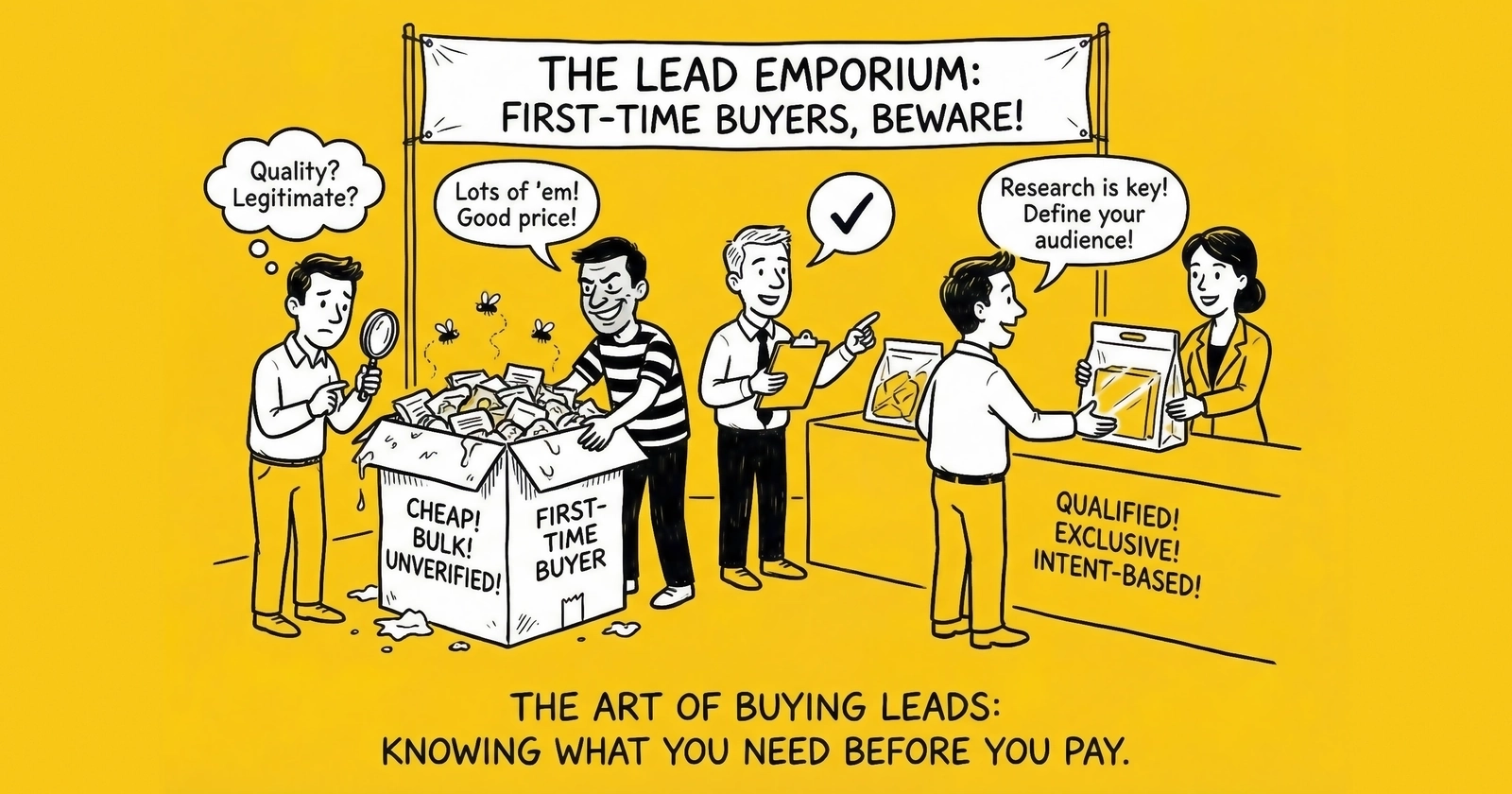
Purchasing leads for the first time involves more than finding a vendor and signing a contract. The decisions you make in your first 90 days determine whether lead buying becomes a profitable customer acquisition channel or an expensive lesson in what you should have asked before writing the check.
You sign a contract with a lead vendor promising 500 leads per week at $45 each. The math looks solid: your sales team converts at 8%, lifetime customer value is $2,400, and that works out to a 3.2:1 return on lead spend.
Six weeks later, reality arrives. Your actual contact rate is 38%. Half of those “leads” never answer despite 12 call attempts. The ones who do answer claim they never requested information. Your sales manager wants to know why conversion dropped to 2.3%. Your CFO wants to know where $90,000 went.
This is not a vendor problem. This is a buyer education problem.
Buying leads is not like buying office supplies. There is no standardized product, no universal quality definition, and no guaranteed outcome. The lead industry generates over $10 billion annually in the United States alone, with buyers ranging from solo insurance agents purchasing 50 leads monthly to national carriers acquiring millions annually. The economics work across this spectrum, but only when buyers understand what they’re purchasing and how to evaluate whether it’s working.
Here’s what first-time buyers consistently underestimate: the difference between a lead that looks good on paper and a lead that converts to revenue. A $25 lead that never answers the phone costs more than a $50 lead that converts to a customer. The metrics that matter aren’t obvious, the contract terms that protect you aren’t standard, and the vendors who deliver quality aren’t always the cheapest.
This guide covers everything first-time lead buyers need to know: when buying makes sense, how to evaluate vendors, what questions to ask, how to structure contracts, and how to track performance so you know within weeks whether a source is profitable.
When to Buy Leads vs. Generate Your Own
Lead buying is not inherently better or worse than internal generation. The right choice depends on your specific situation, resources, and timeline.
When Buying Makes Strategic Sense
The most compelling reason to buy leads is immediate scale. Internal lead generation takes months to build. SEO requires 6-12 months to rank competitively. Content marketing needs consistent investment over quarters before delivering meaningful volume. Paid advertising demands testing and optimization cycles that burn budget before stabilizing. If you need leads now, buying is the fastest path to filling your pipeline.
Buying also makes sense when your sales capacity exceeds your marketing capability. Many businesses have strong sales teams but weak marketing infrastructure. If your salespeople are sitting idle while you figure out Facebook ads, buying leads puts their time to work immediately rather than wasting payroll on unproductive waiting. Similarly, if you lack specialized traffic acquisition expertise, purchasing leads lets you benefit from specialists who have already solved the traffic problem at scale. A mortgage company does not need to master Google Ads when lead generators have spent years perfecting that discipline.
Variable cost structure is another powerful argument for buying. Purchased leads convert fixed marketing costs into variable costs that scale with sales capacity. You pay for leads you receive, not for campaigns that might work, not for content that might rank, not for ads that might convert. This predictability helps with cash flow planning and eliminates the risk of sunk marketing costs. Finally, when you are entering a new vertical or geography, testing market demand through purchased leads is dramatically faster than building generation infrastructure in an unproven market. You can validate demand in weeks rather than months.
When Internal Generation Wins
The calculus shifts toward internal generation when margin optimization becomes critical. Once systems are optimized, internal generation costs significantly less per lead. A $45 purchased lead might cost $15-25 to generate internally at scale. That difference compounds quickly at volume, potentially doubling or tripling your operating margins.
Internal generation also provides complete quality control that purchased leads cannot match. When you generate leads yourself, you control the traffic source, landing page messaging, consent language, and timing of delivery. Purchased leads involve trusting someone else’s processes, and that trust gets tested when quality problems emerge. For businesses with extreme compliance requirements, particularly in financial services and healthcare, internal generation provides the complete documentation chain that regulators demand.
If you already receive significant website traffic, converting that traffic is dramatically cheaper than buying leads from external sources. The visitors are already on your property; capturing their information is a matter of optimization rather than acquisition. Over the long term, internal lead generation capabilities compound in ways that purchased leads cannot. Your content accumulates search authority. Your email lists grow. Your conversion optimization improves with each iteration. Purchased leads are a commodity that any competitor can also buy, offering no sustainable differentiation.
The Hybrid Approach
Most sophisticated buyers use both channels strategically. Internal generation provides baseline volume and typically produces the highest-quality leads because you control every variable. Purchased leads provide scale flexibility and fill capacity gaps when internal sources cannot keep pace with sales team availability. The ratio between internal and purchased leads shifts based on market conditions, sales capacity constraints, and margin requirements. During slow seasons, internal generation may suffice. During peak periods or aggressive growth phases, purchased leads provide the volume that internal sources cannot deliver quickly enough.
Types of Lead Vendors
Not all lead vendors operate the same way. Understanding the three primary models helps you evaluate options and set appropriate expectations for what each relationship will deliver.
Publishers and Direct Generators
Publishers create leads from traffic they own or control directly. They run advertising campaigns on Google and Facebook, build content websites that rank organically, operate comparison engines where consumers research options, and capture consumer intent through forms they designed and manage. Examples include a website ranking for “best auto insurance quotes” that captures form submissions, or an affiliate marketer running Google Ads to a landing page they built from scratch.
Working directly with publishers offers several advantages. You get single source accountability because there is no middle layer to obscure where leads originate. Prices are often lower because you are not paying a broker’s markup. You establish a direct relationship with the generation process, which sometimes allows for customizable forms and qualification questions tailored to your needs. However, publishers also come with limitations. Any single source offers limited scale, and quality varies significantly between publishers. Building meaningful volume requires relationships with many publishers, which creates management overhead. Geographic and demographic coverage is typically limited to whatever traffic that publisher attracts.
Publishers work best when you want tight control over source quality and are willing to invest the relationship management time that multiple vendor relationships demand.
Aggregators and Brokers
Aggregators buy leads from multiple publishers, normalize the data into consistent formats, add validation layers, and resell to buyers. They take title to the leads and assume quality risk, sitting between publishers and buyers as market makers. A lead broker might purchase from 50 different publishers and resell through a unified platform with standardized data formats and centralized reporting.
The aggregator model offers operational simplicity that publishers cannot match. You get significant volume from a single vendor rather than managing dozens of publisher relationships. Data arrives in normalized formats with consistent quality standards. Aggregators typically offer quality guarantees and return policies that individual publishers may not provide. Their platforms often include analytics and reporting that help you optimize performance.
The trade-offs are meaningful, though. Prices are higher because the aggregator’s margin is built into every lead. You get less visibility into original traffic sources, which matters when diagnosing quality problems. Quality can vary within an aggregator’s supply because they are sourcing from multiple publishers. Many aggregators sell the same leads to multiple buyers, which means you are competing with other companies to contact the same consumers. Aggregators work best when you value operational simplicity and volume without the complexity of managing dozens of publisher relationships directly.
Networks and Exchanges
Networks operate real-time auction marketplaces where buyers bid on leads using what the industry calls the ping/post model. They facilitate transactions without taking title to leads, acting as technology infrastructure rather than inventory owners. Examples include MediaAlpha, Boberdoo-powered exchanges, and proprietary ping/post systems where your filters and bids compete with other buyers in real-time auctions.
The exchange model offers true price discovery through competition. You pay precisely what each lead is worth to you based on its attributes, never overpaying for leads that do not fit your ideal profile. Real-time quality signals from other buyer behavior provide information about lead desirability. Access to large supplier networks means significant volume is available to competitive bidders.
However, exchanges require technical integration through API development and maintenance. Bid management demands ongoing optimization and monitoring. Competitive dynamics can drive up prices during high-demand periods. The overall complexity is substantially higher than simple vendor relationships. Exchanges work best when you have technical capability, sufficient volume to justify integration investment, and the analytical resources to optimize bidding strategies over time.
Lead Pricing Models
How you pay for leads affects your economics, risk exposure, and vendor relationship dynamics in ways that go beyond the simple question of cost per lead.
Fixed Price Agreements
Under fixed pricing, you agree to pay a set amount per lead that meets specified criteria. Prices are typically locked for a defined period – monthly, quarterly, or annually. The structure usually includes a base price per lead type and quality tier, with volume commitments that may reduce pricing and caps on daily or weekly volume that prevent supply from overwhelming your sales capacity.
Fixed pricing delivers predictable costs for budgeting and simple accounting. There is no bid management overhead or competitive pressure to monitor. However, you may overpay when market prices drop during low-demand periods, and you may underpay and lose access to quality leads when demand spikes and other buyers outbid you. Fixed pricing offers less flexibility for quality/price tradeoffs within a single agreement. This model works best for buyers with stable demand, limited technical resources, or a strong preference for operational simplicity.
Auction and Ping/Post Pricing
In the ping/post model, you receive a “ping” for each lead containing partial attributes without personally identifiable information. Based on those attributes – geography, credit score range, loan amount, whatever variables matter to your operation – you submit a bid representing what that specific lead is worth to you. The highest bidder receives the complete lead via “post” delivery.
This model lets you pay precisely what each lead is worth based on your conversion data for similar profiles. You can access high-quality leads by bidding competitively, with granular control over which leads you receive. You pay market-rate pricing determined by actual supply and demand rather than arbitrary price lists.
The complexity is substantial, though. You need API integration and bid management infrastructure. Costs can spike during competitive periods when many buyers want similar leads. Technical issues can cause missed leads if your systems are not highly available. Bid optimization requires ongoing analytical attention. Ping/post works best for buyers with technical capability, sufficient volume to justify integration investment, and optimization resources to continuously improve bidding strategies.
Performance-Based Pricing
Performance-based models tie payment to outcomes rather than lead delivery. You pay per qualified appointment, per funded loan, or per closed sale rather than per lead. This structure carries higher per-outcome prices than the raw cost of leads would suggest, because the vendor assumes conversion risk. Performance agreements often include exclusivity requirements.
The appeal is obvious: no risk on lead quality because you only pay when leads convert. Cash flow aligns with revenue since payment coincides with business results. Vendors are strongly incentivized to deliver quality because their revenue depends on your success.
The reality is more complicated. Effective cost per lead is significantly higher than direct purchasing because you are paying for the vendor’s risk premium. Attribution becomes difficult – did this customer really convert because of that specific lead? Vendors naturally cherry-pick the best leads for performance arrangements, leaving lower-quality inventory for other buyers. Performance models have limited availability in most verticals because few vendors are willing to assume conversion risk. This model works best for buyers with limited capital, uncertain conversion rates, or a need to eliminate acquisition risk entirely.
Market Pricing Benchmarks
Current market pricing for quality leads with proper consent documentation varies dramatically by vertical. These 2024-2025 benchmarks provide context for evaluating vendor offers:
| Vertical | Shared Lead Price | Exclusive Lead Price | Premium Tier |
|---|---|---|---|
| Auto Insurance | $15-35 | $50-85 | $100+ |
| Home Insurance | $20-40 | $60-110 | $125+ |
| Life Insurance | $25-50 | $75-160 | $175+ |
| Medicare | $30-80 | $70-150 | $200+ |
| Mortgage (Purchase) | $25-60 | $60-200 | $300+ |
| Mortgage (Refinance) | $20-50 | $50-150 | $200+ |
| Solar | $50-100 | $100-200 | $300+ |
| Home Services | $20-50 | $50-120 | $150+ |
| Personal Injury Legal | $80-200 | $250-500 | $800+ |
| Family Law | $40-100 | $120-350 | $500+ |
Prices below these ranges typically indicate aged leads, questionable quality, or aggressive multi-selling that degrades performance. Premium tiers reflect geographic targeting in high-value markets like California and coastal metro areas, high qualification criteria such as credit scores above 700, or specialty sub-verticals with elevated customer lifetime values.
Understanding True Cost
The price you pay per lead is not your true cost. First-time buyers consistently underestimate the gap between quoted CPL and actual cost per acquired customer. A $75 lead becomes substantially more expensive after you account for return rates running 8-25% of volume, contact failure affecting 20-55% of leads who do not answer or will not engage, conversion rates of just 5-20% among contacted leads, and processing costs including platform fees, validation services, and CRM expenses.
The math is unforgiving. A $75 lead with 15% return rate, 50% contact rate, and 15% conversion yields customers at $1,176 CPA when you calculate $75 divided by 0.85 divided by 0.50 divided by 0.15. If your customer lifetime value is $3,000, that works. If LTV is $800, you are losing money on every sale regardless of how good the leads looked on paper. Calculate your acceptable CPL by working backward from customer lifetime value, target profit margin, and realistic conversion rates before signing any vendor contract.
Evaluating Vendors: The Questions That Matter
Before signing any lead vendor contract, specific questions reveal quality, compliance posture, and fit with your operation. The answers – and how vendors respond to the questions themselves – tell you whether a relationship will be profitable or painful.
Assessing Source Quality
Start with the fundamental question: where do these leads originate? Acceptable answers include specific traffic sources like Google Ads, Facebook campaigns, SEO content sites, and comparison engines. Unacceptable answers are vague references to “various sources” or evasive non-responses. If a vendor will not tell you where leads come from, that information could hurt the sale – and that should concern you.
Ask about typical contact rate for leads in your vertical and geography. Industry benchmarks run 40-60% for fresh exclusive leads and 25-40% for shared leads. If a vendor does not track contact rates or claims 80% or higher, be skeptical. Either their measurement is wrong or their definition of “contact” is generous to the point of meaninglessness.
Probe the validation that occurs before delivery. Look for phone validation confirming numbers are real and dialable, email validation ensuring addresses are deliverable and not disposable, address validation for real properties, duplicate checking against recent leads, and fraud detection. Each layer of validation reduces your return rate and improves conversion.
Understand lead freshness. “Real-time” should mean under 60 seconds from form submission to your system. Anything over 5 minutes should discount pricing. Anything over 24 hours is “aged” inventory and should be priced accordingly. Finally, clarify whether leads are exclusive or shared. Exclusive means you only. Shared typically means 3-7 buyers, though some vendors sell to more. Get the number in writing because more than 7 buyers degrades value significantly.
Verifying Compliance Posture
Compliance questions separate legitimate vendors from those who will create legal liability for your business. Ask how consent is captured and documented. Look for TrustedForm certificates, Jornaya LeadiD, or equivalent third-party consent verification. Request samples of actual consent language from their forms.
The ability to provide consent certificates for each lead is non-negotiable. Certificates should include timestamp, IP address, the exact consent language shown to the consumer, and documentation of the user action taken. If a vendor cannot provide this documentation, do not buy from them regardless of price or volume.
Understand how the vendor handles Do Not Call compliance. They should scrub against the National DNC Registry and any state-specific lists relevant to your operations. Ask about scrub frequency – weekly at minimum, though daily is better for high-volume operations. Inquire about what happens if a lead files a TCPA complaint. Good vendors have established processes for handling complaints, indemnification clauses in their contracts, and experience supporting buyers through litigation. If a vendor claims they have never received a complaint, they either lack meaningful volume or are not being honest about their history.
Confirm how long consent documentation is retained. The TCPA requires documentation retention for at least 5 years. Better vendors retain 7 years or more. Ask where documentation is stored and exactly how you would access it if litigation requires proving consent was obtained.
Understanding Operations and Support
Operational questions determine whether the vendor relationship will be manageable day-to-day. Ask about return policies – standard practice allows 7-14 day return windows for leads that are invalid due to wrong numbers or unreachable contacts, duplicates you received recently from any source, or leads outside your specified filters like wrong geography or product type.
Understand how leads are delivered. API or webhook delivery is fastest, with sub-second delivery possible. CRM integration is most convenient for existing workflows. Email delivery is too slow for high volume. Portal downloads require manual processes that create delays. For any volume exceeding 20 leads per day, invest in API or CRM integration rather than slower methods.
Request details on available reporting. Essential reporting includes volume by day, delivery timestamps, lead attributes, and return status. Better vendors provide source-level performance data, quality trending over time, and competitive intelligence about market conditions. Ask about support availability including account management, technical support hours, escalation paths, and response time expectations. Test responsiveness before signing by sending questions and measuring how long useful answers take.
Before committing, ask to speak with current buyers. Credible vendors provide references without hesitation. Ask references about actual performance versus promised results, return handling efficiency, and overall relationship quality over time.
Setting Up Buyer Filters
Filters determine which leads you receive. Poorly configured filters waste money on leads you cannot convert. Overly restrictive filters starve your sales team of opportunity. Getting filters right requires understanding the categories available and developing a strategy for optimization over time.
Filter Categories and Options
Geographic filters define where you can sell. Set state or regional filters based on licensing and operational capability. ZIP code or radius targeting works well for service businesses that travel to customer locations. DMA (Designated Market Area) targeting serves media buyers focused on specific broadcast regions. Include exclusion zones for areas you cannot serve due to licensing, logistics, or market conditions.
Demographic filters narrow by consumer characteristics. Age ranges apply where legal and relevant to your product. Homeownership status matters for many insurance, mortgage, and home services verticals. Household income brackets help match leads to products appropriate for their financial situation. Family size or composition may be relevant depending on what you sell.
Vertical-specific filters provide the granular targeting that drives conversion. Insurance buyers filter by vehicle year, make, and model, current coverage status, violation history, and credit tier. Mortgage buyers care about loan amount, property value, credit score range, employment status, and property type. Solar buyers filter on property ownership, roof age and condition, electric bill amount, and credit score. Legal lead buyers focus on case type, injury date, representation status, and liability clarity.
Optimizing Filters Over Time
New buyers should start broad and narrow based on performance data. Accept wide filters initially to gather conversion information across segments. Tighten filters only when data demonstrates that specific segments consistently underperform your economics. Cutting segments based on assumptions rather than data often eliminates profitable opportunities.
Your analytics must track conversion rate by every filter dimension – geography, credit tier, loan amount, product type, and any other segmentation available. Without this granular data, filter optimization becomes guesswork rather than science. You might eliminate an entire state that actually contains high-converting ZIP codes mixed with poor performers.
Different segments justify different prices. High-quality segments characterized by 700+ credit scores, high income, and desirable geographies command premium prices but often deliver premium conversion. You must decide whether to pay more for better leads or accept lower conversion at lower prices. Neither approach is inherently correct; the right answer depends on your sales capacity, margin requirements, and growth objectives.
Cap management prevents volume from overwhelming your team. Set daily and weekly caps slightly above sales capacity to create a small buffer for busy days without generating a backlog that ages before contact. Time-of-day filtering addresses operational reality. Leads arriving at midnight when no one answers until 9 AM have already decayed significantly. Either staff for extended hours or filter delivery times to match your availability.
Lead Delivery Methods
How leads arrive affects speed to contact and operational efficiency. The delivery method you choose should match your volume, technical capability, and speed requirements.
API and webhook delivery works best for high-volume buyers. Leads post directly to your system via HTTP API call as soon as they are captured and validated by the vendor. Delivery in sub-second timeframes is possible – the lead can arrive in your CRM before the consumer finishes reading the vendor’s thank-you page. Implementation requires development resources to build and maintain your endpoint, including error handling, logging, and monitoring. Any buyer processing 50 or more leads per day should invest in API integration.
CRM integration provides convenience without custom development. Leads automatically populate in your CRM system – Salesforce, HubSpot, Zoho, or others – through native integrations or middleware platforms like Zapier. Speed runs 1-5 minutes depending on integration method, which is slower than direct API but fast enough for most operations. This approach works well for buyers who want leads in existing workflows without building custom infrastructure.
Email delivery sends lead details to a designated address or distribution list. Speed varies from 1-15 minutes depending on email system performance. This method works only for very low volume under 10 leads per day or initial testing before building proper integration. Email creates lag that degrades conversion and requires manual processes to transfer leads into working systems.
Portal download requires logging into a vendor portal and downloading leads as CSV files or accessing them individually. Speed depends entirely on how often someone checks the portal, which could mean hours of delay. This method works only for aged lead purchases or situations where immediacy does not affect value. For any real-time lead buying, portal download is unacceptable.
Before launching at full volume, test your chosen delivery method to confirm leads arrive correctly. Monitor for delivery failures and maintain backup processes. Ensure your system captures delivery timestamps so you can measure speed-to-contact accurately.
Return Policies and Quality Guarantees
Returns are the mechanism for quality accountability in lead purchasing. Understanding return policies protects your economics and gives you recourse when vendors deliver leads that do not meet specifications.
Understanding Return Categories
Different problems qualify for different return treatments. Invalid phone returns apply when numbers do not exist, are disconnected, or cannot receive calls. Most vendors accept these returns without dispute because the data itself is demonstrably wrong.
Wrong number returns cover situations where the person who answers is not the lead and did not request information. These returns require documentation, typically call recordings or detailed notes, because they involve a judgment about whether the right person was reached. Duplicate returns apply when you already have the consumer in your system from a recent purchase. Standard duplicate windows run 30-90 days, protecting you from paying twice for the same prospect.
Outside filters returns address leads that do not match agreed criteria like wrong state or product type. These should not happen with proper filtering but occur due to data errors or system glitches. No consent returns apply when consumers claim they never filled out a form. Resolution requires review of the consent certificate to determine whether proper documentation exists.
Navigating Return Windows
Standard return windows run 7-14 days for most categories, allowing time to make contact attempts and identify issues before the deadline. Short windows of 3-5 days work only if you have immediate contact capacity; otherwise you lose the ability to return leads you discover are problematic after the window closes.
Extended windows of 30 days come at premium pricing but provide protection for high-value leads where qualification takes longer. The added cost may be worthwhile when individual lead prices justify the additional protection.
Effective return management requires documenting everything with call recordings, notes, and screenshots that support your claims. Vendors dispute undocumented returns, so your word alone will not recover credits. Submit returns promptly within 48 hours of identification rather than batching at the end of the window. Faster submission means faster credit.
Track return rates by source, not just by vendor. If returns from one particular source within a vendor’s supply exceed 15%, that source has quality issues regardless of how the vendor explains the numbers. The return data does not lie even when vendor explanations attempt to rationalize it.
Quality Guarantees Beyond Returns
Some vendors offer broader quality guarantees that go beyond simple return policies. Contact rate guarantees commit the vendor to minimum contact rates, such as 50% within 5 attempts. If performance falls below the guarantee, you receive credit proportional to the shortfall. Conversion guarantees are rarer but exist from some performance-focused vendors who will guarantee minimum conversion rates with remedies if not achieved.
Source quality commitments provide written standards with specific remedies if the vendor breaches them. These might include commitments about traffic sources, validation processes, or freshness windows.
Whatever guarantees a vendor offers, get them in writing with specific measurement methods and clear remedies for breach. Verbal promises have no value when disputes arise months later.
Negotiating Contract Terms
Lead purchase contracts contain terms that significantly affect your economics and risk exposure. First-time buyers often accept standard terms without realizing that vendors have substantial flexibility on many provisions.
Essential Terms to Define
Lead specifications must define exactly what you are buying with precision that prevents disputes. Geography, demographics, product interest, required data fields, and qualification criteria should all be explicit. Ambiguous specifications create return disputes that cost time and money to resolve.
Pricing structure should lock in CPL by lead type, specify volume discounts and their thresholds, and include price adjustment provisions with advance notice requirements. Lock pricing for specified periods of 90-180 days rather than accepting language like “subject to change.”
Return rights need clear definition of what qualifies for returns, the return window timeline, maximum return rates before consequences, and return processing procedures including credit timelines. Volume commitments should specify minimum and maximum lead volumes, how capacity caps work operationally, and what happens when limits are reached on either end.
Payment terms of Net 15 or Net 30 are standard in the industry. Prepayment is sometimes required for new accounts but should convert to terms after establishing payment history. Contract duration should specify month-to-month versus annual commitments, renewal terms, and cancellation provisions including required notice periods.
Compliance warranties require vendor certifications about TCPA compliance, consent capture processes, and data accuracy. Indemnification provisions should protect you from compliance failures attributable to the vendor’s practices.
Terms Worth Negotiating
Trial periods let you evaluate quality before full commitment. Request 30-60 days at reduced minimums with language like “Let me run 500 leads before committing to 5,000 monthly.” Most vendors will accommodate reasonable testing requests.
Return caps with performance triggers protect both parties. Negotiate 8-12% return caps with automatic review and remediation requirements if you consistently hit the cap, rather than accepting unlimited return risk on your side.
Source transparency provisions give you the ability to see source-level performance data and block underperforming sources without terminating the entire relationship. Price protection clauses lock pricing for 90-180 days, requiring advance notice before any adjustments. This protects your economics against sudden market changes.
Cancellation flexibility with 30-day notice requirements is reasonable. Avoid contracts with penalties for early termination that trap you in underperforming relationships. Performance guarantees on contact rate minimums or conversion benchmarks should include price adjustment triggers if guarantees are not met consistently.
Contract Pitfalls to Avoid
Auto-renewal traps lock you into additional periods without opt-out provisions. Any auto-renewal clause should include a notice window and easy opt-out process. Exclusivity clauses that prohibit buying leads from competitors limit your ability to diversify and optimize across vendors. Avoid exclusivity unless the economics are compelling enough to justify the restriction.
Broad force majeure clauses allowing the vendor to suspend delivery for vague reasons without price adjustment leave you vulnerable to supply interruption without recourse. Excessive late payment penalties with 20% or higher monthly interest compound quickly into serious money. Negotiate reasonable penalty structures.
Have an attorney review contracts before signing, especially for significant commitments. The cost of legal review is trivial compared to the cost of unfavorable terms at scale.
Testing Before Scaling
Every new lead source should go through structured testing before receiving full volume. Rushing to scale without proving performance is one of the most expensive mistakes first-time buyers make.
Phase One: Confirming the Basics
The first phase runs weeks one and two with just 25-50 total leads. The goal is confirming that delivery works, data format is correct, and basic quality is acceptable. You are evaluating whether leads arrive in the expected format, whether required fields are actually populated, whether phone numbers are dialable, whether consent certificates are provided as promised, and whether the return process functions correctly.
If basics fail during this phase, stop and resolve issues before continuing. There is no point scaling a relationship that cannot deliver leads correctly. Problems with delivery mechanics or data quality at small scale will multiply catastrophically at larger volumes.
Phase Two: Measuring Contact Performance
Phase two runs weeks three and four with 10-25 leads per day. The goal is measuring contact rate and gathering initial conversion signals. You are evaluating contact rate against targets of 40% or better for exclusive and 25% or better for shared leads, call disposition patterns, initial sales conversation quality, and return rate accumulation.
Continue to phase three only if contact rate meets minimums and return rate stays below 15%. Contact problems at this stage indicate source quality issues that volume will not fix.
Phase Three: Proving Economics
Phase three runs weeks five through eight at your target daily cap. The goal is measuring actual conversion and calculating true economics. You are evaluating lead-to-customer conversion rate, cost per acquisition calculated as CPL divided by conversion rate, customer lifetime value from this specific source, and source contribution margin after all costs.
Continue only if CPA provides acceptable margin against LTV. If economics do not work at this stage, additional volume will not improve the math.
Statistical Confidence
You need sufficient volume for statistical significance before making permanent decisions. For a source with 5% conversion, 100 leads gives just 5 conversions – high variance and low confidence in the true rate. At 500 leads you get approximately 25 conversions with moderate confidence. At 1,000 leads you reach approximately 50 conversions with reasonable confidence in performance.
Do not make permanent decisions based on 50-lead tests. Also do not wait for 10,000 leads before making preliminary decisions. The goal is gathering enough data to make informed choices without wasting budget on extensive testing of sources that clearly do not work.
Tracking Lead Performance
What you measure determines whether you optimize effectively or waste money on sources that look acceptable in aggregate but hide significant problems in the details.
Essential Metrics
Speed to first contact measures time from lead delivery to first contact attempt. Target under 5 minutes for real-time leads. This matters because every minute of delay reduces conversion probability measurably.
Contact rate measures the percentage of leads where you reach a human, calculated as leads contacted divided by leads received. Target 40-60% for fresh exclusive leads and 25-40% for shared leads. Unreachable leads have zero value regardless of how good the data looks.
Qualification rate measures the percentage of contacted leads that represent viable sales opportunities, calculated as qualified leads divided by leads contacted. Target 30-50% of contacted leads. This metric separates source quality from mere reachability.
Conversion rate measures the percentage of leads that become customers, calculated as customers divided by leads received. Targets vary by vertical, typically ranging from 2-15%. This is the ultimate measure of lead value because everything else is intermediate.
Return rate measures the percentage of leads returned to the vendor, calculated as returns divided by leads received. Target under 10%. High return rates indicate source quality issues that the vendor needs to address.
Cost per acquisition is the total cost to acquire one customer from a specific source, calculated as lead cost minus return credits divided by customers acquired. This must be below customer lifetime value with acceptable margin for the source to be profitable.
Breaking Down Performance by Segment
Track all metrics broken down by lead source or vendor, geographic region, product type, credit tier or quality score, day of week and time of day, and individual sales representative. Aggregate metrics hide opportunities. A vendor with 4% overall conversion might have 8% conversion in one state and 1% in another. The correct response is cutting the 1% state and paying premium prices for additional volume in the 8% state – but you cannot make that decision without segmented analysis.
Attribution Challenges
Attribution decisions affect how you credit sources for revenue. First-touch attribution credits the lead source that originated the prospect. Last-touch attribution credits whatever interaction preceded the sale. Most lead buying uses first-touch because the lead source initiated the relationship.
Multi-lead attribution creates complexity when the same consumer becomes a lead multiple times before converting. You must decide how to attribute that conversion – to the first lead, the last lead, or distributed across all touches. Long sales cycles in verticals with 30-90 day consideration periods require tracking systems that maintain connection between leads and eventual sales. If you cannot trace which lead generated which customer, you cannot optimize sources effectively.
Common Buyer Mistakes
These errors cost new buyers significant money. Learning from others’ expensive lessons is substantially cheaper than making the mistakes yourself.
Failing to Track Source-Level Performance
The error is treating all leads the same rather than measuring performance by individual source. The consequence is continuing to buy from underperforming sources while good sources get lost in vendor-level averages. The fix requires source-level tracking from day one. Tag leads by source in your CRM. Report conversion by source weekly, not just monthly vendor totals.
Optimizing for CPL Instead of CPA
The error is choosing vendors based on lowest cost per lead without considering conversion rates. The consequence becomes clear when you calculate real numbers: a $25 lead with 2% conversion costs $1,250 per customer while a $50 lead with 6% conversion costs only $833 per customer. The fix is always calculating and comparing cost per acquisition. The cheapest lead is rarely the most profitable.
Allowing Slow Speed to Contact
The error is letting leads sit in queue while sales reps finish other calls or allowing leads to arrive after hours with no response until morning. The consequence is severe: lead value decays 50% within 48 hours, and competitors who respond faster win the business. The fix requires staffing for immediate response, using automation for after-hours acknowledgment, and measuring and incentivizing speed aggressively.
Giving Up Too Early on Contact
The error is making 2-3 call attempts and marking leads as unresponsive. The consequence is wasted lead cost because 60% of leads require 5 or more attempts to reach. The fix is implementing 8-12 attempt cadences over 10-14 days that mix calls, texts, and emails across multiple time slots.
Failing to Document for Returns
The error is not recording calls or documenting issues, making return claims difficult to support with evidence. The consequence is legitimate returns denied because you cannot prove the lead was invalid. The fix requires recording all calls, training reps to document specific issues contemporaneously, and submitting returns with supporting evidence attached.
Scaling Before Process Optimization
The error is increasing lead volume before the sales process is optimized. The consequence is wasted leads at scale – a 5% conversion rate problem at 100 leads per day wastes 95 opportunities daily, and those losses add up quickly. The fix is proving conversion rate and sales process effectiveness at small volume before scaling. Every 1% conversion improvement at scale multiplies your returns.
Ignoring Compliance Requirements
The error is not verifying consent certificates, calling leads on DNC lists, or ignoring TCPA requirements. The consequence includes $500-$1,500 per violation, class action settlements averaging $6.6 million, and potential criminal referrals in extreme cases. The fix requires demanding consent certificates, scrubbing against DNC lists, training all staff on TCPA requirements, and documenting everything meticulously.
Becoming Dependent on a Single Vendor
The error is concentrating all lead volume with one vendor. The consequence is no leverage in negotiations, catastrophic impact if the vendor has quality issues or operational problems, and no ability to test whether better options exist. The fix is maintaining at least 3 vendors at meaningful volume with no single vendor exceeding 40% of your total lead purchasing.
Ignoring Seasonality
The error is setting fixed budgets and caps without accounting for seasonal demand patterns. The consequence is over-buying during slow periods when leads go stale and under-buying when demand peaks and sales capacity is available. The fix requires studying your vertical’s seasonality. Insurance peaks during life events and policy renewals. Mortgage follows rate movements. Solar follows spring and summer. Home services spike with weather events. Adjust caps and budgets to match demand cycles.
Continuing Without Exit Criteria
The error is continuing to buy from underperforming sources hoping performance improves eventually. The consequence is months of losses while “giving it more time.” The fix is defining exit criteria before starting: if conversion falls below a specific threshold for a defined number of consecutive weeks, pause and review. Honor those criteria when triggered rather than rationalizing continued spending.
Frequently Asked Questions
What is the average cost per lead when buying from vendors?
Lead costs vary dramatically by vertical, quality tier, and exclusivity. Auto insurance leads range from $25-75 for shared to $60-150 for exclusive. Mortgage leads run $50-200 depending on loan type and borrower quality. Solar leads cost $75-300 based on property and credit characteristics. Legal leads for personal injury can exceed $200-500 given high customer lifetime values. These are 2024-2025 market rates; prices fluctuate with demand, seasonality, and economic conditions.
How do I know if a lead vendor is legitimate?
Legitimate vendors provide clear answers about lead sources without evasion, consent certificates such as TrustedForm or equivalent for every lead, documented return policies with reasonable windows, references from current buyers willing to discuss performance, and responsive account management that answers questions promptly. Red flags include vague sourcing explanations, inability to provide consent documentation, unrealistic quality claims like 90% or higher contact rates, and pressure to sign quickly without time for due diligence.
What is a good contact rate for purchased leads?
For fresh exclusive leads delivered in real-time, target 40-60% contact rate within 5 attempts. For shared leads sold to 3-5 buyers, expect 25-40%. For aged leads that are 48 or more hours old, expect 15-30%. Contact rates consistently below these benchmarks indicate source quality issues, not normal market conditions.
Should I buy exclusive or shared leads?
Exclusive leads cost 2-3 times more but convert at higher rates because you are the only company contacting the consumer. Shared leads cost less but compete with 3-7 other buyers for the same consumer’s attention. Calculate your effective cost per acquisition for each type. If exclusive leads at $75 convert at 8%, your CPA is $937. If shared leads at $25 convert at 2%, your CPA is $1,250. In this example, exclusive leads are actually cheaper despite higher CPL.
How many leads should I start with when testing a new vendor?
Start with 25-50 leads in the first week to verify delivery mechanics and basic quality. Expand to 10-25 per day for weeks 2-4 to measure contact rates. Run at target volume for weeks 5-8 to measure conversion. You need at least 500-1,000 leads to reach statistical confidence on conversion rates for a source converting at 5%.
What return rate is normal for purchased leads?
Return rates of 5-10% are normal and manageable within standard economics. Returns of 10-15% indicate quality issues worth investigating with the vendor. Returns above 15% suggest systematic problems with the source that require immediate attention. Some returns are expected for wrong numbers, duplicates, and out-of-filter leads; the question is whether your rate is consistent with industry norms.
How quickly should I contact leads after they arrive?
Contact leads within 5 minutes of delivery. Research shows 391% higher conversion when responding within one minute, and 21 times higher qualification probability within five minutes versus 30 minutes. If you cannot contact leads within 5 minutes consistently, you are leaving significant value on the table.
What is ping/post and do I need it?
Ping/post is a real-time auction system where you bid on leads based on partial attributes before receiving complete information. You need it if you want market-rate pricing and granular control over lead selection. You do not need it if you prefer fixed-price simplicity and have limited technical resources. Ping/post requires API integration and bid management capability that smaller buyers may not have.
How do I handle leads that claim they never requested information?
First, check the consent certificate for that lead. If valid consent was captured with timestamp, IP address, and form completion evidence, the consumer may have forgotten or is confused about which site they used. If no consent certificate exists or it shows problems, return the lead and document the issue for your records. If this happens frequently with one vendor, that vendor has consent capture problems that warrant terminating the relationship.
What technology do I need to buy leads effectively?
Essential requirements include a CRM to manage leads and track outcomes, a phone system with call recording capability, and a process for measuring speed to contact. Recommended additions include API integration for real-time delivery, automated lead distribution to sales reps, and an analytics platform for source-level reporting. Advanced capabilities include ping/post bidding systems, predictive lead scoring, and multi-touch attribution. Start with essentials and add capability as volume justifies investment.
Key Takeaways
Calculate cost per acquisition, not cost per lead. The cheapest leads often produce the most expensive customers. A $75 lead with 10% conversion delivers customers at $750 CPA, while a $40 lead with 3% conversion delivers customers at $1,333 CPA.
Speed-to-contact determines success more than almost any other variable. Leads contacted within one minute convert 391% better. Build infrastructure for immediate response before buying your first lead.
Require consent documentation on every lead. TrustedForm certificates or equivalent protect you from TCPA liability that can exceed $6.6 million per lawsuit. No documentation, no purchase, regardless of price.
Evaluate vendors rigorously before committing. Source transparency, consent certificates, validation standards, return policies, and reference clients separate legitimate vendors from those who will cost you money and create compliance risk.
Track performance by source, not just vendor. Individual sources within the same vendor can show 2-3 times performance differences. Source-level tracking enables optimization that aggregate metrics hide.
Start small and scale based on data. Trial periods of 100-200 leads per vendor, 2-3 vendors tested simultaneously, and 60-90 days to evaluate performance provide the information needed for informed decisions. Commit volume and contracts only after proving results.
Negotiate everything. Trial terms, return policies, pricing, contract length, and cancellation provisions are all negotiable. Standard terms favor vendors; negotiated terms protect buyers.
Fire underperformers quickly. Return rates above 20%, contact rates below 40%, or conversion rates substantially below benchmarks warrant immediate attention and quick termination if issues remain unresolved. The industry has many vendors; loyalty to poor performers is expensive.
Sources
- Harvard Business Review: The Short Life of Online Sales Leads - Original research on speed-to-contact showing 391% conversion improvement for 1-minute vs. 2-minute response
- InsideSales.com Lead Response Research - Studies documenting 21x higher qualification within 5 minutes vs. 30 minutes
- CFPB Compliance Resources - Consumer protection regulations affecting lead generation and consent requirements
- Salesforce Resources - CRM best practices and lead management workflow benchmarks
- HubSpot Marketing Statistics - Lead conversion benchmarks and cost per acquisition research across industries
- SBA Small Business Guide - Vendor evaluation and contract negotiation guidance for small business buyers
This guide draws on industry research including Lead Response Management Study for speed-to-contact statistics, Lead Connect Survey for first-responder advantage data, and operational benchmarks from insurance, mortgage, solar, and legal lead markets. Pricing reflects 2024-2025 market conditions. Validate current pricing and terms with specific vendors before making purchase decisions.