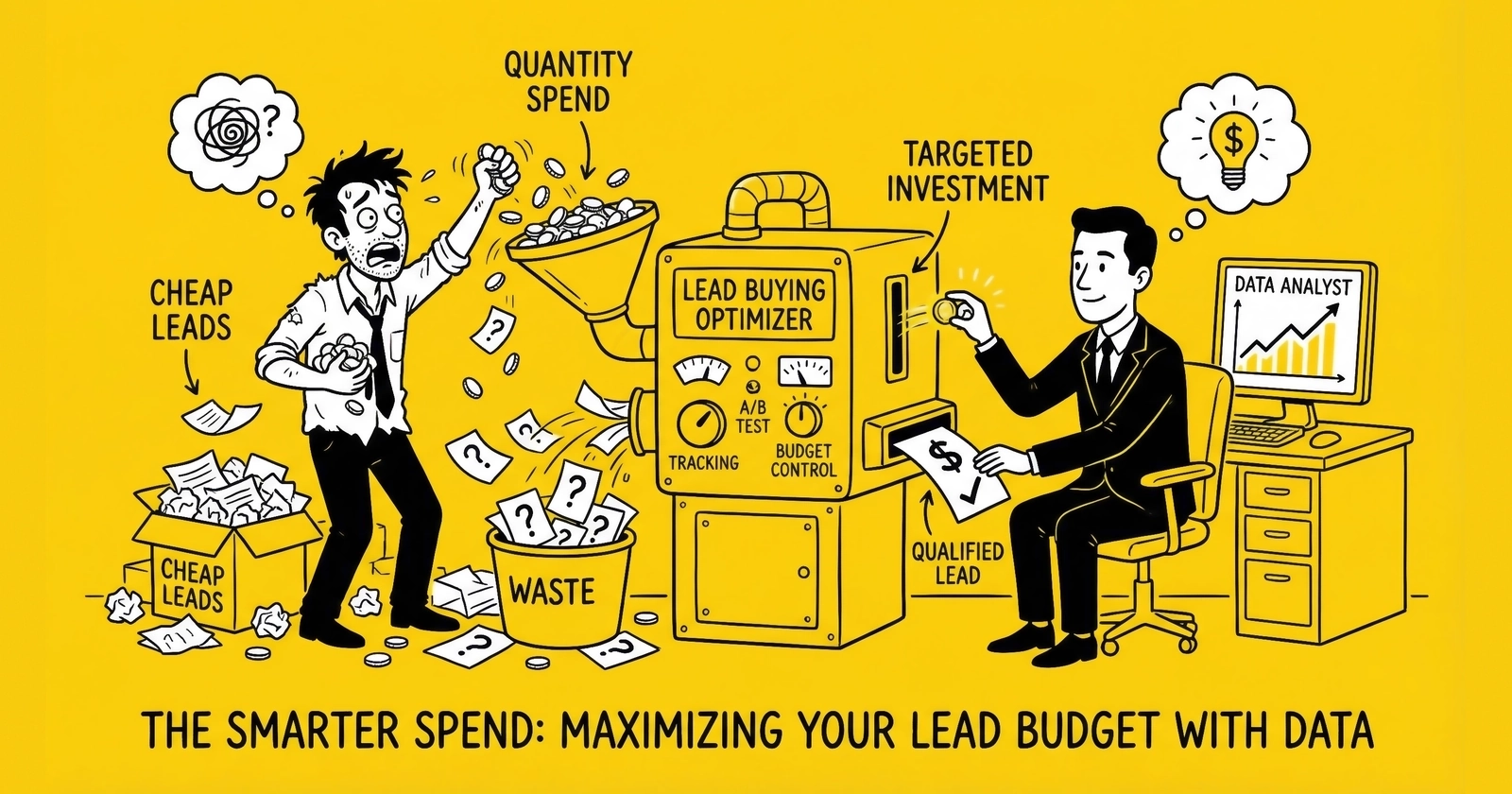
A practical guide to purchasing insurance leads that actually convert, with real pricing benchmarks, ROI calculations, and budget optimization strategies for agents in 2025.
A new insurance agent drops $2,000 on their first batch of leads. Three weeks later, they have made exactly two sales. The leads were not fraudulent. The contact information was valid. The problem: they bought the wrong leads, at the wrong price, without the infrastructure to work them properly.
This scenario plays out thousands of times each year across the insurance industry. Agents hear about lead buying as a growth strategy, allocate budget without understanding the economics, and discover too late that lead purchasing is a system – not a shortcut. The agents who succeed at lead buying approach it with the same discipline they would apply to any other business investment: understanding unit economics before spending, building infrastructure before scaling, and tracking performance with ruthless precision.
This guide provides the framework for making lead buying work within your budget. Whether you are spending $500 per month or $50,000, the principles remain the same. Only the scale changes.
Understanding the Insurance Lead Market
Before spending a dollar on leads, you need to understand the market you are entering. Insurance leads represent the largest and most sophisticated vertical in the lead generation economy, with an estimated $5.2-6.8 billion in annual transaction value across all insurance sub-verticals. This is not a cottage industry – it is a mature marketplace with established players, predictable pricing, and well-documented economics.
The market structure matters because it determines who you are competing against. When you purchase a shared lead, you are often competing with Progressive, GEICO, and Allstate – companies that spent a combined $7 billion on advertising in 2024 alone. Progressive’s $3.5 billion advertising spend that year represented a near-tripling from the prior year, flooding the market with demand and pushing lead prices higher.
Two publicly traded companies provide visibility into market dynamics. MediaAlpha reported $864.7 million in revenue for 2024, with transaction value exceeding $1.5 billion through their programmatic marketplace. EverQuote crossed $500.2 million in revenue for 2024, with their automotive vertical alone generating $446 million. These companies represent perhaps half the intermediated market – the rest flows through dozens of smaller brokers, direct publisher relationships, and affiliate networks.
Understanding this context helps you set realistic expectations. You are not buying from a small vendor who needs your business. You are participating in a sophisticated marketplace where your $2,000 monthly budget represents a rounding error in the daily transaction volume.
Why Lead Pricing Varies So Dramatically
Walk through any insurance marketing conference and you will hear wildly different numbers. One agent claims they pay $15 per lead. Another insists quality leads cost $100 or more. Both may be telling the truth – they are simply buying different products.
Lead pricing reflects four primary variables, each creating substantial variation in what agents pay for ostensibly similar products. Exclusivity determines whether you compete for the prospect’s attention. Exclusive leads – sold to one buyer only – command 2-3x the pricing of shared leads sold to 3-7 buyers. An auto insurance lead selling at $25 shared might price at $60-80 exclusive. The premium reflects genuine value: exclusive leads convert 50-100% higher because you are not racing four competitors to make contact.
Recency measures how fresh the lead is. Real-time leads deliver within seconds of form submission while the consumer is still thinking about insurance. Aged leads – 30, 60, or 90+ days old – price at 5-20% of fresh lead values. The decay curve is brutal: a lead loses roughly 50% of its value every 24-48 hours in most insurance verticals.
Qualification depth refers to how much information was captured and verified. A lead with just name and phone number is worth less than one with vehicle information, driving history, current coverage details, and verified contact data. Deeper qualification reduces buyer risk and improves conversion rates. Finally, vertical and geography create substantial variation. Medicare leads during Annual Enrollment Period command $80-150, while auto leads in less competitive states might run $20-40. Coastal urban areas command premiums over rural markets. High-risk drivers cost less to acquire than preferred risks.
The Real Economics of Lead Buying
Before you buy a single lead, understand the math that determines whether lead buying works for you. The critical calculation is cost per sale, not cost per lead. If you purchase 100 leads at $40 each ($4,000 total), achieve a 50% contact rate (50 conversations), and convert 10% of contacts (5 sales), your cost per sale is $800. Whether that works depends on your commission structure and customer lifetime value.
For auto insurance, typical first-year commission runs 10-15% of premium. On a $1,500 annual premium, that is $150-225 per policy in year one. At $800 cost per sale, you lose money in the first year. But auto insurance customers retain for 3-5 years on average, with lifetime value reaching $1,500-$3,000. Against $2,500 lifetime value, that $800 acquisition cost yields a 3:1 return – profitable, though requiring patience and capital.
The math changes significantly by line of business:
| Line of Business | Typical CPL Range | Expected Conversion | Customer LTV | Target CPA |
|---|---|---|---|---|
| Auto Insurance | $20-80 | 8-12% | $1,500-3,000 | $500-800 |
| Home Insurance | $25-100 | 7-10% | $2,000-4,000 | $600-1,000 |
| Life Insurance | $30-125 | 5-8% | $3,000-6,000 | $800-1,500 |
| Medicare | $35-150 | 6-10% | $800-1,200 | $200-400 |
| Commercial | $50-200 | 3-5% | $5,000-15,000 | $1,500-3,000 |
These benchmarks assume competent sales execution and reasonable speed-to-contact. Your results will vary based on your specific circumstances – but they should not vary by orders of magnitude from these ranges. If your cost per sale is 3x these benchmarks, something is wrong with your process, your lead sources, or both.
Setting Your Lead Buying Budget
Budget allocation is where most agents make their first mistake. They allocate what feels comfortable rather than what the math supports. Or they commit too much too fast, burn through capital before optimizing, and conclude that lead buying does not work.
The Minimum Viable Budget
For most insurance agents, the minimum effective lead buying budget is $1,500-$2,500 per month. Below this threshold, you cannot purchase enough leads to generate statistically meaningful data about what is working. You will be making decisions based on a handful of outcomes rather than patterns.
At $2,000 monthly for auto insurance leads, you face a fundamental choice about how to allocate that budget. With shared leads at $25 each, you get 80 leads per month – approximately 4 per business day. With exclusive leads at $65 each, you get 31 leads per month – approximately 1.5 per business day. A blended approach gives you a mix of both, perhaps 50 shared and 15 exclusive.
The shared approach gives you more attempts but more competition. The exclusive approach gives you better conversion odds but fewer total opportunities. Most agents find that starting with exclusive leads, despite higher per-lead costs, produces better outcomes until they develop the systems and speed required to compete on shared leads.
Budget Allocation by Experience Level
Your lead buying strategy should evolve as your capabilities mature. New agents in their first three months of lead buying should start with 25-30% of their comfortable marketing budget on leads, choosing one lead type and one vertical – exclusive auto, for example. The focus during this period should be building systems before scaling spend, tracking every lead outcome meticulously. A monthly budget of $1,500-$2,500 is appropriate for this learning phase.
As you develop competency during months four through eight, increase to 40-50% of your marketing budget if early metrics justify it. Add a second lead type or vertical based on performance data. Begin testing different lead sources for comparison. Implement CRM automation and follow-up sequences. Monthly budgets of $3,000-$5,000 become appropriate as your systems mature.
For established lead buyers with nine or more months of experience, lead buying can become your primary growth channel if ROI supports it. Diversify across 3-4 lead sources to reduce dependency. Blend exclusive, shared, and possibly aged leads based on capacity. Consider live transfer leads for immediate conversations. Monthly budgets can scale to $5,000-$25,000 or more depending on demonstrated ROI.
The 60-Day Float Rule
Before committing to any lead buying budget, understand the cash flow reality. Lead purchases typically require payment upfront or on short terms (NET 7-15 days). Commission revenue comes later – sometimes much later for life insurance or complex commercial policies.
The rule of thumb: maintain 60 days of lead spending as working capital buffer. If your monthly lead budget is $3,000, you need $6,000 in reserves before starting. This buffer protects you from the timing gap between spending on leads and receiving commission revenue.
Undercapitalization kills more lead buying programs than bad leads. Agents commit their entire marketing budget to leads, hit a slow month, cannot afford the next batch, and lose momentum just as their pipeline was building.
Choosing the Right Lead Types
Not all leads are created equal, and the right lead type for you depends on your sales infrastructure, response capability, and business goals.
Exclusive Leads: The Premium Option
Exclusive leads sell to you alone. No one else will call that prospect from the same lead submission. This exclusivity commands premium pricing – typically 2-3x shared lead costs – but delivers measurable advantages.
Exclusive leads make sense when you cannot respond to leads within 2 minutes of receipt, when your sales strength is relationship building rather than high-volume processing, when you are new to lead buying and want to isolate variables, or when your close rate on shared leads consistently underperforms expectations.
The exclusive lead advantage manifests in measurable performance improvements. Contact rates run 50-60% versus 45-55% for shared leads. Conversion rates run 12-15% of contacts versus 8-12% for shared. The consumer experience is better – they receive one professional call, not five competing pitches. You have time for thoughtful follow-up sequences rather than frantic speed-dialing.
Consider this math comparison: 50 exclusive leads at $70 equals $3,500 in spend. A 55% contact rate produces 27.5 conversations. At 14% conversion, you close 3.85 sales. Cost per sale: $909. Exclusive leads cost more per sale in this example but produce more predictable outcomes with less operational intensity.
Shared Leads: The Volume Play
Shared leads sell to 3-7 buyers simultaneously. Everyone receives the same information at approximately the same time. Victory goes to the fastest responder.
Shared leads make sense when you can consistently respond within 60 seconds of receipt, when you have call center infrastructure or dedicated sales staff, when volume matters more than per-lead conversion rate, and when your cost-per-sale tolerance is low while you can make up margin on volume.
The shared lead challenge is substantial. Research consistently shows that 78% of customers purchase from the first responder who reaches them. If you are not calling within the first minute, you are competing for the 22% remaining after faster competitors have already connected.
The volume math looks different: 100 shared leads at $25 equals $2,500 in spend. A 50% contact rate produces 50 conversations. At 10% conversion, you close 5 sales. Cost per sale: $500. Shared leads deliver lower cost per sale in this example – but only if you can execute the speed required. Most individual agents cannot compete on speed with carrier call centers staffed specifically for rapid response.
Live Transfers: Immediate Conversations
Live transfer leads connect you directly with a consumer who is currently on the phone, pre-screened for interest and basic qualification. The consumer called a marketing number, spoke with a screening agent, and was transferred to you while still in buying mode.
Live transfers make sense when you want guaranteed conversations rather than contact attempts, when your strength is phone sales once the conversation starts, when you have predictable availability during business hours, and when higher cost per lead is acceptable for higher conversion rates.
The economics differ significantly from form leads. Live transfers price at $75-150 or more for auto insurance, higher for other lines. Contact is 100% – the consumer is already on the phone. Conversion rates run 15-25% versus 8-12% for form leads. Cost per sale often compares favorably despite higher CPL because you eliminate the contact rate variable entirely.
The operational requirement is non-negotiable: live transfers require you to answer immediately. A transfer that goes to voicemail is worthless. If you cannot guarantee availability during transfer windows, this model does not work.
Aged Leads: The Budget Stretcher
Aged leads are unsold or recycled inventory, typically 30-90+ days old. Pricing drops to 5-20% of fresh lead costs, but so does performance.
Aged leads make sense when you have systematic nurture capabilities through email sequences and long-term follow-up, when your sales capacity exceeds your fresh lead budget, when you want to train new staff on lower-stakes leads, and when you understand and accept the lower conversion expectations.
Set realistic expectations for aged lead performance. Contact rates run 30-40% versus 50% or more for fresh leads. Conversion rates reach 5-8% of contacts versus 10% or more for fresh. Many prospects have already purchased elsewhere. Contact information degradation runs 3-5% per month as people change phone numbers and email addresses.
The math can still work: if aged leads cost $5 and convert at 5%, your cost per sale is $100 – potentially excellent economics if you have the persistence to work through lower contact rates.
Evaluating Lead Vendors
The lead vendor landscape ranges from sophisticated programmatic marketplaces to small regional brokers. Choosing the right vendor directly impacts your results.
What to Look For in a Lead Vendor
In an environment where TCPA settlements average $6.6 million and litigation increased 67% in 2024, consent documentation is not optional. Require TrustedForm certificates or Jornaya LeadiD tokens on every lead. These third-party services independently document that the consumer provided consent, capturing exactly what they saw and agreed to. Vendors who cannot provide consent documentation are either cutting corners or operating in gray areas. Either way, the legal exposure flows downstream to you when you call that lead.
Transparent pricing separates quality vendors from those who should raise suspicion. Quality vendors publish pricing clearly or provide detailed quotes based on your specifications. Be wary of vendors who dodge pricing questions, promise special deals, or use multi-step discovery processes designed to qualify you before revealing costs.
Return policies reveal how much confidence vendors have in their product. Understand exactly when you can return a lead and for what reasons. Standard return policies allow returns for disconnected phone numbers that are verified non-working, wrong numbers where the person has no interest in insurance, duplicate leads already in your system, and leads outside your licensed states. Return windows typically run 48-72 hours. A vendor offering no returns is a red flag; a vendor with generous returns on quality issues has skin in the game.
Source transparency matters because it indicates lead quality. Where do the leads come from? Quality vendors can explain their traffic sources – search advertising, comparison sites, affiliate networks, or organic content. Vendors who cannot or will not explain their sources may be aggregating from unknown quality tiers.
Volume reliability determines whether a vendor can deliver consistent volume at the quality you need. Start with a test before committing to volume. If a vendor pressures you into large commitments before you have validated their leads, walk away.
Red Flags That Should Disqualify Vendors
Certain vendor behaviors should immediately raise concerns. Pressure tactics like “this pricing is only available today” or “we need commitment before we can send samples” indicate a vendor more focused on closing you than serving you. Vague sourcing claims like “we have proprietary technology” without explaining what that technology does or where traffic comes from signals potential quality issues.
Lack of consent documentation in 2025 is disqualifying. The litigation risk is not worth the savings. Unusually low pricing raises questions you should ask directly – if leads are priced 50% below market, either quality is compromised, consent is questionable, or the leads are significantly aged. Finally, inability to provide references suggests insufficient track record. Established vendors have satisfied customers willing to speak.
Starting with a Test
Never commit significant volume without testing. A proper test requires purchasing 50-100 leads at stated pricing, working them with your standard process, tracking every outcome including contacts, conversations, quotes, and sales, comparing results to vendor claims and your benchmarks, and evaluating return rate and return process.
A 100-lead test at $40 per lead costs $4,000. That is cheap insurance against committing to a source that does not perform. Vendors who refuse reasonable tests are not confident in their product.
Optimizing Speed-to-Contact
If there is one operational factor that determines success in lead buying, it is speed-to-contact. The data is unambiguous: faster response correlates directly with higher conversion. This is not marketing theory – it is documented reality that separates successful operations from struggling ones.
The Research Foundation
Multiple studies have documented the speed-to-contact effect with remarkable consistency. Velocify’s research found that calling a lead within the first minute boosts conversion rates by 391% compared to delayed outreach. This finding has been replicated across industries and lead types.
The Lead Response Management Study demonstrated that teams calling leads within five minutes are 100 times more likely to connect compared to waiting an hour. The same research found them 21 times more likely to qualify the lead. The Lead Connect Survey found that 78% of customers purchase from the first responder who reaches them. When multiple agents compete for the same shared lead, the winner is determined by who calls first – not by price or product superiority.
Why Speed Matters
The speed-to-contact effect is not merely about being available when the consumer is near their phone. Several psychological dynamics amplify the advantage.
Recency and attention play a crucial role. A consumer who just completed an insurance form has insurance actively in their working memory. They are thinking about coverage and prepared for a conversation. An hour later, they have moved on to other tasks. Commitment and consistency also factor in – taking the action of submitting a form creates a small commitment. Following through by engaging with the responding agent feels psychologically consistent.
Trust through responsiveness influences consumer perception. A rapid, professional response signals competence. If this agent responds quickly to a quote request, the consumer reasons, they will probably respond quickly to claims or service needs. Shopping momentum matters as well. A consumer actively comparing insurance options has momentum. A call that arrives while they are still comparing catches them in that mode.
Building Speed Infrastructure
Achieving sub-minute response times requires purpose-built infrastructure. Real-time lead delivery means your leads must arrive the moment they are generated – not batched and delivered hourly. Configure your lead sources for real-time API delivery or email with immediate notification.
Instant notification ensures that when a lead arrives, you know immediately. This means phone alerts, desktop notifications, or integration with your CRM that pushes leads to your screen in real time. One-click calling eliminates friction in the response process. Every second matters. If you have to copy a phone number, open your dialer, and paste it in, you have lost 15-30 seconds. Click-to-call functionality from your lead queue eliminates this friction.
Automated first touch can work in parallel with your call preparation. While you prepare to call, have your system send an immediate SMS: “Thanks for requesting an insurance quote. I am calling you now.” This establishes contact and signals that response is incoming. Finally, dedicated lead response time means if leads can arrive anytime during business hours, you need availability during those hours. This may mean blocking calendar time specifically for lead response or having a team member whose primary job is first contact.
When You Cannot Respond Quickly
If your practice structure makes sub-minute response impossible, adjust your strategy accordingly. Buy exclusive leads rather than shared – competition matters less when you are the only caller. Invest in live transfers where the contact is already established. Use automated sequences to maintain engagement until you can follow up. Consider aged leads where speed is less determinative. Hire staff specifically for lead response.
Do not buy shared leads and work them on your schedule. The economics simply do not work when faster competitors have already closed the sale.
Tracking and Measuring Performance
Lead buying without rigorous tracking is gambling. You may get lucky, but you cannot consistently improve what you do not measure.
Essential Metrics to Track
Effective tracking operates at two levels. Per-lead tracking captures lead source and vendor, receipt timestamp, first contact attempt timestamp, contact outcome (reached, voicemail, no answer, wrong number), conversation outcome (quoted, not quoted, declined), sale outcome (bound, pending, lost), and return status if applicable.
Aggregate metrics by source reveal patterns across your lead purchases. Track contact rate (percentage of leads where you reach the consumer), quote rate (percentage of contacts that receive quotes), close rate (percentage of quotes that convert to sales), cost per contact (lead cost divided by contact rate), cost per quote (lead spend divided by quotes delivered), cost per sale (total lead spend divided by policies bound), and return rate (percentage of leads returned for refund).
Calculating True Cost Per Lead
The price you pay for a lead is not your true cost per lead. True cost includes the base lead cost you paid the vendor, minus returns received which reduce effective CPL, plus the invalid rate for leads that could not be worked due to bad data which increases effective CPL, plus operational cost representing time spent working the lead and proportional allocation of systems costs.
Consider this calculation: purchased 100 leads at $50 each equals $5,000. Returned 8 leads for refund equals minus $400. Net lead cost equals $4,600. If 5 leads had disconnected phones beyond the return window, that represents a 5% invalid rate. Effective leads worked equals 87. True cost per workable lead equals $52.87. This true cost is what matters for ROI calculations, not the headline price.
Source-Level Analysis
Not all lead sources perform equally, even at identical pricing. You must track performance at the source level to identify what works.
| Metric | Source A | Source B | Source C |
|---|---|---|---|
| CPL | $45 | $42 | $38 |
| Contact Rate | 58% | 48% | 52% |
| Quote Rate | 35% | 28% | 22% |
| Close Rate | 12% | 9% | 6% |
| Cost per Sale | $645 | $972 | $1,218 |
Despite Source C having the lowest CPL, Source A delivers 89% better cost-per-sale economics. Source-level tracking reveals this; aggregate tracking obscures it. Cut underperforming sources aggressively. Double down on sources that outperform. This continuous optimization is how lead buying profitability improves over time.
Building Your Tracking System
At minimum, you need a spreadsheet that captures every lead with date received, source or vendor, cost, contact attempts and outcomes, quote delivered (yes or no), sale outcome, and commission earned. More sophisticated operations use CRM systems like Salesforce, HubSpot, AgencyBloc, or HawkSoft with lead tracking workflows that automate much of this capture. The specific tool matters less than consistent discipline in recording outcomes.
Compliance and Legal Requirements
TCPA compliance is not optional. The Telephone Consumer Protection Act has become what legal experts call “the biggest cash cow in history” for the plaintiff’s bar. In 2024, 2,788 TCPA cases were filed – up 67% from the prior year. Class action filings reached record highs, with average settlements exceeding $6.6 million.
Understanding Your Legal Exposure
TCPA creates a private right of action with statutory damages of $500 per violation – $1,500 if the violation is willful. There is no cap on aggregate damages. An agent who makes 1,000 non-compliant calls faces potential exposure of $500,000 to $1,500,000 before defense costs.
Class certification is common. Courts have certified classes of thousands of call recipients. The economics favor plaintiffs: contingency attorneys take cases knowing that defendants often settle rather than face trial. Serial litigators – professional plaintiffs who maintain multiple phone numbers specifically to generate TCPA claims – account for an estimated 31-41% of filings. One plaintiff testified in court that she maintained 35 cell phones to support her “business” of filing complaints.
Consent Requirements
For telemarketing calls using autodialers or prerecorded messages, Prior Express Written Consent (PEWC) is required. This means a written agreement where electronic signatures count, clear disclosure that the consumer authorizes marketing calls and texts, identification of the specific phone number authorized, a statement that consent is not a condition of any purchase, and clear and conspicuous disclosure language.
When you buy leads, you are relying on the lead generator’s consent capture. If their consent was deficient, you inherit the liability when you call.
Protecting Yourself
Requiring consent documentation means every lead should include a TrustedForm certificate, Jornaya LeadiD, or equivalent third-party verification. These services capture independent evidence of what the consumer saw and agreed to at the moment of form submission. Reviewing the consent language means obtaining the actual disclosure language from your lead vendors. Ensure it authorizes calls to the specific number captured, identifies you or a category that includes you as authorized to call, and meets PEWC requirements.
Implementing litigator scrubbing through services like Litigator Scrub and TCPA Litigator List that maintain databases of known serial plaintiffs helps you cross-reference leads against these lists before calling. Maintaining internal DNC lists ensures that when any consumer asks not to be called, you add them immediately to your suppression list and honor these requests without delay.
Document everything by keeping records of consent certificates, call recordings where legal, and opt-out requests for at least five years – beyond the four-year statute of limitations. Respect time-of-day restrictions since federal rules prohibit telephone solicitations before 8:00 a.m. or after 9:00 p.m. in the recipient’s local time zone. Many states have stricter windows.
Working with Compliant Vendors
The safest lead sources provide TrustedForm or Jornaya documentation on every lead, can show you their consent capture forms and language, have clear PEWC disclosure that names you or your category, have established track records without TCPA litigation, and maintain their own compliance programs.
Do not purchase leads from vendors who cannot or will not demonstrate their consent practices. The cost savings are never worth the legal exposure.
Building Long-Term Lead Buying Success
Lead buying is a system, not a tactic. The agents who build sustainable growth through lead purchasing approach it as ongoing optimization, not one-time setup.
The Continuous Improvement Cycle
Successful lead buyers operate a monthly improvement cycle. During weeks one and two, review prior month performance by source. Identify top performers and underperformers. Calculate true cost per sale by source. During week three, make adjustments. Cut or reduce volume from underperforming sources. Test new sources identified through research. Adjust lead types based on conversion patterns.
During week four, optimize processes. Review speed-to-contact metrics. Assess follow-up sequence effectiveness. Identify training needs for sales improvement. Monthly, document learnings and update benchmarks. What worked? What failed? What will you try differently?
This systematic approach compounds over time. An agent who improves cost-per-sale by 5% monthly through optimization is 80% more efficient after one year.
Diversification and Risk Management
Do not become dependent on a single lead source. The agents who struggle most dramatically are those who built their business around one vendor that changed terms, degraded quality, or closed.
Aim for no single vendor representing more than 40% of your lead volume. Maintain relationships with 3-4 sources even if one significantly outperforms the others. Test new sources quarterly to identify potential alternatives. Similarly, diversify across lead types. A blend of exclusive, shared, and aged leads – with live transfers if they fit your operation – provides stability. When one channel underperforms, others may compensate.
Scaling Strategically
Scale lead buying only when the economics justify it. The sequence begins with proving the model works by demonstrating positive ROI on your initial budget before increasing spend. Build infrastructure before volume by ensuring your CRM, follow-up systems, and sales processes can handle increased lead flow before purchasing more leads.
Increase incrementally by scaling 20-30% at a time, not 2x overnight. This lets you detect degradation before it becomes catastrophic. Monitor for quality degradation – as volume increases, watch for declining contact rates or conversion rates. Some sources cannot maintain quality at scale. Expand sources before maxing out one, rather than taking one vendor to maximum volume, to maintain diversification.
When to Pull Back
Not every period should be a growth period. Pull back lead buying when cost per sale exceeds sustainable levels (3x your target) for two consecutive months, when you cannot adequately work the leads you are purchasing, when cash flow requires preservation of capital, when market conditions such as carrier pricing and competitive dynamics become unfavorable, or when compliance concerns emerge with your sources.
Pulling back is not failure – it is rational response to data. Resume when conditions improve.
Frequently Asked Questions
How much should I budget for insurance leads as a new agent?
Start with $1,500-2,500 per month for a minimum viable lead buying program. This provides enough volume (50-100 leads monthly depending on type) to generate meaningful data while limiting downside risk. Ensure you have an additional 60 days of lead budget as working capital buffer before starting. New agents should focus on exclusive leads initially, as these are more forgiving of slower response times while you build infrastructure.
What is a good cost per sale target for insurance leads?
Target cost per sale varies by line of business based on customer lifetime value. For auto insurance, $500-800 per sale is sustainable given $1,500-3,000 LTV. For life insurance, $800-1,500 is reasonable given $3,000-6,000 LTV. For Medicare, target $200-400 given $800-1,200 LTV. If your cost per sale consistently exceeds 40% of customer lifetime value, your lead buying program is not sustainable.
Should I buy exclusive or shared insurance leads?
Choose exclusive leads if you cannot consistently respond within 60 seconds, if you are new to lead buying, or if relationship-based selling is your strength. Choose shared leads only if you have call center infrastructure for immediate response. Shared leads cost less per lead but require speed to convert – 78% of customers buy from the first responder. Most individual agents should start with exclusive leads until they develop systems for rapid response.
How quickly do I need to contact insurance leads?
Contact leads within 60 seconds of receipt for optimal results. Research shows 391% higher conversion for leads contacted within one minute. For shared leads where you compete with other buyers, speed is determinative – if you cannot call within two minutes, you are competing for the 22% of customers who did not buy from faster competitors. Exclusive leads are more forgiving but still decay rapidly.
What consent documentation should insurance leads include?
Every lead should include TrustedForm certificates, Jornaya LeadiD tokens, or equivalent third-party consent verification. These services independently document that the consumer provided Prior Express Written Consent (PEWC) for telemarketing. Do not purchase leads without consent documentation – TCPA settlements average $6.6 million, and 2,788 cases were filed in 2024. The legal exposure from non-compliant leads far exceeds any savings from cheaper sources.
How do I calculate true cost per lead for insurance?
True cost per lead equals: (Lead spend - Returns received) / (Leads purchased - Invalid leads). For example: 100 leads at $50 each ($5,000) minus 8 returned leads ($400 refund) equals $4,600 net cost. If 5 leads had disconnected phones beyond the return window, you effectively worked 87 leads. True cost per workable lead: $52.87. Use this figure, not headline CPL, for ROI calculations.
What metrics should I track for insurance lead buying?
Track per-lead metrics including source, cost, receipt time, first contact time, contact outcome, quote delivery, and sale outcome. Calculate aggregate metrics by source: contact rate, quote rate, close rate, cost per contact, cost per sale, and return rate. Source-level analysis is critical – aggregate metrics obscure which sources actually perform. Review metrics monthly and cut underperforming sources within 60-90 days.
How do I identify bad insurance lead vendors?
Red flags include: pressure tactics demanding commitment before testing, vague or evasive answers about traffic sources, inability to provide TrustedForm or equivalent consent documentation, pricing significantly below market without explanation, refusal to provide customer references, and no clear return policy for invalid leads. Always run a 50-100 lead test before committing significant volume to any vendor.
When should I scale up my insurance lead budget?
Scale only after proving positive ROI over 2-3 months, ensuring your infrastructure (CRM, follow-up systems, sales capacity) can handle increased volume, and confirming sources can maintain quality at higher volume. Increase 20-30% at a time rather than doubling overnight. Monitor for quality degradation as you scale – declining contact or conversion rates signal you are exceeding sustainable volume. Add sources rather than maxing out one vendor.
How do I handle insurance leads I cannot reach?
For leads you cannot contact after multiple attempts, implement a systematic nurture sequence: email follow-up explaining who you are and why you are calling, SMS messages during business hours, and spaced callback attempts over 7-10 days. After your contact sequence exhausts, move leads to aged lead nurture (monthly touchpoint) or close them. Do not continue calling repeatedly – this wastes time and may trigger complaints. Track “never contacted” rates by source as a quality indicator.
Key Takeaways
-
Lead buying is a system requiring infrastructure before scale. Build your CRM, tracking, and response processes before increasing budget. Agents who spend first and optimize later typically fail.
-
Speed-to-contact is the single most important success factor. Leads contacted within 60 seconds convert 391% higher. If you cannot respond quickly, buy exclusive leads or live transfers rather than shared leads where speed determines outcomes.
-
Calculate cost per sale, not cost per lead. A $25 lead that converts at 5% costs $500 per sale. A $70 lead that converts at 12% costs $583 per sale. The cheaper lead may deliver worse economics depending on your conversion rates.
-
Require consent documentation on every lead. TrustedForm certificates or Jornaya LeadiD are essential compliance protection. TCPA settlements average $6.6 million, and litigation increased 67% in 2024. The legal exposure from non-compliant leads is not worth any savings.
-
Track performance at the source level. Aggregate metrics hide which sources actually work. A source with 10% lower CPL may have 40% worse cost-per-sale economics. Cut underperformers and double down on winners through monthly source-level analysis.
-
Maintain diversification across vendors and lead types. No single vendor should represent more than 40% of your lead volume. Blend exclusive, shared, and potentially aged leads based on your capacity and economics. Dependency on one source creates unacceptable risk.
-
Scale incrementally based on proven results. Increase lead budget 20-30% at a time after demonstrating positive ROI. Ensure infrastructure can handle increased volume before purchasing more leads. Pull back when economics deteriorate rather than hoping for improvement.
-
Approach lead buying as continuous optimization. Monthly review cycles identifying what works, cutting what does not, and testing new approaches compound into sustainable improvement. The agents who succeed treat lead buying as an ongoing discipline, not a one-time setup.
Sources
- Harvard Business Review: The Short Life of Online Sales Leads - Research on lead response timing and the 391% conversion improvement for leads contacted within one minute
- MediaAlpha Investor Relations - Publicly traded insurance lead exchange reporting $864.7M revenue and $1.5B transaction value for 2024
- Allstate Investors - Major carrier financial disclosures including advertising spend data
- Insurance Information Institute - Industry statistics on insurance market size and carrier operations
- TrustedForm by ActiveProspect - Consent documentation platform providing independent verification of lead capture consent
- Verisk (Jornaya) - LeadiD platform providing consent verification and lead journey tracking
- WebRecon LLC - TCPA litigation tracking reporting 2,788 cases filed in 2024 and settlement data
Statistics and pricing benchmarks current as of 2025. Lead pricing, conversion rates, and regulatory requirements change continuously. Validate current conditions before making significant purchasing decisions.