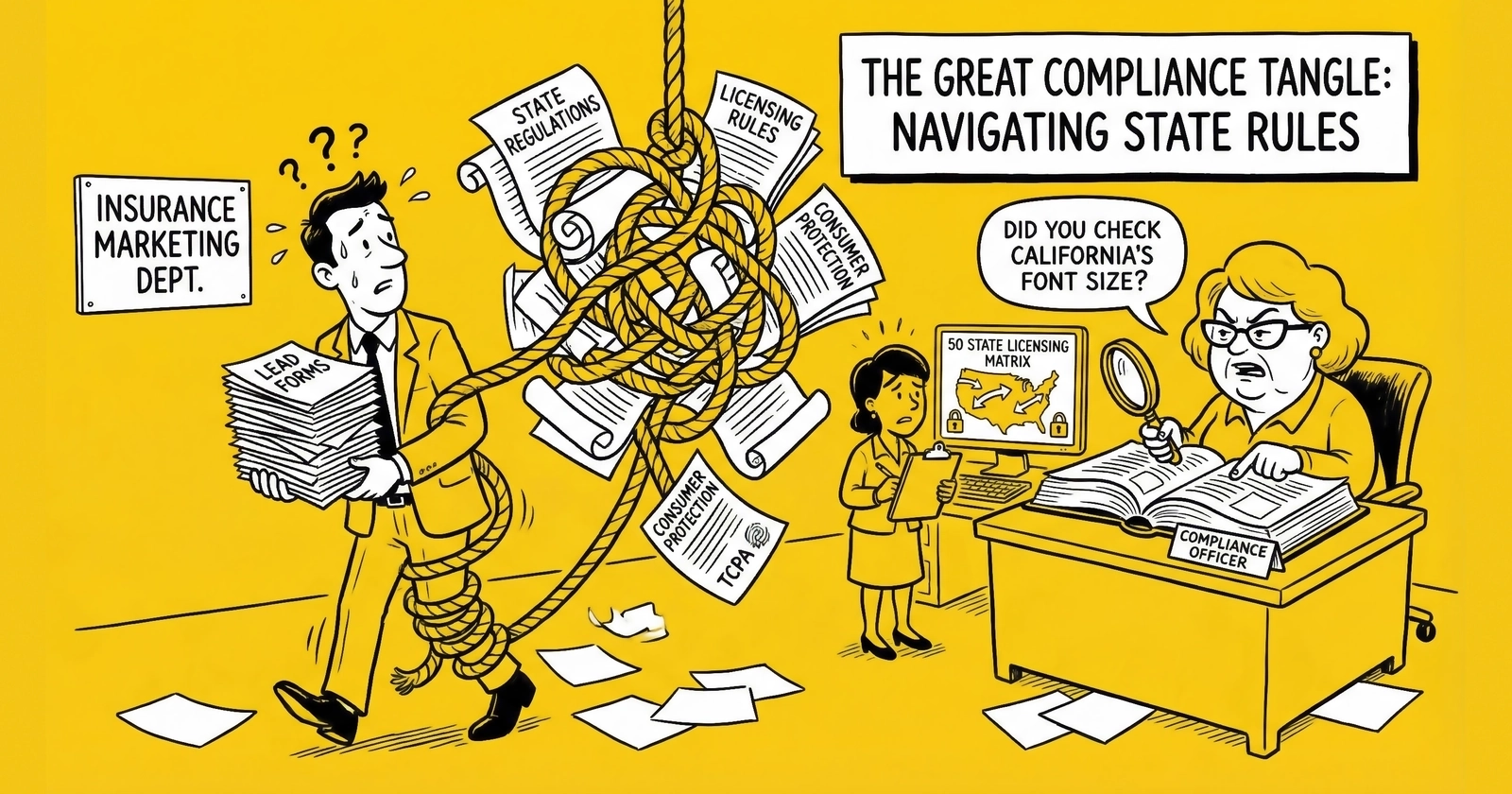
A comprehensive guide to navigating the regulatory patchwork of insurance lead generation, from producer licensing verification to the line between lead generation and solicitation. Updated for 2025 with state-by-state requirements, CMS Medicare rules, and compliance frameworks that protect your operation.
A lead generator in Arizona built a profitable insurance business generating 15,000 auto leads monthly. They sold to agents in 38 states, verified contact information, captured TrustedForm certificates, and maintained TCPA-compliant consent. By industry standards, they ran a clean operation.
Then New York happened.
The New York Department of Financial Services investigated after an agent complaint. The lead generator’s landing pages included language like “Compare rates from top carriers” and displayed carrier logos. Their scripts discussed coverage options. In most states, this was standard practice. In New York, it crossed the line from lead generation into unlicensed solicitation. The resulting investigation cost $180,000 in legal fees, required business restructuring, and forced them to exit the New York market entirely.
This is the compliance landscape for insurance lead generation. Federal TCPA rules provide a baseline, but 50 state insurance departments each interpret “solicitation” differently. What constitutes compliant lead generation in Texas may constitute unlicensed insurance activity in California. The penalties range from cease-and-desist orders to criminal referrals for unauthorized practice.
This guide provides the state-specific intelligence you need to operate compliantly across the insurance lead generation landscape. You will understand which states pose the highest regulatory risk, how to structure your operations to stay on the right side of licensing requirements, and what verification processes protect both you and your buyer relationships.
The Fundamental Question: Lead Generation vs. Solicitation
Before diving into state-specific requirements, you must understand the legal distinction that determines whether your activities require an insurance license.
What Lead Generation Is
Lead generation, in its compliant form, involves collecting consumer information and transferring it to licensed agents or carriers. You are connecting interested consumers with licensed professionals who can discuss and sell insurance products. Your role is facilitating the connection, not selling insurance.
Compliant lead generation collects basic contact information such as name, phone, email, and address while capturing general interest in insurance products or quotes. The operation transfers consumer information to licensed entities and markets the opportunity to receive quotes without recommending specific products. Throughout this process, you operate as a marketing service, not an insurance service.
What Solicitation Is
Solicitation involves actively inducing consumers to purchase insurance products. When you cross from connecting consumers with agents to influencing their insurance decisions, you enter regulated territory that requires licensing.
Activities that typically constitute solicitation include quoting specific premium amounts, recommending particular carriers or products, and comparing coverage options in ways that constitute advice. Discussing specific policy features and benefits, helping consumers evaluate which coverage meets their needs, or making representations about policy terms or costs all fall into this regulated category.
The Blurry Middle Ground
The challenge is that the line between lead generation and solicitation is not bright. Many activities fall into a gray zone where state regulators apply different interpretations.
Consider a form that asks: “What coverage level are you looking for?” followed by options like “Minimum state requirements,” “Standard coverage,” or “Full coverage with comprehensive.” Is this lead qualification or coverage advice? The answer depends on which state you ask.
Or consider a call center script that says: “Based on your driving history, you would likely qualify for our preferred rate programs.” Is this marketing language or a coverage recommendation? California might view it one way; Texas might view it differently.
The compliance-focused approach: when in doubt, stay conservative. Activities that might constitute solicitation in the strictest states should be avoided in all states unless you have specific legal guidance otherwise.
State-by-State Licensing Requirements
State insurance departments regulate insurance activity within their borders. Each department interprets “solicitation” according to its own statutes, regulations, and enforcement patterns. The following analysis covers the major markets and their regulatory approaches.
California: The Strictest Standard
California maintains among the nation’s most restrictive interpretations of what constitutes licensed insurance activity. The California Insurance Code Section 1621 defines who requires licensing, and the California Department of Insurance has applied this definition broadly to lead generation activities.
Regulatory Position
California requires anyone who “aids” in the solicitation of insurance to hold a license. The Department has interpreted “aiding” to include lead generation activities that involve detailed product discussions, steering consumers toward specific carriers, or making representations about coverage options.
Key Compliance Requirements
To operate compliantly in California, you must avoid discussing specific carriers, products, or coverage options on landing pages or in scripts. Do not display carrier logos without explicit carrier authorization and compliance review, and remove language that could be construed as recommending products – phrases like “save up to 40% with these top-rated carriers” create immediate exposure. Focus exclusively on connecting consumers with licensed agents, not on discussing insurance itself. Maintain conservative disclosure language that clearly identifies you as a lead generation service, not an insurance provider.
Enforcement Pattern
California actively investigates lead generators whose marketing materials appear to cross solicitation thresholds. Investigations typically originate from consumer complaints, carrier referrals, or competitive complaints from licensed agents. The Department has issued cease-and-desist orders and pursued civil penalties against lead generators operating without appropriate licensing.
Practical Guidance
If you generate insurance leads in California, your marketing materials, landing pages, and scripts should be reviewed by a licensed insurance producer familiar with California requirements. What works in other states may create exposure in California. Consider California the compliance baseline: if your operations pass California scrutiny, they will likely pass scrutiny elsewhere.
Texas: More Permissive Framework
Texas takes a more permissive approach to insurance lead generation, though important limitations still apply.
Regulatory Position
The Texas Department of Insurance generally allows unlicensed lead generation provided the lead generator does not provide specific insurance advice, quote premium rates, compare specific policies or carriers, or make recommendations about coverage. Lead generation that simply captures consumer interest and transfers contact information typically operates without licensing requirements.
Key Compliance Requirements
Agents receiving leads must hold valid Texas licenses for the specific line of insurance – health, auto, life, or property – matching the leads. Lead generators should verify buyer licensing status before first delivery. Marketing materials should not include specific rate quotes or carrier comparisons, and scripts should focus on qualification and information transfer rather than coverage discussions.
Enforcement Pattern
Texas enforcement has focused more on unlicensed agents than on lead generators. However, lead generators who cross into coverage discussions or who sell leads to unlicensed buyers face regulatory exposure.
Practical Guidance
Texas provides more operational flexibility than California, but prudent practitioners maintain conservative practices regardless. Verify that every buyer holds appropriate Texas licenses for their lines of business. Document your verification process.
Florida: Clear Guidance, Active Enforcement
Florida’s Office of Insurance Regulation has issued specific guidance distinguishing lead generation from solicitation, providing clarity that many states lack.
Regulatory Position
Lead generators who capture consumer interest and transfer contact information typically do not need licensing. However, call centers that discuss specific insurance products, quote rates, or help consumers compare options have crossed into licensed territory.
Key Compliance Requirements
Call center operations require particularly careful compliance review. Scripts must avoid specific product discussions, and lead forms can collect qualification information but should not provide coverage advice. Real-time transfers should connect consumers with licensed agents without lead generator staff providing coverage information.
Enforcement Pattern
Florida has pursued enforcement against lead generators operating call centers that functioned as unlicensed sales operations. The distinction often turns on whether call center staff are collecting information (compliant) or discussing coverage options (potentially unlicensed).
Practical Guidance
If you operate call centers handling Florida insurance leads, ensure staff training emphasizes the distinction between information collection and coverage discussion. Record calls for compliance monitoring. Have licensed producers review call scripts and monitor actual call content periodically.
New York: Aggressive Enforcement Stance
New York represents one of the highest-risk jurisdictions for insurance lead generation operations.
Regulatory Position
The New York Department of Financial Services has pursued enforcement actions against lead generators whose marketing materials were deemed too specific about insurance products. The Department interprets its authority broadly and has taken positions that would surprise operators accustomed to other states’ approaches.
Key Compliance Requirements
Marketing materials require exceptional care in New York. Carrier logos, rate comparisons, and specific coverage discussions create significant risk. Landing pages should focus exclusively on connecting consumers with licensed professionals, and any language that could be construed as influencing insurance decisions should be removed.
Enforcement Pattern
New York has initiated investigations based on website content alone, without requiring consumer complaints. The Department monitors advertising practices and has staff reviewing insurance-related marketing. Practitioners who assume they can fly under the radar in New York face meaningful risk.
Practical Guidance
Consider whether the New York market is worth the compliance burden. If you operate nationally, you may need New York-specific landing pages and scripts that meet the state’s stricter standards. Alternatively, some operators choose to geo-fence New York and exclude it from their operations rather than maintain dual compliance frameworks.
Other Notable State Approaches
Beyond the major markets, several states warrant specific attention.
Maryland has adopted regulatory positions similar to California’s strict approach. The Maryland Insurance Administration requires licensing for activities that could influence insurance purchasing decisions.
Connecticut requires prior approval for certain insurance advertising, which can affect lead generation materials promoting specific carriers or coverage types.
Ohio has pursued enforcement against both lead generators and attorneys who worked with them when advertising was deemed misleading, establishing that lead generation compliance issues can create liability for downstream participants.
Illinois has licensing requirements that extend to various insurance-related activities, and the Department of Insurance has investigated lead generation operations that appeared to cross solicitation thresholds.
Washington maintains active enforcement programs and has updated regulations to address digital marketing practices that previous rules did not contemplate.
Producer License Verification: Your First Line of Defense
Beyond your own compliance, you bear responsibility for the compliance of your buyer relationships. Selling leads to unlicensed buyers creates liability for both parties and exposes your entire operation to regulatory scrutiny.
Why Verification Matters
When you sell leads to an agent licensed in Florida but the leads originate from Texas consumers, that agent is operating illegally in Texas. The agent lacks authority to sell insurance to Texas residents, and the leads you provided facilitated that unlicensed activity.
State regulators have pursued enforcement against lead generators who sold leads to unlicensed buyers, viewing the lead generator as enabling unlicensed practice. Your verification process protects against these enforcement risks while also protecting buyer relationships – sophisticated buyers expect their lead sources to verify licensing.
Verification Methods
National Insurance Producer Registry (NIPR)
The NIPR provides a centralized database for producer license verification across participating states. The system allows real-time lookup of active license status, lines of authority indicating which insurance products the producer can sell, states where the producer holds licenses, license expiration dates, and appointment status with specific carriers. Most states participate in NIPR, making it the primary verification resource for multi-state operations. Access requires registration and fee payment based on verification volume.
State Insurance Department Databases
For states with limited NIPR participation or for detailed verification, state insurance department websites provide license lookup functionality. These databases typically include license status and type, lines of authority, disciplinary history, carrier appointments, and license expiration dates. State databases serve as the authoritative source but require individual queries for each state, making them less efficient for high-volume verification.
Verification Frequency
Initial verification before first lead delivery establishes baseline compliance. But licenses expire, lapse, and sometimes face disciplinary action. A buyer who was licensed when your relationship began may not remain licensed indefinitely.
The recommended verification schedule begins with initial verification before any leads are delivered, followed by quarterly re-verification for active buyers. Conduct immediate re-verification upon any indication of licensing issues, and perform an annual audit of all active buyer licenses.
Automated verification systems can integrate NIPR or state database queries into your distribution platform, preventing leads from routing to buyers with lapsed or invalid licenses. This automation eliminates human error and provides documented compliance evidence.
Line of Authority Matching
Producer licenses specify “lines of authority” indicating which insurance products the producer can sell. A health insurance license does not authorize auto insurance sales. A life insurance license does not authorize property and casualty sales.
Your verification must confirm that each buyer holds the appropriate line of authority for the leads they receive:
| Lead Type | Required Line of Authority |
|---|---|
| Auto Insurance | Property and Casualty (P&C) |
| Home Insurance | Property and Casualty (P&C) |
| Life Insurance | Life |
| Health Insurance | Health |
| Medicare | Health (often with Medicare-specific certification) |
| Commercial Insurance | Property and Casualty (P&C), often with commercial lines endorsement |
Mismatched leads create compliance exposure. An agent receiving auto leads under a health insurance license cannot legally respond to those leads, and your delivery facilitated that violation.
Medicare Lead Generation: The Strictest Framework
Medicare leads operate under federal oversight that exceeds any state-level requirements. The Centers for Medicare and Medicaid Services (CMS) regulates Medicare Advantage and Part D marketing with rules that fundamentally reshape lead generation economics.
The TPMO Framework
Third-Party Marketing Organization (TPMO) is the CMS designation for entities performing lead generation, marketing, sales, and enrollment functions for Medicare plans. If you generate Medicare leads, you likely qualify as a TPMO and face specific compliance obligations.
One-to-One Consent: The Game-Changer
Effective for Contract Year 2025, CMS requires prior express written consent before sharing beneficiary information with other TPMOs. This consent must specifically name each entity receiving the data.
The practical impact: lead aggregators who previously collected Medicare leads and distributed them through ping trees to multiple buyers face fundamental business model challenges. The blanket consent approach – “we may share your information with our network of partners” – no longer satisfies CMS requirements for Medicare leads.
Compliant Medicare consent must specifically identify each TPMO that will receive beneficiary information, obtain consent before sharing occurs, maintain documentation of consent for each specific sharing arrangement, and apply regardless of calling technology – even manual dialing requires written consent.
Call Recording Requirements
CMS mandates recording of all sales, marketing, and enrollment calls with beneficiaries. This includes both inbound and outbound calls. The requirement applies to all calls, not just those that result in enrollment.
Calls must be retained for the period specified by CMS, typically 10 years for enrollment records. Recordings must be accessible for CMS audits, and call recording systems must capture complete conversations rather than partial recordings.
Marketing Material Approval
Consumer-facing marketing materials for Medicare plans require CMS approval, typically submitted through the carrier. This includes websites promoting specific carriers or plan groups, landing pages with Medicare content, social media content about Medicare products, email and direct mail materials, and event marketing and promotional materials.
The approval process requires 30-45 days, meaning campaign launches require significant advance planning. Using non-approved materials creates compliance violations for both the lead generator and the carriers or agents purchasing those leads.
Prohibited Practices
CMS specifically prohibits certain marketing practices in Medicare lead generation. These include using terms like “free,” “limited time,” or urgency-creating language, as well as implying CMS or government endorsement. Holding marketing or sales events within 12 hours of educational events at the same location is prohibited, as is making unsolicited calls about Medicare plans. The cross-selling prohibition prevents using calls about other products as a means to generate Medicare leads.
Medicare Enrollment Period Considerations
Lead generation activity must align with Medicare enrollment periods.
Annual Enrollment Period (AEP): October 15 through December 7
This 54-day window accounts for 60-70% of annual Medicare lead volume. Marketing intensity peaks during AEP, with lead prices often doubling or tripling compared to off-season levels. All TPMO compliance requirements apply with heightened CMS monitoring.
Open Enrollment Period (OEP): January 1 through March 31
The OEP allows Medicare Advantage enrollees to make changes (Original Medicare enrollees with standalone Part D cannot switch during OEP). Marketing restrictions continue to apply, though competition and pricing are typically less intense than AEP.
Special Enrollment Periods (SEPs)
Outside AEP and OEP, Medicare leads come from consumers with qualifying life events. Year-round marketing for SEP-eligible consumers requires the same compliance framework but operates at lower volumes.
TCPA Compliance: The Federal Baseline
While state insurance licensing provides vertical-specific requirements, the Telephone Consumer Protection Act establishes federal requirements for how leads can be contacted. The TCPA framework applies regardless of state, creating a compliance floor that all insurance lead generation must satisfy.
Prior Express Written Consent (PEWC) Requirements
For telemarketing calls using automated dialing or prerecorded messages, PEWC requires written agreement (electronic signatures acceptable), clear and conspicuous disclosure of marketing purpose, consumer signature demonstrating consent, confirmation that consent is not a condition of purchase, and specific identification of the party authorized to call.
Consent Documentation Best Practices
Industry-standard consent verification uses services like TrustedForm or Jornaya to document what consumers saw and agreed to when providing consent.
TrustedForm certificates provide visual recording of the consumer’s session, documentation of consent language displayed, timestamp and IP address verification, and a certificate that can be presented in litigation.
Jornaya LeadiD provides a unique identifier tracking the lead through its lifecycle, consent documentation and compliance reporting, and behavioral intelligence about consumer shopping patterns.
Sophisticated insurance lead buyers require consent verification as a condition of purchase. Leads without TrustedForm or Jornaya documentation may face rejection or significant price discounts.
The One-to-One Consent Context
The FCC’s one-to-one consent rule, which would have required separate consent for each seller, was vacated by the Eleventh Circuit in January 2025. However, many industry participants continue implementing one-to-one consent practices for several reasons. CMS already requires one-to-one consent for Medicare leads, and state regulators may pursue similar requirements. Sophisticated buyers increasingly demand seller-specific consent, and litigation risk remains in consumer-friendly jurisdictions.
Even without a federal mandate, the industry has shifted toward more specific consent practices. Building one-to-one consent capability positions your operation for whatever regulatory developments emerge.
Revocation Rule Changes
Effective April 2025, FCC rules require honoring consent revocation requests within 10 business days through any reasonable method. Standard opt-out keywords – “STOP,” “quit,” “revoke,” “opt out,” “cancel,” “unsubscribe,” and “end” – must be honored immediately. Text messages must include clear opt-out instructions, Do Not Call requests must be honored within 10 business days, and companies cannot designate exclusive revocation methods.
These requirements apply across all lead generation, but insurance leads face particular scrutiny given the volume of TCPA litigation in the insurance vertical.
Building a Compliance Framework
Understanding requirements is step one. Implementing systems that ensure ongoing compliance is where successful operations separate from those facing enforcement risk.
Policy Development
Written policies document your compliance approach and provide evidence of compliance intent if regulatory inquiries occur.
Consent Acquisition Policy
Your consent acquisition policy should establish standards for obtaining valid consent, disclosure requirements, signature capture methods, and documentation and retention procedures.
Lead Acceptance Criteria
Lead acceptance criteria define requirements for leads acquired from third parties, consent verification mandates, age limits, and quality standards.
Buyer Verification Policy
The buyer verification policy covers initial license verification procedures, ongoing verification schedule, line of authority matching requirements, and documentation of verification activities.
Marketing Material Review Policy
Your marketing material review policy establishes the review process before materials launch, compliance review by licensed producers, and state-specific considerations for high-risk jurisdictions.
Training Programs
Compliance depends on people executing correctly.
Initial Training
Initial training covers the legal framework overview, company-specific policies and procedures, role-specific requirements, and documentation requirements.
Ongoing Training
Ongoing training includes annual refresher training, updates when regulations change, and supplemental training after compliance incidents.
Documentation
Training documentation should include training dates and content covered, personnel who received training, assessment results, and acknowledgment of policy receipt.
Monitoring and Audit
Compliance requires ongoing verification, not one-time implementation.
Real-Time Monitoring
Real-time monitoring includes DNC suppression before calls or messages, consent verification before lead delivery, time-of-day enforcement based on recipient time zone, and license verification before buyer routing.
Periodic Audits
Periodic audits encompass quarterly review of marketing materials against state requirements, monthly verification of buyer license status, regular review of call recordings for script compliance, and annual comprehensive compliance audit.
Exception Monitoring
Exception monitoring tracks blocked call attempts to identify list quality issues, investigates consumer complaints, and monitors for patterns suggesting system failures or policy violations.
Technology Solutions
Compliance technology provides systematic protection against human error and documented evidence of compliance efforts.
Consent Verification
TrustedForm and Jornaya have become industry-standard for insurance lead generation. Integration typically costs $0.15-0.50 per lead but provides litigation protection worth orders of magnitude more.
License Verification
Automated systems integrating NIPR or state databases prevent leads from routing to unlicensed buyers. The automation eliminates manual verification delays and provides audit trails.
Call Recording
Dialing platforms should capture all calls for compliance verification and litigation defense. Retention should extend at least five years, beyond the four-year TCPA statute of limitations.
Suppression Services
DNC suppression services such as DNCScrub and DNC.com provide registry screening and compliance documentation. Litigator suppression lists including Litigator Scrub and TCPA Litigator List help identify serial plaintiffs. Properly maintaining your internal DNC lists is equally critical.
Compliance Costs and ROI
Compliance requires investment. Understanding the cost structure helps you budget appropriately and recognize compliance as competitive advantage rather than pure expense.
Estimated Annual Compliance Costs
For a mid-sized insurance lead generation operation generating 10,000-50,000 leads monthly:
| Category | Annual Cost Range | Notes |
|---|---|---|
| Legal counsel (specialized) | $15,000-40,000 | Review of materials, regulatory monitoring, enforcement response |
| Consent verification services | $18,000-60,000 | TrustedForm/Jornaya at scale |
| License verification systems | $5,000-15,000 | NIPR access, automation tools |
| Compliance personnel | $40,000-80,000 | Dedicated compliance staff or fractional role |
| Training and documentation | $5,000-10,000 | Development and delivery of training programs |
| Audit and monitoring | $10,000-25,000 | Internal audit time, periodic external review |
| Total | $93,000-230,000 | Varies by scale and complexity |
The ROI Calculation
A single TCPA violation carries $500-1,500 in statutory damages. A class action affecting 10,000 leads creates potential exposure of $5-15 million before legal fees. Average TCPA settlements exceed $6.6 million.
Insurance license violations add regulatory penalties, business disruption, and potential market exclusion.
Against these risks, annual compliance investments of $100,000-200,000 provide meaningful protection. If proper compliance infrastructure prevents even one major enforcement action over a 10-year period, the investment delivers returns exceeding 10x.
Beyond risk mitigation, compliance creates competitive advantage through access to sophisticated buyers who require compliance verification, ability to operate in high-value but regulated markets like Medicare and New York, protection of buyer relationships through verified practices, and barrier to entry protecting against unsophisticated competitors.
Key Takeaways
-
The line between lead generation and solicitation determines licensing requirements. Compliant lead generation collects information and connects consumers with licensed agents; solicitation provides coverage advice that requires licensing.
-
State requirements vary dramatically. California applies the strictest interpretation, requiring licensing for anyone who “aids” in solicitation. Texas takes a more permissive approach. New York aggressively enforces against marketing materials deemed too specific.
-
Producer license verification is mandatory for compliant operations. Verify licenses before first delivery, re-verify quarterly, and confirm line of authority matches lead type. Use NIPR for efficient multi-state verification.
-
Medicare leads face the strictest federal framework through CMS rules. One-to-one consent, call recording, and marketing material approval requirements exceed any state-level obligations.
-
TCPA compliance provides the federal baseline. Consent documentation through TrustedForm or Jornaya has become industry-standard. The April 2025 revocation rules require 10-business-day response to opt-out requests.
-
Compliance costs represent investment, not expense. Annual compliance budgets of $100,000-200,000 for mid-sized operations provide protection against enforcement risks that can reach millions of dollars.
-
Conservative compliance creates competitive advantage. Operating to the strictest state standards (California’s approach) positions you to operate nationally without state-specific concerns.
Frequently Asked Questions
Do insurance lead generators need to be licensed?
In most states, lead generators who simply collect consumer information and transfer it to licensed agents do not need insurance licenses. However, the definition of “lead generation” versus “solicitation” varies by state. Activities that cross into coverage discussions, rate quotations, or product recommendations may require licensing. California, New York, and Maryland apply the strictest interpretations. Conservative practitioners maintain practices that satisfy the strictest state requirements regardless of where they operate.
How do I verify that my buyers are properly licensed?
Use the National Insurance Producer Registry (NIPR) for efficient multi-state verification, or query individual state insurance department databases. Verification should occur before first lead delivery, with quarterly re-verification for active buyers. Confirm that licenses are active, cover the appropriate line of authority (auto, health, life, etc.), and include the states where leads originate. Document all verification activities with date-stamped records.
What happens if I sell leads to an unlicensed agent?
Selling leads to unlicensed buyers creates liability for both parties. State regulators can pursue enforcement against lead generators for enabling unlicensed practice. You may face cease-and-desist orders, civil penalties, and potential exclusion from state markets. Beyond regulatory exposure, selling to unlicensed buyers creates buyer relationship problems when those buyers face enforcement. Verification processes protect you, protect buyers, and demonstrate compliance intent to regulators.
How are Medicare leads different from other insurance leads?
Medicare leads face federal CMS oversight in addition to state insurance regulations. Key differences include: one-to-one consent requirements (each TPMO receiving beneficiary information must be specifically named in consent), mandatory call recording for all beneficiary interactions, CMS approval requirements for marketing materials, and prohibitions on urgency language and unsolicited calls. Medicare compliance requires specialized infrastructure and typically costs 50-100% more than general insurance lead compliance.
What consent documentation do I need for insurance leads?
Industry-standard consent documentation uses third-party verification services like TrustedForm or Jornaya. These services document what consumers saw, when they consented, and what disclosures were displayed. Sophisticated buyers require TrustedForm certificates or Jornaya LeadiDs as a condition of purchase. Beyond third-party verification, retain consent timestamps, IP addresses, page URLs, and the specific disclosure language displayed. Retention should extend at least five years to cover the four-year TCPA statute of limitations plus buffer.
Can I use the same landing pages in all 50 states?
Technically yes, but state-specific compliance risks may warrant geographic variation. Landing pages that satisfy California and New York requirements will generally work nationwide. However, pages with carrier comparisons, coverage discussions, or rate-related language may need state-specific versions or geographic exclusions for high-risk states. Some operators maintain separate “conservative” pages for California/New York and “standard” pages for other states. Others apply the strictest standards universally to simplify compliance.
How often do insurance regulations change?
State insurance regulations evolve continuously, though major changes typically occur with annual legislative sessions or commissioner turnover. CMS Medicare rules update annually with final rules published each spring for the following contract year. TCPA and FCC rules change less frequently but can shift with administration changes. Operators should monitor regulatory developments through industry associations (Performance Marketing Association, industry legal counsel bulletins), state insurance department announcements, and CMS updates. Annual compliance audits should incorporate regulatory changes from the preceding year.
What are the penalties for insurance lead compliance violations?
Penalties vary by jurisdiction and violation type. TCPA violations carry $500-1,500 per violation with no aggregate cap, meaning class actions can reach tens or hundreds of millions in potential exposure. State insurance violations can include cease-and-desist orders, civil penalties ranging from $1,000 to $50,000 or more per violation, license revocation (for licensed entities), and potential criminal referral for unauthorized practice. CMS Medicare violations can include civil monetary penalties up to $100,000 per violation, suspension of marketing or enrollment activities, and contract termination. The cumulative exposure from compliance failures can easily exceed the entire value of a lead generation operation.
Should I hire a compliance officer or use outside counsel?
The answer depends on your scale and complexity. Operations generating under 10,000 leads monthly can often manage with outside counsel for periodic review, compliance audits, and enforcement response. Operations above 25,000 leads monthly typically benefit from dedicated in-house compliance personnel who can manage day-to-day operations, training, and monitoring. Many mid-sized operations use a hybrid model: fractional or part-time in-house compliance staff for routine operations, with specialized outside counsel for regulatory interpretation, material review, and enforcement response. Medicare-focused operations almost always require dedicated compliance personnel given the framework’s complexity.
How do I handle multi-state lead generation compliance?
Build your operation to satisfy the strictest state requirements, then you can operate nationally without state-specific concerns. California’s requirements provide a reasonable baseline since their interpretation of “aiding in solicitation” is among the strictest. Alternatively, implement state-specific logic that applies different rules to different markets: conservative pages for California/New York/Maryland, standard pages elsewhere, and exclusions for markets that do not justify compliance investment. Ensure buyer verification includes state-level license confirmation and line of authority matching. Document which states you serve and maintain records of compliance considerations for each.
Resources and Further Reading
Regulatory Bodies:
- National Association of Insurance Commissioners (NAIC): Model regulations and state coordination
- National Insurance Producer Registry (NIPR): Producer license verification
- Centers for Medicare and Medicaid Services (CMS): Medicare marketing guidelines
Compliance Technology:
- TrustedForm (ActiveProspect): Consent documentation and verification
- Jornaya (Verisk): Lead intelligence and compliance solutions
- DNCScrub (Contact Center Compliance): DNC registry suppression
Industry Resources:
- Performance Marketing Association: Industry advocacy and compliance guidance
- TCPAWorld (Troutman Amin): TCPA litigation monitoring and analysis
- State insurance department websites: License lookup and regulatory bulletins
Sources
- National Association of Insurance Commissioners (NAIC) - Model regulations and state coordination for insurance licensing requirements
- National Insurance Producer Registry (NIPR) - Producer license verification database for multi-state compliance
- CMS Medicare Marketing Guidelines - Federal regulations governing Medicare lead generation and TPMO requirements
- California Department of Insurance - State regulations on producer licensing and solicitation definitions
- New York Department of Financial Services - State insurance regulatory guidance and enforcement
- TrustedForm by ActiveProspect - Consent documentation platform for TCPA compliance verification
- Verisk (Jornaya) - Lead intelligence and compliance solutions for consent tracking
Regulatory information current as of late 2025. Insurance regulations evolve continuously. Consult qualified legal counsel familiar with your specific operating states before implementing compliance programs.