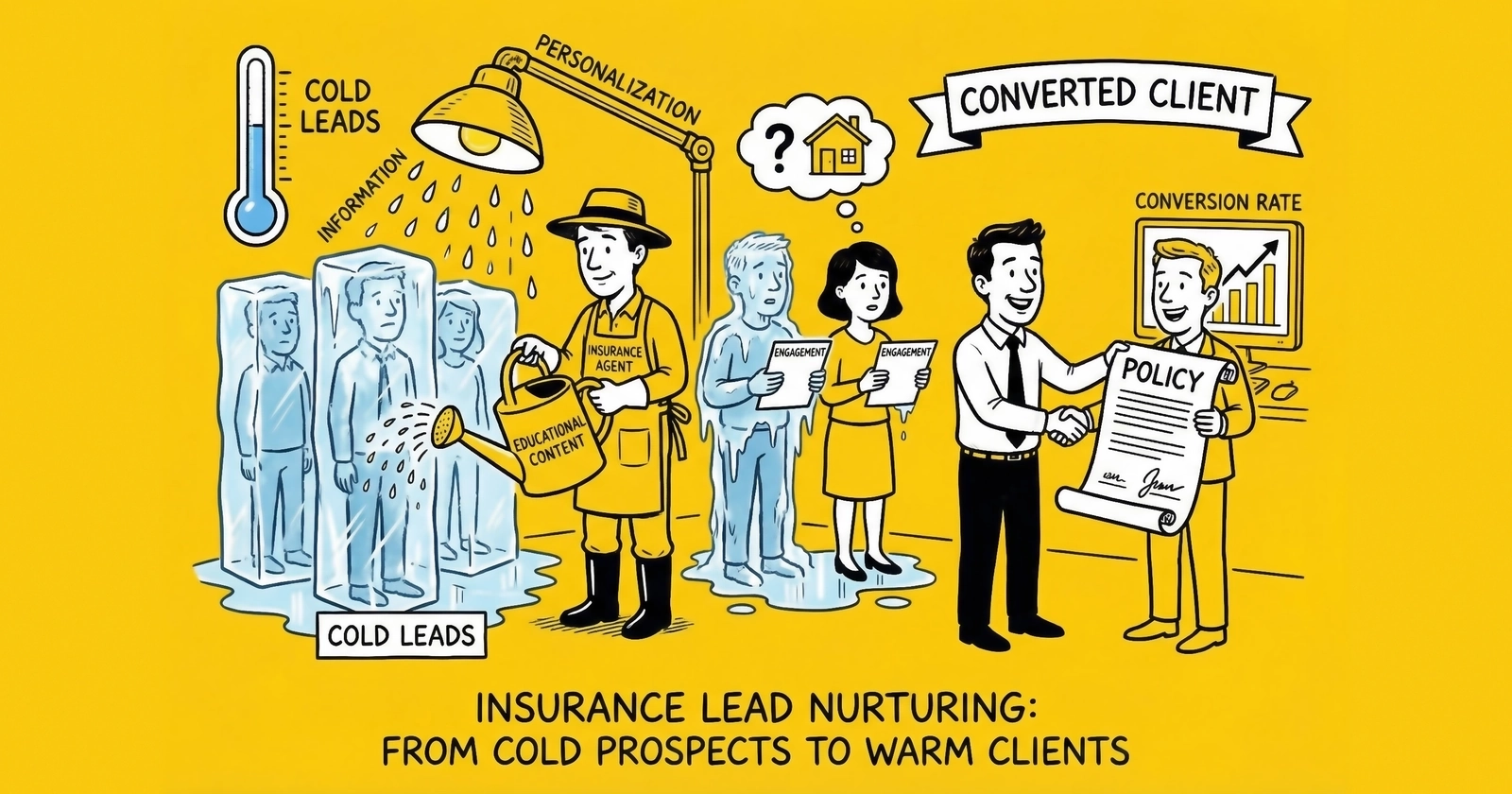
A comprehensive guide to transforming aged insurance leads into paying customers through strategic nurturing systems.
Introduction: The Untapped Value in Your Lead Database
Every insurance agency and carrier sits on a goldmine they systematically ignore: the leads that did not convert on first contact.
These leads represent significant acquisition investment. An auto insurance lead costs $15-75 at purchase. A Medicare lead during Annual Enrollment Period can exceed $150. A home insurance lead runs $20-100. When these leads do not convert immediately, most operations write them off as sunk costs and chase the next batch of fresh inventory.
This is a strategic error that costs the insurance industry billions annually.
The mathematics of lead nurturing tell a different story than the “speed or nothing” mentality that dominates industry thinking. While it is absolutely true that leads contacted within one minute convert 391% better than those contacted later, and 78% of customers purchase from the first responder, these statistics describe first-contact dynamics. They do not account for the substantial percentage of consumers who were not ready to buy at the moment of initial contact but will purchase insurance within the next 30, 60, or 90 days.
Research from the insurance industry indicates that only 25-35% of consumers who request insurance quotes purchase within the first week. The remaining 65-75% either purchase later from someone who stayed in touch, purchase from a competitor who reached them at the right moment, or delay their decision entirely. A systematic nurturing approach captures a meaningful portion of this deferred demand.
This article provides a comprehensive framework for building insurance lead nurturing systems that convert cold leads into customers. We will cover the psychology of insurance buying decisions, multi-channel nurturing sequences, compliance requirements specific to insurance communications, technology infrastructure, measurement frameworks, and tactical execution across auto, home, life, health, and Medicare verticals.
Those who master lead nurturing build sustainable competitive advantage. While competitors fight over the same fresh lead inventory with increasingly compressed margins, nurturing-capable operations extract additional value from every lead they purchase. This efficiency compounds over time, creating cost structures that less sophisticated competitors cannot match.
Understanding the Insurance Buying Psychology
Before designing nurturing systems, you must understand why consumers who requested insurance quotes did not purchase immediately. The reasons are not random, and effective nurturing addresses each barrier systematically.
The Consideration Cycle
Insurance purchases follow predictable psychological patterns that differ by product type and consumer circumstance.
Auto insurance consumers typically shop when triggered by external events: rate increases from their current carrier, policy renewal notices, life changes like moving or adding a driver, or vehicle purchases. The shopping window is compressed but not instantaneous. Industry data suggests auto insurance shoppers compare an average of 4-6 quotes before purchasing, a process that can take days to weeks depending on urgency.
Home insurance shopping correlates heavily with real estate transactions, where timing is often dictated by closing schedules rather than consumer preference. Outside of home purchases, shopping typically follows rate increases, claim experiences, or major home improvements. The consideration cycle is longer than auto, often 2-4 weeks.
Life insurance presents the longest consideration cycle. The product requires consumers to contemplate their mortality, assess their financial obligations, and often undergo medical underwriting. Many consumers request quotes months before purchasing, as they work through both emotional and practical considerations. Industry research indicates that life insurance purchase decisions often take 60-90 days from initial inquiry to policy issuance.
Health insurance and Medicare operate on regulatory calendars that dictate timing. The Annual Enrollment Period (October 15 through December 7 for Medicare) creates concentrated shopping windows where urgency is high but decision complexity is also elevated. Consumers who request quotes early in enrollment periods often need time to compare options before committing.
Barriers to Immediate Purchase
Understanding why consumers pause helps you design nurturing content that addresses their specific concerns.
Information gathering phase. Many consumers request quotes as part of research, not as a precursor to immediate purchase. They are comparing prices, understanding coverage options, or simply getting educated. These consumers need information, not sales pressure.
Competing priorities. Insurance is rarely the most urgent item on a consumer’s agenda. Work deadlines, family obligations, and daily life frequently interrupt the buying process. Consumers who were ready to buy at 2 PM may be unreachable by 3 PM and have mentally moved on by the next day.
Decision complexity. Insurance products involve tradeoffs between coverage levels, deductibles, and premiums that many consumers find confusing. Rather than make a decision they are uncertain about, they delay. This delay creates an opportunity for educational nurturing that builds confidence.
Price shopping without urgency. Some consumers request quotes to validate their current coverage is fairly priced, with no immediate intention to switch. If your quote comes in higher than their current policy, they file the information away. If it comes in lower, they may still not switch immediately due to inertia. Nurturing maintains the connection until something triggers action.
Bad timing of initial contact. The consumer was in a meeting, driving, or otherwise unavailable when your agent called. They intended to call back but never did. This is not rejection; it is simple logistics that nurturing can overcome.
The Trust Development Process
Insurance is a trust-based product. Consumers are making promises to pay premiums in exchange for promises of protection they hope never to need. This trust does not develop instantaneously for most consumers.
Nurturing sequences build trust through consistent, valuable communication over time. Each touchpoint that provides useful information without aggressive sales pressure deposits into a trust account. When the consumer is ready to buy, they purchase from the entity they trust, which is often the one that stayed professionally present without becoming annoying.
Research on insurance consumer behavior indicates that brand familiarity significantly impacts carrier selection. For consumers comparing similar prices, familiarity often becomes the deciding factor. Nurturing creates familiarity in a controlled, professional manner.
The Multi-Channel Nurturing Framework
Effective insurance lead nurturing operates across multiple channels, each serving specific purposes in the consumer journey. Single-channel approaches consistently underperform multi-channel strategies in conversion rate studies.
Email: The Backbone of Nurturing
Email remains the primary nurturing channel due to its low cost, high deliverability, and ability to convey detailed information. However, email effectiveness varies significantly based on execution quality.
Deliverability fundamentals. Before designing email sequences, ensure your sending infrastructure supports deliverability. Use authenticated domains (SPF, DKIM, DMARC), maintain clean lists by removing bounces and unengaged addresses, and warm new sending domains gradually. Industry benchmarks show insurance email open rates averaging 15-25%, but poorly configured senders may see rates below 10% while optimized senders exceed 30%.
Sequence design for insurance. Insurance nurturing emails should follow a clear progression from educational content to soft offers to direct calls to action. A typical sequence might include:
- Day 1: Value-add content related to their quoted product (understanding coverage options, common mistakes to avoid)
- Day 3: Educational comparison content (what to look for when comparing policies)
- Day 7: Soft reminder with additional value (seasonal insurance tips, life event considerations)
- Day 14: Direct reminder about their quote with any updated information
- Day 21: Final opportunity messaging before moving to maintenance cadence
- Ongoing monthly: Newsletter-style content that maintains relationship without sales pressure
Subject line optimization. Insurance email subject lines face unique challenges. Spam filters are tuned to catch insurance solicitations, and consumers have developed resistance to obvious sales messaging. Testing shows that informational subject lines outperform promotional ones for nurturing sequences. “Understanding your auto insurance deductible options” outperforms “Your quote is waiting - save 20% today” in both open rates and downstream conversion.
Content personalization. Effective nurturing emails reference the specific product the consumer quoted, their location (for state-specific regulations and carrier availability), and any information gathered during initial contact. Generic emails perform significantly worse than personalized communications.
SMS and Text Messaging
Text messaging offers immediate deliverability and high open rates (industry averages exceed 90%) but requires careful compliance management and content optimization.
Compliance requirements. SMS marketing to insurance leads requires Prior Express Written Consent (PEWC) under TCPA regulations. Your lead capture forms must include clear disclosure that the consumer agrees to receive text messages at the provided number, and this consent must be documented with technologies like TrustedForm or Jornaya. Non-compliant text messaging exposes your operation to TCPA liability of $500-$1,500 per message, making compliance infrastructure non-negotiable.
SMS content strategy. Text messages should be brief, valuable, and include clear calls to action. Effective insurance nurturing texts include:
- Appointment reminders and confirmations
- Quote expiration notifications
- Market updates relevant to their situation (rate changes, new product availability)
- Simple check-ins asking if they have questions
- Requests to schedule calls at their convenience
Timing considerations. Text messaging faces stricter timing requirements than email in many states. Federal TCPA rules prohibit calls and texts before 8 AM or after 9 PM in the consumer’s time zone, but several states have narrower windows. California restricts marketing texts to 8 AM - 8 PM. Florida requires 8 AM - 8 PM for calls. Before implementing SMS nurturing, verify your operation can respect state-specific timing requirements.
Phone Outreach in Nurturing Sequences
While initial speed-to-contact determines first-contact success, strategic phone outreach throughout the nurturing cycle significantly impacts overall conversion.
Structured call sequences. Rather than random follow-up calls, implement structured outreach patterns. Industry research suggests optimal contact attempt patterns include:
- 6-8 contact attempts total for aged leads
- Varied timing across morning, afternoon, and early evening
- Mixed days of the week (avoiding Monday-only or Friday-only patterns)
- Voicemail on every attempt with varied messages
Voicemail strategy. Voicemails are often overlooked in lead nurturing, but they serve an important function: keeping your name and offer present in the consumer’s awareness. Effective insurance voicemails are brief (under 30 seconds), reference a specific reason for calling, provide value rather than pure sales pressure, and include a callback number.
Call disposition tracking. Document every call attempt outcome: no answer, voicemail left, wrong number, contact but not interested, contact but not ready, contact and interested, contact and converted. This data enables optimization of call timing, message effectiveness, and sequence length.
Direct Mail for High-Value Segments
Physical mail has experienced a renaissance in insurance marketing as digital channels become increasingly crowded. For high-value leads (life insurance, high-premium home insurance, Medicare), direct mail can provide meaningful lift.
Cost-effective targeting. Direct mail costs make blanket deployment prohibitive, but targeted mailings to specific segments can be highly effective. Consider direct mail for:
- Leads who engaged with emails but have not converted
- High estimated policy value leads (expensive homes, multiple vehicles)
- Life insurance leads over 45 (demographic research shows higher mail engagement)
- Medicare leads during enrollment periods
Content approach. Insurance direct mail performs best when it provides tangible value: comparison worksheets, coverage checklists, or educational content that the recipient will keep rather than immediately discard. Include clear response mechanisms (phone number, dedicated URL, QR code) and track response rates by mail piece variation.
Building the Nurturing Technology Stack
Effective lead nurturing requires technology infrastructure that automates sequences, tracks engagement, manages compliance, and enables continuous optimization. Building this infrastructure before scaling nurturing efforts prevents expensive remediation later.
CRM Requirements
Your Customer Relationship Management system serves as the operational backbone of nurturing. Essential CRM capabilities for insurance lead nurturing include:
Lead lifecycle tracking. The CRM must track each lead’s journey from acquisition through conversion or final disposition. This includes source attribution, all contact attempts, engagement signals (email opens, link clicks, call outcomes), and status changes.
Automated workflow triggers. Nurturing sequences should fire automatically based on lead status changes, time delays, and engagement behaviors. Manual sequence management does not scale and introduces inconsistency. The CRM should support complex conditional logic: “If lead opened email 2 but did not respond to email 3, and it has been 5 days since last call attempt, trigger call sequence B.”
Multi-channel orchestration. The CRM must coordinate activity across email, SMS, phone, and any other channels in your nurturing mix. Channel-specific tools that do not communicate create fragmented customer experiences and compliance risks.
Compliance documentation. Every consumer interaction must be logged with timestamps, content delivered, and consent verification. This documentation becomes essential if compliance questions arise. Many CRMs integrate with TrustedForm and Jornaya to attach consent certificates directly to lead records.
Email Platform Selection
Insurance-specific email requirements include:
Deliverability management. Insurance emails face elevated spam filtering. Choose platforms with strong deliverability track records and proactive reputation management. SendGrid, Mailchimp, and HubSpot all offer robust deliverability tools, but implementation quality matters more than platform selection.
Automation capabilities. Your email platform must support complex drip sequences with branching logic, engagement-based triggers, and dynamic content insertion. Basic autoresponders are insufficient for sophisticated nurturing.
Suppression management. The platform must respect unsubscribe requests immediately and globally, integrate with your internal do-not-contact lists, and support CAN-SPAM compliance automatically.
Dialer and Phone Integration
Phone outreach at scale requires power or predictive dialing capabilities integrated with your CRM.
Dialer compliance features. Ensure your dialer supports DNC list scrubbing (both federal and state registries), calling hour restrictions by time zone, and litigator database screening. Non-compliant dialing exposes you to TCPA liability that can exceed the value of your entire lead database.
Recording and documentation. All outbound calls should be recorded for quality assurance and compliance documentation. These recordings provide evidence of proper disclosure and consent practices if disputes arise.
Local presence dialing. Technology that displays local area codes on outbound calls can significantly improve contact rates. Consumers are more likely to answer calls from familiar area codes. However, this technology must be implemented compliantly; falsely displaying numbers you do not own violates federal law.
Analytics and Reporting
Nurturing optimization requires granular analytics:
Sequence performance metrics. Track conversion rates, engagement rates, and time-to-conversion for each nurturing sequence. Identify which sequences, messages, and channels perform best for which lead segments.
Channel attribution. Understand which touchpoints contribute to conversion. A consumer who converts after a phone call may have been influenced by preceding emails. Multi-touch attribution provides visibility into these dynamics.
Cohort analysis. Compare performance across lead cohorts by acquisition source, acquisition date, product type, and demographic characteristics. This analysis reveals which lead segments respond best to nurturing and which may not be worth the investment.
Insurance-Specific Nurturing Strategies by Vertical
While nurturing principles apply broadly, each insurance vertical has specific characteristics that inform strategy optimization.
Auto Insurance Nurturing
Auto insurance leads present the highest volume opportunity but also the most competitive landscape.
Competitive intelligence. Many auto insurance consumers are shopping based on price comparison. Nurturing content that helps consumers understand what affects their rates (driving record impact, credit score factors, coverage level tradeoffs) positions your agency as an advisor rather than just another quote source.
Rate change triggers. Monitor for announcements of rate increases from major carriers. When a competitor announces increases, nurturing campaigns can reference this news: “Rates are changing across the industry. Let us make sure you are still getting the best value.” This positions your outreach as helpful rather than purely sales-driven.
Policy renewal timing. If you captured policy renewal date during lead acquisition, nurture sequences can intensify as renewal approaches. A consumer who was not ready to switch in March may be very ready when their July renewal arrives, particularly if your nurturing has maintained the relationship.
Multi-policy opportunities. Auto insurance leads often represent opportunities for bundling. Nurturing content can introduce home, renters, or umbrella coverage options, expanding the potential lifetime value of converted leads.
Home Insurance Nurturing
Home insurance nurturing requires understanding the connection between home insurance and real estate transactions.
Transaction timeline alignment. Leads from home buyers have specific timeline pressures. If you know their closing date, sequence timing should intensify as closing approaches. Lenders require proof of insurance before closing, creating a hard deadline that focuses consumer attention.
Coverage education focus. Many homeowners are underinsured without realizing it. Nurturing content about replacement cost versus actual cash value, flood insurance requirements, and coverage gaps creates value while positioning your agency as a knowledgeable advisor.
Seasonal content. Home insurance nurturing should include seasonal preparedness content: hurricane preparation in coastal areas, winterization in northern regions, wildfire preparation in western states. This content provides genuine value while maintaining your presence.
Life event triggers. Major home improvements, new construction in the neighborhood (indicating rising values), and family changes all create insurance reassessment opportunities. Nurturing content that helps consumers understand how life changes affect their coverage needs generates engagement.
Life Insurance Nurturing
Life insurance requires the most patient nurturing approach due to extended consideration cycles and emotional complexity.
Educational content emphasis. Many life insurance leads come from consumers who do not fully understand their coverage needs. Nurturing sequences should educate on term versus permanent insurance, coverage amount calculation, and underwriting processes. This education builds confidence to purchase.
Needs assessment tools. Interactive content that helps consumers calculate their coverage needs generates engagement while qualifying the lead further. A consumer who completes a needs assessment understands their situation better and is more likely to purchase appropriate coverage.
Beneficiary and estate planning. Life insurance connects to broader financial planning. Nurturing content that addresses beneficiary designation, integration with estate plans, and tax implications positions your agency as a comprehensive resource.
Medical underwriting preparation. For leads who expressed interest but did not complete the application process, nurturing content about what to expect from medical underwriting reduces anxiety and encourages completion. Many consumers abandon life insurance applications due to uncertainty about the process.
Health and Medicare Nurturing
Health insurance nurturing operates under stricter regulatory requirements and calendar-driven enrollment periods.
CMS compliance for Medicare. Third-Party Marketing Organizations (TPMOs) must comply with CMS regulations that exceed TCPA requirements. The one-to-one consent rule effective October 1, 2024 requires separate explicit authorization for each organization that will receive beneficiary information. Nurturing communications must use CMS-approved materials and include required disclaimers.
Enrollment period optimization. Medicare nurturing must account for Annual Enrollment Period (October 15 through December 7) and Open Enrollment Period (January 1 through March 31). Lead nurturing sequences should intensify as enrollment windows approach and may need to pause during blackout periods.
Plan comparison assistance. Medicare beneficiaries often feel overwhelmed by plan options. Nurturing content that simplifies comparison (drug formulary checking, network coverage, premium versus out-of-pocket tradeoffs) provides substantial value.
Agent relationship building. Medicare decisions often involve family members and caregivers. Nurturing content that is shareable and explains options clearly helps your agency become the trusted resource for the entire family’s Medicare decisions.
Aged Lead Strategies: Converting the Unconverted
Aged leads, those more than 30 days from original inquiry, require specialized approaches that differ from fresh lead handling.
Aged Lead Economics
Aged insurance leads price at 5-20% of fresh lead costs, creating dramatically different economics:
| Lead Age | Typical Pricing | Expected Conversion Rate |
|---|---|---|
| 0-7 days | 80-100% of fresh | 15-20% |
| 7-30 days | 40-60% of fresh | 10-15% |
| 30-60 days | 10-20% of fresh | 6-10% |
| 60-90 days | 5-10% of fresh | 4-8% |
| 90+ days | 2-5% of fresh | 2-5% |
While conversion rates are lower, the dramatically reduced acquisition costs can make aged leads more profitable per dollar spent than fresh leads. A $3 aged lead converting at 6% produces sales at $50 cost per acquisition. A $50 fresh lead converting at 15% produces sales at $333 cost per acquisition.
Rework Strategy for Aged Leads
Approaching aged leads requires different tactics than fresh lead handling:
Acknowledge the time gap. Do not pretend the lead is fresh. Opening with “I am following up on the insurance information you requested some time ago” is more honest and effective than fresh-lead scripts.
Lead with value, not urgency. Aged lead scripts should not create artificial urgency. Instead, offer genuine value: “I wanted to check if you were able to find the coverage you were looking for, or if I can still help.”
Expect changed circumstances. A meaningful percentage of aged leads will have already purchased insurance, moved, changed their vehicle situation, or otherwise changed their needs. Qualifying questions should identify these changes early to avoid wasting time on unconvertible contacts.
Longer, more persistent sequences. Aged lead nurturing should include more touchpoints over longer timeframes than fresh lead sequences. The consumer has already demonstrated they are not impulsive buyers; patience is required.
Data Hygiene for Aged Leads
Lead data degrades over time. Before investing significant nurturing resources in aged leads:
Phone validation. Check phone numbers against current carrier databases to verify they remain active and assigned. Expect 3-5% monthly degradation in phone validity.
Email verification. Run aged email addresses through deliverability verification services. Sending to invalid addresses damages your sender reputation.
Address validation. For leads where you may send direct mail, verify addresses remain valid and the individual still resides there.
Deduplication. Aged lead databases often contain duplicates from multiple purchase points. Deduplicate before nurturing to avoid annoying the same consumer with multiple simultaneous sequences.
Compliance Framework for Insurance Lead Nurturing
Insurance lead nurturing operates under multiple overlapping regulatory frameworks. Non-compliant nurturing can generate liability that exceeds the lifetime value of every lead in your database.
TCPA Requirements
The Telephone Consumer Protection Act governs calls and text messages to consumers:
Prior Express Written Consent. Telemarketing calls and texts to cell phones require PEWC, which must be documented and retained. Your consent language must clearly identify the specific seller(s) authorized to contact the consumer and describe the types of communications they will receive.
Calling hours. Federal TCPA restricts calls to 8 AM - 9 PM in the consumer’s time zone. Many states impose stricter requirements. Your systems must determine consumer time zones and enforce appropriate restrictions.
Do Not Call compliance. You must scrub against the National DNC Registry, state DNC lists, and your internal DNC list before each contact attempt. Consumers who request to be removed must be suppressed within 30 days federally, with some states requiring faster compliance.
Litigator scrubbing. Serial TCPA litigators have made filing claims a business model. Scrub your call lists against litigator databases before outreach. A single call to a professional plaintiff can result in litigation costs exceeding the value of thousands of converted leads.
CAN-SPAM Requirements
Commercial email must comply with CAN-SPAM Act requirements:
Clear identification. Emails must clearly identify the sender and include valid physical postal address.
Honest subject lines. Subject lines must not be deceptive or misleading about the content of the message.
Unsubscribe mechanism. Every commercial email must include a clear, conspicuous mechanism for opting out of future messages.
Prompt unsubscribe processing. Unsubscribe requests must be honored within 10 business days.
State Insurance Regulations
Insurance marketing faces additional regulation at the state level:
Licensing requirements. In most states, anyone soliciting insurance or providing coverage advice must hold appropriate licenses. Lead nurturing that crosses from general information into specific recommendations may trigger licensing requirements.
Advertising rules. Many states require approval of marketing materials or specific disclosures in insurance advertising. Review your nurturing content against applicable state advertising regulations.
Medicare-specific requirements. CMS imposes substantial additional requirements on Medicare marketing, including creative approval requirements, specific disclaimer language, and restrictions during certain periods.
Documentation and Retention
Maintain documentation that proves compliant operations:
Consent records. Retain consent certificates (TrustedForm, Jornaya) for at least five years, beyond the TCPA four-year statute of limitations.
Contact records. Document every contact attempt with timestamp, method, content delivered, and outcome.
Suppression records. Maintain records of when consumers were added to suppression lists and the reason for suppression.
Training records. Document staff training on compliance requirements and refresher training.
Measuring Nurturing Performance
Effective measurement enables continuous optimization and justifies ongoing investment in nurturing infrastructure.
Key Performance Indicators
Track these metrics across your nurturing programs:
Sequence conversion rate. The percentage of leads entering a nurturing sequence who eventually convert. This is your primary outcome metric.
Time to conversion. How long leads spend in nurturing before converting. Understanding this timeline informs sequence length decisions.
Engagement rates by channel. Email open rates, click rates, SMS response rates, call answer rates. These leading indicators predict downstream conversion.
Cost per nurture-converted lead. Total nurturing program costs (technology, labor, communication costs) divided by conversions. Compare to fresh lead acquisition costs.
Sequence exit reasons. Track why leads exit sequences: converted, unsubscribed, marked unqualified, completed sequence without converting. High unsubscribe rates may indicate overly aggressive messaging.
Channel contribution. Which channels contribute most to conversions. Multi-touch attribution helps allocate credit appropriately.
A/B Testing Framework
Systematic testing improves performance over time:
Test one variable at a time. Changing multiple elements simultaneously makes it impossible to determine what caused any observed difference.
Run tests to statistical significance. Small sample sizes produce unreliable results. Use statistical significance calculators to determine required sample sizes before concluding tests.
Test high-impact elements first. Subject lines, call timing, and offer structure typically have larger impacts than secondary elements like email formatting.
Document and institutionalize winners. When tests identify winners, update your standard sequences. Many organizations run tests but fail to implement learnings consistently.
ROI Calculation
Calculate the return on investment in nurturing infrastructure:
Incremental conversion value. Estimate how many leads convert through nurturing who would not have converted otherwise. This is your incremental revenue.
Program costs. Include technology costs, staff time, communication costs (email platform, SMS, phone, mail), and allocated overhead.
Net ROI. (Incremental revenue - Program costs) / Program costs. A nurturing program that costs $50,000 annually and generates $200,000 in incremental commission revenue delivers 300% ROI.
Advanced Nurturing Tactics
Beyond fundamental sequences, advanced tactics can significantly improve nurturing performance.
Behavioral Triggers
Move beyond time-based sequences to behavior-triggered communications:
Website revisit triggers. When a nurtured lead returns to your website, trigger immediate outreach. This return visit indicates renewed interest that may not last long.
Email engagement escalation. Leads who click links in emails signal higher engagement. Trigger more aggressive follow-up for engaged leads while maintaining lighter touch for non-engagers.
Competitive research signals. If you can identify when leads are actively researching competitors (through intent data providers or similar signals), accelerate outreach timing.
Personalization at Scale
Technology enables personalization that was previously possible only through individual agent attention:
Dynamic content insertion. Insert lead-specific information (quoted premium, coverage type, location-specific content) into nurturing messages automatically.
Behavioral personalization. Reference past interactions in communications: “I noticed you were looking at our term life comparison guide. Here is some additional information that might help.”
Agent assignment consistency. When leads are assigned to specific agents, ensure all nurturing communications come from that agent to build relationship consistency.
Win-Back Campaigns
Leads who explicitly declined or became unreachable should not be abandoned permanently:
Timed re-engagement. After 90-180 days of inactivity, run win-back campaigns that acknowledge the gap and offer fresh value.
Changed circumstance outreach. Major events (annual policy renewals, tax season, Medicare enrollment periods) provide legitimate reasons to reconnect.
New product announcements. When you add carriers or products, notify previously unconverted leads who might benefit.
Key Takeaways
-
The majority of insurance leads do not purchase within the first contact window, but 65-75% of consumers who request quotes will purchase insurance eventually. Systematic nurturing captures deferred demand that competitors abandon.
-
Multi-channel nurturing significantly outperforms single-channel approaches. Effective programs integrate email, SMS, phone, and potentially direct mail, with each channel serving specific purposes in the customer journey.
-
Compliance infrastructure is non-negotiable. TCPA liability of $500-$1,500 per violation makes non-compliant nurturing financially catastrophic. Invest in proper consent documentation, list hygiene, and timing restrictions before scaling nurturing programs.
-
Aged leads at 5-20% of fresh lead pricing can deliver superior cost-per-acquisition economics when nurturing systems are optimized. The $50 CPA from aged leads often beats the $333+ CPA from fresh leads at full price.
-
Technology investment in CRM, email automation, and dialer infrastructure must precede nurturing scale. Manual processes do not scale and introduce compliance risks.
-
Each insurance vertical requires tailored approaches: auto emphasizes competitive intelligence and renewal timing, home connects to real estate transactions and seasonal content, life requires patient education, and Medicare operates under CMS regulations that exceed standard requirements.
-
Measurement enables optimization. Track sequence conversion rates, time to conversion, channel contribution, and cost per nurture-converted lead. Systematic A/B testing improves performance over time.
-
Behavioral triggers based on website visits, email engagement, and competitive research signals enable more responsive nurturing than purely time-based sequences.
Frequently Asked Questions
What is insurance lead nurturing?
Insurance lead nurturing is the systematic process of maintaining contact with leads who did not purchase on initial contact, providing value through educational content and timely reminders until they are ready to convert. Unlike one-time outreach, nurturing involves planned sequences of communications across email, phone, text, and other channels designed to build trust and keep your agency top-of-mind when the consumer is ready to buy.
How long should insurance lead nurturing sequences run?
Sequence length should match the consideration cycle for each product. Auto insurance sequences typically run 30-60 days, as consumers usually make decisions within policy renewal windows. Home insurance sequences may extend to 60-90 days, particularly for leads connected to home purchases. Life insurance requires the longest sequences, often 90-180 days, reflecting the extended consideration cycle for mortality-related products. Medicare nurturing should align with enrollment periods, intensifying during AEP and OEP windows.
What channels are most effective for insurance lead nurturing?
Email serves as the backbone of most nurturing programs due to low cost and ability to convey detailed information. SMS provides immediacy and high open rates (90%+) but requires careful compliance management. Phone outreach, structured in proper sequences with varied timing, remains essential for insurance where consumers often need to speak with agents before purchasing. Direct mail can be effective for high-value segments like life insurance and Medicare but is typically too expensive for mass deployment.
How do you maintain TCPA compliance in lead nurturing?
TCPA compliance requires documented Prior Express Written Consent for calls and texts to cell phones, adherence to calling hour restrictions (8 AM - 9 PM federal, stricter in many states), scrubbing against national and state Do Not Call registries plus internal suppression lists, and immediate honoring of opt-out requests. Use consent documentation services like TrustedForm or Jornaya and retain records for at least five years. Implement litigator scrubbing to avoid contact with known serial plaintiffs.
What is a realistic conversion rate for nurtured insurance leads?
Conversion rates vary significantly by lead age and quality. Fresh leads in active nurturing sequences convert at 15-20%, declining to 6-10% for 30-60 day aged leads and 2-5% for 90+ day aged leads. However, the reduced acquisition cost of aged leads often makes them more profitable per dollar invested. A $3 aged lead converting at 6% produces $50 cost per acquisition, compared to $333+ for a $50 fresh lead at 15% conversion.
How do you prevent leads from unsubscribing during nurturing?
Unsubscribe rates increase when nurturing feels like pure sales pressure rather than genuine value. Maintain appropriate frequency (not more than 2-3 emails per week, often less), provide genuinely useful content rather than repetitive sales messages, personalize communications based on the lead’s specific situation, and give leads control through preference centers that allow them to choose communication frequency and channels. Monitor unsubscribe rates by sequence and adjust aggressive campaigns.
Should aged leads receive different nurturing than fresh leads?
Yes. Aged lead nurturing should acknowledge the time gap rather than pretending the inquiry is fresh. Lead with value rather than urgency, as these consumers have already demonstrated they are not impulsive buyers. Expect changed circumstances and qualify early in conversations. Run longer sequences with more touchpoints, as aged leads require patience. Also verify data quality (phone, email validity) before investing significant resources.
How do you measure the ROI of insurance lead nurturing programs?
Calculate incremental conversion value by estimating how many leads convert through nurturing who would not have converted otherwise. Subtract total program costs including technology, staff time, and communication expenses. Divide by program costs to get ROI percentage. Additionally track leading indicators like sequence conversion rates, cost per nurture-converted lead, and channel contribution to identify optimization opportunities.
What technology is required for effective insurance lead nurturing?
At minimum, you need a CRM capable of lead lifecycle tracking and automated workflow triggers, an email platform with deliverability management and automation capabilities, and phone systems with compliance features (DNC scrubbing, calling hour enforcement, recording). More sophisticated operations add SMS platforms, direct mail integration, and analytics tools for multi-touch attribution. Ensure all systems integrate to provide unified view of each lead’s journey.
How does Medicare lead nurturing differ from other insurance products?
Medicare nurturing operates under CMS regulations that exceed standard TCPA requirements. Third-Party Marketing Organizations must comply with one-to-one consent rules, use only CMS-approved marketing materials, include specific disclaimers, and respect enrollment period restrictions. Sequences must align with Annual Enrollment Period (October 15 - December 7) and Open Enrollment Period (January 1 - March 31). Content should help beneficiaries navigate complex plan comparisons while remaining compliant with CMS marketing rules.
Sources
- Harvard Business Review: The Short Life of Online Sales Leads - Research on lead response timing, 391% conversion improvement, and 78% first-responder purchase rate
- CMS Medicare Marketing Guidelines - Federal regulations governing Medicare lead nurturing and TPMO requirements
- TrustedForm by ActiveProspect - Consent documentation platform for TCPA compliance in nurturing sequences
- Verisk (Jornaya) - Lead intelligence platform for consent verification and compliance tracking
- National Association of Insurance Commissioners (NAIC) - State insurance regulations affecting lead nurturing communications
- Kaiser Family Foundation Medicare - Research on Medicare enrollment periods and beneficiary decision-making patterns
This article is part of The Lead Economy book series on professional lead generation. For additional resources on insurance lead acquisition, compliance frameworks, and conversion optimization, visit the complete guide at [The Lead Economy].
Statistics and regulatory information current as of late 2025.