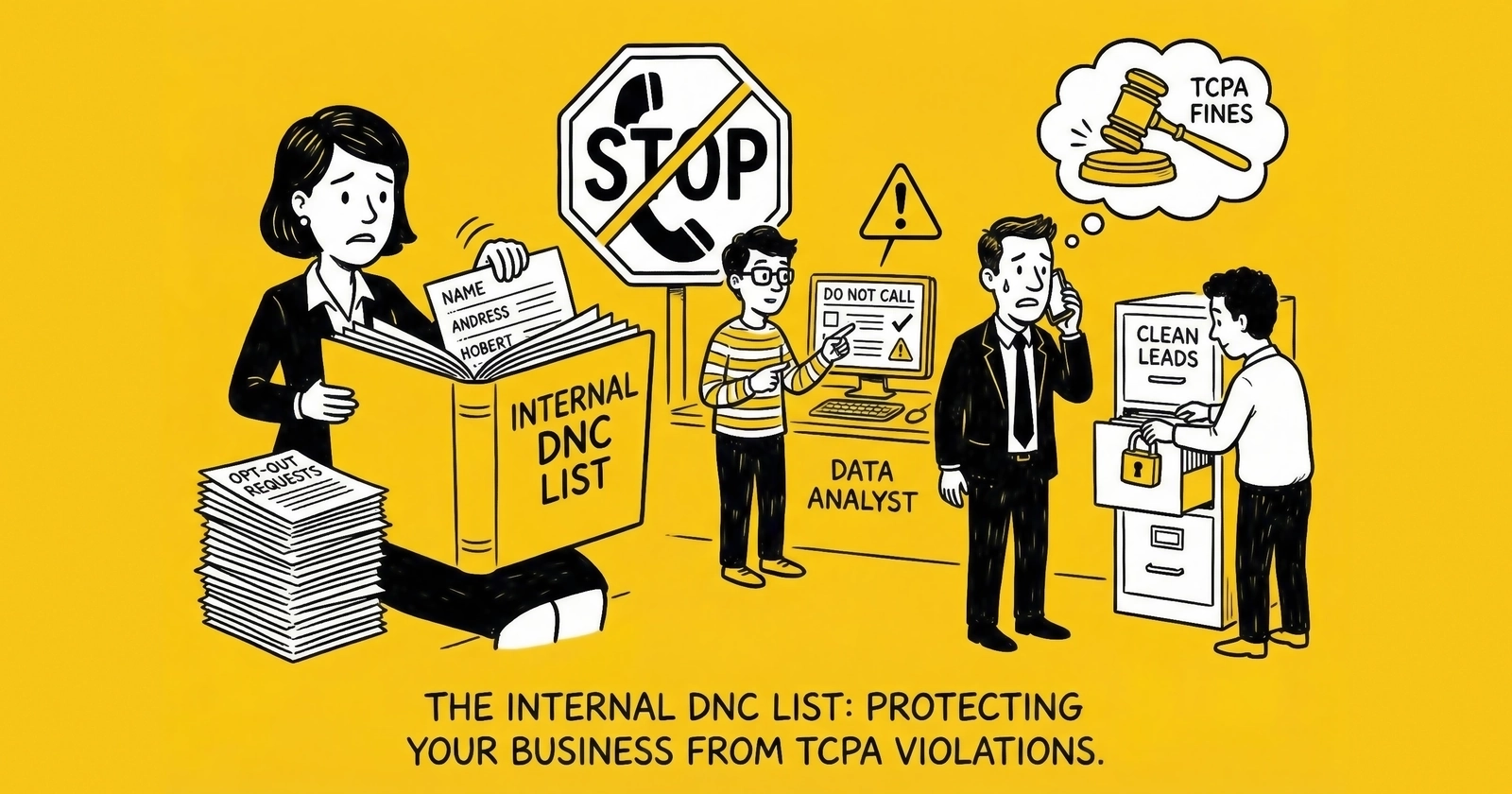
A comprehensive operational guide to building, maintaining, and enforcing internal Do Not Call lists that protect your business from regulatory exposure and litigation risk.
Introduction: The $500 Phone Number
Every phone number in your database carries a potential price tag. For numbers on your internal Do Not Call list, that price is $500 per violation under the Telephone Consumer Protection Act (TCPA), potentially trebling to $1,500 for willful violations. There is no cap on aggregate damages. A company that fails to honor 10,000 internal DNC requests faces potential exposure of $5 million to $15 million, before attorney fees and litigation costs.
In Q1 2025 alone, 507 TCPA class actions were filed, representing a 112% increase over the same period in 2024. The average settlement for TCPA class actions now exceeds $6.6 million. Nearly 80% of all TCPA lawsuits are filed as class actions, compared to just 2-5% for other consumer protection statutes.
Internal DNC list management is not a compliance checkbox. It is core business infrastructure that separates sustainable operations from ticking time bombs.
This guide covers the complete operational framework for internal DNC management: what the law requires, how to build compliant policies, the technology systems that enforce those policies, and the ongoing practices that prevent the single failure that could end your business.
What Is an Internal DNC List?
An internal Do Not Call list is a company-specific database of phone numbers belonging to consumers who have requested not to receive telemarketing calls from that particular company. Unlike the National Do Not Call Registry, which is maintained by the Federal Trade Commission and contains over 240 million phone numbers, internal DNC lists are company-specific and mandatory regardless of whether a number appears on any external registry.
The Legal Foundation
The TCPA and the Telemarketing Sales Rule (TSR) require companies to maintain written procedures for maintaining an internal DNC list. This requirement exists independently of the National Registry. A consumer who has never registered with the FTC but has told your company to stop calling has created a binding obligation on your operation.
Federal regulations at 47 CFR 64.1200(d) specify that any person who wishes not to receive telephone solicitations from a particular company shall be added to that company’s internal DNC list and not be contacted for telemarketing purposes. The regulations require companies to maintain these lists, update them regularly, and ensure all personnel and agents have access to the list before making calls.
The Telemarketing Sales Rule, enforced by the FTC, contains similar requirements and extends to any seller or telemarketer on their behalf. The TSR requires that internal DNC requests be honored for at least five years, though industry best practice is indefinite retention.
Internal DNC vs. National Registry: Critical Differences
The National Do Not Call Registry and internal DNC lists serve different purposes and operate under different rules. Understanding these distinctions is essential for building compliant systems.
The National Registry operates as a consumer-driven opt-out system. Consumers register their phone numbers with the FTC, and telemarketers must scrub calling lists against the registry at least every 31 days. The system includes important exemptions: established business relationships provide exemptions for up to 18 months after a transaction or 3 months after an inquiry. The registry covers telemarketing calls generally, not calls from specific companies.
Internal DNC lists function entirely differently. When consumers request directly with a specific company not to be called, there is no established business relationship exemption. If a consumer asks not to be called, you must stop calling, even if you sold them a policy yesterday. Internal DNC requests must be honored within a reasonable time, now defined by the FCC as 10 business days. The obligation is perpetual unless the consumer affirmatively re-consents.
The critical distinction is that internal DNC requests are absolute. A consumer who bought insurance from you last week can still request to be added to your internal DNC list, and you must honor that request. The established business relationship that would exempt you from National Registry requirements provides no protection against internal DNC violations.
The Regulatory Framework
Understanding the regulatory landscape helps you build policies that satisfy all applicable requirements, not just federal minimums. The layers of regulation create a complex compliance environment where the most restrictive standard always wins.
Federal Requirements
The TCPA establishes the foundation for internal DNC requirements through 47 CFR 64.1200. Companies making telephone solicitations must maintain a list of persons who have requested not to be called, and those requests must be recorded and honored. Company representatives must be informed of, and trained in, the existence and use of the list. The list must be maintained in writing, and requests must be honored for the life of the relationship, effectively creating an indefinite obligation.
The Telemarketing Sales Rule, codified at 16 CFR 310, adds additional requirements. Sellers and telemarketers must maintain internal DNC lists, with requests honored for at least five years. Consent records must now be retained for five years from the date the record was created, updated from two years in March 2024. Written policies and procedures must exist for maintaining DNC lists.
The FCC’s revocation rules, effective April 2025, impose specific timing and method requirements. Revocation requests must be honored within 10 business days. Companies must accept revocation through any reasonable method the consumer chooses, meaning you cannot force consumers into a specific opt-out channel. Specific keywords trigger immediate revocation obligations when received via text: “stop,” “quit,” “revoke,” “opt out,” “cancel,” “unsubscribe,” and “end.” Confirmation messages are permitted within 5 minutes of an opt-out request, but they may contain no marketing content.
State Requirements
State mini-TCPA laws often impose additional requirements beyond federal standards, creating a patchwork of obligations that varies by jurisdiction.
The Florida Telephone Solicitation Act (FTSA) provides a 15-day safe harbor for text message opt-out processing, which is actually more generous than the federal 10-day requirement. However, Florida restricts calls to a maximum of three per 24-hour period on the same subject matter and limits calling hours to 8:00 AM to 8:00 PM local time.
Oklahoma’s Telephone Solicitation Act (OTSA) imposes similar three-call limits per 24 hours, along with state registration requirements for telemarketers and enhanced consent requirements that exceed federal standards.
Texas SB 140, effective September 2025, significantly expands the state’s telemarketing regulations. The law broadens the definition of covered communications to include text messages and electronic transmissions. Telemarketers must register with the Secretary of State and post a $10,000 security bond. Violations are actionable under the Deceptive Trade Practices Act, exposing violators to treble damages.
Beyond these specific states, eleven states maintain their own DNC registries separate from the National Registry: Colorado, Connecticut, Indiana, Louisiana, Massachusetts, Missouri, Oklahoma, Pennsylvania, Tennessee, Texas, and Wyoming. Your internal DNC list management must integrate with suppression against these state registries.
Industry-Specific Overlays
Certain verticals face additional consent and calling restrictions that layer on top of general telemarketing rules.
Medicare marketing operates under strict CMS requirements. One-to-one consent is required for Medicare Advantage and Part D marketing, meaning you cannot use general consent to market specific plans. A 48-hour waiting period separates education events from enrollment activities. CMS requires 10-year record retention, far exceeding standard TCPA requirements, and Scope of Appointment restrictions limit what can be discussed during scheduled calls.
Insurance marketing varies significantly by jurisdiction. State-specific insurance marketing regulations create a patchwork of requirements that must be analyzed market by market. Unfair trade practice restrictions vary by jurisdiction, and some states require specific DNC procedures for insurance solicitations that exceed general telemarketing requirements.
Financial services face additional consent requirements from the CFPB and RESPA. Mortgage marketing requires specific consent procedures, and restrictions on referral compensation can affect lead practices in ways that intersect with calling compliance.
Building Your Internal DNC Policy
A compliant internal DNC policy requires documented procedures that address capture, storage, access, synchronization, and enforcement. This section walks through each required component with guidance on implementation.
Purpose and Scope
Your policy must begin with an explicit statement of scope. Specify that the policy applies to all telemarketing communications, all personnel who make or facilitate calls, and all vendors or agents who make calls on your behalf. Define “telemarketing” consistent with TCPA definitions to include calls that encourage the purchase, rental, or investment in property, goods, or services. Ambiguity in scope creates gaps that plaintiffs’ attorneys will exploit.
DNC Request Capture
Document all channels through which consumers may submit DNC requests: verbal requests during phone calls, text message keywords (STOP, QUIT, REVOKE, OPT OUT, CANCEL, UNSUBSCRIBE, END), email requests, web form submissions, written mail requests, and requests through third parties or agents.
The critical principle is that DNC requests received through any reasonable channel must be honored, consistent with the April 2025 FCC revocation rules. You cannot require consumers to use a specific method to opt out. If they call your general customer service line and ask to stop receiving calls, that request is as binding as one submitted through a dedicated opt-out form.
Recording Requirements
Each DNC request must capture essential information for compliance verification and audit purposes. Record the phone number or numbers to be suppressed, the date and time of the request, the channel through which the request was received, the identity of the consumer if known, the name of the employee or system that recorded the request, and any additional context relevant to the scope of the request.
For verbal requests, specify that the recording must be created immediately, not at the end of the call or shift. Delay between receiving a request and documenting it creates risk of error and gaps in your audit trail.
Processing Timeline
Specify that all DNC requests will be processed within 10 business days, consistent with April 2025 FCC requirements. This is the outer limit, not the target. Industry best practice is 24-48 hour processing for electronic channels and same-day processing for verbal requests. Document the escalation path if processing cannot be completed within the required timeline, identifying who is responsible for expediting delayed requests.
System Synchronization
Specify all systems where the DNC list must be propagated. This typically includes your primary CRM or lead management system, dialing platforms and predictive dialers, text messaging systems, email marketing platforms, third-party call centers, and lead vendor systems for suppression requests.
Document the synchronization frequency for each system. Real-time synchronization is preferred; batch synchronization should occur no less than daily. For systems that cannot accept real-time updates, document the maximum acceptable latency and monitoring procedures to verify updates are applied.
Training Requirements
All personnel who make calls or have access to calling systems must receive training on how to recognize a DNC request, how to record DNC requests in each relevant system, the consequences of failing to honor DNC requests, and escalation procedures for unclear situations.
Training must be documented and repeated at least annually. New personnel must complete training before making calls, with no exceptions. The training program should include assessment components that verify comprehension, not just completion.
Vendor Management
Third parties who make calls on your behalf must maintain their own internal DNC lists that incorporate your suppression data. Contracts must include explicit provisions requiring vendors to honor DNC requests, provide contractual commitments to compliance, accept regular audits, and include indemnification provisions covering TCPA violations.
Specify the frequency of suppression file transfers to vendors and the format requirements for those transfers. Daily transfers at minimum, with same-day transfer for high-risk numbers.
Audit and Monitoring
Document the schedule for regular audits: daily automated monitoring of DNC suppression effectiveness, weekly manual review of sample call records against the DNC list, monthly formal audits of policy compliance, and quarterly vendor compliance verification.
Specify who is responsible for each audit function and the escalation path for identified issues. Audit findings without clear ownership and resolution timelines are compliance theater, not compliance.
Incident Response
Document the procedure when a potential DNC violation is identified. The response must include immediate cessation of calls to the affected number, documentation of the potential violation, investigation of root cause, notification to the compliance officer and legal counsel, remediation of the underlying system or process failure, and consideration of proactive outreach to the affected consumer.
Record Retention
Specify retention periods for each category of DNC-related records. DNC list entries should be retained indefinitely until the consumer re-consents. DNC request records require a minimum of 5 years, with 7 years recommended. Training records should be kept for the duration of employment plus 5 years. Audit records require 5-year retention. Incident reports should be retained for 7 years or the duration of any related litigation, whichever is longer.
Technology Requirements
Policy without technology is aspiration. Effective DNC management requires systems that enforce compliance automatically, removing human discretion from the equation.
Core System Architecture
Your internal DNC list should exist as a dedicated database or table, not scattered across multiple systems. This primary database is the authoritative source. All other systems synchronize from this master list.
The database must capture essential fields for each suppressed number. Store the phone number as the primary key in standardized format, along with the date added, source of the request including channel, employee, and system, scope of the request covering all products, specific products, or specific channels, consumer identifier if applicable, a notes field for additional context, and a status field for active or pending removal if re-consent is received.
Phone number standardization is critical. Store all numbers in E.164 format (e.g., +12025551234) to eliminate matching failures from formatting variations. A number stored as “(202) 555-1234” will not match “2025551234” in a naive lookup, and that kind of formatting inconsistency can result in violations.
The real-time suppression engine is the heart of your compliance infrastructure. Before any call is placed, the dialing system must query the DNC database and receive confirmation that the number is not suppressed. This query must occur in real-time, not rely on batch-updated local caches that may be stale. Suppression queries should return results in under 100 milliseconds to avoid impacting dialing efficiency. The system must hard-block calls to suppressed numbers, not merely warn operators.
Ingestion processors handle the multiple channels that feed DNC requests into your system. Each channel requires a dedicated processor: an SMS keyword processor that monitors for opt-out keywords and creates DNC records automatically, an email parser that identifies opt-out requests and routes them for processing, a web form integration that creates DNC records upon submission, a call recording integration that flags calls containing verbal opt-out requests for review, and an API endpoint for vendor and partner systems to submit DNC requests. Automation is essential. Manual processing introduces delays and errors that create liability.
The synchronization service propagates DNC additions from the primary database to all consuming systems. This includes push-based real-time synchronization to dialing platforms, batch export generation for systems that cannot accept real-time updates, confirmation logging that verifies each system has received and applied the update, and alerting when synchronization fails or falls behind schedule.
Audit and reporting capabilities must provide visibility into total numbers on the internal DNC list, daily additions and rare removals, time from request to system-wide suppression, any calls placed to numbers after DNC request receipt which constitute violations, and system synchronization status across all platforms. Build dashboards that surface these metrics to compliance personnel daily.
Integration with DNC Scrubbing Services
Your internal DNC list is one component of a comprehensive suppression strategy. The complete stack includes multiple data sources that must work together.
National DNC Registry access comes through FTC’s Telemarketing Sales Rule registration. You must scrub against the National Registry at least every 31 days, though most operations scrub weekly or more frequently to minimize risk.
State DNC registries require subscription for each applicable state. Commercial services like DNC.com or Contact Center Compliance Corporation aggregate state registries into a single feed, simplifying integration.
Litigator suppression lists have become increasingly important. Services like Litigator Scrub, TCPA Litigator List, and Contact Center Compliance maintain databases of known TCPA plaintiffs. These lists contain over 600,000 names of professional plaintiffs, TCPA attorneys, and individuals who have sent demand letters. Calling someone on these lists dramatically increases your litigation risk.
The FCC Reassigned Numbers Database identifies phone numbers that have been reassigned to new owners. Calling a reassigned number with consent that applied to the previous owner creates liability, even if you believed you had valid consent.
Wireless number identification services help apply appropriate consent requirements by distinguishing wireless numbers from landlines. The consent requirements for automated calls to wireless numbers differ from landline requirements.
Recommended Technology Vendors
For DNC management and scrubbing, Contact Center Compliance Corporation (DNCScrub) provides comprehensive suppression covering federal registry, state registries, internal lists, and litigator databases. DNC.com offers registry access and suppression services with compliance reporting. Gryphon Networks provides an integrated compliance platform with real-time suppression.
For litigator databases specifically, Litigator Scrub from Contact Center Compliance, TCPA Litigator List, and PossibleNOW all maintain actively updated databases of known plaintiffs and high-risk numbers.
Major lead distribution platforms include built-in DNC suppression capabilities. Boberdoo offers built-in DNC integration configurable per source and buyer. LeadsPedia includes DNC scrubbing as part of its lead validation flow. LeadExec provides integrated compliance checking before distribution.
Modern dialing platforms include DNC compliance features. Five9 offers configurable DNC list integration. Convoso provides real-time DNC checking. RingCentral includes compliance tools integrated with its contact center platform.
Implementation Priorities
When building or upgrading DNC management systems, prioritize based on risk reduction.
Immediate priorities that should be addressed within 30 days include implementing real-time suppression against your internal DNC list before any call, automating SMS opt-out keyword processing, establishing daily synchronization to all dialing platforms, and creating manual processes for other channels pending automation.
High priority items for the next 90 days include integrating National Registry scrubbing, automating email opt-out processing, implementing litigator suppression, and building a compliance dashboard with key metrics.
Medium priority improvements over 180 days include adding state registry suppression, implementing reassigned number checking, building a comprehensive audit trail, and developing vendor compliance monitoring.
Ongoing activities include regular system audits and penetration testing, performance optimization for high-volume operations, and integration with new channels as they emerge.
Operational Best Practices
Technology enables compliance, but operational discipline ensures it. The systems you build are only as effective as the processes that govern their use.
Daily Operations
Before launching any outbound campaign, verify that your internal DNC list is current and synchronized to the calling system. Confirm that your National Registry scrub is within 31 days and state registry scrubs are current for all target states. Verify that litigator suppression is active. Check that time zone restrictions are properly configured and the campaign complies with all calling hour restrictions.
During active calling, monitor DNC suppression hit rates. Unusually low rates may indicate synchronization failure that requires immediate investigation. Track consumer complaints and requests received during the campaign. Watch for any system alerts or error conditions that could indicate compliance gaps.
Before the next calling day, process all DNC requests received during the day. Verify synchronization to all systems is complete. Review any potential violations flagged by monitoring. Generate a daily compliance report that provides a clear picture of the day’s calling activity and any issues identified.
Handling Edge Cases
Not every consumer request is clear. “I’m not interested” is not necessarily a DNC request. “Stop calling me” is. Train personnel to recognize unambiguous DNC language: “Put me on your do not call list,” “Stop calling,” “Don’t call me again,” “Remove my number,” and “Take me off your list.”
For ambiguous statements, train personnel to clarify: “Would you like me to add your number to our do not call list so you won’t receive any future calls from us?” This question resolves ambiguity without pressuring the consumer in either direction.
When in doubt, treat the request as a DNC and add the number. The risk of failing to honor a legitimate request vastly exceeds the cost of over-suppression. A single violation can cost $500 to $1,500. A suppressed number costs you only the lost opportunity to make one more call.
Consumers may request suppression for specific products or channels while remaining open to others. Document the specific scope of each request. A consumer might say “Don’t call me about insurance” (product-specific), “Don’t call me, but you can email” (channel-specific), or “Don’t call this number, but my office number is fine” (number-specific). When the scope is unclear, apply the broadest interpretation. Add the number for all products and all channels.
If a spouse or family member requests that you stop calling, treat it as valid. The risk of arguing about authorization is not worth the potential violation. Document the request and suppress the number.
Consumers may affirmatively request to receive calls again after a DNC request. This requires clear, documented re-consent. The consumer must affirmatively state they want to receive calls. Document the date, time, and method of re-consent. Obtain prior express written consent if required for future telemarketing. Keep the original DNC request in your records with notation of re-consent. Do not assume re-consent from silence or from a new form submission that does not explicitly address the previous DNC request.
Vendor Management
Third-party vendors who make calls on your behalf create direct liability for your company. The FCC has established that vicarious liability applies when callers act as agents of sellers, and sellers cannot escape responsibility by hiring others to make non-compliant calls.
Vendor agreements must include explicit obligations to maintain internal DNC lists, requirements to accept your suppression file and apply it before calling, acknowledgment that the vendor will honor DNC requests received during calls, commitment to notify you of DNC requests within 24 hours, audit rights to verify compliance, indemnification for TCPA violations arising from vendor conduct, and insurance requirements adequate to support indemnification.
Operationally, transmit suppression files to vendors at least daily. Require confirmation that files were received and applied. Audit vendor compliance monthly through test calls or record review. Conduct annual on-site compliance reviews for high-volume vendors.
Before engaging any calling vendor, review their DNC compliance policies and procedures. Verify they have systems capable of real-time suppression. Check their history of TCPA litigation or regulatory action. Confirm insurance coverage and financial stability. Conduct test calling to verify compliance in practice, not just policy.
Training Program Structure
Initial training before any personnel make their first call must cover the overview of TCPA requirements and penalties, company DNC policy and procedures, how to recognize and record DNC requests, system training for DNC entry, and consequences of policy violations.
Ongoing training includes annual refresher sessions on TCPA requirements, quarterly updates on regulatory changes, immediate training when policies or systems change, and remedial training when issues are identified.
Documentation is essential. Maintain training completion records for all personnel. Document training content and date of delivery. Require signed acknowledgment of policy understanding. Retain records for the duration of employment plus five years.
Audit and Compliance Monitoring
Systematic monitoring identifies issues before they become lawsuits. The goal is not to create paperwork but to catch problems when they are still small and fixable.
Internal Audit Program
Daily automated monitoring should compare call records against the DNC list to identify potential violations, monitor synchronization status across all systems, track DNC request processing time against the 10-day requirement, and alert on any calls to numbers added to DNC within the past 10 days.
Weekly manual review involves sampling 50-100 call recordings for DNC request recognition, reviewing any flagged potential violations, verifying DNC requests from all channels were processed, and checking vendor suppression file transmission confirmation.
Monthly formal audits calculate compliance rates across all metrics, review all incidents and near-misses, verify training completion is current, assess system performance and identify improvements, and document findings and remediation actions.
Quarterly executive reviews report compliance metrics to leadership, review any litigation, complaints, or regulatory inquiries, assess resource adequacy for the compliance program, and approve policy updates based on regulatory changes.
Key Metrics to Track
| Metric | Target | Alert Threshold |
|---|---|---|
| Time from DNC request to suppression | <24 hours | >48 hours |
| Calls to numbers on DNC list | 0 | Any |
| DNC synchronization latency | <1 hour | >4 hours |
| Training completion rate | 100% | <95% |
| Vendor suppression confirmation rate | 100% | <100% |
| System uptime for suppression queries | 99.9% | <99.5% |
Documentation and Record Retention
Maintain complete records that demonstrate compliance across all areas of your DNC program.
DNC list records should include the current suppression list with all required fields, historical record of additions including when, how, and by whom, and any removals with documented re-consent.
Process documentation should capture written policies and procedures including current and historical versions, system configuration documentation, synchronization logs, and query logs showing suppression checks performed.
Training records should preserve training materials used, attendance records with signatures, assessment results, and policy acknowledgment forms.
Audit records should include all audit reports and findings, remediation plans and completion verification, and incident reports and resolution documentation.
Retain all records for minimum 5 years. Consider 7-year retention to align with state statutes of limitation. Retain DNC list entries indefinitely unless the consumer re-consents. Retain litigation-related records for the duration of litigation plus 5 years.
Responding to DNC Violations
Despite best efforts, violations occur. Your response determines whether an incident becomes a lawsuit.
Immediate Response Protocol
In the first four hours after discovering a potential violation, stop all calling to the affected number immediately. Document the violation with all available information. Notify the compliance officer. Preserve all records related to the call and the consumer.
Between hours 4 and 24, investigate the root cause. Determine scope: was this an isolated incident or a systemic issue? Review all calls to this consumer and similarly situated consumers. Brief legal counsel if the violation appears significant.
During days 2 through 7, implement immediate remediation for the identified root cause. Document corrective actions taken. Consider proactive outreach to the affected consumer. Prepare an incident report for compliance records.
Root Cause Categories
System failures occur when synchronization delays leave numbers off suppression lists, when query timeouts allow calls to proceed, or when system downtime bypasses suppression checks. Remediation requires fixing the technical issue, implementing redundancy, and adding monitoring to catch future failures before they cause violations.
Process failures happen when DNC requests are recorded but not entered into systems, when wrong numbers are added to suppression lists, or when requests are misclassified and not processed. Remediation involves retraining personnel, improving quality checks, and adding automation to reduce manual error.
Vendor failures result when vendors fail to apply suppression files, fail to process DNC requests received during calls, or when synchronization to vendors is delayed. Remediation requires addressing issues with the vendor, considering termination for repeat problems, and strengthening contractual remedies.
Training failures occur when personnel fail to recognize DNC requests, fail to record requests properly, or circumvent suppression controls. Remediation includes retraining, discipline for willful violations, and strengthening controls to prevent workarounds.
Consumer Outreach Considerations
Proactive outreach to consumers who received calls in violation of DNC requests can defuse situations before they become complaints or litigation. This is a strategic decision that involves tradeoffs.
Outreach demonstrates good faith and commitment to compliance. It may prevent the consumer from filing a complaint or consulting an attorney. It creates documentation of remediation efforts, and some consumers appreciate acknowledgment and apology.
However, outreach also draws attention to a violation the consumer may not have noticed. It creates documentation that confirms the violation occurred. It may be perceived as further harassment, and it could trigger demand for compensation.
Consult with legal counsel before conducting proactive outreach. The decision should consider the severity of the violation, the consumer’s apparent awareness and reaction, and your organization’s litigation posture.
When to Involve Legal Counsel
Involve TCPA defense counsel immediately when you receive a demand letter or lawsuit, when a violation affects more than a small number of consumers, when you discover a systemic issue that may have caused repeated violations, when a known serial litigator was called, when you receive a regulatory inquiry from FCC, FTC, or state AG, or when the violation involved knowing or willful conduct.
Frequently Asked Questions
1. What is an internal Do Not Call list and how is it different from the National DNC Registry?
An internal Do Not Call list is a company-specific database of phone numbers belonging to consumers who have requested not to receive calls from that particular company. The National Do Not Call Registry is maintained by the FTC and contains numbers registered by consumers to avoid telemarketing calls from any company. The key difference is that internal DNC requests are absolute. Even if a consumer has an established business relationship with you that would exempt their number from National Registry requirements, they can still request to be added to your internal DNC list, and you must honor that request.
2. How quickly must I honor an internal DNC request?
The FCC’s April 2025 revocation rules require companies to honor revocation requests within 10 business days. This is the maximum allowable time. Industry best practice is 24-48 hours for requests received through electronic channels (text, email, web forms) and same-day processing for verbal requests made during calls. The 10-day window is measured from when the request is received, not when it is entered into your systems.
3. What happens if I call someone on my internal DNC list?
Each call to a number on your internal DNC list constitutes a separate TCPA violation. Statutory damages are $500 per violation, increasing to $1,500 if the court finds the violation was willful or knowing. There is no cap on aggregate damages. A pattern of calls to suppressed numbers can also support class certification, exposing your company to claims from all consumers who may have been similarly affected.
4. Does an internal DNC request expire after a certain period?
No. Unlike the National Registry, which requires scrubbing every 31 days and is subject to established business relationship exemptions, internal DNC requests are perpetual. Once a consumer requests to be added to your internal DNC list, that number must remain suppressed indefinitely unless the consumer affirmatively provides new consent to receive calls. The TSR requires honoring requests for at least five years, but there is no mechanism for automatic expiration, and best practice is indefinite retention.
5. If a customer just bought from me, can they still request to be on my internal DNC list?
Yes. The established business relationship exemption applies only to the National Do Not Call Registry. It provides no protection against internal DNC requests. A customer who purchased insurance from you yesterday can call today and request to be added to your internal DNC list, and you must honor that request. You cannot call that customer for telemarketing purposes even though you have a fresh transaction relationship.
6. How do I handle requests that come through text message?
The FCC has identified specific keywords that trigger revocation obligations when received via text: “stop,” “quit,” “revoke,” “opt out,” “cancel,” “unsubscribe,” and “end.” Your system must automatically process these keywords and add the number to your internal DNC list without human intervention. You may send a one-time confirmation message within 5 minutes of the opt-out request, but it cannot contain any marketing content. If you send multiple message types, the confirmation may ask which types the consumer wishes to discontinue, but if they do not respond, treat it as a global opt-out.
7. What training do I need to provide to employees who make calls?
All personnel who make calls or have access to calling systems must be trained on recognizing DNC requests, recording them properly in your systems, the consequences of failing to honor requests, and escalation procedures for unclear situations. Training must be documented and repeated at least annually. New personnel must complete training before making calls. Keep records of training completion for the duration of employment plus five years.
8. What are my obligations when using third-party call centers?
You remain liable for calls made on your behalf by third parties. Vendor contracts must include explicit obligations to maintain internal DNC lists, requirements to honor your suppression file, commitments to notify you of DNC requests received during calls, audit rights, and indemnification provisions. Transmit suppression files to vendors at least daily and require confirmation of receipt and application. Audit vendor compliance monthly.
9. How long must I retain internal DNC list records?
The TSR requires retaining consent and DNC-related records for five years from the date the record was created. This was extended from two years in March 2024. Best practice is seven-year retention to align with various state statutes of limitation. DNC list entries themselves should be retained indefinitely. Training records should be kept for the duration of employment plus five years. Audit records and incident reports should be retained for at least five years.
10. What technology do I need for compliant internal DNC management?
At minimum, you need: (1) a centralized DNC database that serves as the authoritative source, (2) real-time suppression queries that block calls before they are placed, (3) automated processing for text message opt-outs, (4) synchronization services that propagate DNC updates to all calling systems within your required timeline, and (5) audit and reporting capabilities that track compliance metrics. Commercial solutions from providers like Contact Center Compliance, DNC.com, and Gryphon Networks provide integrated platforms that handle these functions. Most major dialing platforms and lead distribution systems include DNC integration capabilities.
Key Takeaways
-
Internal DNC lists are mandatory and absolute. Every company that makes telemarketing calls must maintain an internal DNC list. Established business relationships provide no exemption. If a consumer asks not to be called, you must stop calling, regardless of any prior transaction.
-
The 10-business-day processing rule is the maximum, not the target. The April 2025 FCC rules require honoring revocation requests within 10 business days. Industry best practice is 24-48 hours for electronic requests and same-day for verbal requests.
-
Automation is essential. Manual DNC processing introduces delays and errors that create liability. Text message opt-outs must be processed automatically. Real-time suppression queries must block calls before they are placed.
-
Synchronization determines compliance. Your internal DNC list is only as effective as your ability to propagate it across all calling systems. Real-time synchronization is preferred. Batch updates should occur at least daily.
-
Vendor liability transfers to you. Third parties who make calls on your behalf create direct liability for your company. Contractual protections, regular audits, and daily suppression file transfers are non-negotiable.
-
Documentation is defense. Comprehensive records of policies, training, system configurations, and audits demonstrate good faith compliance efforts. Retain records for at least five years, preferably seven.
-
The cost of compliance is a fraction of the cost of violation. A single class action settlement averages $6.6 million. The technology and operational investment for compliant DNC management is a rounding error by comparison.
-
Document every DNC addition with timestamp, source channel, and processing confirmation. Complete records of when requests were received, how they were received, and when they were processed provide the audit trail needed to defend against claims of non-compliance.
-
Test DNC suppression accuracy monthly. Regular testing with known DNC numbers verifies that suppression systems are functioning correctly. Any calls to DNC numbers during testing indicate system gaps requiring immediate remediation.
-
State laws create additional requirements beyond federal minimums. Florida, Oklahoma, Texas, and other states impose stricter calling limits, processing timelines, and registration requirements. Compliance programs must address the most restrictive applicable standard.
Building a Compliance Culture
Internal DNC list management is not a legal requirement that you satisfy and forget. It is a continuous operational discipline that reflects your organization’s commitment to respecting consumer preferences.
The companies that face TCPA exposure typically share common characteristics. They treat compliance as a cost to be minimized rather than a foundation to be built. They rely on manual processes that break under pressure. They assume that vendors are handling compliance without verifying. They discover systemic issues only when litigation arrives.
The companies that thrive approach compliance differently. They invest in technology that enforces rules automatically. They train personnel until compliance is instinct. They audit continuously and fix issues immediately. They view every DNC request not as lost opportunity but as risk avoided.
The choice between these approaches is not abstract. It is made in daily decisions about budget allocation, system design, and operational priority. The consequences of those decisions arrive in the form of demand letters, class action complaints, and regulatory inquiries.
Choose wisely. The math is unforgiving.
This article provides general information about internal DNC list management practices. It is not legal advice. TCPA requirements change frequently, and state laws vary significantly. Consult qualified TCPA counsel for guidance on your specific situation.
Statistics and regulatory information current as of late 2025. Sources: FCC regulatory filings, FTC Telemarketing Sales Rule, WebRecon TCPA litigation data.