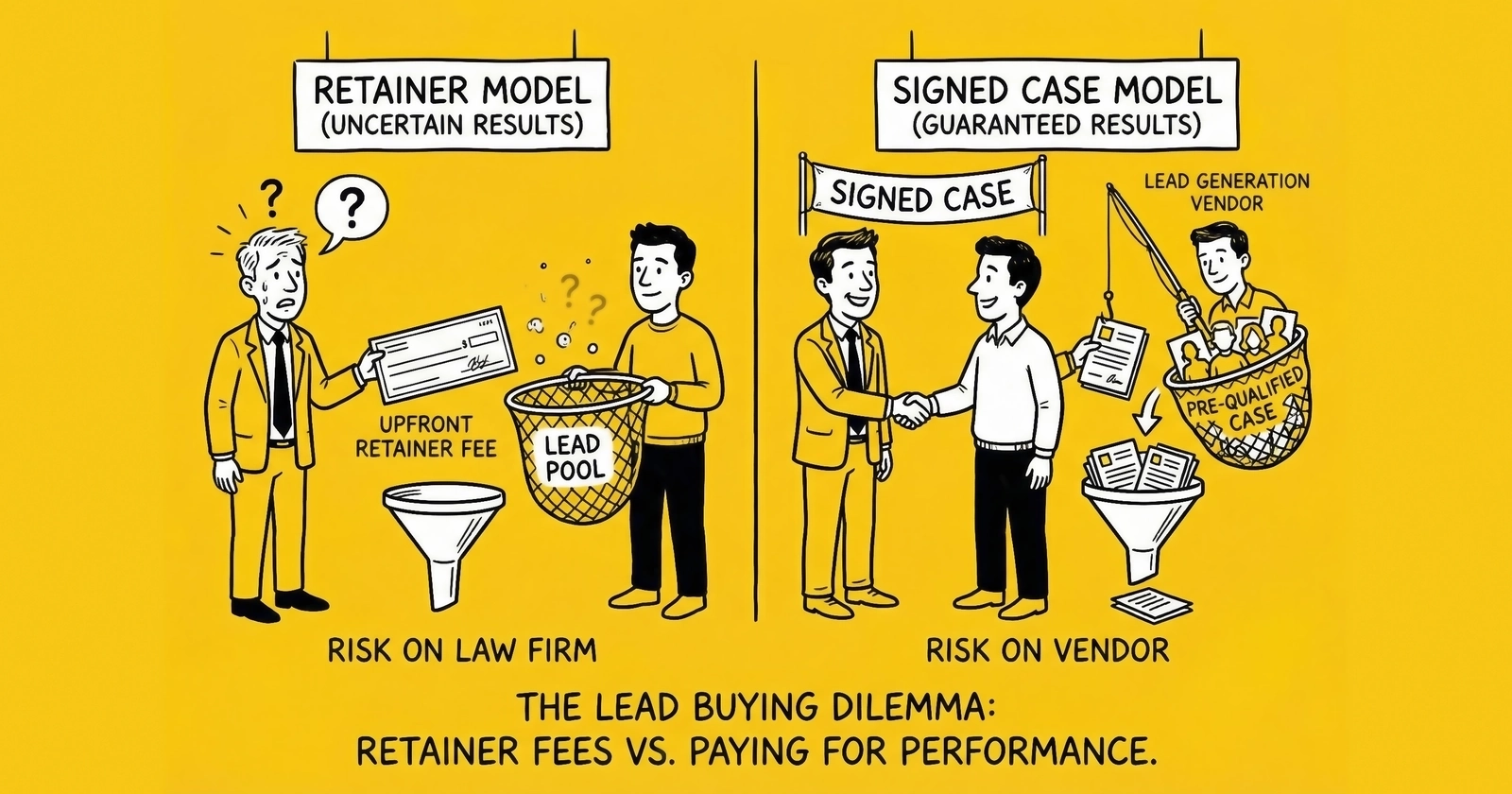
The complete guide to understanding how law firms acquire clients through lead buying versus signed case purchasing, including pricing benchmarks, ROI analysis, and strategic frameworks for choosing the right acquisition model for your practice.
Law firms face a fundamental choice when acquiring clients through third-party channels: buy leads and handle conversion internally, or purchase signed retainers where someone else has already secured the client relationship. This decision shapes everything from capital requirements to profit margins, from staffing needs to risk exposure.
A personal injury firm purchasing raw leads at $350 each must staff an intake team, invest in speed-to-contact infrastructure, and accept that many leads will never convert. That same firm could purchase signed retainers at $1,500-$3,000 each, receiving clients who have already committed to representation. The math seems straightforward until you calculate true cost per acquired case – and realize the lead model often produces better economics when executed well.
The retainer versus signed case decision is not merely tactical. It determines your competitive position in the legal marketplace. Firms that master lead conversion build sustainable advantages that competitors cannot easily replicate. Firms that rely entirely on purchased retainers create dependency on vendors who capture the margin between lead cost and signing.
This guide examines both models comprehensively: the economics that drive pricing, the operational requirements for each approach, the ROI calculations that reveal true acquisition costs, and the strategic frameworks for deciding which model fits your practice. Whether you operate a solo practice handling 20 cases annually or a multi-attorney firm signing 500 clients per year, understanding these dynamics is essential for sustainable growth.
Understanding the Two Models: Leads vs Signed Cases
Before diving into economics and operations, we need to establish clear definitions. The terminology in legal client acquisition can be imprecise, and that imprecision costs firms money when they compare options without understanding what they are actually buying.
The Lead Model Defined
In the lead model, a law firm purchases contact information for consumers who have expressed interest in legal services. The consumer has typically searched for relevant legal terms online, clicked on an advertisement, completed a form indicating their legal need, and provided contact information along with consent to be contacted.
What the consumer has NOT done is speak with an intake professional about their case, agree to representation, sign any documents, or commit to hiring the firm in any way.
The lead represents opportunity, not commitment. The law firm must convert that opportunity into a client relationship through its own intake process.
Lead Pricing Ranges by Practice Area:
| Practice Area | Shared Lead CPL | Exclusive Lead CPL | Live Transfer |
|---|---|---|---|
| Auto Accident | $50-$150 | $200-$500 | $400-$600 |
| Medical Malpractice | $100-$250 | $400-$800 | $600-$1,000+ |
| Mass Tort | $50-$150 (raw) | $100-$400 | Varies by campaign |
| Workers’ Compensation | $30-$75 | $100-$250 | $200-$350 |
| Criminal Defense (DUI) | $50-$100 | $150-$400 | $250-$500 |
| Family Law | $30-$90 | $100-$300 | $200-$400 |
| Bankruptcy | $20-$50 | $50-$150 | $100-$250 |
The Signed Case Model Defined
In the signed case model, a law firm purchases cases where the consumer has already been contacted and qualified by an intake professional, agreed to representation, signed a retainer agreement or representation letter, and been verified against case acceptance criteria.
The case represents a committed client relationship with documentation already in place. The law firm assumes case management from the point of signing.
Signed Case Pricing Ranges by Practice Area:
| Practice Area | Standard Signed Case | Premium/Documented | Notes |
|---|---|---|---|
| Auto Accident | $800-$2,000 | $2,000-$4,000 | Injury severity affects pricing |
| Medical Malpractice | $3,000-$7,500 | $7,500-$15,000+ | Expert pre-screening adds value |
| Mass Tort | $500-$1,500 | $1,500-$5,000+ | Campaign maturity drives pricing |
| Workers’ Compensation | $400-$1,200 | $1,200-$2,500 | Documented treatment matters |
| Sexual Harassment | $750-$2,000 | $2,000-$4,000 | Severity and perpetrator level |
| Wrongful Termination | $600-$1,500 | $1,500-$3,000 | Employer size affects economics |
The Hybrid: Live Transfers
Live transfers occupy the middle ground between raw leads and signed cases. In a live transfer, a consumer has been pre-qualified by an intake specialist, then transferred by phone in real-time to the law firm, which takes the call and completes the signing process. For more on delivery options, see our overview of lead delivery methods.
Live transfers price between leads and signed cases, typically 2-3x raw lead costs but 30-50% below signed case prices. They offer higher conversion than raw leads (the consumer is already engaged and qualified) while allowing the firm to control the closing process.
The Economics: What Each Model Really Costs
Surface-level pricing comparisons between leads and signed cases are misleading. A $400 lead versus a $2,000 signed case looks like 5:1 price difference. The true cost comparison requires accounting for conversion rates, operational overhead, and opportunity costs.
Lead Model True Cost Analysis
Purchasing raw leads requires investment beyond the lead price itself. Consider the complete cost stack for a personal injury practice buying 100 leads at $350 each:
Direct Costs:
| Cost Category | Per Lead | Total (100 leads) |
|---|---|---|
| Lead purchase price | $350 | $35,000 |
| Platform/delivery fees | $5 | $500 |
| Processing/payment fees | $10 | $1,000 |
| Total acquisition | $365 | $36,500 |
Operational Costs:
| Cost Category | Rate | Total |
|---|---|---|
| Contact attempts (avg 4x per lead) | $5/attempt | $2,000 |
| Qualification time (15 min avg) | $25/hr allocated | $625 |
| CRM/tracking systems | $2/lead | $200 |
| Speed-to-contact infrastructure | $3/lead | $300 |
| Total operations | $3,125 |
Conversion Funnel:
| Stage | Count | Rate |
|---|---|---|
| Leads purchased | 100 | - |
| Successfully contacted | 65 | 65% |
| Qualified and interested | 42 | 65% of contacted |
| Signed retainers | 18 | 43% of qualified |
| Cases accepted after review | 15 | 83% of signed |
True Cost Per Signed Case:
Total investment: $36,500 + $3,125 = $39,625 Cases signed: 18 Cost per signed case: $2,201
True cost per accepted case (15 cases): $2,642
This 18% conversion rate and $2,201 cost per signed case represents average performance. Strong intake operations achieve 25-30% conversion and $1,500-$1,800 cost per signed case. Poor intake operations see 10-12% conversion and $3,500+ cost per signed case.
Signed Case Model True Cost Analysis
Purchasing signed cases appears simpler – you pay the vendor price and receive a client. But additional costs exist:
Direct Costs (100 signed cases at $1,800 avg):
| Cost Category | Amount |
|---|---|
| Signed case purchase | $180,000 |
| Transfer/documentation fees | $2,500 |
| Total acquisition | $182,500 |
Quality Review Costs:
| Cost Category | Amount |
|---|---|
| Case review time (2 hrs avg at $150/hr) | $30,000 |
| Cases rejected after review (15%) | Lost investment on 15 cases |
| Client onboarding/reconciliation | $5,000 |
| Total quality costs | $35,000 |
Case Rejection Analysis:
Of 100 signed cases purchased:
- 85 accepted after attorney review
- 15 rejected for various reasons
Those 15 rejected cases represent $27,000 in lost investment (15 x $1,800). Vendors vary in their return policies – some offer full refunds, others partial, some none.
True Cost Per Accepted Case:
Assuming 50% recovery on rejected cases: Total investment: $182,500 + $35,000 - $13,500 (refunds) = $204,000 Accepted cases: 85 Cost per accepted case: $2,400
The Comparative Analysis
| Metric | Lead Model | Signed Case Model |
|---|---|---|
| Initial investment (100 units) | $39,625 | $182,500 |
| Cases signed/purchased | 18 | 100 |
| Cases accepted | 15 | 85 |
| Cost per signed case | $2,201 | $1,825 |
| Cost per accepted case | $2,642 | $2,400 |
| Operational complexity | High | Low |
| Capital intensity | Low | High |
| Control over process | Full | None |
The signed case model shows slightly lower cost per accepted case in this example – but this assumes average-to-good vendor quality and reasonable rejection rates. The variance in outcomes is higher with signed case purchasing due to quality variability across vendors.
The Hidden Economics
Several factors affect true cost beyond these calculations.
Client Retention and Quality Signals
Clients acquired through your own intake process tend to have stronger relationships with your firm. They spoke with your team, understood your approach, and chose you specifically. Signed cases may arrive with weaker allegiance – they signed with “a lawyer,” not necessarily with you.
Case Value Correlation
Some evidence suggests leads converted through rigorous internal intake produce higher average case values than purchased signed cases. Intake processes that screen for case quality early may filter to better cases.
Speed-to-File Advantages
When you control intake, you can preserve evidence faster, guide clients on documentation, and begin case development immediately. Purchased signed cases may arrive days or weeks after signing, with documentation gaps.
Referral Potential
Clients who experience your intake process – even if they do not sign – sometimes refer others. Purchased signed cases bypass this relationship-building entirely.
Operational Requirements: What Each Model Demands
The choice between lead buying and signed case purchasing fundamentally affects staffing, technology, and operational focus. Understanding these requirements helps firms assess whether they have the infrastructure for each approach.
Lead Model Operational Requirements
Success with raw leads requires building a client conversion engine. The components include:
Speed-to-Contact Infrastructure
Research consistently demonstrates that lead response time is the single highest-leverage variable in legal lead conversion. Understanding the lead decay curve is essential: one-minute response achieves 391% higher conversion. Leads contacted within one hour convert at 7x the rate of leads contacted after 24 hours.
Building speed-to-contact capability requires investment across three areas.
Real-time lead delivery demands direct CRM integration with lead vendors, mobile push notifications for new leads, automated SMS acknowledgment upon receipt, and backup routing when primary staff are unavailable.
Dedicated intake staff means specialists whose primary job is lead response, with coverage during all lead delivery hours (often 8am-10pm), after-hours answering service with qualification training, and backup coverage for breaks, lunch, and absences.
Multi-channel follow-up uses phone as the primary contact method, SMS for non-answers and follow-up, email for information delivery, and voicemail drop for automated follow-up sequences.
The firms achieving 25%+ lead-to-case conversion invest heavily in this infrastructure. The firms seeing 12% conversion typically treat lead response as a secondary duty for staff with competing priorities.
Intake Qualification Capability
Beyond speed, effective intake requires qualification expertise across several dimensions.
Case criteria training ensures intake specialists understand which cases meet firm acceptance criteria. For personal injury, this includes statute of limitations verification, liability assessment basics, injury severity indicators, insurance coverage indicators, and screening for consumers already represented by other attorneys.
Script development creates standardized approaches that ensure consistent qualification while building rapport. Effective scripts establish urgency and credibility early, gather essential case information efficiently, address common objections, and guide the conversation toward scheduling or signing.
Objection handling addresses the predictable resistance points that separate successful intake operations from mediocre ones. When prospects say “I want to think about it,” “I am talking to other lawyers,” “Can you send me information first,” or “I am not ready to decide,” trained intake specialists convert many of these objections into signed cases. Untrained staff lose them.
Signing Infrastructure
Converting qualified prospects to signed clients requires three capabilities working together.
Electronic signature capability through services like DocuSign, HelloSign, or practice management integrations enables remote signing within minutes of the intake call. Requiring in-person signing dramatically reduces conversion.
Fee explanation competency means intake staff can explain contingency arrangements, cost responsibilities, and fee structures clearly and confidently. Confusion about fees is a major conversion killer.
Immediate follow-up reinforces the signing decision and begins the client relationship. After signing, immediate welcome communication keeps the client engaged. Signed clients who hear nothing for days may experience buyer’s remorse.
Signed Case Model Operational Requirements
Purchasing signed cases requires different capabilities.
Vendor Evaluation and Management
Managing signed case vendors effectively requires systematic quality tracking, contract negotiation skill, and vendor diversification strategy.
Quality tracking means measuring every vendor by case acceptance rate after attorney review, average case value of accepted cases, client cooperation and communication quality, documentation completeness at delivery, and return/refund experience. Without this data, firms cannot distinguish good vendors from bad.
Contract negotiation must address return policies for rejected cases, timeline for rejection decisions, documentation requirements at delivery, exclusivity and volume commitments, and pricing tiers based on case characteristics. These terms determine whether the relationship works economically.
Vendor diversification reduces dependency risk. Relying on a single signed case vendor creates supply vulnerability. Following sound principles of lead source diversification, build relationships with multiple sources to ensure consistent flow and provide negotiating leverage.
Case Review Processes
Every signed case requires attorney review before proceeding.
Rapid review protocols ensure signed cases are reviewed within 24-48 hours of receipt. Delays create client experience issues and may exceed return windows specified in vendor contracts.
Acceptance criteria documentation establishes clear, written standards for case acceptance that prevent inconsistent decisions and facilitate vendor feedback. Document why cases are rejected to identify patterns and improve vendor selection.
Client communication must happen immediately after acceptance. Accepted cases require prompt attorney contact to establish the relationship. Clients who signed with a vendor but never hear from their “lawyer” become problematic – and sometimes seek other representation.
Onboarding Systems
Transitioning signed cases to active representation requires attention to documentation, expectations, and case development timing.
Documentation gathering addresses the reality that cases often arrive without complete records. Systems for requesting and tracking medical records, police reports, and other documents are essential for signed case operations.
Expectation setting matters because clients may have received information from vendors that does not match your processes. Early communication aligns expectations before misunderstandings create problems.
Case development initiation must happen faster than with leads you converted yourself. Unlike cases where you controlled intake from the start, purchased signed cases may arrive days or weeks after signing. You may be behind on evidence preservation and case development, requiring accelerated initial case work.
ROI Analysis: Calculating True Return on Investment
Both lead buying and signed case purchasing generate ROI when executed properly. Calculating true ROI requires accounting for the complete cost stack, realistic conversion rates, and case outcome economics.
Lead Model ROI Framework
The Complete Formula:
Net Case Revenue = (Settlement/Verdict x Fee Percentage) - Case Costs - Overhead Allocation
True Lead Cost = Lead Purchase + Intake Costs + (Rejected Case Cost x Rejection Rate)
True ROI = (Net Case Revenue - True Lead Cost) / True Lead Cost x 100
Worked Example: Auto Accident Practice
A personal injury firm purchases 100 auto accident leads at $400 each:
| Revenue Side | Calculation |
|---|---|
| Leads purchased | 100 |
| Cases signed (20%) | 20 |
| Cases accepted (90%) | 18 |
| Cases settled (85%) | 15.3 (round to 15) |
| Average settlement | $45,000 |
| Total settlements | $675,000 |
| Attorney fee (33%) | $222,750 |
| Case costs per case | $3,500 |
| Total case costs | $52,500 |
| Net fee revenue | $170,250 |
| Cost Side | Amount |
|---|---|
| Lead purchase | $40,000 |
| Intake operations | $3,500 |
| Total lead investment | $43,500 |
| Overhead allocation (15% of net fee) | $25,538 |
| Total cost | $69,038 |
| ROI Calculation | |
|---|---|
| Net fee revenue | $170,250 |
| Total cost | $69,038 |
| Net return | $101,212 |
| ROI | 147% |
This 147% ROI means every dollar invested in leads returns $2.47. The economics are strong, but they depend critically on the 20% conversion rate assumption. At 15% conversion, ROI drops to 95%. At 10% conversion, ROI falls to 45%.
Signed Case Model ROI Framework
The Complete Formula:
Net Case Revenue = (Settlement/Verdict x Fee Percentage) - Case Costs - Overhead Allocation
True Signed Case Cost = Purchase Price + Review Costs + (Rejected Cases x Unrecoverable Cost)
True ROI = (Net Case Revenue - True Signed Case Cost) / True Signed Case Cost x 100
Worked Example: Auto Accident Practice
Same firm purchases 30 signed auto accident cases at $2,000 each:
| Revenue Side | Calculation |
|---|---|
| Signed cases purchased | 30 |
| Cases accepted after review (85%) | 25.5 (round to 25) |
| Cases settled (85%) | 21.25 (round to 21) |
| Average settlement | $40,000 |
| Total settlements | $840,000 |
| Attorney fee (33%) | $277,200 |
| Case costs per case | $3,500 |
| Total case costs | $73,500 |
| Net fee revenue | $203,700 |
| Cost Side | Amount |
|---|---|
| Signed case purchase (30 x $2,000) | $60,000 |
| Case review costs (30 x $300) | $9,000 |
| Rejected case loss (5 x $2,000 x 50% unrecoverable) | $5,000 |
| Total case investment | $74,000 |
| Overhead allocation (15% of net fee) | $30,555 |
| Total cost | $104,555 |
| ROI Calculation | |
|---|---|
| Net fee revenue | $203,700 |
| Total cost | $104,555 |
| Net return | $99,145 |
| ROI | 95% |
The 95% ROI means every dollar invested returns $1.95. This is a solid return, though lower than the lead model example. However, the signed case model required $74,000 in case investment versus $43,500 for leads – nearly double the capital requirement for similar net returns.
Comparing the Models Side by Side
| Metric | Lead Model | Signed Case Model |
|---|---|---|
| Initial investment | $43,500 | $74,000 |
| Net return | $101,212 | $99,145 |
| ROI percentage | 147% | 95% |
| Capital efficiency | Higher | Lower |
| Operational complexity | Higher | Lower |
| Cases produced | 15 settled | 21 settled |
| Volume per dollar | Lower | Higher |
The lead model produces higher ROI but lower absolute volume. The signed case model produces more cases but requires more capital and generates lower percentage returns.
Sensitivity Analysis: How Variables Affect ROI
Lead Model Sensitivity:
| Conversion Rate | Cost per Signed Case | ROI |
|---|---|---|
| 10% | $4,350 | 45% |
| 15% | $2,900 | 95% |
| 20% | $2,175 | 147% |
| 25% | $1,740 | 200% |
| 30% | $1,450 | 257% |
Conversion rate is the primary driver. The difference between 15% and 25% conversion doubles ROI.
Signed Case Model Sensitivity:
| Acceptance Rate | Effective Cost per Case | ROI |
|---|---|---|
| 70% | $2,857 | 55% |
| 80% | $2,500 | 80% |
| 85% | $2,353 | 95% |
| 90% | $2,222 | 110% |
| 95% | $2,105 | 125% |
Acceptance rate after attorney review significantly affects economics. Vendors with high rejection rates destroy ROI.
Strategic Considerations: Choosing the Right Model
The lead versus signed case decision extends beyond immediate ROI calculations. Strategic factors including firm positioning, growth objectives, and risk tolerance should guide the choice.
When the Lead Model Works Best
The lead model produces superior results under several conditions.
Firms with existing intake infrastructure should favor leads. When dedicated intake staff, speed-to-contact systems, and proven conversion processes are already in place, the infrastructure investment has been made. Leads leverage it.
The lead model works when volume is limited but quality matters. Smaller firms handling 50-200 cases annually benefit from controlling their own intake. They can select clients carefully, build relationships during intake, and ensure case quality.
Practice areas that reward relationship-building favor the lead model. Family law, estate planning, and complex commercial litigation benefit from relationship development that begins with first contact. Purchased signed cases bypass this critical phase.
Firms seeking sustainable competitive advantage should build intake capability. This creates a moat that competitors cannot easily replicate by simply buying more signed cases. Firms that master lead conversion develop durable advantages.
When capital is more constrained than time, leads make economic sense. They require lower initial investment per case. Firms with limited capital but strong operational capacity should favor the lead model.
When Signed Cases Work Best
Purchased signed cases produce better results under different circumstances.
Speed to scale matters most when a firm is opening a new office, entering a new practice area, or recovering from capacity changes. These situations demand cases faster than lead-based growth allows. Signed cases provide immediate inventory.
Limited intake capacity makes signed cases economically rational. Solo practitioners and small firms without dedicated intake staff may struggle to achieve competitive conversion rates. Paying the premium for signed cases avoids the operational complexity they cannot support.
Mass tort campaigns require volume that overwhelms most intake operations. Generating 1,000+ leads monthly and converting them requires infrastructure many firms lack. Purchasing signed retainers at scale is more practical for firms seeking hundreds or thousands of cases.
Practice areas with binary qualification criteria see less variance between lead conversion and signed case quality. Bankruptcy qualification and specific mass tort diagnoses have clear accept/reject standards. The premium for signed cases buys less incremental value in these categories.
Firms prioritizing predictability may prefer signed cases despite lower ROI. The variance in lead conversion outcomes is higher than signed case acceptance variance. Risk-averse firms may choose the more predictable returns of purchased cases.
The Hybrid Approach
Many successful firms combine both models strategically.
Core volume comes from leads, with 60-70% of client acquisition flowing through internal intake. This builds client relationships, controls quality, and generates strong ROI.
Supplemental volume from signed cases comprises 20-30% of acquisition. These purchased cases fill gaps during high-demand periods, support specific practice areas, or maintain pipeline stability when lead flow fluctuates.
Overflow and backup capacity reserves 10-20% for opportunistic signed case purchases when quality vendors offer attractive terms.
This hybrid approach captures the advantages of both models while hedging their respective weaknesses.
Vendor Selection and Management
Whether purchasing leads or signed cases, vendor selection dramatically affects outcomes. The difference between a quality vendor and a problematic one can swing ROI by 100+ percentage points.
Lead Vendor Evaluation Criteria
Evaluate lead vendors across quality indicators, performance metrics, and warning signs.
Quality Indicators
Source transparency reveals where leads originate and whether the acquisition methods align with your standards. Consent documentation ensures TCPA compliance. Data verification through phone validation and address confirmation reduces wasted contact attempts. Understanding whether distribution is exclusive or shared determines how many competitors receive the same leads. Delivery speed – real-time versus batched – affects your ability to achieve speed-to-contact. Return policies for invalid leads protect your investment when data quality fails.
Performance Metrics
Track every vendor by contact rate (leads who answer), qualification rate (contacted leads meeting your criteria), conversion rate (qualified leads who sign), average case value from that vendor’s leads, and return/credit rate. Our guide on evaluating lead vendors covers the questions to ask before making commitments. Without this data, you cannot make informed decisions about which vendors to continue with.
Red Flags
Watch for unwillingness to share source information, no consent documentation provided, high return rates above 15%, inconsistent lead quality, payment required before delivery, and no exclusivity guarantees when paying exclusive prices. Any of these signals potential problems that worsen over time.
Signed Case Vendor Evaluation Criteria
Evaluate signed case vendors using similar rigor applied to different factors.
Quality Indicators
Intake process transparency shows how vendors qualify cases before signing. Retainer agreement quality determines whether the documentation will hold up under scrutiny. Case documentation completeness affects how much work remains after handoff. Client communication during handoff sets the tone for the attorney-client relationship. Return and refund policies protect against cases that do not meet criteria. Case criteria alignment with your practice ensures vendors understand what you actually need.
Performance Metrics
Track acceptance rate after attorney review, average case value of accepted cases, client cooperation quality, documentation gaps requiring additional work, and refund processing experience. These metrics reveal whether the vendor relationship is economically viable.
Red Flags
Beware of high rejection rates above 20%, poor client communication during transition, incomplete retainer agreements, resistance to providing intake records, unclear fee arrangements with clients, and cases arriving outside stated criteria. These problems compound over time and erode the economics that made signed cases attractive.
Contract Negotiation Priorities
Lead agreements should address clear exclusivity definitions, reasonable return windows of 24-72 hours, volume-based pricing tiers, pause and resume capability, source disclosure requirements, and compliance documentation access. These terms protect your investment and ensure the relationship works long-term.
Signed case agreements need clear acceptance criteria, sufficient review periods, full refund for rejected cases, client communication protocols during handoff, documentation requirements at delivery, and case transfer procedures. Without these protections, vendors have limited accountability for quality.
Practice Area Considerations
The lead versus signed case decision plays out differently across practice areas. Economics, conversion dynamics, and client expectations vary significantly.
Personal Injury
The lead model offers several advantages in personal injury. Speed-to-contact preserves evidence before it disappears. Intake builds case-specific relationships that matter through lengthy litigation. Injury severity can be assessed during intake to filter cases. And conversion rates tend to be higher with urgent cases where prospects need immediate help.
Signed cases provide immediate case inventory, scale without intake infrastructure, and work well for volume-focused practices prioritizing quantity over relationship depth.
| Metric | Lead Model | Signed Case Model |
|---|---|---|
| CPL/CPC | $250-$500 | $1,500-$3,000 |
| Conversion rate | 15-25% | N/A |
| Acceptance rate | N/A | 80-90% |
| Cost per accepted case | $1,500-$2,500 | $1,700-$3,500 |
Personal injury typically favors the lead model when intake capability exists. The relationship-building and speed advantages are significant.
Mass Tort
The lead model in mass tort offers lower per-lead investment, flexibility to adjust with campaign changes, and better economics for building proprietary case inventory when you have intake capacity.
Signed cases eliminate qualification complexity, scale to thousands of cases, remove the intake bottleneck, and ensure qualification criteria are met before purchase. For firms without large intake operations, these advantages outweigh the higher per-case cost.
| Metric | Lead Model | Signed Case Model |
|---|---|---|
| CPL/CPC | $75-$300 | $500-$5,000 |
| Conversion rate | 8-18% | N/A |
| Acceptance rate | N/A | 70-90% |
| Cost per accepted case | $800-$2,500 | $700-$5,500 |
Mass tort often favors signed cases due to scale requirements and qualification complexity. Firms seeking 500+ cases typically cannot process enough leads through internal intake.
Criminal Defense
The lead model dominates criminal defense for good reasons. Immediate response matters critically when someone faces arrest or charges. The relationship from first call builds trust that sustains through the case. Fee explanation requires a personal touch that third-party signings cannot replicate. And the intake experience generates referral potential that signed cases miss entirely.
Signed cases are less common in criminal defense and typically used only for overflow situations when intake capacity is temporarily exhausted.
| Metric | Lead Model | Signed Case Model |
|---|---|---|
| CPL/CPC | $150-$400 | $600-$1,500 |
| Conversion rate | 20-35% | N/A |
| Acceptance rate | N/A | 85-95% |
| Cost per accepted case | $600-$1,500 | $700-$1,700 |
Criminal defense strongly favors the lead model. The urgency of criminal matters means clients want to speak with their lawyer immediately. Signed case purchases bypass the relationship-building that criminal clients expect.
Family Law
Family law strongly favors the lead model because relationship is central to the practice. Case complexity requires detailed intake to understand the situation properly. Conflict checking must happen during intake. And setting expectations about process, timeline, and emotional realities works best through direct conversation.
Signed cases are rare in family law, occasionally used for high-volume uncontested divorce practices where client relationships are less central to outcomes.
| Metric | Lead Model | Signed Case Model |
|---|---|---|
| CPL/CPC | $100-$300 | $500-$1,200 |
| Conversion rate | 18-30% | N/A |
| Acceptance rate | N/A | 80-90% |
| Cost per accepted case | $500-$1,200 | $600-$1,400 |
Family law practice almost universally favors leads. The client relationship is too central to the practice to bypass with purchased signings.
Employment Law
The lead model in employment law enables case strength assessment during intake, rapport building with emotional clients who have experienced workplace mistreatment, employer size qualification that determines case economics, and documentation guidance that helps preserve evidence.
Signed cases can work for volume practices, particularly for standardized claim types like wage and hour violations where qualification criteria are more binary.
| Metric | Lead Model | Signed Case Model |
|---|---|---|
| CPL/CPC | $100-$275 | $600-$1,500 |
| Conversion rate | 15-25% | N/A |
| Acceptance rate | N/A | 75-85% |
| Cost per accepted case | $600-$1,500 | $800-$1,800 |
Employment law works well with both models. The choice often depends on case type – discrimination suits favor leads for relationship building, while wage claims can work with signed case purchasing.
Frequently Asked Questions
1. What is the difference between buying leads and buying signed cases for a law firm?
Buying leads means purchasing contact information for consumers who have expressed interest in legal services but have not committed to hiring anyone. The consumer completed a form or responded to advertising but has not spoken with intake staff, agreed to representation, or signed any documents. Lead prices typically range from $50-$500 depending on practice area and quality. Buying signed cases means purchasing cases where a consumer has already been contacted, qualified, and has signed a retainer agreement. The law firm receives a committed client with documentation in place. Signed case prices typically range from $500-$5,000+ depending on practice area and case quality. The fundamental difference: leads require conversion work while signed cases arrive ready for case development.
2. Which model produces better ROI: leads or signed cases?
Neither model inherently produces better ROI – execution determines outcomes. Lead model ROI depends critically on conversion rate. Firms achieving 20-25% lead-to-case conversion typically see 150-200% ROI. Firms at 10-12% conversion may see only 40-60% ROI. Signed case model ROI depends on case acceptance rate and vendor quality. Acceptance rates of 85-90% typically produce 90-120% ROI, while 70% acceptance rates can drop ROI to 50-60%. In many scenarios, the lead model produces higher ROI percentage but lower absolute volume, while the signed case model produces more cases but requires more capital and generates lower percentage returns. Firms with strong intake capability typically achieve better ROI with leads.
3. What conversion rate should I expect when buying leads for personal injury cases?
Industry benchmarks for personal injury lead conversion range from 12-25%, with significant variance based on intake capability. The conversion funnel typically shows: 55-75% contact rate (leads who answer calls), 50-70% qualification rate among contacted leads, 50-75% signing rate among qualified leads, and 80-95% acceptance rate after attorney review. End-to-end conversion (lead to accepted case) typically ranges from 12-20% for average intake operations and 18-28% for strong intake operations. Speed-to-contact is the highest-leverage variable – one-minute response achieves 391% higher conversion than five-minute response. Firms investing in speed infrastructure consistently outperform those treating lead response as a secondary priority.
4. How much should I pay for a signed personal injury case?
Signed personal injury case pricing varies by case characteristics and market conditions. Auto accident cases with documented treatment typically price at $1,500-$2,500. Cases indicating serious injury (hospitalization, surgery) command $2,500-$4,000. Medical malpractice signed cases range from $3,000-$15,000 depending on case strength and expert pre-screening. Mass tort signed retainers range from $500-$5,000+ based on campaign maturity and documentation quality. Geographic variation adds 20-40% to pricing in premium markets like Los Angeles, New York, and Miami. When evaluating pricing, calculate your expected acceptance rate and work backward to determine effective cost per accepted case – a $2,000 case with 90% acceptance costs $2,222 effective, while a $1,500 case with 70% acceptance costs $2,143 effective.
5. What infrastructure do I need to succeed with lead buying?
Successful lead conversion requires speed-to-contact infrastructure, intake capability, and signing systems. For speed: real-time lead delivery integration with your CRM, mobile push notifications for new leads, dedicated intake staff (not shared with other duties), after-hours coverage or answering service with qualification training, and automated SMS acknowledgment upon lead receipt. For intake: case criteria training for all intake staff, standardized qualification scripts, objection handling protocols, and call recording for quality assurance. For signing: electronic signature capability (DocuSign, HelloSign, or practice management integration), clear fee explanation training, and immediate post-signing communication sequences. Firms achieving 20%+ conversion have made these investments. Firms at 10-12% typically lack one or more components.
6. What should I look for when evaluating signed case vendors?
Evaluate signed case vendors on quality indicators, contractual terms, and track record. Quality indicators include: intake process transparency (how are cases qualified?), retainer agreement quality (are they legally sound?), documentation completeness (what arrives with the case?), client communication during handoff, and case criteria alignment with your practice. Contractual terms to negotiate include: acceptance criteria clarity, review period length (48-72 hours minimum), return/refund policies for rejected cases, documentation requirements, and client communication protocols. Track record metrics include: acceptance rate after attorney review (target 85%+), average case value of accepted cases, client cooperation quality, and refund processing experience. Red flags include high rejection rates (above 20%), incomplete retainers, resistance to sharing intake records, and cases outside stated criteria.
7. Can I use both lead buying and signed case purchasing together?
Yes, many successful firms combine both models strategically. A common hybrid approach: 60-70% of client acquisition from leads converted through internal intake (building relationships and strong ROI), 20-30% from purchased signed cases for specific needs (new practice areas, volume peaks, geographic expansion), and 10-20% reserved for opportunistic purchases when quality vendors offer attractive terms. This hybrid captures lead model advantages (relationship building, higher ROI, competitive moat) while using signed cases for flexibility. The key is viewing signed cases as supplemental rather than primary – firms that rely entirely on purchased cases create vendor dependency and miss the advantages of owned intake capability.
8. How do mass tort case acquisitions differ from standard personal injury leads?
Mass tort acquisitions operate differently due to scale, qualification complexity, and campaign dynamics. Scale: mass tort litigation may require hundreds or thousands of cases, volumes that exceed most firms’ internal intake capacity. Qualification: eligibility criteria for mass torts can be complex (specific diagnoses, exposure timing, documentation requirements), making qualified signed cases more valuable relative to raw leads. Campaign dynamics: mass tort campaigns have lifecycles (emergence, growth, maturity, decline) that affect pricing dramatically – a signed retainer worth $1,000 during growth might cost $4,000 at maturity. Most mass tort practitioners favor signed case purchasing for volume operations because the qualification complexity makes raw lead conversion inefficient at scale. However, some firms build internal mass tort intake capabilities to capture the economics themselves.
9. What are the biggest mistakes firms make when buying leads or cases?
Common lead buying mistakes include: underinvesting in speed-to-contact infrastructure (the single highest ROI investment), treating intake as a secondary duty rather than dedicated function, not tracking conversion by source to eliminate underperformers, accepting leads without proper consent documentation (TCPA liability), and evaluating leads too quickly (legal cases need 18-24 months for true ROI measurement). Common signed case mistakes include: not negotiating adequate review periods before case acceptance, failing to track vendor quality systematically, accepting cases outside practice area expertise to meet volume goals, poor client transition communication that damages relationships, and over-relying on single vendors creating supply dependency. Both models fail when firms pay commodity prices expecting premium quality or premium prices without verifying quality justifies the cost.
10. How should I calculate whether leads or signed cases are more cost-effective for my practice?
Calculate true cost per accepted case for both models using your specific data. For leads: (lead cost + intake cost per lead) / conversion rate = cost per signed case. Then adjust for attorney review rejection: cost per signed case / acceptance rate = cost per accepted case. For signed cases: (purchase price + review cost) / acceptance rate + (rejected cases x unrecoverable cost) = cost per accepted case. Compare these figures directly. Then consider strategic factors: Do you have intake infrastructure? Is capital constrained? Does your practice area benefit from intake relationship-building? What is your risk tolerance for conversion variance? The financially superior option depends on your conversion rates, vendor quality, and operational capabilities. Run the math with your actual data before deciding, and update calculations quarterly as performance data accumulates.
Key Takeaways
-
The lead model and signed case model represent fundamentally different acquisition approaches with distinct economics, operational requirements, and strategic implications. Neither is universally superior – the right choice depends on firm capabilities and objectives.
-
True cost per accepted case often differs from surface-level pricing. A $350 lead with 18% conversion costs $1,944 per case; a $2,000 signed case with 85% acceptance costs $2,353 per case. Calculate true costs before comparing options.
-
Lead model ROI depends critically on conversion rate. The difference between 15% and 25% conversion doubles ROI. Speed-to-contact is the highest-leverage investment – one-minute response achieves 391% higher conversion.
-
Signed case model ROI depends on vendor quality and acceptance rates. Rejection rates above 15-20% dramatically reduce effective returns. Track vendor performance systematically and eliminate underperformers.
-
The lead model builds competitive advantage. Intake capability is a moat that competitors cannot easily replicate. Firms that master lead conversion develop sustainable advantages beyond what signed case purchasing provides.
-
The signed case model provides speed and simplicity. Firms needing immediate inventory, lacking intake infrastructure, or operating mass tort campaigns may find purchased cases more practical despite lower ROI.
-
Most successful firms use hybrid approaches: 60-70% leads through internal intake, 20-30% signed cases for supplemental needs, 10-20% opportunistic purchasing. This captures advantages of both models while hedging weaknesses.
-
Practice area matters. Personal injury, criminal defense, and family law typically favor leads for relationship building. Mass tort often favors signed cases for scale. Employment law works with either depending on case type.
-
Vendor selection dramatically affects outcomes. The difference between quality and poor vendors can swing ROI by 100+ percentage points. Evaluate systematically and track performance continuously.
-
Calculate true ROI with complete cost stacks including intake costs, review time, rejection losses, and overhead allocation. Surface-level comparisons mislead; true cost analysis reveals actual economics.
Conclusion
The retainer versus signed case decision shapes law firm economics in ways that extend far beyond immediate acquisition costs. Firms that build intake capability create sustainable competitive advantages – they convert leads efficiently, build client relationships from first contact, and control the quality signals that determine case value. Firms that rely on purchased cases achieve faster scaling but create vendor dependency and miss relationship-building opportunities.
The math guides but does not dictate the choice. A firm achieving 25% lead conversion will see dramatically different economics than one at 12%. A signed case vendor with 90% acceptance rate delivers different value than one at 70%. Your specific capabilities and performance determine which model produces better results.
For most firms, the answer is not either/or but how much of each. Build internal intake capability for core volume – this investment compounds over time as processes improve and conversion rates increase. Use signed case purchasing for supplemental needs, new practice areas, and volume flexibility. Track everything, measure relentlessly, and shift allocation based on performance data.
The firms that thrive in legal client acquisition understand that both leads and signed cases are tools serving a larger strategy. The goal is not to buy leads or buy cases – the goal is to build a sustainable practice that serves clients profitably. The acquisition model you choose should support that objective, not define it.
Pricing benchmarks and ROI calculations current as of late 2025. Actual results vary based on practice area, geography, intake capability, and vendor quality. This article provides general business information and does not constitute legal advice. Consult with appropriate professionals for guidance specific to your situation.