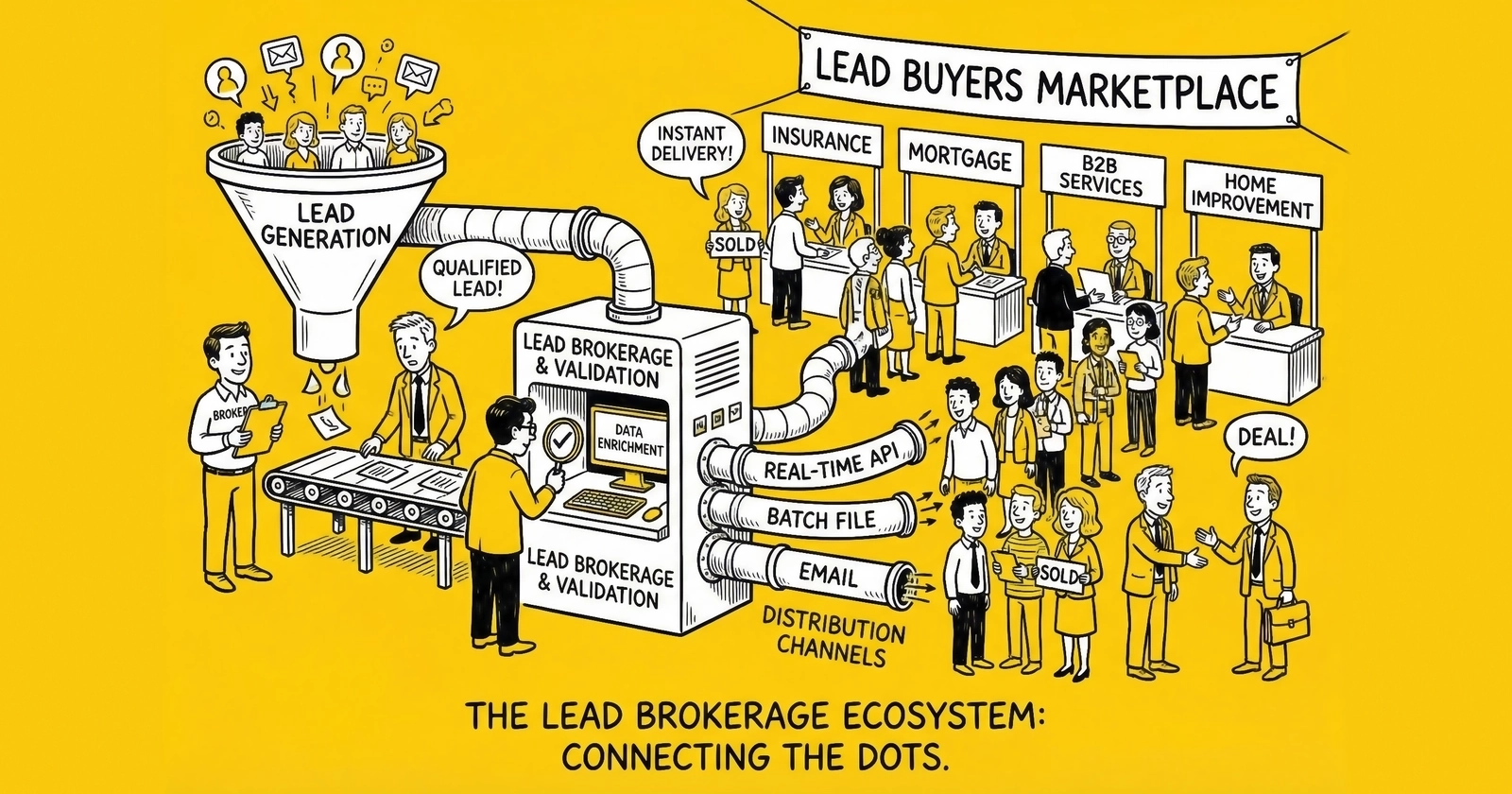
The complete guide to starting and scaling a lead distribution operation in 2025 – from understanding market economics to building buyer relationships that last.
Between the companies that generate leads and the businesses that buy them sits an essential layer of the lead economy: the lead broker. These distribution specialists aggregate supply from multiple publishers, route leads to appropriate buyers, and capture margin for coordinating the marketplace. For practitioners with the right skills and capital, lead brokerage offers a path to building substantial recurring revenue businesses.
This is not a business for the undercapitalized or the compliance-casual. The lead brokerage model requires significant working capital, sophisticated technology infrastructure, and deep relationships on both the supply and demand sides of the market. Get it right, and you build a cash-flowing operation that scales with the digital advertising ecosystem. Get it wrong, and you discover why 82% of small business failures stem from cash flow problems – often learning that lesson with your own capital.
This guide covers everything you need to know to enter the lead distribution business in 2025: market economics, operational requirements, technology selection, compliance frameworks, and the specific steps to launch and scale a profitable brokerage operation.
What Is Lead Brokerage?
A lead broker is a company that purchases leads from publishers at one price and resells them to buyers at another, capturing the spread. Unlike affiliate networks that simply facilitate transactions between parties, brokers take ownership of inventory. They bear the risk of returns and non-payment while providing value through aggregation, quality filtering, and market-making.
The broker sits in the middle tier of the three-tier lead marketplace:
Tier 1: Lead Generators (Publishers) create the raw material – consumer intent packaged as contact information with consent documentation. They own or control traffic sources, landing pages, and forms where consumers express interest. Publishers sell leads directly to buyers or through intermediaries like brokers.
Tier 2: Aggregators and Distributors (Brokers) connect supply and demand. They aggregate leads from multiple publishers, validate quality, ensure compliance, and route leads to appropriate buyers. This tier captures margin for reducing transaction costs and providing market liquidity.
Tier 3: Lead Buyers (End Clients) are the businesses that actually want to acquire customers – insurance carriers, mortgage lenders, solar installers, law firms. Their willingness to pay sets the entire market’s economics.
Lead brokerage exists because direct relationships between publishers and buyers don’t scale. A publisher generating 100 leads daily might work directly with three or four buyers. A publisher generating 10,000 leads daily across multiple verticals cannot possibly maintain direct relationships with the hundreds of buyers who might want different slices of that inventory. Brokers solve this coordination problem.
Similarly, buyers benefit from aggregation. An insurance agent wanting 50 leads monthly doesn’t have the purchasing power to negotiate directly with major publishers. Brokers bundle demand from thousands of small buyers into volumes that attract publisher attention and competitive pricing.
Lead Brokerage Market Economics in 2025
Understanding the economics of lead distribution is essential before investing capital in this business model. The numbers separate operators building wealth from those burning through capital wondering what went wrong.
Margin Structure Reality
newcomers often hear about “30-40% gross margins” in lead brokerage and assume the business prints money. The reality is more nuanced – and more humbling.
Gross margin on a lead – the spread between purchase price and sale price – typically ranges from 25-40% depending on vertical and volume. On a $50 purchase with $70 sale, that’s $20 or 40% gross.
Net margin after operational realities rarely exceeds 15-18%. Here’s what erodes the spread:
Return rates run 8-15% industry average. A 12% return rate on $50 leads means $6 per lead sold evaporates when buyers reject post-purchase. Returns happen because leads don’t answer phones, provide false information, or don’t meet buyer criteria that wasn’t explicit in the original filters.
Float cost emerges from timing mismatches. You pay publishers in 15 days. Buyers pay you in 45 days. That 30-day float on working capital costs money – either in interest if you’re borrowing, or in opportunity cost if you’re using your own capital. At scale, float cost runs $0.50-$1.00 per lead.
Duplicate leakage affects 2-3% of volume. Even with suppression, some leads prove to be duplicates captured through different entry points that can’t be sold or must be refunded.
Bad debt means not every buyer pays. Credit-checking your buyers and requiring prepayment reduces this risk, but budget 1-2% for uncollectable receivables.
Processing costs include payment processing (2.8% + $0.30 on credit cards), validation services ($0.05-$0.25 per lead), platform fees, and infrastructure.
The math transforms quickly. A lead purchased for $50 and sold for $70 shows $20 gross margin (28.6%). After returns (-$6), float cost (-$0.80), duplicates (-$1.50), bad debt (-$1.00), and processing (-$2.00), the net margin drops to $8.70 (12.4%). This is a healthy operation. Many brokers run tighter margins.
Working Capital Requirements
The 60-day float rule governs lead brokerage economics: you need approximately 60 days of working capital to operate safely.
Why 60 days? You pay publishers within 7-15 days of lead delivery. Buyers pay you within 30-45 days of lead delivery. During that gap, you’re funding inventory with your own capital. Add processing time, dispute resolution, and payment delays, and 60 days provides adequate cushion.
Working capital requirements scale with volume:
- 10,000 leads per month: $150,000-$200,000 required
- 50,000 leads per month: $500,000-$750,000 required
- 100,000 leads per month: $1,000,000+ required
Undercapitalization is the most common cause of broker failure. The business looks profitable on paper while cash bleeds out to fund the receivables-payables gap.
CPL Benchmarks by Vertical
Lead prices vary dramatically by vertical, reflecting customer lifetime value, competitive intensity, and regulatory complexity:
| Vertical | CPL Range | Typical Range | Premium Tier |
|---|---|---|---|
| Auto Insurance | $5-150 | $25-75 | $100+ |
| Mortgage | $12-200+ | $50-100 | $150+ |
| Solar | $20-300 | $75-150 | $200+ |
| Legal (PI) | $100-3,000+ | $200-500 | $800+ |
| Home Services | $15-230 | $40-100 | $150+ |
| Medicare | $30-80 | $40-60 | $75+ |
Geographic variation adds another dimension. California solar leads command premiums that would be absurd in North Dakota. Florida auto insurance leads reflect the state’s high premiums and litigation environment. Local market conditions matter as much as vertical averages.
Building a Lead Distribution Business: Step by Step
The sequence matters enormously in this industry. Most failed lead businesses didn’t fail because the operators lacked intelligence or work ethic. They failed because they built traffic before they had buyers, launched landing pages before establishing compliance infrastructure, or spent money before understanding unit economics.
Phase 1: Foundation (Weeks 1-4)
The first month is entirely about validation and foundation. You’ll spend no money on traffic or lead purchases. What you will do is ensure that when you do spend money, you’re not lighting it on fire.
Buyer Identification and Outreach
This is the single most important activity. Finding buyers before you source leads inverts the typical failure pattern of “build it and they will come.”
Create a target buyer list of at least fifty potential accounts. For insurance, this means agencies, brokerages, and carrier distribution partners. For mortgage, it’s loan officers, branch managers, and broker shops. For home services, it’s local contractors, regional franchises, and national brands with local service delivery.
Craft a brief, honest outreach message. Something like: “I’m launching a lead distribution operation focused on [vertical] in [geography]. I’m reaching out to potential buyers early to understand what lead quality and volume would be valuable to your business. Would you have fifteen minutes for a call? I’m not selling anything yet – I’m gathering input to build something worth buying.”
Expect a 10-20% response rate. From fifty outreaches, you should generate five to ten substantive conversations. Document what you learn: target lead volume per day or week, acceptable price ranges, required lead fields, delivery preferences, geographic coverage, and quality expectations. This information shapes every decision for the next six months.
Aim to have at least three committed buyers before you source leads. This provides diversification from day one and creates competitive tension that prevents any single buyer from dictating terms. The 25% rule applies immediately: no single buyer should ever represent more than 25% of your planned volume. Concentration risk kills lead businesses when a single buyer churns or changes terms.
Publisher Identification and Qualification
Simultaneously, identify potential lead sources. The quality of your supply determines the quality of your buyer relationships.
Research publishers in your target verticals. Attend industry events like LeadsCon, join LinkedIn groups focused on lead generation, and reach out to operators who might be looking for additional distribution.
For each potential publisher, evaluate:
Traffic quality indicators. Where does their traffic originate? Organic search traffic typically converts better than social media traffic, which typically converts better than display advertising.
Consent documentation practices. Do they use TrustedForm, Jornaya, or equivalent consent verification? Can they provide sample certificates for review?
Historical performance. What return rates do their current buyers report? What contact rates?
Volume and consistency. Can they deliver consistent volume, or does their traffic fluctuate unpredictably?
Compliance posture. Review their landing pages, consent disclosures, and TCPA documentation practices.
Request small test batches (50-100 leads) before committing to volume. Track performance at the individual lead level before scaling any source.
Economic Model Validation
With buyer and publisher intelligence in hand, build your first economic model. Start with anticipated costs:
- Lead purchase price from publishers
- Validation services ($0.05-$0.25 per lead)
- Consent verification (TrustedForm/Jornaya: $0.15-$0.50 per lead)
- Platform fees (varies by provider)
- Payment processing (2.8% + $0.30)
- Float cost calculation
- Return reserve (12-15% of lead value)
Model revenue based on buyer conversations. Build scenarios at 1,000, 5,000, and 10,000 leads per month to understand scale requirements.
Calculate breakeven. What lead volume and margin do you need to cover fixed costs – technology, compliance services, your own time? Most new brokers need at least 5,000-10,000 leads monthly at $5-10 margin per lead to generate meaningful income after accounting for all costs.
Legal Entity and Compliance Foundation
Form your legal entity before any business activity. For most lead distribution companies, a Limited Liability Company (LLC) provides the right balance of liability protection, tax flexibility, and administrative simplicity.
Apply for an Employer Identification Number (EIN) immediately after formation. Open a dedicated business bank account – never commingle personal and business funds.
Consider your insurance needs. General liability coverage is standard, but lead distribution companies should also investigate errors and omissions (E&O) coverage and cyber liability policies. TCPA litigation risk makes E&O coverage particularly relevant.
Establish compliance infrastructure:
Implement consent capture verification. Integrate with TrustedForm, Jornaya, or equivalent services to verify the consent documentation accompanying every lead you purchase.
Build DNC scrubbing processes. Register with the National Do Not Call Registry and implement scrubbing processes for any leads that might be used for outbound contact.
Document everything. Create a compliance manual describing your consent verification process, data handling procedures, and retention policies.
Phase 2: Infrastructure (Weeks 5-8)
With validation complete and foundation set, you’re ready to build your distribution infrastructure.
Technology Stack Selection
Your technology stack needs to handle four core functions: lead intake, validation and compliance, distribution and routing, and financial reconciliation.
Lead Distribution Platforms form the core of your operation. Major options include:
boberdoo has been the industry standard since 2000. Their platform handles ping/post auctions, direct posting, call routing, and billing. Pricing typically starts around $1,000 monthly plus setup and per-transaction fees. The platform excels at financial operations and sophisticated waterfall logic.
LeadsPedia combines lead distribution with affiliate tracking in a unified platform. Pricing ranges from approximately $450 to $2,500 monthly depending on features and volume. The platform works well for operations handling both web leads and calls.
LeadExec offers a browser-based platform with multiple distribution methods and built-in TCPA certification capabilities. Free tier available, paid plans from approximately $660 monthly.
Phonexa focuses on pay-per-call operations with comprehensive call tracking, IVR systems, and attribution analytics. Best for operations where phone leads represent significant volume.
Choose your platform based on your specific operational requirements. High-volume ping/post operations often require boberdoo’s flexibility. Operations handling both web leads and affiliate relationships might prefer LeadsPedia. Call-heavy operations gravitate toward Phonexa.
Consent Verification Integration is non-negotiable. Every lead you purchase should include verifiable consent documentation:
TrustedForm from ActiveProspect creates certificates documenting the lead capture event – what the consumer saw, what they agreed to, and when they clicked submit. Certificates include session replay functionality.
Jornaya (Verisk Marketing Solutions) provides similar consent verification through their LeadiD system, plus behavioral intelligence about consumer shopping patterns.
Both providers are regularly cited in legal proceedings. Our TrustedForm vs Jornaya comparison covers the detailed differences. Having independent consent documentation has become table stakes for any legitimate lead operation.
Validation Services reduce fraud and improve contact rates:
- Phone validation from providers like Neustar, Melissa, or Ekata
- Email validation to confirm deliverability
- Address verification through CASS-certified providers
- Litigator scrubbing to identify and exclude known TCPA plaintiffs
Real-time validation costs $0.01-$0.05 per lead but saves many times that amount by rejecting fraudulent or invalid leads before paying for them.
CRM and Tracking Configuration
Configure your lead storage and delivery systems. Set up buyer delivery endpoints with correct field mappings, delivery schedules, and acceptance criteria. Test each integration with sample leads before going live.
Implement tracking across every touchpoint. Every lead should track: source identification, acquisition cost, validation results, delivery outcome, buyer feedback, return status, and conversion data if available.
Phase 3: Operations Launch (Weeks 9-12)
With infrastructure in place, you’re ready to begin operations.
Initial Volume Testing
Start with small volumes from your validated publishers – perhaps 50-100 leads daily. Monitor key metrics:
- Delivery success rate to buyers
- Return rates by source and by buyer
- Contact rates reported by buyers
- Validation failure rates
- Margin per lead after all costs
Calculate your preliminary unit economics after the first week. If you’re losing money per lead at small scale, scaling up only amplifies losses.
Buyer Feedback Integration
Your buyers’ feedback is the truth about your lead quality. After delivering your first hundred leads, contact each buyer for a status check. Ask directly: How are these leads performing? Are they answering the phone? Are they legitimate prospects? Any quality concerns?
Buyers who receive quality leads will tell you quickly – it’s good news they want to share. Buyers receiving poor quality leads may be slower to respond. Push for candid feedback. Better to learn about quality issues after one hundred leads than after one thousand.
Source Optimization
Track return patterns by source. A source with 5% returns subsidizes your margin. A source with 25% returns destroys it. Track returns by source, pause underperformers quickly, and maintain relationships with buyers to understand their rejection patterns.
Establish return thresholds that trigger action. If a source’s return rate exceeds 15%, pause and investigate immediately. If invalid contact rates spike, check for fraud or bot traffic.
Phase 4: Scale (Weeks 13-16 and Beyond)
With validated economics and proven processes, you’re ready to grow – carefully.
Expanding Buyer Relationships
As volume grows, deepen buyer relationships. Provide performance reports showing lead quality metrics. Ask about additional capacity – many buyers want more volume from proven sources. Inquire about premium tiers or exclusive arrangements that might command higher prices.
Add new buyers to diversify and create competition for your leads. Each new buyer relationship reduces concentration risk and potentially improves pricing through competition. If you’re using ping/post distribution, adding buyers increases your match rate and average sale price.
Source Expansion
Once you’ve validated profitable sources, expand carefully. Test new publishers with small volumes before committing to scale. Maintain source-level tracking as you expand – blended averages hide problems.
Different sources have different quality characteristics. Some will produce excellent leads at low volumes but degrade at scale as they reach beyond their core audiences. Monitor quality metrics continuously as you scale any source.
Quality Monitoring Systems
Implement systematic quality monitoring. Track key indicators by source: return rate, buyer feedback scores, invalid contact rate, and downstream conversion data when available.
Build a quality scorecard reviewed weekly. Sources, lead types, and buyers all get quality grades. This discipline catches problems early and supports difficult decisions about cutting underperformers.
Distribution Models and Routing Logic
How you route leads from sources to buyers determines your revenue per lead. Understanding lead distribution systems and routing is essential because the difference between optimal and suboptimal routing can mean 15-25% variance in revenue.
Ping/Post Distribution
Ping/post is a two-stage distribution system. In the “ping” stage, partial lead information (without personally identifiable information) goes to potential buyers who bid on the lead. In the “post” stage, complete information goes to the winning bidder(s).
This model originated in insurance and has spread across verticals because it optimizes pricing through real-time auction dynamics. Buyers only receive (and pay for) leads they explicitly want, reducing returns and improving match quality.
Platforms like boberdoo support parallel pinging, sending pings to all matching buyers simultaneously rather than working through them sequentially. This matters because sequential routing introduces latency – by the time you’ve pinged your tenth buyer, the first buyer may have lost interest or the consumer may have moved on.
Waterfall Distribution
Waterfall distribution creates sequential routing hierarchy where leads flow from top-tier buyers to subsequent tiers based on specific criteria. In financial services, leads route first to premium buyers with strict criteria and higher bids. If these buyers don’t accept within a specified timeframe, the lead “waterfalls” to the next tier with broader criteria or lower bids.
Waterfall works well when you have tiered buyer relationships – exclusive partners who get first look, then secondary buyers, then tertiary backup options.
Exclusive vs. Shared Distribution
Exclusive distribution sells each lead to a single buyer. The buyer pays premium pricing for guaranteed exclusivity – no competition from other vendors contacting the same consumer. Exclusive leads typically command 2-3x the price of shared leads.
Shared distribution sells leads to multiple buyers simultaneously (typically 3-7), with each buyer aware they’re competing with others. Combined revenue from multiple shared sales often exceeds single exclusive sales: three buyers at $15 each ($45 total) beats one exclusive buyer at $35.
Advanced platforms can evaluate both options for each lead and automatically execute the optimal scenario based on current buyer bids and availability.
TCPA Compliance for Lead Brokers
The Telephone Consumer Protection Act has become the single largest legal threat to businesses in the lead economy. In Q1 2025 alone, 507 TCPA class actions were filed – a 112% increase over the same period in 2024. The average TCPA class action settlement exceeds $6.6 million.
As a broker, you inherit compliance risk from your publishers. Validating their consent capture meets your standards is not optional – it’s existential.
Consent Verification Requirements
Every lead you purchase should include verifiable consent documentation:
TrustedForm certificates document the exact moment of consent with session replay showing what the consumer saw and did. Certificates must be claimed at the time of lead purchase – unclaimed certificates expire.
Jornaya LeadiD tokens provide similar documentation plus behavioral intelligence about consumer shopping patterns.
The mere presence of a verification certificate does not guarantee compliance. A TrustedForm certificate documents what happened – it does not ensure that what happened was compliant. If the underlying disclosure was deficient or the form was misconfigured, the certificate simply documents non-compliance.
Retrieve and review certificates before relying on the documented consent. Establish minimum standards for consent language, disclosure visibility, and documentation completeness.
Prior Express Written Consent (PEWC)
For telemarketing calls using autodialers or prerecorded messages to cell phones, you need Prior Express Written Consent. Valid PEWC requires:
- An agreement in writing (electronic signatures satisfying E-SIGN are acceptable)
- The signature of the person being called
- Clear authorization for the specific seller to deliver marketing messages
- Identification of the specific telephone number
- Consent cannot be a condition of purchase
- Clear and conspicuous disclosure
Revocation Handling
The FCC’s April 2025 revocation rules require honoring opt-out requests within ten business days through any reasonable method. Standard opt-out keywords include “stop,” “quit,” “revoke,” “opt out,” “cancel,” “unsubscribe,” and “end.”
Ensure your systems and those of your buyers can honor revocations within the required timeframe. If consent status is not synchronized across all channels and platforms within ten days, non-compliant contacts can occur after revocation.
Litigator Scrubbing
An estimated 31-41% of TCPA filings come from serial litigators – professional plaintiffs who maintain multiple phone numbers specifically to generate litigation opportunities. Cross-reference every phone number against litigator databases (from providers like Contact Center Compliance or PossibleNOW) before making contact.
Documentation Retention
Retain consent documentation for at least five years – beyond the four-year TCPA statute of limitations. This documentation becomes your defense in litigation.
Common Mistakes and How to Avoid Them
Nine mistakes destroy lead distribution businesses more reliably than market conditions or competition.
Fatal Mistakes (Business-Ending)
Compliance negligence. TCPA litigation increased 67% in 2024 over 2023. The average class action settlement exceeds $6.6 million. Build compliance infrastructure before purchasing your first lead.
Undercapitalization. The 60-day float rule is not optional. Maintain six months of operating expenses plus 20% buffer. Many profitable operations fail because they cannot finance the cash gap created by their own growth.
Single-buyer dependency. No single buyer should represent more than 25% of revenue. Concentration creates fatal vulnerability when buyers churn, change terms, or delay payments.
Expensive Mistakes (Margin-Killing)
Quality blind spots. Track return rates, contact rates, and conversion rates by source. A source with 5% returns is worth three times more than a source with 15% returns, even at the same purchase price.
Pricing without data. Most brokers don’t know their true cost per lead. Include acquisition cost, validation fees, consent verification, return reserves, float cost, and overhead allocation. Price based on fully-loaded costs plus target margin.
Technology underinvestment. Manual processes don’t scale. Invest in distribution platforms, compliance automation, and quality monitoring systems before you need them.
Growth Mistakes (Stall-Causing)
Scaling before optimizing. If your unit economics are marginally positive at 1,000 leads monthly, they may be negative at 10,000. Optimize conversion, quality, and margin before scaling volume.
Ignoring industry relationships. Lead distribution is a relationship business. Attend industry conferences, join trade associations, and build peer relationships. The best buyers and sources come through trusted introductions.
Not preparing for the future. Cookie deprecation, privacy regulations, and AI are reshaping lead economics. Implement server-side tracking, build first-party data strategies, and allocate capacity to understanding emerging technologies.
Key Takeaways
-
Lead brokerage purchases leads from publishers and resells to buyers, capturing 15-18% net margin after returns, float costs, and operational expenses – not the 30-40% gross margins often quoted.
-
The 60-day float rule is non-negotiable: maintain working capital covering 60 days of lead purchases, as you pay publishers within 15 days but collect from buyers in 45 days.
-
Secure committed buyers before sourcing leads – the typical failure pattern is building supply before demand. Aim for at least three buyers with no single buyer exceeding 25% of volume.
-
Technology infrastructure is essential: lead distribution platforms (boberdoo, LeadsPedia, LeadExec), consent verification (TrustedForm, Jornaya), validation services, and DNC scrubbing are table stakes.
-
TCPA compliance is existential – 507 class actions filed in Q1 2025 alone with average settlements exceeding $6.6 million. Verify consent documentation on every lead before purchasing.
-
Track quality metrics at the source level: return rates, contact rates, and conversion data. A 12% return rate versus 5% represents the difference between profitable and loss-making sources.
-
The businesses that survive treat compliance, quality monitoring, and buyer diversification as core infrastructure rather than optional costs.
Frequently Asked Questions
How much capital do I need to start a lead brokerage business?
The minimum viable capital depends on your target volume and vertical. For a modest operation processing 5,000-10,000 leads monthly, expect to need $75,000-$150,000 in working capital. This covers the float between paying publishers (NET 7-15) and collecting from buyers (NET 30-45), plus reserves for returns, technology costs, and operational expenses. The 60-day float rule means your working capital requirement is approximately 2x your monthly lead purchasing volume. For larger operations processing 50,000+ leads monthly, capital requirements can exceed $500,000-$750,000.
What is the difference between a lead broker and a lead aggregator?
The terms are often used interchangeably, but there are technical distinctions. A lead broker takes ownership of leads – they purchase from publishers regardless of whether they can sell at a profit, bearing inventory risk. An aggregator may simply facilitate transactions between publishers and buyers, taking a percentage without owning inventory. Some aggregators operate as pure pass-through platforms (similar to affiliate networks), while others function as brokers with inventory risk. The hybrid model is common: many operations aggregate from multiple sources while also taking principal risk on certain lead types.
How do I find reliable lead publishers to source from?
Start with industry events like LeadsCon, Affiliate Summit, and vertical-specific conferences where publishers actively seek distribution partners. Join LinkedIn groups focused on lead generation in your target verticals. Ask your buyers who else supplies them – they may provide referrals to publishers they respect. Before committing to volume, request test batches of 50-100 leads and track performance meticulously. Evaluate consent documentation practices, return rates, contact rates, and buyer feedback. Quality publishers will have TrustedForm or Jornaya integration, transparent traffic sources, and verifiable performance history.
What technology platform should I use for lead distribution?
Your platform choice depends on your specific operational model. boberdoo (from ~$1,000/month) is the industry standard for complex ping/post operations with sophisticated financial instrumentation and approximately 85 standard reports. LeadsPedia ($450-2,500/month) combines lead distribution with affiliate tracking in a unified interface – ideal for hybrid operations. LeadExec offers a browser-based platform with built-in TCPA certification and a free starter tier. Phonexa specializes in pay-per-call operations with comprehensive voice routing. For most new brokers, boberdoo or LeadsPedia provide the right balance of capability and complexity. Choose based on your vertical, volume, and whether you need call handling alongside web leads.
How do I protect myself from TCPA liability as a broker?
TCPA liability follows the lead. Every lead you purchase should include verifiable consent documentation – TrustedForm certificates or Jornaya LeadiDs. Claim and review certificates before purchasing leads to verify consent language meets standards. Implement litigator scrubbing against databases of known TCPA plaintiffs before any leads reach your buyers. Maintain consent documentation for at least five years. Structure your publisher contracts to include TCPA representations, warranties, and indemnification provisions. However, understand that indemnification only helps if your publisher can actually pay – your primary protection is purchasing only leads with bulletproof consent documentation.
What return rates should I expect and accept from buyers?
Industry standard return rates run 8-15% across most verticals, though this varies significantly by lead type and buyer. Establish clear return policies upfront: specify acceptable return reasons (disconnected phones, duplicate leads the buyer already possesses, consumers outside agreed criteria), return windows (typically 24-72 hours), and documentation requirements. See our guide on lead return policies and negotiation for detailed frameworks. Track returns by source at the individual lead level. A source averaging 5% returns is profitable; a source averaging 20% returns is destroying your margin even if the purchase price looks attractive. When return rates spike from a specific source, pause immediately and investigate before the damage compounds.
Should I focus on one vertical or diversify across multiple?
Start with a single vertical where you have knowledge, relationships, or competitive advantage. Building buyer relationships, understanding quality signals, and establishing compliant operations requires vertical-specific expertise. Once you’ve achieved profitable operations in your primary vertical – typically at 5,000-10,000 leads monthly – consider adding a second vertical. Diversification provides insurance against vertical-specific downturns (mortgage lead demand drops when rates rise, for example), but premature diversification spreads your attention too thin. The most successful brokers often dominate a single vertical before expanding.
How do I handle the cash flow gap between paying publishers and collecting from buyers?
The timing mismatch between paying publishers (NET 7-15) and collecting from buyers (NET 30-45) creates structural cash flow challenges. Three strategies help: First, negotiate extended payment terms with publishers where possible – even moving from NET 7 to NET 15 reduces float requirements significantly. Second, negotiate faster payment from buyers – NET 15 versus NET 30 cuts your float in half, and this is often more valuable than a slightly higher lead price. Third, build relationships with revenue-based lenders or factoring services before you need them. Some brokers use invoice factoring to accelerate cash flow, selling receivables at a discount to get immediate capital. The key is having capital sources arranged before you’re in a cash crisis.
What margins should I target for a sustainable lead brokerage operation?
Target gross margins of 25-40% between purchase price and sale price, understanding that net margins after returns, float costs, and operational expenses typically compress to 15-18%. If your net margin per lead falls below 10% of the sale price, your operation is likely unsustainable – small increases in returns or costs will push you into unprofitability. Build pricing models that include all costs: lead purchase, validation services, consent verification, platform fees, payment processing, return reserves (12-15% of lead value), float cost, and overhead allocation. Price based on fully-loaded costs plus your target margin, and revisit pricing monthly as costs and market conditions shift.
How quickly can I expect to reach profitability?
A realistic timeline to sustainable profitability is 4-6 months for a well-capitalized operation with the right foundation. Weeks 1-4 should focus on buyer relationships, publisher identification, and infrastructure setup – no revenue yet. Weeks 5-8 bring initial lead flow at small volumes, likely break-even or slight losses as you optimize. Weeks 9-12 should show positive unit economics on optimized sources. Weeks 13-16 and beyond is when you scale profitable channels while adding new buyers and sources. Most operations that fail do so in months 4-6 when initial excitement fades and operational realities emerge – buyers dispute quality, returns spike, or cash flow tightens. Patience during this phase separates survivors from casualties.
What key metrics should I track daily in my lead brokerage operation?
Monitor these metrics daily: Lead volume by source and buyer. Gross margin per lead (sale price minus purchase price). Return rate by source and by buyer (anything above 15% demands immediate investigation). Delivery success rate (failed deliveries represent zero revenue). Buyer concentration (no buyer should approach 30% of volume without triggering diversification efforts). Cash position relative to outstanding payables and receivables. Validation failure rate by source (spikes may indicate fraud). Weekly, review: net margin per lead after all costs, buyer feedback on contact rates and quality, source quality scorecards, and aging of receivables. Those who succeed track numbers obsessively; the operators who fail trust their intuition until it’s too late.
This guide is based on industry data and operator experience current as of late 2025. Lead economics, compliance requirements, and market conditions evolve continuously. Validate current conditions before making significant investment decisions. Consult qualified legal counsel for TCPA and regulatory compliance guidance specific to your operation.