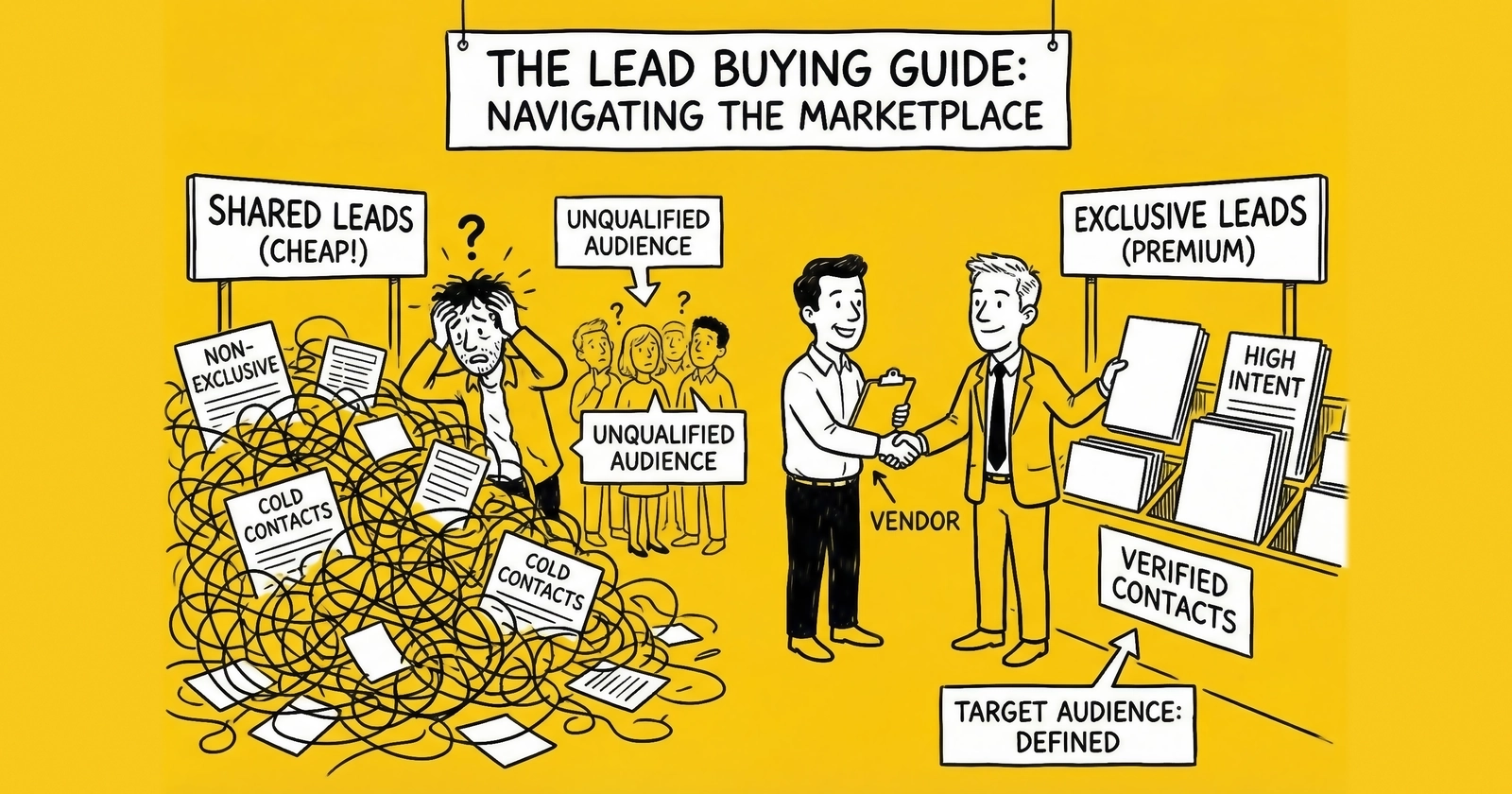
The decision to purchase leads rather than generate them internally represents a strategic inflection point for growing organizations. It trades the control and customization of owned lead generation for speed, scalability, and the ability to convert fixed marketing costs into variable expenses that scale with sales capacity.
Most first-time lead buyers make predictable mistakes that consume budget and damage confidence before campaigns have a fair chance to prove their value. They select vendors based on price alone, underestimate the operational infrastructure required to process purchased leads effectively, or set unrealistic expectations about day-one performance. The pattern repeats so consistently that experienced buyers can spot newcomers by the questions they ask – or fail to ask – during vendor conversations.
This guide exists to accelerate the learning curve that every lead buyer eventually traverses. The frameworks presented here represent accumulated wisdom from organizations that have purchased millions of leads across major verticals including insurance, mortgage, solar, legal, and home services. For a comprehensive understanding of how the lead generation industry works, this context helps frame your entry into the market. Some lessons cost those organizations significantly before crystallizing into the principles shared below.
The economics of lead buying are fundamentally sound when executed properly. Organizations with mature lead buying programs often achieve significantly lower customer acquisition costs than those relying solely on internal generation – primarily because purchasing enables specialization where each party focuses on their comparative advantage. Publishers generate traffic efficiently; buyers convert leads effectively. The arbitrage between these activities creates value captured by both parties.
But sound economics only materialize when buyers approach the discipline systematically. Random vendor selection, inadequate tracking infrastructure, and inconsistent follow-up processes transform potential efficiency gains into expensive lessons. The difference between lead buying success and failure lies less in the leads themselves than in the operational framework surrounding their processing.
Understanding the Lead Buying Landscape
The Three-Tier Marketplace Structure
The lead generation ecosystem operates through a three-tier structure that every buyer should understand before initiating vendor conversations. This architecture explains why the same lead might appear at different prices from different sources, and why quality varies so dramatically across the supply chain.
At the foundation sit publishers – the entities that actually capture consumer information through websites, landing pages, and digital advertising. Publishers invest in traffic acquisition through paid media, content marketing, and affiliate relationships. They own the consumer relationship at the moment of form submission and bear the cost of generating initial interest.
Aggregators occupy the middle tier, purchasing leads from multiple publishers and reselling to end buyers. Aggregators add value through quality normalization, compliance verification, and buyer matching at scale. They maintain relationships with dozens or hundreds of publishers while serving buyers who lack the operational capacity to manage that many vendor relationships directly.
End buyers represent the final tier – the insurance agents, solar installers, mortgage lenders, and service providers who actually convert leads into customers. Buyers may purchase directly from publishers (fewer relationships, potentially better pricing) or through aggregators (one relationship, diversified supply).
Understanding your position in this structure matters because it affects pricing, quality variability, and recourse options. Direct publisher relationships typically offer more consistency and clearer quality attribution. Aggregator relationships provide diversification and simplified vendor management at the cost of an additional margin layer.
| Tier | Role | Value Proposition | Margin Range |
|---|---|---|---|
| Publisher | Creates lead through owned traffic | Traffic generation expertise, compliance documentation | 40-60% of final price |
| Aggregator | Consolidates and redistributes | Quality normalization, buyer matching, scale | 15-30% margin |
| Buyer | Converts lead to customer | Sales capability, customer lifetime value | Remainder after conversion costs |
Lead Types and Pricing Models
Lead purchasing encompasses several distinct product types, each with different economics and operational requirements. Selecting the appropriate lead type depends on your sales capacity, competitive positioning, and conversion capabilities.
Exclusive leads sell to only one buyer, commanding premium pricing in exchange for eliminated competition. When a lead costs $50 in shared configuration, its exclusive equivalent typically runs $150-200 – a 3-4x multiplier reflecting the full capture of conversion opportunity. Exclusive leads make sense when your close rate justifies the premium and your sales process excels at methodical qualification rather than rapid response.
Shared leads distribute to multiple buyers (typically 3-5) at lower individual prices. The shared model creates competitive dynamics requiring fast contact speeds – research from Google and the Corporate Executive Board shows that 35-50% of sales go to the vendor that responds first. If your operation cannot guarantee sub-5-minute contact attempts, shared leads will underperform their potential.
Live transfers connect prospects directly with sales agents via phone, eliminating the lead-to-contact gap entirely. Transfer pricing typically runs $30-100+ per connected call depending on vertical and qualification level. Live transfers achieve the highest conversion rates (15-25% to sale in favorable conditions) but require real-time agent availability and impose higher per-opportunity costs.
Aged leads represent inventory that has exceeded the fresh delivery window – typically 24-90 days old depending on vertical definition. Aged leads price at 60-90% discounts versus fresh equivalents but require different sales approaches. The economics work when your close rate degradation is less severe than the price discount – some organizations build profitable campaigns around aged inventory that competitors dismiss.
| Lead Type | Typical Multiplier vs. Shared | Best For | Operational Requirement |
|---|---|---|---|
| Exclusive | 3-4x | High-touch consultative sales | Strong qualification process |
| Shared | 1x (baseline) | Speed-focused operations | Sub-5-minute contact |
| Live Transfer | 2-3x | Real-time availability | Immediate agent availability |
| Aged | 0.1-0.4x | Persistent nurture capability | Long-term follow-up sequences |
Vendor Evaluation Framework
The Five Criteria for Vendor Assessment
Vendor selection determines campaign success more than any other single factor. Price matters, but price without quality context is meaningless – a $20 lead that never converts costs infinitely more than a $50 lead that closes 10% of the time.
Effective vendor evaluation requires examining five dimensions systematically rather than optimizing on price alone. Organizations that conduct rigorous vendor assessment before campaign launch consistently outperform those selecting vendors primarily on cost basis.
Source transparency reveals where leads actually originate. Reputable vendors can describe their traffic sources with specificity – which advertising platforms, what landing page messages, which targeting parameters. Vendors who deflect sourcing questions or provide vague answers (“various online sources”) often aggregate from questionable supply chains. Ask for sample landing pages and advertising creative to understand the consumer experience generating your leads.
Compliance documentation protects against TCPA liability that ultimately falls on the calling party regardless of lead source. Vendors should provide clear consent language, explain their PEWC capture process, and ideally offer integration with consent verification platforms like TrustedForm or Jornaya. Request sample consent records and verify they meet current regulatory requirements. Though the FCC’s one-to-one consent rule was vacated in January 2025, many sophisticated buyers still require seller-specific consent.
Quality metrics provide historical performance data enabling informed expectations. Reputable vendors share contact rates, duplicate rates, and aggregate conversion statistics (often anonymized across their buyer base). Vendors who cannot or will not share quality metrics likely lack the measurement infrastructure that signals operational maturity.
Return policy terms define recourse when leads fail to meet specifications. Standard policies allow returns within 24-72 hours for invalid contact information, duplicates, and out-of-criteria records. Understand what constitutes acceptable return reasons and what documentation you need to support claims. Vague return policies or excessive restrictions suggest vendors prioritizing volume over quality.
Integration capabilities determine operational efficiency at scale. Real-time API delivery enables immediate lead processing, while email or portal-only delivery creates manual steps and contact delays. Evaluate whether vendor systems can integrate with your CRM and whether they support the tracking parameters you need for campaign attribution.
Questions to Ask Before Signing
The vendor evaluation conversation should be interrogative rather than passive. Vendors expect educated buyers to ask difficult questions – their willingness to answer directly correlates with operational quality.
Regarding lead generation methodology, ask: “Walk me through the consumer journey from ad impression to lead submission. What does the landing page look like? What questions appear on the form? What consent language is displayed?” Vendors who can articulate this process in detail operate with intentionality; those who cannot are either aggregating blindly or obscuring quality problems.
About quality assurance processes, inquire: “What validation occurs before leads reach my system? How do you detect and prevent fraud? What is your historical invalid lead rate for buyers in my vertical?” The answers reveal infrastructure maturity. Sophisticated vendors describe multi-layer validation including phone verification, email validation, duplicate checking, and fraud detection. Basic operations might validate only format compliance.
On performance expectations, clarify: “What contact rate should I expect in the first 48 hours? What close rate do your buyers in my vertical typically achieve? How long before I should evaluate whether leads are performing adequately?” Vendors who set realistic expectations upfront demonstrate honesty that correlates with long-term partnership quality.
Concerning compliance and liability, establish: “Who owns TCPA liability for leads delivered under this agreement? What consent documentation can you provide if I face a legal challenge? Do you integrate with TrustedForm, Jornaya, or similar platforms?” The correct answer places liability thoughtfully and includes robust documentation capabilities. Vendors dismissing compliance concerns create risk that no pricing advantage justifies.
Vendor Recommendation Framework
Rather than prescribing specific vendors (whose quality varies by vertical, geography, and time period), this framework enables systematic comparison across candidates. Score each vendor on a 1-5 scale for each criterion, then weight by importance to your operation.
| Criterion | Weight | Vendor A | Vendor B | Vendor C |
|---|---|---|---|---|
| Source Transparency | 20% | Score | Score | Score |
| Compliance Documentation | 25% | Score | Score | Score |
| Quality Metrics Available | 20% | Score | Score | Score |
| Return Policy Terms | 15% | Score | Score | Score |
| Integration Capabilities | 20% | Score | Score | Score |
| Weighted Total | 100% | – | – | – |
For first-time buyers, prioritize compliance documentation and quality metrics over price optimization. The risks of working with non-compliant or low-quality vendors exceed any savings achieved through aggressive negotiation. As you gain experience and develop quality benchmarks, you can more confidently evaluate price-quality tradeoffs. Our guide on evaluating lead vendors provides a detailed framework for this assessment.
Budget Allocation Templates
Setting Initial Campaign Budgets
First-time lead buyers often make two opposing budget errors: starting too small to generate statistically meaningful data, or committing too much before establishing quality baselines. Neither extreme serves learning objectives well.
The minimum effective budget depends on your vertical’s pricing and the sample size needed for reliable performance assessment. Statistical confidence in conversion rate measurement typically requires 100+ conversions – and if you expect 5% close rates, that means purchasing 2,000+ leads. Back-calculate from there to establish minimum test budgets.
For a mortgage vertical example with $40 average CPL and expected 4% close rate, meaningful testing requires approximately 2,500 leads (100 conversions / 0.04) at $100,000 total investment. Smaller tests may indicate directional performance but lack statistical reliability for confident decision-making.
Organizations with limited initial budgets should narrow vertical or geographic focus rather than spreading thin across multiple campaigns. Better to develop deep understanding of one lead type in one region than superficial data across many.
| Vertical | Typical CPL Range | Target Test Conversions | Assumed Close Rate | Minimum Test Budget |
|---|---|---|---|---|
| Auto Insurance | $15-35 | 100 | 8% | $15,000-40,000 |
| Medicare Insurance | $35-80 | 100 | 6% | $60,000-135,000 |
| Solar | $50-150 | 100 | 5% | $100,000-300,000 |
| Mortgage | $30-75 | 100 | 4% | $75,000-190,000 |
| Home Services | $20-60 | 100 | 10% | $20,000-60,000 |
Multi-Vendor Budget Distribution
Allocating budget across multiple vendors reduces concentration risk and enables comparative performance assessment. However, splitting budget too finely compromises sample size per vendor. For initial campaigns, target 2-3 vendors maximum with minimum 30% budget allocation to each.
The recommended initial distribution concentrates primary spend while maintaining comparison capability and preserving flexibility:
- Primary vendor (50%): Your highest-confidence selection based on evaluation framework
- Secondary vendor (35%): Strong alternative enabling head-to-head comparison
- Reserve/Test (15%): Held for optimization adjustments or testing additional sources mid-campaign
As campaigns mature and performance data accumulates, shift allocation toward proven performers. But maintain some vendor diversity even in steady-state operations – lead quality from any single source can degrade without warning due to traffic source changes, competitive dynamics, or operational issues at the vendor.
Weekly Budget Pacing
Daily and weekly budget management prevents overspending during poor-performance periods and ensures consistent lead flow for sales team capacity planning. Establish weekly caps that align with sales processing capacity, then distribute daily to prevent day-of-week volatility.
For a campaign with $20,000 weekly budget and five sales agents each capable of processing 20 leads daily:
- Daily capacity: 100 leads
- If average CPL is $40, daily budget is $4,000
- Weekly total aligns at $20,000 (5 operating days)
Build in capacity buffers – running at 100% sales capacity consistently leaves no margin for high-volume days or operational interruptions. Most experienced buyers target 70-80% capacity utilization under normal conditions.
Quality Measurement Infrastructure
Metrics That Matter for Lead Buyers
Effective lead buying requires measurement infrastructure tracking leads from purchase through conversion. Without closed-loop reporting, you cannot distinguish vendor quality differences or identify optimization opportunities. The cost of building this infrastructure repays itself within the first campaign cycle.
Contact rate measures the percentage of leads successfully reached through your intended communication channel. For phone-based sales processes, contact rates typically range 25-40% on first-day attempts. Rates significantly below this range indicate data quality problems (wrong numbers, opt-outs, fraud) requiring vendor conversation.
Qualified lead rate tracks the percentage of contacted leads meeting your actual buyer criteria. Not every lead that contact validates represents a genuine opportunity – some may have misrepresented circumstances on the form or changed their situation since submission. Qualified rates below 50% suggest form design problems at the source or targeting mismatches.
Close rate represents the percentage of qualified leads converting to customers. Close rates vary dramatically by vertical, sales capability, and competitive positioning. More important than absolute close rate is relative performance across vendors and over time – directional changes indicate quality shifts requiring investigation.
Customer acquisition cost (CAC) divides total campaign costs (leads, operations, sales) by customers acquired. CAC provides the comprehensive efficiency metric but requires complete cost attribution. Many organizations undercount CAC by excluding overhead, technology, and labor costs – accurate CAC calculation includes everything required to transform purchased leads into paying customers.
Return on investment (ROI) compares customer lifetime value to acquisition cost. Positive unit economics require LTV exceeding CAC by a margin covering overhead and profit requirements. Understanding your LTV enables appropriate CAC targets – you can pay more for leads if customers generate more lifetime revenue. For detailed frameworks on these calculations, see our guides on calculating true cost per lead and measuring true ROI.
| Metric | Calculation | Benchmark Range | Action Trigger |
|---|---|---|---|
| Contact Rate | Contacts / Leads | 25-40% | Below 20% review source |
| Qualified Rate | Qualified / Contacts | 50-70% | Below 40% review targeting |
| Close Rate | Closed / Qualified | Vertical-specific | 30%+ variance triggers review |
| CAC | Total Cost / Customers | LTV / 3 to LTV / 5 | Above LTV indicates negative ROI |
| ROI | (LTV - CAC) / CAC | 100%+ | Below 50% requires optimization |
Building Tracking Infrastructure
Before purchasing leads, establish the tracking systems necessary for meaningful measurement. Retroactive tracking implementation loses data from early campaign periods when learning is most valuable.
CRM integration represents the foundational requirement. Every purchased lead must enter your CRM with source attribution enabling vendor-level analysis. Most CRMs support custom fields for tracking lead source, vendor name, campaign identifier, purchase date, and purchase price. If your CRM lacks these capabilities, consider upgrade before campaign launch.
Disposition tracking records outcomes at each pipeline stage: contacted/not contacted, qualified/disqualified, proposal sent/not sent, closed won/closed lost. Consistent disposition coding enables funnel analysis identifying where leads fall out. Inconsistent or incomplete disposition data makes quality analysis impossible.
Time-to-event measurement tracks elapsed time between key milestones: lead received to first contact attempt, first attempt to successful contact, contact to appointment set, appointment to proposal, proposal to close. Speed metrics identify operational bottlenecks and enable process optimization.
Revenue attribution connects closed deals back to their source leads with actual revenue figures. This connection enables accurate ROI calculation and LTV estimation by lead source. Without revenue attribution, ROI analysis requires assumption-based estimation rather than measured calculation.
Quality Feedback Loops
Quality measurement only creates value when it drives action. Establish systematic feedback loops between your tracking data and vendor management practices.
Weekly quality reviews should examine vendor performance across core metrics. Create standardized scorecards enabling consistent comparison over time. When metrics diverge significantly from baseline or historical patterns, initiate vendor conversations to understand what changed.
Return claim processing converts quality problems into financial recourse. Document invalid leads with specific evidence (call recordings showing disconnected numbers, screenshots of duplicate records, notes explaining qualification failures). Submit returns within policy windows and track claim resolution rates by vendor.
Vendor performance conversations should occur monthly during initial campaigns, transitioning to quarterly as relationships stabilize. Share your quality data transparently – vendors want to understand buyer performance to optimize their operations. Collaborative relationships produce better outcomes than adversarial negotiations.
Campaign Optimization Strategies
First 30 Days: Establish Baselines
Initial campaign periods should focus on baseline establishment rather than aggressive optimization. Resist the urge to make dramatic changes based on early data – small samples produce unreliable indicators that reverse with additional volume.
During weeks one and two, prioritize data collection and operational validation. Confirm leads are flowing correctly to your CRM. Verify disposition tracking is capturing outcomes accurately. Ensure sales processes are executing consistently. Address any integration or process issues before they corrupt larger data samples.
Weeks three and four enable initial quality assessment. By this point you should have enough lead volume for directional indicators. Compare vendor performance on contact rate and qualified rate – these early-funnel metrics reveal quality differences before close rate data becomes statistically meaningful. Note patterns requiring attention without making major allocation shifts yet.
The end of month one should produce documented baselines for each metric and each vendor. These baselines become comparison points for future optimization. Establish tolerance ranges – the normal variation you expect around baseline – to distinguish signal from noise in future periods.
Months 2-3: Optimize Allocation
With baseline data established, begin shifting allocation toward better-performing vendors. Move deliberately rather than dramatically – shift 10-15% of budget at a time rather than making wholesale changes that obscure cause and effect.
Apply diminishing returns logic to allocation decisions. The best vendor deserves more budget, but not unlimited concentration. Quality may degrade as you push any single vendor beyond their optimal volume capacity. Maintain diversification even as you optimize.
Test new vendors during this period while maintaining core performers. The test allocation (15% in initial distribution) enables experimenting with additional sources without disrupting proven channels. Apply the same evaluation framework to new vendors that you used for initial selection.
Implement filter refinements based on qualification patterns. If certain lead attributes correlate with qualification failures, work with vendors to exclude those segments. Geographic restrictions, credit tier filters, and property value minimums represent common refinement targets based on early-funnel quality data.
Ongoing: Continuous Improvement
Mature lead buying operations establish systematic review cycles driving continuous improvement. Monthly performance reviews examine metric trends, vendor rankings, and emerging patterns. Quarterly strategic reviews assess channel mix, budget levels, and vendor relationship health.
A/B testing applies to lead buying just as it does to marketing campaigns. Test different follow-up sequences, contact timing strategies, and nurture content. Test different lead types (exclusive vs. shared) to find optimal configurations. Test pricing negotiations to understand quality-price tradeoffs.
Vendor relationship management becomes increasingly important over time. Strong vendor relationships yield preferential treatment when inventory tightens, advance notice of quality changes, and collaboration on optimization opportunities. Treat vendors as partners rather than adversaries – their success enabling your success creates aligned incentives.
Market monitoring keeps you informed of industry changes affecting lead quality and availability. TCPA regulatory changes, platform policy updates, and competitive dynamics all influence lead market conditions. Organizations that anticipate rather than react to changes maintain competitive advantages.
Common First-Campaign Mistakes
Operational Mistakes
The most damaging mistakes occur outside the lead-buying transaction itself, in the operational framework surrounding lead processing. Speed-to-contact failure represents the most common and most costly operational mistake. The MIT Lead Response Management study found that leads contacted within five minutes are 21 times more likely to qualify than those contacted at thirty minutes. Yet most organizations fail to achieve five-minute contact on purchased leads.
The fix requires operational redesign, not just good intentions. Implement automated routing that delivers leads directly to available agents. Create escalation protocols when primary agents are unavailable. Consider live transfer products if your operation cannot consistently achieve rapid outbound contact.
Inadequate follow-up persistence represents the second major operational failure. Most sales organizations abandon leads after 2-3 unsuccessful contact attempts. Research indicates that optimal contact persistence extends to 6-8 attempts over 10-14 days. Leads that don’t answer today may answer tomorrow – persistence dramatically increases cumulative contact rates.
CRM and process discipline failures corrupt measurement and impede optimization. When sales agents fail to update lead status, skip disposition coding, or work leads outside the CRM, data quality degrades. The resulting analytics become unreliable, making optimization impossible. Invest in training and accountability systems that ensure consistent data hygiene.
Vendor Management Mistakes
Price-focused vendor selection ignores the quality dimension that ultimately determines campaign economics. A $30 lead from a quality vendor may outperform a $20 lead from a questionable source by such margin that the “expensive” leads produce lower customer acquisition cost. Evaluate vendors on total value, not unit price alone.
Insufficient vendor diversification creates concentration risk. When your entire lead volume comes from one source, quality degradation at that source paralyzes your operation. Maintain at least two to three vendors even after performance optimization reveals a clear leader.
Poor communication with vendors prevents collaborative optimization. Vendors need quality feedback to improve their operations. Buyers who share conversion data, return reasons, and qualification patterns enable vendors to optimize traffic sources and targeting. The resulting improvements benefit both parties.
Failure to document agreements creates disputes when expectations diverge. Confirm pricing, caps, return policies, and delivery specifications in written agreements before campaigns launch. Verbal understandings erode over time and provide no recourse when disagreements emerge.
Expectation Mistakes
Unrealistic day-one expectations set campaigns up for premature cancellation. Lead buying programs require optimization time to reach potential – expecting immediate positive ROI ignores the learning curve inherent in any new channel. Budget for three to six months of iteration before assessing long-term viability.
Comparing purchased leads to internal generation without context produces misleading conclusions. Internal leads often benefit from brand familiarity and self-selected intent that purchased leads lack. Fair comparison requires adjusting for these differences or measuring against appropriate benchmarks.
Ignoring lifetime value in ROI calculation understates true campaign economics. Initial purchase margins may appear slim while lifetime value makes economics highly favorable. Understand your LTV by customer source before concluding that lead buying fails to deliver adequate returns.
Key Takeaways
-
Start vendor evaluation with compliance and quality metrics, not price – the cheapest leads often carry the highest total cost when invalid rates, close rates, and liability exposure factor into complete economics.
-
Budget for statistical significance in test campaigns – undersized tests produce unreliable data that misleads optimization efforts. Calculate minimum viable budget based on expected conversion rates and target sample sizes.
-
Speed-to-contact determines shared lead ROI more than any other operational factor – without sub-5-minute contact capability, shared lead economics deteriorate dramatically. Invest in operational infrastructure before scaling purchased lead volume.
-
Build tracking infrastructure before campaign launch – retroactive measurement implementation loses critical early-campaign data. CRM integration, disposition tracking, and revenue attribution should be complete before first leads arrive.
-
Maintain vendor diversification even after identifying top performers – quality from any single source can degrade without warning. Portfolio approaches reduce concentration risk and provide comparison benchmarks.
-
Treat vendors as partners rather than adversaries – collaborative relationships produce quality improvements, preferential treatment, and advance notice of changes that benefit both parties.
-
Plan for three to six month optimization cycles before ROI assessment – lead buying programs require learning time. Premature cancellation based on early results abandons campaigns before they reach potential.
-
Establish systematic review cycles and feedback loops – continuous improvement requires consistent measurement, regular analysis, and actionable insights driving vendor and operational adjustments.
Frequently Asked Questions
How much budget should I allocate to my first lead buying campaign?
Initial campaign budgets should balance statistical significance requirements against risk tolerance. Calculate minimum viable budget by working backward from conversion rate expectations: if you need 100 conversions for reliable data and expect 5% close rates, you need 2,000 leads. Multiply by expected CPL for total budget. For most verticals, meaningful first campaigns require $20,000-100,000+ depending on lead pricing. Organizations with tight budgets should narrow focus to a single vertical or geography rather than spreading thin across multiple campaigns. Underfunded tests produce unreliable data that misleads future decisions.
What close rates should I expect from purchased leads?
Close rates vary dramatically by vertical, lead type, and sales capability. Auto insurance leads typically close at 5-12%, Medicare leads at 4-8%, mortgage leads at 3-6%, solar leads at 3-8%, and home services leads at 8-15%. These ranges assume competent sales operations working fresh leads with appropriate follow-up persistence. Exclusive leads generally convert at 1.5-2x shared lead rates due to eliminated competition. Your actual close rates depend heavily on speed-to-contact, follow-up persistence, and sales skill – operational excellence can double conversion rates from the same lead quality.
How quickly should I contact purchased leads?
Speed-to-contact represents the most controllable variable in purchased lead performance. The MIT Lead Response Management study shows that leads contacted within five minutes are 21 times more likely to qualify than those contacted at thirty minutes. For shared leads competing against multiple buyers, first contact frequently wins the business. Operationally, this requires automated lead routing to available agents, escalation protocols for immediate response, and potentially live transfer products if consistent rapid outbound contact proves difficult to achieve.
Should I start with exclusive or shared leads?
For detailed analysis of this decision, see our guide on exclusive lead buying and whether the premium is worth it. The choice depends on your operational capabilities and sales process characteristics. Shared leads suit organizations with rapid-response call centers capable of consistent sub-5-minute contact. The lower per-lead cost creates favorable unit economics when speed advantages materialize. Exclusive leads fit organizations with consultative sales processes prioritizing thorough qualification over rapid response. The elimination of competition allows methodical engagement without speed pressure. First-time buyers should often start with shared leads to develop speed discipline, then test exclusive leads once operational capabilities mature.
What return policy terms should I expect?
Standard industry return policies allow returns within 24-72 hours for specific qualifying reasons: invalid contact information (disconnected phones, undeliverable emails), duplicate records matching your existing database, and out-of-criteria leads failing to match filter specifications. Documentation requirements typically include call recordings demonstrating unreachable numbers, duplicate match evidence from your CRM, or notes explaining specific qualification failures. Vendors may impose return caps (commonly 10-15% of monthly volume) limiting exposure to systematic return abuse. Negotiate clear return terms before campaign launch and document agreements in writing.
How many vendors should I work with initially?
Start with two to three vendors to enable performance comparison while maintaining meaningful volume with each. Too many vendors spreads budget thin, compromising statistical reliability per source. Too few creates concentration risk and eliminates comparison opportunities. Allocate at minimum 30% of budget to each vendor to generate sufficient data for quality assessment. As campaigns mature and performance differences emerge, shift allocation toward proven performers while maintaining at least two sources for risk mitigation. Expand to additional vendors only after establishing stable performance with initial sources.
When should I evaluate whether lead buying is working?
Allow three to six months for meaningful evaluation. Initial periods establish baselines and identify operational issues. Optimization cycles require additional time to implement and measure. Premature evaluation based on early data frequently leads to incorrect conclusions – both false negatives (abandoning campaigns that would have succeeded with optimization) and false positives (scaling campaigns with temporarily inflated performance). At evaluation point, compare full customer acquisition cost against lifetime value, factoring in all costs including technology, operations, and sales overhead. Positive unit economics with reasonable payback periods indicate successful programs.
How do I handle TCPA compliance for purchased leads?
TCPA liability ultimately falls on the calling party regardless of lead source, making compliance verification essential before purchase. Require vendors to provide consent documentation including clear disclosure language, consumer signature capture, and specific identification of authorized callers. Though the FCC’s one-to-one consent rule was vacated in January 2025, many buyers still require consent specific to each seller rather than blanket multi-seller consent. Request integration with consent verification platforms like TrustedForm or Jornaya providing independent documentation. Maintain your own records linking consent evidence to each lead. When in doubt, consult qualified legal counsel – TCPA violations carry statutory damages of $500-1,500 per call, creating substantial exposure from compliance failures.
What integration capabilities should I require from vendors?
Integration requirements depend on your operational infrastructure and speed-to-contact goals. Minimum capability includes real-time API delivery enabling immediate lead processing – email or portal-only delivery introduces delays degrading contact rates and limiting automation. Verify API documentation quality and support availability for integration troubleshooting. Request webhook notifications for lead delivery confirmation and status updates. Confirm the vendor can include your required tracking parameters (campaign IDs, source identifiers) in lead records for attribution. For mature operations, evaluate bidirectional integration capabilities enabling outcome reporting back to vendors for quality optimization.
This guide reflects lead buying best practices as of January 2026. Market conditions, regulatory requirements, and vendor landscapes evolve continuously. Verify current terms and compliance requirements before implementing any campaign.