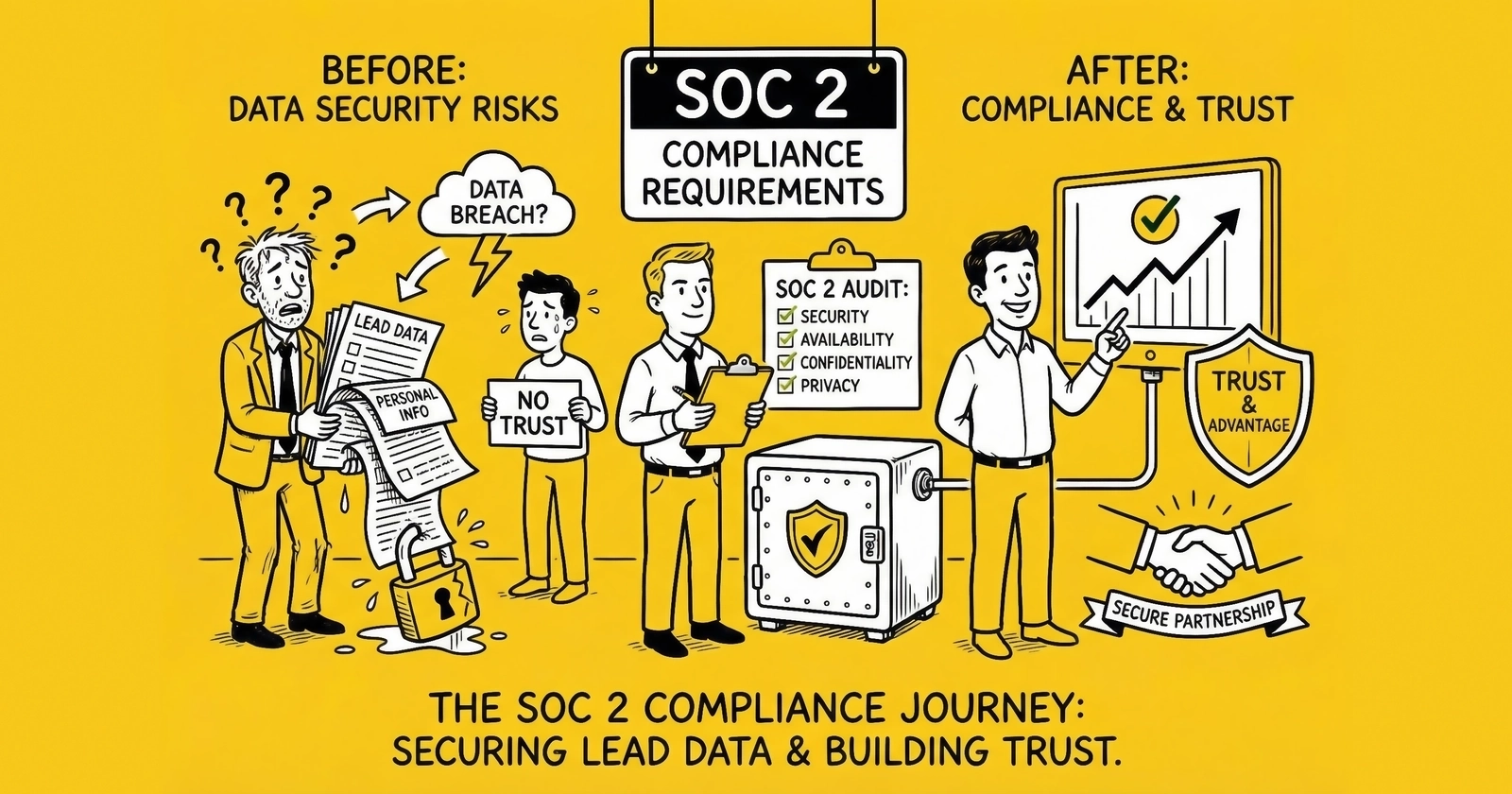
A comprehensive guide to data security certifications, compliance frameworks, and the infrastructure that separates trustworthy lead generation operations from those waiting for a breach that ends their business.
The Breach That Changes Everything
Consider a mid-sized lead generation company processing 2.3 million consumer records annually. Their buyer contracts include standard security representations. Their landing pages display trust badges. Their sales team assures prospects that data is “fully protected.”
Then a misconfigured API endpoint exposes hundreds of thousands of lead records containing names, phone numbers, email addresses, and in some cases, health insurance information and income ranges. The exposure lasts nearly two weeks before a security researcher’s disclosure forces action.
The aftermath: Class action lawsuits citing negligence and state data protection violations. Regulatory investigations in multiple states. Buyer contracts terminated within days, representing the majority of monthly revenue. Enterprise prospects in final contract negotiations walk away permanently.
Total exposure exceeds what cyber insurance can cover. The company files for bankruptcy protection.
This illustrative scenario reflects patterns that repeat across the lead generation industry with disturbing regularity. The difference between companies that survive security incidents and those destroyed by them comes down to one factor: whether they built security infrastructure before they needed it or assumed security was someone else’s problem.
SOC 2 certification has become the dividing line. For sophisticated buyers, it is the minimum threshold for serious consideration. For lead generators, it represents both operational protection and competitive differentiation. This guide covers what SOC 2 requires, how it intersects with other compliance frameworks, and how to build security infrastructure that satisfies enterprise buyers while actually protecting your business.
Understanding SOC 2: The Foundation of Trust
What SOC 2 Actually Means
SOC 2 (System and Organization Controls 2) is an auditing procedure developed by the American Institute of Certified Public Accountants (AICPA) that examines how organizations manage customer data. Unlike regulatory mandates such as HIPAA or PCI DSS, SOC 2 is a voluntary framework that has become a de facto requirement in B2B relationships involving sensitive data.
The framework evaluates organizations against five Trust Services Criteria:
Security (Required): The foundational criterion addressing protection against unauthorized access. This covers network security, access controls, encryption, intrusion detection, and incident response capabilities.
Availability: Systems operate and remain accessible as committed. This addresses uptime guarantees, disaster recovery, business continuity, and performance monitoring.
Processing Integrity: System processing is complete, valid, accurate, timely, and authorized. This covers data quality controls, error handling, and processing validation.
Confidentiality: Information designated as confidential is protected appropriately. This addresses data classification, encryption at rest and in transit, and access restrictions based on data sensitivity.
Privacy: Personal information is collected, used, retained, disclosed, and disposed of in accordance with commitments and regulatory requirements. This overlaps significantly with privacy regulations like CCPA and GDPR.
Every SOC 2 audit addresses Security. Organizations select additional criteria based on their business model and buyer requirements. Lead generation operations typically include Confidentiality and Privacy given the sensitive nature of consumer data.
Type 1 vs. Type 2 Certification
SOC 2 audits come in two types with fundamentally different scopes:
SOC 2 Type 1 examines whether security controls are designed appropriately at a specific point in time. The auditor evaluates your policies, procedures, and systems as they exist on the audit date. Type 1 is essentially a snapshot assessment that answers: “Do you have the right controls in place?”
SOC 2 Type 2 examines whether controls operated effectively over a defined period, typically 6 to 12 months. The auditor not only evaluates control design but tests whether those controls actually functioned as intended throughout the observation period. Type 2 answers: “Did your controls actually work?”
The distinction matters enormously. Type 1 certification can be achieved in 3 to 6 months with appropriate preparation. It demonstrates intent and design but says nothing about operational consistency. Type 2 certification requires a minimum 6-month observation period during which the auditor samples evidence of control operation.
Enterprise buyers increasingly require Type 2 certification because Type 1 has become achievable with sufficient paper documentation regardless of actual security posture. Type 2 cannot be gamed. Either the controls operated effectively throughout the observation period or they did not.
For lead generation operations, the practical recommendation is clear: Start with Type 1 to establish baseline certification quickly, then transition to Type 2 for full credibility. Budget 12 to 18 months from decision to Type 2 certification.
The Audit Process
SOC 2 audits are conducted by licensed CPA firms with information security expertise. The process follows a predictable sequence:
Scoping (4-6 weeks): Define which systems, processes, and Trust Services Criteria fall within audit scope. Scoping decisions significantly impact cost and complexity. Narrow scope is not cheating, it is strategic focus on systems that actually touch customer data.
Readiness Assessment (4-8 weeks): The auditor evaluates current state against SOC 2 requirements and identifies gaps. This assessment produces a remediation roadmap prioritizing issues that must be addressed before the formal audit.
Remediation (8-24 weeks): Address gaps identified in readiness assessment. This phase consumes the most time and resources. Common remediation items include access control improvements, policy documentation, logging implementation, and vendor management formalization.
Type 1 Audit (4-6 weeks): For Type 1, the auditor examines control design as of the specified date. Evidence collection focuses on policies, procedures, system configurations, and organizational charts demonstrating appropriate control structure.
Observation Period (6-12 months): For Type 2, controls must operate continuously during this period. The auditor samples evidence throughout, testing whether controls function consistently rather than sporadically.
Type 2 Audit (4-8 weeks): The auditor completes testing, evaluates evidence, and issues the final report. The report includes a description of your system, management’s assertion about control effectiveness, the auditor’s opinion, and detailed testing results.
Annual Renewal: SOC 2 certification requires annual audits. The Type 2 report is valid for one year. Most organizations maintain continuous compliance rather than treating audits as annual sprints.
What SOC 2 Costs
SOC 2 costs vary significantly based on organization size, scope complexity, and current security posture. Realistic ranges for lead generation operations:
Readiness Assessment: $15,000 to $40,000
Remediation: $30,000 to $150,000 (the largest variable depending on current state)
Type 1 Audit: $25,000 to $75,000
Type 2 Audit: $40,000 to $100,000
Annual Ongoing: $50,000 to $120,000 (audit fees plus continuous compliance operations)
Total First-Year Investment: $70,000 to $265,000 for Type 1; $110,000 to $365,000 through Type 2
These figures exclude internal labor, which can equal or exceed external costs. Organizations without dedicated security personnel should budget for fractional CISO services ($3,000 to $10,000 monthly) or a full-time security hire ($120,000 to $200,000 annually including benefits).
The ROI calculation is straightforward for operations pursuing enterprise buyers. A single enterprise contract worth $200,000 annually justifies the entire first-year investment. Loss of that contract due to security concerns or a breach dwarfs certification costs.
SOC 2 in the Lead Generation Context
Why Buyers Demand SOC 2
Lead buyers increasingly require SOC 2 certification from their vendors for reasons rooted in their own risk management:
Downstream Liability: When a buyer’s lead vendor suffers a breach, the buyer faces regulatory scrutiny, consumer lawsuits, and reputational damage even though they did not control the compromised systems. This is why evaluating lead vendors on security criteria is essential. SOC 2 provides documented due diligence demonstrating the buyer exercised appropriate vendor oversight.
Regulatory Pressure: Industries like insurance, financial services, and healthcare face their own compliance requirements that extend to vendor management. HIPAA requires covered entities to ensure business associates implement appropriate safeguards. State insurance regulations require data security standards for licensees and their vendors. SOC 2 satisfies these vendor management requirements efficiently.
Incident Response: When breaches occur, organizations with SOC 2-certified vendors can demonstrate they selected vendors meeting recognized security standards. This documentation reduces regulatory penalties and supports insurance claims.
Procurement Standardization: Enterprise procurement teams need standardized evaluation criteria. SOC 2 provides a common language for security assessment without requiring custom audits of each vendor.
What SOC 2 Means for Lead Operations
For lead generation businesses, SOC 2 certification requires attention to several operational areas:
Access Control Architecture: Who can access lead data and how? SOC 2 requires documented access policies, role-based permissions, regular access reviews, and prompt deprovisioning when employees depart. Multi-factor authentication is effectively required for systems containing consumer data.
Encryption Standards: Lead data must be encrypted both in transit and at rest. TLS 1.2 or higher for data transmission is the minimum standard. Database encryption, key management procedures, and documentation of encryption coverage fall within scope.
Change Management: Modifications to systems processing lead data must follow documented procedures including testing, approval, and rollback capabilities. This affects everything from landing page updates to distribution platform configuration changes.
Vendor Management: Third-party services touching lead data – consent verification platforms, fraud detection services, delivery endpoints – require security evaluation and ongoing monitoring. Your SOC 2 scope includes oversight of your vendors’ security posture.
Incident Response: Documented procedures for detecting, responding to, and recovering from security incidents. This includes breach notification protocols, forensic capabilities, and communication plans.
Logging and Monitoring: Comprehensive audit trails for access to lead data, system changes, and security events. Logs must be protected from tampering and retained for periods supporting incident investigation.
Physical Security: Even for cloud-hosted operations, physical security of endpoints accessing lead data matters. Laptop encryption, mobile device management, and facility access controls fall within scope.
Building SOC 2-Ready Infrastructure
Lead generation operations can architect for SOC 2 compliance from the outset, reducing certification costs and timeline:
Cloud Platform Selection: Major cloud providers (AWS, Google Cloud, Azure) maintain their own SOC 2 certifications covering infrastructure security. Building on certified platforms inherits their security controls, narrowing your audit scope to application-layer and operational concerns.
Identity Management: Implement centralized identity management from day one. Solutions like Okta, Azure AD, or Google Workspace provide single sign-on, multi-factor authentication, and access logging that satisfy multiple SOC 2 controls simultaneously.
Lead Distribution Platform Security: Evaluate distribution platforms on security capabilities. Boberdoo, LeadsPedia, and similar platforms offer role-based access controls, API authentication, encryption, and audit logging. Document platform security features as part of your SOC 2 evidence.
Data Classification: Establish data classification policies distinguishing consumer PII from operational data. Apply access restrictions, encryption requirements, and retention policies based on classification. Lead data containing SSNs or health information requires higher protection than contact information alone.
Secure Development Practices: If building custom landing pages or integration code, implement secure development lifecycle practices including code review, vulnerability scanning, and separation of development and production environments.
Beyond SOC 2: The Compliance Ecosystem
SOC 2 does not exist in isolation. Lead generation operations face overlapping compliance frameworks depending on verticals served, buyer requirements, and jurisdictions of operation.
HIPAA for Health-Related Leads
The Health Insurance Portability and Accountability Act applies when lead generation involves protected health information (PHI). This includes Medicare leads where health conditions are captured, health insurance leads with medical history, and any lead data combined with health-related information.
HIPAA requirements exceed SOC 2 in several areas:
Business Associate Agreements: Lead generators handling PHI must execute Business Associate Agreements with covered entities (insurance carriers, healthcare providers) and their own vendors.
PHI Safeguards: Specific technical, administrative, and physical safeguards prescribed by HIPAA may exceed general SOC 2 security requirements.
Breach Notification: HIPAA mandates specific notification timelines (60 days to individuals, immediate to HHS for breaches exceeding 500 records) that exceed general SOC 2 incident response requirements.
Retention and Disposal: HIPAA requires six-year retention of certain records and documented disposal procedures for PHI.
For Medicare lead generation, the October 2024 CMS marketing rules added consent documentation requirements that intersect with both HIPAA and TCPA compliance. Organizations in this vertical face the most complex compliance landscape in the industry.
PCI DSS for Payment Processing
The Payment Card Industry Data Security Standard applies if your operation processes, stores, or transmits payment card data. In lead generation, this typically arises with premium content offers requiring payment, subscription services with billing components, or lead purchase transactions processed through your systems.
PCI DSS is prescriptive where SOC 2 is flexible. The standard specifies exact requirements for network segmentation, encryption algorithms, password complexity, and dozens of other controls. Non-compliance can result in card brand fines, increased processing fees, and loss of payment processing capability.
Most lead generation operations can avoid PCI DSS scope by using hosted payment solutions (Stripe, PayPal) that handle card data without it touching your systems. This approach is strongly recommended unless payment processing is core to your business model.
State Privacy Laws
The California Consumer Privacy Act (CCPA), as amended by CPRA, establishes data protection requirements for businesses handling California residents’ personal information. Similar laws in Virginia, Colorado, Connecticut, Utah, Texas, and other states create a patchwork of privacy obligations.
Key privacy law requirements intersecting with SOC 2:
Data Inventory: Understanding what personal information you collect, where it resides, and how it flows through your systems.
Access and Deletion Rights: Technical capabilities to respond to consumer requests for data access, deletion, and portability.
Data Minimization: Collecting only information necessary for stated purposes and retaining it only as long as necessary.
Vendor Contracts: Specific contractual provisions with service providers processing personal information.
SOC 2’s Privacy criterion aligns closely with these requirements. Organizations pursuing SOC 2 with Privacy included can satisfy significant portions of state privacy law compliance simultaneously.
TCPA and Consent Documentation
While TCPA compliance is covered extensively elsewhere, its intersection with data security warrants mention. Consent documentation represents sensitive data requiring protection:
Consent Certificates: TrustedForm and Jornaya certificates contain personally identifiable information and must be secured appropriately.
Retention Security: Five to seven year consent retention requirements mean PII persists in your systems longer than many other data categories, increasing breach exposure.
Access Logging: Demonstrating consent existed at time of contact requires audit trails showing who accessed consent records and when.
SOC 2 controls supporting TCPA compliance include access logging, data retention policies, and encryption of stored consent documentation.
Implementing Security Infrastructure
The Security Stack for Lead Generation
A complete security infrastructure for lead generation operations comprises multiple layers:
Network Security Layer
Firewall configuration controlling inbound and outbound traffic. Web application firewalls (WAF) protecting landing pages and APIs from common attacks. DDoS protection preventing service disruption. Network segmentation isolating systems containing sensitive data.
For cloud-hosted operations, these controls are typically provided by the cloud platform (AWS WAF, CloudFlare, Google Cloud Armor) rather than implemented independently.
Identity and Access Management Layer
Centralized identity provider (Okta, Azure AD, Google Workspace) managing authentication across all systems. Multi-factor authentication required for all users accessing systems containing lead data. Role-based access control limiting permissions to job requirements. Privileged access management with additional controls for administrative accounts.
Application Security Layer
Secure development practices for custom code including code review, static analysis, and vulnerability scanning. Input validation on all forms and APIs preventing injection attacks. Session management preventing session hijacking. Output encoding preventing cross-site scripting.
Data Protection Layer
Encryption in transit using TLS 1.2 or higher for all data transmission. Encryption at rest for databases, file storage, and backups. Key management procedures ensuring encryption keys are protected and rotated appropriately. Data masking limiting exposure of full records in development and testing environments.
Logging and Monitoring Layer
Centralized log aggregation collecting events from all systems. Security information and event management (SIEM) correlating events and detecting anomalies. Alerting on security-relevant events requiring investigation. Log retention meeting audit and incident investigation requirements.
Endpoint Security Layer
Endpoint detection and response (EDR) on all devices accessing lead systems. Mobile device management for phones and tablets. Laptop encryption preventing data exposure from device theft. Patch management ensuring operating systems and applications remain current.
Backup and Recovery Layer
Regular backups of lead data and system configurations. Backup encryption matching production data protection. Tested recovery procedures validating backup integrity. Geographic separation of backups for disaster recovery.
Prioritizing Security Investments
Not all security controls provide equal value. For lead generation operations, prioritize investments based on risk and audit requirements:
Tier 1: Immediate Requirements (Implement Before Collecting Data)
- Multi-factor authentication on all systems
- Encryption in transit (TLS) for all landing pages and APIs
- Encryption at rest for databases
- Access logging for systems containing lead data
- Endpoint encryption for all laptops
Tier 2: Foundational Controls (Implement Within 90 Days)
- Centralized identity management
- Role-based access control with regular reviews
- Vulnerability scanning on a recurring schedule
- Incident response procedures documented
- Vendor security assessment program
Tier 3: Maturity Controls (Implement Within 180 Days)
- SIEM implementation with alerting
- Endpoint detection and response
- Penetration testing (annual at minimum)
- Security awareness training program
- Business continuity and disaster recovery testing
Tier 4: Advanced Capabilities (Ongoing Investment)
- Data loss prevention (DLP) technologies
- Advanced threat protection
- Red team exercises
- Continuous security monitoring (SOC)
Vendor Security Management
Lead generation operations depend on numerous vendors: distribution platforms, consent verification services, fraud detection, delivery endpoints, cloud providers, and more. Each vendor with access to lead data represents potential security exposure.
Effective vendor management includes:
Security Assessment Before Engagement: Review vendor SOC 2 reports, security questionnaires, and compliance certifications before sharing lead data. Major platforms like Boberdoo, LeadsPedia, TrustedForm, and Jornaya maintain SOC 2 certifications. Verify currency and scope.
Contractual Security Requirements: Include security provisions in vendor contracts specifying data protection obligations, breach notification requirements, and audit rights. Standard service agreements may not adequately address security.
Ongoing Monitoring: Review vendor SOC 2 reports annually. Monitor security news for vendor breaches. Maintain an inventory of vendor access to your data and systems.
Fourth-Party Risk: Your vendors have their own vendors. Understand the chain of custody for your data. SOC 2 reports typically describe the vendor’s sub-service organizations and their security oversight.
The Business Case for Security Investment
Competitive Differentiation
In a market where many lead generators treat security as an afterthought, certification provides meaningful differentiation:
RFP Advantage: Enterprise buyers use SOC 2 as a filtering criterion. Lack of certification eliminates you from consideration before substantive evaluation begins.
Pricing Power: Security-certified vendors can command premium pricing. Buyers expect to pay more for reduced risk. The premium typically exceeds certification costs.
Retention: Buyers invest in vendor security reviews and integration. Once satisfied with your security posture, switching costs discourage churn.
Risk Mitigation
The financial case for security investment becomes clearer when quantifying breach exposure:
Average Cost of Data Breach (2024): $4.88 million according to IBM’s Cost of a Data Breach Report. Lead generation breaches involving consumer PII typically exceed average costs due to regulatory penalties and class action exposure.
Cyber Insurance Limitations: Policies exclude claims arising from negligent security practices. Without documented controls, coverage may be denied when needed most.
Business Interruption: Breach response consumes executive attention for months. Buyer departures, revenue decline, and reputational damage compound direct costs.
Regulatory Penalties: State privacy laws authorize penalties up to $7,500 per violation in California. HIPAA violations can reach $1.5 million per violation category. Accumulated penalties for a significant breach can exceed $50 million.
Comparing these exposures to $150,000 to $300,000 annual security investment makes the ROI calculation straightforward.
Buyer Requirements Evolution
Buyer security requirements are tightening, not relaxing:
Insurance Carriers: Major carriers increasingly mandate SOC 2 Type 2 certification for lead vendors. Some require attestation before contract execution; others allow a remediation period but make certification a condition of renewal.
Enterprise Buyers Generally: Procurement teams standardize on SOC 2 as the baseline. Custom security assessments are expensive for buyers; accepting SOC 2 reduces their vendor management burden.
Aggregators and Exchanges: Lead exchanges and aggregation platforms face their own buyer pressure. They transfer that pressure to their suppliers. A lead exchange requiring SOC 2 from members creates cascading compliance requirements throughout their network.
Operations that delay certification find themselves increasingly constrained in buyer selection. The most valuable buyers leave; those remaining are often those with weaker security focus and correspondingly higher risk profiles.
Implementation Roadmap
Phase 1: Assessment and Planning (Weeks 1-8)
Week 1-2: Executive Alignment
Secure commitment from leadership for SOC 2 certification timeline and budget. Assign executive sponsor and project lead. Establish steering committee including representatives from IT, operations, legal, and finance.
Week 3-4: Current State Assessment
Inventory systems touching lead data. Document existing security controls. Identify obvious gaps against SOC 2 requirements. Evaluate vendor security posture.
Week 5-6: Scope Definition
Define Trust Services Criteria to include (Security required; Availability, Confidentiality, Privacy based on buyer requirements). Define system boundaries – which systems fall within audit scope. Document sub-service organizations (vendors) and their security certifications.
Week 7-8: Readiness Assessment
Engage SOC 2 auditor or readiness consultant. Complete formal gap analysis against selected criteria. Prioritize remediation items. Develop remediation timeline and resource plan.
Phase 2: Remediation (Weeks 9-24)
Week 9-12: Policy Development
Document information security policy covering all SOC 2 control areas. Develop supporting procedures for access management, incident response, change management, and vendor oversight. Create employee handbook sections addressing security responsibilities.
Week 13-16: Technical Controls
Implement multi-factor authentication across all systems. Configure encryption for data at rest where gaps exist. Deploy logging and monitoring solutions. Remediate vulnerability scan findings.
Week 17-20: Operational Controls
Conduct access reviews and remove unnecessary permissions. Establish vendor security assessment program. Implement change management procedures. Train personnel on security policies and procedures.
Week 21-24: Testing and Validation
Conduct internal audit of control operation. Perform penetration testing. Test incident response procedures. Validate disaster recovery capabilities.
Phase 3: Type 1 Audit (Weeks 25-30)
Week 25-26: Pre-Audit Preparation
Compile evidence for all controls. Conduct management review of audit readiness. Address any remaining remediation items.
Week 27-29: Type 1 Audit Fieldwork
Auditor examines control design. Evidence review and control testing. Management interviews and walkthrough sessions.
Week 30: Report Issuance
Auditor issues Type 1 report. Address any identified exceptions. Begin marketing certification to buyers.
Phase 4: Type 2 Transition (Months 8-18)
Months 8-14: Observation Period
Operate controls continuously. Maintain evidence of control operation. Address any control gaps identified during operation.
Month 15-16: Type 2 Audit Preparation
Compile evidence from observation period. Conduct readiness review. Address any drift from Type 1 control design.
Month 17-18: Type 2 Audit Fieldwork and Report
Auditor tests control operation throughout observation period. Issue Type 2 report. Establish annual audit cycle.
Common Mistakes and How to Avoid Them
Mistake 1: Scope Creep
Organizations often include systems in audit scope that do not touch customer data, dramatically increasing cost and complexity without corresponding value.
What to do instead: Define scope based on data flows. Map how lead data enters, moves through, and exits your systems. Only systems actually touching lead data require inclusion in scope. Marketing automation for internal newsletters does not belong in SOC 2 scope.
Mistake 2: Documentation Theater
Creating policies that exist on paper but are not followed in practice. Auditors testing control operation will discover the gap, and Type 2 audits will fail.
What to do instead: Write policies that reflect actual operations. If your real access review frequency is quarterly, document quarterly reviews rather than monthly reviews you will not perform. Auditors prefer honest, achievable controls to aspirational policies violated in practice.
Mistake 3: Ignoring Vendor Risk
Assuming vendor SOC 2 certifications extend to your operations automatically. Your SOC 2 audit includes your vendor oversight program, not your vendors’ internal controls.
What to do instead: Develop a formal vendor management program that includes initial security assessment before engagement, annual review of vendor SOC 2 reports, contractual security requirements, and monitoring for vendor security incidents.
Mistake 4: Treating Certification as a Project
Achieving certification then letting controls atrophy until the next audit. Security incidents do not wait for convenient timing.
What to do instead: Build continuous compliance into operations. Monthly access reviews. Quarterly vulnerability scans. Ongoing security monitoring. Annual penetration testing. The audit becomes a validation exercise rather than a remediation sprint.
Mistake 5: Underestimating Internal Effort
Assuming the auditor handles everything. SOC 2 requires extensive evidence collection, system configuration, and organizational change that consumes significant internal resources.
What to do instead: Budget 0.5 to 1.0 FTE of internal effort during remediation and audit periods. Assign clear ownership for each control area. Establish a compliance calendar with ongoing responsibilities.
Frequently Asked Questions
1. What is SOC 2 certification and why does it matter for lead generation?
SOC 2 (System and Organization Controls 2) is an auditing framework developed by the American Institute of Certified Public Accountants that evaluates how organizations protect customer data. It examines controls across five Trust Services Criteria: Security, Availability, Processing Integrity, Confidentiality, and Privacy. For lead generation, SOC 2 matters because it has become the de facto standard for enterprise buyers evaluating vendor security. Insurance carriers, large agencies, and sophisticated lead buyers increasingly require SOC 2 certification as a condition of doing business. The certification demonstrates that your organization has implemented appropriate controls to protect the consumer data flowing through your systems.
2. What is the difference between SOC 2 Type 1 and Type 2 certification?
SOC 2 Type 1 examines whether security controls are appropriately designed at a specific point in time. The auditor evaluates your policies, procedures, and systems as they exist on the audit date. Type 2 examines whether those controls actually operated effectively over a defined period, typically 6 to 12 months. Type 1 answers “do you have the right controls?” while Type 2 answers “did your controls actually work?” Enterprise buyers increasingly require Type 2 because it cannot be achieved through documentation alone. The observation period requires controls to function consistently over months, providing much stronger assurance than the point-in-time Type 1 snapshot.
3. How much does SOC 2 certification cost for a lead generation company?
Costs vary based on organization size, scope complexity, and current security posture. Realistic ranges for lead generation operations include $15,000 to $40,000 for readiness assessment, $30,000 to $150,000 for remediation depending on current state, $25,000 to $75,000 for Type 1 audit fees, and $40,000 to $100,000 for Type 2 audit fees. Total first-year investment typically ranges from $110,000 to $365,000 through Type 2 certification. Annual ongoing costs run $50,000 to $120,000 including audit fees and continuous compliance operations. These figures exclude internal labor, which can equal or exceed external costs. Organizations without dedicated security personnel should budget for fractional CISO services at $3,000 to $10,000 monthly.
4. How long does it take to achieve SOC 2 certification?
Type 1 certification can be achieved in 6 to 8 months with appropriate preparation. This includes 8 weeks for assessment and planning, 16 weeks for remediation, and 6 weeks for the audit process. Type 2 certification requires an additional 6 to 12 month observation period after Type 1. The practical timeline from initial decision to Type 2 certification is 12 to 18 months for most lead generation operations. Organizations with strong existing security practices may move faster; those starting from minimal security infrastructure may require longer remediation periods.
5. Which SOC 2 Trust Services Criteria should lead generation companies include?
Security is required for all SOC 2 audits. Lead generation operations should typically include Confidentiality and Privacy given the sensitive nature of consumer data. Confidentiality addresses protection of information designated as confidential through access restrictions and encryption. Privacy addresses collection, use, retention, and disclosure of personal information in accordance with privacy commitments and regulations. Availability is important for operations with uptime commitments in buyer contracts. Processing Integrity matters for operations where lead data accuracy is contractually guaranteed. Most lead generation companies start with Security, Confidentiality, and Privacy, adding other criteria based on specific buyer requirements.
6. How does SOC 2 interact with HIPAA for health insurance and Medicare leads?
HIPAA applies when lead generation involves protected health information, including Medicare leads with health conditions and health insurance leads with medical history. HIPAA requirements exceed SOC 2 in several areas including mandatory Business Associate Agreements, specific technical and administrative safeguards, prescribed breach notification timelines, and six-year record retention. SOC 2 certification demonstrates strong security practices but does not satisfy HIPAA compliance alone. Organizations handling health-related leads need both: SOC 2 for general buyer requirements and HIPAA compliance for regulatory obligations. The October 2024 CMS marketing rules added consent documentation requirements creating the most complex compliance landscape in the lead generation industry.
7. What security controls are most important for lead generation operations?
Priority controls for lead generation include multi-factor authentication on all systems accessing lead data, encryption in transit using TLS 1.2 or higher for all landing pages and APIs, encryption at rest for databases containing consumer information, centralized identity management with role-based access control, comprehensive logging of access to lead data, endpoint encryption on all devices, documented incident response procedures, and formal vendor security assessment programs. These controls address the primary attack vectors for lead data exposure: unauthorized access, interception during transmission, theft of devices containing data, and compromise through vendors with access to your systems.
8. How do state privacy laws like CCPA affect lead generation security requirements?
State privacy laws including CCPA, CPRA, and similar laws in Virginia, Colorado, Connecticut, Utah, Texas, and other states create data protection requirements overlapping with SOC 2. Key requirements include data inventory understanding what personal information you collect and where it resides, technical capabilities for consumer access and deletion requests, data minimization collecting only necessary information and retaining it only as long as needed, and specific contractual provisions with service providers. SOC 2’s Privacy criterion aligns closely with these requirements. Organizations pursuing SOC 2 with Privacy included satisfy significant portions of state privacy law compliance simultaneously. The patchwork of state laws makes comprehensive security infrastructure more valuable than jurisdiction-specific compliance efforts.
9. Can we use our cloud provider’s SOC 2 certification instead of getting our own?
No. Cloud provider certifications (AWS, Google Cloud, Azure) cover infrastructure security but do not extend to your application, operations, or data handling practices. These providers operate on a shared responsibility model: they secure the infrastructure; you secure everything you build on it. However, building on SOC 2-certified platforms reduces your audit scope. The cloud provider’s controls for physical security, network infrastructure, and foundational services are inherited. Your audit focuses on application security, access management, operational procedures, and oversight of your vendors. Reference the cloud provider’s SOC 2 report in your own documentation, but you still need your own certification covering your layer of the stack.
10. What happens if we have a data breach while pursuing SOC 2 certification?
A breach during the certification process does not automatically prevent certification, but it significantly complicates the situation. The auditor will examine your incident response, how you detected the breach, containment measures, root cause analysis, and remediation steps. Effective incident handling can actually demonstrate control operation. However, if the breach reveals fundamental control failures, certification may be delayed until remediation is complete. The more important concern is business impact. A breach during certification may accelerate buyer departures and complicate insurance claims. This reality underscores why security infrastructure should precede, not follow, certification pursuit. Build the controls because they protect your business, then demonstrate them through certification.
Key Takeaways
-
SOC 2 Type 2 has become the minimum standard for enterprise lead buyers. Insurance carriers, large agencies, and sophisticated buyers increasingly require Type 2 certification before contract execution. Organizations without certification face shrinking buyer options concentrated among lower-value, higher-risk counterparties.
-
Type 1 and Type 2 differ fundamentally. Type 1 examines control design at a point in time; Type 2 examines control operation over 6 to 12 months. Start with Type 1 for initial certification, then transition to Type 2 for full credibility. Budget 12 to 18 months from decision to Type 2 certification.
-
Total first-year investment ranges from $110,000 to $365,000. This includes readiness assessment, remediation, audit fees, and technology investments. Annual ongoing costs run $50,000 to $120,000. These figures exclude internal labor, which can equal or exceed external costs.
-
Scope definition determines cost and complexity. Include only systems actually touching lead data in audit scope. Marketing automation for internal communications, development environments without production data, and administrative systems unrelated to lead processing do not require inclusion.
-
SOC 2 overlaps with but does not replace other compliance frameworks. HIPAA applies to health-related leads with requirements exceeding SOC 2. State privacy laws require specific consumer rights capabilities. PCI DSS applies if processing payment cards. Build comprehensive compliance programs addressing all applicable frameworks.
-
Priority security controls include MFA, encryption, access logging, and vendor management. These controls address primary attack vectors and satisfy multiple SOC 2 requirements simultaneously. Implement before collecting lead data rather than retrofitting after exposure.
-
Continuous compliance beats annual audit sprints. Build security operations into normal business processes. Monthly access reviews, quarterly vulnerability scans, ongoing monitoring. The annual audit becomes validation rather than remediation.
-
Breach costs vastly exceed certification costs. Average data breach cost reached $4.88 million in 2024. Regulatory penalties can reach tens of millions. Cyber insurance excludes negligent security practices. The ROI calculation for security investment is unambiguous.
-
Documentation must reflect actual operations. Policies that exist on paper but are not followed will fail Type 2 audits. Write achievable controls and follow them consistently rather than aspirational policies violated in practice.
-
Start now. Buyer requirements are tightening. The 12 to 18 month timeline to Type 2 certification means decisions made today affect competitive position in 2026. Organizations that delay certification find themselves increasingly constrained as valuable buyers concentrate among certified vendors.
Building Security Before You Need It
The lead generation company that filed for bankruptcy did not lack security awareness. They had security represented in their contracts. They had trust badges on their landing pages. They had assurances ready for any buyer who asked.
What they lacked was infrastructure. The actual controls, systems, and processes that protect data against unauthorized access, detect breaches when they occur, and provide evidence of security practices when litigation arrives.
SOC 2 certification is not about creating documentation to satisfy auditors. It is about building the security infrastructure your business needs to survive in an environment where breaches end companies, buyers demand proof of protection, and the cost of security failure vastly exceeds the cost of security investment.
Those who thrive treat security as core business infrastructure, not as overhead or checkbox compliance. They invest the $150,000 to $300,000 annually because they understand the alternative is $12 million in breach exposure with inadequate insurance coverage and buyer contracts that evaporate when protection matters most.
Those who fail assume security is someone else’s problem until a misconfigured endpoint, a compromised vendor, or a malicious actor makes it their problem in the most expensive possible way.
Build the infrastructure. Pursue the certification. The leads flowing through your systems represent consumer trust. The buyers sending you volume represent business relationships built on confidence. Both deserve protection that exists beyond representations in contracts and badges on landing pages.
Your security posture is not a competitive advantage. It is a survival requirement. Build it before you need it.
This article reflects compliance frameworks and industry practices as of late 2025. Security requirements evolve through regulatory changes, industry standards updates, and buyer expectations. Consult qualified information security and legal counsel for current requirements specific to your operations.
Related Resources: