The practical roadmap from zero to profitable lead generation affiliate – including capital requirements, traffic strategies, compliance essentials, and the operational realities most guides conveniently skip.
Introduction: What a Lead Gen Affiliate Business Actually Requires
You want to start a lead generation affiliate business. The appeal is obvious: lower capital requirements than building your own lead generation operation, no need to establish buyer relationships from scratch, and the ability to monetize traffic acquisition skills without managing complex fulfillment infrastructure.
The lead generation affiliate model works. Thousands of operators build meaningful income connecting consumer traffic to lead offers. But the model works differently than most newcomers expect, and the failure rate among new entrants remains high – industry estimates suggest only around 5% of new affiliates achieve sustainable profitability within their first year.
This guide covers what you actually need to launch and grow a lead generation affiliate business in 2026. The numbers are realistic. The timelines are honest. The operational requirements reflect how this business actually functions, not how course sellers describe it.
If you finish this guide and decide the affiliate path is not for you, that is a good outcome. Better to know now than after depleting your capital and spending months on an ill-suited model. If you finish and still want to proceed, you will have a blueprint grounded in operational reality.
What Is a Lead Generation Affiliate Business?
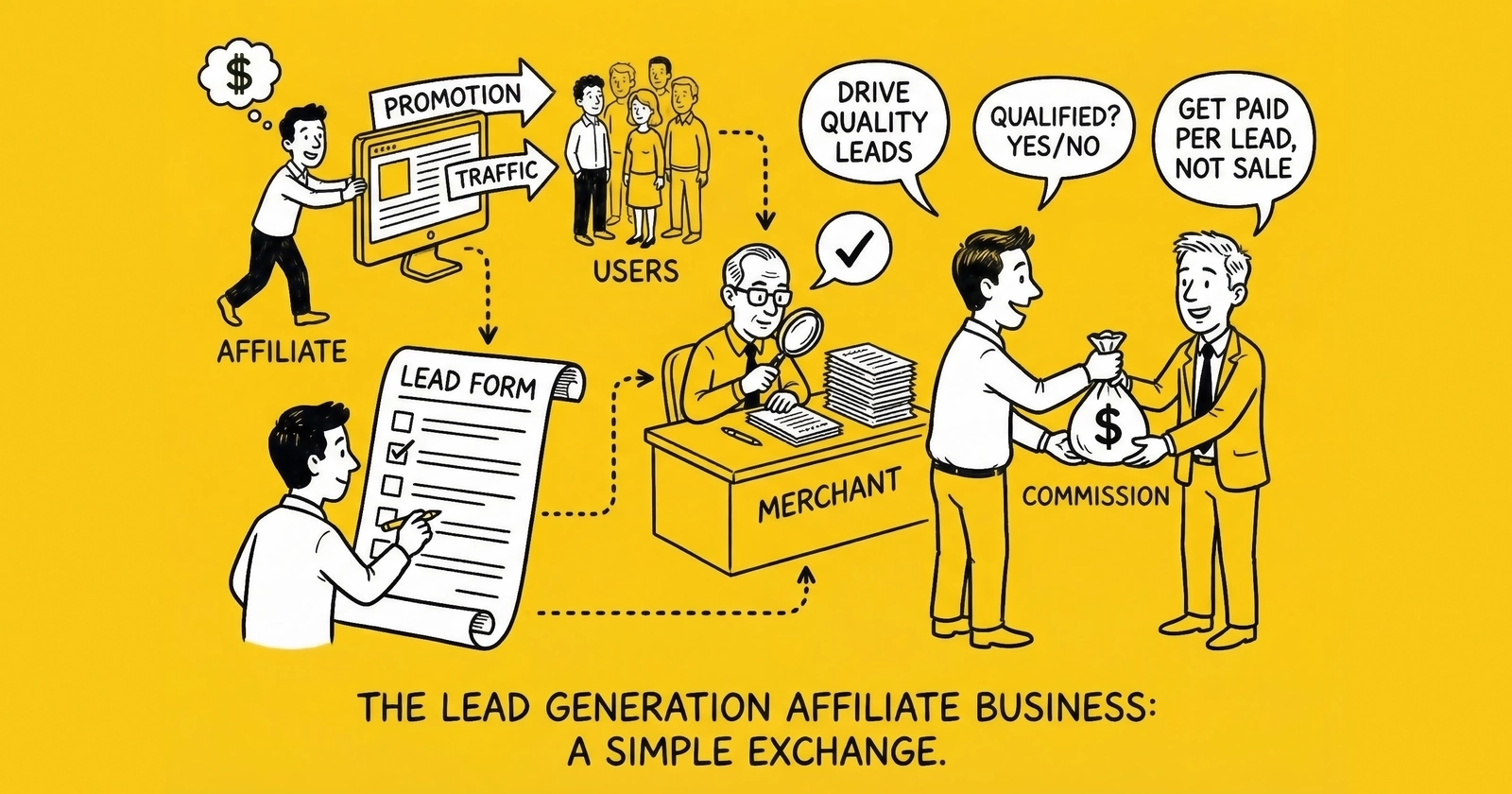
A lead generation affiliate business generates traffic and directs it to lead capture offers operated by someone else – typically networks, aggregators, or direct advertisers. When visitors convert into leads on those offers, you earn a commission, usually structured as cost-per-lead (CPL) or cost-per-acquisition (CPA).
The Core Distinction: Affiliate vs. Direct Generator
Understanding this distinction matters because it shapes every aspect of your operation.
Direct lead generators own the entire funnel. They build landing pages, capture consumer data, document consent, manage compliance infrastructure, and sell leads directly to buyers. They absorb all risk and capture all margin. Capital requirements typically range from $25,000 to $100,000 for meaningful operation.
Lead generation affiliates own only the traffic acquisition. You drive visitors to offers operated by networks or advertisers. They handle landing pages, forms, consent capture, compliance, and buyer relationships. You earn a percentage of the lead value – typically 15-40% less than what direct generators capture – but you avoid the operational complexity and compliance liability they absorb.
The affiliate model trades margin for simplicity. This trade-off makes sense for operators who excel at traffic acquisition but lack the capital, relationships, or risk tolerance for full lead generation operations.
How the Economics Work
The math is straightforward in concept, challenging in execution.
You acquire traffic at a cost (your cost-per-click or CPM). You send that traffic to offers that pay when visitors convert. Your profit is the difference between what you spend and what you earn.
Example Economics:
| Metric | Value |
|---|---|
| Traffic cost per click | $0.85 |
| Click-to-conversion rate | 4.5% |
| Effective cost per lead | $18.89 |
| Offer payout per lead | $28.00 |
| Gross profit per lead | $9.11 |
| Margin | 32.5% |
This example shows profitable unit economics. The challenge: achieving and maintaining these numbers consistently across campaigns, traffic sources, and market conditions.
The Affiliate Ecosystem
Lead generation affiliates operate within a structured ecosystem:
Affiliate Networks aggregate offers from multiple advertisers and provide affiliates with tracking, reporting, and payment infrastructure. Major lead generation networks include MaxBounty, Perform[cb], Aragon Advertising, and vertical-specific networks in insurance, mortgage, solar, and other sectors. Networks typically take 10-30% of advertiser payouts as their margin, meaning your effective payout is lower than what the advertiser actually pays.
Direct Advertiser Programs cut out the network intermediary. Large lead buyers like EverQuote, MediaAlpha, Quinstreet, and vertical-specific companies operate affiliate programs directly. Direct programs often pay higher CPLs but require more vetting and relationship management.
Offer Aggregators compile offers from multiple sources, allowing affiliates to test and compare options. Platforms like OfferVault and oDigger help affiliates discover opportunities.
Traffic Networks provide the supply side. Google Ads, Facebook/Meta, TikTok, Taboola, Outbrain, and dozens of programmatic platforms sell the traffic you purchase and redirect to offers.
Capital Requirements: The Real Numbers
The low barrier to entry is both the affiliate model’s greatest strength and its most dangerous trap. Yes, you can start with relatively modest capital. No, that does not mean success is cheap.
Minimum Viable Capital: $5,000-$10,000
This range represents the floor for meaningful testing. Your capital funds initial traffic experiments, tracking infrastructure, and learning curve losses – because you will lose money while learning what works.
Breakdown:
| Category | Amount | Purpose |
|---|---|---|
| Traffic Testing | $3,000-$6,000 | 60-90 days of campaign testing at $50-$100/day |
| Tracking Tools | $500-$1,200 | Voluum, RedTrack, or similar (first 6 months) |
| Landing Page Hosting | $300-$600 | Pre-landers and testing pages |
| Spy Tools | $400-$800 | Competitive intelligence (Adplexity, SpyFu, etc.) |
| Reserve Buffer | $800-$1,500 | Unexpected costs, extended testing |
At this capital level, constraints are severe. You can test one or two traffic sources and two or three verticals. You cannot survive extended losing streaks. Every dollar matters.
Recommended Capital: $15,000-$25,000
This range provides meaningful margin for error – the capital to survive the learning curve that defeats most newcomers.
Breakdown:
| Category | Amount | Purpose |
|---|---|---|
| Traffic Testing | $8,000-$15,000 | 4-6 months of testing across multiple sources |
| Technology Stack | $2,000-$3,500 | Tracking, hosting, tools, subscriptions |
| Education/Training | $1,000-$2,000 | Courses, communities, industry events |
| Operating Reserve | $4,000-$5,000 | Extended runway for optimization phase |
At this level, you can afford to learn. You can test three or four traffic sources and identify winners. You can survive a bad month without existential crisis.
What the Money Actually Funds
Traffic Spend: The largest variable cost. Google Ads CPCs for lead generation keywords range from $2-15 depending on vertical and competition. Facebook typically runs $0.50-$3.00 CPC but conversion rates vary significantly. Native advertising platforms like Taboola and Outbrain often deliver $0.20-$0.80 CPCs with lower intent traffic. Plan to spend 70-80% of your capital on traffic during the learning phase.
Tracking and Analytics: Accurate attribution is essential. Native platform tracking (Google/Facebook pixels) provides baseline data, but third-party tracking platforms like Voluum ($99-$299/month), RedTrack ($83-$249/month), or BeMob ($49-$149/month) provide the granular analysis needed for optimization. Budget $100-$300/month.
Competitive Intelligence: Understanding what competitors run – their creatives, landing pages, and traffic sources – accelerates learning. Tools like Adplexity ($149-$249/month), SpyFu ($33-$79/month), or SimilarWeb provide this intelligence.
Landing Pages and Pre-landers: While networks provide offer pages, most successful affiliates use pre-landers – intermediate pages that warm traffic before the offer. Hosting and page builder costs run $50-$150/month.
Choosing Your Vertical Focus
Vertical selection determines your competitive landscape, compliance requirements, and margin potential. Lead generation affiliates typically focus on high-volume consumer verticals with established offer ecosystems.
High-Volume Lead Generation Verticals
Insurance represents the largest lead generation vertical by transaction volume, with auto insurance alone commanding billions in annual lead spend. The economics are attractive: shared leads typically pay $8-$25, while exclusive leads command $40-$85. Traffic complexity runs moderate to high because competitive keywords attract well-funded advertisers. Compliance requirements center on TCPA and state insurance regulations – significant but manageable for affiliates who invest in understanding them. This vertical suits affiliates with strong paid search or native advertising skills who can compete on keyword optimization and creative quality. Insurance offers provide consistent demand year-round with predictable spikes during Medicare open enrollment periods and seasonal patterns in auto and home coverage. The intensity of competition is the primary challenge; you are not just competing against other affiliates but also against direct generators with deep pockets and extensive experience.
Solar energy shows strong growth trajectory driven by policy incentives, rising energy costs, and climate awareness. Qualified leads typically pay $35-$85, among the highest payouts in consumer lead generation. Traffic complexity is moderate, but geographic targeting is essential – solar offers concentrate in high-solar-value states like California, Arizona, Texas, Florida, and Nevada. A California lead may pay three times what a Midwest lead commands, making geographic precision critical to profitability. Compliance requirements are lighter than insurance or financial services. This vertical suits affiliates who understand geographic arbitrage and can build campaigns that target high-value markets while avoiding unprofitable regions.
Home services encompasses HVAC, roofing, plumbing, windows, and related trades. The market is fragmented with thousands of local buyers alongside national aggregators like Angi and HomeAdvisor. Typical CPLs range from $15-$50 depending on service type and urgency. Traffic complexity is moderate, but local targeting is critical – campaigns must reach homeowners in specific service areas. Compliance is relatively light compared to regulated industries. Strong seasonal components characterize this vertical: HVAC spikes in summer heat and winter cold, roofing demand surges after storm events. Affiliates comfortable managing locally-targeted campaigns across multiple markets thrive here.
Mortgage and refinance is a highly cyclical vertical exquisitely sensitive to interest rate environment. CPLs range from $20-$75 depending on rate conditions and loan type. Traffic complexity is high due to expensive keywords and sophisticated competition from direct lenders and established affiliates. Compliance is heavy – RESPA, TILA, and state licensing considerations apply. This vertical suits experienced affiliates with financial services knowledge who can navigate regulatory requirements. Market conditions swing dramatically: lead generation expands during favorable rate periods and contracts sharply when rates rise. The 2022-2024 rate environment significantly compressed this market; 2026 conditions depend on Federal Reserve policy direction.
Education and career training represents a significant market with complex compliance requirements. CPLs typically range from $15-$60 depending on program type and consumer qualification. Traffic complexity is moderate. However, compliance is heavy – FTC oversight and state regulations create substantial requirements for marketing claims and disclosures. This vertical suits affiliates willing to navigate regulatory complexity in exchange for reduced competition from those who find compliance too burdensome. For-profit higher education has contracted significantly due to regulatory pressure, but vocational training, certification programs, and career services show stronger performance for affiliates who position appropriately.
Vertical Selection Framework
Choosing your vertical requires evaluating multiple dimensions that interact in complex ways. Offer availability determines whether you can actually execute – are there quality offers accepting new affiliates, or does the vertical require extensive vetting and established relationships? Some verticals have limited network presence, requiring direct advertiser relationships that new affiliates cannot easily establish.
Traffic economics shape your margin potential. High-value leads often require high-cost traffic; a vertical paying $80 CPL but requiring $10 CPCs presents different math than one paying $25 CPL with $2 CPCs. Understand realistic CPCs for your target vertical before committing capital.
Competition intensity determines how hard you must work for each conversion. Crowded verticals compress margins as affiliates bid against each other for the same traffic. Less saturated verticals may offer better unit economics but smaller total addressable market.
Compliance burden affects operational complexity and liability exposure. Heavier compliance requirements in financial services and education create barriers that reduce competition – but only for affiliates willing to invest in meeting those requirements. If you find compliance burdensome, choose verticals where it is lighter rather than cutting corners in regulated industries.
Seasonality impacts cash flow and campaign management. Verticals with strong seasonal patterns – home services, certain insurance types – require managing through slow periods when traffic converts poorly or offers pause. Your capital and patience must survive the valleys between peaks.
Start with one vertical. Master it before expanding. The affiliates who try to run campaigns across five verticals simultaneously usually fail at all five because they spread their learning and capital too thin to achieve proficiency anywhere.
Finding and Evaluating Offers
Your offer selection determines your ceiling. Even perfect traffic optimization cannot overcome a bad offer.
Sources of Lead Generation Offers
Affiliate networks serve as the primary entry point for most new affiliates. These networks aggregate offers from dozens or hundreds of advertisers, providing a single dashboard for tracking, reporting, and payment. The convenience comes at a cost – networks take 10-30% of what advertisers pay, meaning your effective payout is lower than direct relationships would provide. Major players include MaxBounty with its broad cross-vertical selection, Perform[cb] which dominates insurance and financial services, and Aragon Advertising known for home services and insurance strength. ClickDealer offers both international and US inventory, while vertical-specific networks concentrate on niches like Medicare or solar.
Direct advertiser programs bypass the network intermediary entirely. Large lead buyers like EverQuote and MediaAlpha in insurance, SunRun and Vivint in solar, and Angi Leads and HomeAdvisor in home services all operate their own affiliate programs. These direct relationships typically pay 10-30% more than network offers, but approval processes are more stringent and relationship management requires more attention. Direct programs make sense once you have proven volume and a track record of quality traffic.
Offer aggregators help you discover what is available across the ecosystem. OfferVault maintains the most comprehensive database, while oDigger provides useful search and comparison functionality. Community forums like affLIFT and STM Forum offer something aggregators cannot – real affiliate experience with offers, including warnings about payment problems, cap issues, and tracking discrepancies that official listings never reveal.
Evaluating Offer Quality
Not all offers are created equal. The offer paying the highest CPL is not necessarily your best option – stability, conversion rates, and payment reliability matter as much as headline numbers. Evaluate each opportunity across five critical dimensions before committing significant traffic.
Payout structure tells you what you can earn and when you will receive it. Beyond the headline CPL or CPA, understand whether tiered payouts reward volume growth, what payment schedule applies (Net 7 provides faster cash flow than Net 30), and whether holdbacks or reserves reduce your effective payout. A $30 CPL with 10% holdback and Net 30 terms may be worse than a $26 CPL with no holdback and Net 7 payment.
Conversion requirements define what actually counts as a payable lead. Some offers pay on simple form fills while others require phone verification or even scheduled appointments. Geographic restrictions determine where you can source traffic – an offer paying $40 CPL but only accepting leads from three states limits your scale dramatically. Strict validation that rejects 30% of submitted leads effectively cuts your payout by 30%, regardless of what the headline number promises.
Tracking and attribution reliability directly impacts your revenue. If the advertiser’s tracking misses 15% of conversions, you lose 15% of your earnings. Ask about attribution windows, conversion reporting latency, and discrepancy resolution processes. Networks with formal dispute procedures and responsive support are worth lower headline payouts compared to those where tracking problems become your problem.
Offer stability protects against sudden disruption. Offers that have run consistently for 12+ months with stable terms present lower risk than new offers that might pause after two weeks. Research advertiser reputation in community forums – affiliates share warnings about payment problems, sudden cap reductions, and unexpected term changes.
Compliance requirements shape what you can and cannot do. Traffic source restrictions determine whether your preferred platforms are even allowed. Creative guidelines constrain your messaging. Disclosure requirements and consent documentation needs affect your landing page design. Misunderstanding compliance requirements leads to chargebacks, clawbacks, and account termination.
Red Flags in Offer Evaluation
Experience teaches you to recognize warning signs quickly. Payouts significantly above market average almost always indicate problems – either the offer is unsustainable and will pause soon, or the advertiser is attracting fraud and will eventually crack down with aggressive validation that rejects legitimate leads. Vague conversion definitions create dispute risk because “qualified lead” can mean whatever the advertiser decides after they have your traffic.
Long payment terms combined with large holdbacks signal cash flow danger. Net 60 with 20% holdback means you might wait three months to see most of your money – if you see it at all. Frequent offer pauses or term changes indicate an advertiser still figuring out their economics, often at your expense when they decide CPLs need to drop 30%. No clear compliance guidelines suggest the advertiser will blame you for problems they did not anticipate, while limited transparency about who actually receives the leads makes it impossible to assess whether this is a legitimate operation or a data harvesting scheme.
Traffic Acquisition Strategies
Your traffic acquisition capability is your competitive advantage. Lead generation affiliates succeed or fail based on their ability to acquire converting traffic profitably. The traffic sources you master determine your opportunity set, and each platform demands different skills, creative approaches, and optimization strategies.
Paid Search (Google Ads, Microsoft Ads)
Paid search captures the highest-intent traffic available – consumers actively searching for products or services in your vertical. When someone types “auto insurance quotes” into Google, they are already in buying mode. This intent advantage makes search traffic convert at rates that social and native cannot match, which justifies the higher cost per click.
The appeal is straightforward: precise keyword targeting lets you reach exactly the consumers you want, measurement is accurate enough to optimize with confidence, and scale follows budget. If you find a profitable keyword set, you can generally spend more to get more. The challenge is equally straightforward: everyone else knows this too. Competitive keywords in insurance, mortgage, and other high-value verticals command CPCs of $3-$15 or more. Policy compliance requires constant attention – Google’s advertising policies evolve continuously, and account suspensions can devastate operations overnight. Building profitable search campaigns requires significant testing budget before winners emerge.
Success in paid search comes down to a few core disciplines. Keyword research must focus on high-intent, conversion-oriented terms rather than informational queries. “Auto insurance quotes” converts far better than “car insurance information” because the searcher is ready to act. Use exact and phrase match to maintain relevance – broad match wastes budget on tangential queries. Quality Score optimization directly reduces your costs; Google rewards relevance with lower CPCs, so ensure your landing pages, expected click-through rates, and ad copy all align with keyword intent. Aggressive negative keyword management prevents wasted spend on queries that look relevant but never convert. Geographic targeting deserves special attention because many lead offers pay differently by state or region – segment campaigns to optimize for payout variations rather than running nationwide at average economics.
In insurance verticals, expect CPCs of $3-$15 with landing page conversion rates of 3-8%. Solar typically runs $2-$8 CPC with 4-10% conversion. Home services keywords cost $1-$6 per click and convert at 5-12%. These ranges vary by competition, seasonality, and your landing page quality.
Social Media Advertising (Facebook/Meta, TikTok)
Social platforms offer enormous audience reach and sophisticated targeting capabilities that search cannot match. You can target by demographics, interests, behaviors, and – most powerfully – lookalike audiences based on your existing converters. CPCs typically run lower than search, and the creative testing flexibility allows rapid iteration on messaging. However, social advertising is fundamentally different from search because you are interrupting people rather than answering their questions. Users scrolling their feeds are not actively looking for insurance quotes or solar installations. This lower intent means conversion rates lag search, and you must work harder to capture attention and build motivation before the click.
The challenges compound over time. Policy enforcement has grown increasingly strict as platforms respond to regulatory pressure and advertiser complaints. Account instability plagues even compliant advertisers – bans arrive without warning and appeals often fail. Creative fatigue accelerates on social platforms because the same audiences see your ads repeatedly, requiring constant testing to maintain performance.
Succeeding on Facebook and Meta requires mastering several interconnected disciplines. Your audience strategy should layer interest targeting, lookalike audiences built from converter data, and increasingly, broad targeting that lets Facebook’s algorithm find converters. Plan to test 10-20 creative variations per campaign – image, video, and carousel formats each perform differently depending on vertical and offer. Pre-landers are nearly essential for social traffic; educational content that warms cold audiences before they see offer pages dramatically improves conversion rates and helps maintain compliance. Account structure matters more than many new affiliates realize – use multiple ad accounts across different Business Manager organizations to mitigate the risk that a single ban eliminates your entire operation.
Expected metrics on Facebook show insurance verticals running $0.80-$2.50 CPC with 2-5% conversion, solar at $0.60-$1.80 CPC with 3-6% conversion, and home services at $0.40-$1.20 CPC with 4-8% conversion. TikTok presents different opportunities – lower CPCs and less saturated inventory, but video-native creative is non-negotiable. Performance varies dramatically by demographic since TikTok skews younger, limiting suitability for verticals like Medicare or mortgage that target older consumers.
Native Advertising (Taboola, Outbrain, MGID)
Native platforms display sponsored content within publisher sites, appearing alongside editorial content as “recommended articles” or “sponsored content.” The traffic is discovery-based – users are browsing content, not searching for solutions. This creates both opportunity and challenge: enormous scale at attractive CPCs, but intent levels that require significant warming before conversion.
The native advertising ecosystem delivers advantages that attract many affiliates. Scale is virtually unlimited for those who can make the economics work – billions of daily impressions across major publisher networks. CPCs run significantly lower than search, often $0.20-$0.90 depending on vertical and targeting. Policy scrutiny tends to be lighter than Google or Facebook, though disclosure requirements still apply. Content-driven funnels perform particularly well because native traffic expects to consume content, not immediately transact.
The challenges are equally significant. Low intent means you cannot send native traffic directly to offer pages and expect meaningful conversion rates. Quality varies dramatically by publisher – premium news sites deliver engaged visitors while content farms generate clicks that never convert. Click fraud and bot traffic plague native networks, requiring careful monitoring and aggressive publisher blocking. Compelling content angles are essential because you are competing for attention against actual editorial content.
Three factors determine native advertising success. Headline testing matters more than on any other platform – native clicks live or die by their headlines. Test dozens of variations, knowing that curiosity-driven and news-style headlines typically outperform direct approaches. Publisher blocking requires constant attention; review placement reports daily during launch phases and aggressively block sources that consume budget without converting. Pre-landers are essentially mandatory for native traffic. Advertorial-style content that educates and builds interest performs well, though you must maintain FTC-compliant disclosure that the content is sponsored advertising.
Insurance campaigns on native platforms typically see $0.30-$0.90 CPC with 1-3% conversion to pre-landers and 3-8% conversion from pre-landers to offers. Solar runs $0.20-$0.70 CPC with 2-4% initial conversion and 4-10% post-pre-lander. General consumer offers range from $0.15-$0.50 CPC with highly variable conversion depending on offer type and content quality.
Organic Traffic (SEO, Content)
Building organic traffic assets requires patience that most affiliates lack, but delivers economics that paid traffic cannot match. Once a page ranks for valuable keywords, every conversion flows to your bottom line without traffic acquisition cost. The margins on organic traffic typically exceed paid channels by 30-50% or more. Beyond immediate economics, organic assets accumulate value – a ranking site can be sold for meaningful multiples of annual profit, creating wealth that campaign-based operations cannot replicate. And unlike paid platforms, you are not dependent on Google or Facebook’s advertising policies and algorithm changes.
The timeline is the primary barrier. Meaningful organic traffic takes 6-18 months to develop, requiring content investment and technical SEO work with no guaranteed payoff. Algorithm changes introduce volatility even for established sites – a single core update can cut traffic in half overnight. Competitive landscapes evolve as well-funded competitors invest in content and link building that smaller companies cannot match.
Organic strategies suit affiliates with content creation capability, patient capital, and a long-term orientation. Few succeed with organic-only approaches from the start; the timeline is simply too long for operators who need near-term cash flow. Most successful organic affiliates develop hybrid models, using paid traffic to generate immediate revenue while building organic assets that eventually reduce paid dependency. If you have the temperament and resources for this approach, the long-term economics justify the patience required.
Compliance Essentials for Lead Gen Affiliates
Compliance is not optional. TCPA violations carry statutory damages of $500-$1,500 per violation. A single campaign generating 10,000 leads with consent problems creates $5-15 million in potential liability.
Understanding Your Compliance Position
As an affiliate, you do not directly capture consumer consent – the network or advertiser does through their offer pages. This creates a tempting illusion of insulation from compliance problems. The illusion is dangerous because it obscures the very real liability exposure you carry.
Your traffic source compliance is entirely your responsibility. Every advertisement you run must comply with platform policies and FTC guidelines. Deceptive advertising practices – misleading claims, fake urgency, hidden material relationships – create direct liability that you cannot offload to your network or advertiser. When the FTC investigates misleading lead generation advertising, they pursue everyone in the chain, not just the party collecting the data.
The FTC requires clear disclosure of material relationships in advertising. If you earn money when consumers click through and convert, that financial relationship must be evident to the people seeing your ads. “Advertisement” or “Sponsored Content” labels are not optional for native advertising. Social media ads must not obscure their commercial nature. The specifics vary by platform and format, but the principle is universal: consumers have a right to know when they are being marketed to.
Offer representation creates liability even when you are making claims about someone else’s product. If your pre-lander promises “save up to 50% on car insurance” and the advertiser’s product cannot deliver that, you are liable for the misleading claim regardless of what the advertiser’s own materials say. Do not assume the advertiser’s compliance team has vetted claims you can freely repeat. If your traffic sources extend to outbound calling or SMS – less common for web affiliates but relevant for call campaigns – Do Not Call compliance adds another layer of regulation that carries significant statutory penalties.
Key Compliance Requirements
The Telephone Consumer Protection Act shapes lead generation more than any other regulation, even for affiliates who never touch a phone. While you typically do not capture TCPA consent directly, your marketing practices must not undermine the advertiser’s consent capture process. Pre-landers that promise “no phone calls” or “email only” when the offer page collects phone numbers and discloses calling intent create legal exposure for everyone involved. Your traffic feeds into a consent chain – if that chain breaks because your messaging contradicts the offer’s disclosures, liability flows back to you.
FTC guidelines establish the foundation for truthful advertising across all channels. The Commission requires clear and conspicuous disclosure of affiliate relationships, meaning consumers must understand you profit from their actions. Advertising claims must be truthful and substantiated – you cannot promise “save 40%” if you have no evidence supporting that figure. Native advertising must be clearly identified as advertising, not disguised as editorial content. The FTC has pursued significant enforcement actions against lead generation operations that violated these principles, and those actions often named affiliates alongside advertisers and networks.
Platform policies add another compliance layer specific to each traffic source. Google prohibits misleading claims and requires landing page transparency, including clear disclosure of what happens to user data. Facebook restricts certain lead generation categories and requires accurate targeting that does not discriminate based on protected characteristics. Native platforms mandate sponsored content disclosure in specific formats. These policies change frequently – what was compliant six months ago may violate current terms. Staying current is not optional when account suspension means losing your traffic source overnight.
Compliance Best Practices
Pre-landers require particular attention because they sit between your traffic sources and the advertiser’s offer pages. Every pre-lander should include clear sponsorship disclosure – “Advertisement” or “Sponsored Content” in a prominent location that visitors actually see. Claims on pre-landers must align with what the offer actually provides; if your pre-lander promises benefits the offer cannot deliver, you create liability regardless of what the offer page says. Do not collect personal information on pre-landers unless you have proper consent infrastructure including privacy policies, clear disclosure of data use, and documented opt-in. Link to privacy policy and terms of service from every page.
Creative compliance across all advertising channels follows consistent principles. Avoid misleading claims and fake urgency – “only 3 spots left” when inventory is unlimited, or “offer expires tonight” for evergreen offers, invites regulatory scrutiny. Never imply government affiliation for benefit programs; Medicare and Social Security imagery without clear disclaimer creates serious legal exposure. Use accurate imagery that represents what consumers will actually experience, not misleading stock photos suggesting outcomes the product cannot deliver. Include required disclosures in ad copy where platform policies specify them.
Documentation protects you when problems arise. Archive every creative, landing page, and offer term you work with – screenshots with timestamps establish what was actually running when. Document explicit approval from networks for your promotional methods, especially anything that could be considered edge-case. Maintain records of compliance reviews showing you actively evaluated and addressed potential issues. Track policy changes across platforms so you can demonstrate timely adaptation to new requirements. When regulators or attorneys come asking questions, documentation is the difference between demonstrating good faith and appearing negligent.
Building Your Operational Infrastructure
Successful lead generation affiliates build systems that enable consistent execution and continuous optimization. The difference between hobbyists who burn capital and operators who build sustainable businesses often comes down to infrastructure – the tracking, hosting, financial, and operational systems that make professional operation possible.
Tracking and Analytics Stack
Platform tracking through Google and Facebook pixels provides baseline data, but it lacks the granularity needed for serious optimization. You cannot compare performance across traffic sources, test creative variations with statistical rigor, or calculate true ROI when you only see what individual platforms choose to show you. Third-party tracking platforms solve this by providing cross-platform attribution that shows where conversions actually come from, traffic source performance comparison across your entire portfolio, creative and landing page testing with proper statistical controls, conversion path analysis revealing where visitors drop off, and revenue and ROI calculation at the campaign, ad set, and creative level.
The industry-standard platforms each offer different strengths. Voluum dominates affiliate tracking with comprehensive features at $99-$299 per month, though the learning curve can be steep for newcomers. RedTrack provides a strong alternative with better automation features at $83-$249 monthly. BeMob offers a budget-friendly option at $49-$149 for affiliates with lighter tracking needs. ThriveTracker provides a self-hosted solution for larger operations that want full data control.
Beyond core tracking, integration with complementary analytics tools rounds out your visibility. Google Analytics 4 provides traffic analysis and audience insights that tracking platforms do not capture. Heatmapping tools like Hotjar and Crazy Egg reveal how visitors actually interact with your landing pages – where they click, how far they scroll, what captures attention. Spreadsheet dashboards consolidate key metrics for daily performance review, giving you a single view across all platforms and campaigns.
Landing Page and Pre-lander Infrastructure
Your hosting infrastructure directly impacts conversion rates. Pages must load in under two seconds – every additional second of load time costs you conversions, with some studies showing 7% loss per second of delay. Mobile optimization is non-negotiable when 60% or more of traffic comes from phones and tablets. Reliable uptime matters more than you might expect; even 99% uptime means 7+ hours of downtime monthly, and every minute of downtime means lost conversions at whatever your current traffic rate. CDN integration ensures visitors worldwide experience fast load times regardless of where your primary servers sit.
Hosting options span from free to premium depending on your needs and technical capability. Cloudflare Pages offers a free tier that handles surprisingly serious traffic loads with excellent global performance. ClickFunnels at $97-$297 monthly provides an all-in-one page building and hosting solution popular with affiliates who want simplicity over flexibility. Unbounce at $99-$299 specializes in landing page optimization with built-in A/B testing. Custom hosting through Cloudways or DigitalOcean at $25-$100 monthly provides more control for technically capable operators.
Page building tools determine how quickly you can create and test new pages. Dedicated landing page builders like Unbounce, Leadpages, and Instapage optimize for conversion-focused design and rapid testing. WordPress combined with Elementor or Thrive provides flexibility for those comfortable with content management systems. Custom HTML and CSS deliver maximum control for operators with development capability or the budget to hire developers.
Financial Management
Operate through a separate business entity – an LLC at minimum, potentially a corporation as you scale. The liability protection matters in lead generation where TCPA exposure and advertising disputes create real risk that should not attach to personal assets. Beyond protection, a proper entity simplifies accounting, enables business banking relationships, and presents professionally to networks and advertisers who may evaluate your legitimacy.
Dedicated financial accounts create the separation you need for clean operations. A separate business bank account keeps affiliate revenue and expenses distinct from personal finances. Dedicated credit cards for traffic spend provide float that eases cash flow pressure while building business credit history. Clear separation also simplifies tax preparation and provides documentation if you ever face audit or investigation.
Cash flow management demands constant attention because lead generation affiliate economics involve significant timing gaps. Traffic spend hits immediately or within your credit card billing cycle of 15-30 days. Network payments typically arrive Net 7 to Net 30 after month-end, sometimes longer. This creates potential cash flow gaps of 30-60 days between when you spend and when you collect – longer if networks hold reserves or delays occur. Maintain reserves covering at least 30 days of operating expenses plus your active daily traffic spend. Running out of capital because revenue is “in transit” is a preventable failure mode that destroys otherwise viable operations.
Operational Routines
Sustainable affiliate operations require consistent routines that prevent small problems from becoming disasters. Your daily rhythm sets the foundation. Each morning should include reviewing overnight campaign performance to identify any sudden changes requiring immediate action, pausing underperforming ads or placements before they consume more budget, checking tracking platforms for discrepancies between what traffic sources report and what networks confirm, monitoring offer status for cap limits or unexpected pauses, and approving new creative tests to keep the optimization cycle moving. This daily review should take 30-60 minutes once systems are established, though new campaigns demand more intensive monitoring.
Weekly routines provide the strategic layer that daily checks cannot. Block time for deep performance analysis breaking down results by source, creative, and placement to identify patterns invisible in daily snapshots. Competitor research and creative refresh planning keep you ahead of fatigue and competition. Cash flow reconciliation ensures your financial picture matches reality. Network relationship touchpoints – even brief check-ins – maintain the connections that help when problems arise or opportunities emerge. Strategic planning for the coming week translates analysis into action.
Monthly routines zoom out further. A full financial review confirms profitability and identifies concerning trends. Offer portfolio evaluation assesses whether your current mix still makes sense or whether changes are needed. Traffic source assessment examines each platform’s contribution to overall results. Compliance audit of active campaigns catches drift before it creates problems. Goal review and strategy adjustment keep your daily and weekly activities aligned with larger objectives.
Scaling Your Lead Gen Affiliate Business
Scaling requires different skills than launching. The tactics that work at $100/day often break at $1,000/day, and what works at $1,000/day may not survive $10,000/day. Understanding when and how to scale separates affiliates who build meaningful businesses from those who find a winning campaign, push too hard too fast, and watch margins collapse.
When to Scale
The urge to scale arrives as soon as you see profitable campaigns – resist it until the foundation is solid. Proven unit economics must show positive ROI sustained over 2-4 weeks, not just a few good days that could be variance. Sufficient data means statistical significance on what is actually working, typically requiring 100 or more conversions per variable you want to evaluate. Capital reserves must absorb the performance degradation that almost always accompanies scaling – your ROI will likely decline as you push harder, and you need budget to weather that transition. Operational capacity determines whether you can actually manage increased complexity; scaling before you have systems to handle more campaigns, more creatives, and more optimization decisions leads to chaos that destroys the profitability you are trying to grow.
Scaling Strategies
Vertical scaling means pushing more budget into winning campaigns, extracting more from what already works. The temptation is dramatic moves – tripling budget to triple results – but platform algorithms struggle with sudden changes. Scale in 20-30% increments, allowing 48-72 hours between increases for optimization to catch up. Monitor carefully for the warning signs that indicate you are hitting natural limits: CPC increases as you exhaust the most efficient inventory, conversion rate decline as you reach less qualified audiences, and offer cap limitations that restrict how many leads you can actually deliver.
Horizontal scaling expands winning concepts into adjacent territory. Take what works in one geographic market and test others. Apply successful creative angles to new audience segments. Develop variations on proven creative themes. Move winning approaches to complementary traffic sources. This strategy maintains the core of what works while expanding reach without the diminishing returns of pure vertical scaling.
Traffic source expansion builds resilience while capturing additional scale. Once one platform is profitable and stable, adjacent platforms often respond to similar approaches. Google success frequently translates to Microsoft Ads with modest adjustments. Facebook learnings apply to TikTok, though creative formats must adapt to video-native requirements. Native success on Taboola may replicate on Outbrain, though publisher quality and audience composition differ. Expect performance variance – each platform has distinct characteristics – but the learning curve is shorter when you are adapting proven concepts rather than starting from scratch.
Vertical expansion adds entirely new offer categories to your portfolio. Approach this only after achieving consistent profitability in your primary vertical because each new vertical carries its own learning curve, competitive dynamics, and compliance requirements. The capital and time investment is real. However, vertical diversification protects against the risk of single-vertical exposure; when one market contracts, others may expand.
Common Scaling Mistakes
Scaling too fast is the most common error. Tripling budget overnight typically degrades performance as platform algorithms bid on less qualified traffic to meet your suddenly expanded volume targets. The algorithm has learned what works at your previous spend level – it has no data on what works at triple the spend, so it experiments on your dime. The result is usually higher costs, lower conversion rates, and sometimes permanent campaign damage that takes weeks to recover.
Ignoring diminishing returns leads to destroyed unit economics. Every traffic source has natural scale limits based on audience size, competition, and quality distribution. Pushing beyond those limits means each incremental dollar spent returns less than the previous. At some point – and you need to recognize when you reach it – additional spend actually costs you money rather than making it.
Neglecting existing campaigns while chasing expansion sacrifices proven performers for unproven experiments. Your winning campaigns need ongoing optimization, creative refresh, and attention to maintain performance. Expansion should supplement your core, not distract from it. The affiliate who lets winners decay while building new experiments often ends up with neither.
Underestimating complexity catches affiliates who scaled spend without scaling systems. Managing $10,000/day across multiple sources and verticals requires different tracking, analysis, and decision-making infrastructure than managing $500/day on one source. The same daily review process that worked at low volume becomes inadequate at higher levels. If your operations cannot keep pace with your spending, scale overwhelms rather than compounds.
Common Mistakes and How to Avoid Them
The patterns of failure in affiliate marketing repeat with predictable regularity. Understanding these patterns – and building habits that prevent them – distinguishes survivors from casualties.
Undercapitalization kills more affiliate businesses than any other factor. The pattern is depressingly common: an affiliate starts with $3,000, spends $2,500 learning what does not work, and lacks the runway to capitalize when promising approaches finally emerge. They die just as the learning starts to pay off. The solution is unromantic but effective – start with three to four times the minimum you think you need. Unused capital is a far better problem than insufficient runway.
Chasing shiny objects wastes the learning that makes affiliates successful. New entrants hop between offers, verticals, and traffic sources, never staying long enough to develop real expertise. Each switch resets the learning curve. This approach maximizes learning costs while minimizing learning value. Commit to one vertical and one primary traffic source for at least 90 days. Depth beats breadth early in the journey.
Ignoring compliance feels like efficiency until the first legal letter arrives. Cutting corners on disclosures, making unsupported claims, or violating platform policies creates liability that eventually catches up. FTC enforcement actions, platform bans, and network terminations all follow compliance failures. Build compliance into operations from day one – the cost of doing it right is trivial compared to the cost of doing it wrong.
Inadequate tracking leaves affiliates flying blind. With only platform pixels, you cannot diagnose problems accurately, identify winners with confidence, or optimize effectively. You are guessing where you should be analyzing. Invest in proper tracking infrastructure before scaling spend. The monthly cost of professional tracking is trivial compared to the waste of untracked campaigns that consume capital without yielding actionable data.
Single offer dependency creates existential risk. When your entire business depends on one offer, you are one advertiser decision away from disaster. Offers pause without warning, terms change mid-campaign, caps fill and leave you without places to send traffic, advertisers shut down entirely. Once your primary approach is working, diversify across multiple offers and networks. Apply the 30% rule: no single offer should represent more than 30% of revenue.
Ignoring cash flow leaves affiliates profitable on paper but broke in reality. The timing gap between spending on traffic and collecting from networks defeats affiliates who cannot bridge it. They run out of cash while waiting for revenue they have already earned. Maintain reserves that cover operating expenses, negotiate favorable payment terms where possible, and manage credit carefully. Profitability means nothing if you run out of cash before collecting.
Burnout through over-optimization exhausts operators without improving results. Checking campaigns every hour, making constant changes based on limited data, never stepping back for strategic thinking – this approach leads to exhaustion and increasingly poor decisions. Establish routines with defined optimization windows. Daily reviews are sufficient for most stable campaigns. Save obsessive monitoring for launch phases when data emerges rapidly.
Realistic Timeline: From Zero to Profitable
Understanding the typical timeline helps set appropriate expectations and patience. The path from first campaign to sustainable profitability follows a predictable arc, though your specific timing will vary based on capital, focus, and aptitude.
Month 1-2: Foundation and Initial Testing
The first two months focus on building infrastructure and beginning to learn. Entity formation and business setup establish the legal and financial foundation. Network applications and offer sourcing identify initial opportunities to pursue. Tracking infrastructure deployment gives you the visibility needed to learn from your tests. Initial traffic experiments begin – and you should expect to lose money during this phase. You are paying tuition to learn platform mechanics, offer requirements, and what approaches show promise in your chosen vertical.
Expect to spend $2,000-$5,000 on testing during these months with net negative results. The goal is not profit; it is learning. By month two, you should have identified a few promising directions worth deeper exploration and eliminated approaches that clearly do not work for your situation.
Month 3-4: Optimization and Validation
Months three and four shift from exploration to focus. Concentrate on the promising campaigns that emerged from initial testing. Creative and landing page testing isolates what drives conversion. Bid and targeting optimization refines efficiency. Gradual expansion of winning approaches tests whether early success can grow.
By the end of month four, your best campaigns should approach break-even or achieve modest profitability. You should have clear understanding of your unit economics – what traffic costs, what it converts at, what offers pay. Validated traffic source and offer combinations give you something to build on. Your optimization skills improve from raw pattern recognition to more systematic methodology.
Month 5-6: Profitability and Initial Scale
Months five and six translate validation into meaningful results. Scaling validated campaigns pushes winning approaches harder. Adding secondary traffic sources or offers diversifies without abandoning what works. Building operational routines creates sustainability rather than constant firefighting. Reinvesting profits into growth compounds early success.
This phase should deliver consistent profitability on core campaigns – not every day, not every campaign, but overall positive returns. Monthly revenue for affiliates at this stage typically ranges from $5,000-$15,000, though variation is significant based on capital deployed and market conditions. More importantly, you should have a sustainable operational rhythm that does not require constant crisis management.
Month 7-12: Growth and Stabilization
The second half of year one focuses on building a real business from your initial success. Aggressive scaling of proven winners captures available opportunity. Diversification across offers and sources reduces single-point-of-failure risk. If scale justifies it, team building begins – perhaps a virtual assistant for routine tasks or a designer for creative production. Process documentation and systemization convert tribal knowledge into repeatable operations.
Revenue during this period varies widely based on how aggressively you scale and what your market allows. $10,000-$50,000 or more monthly is achievable for affiliates who reached this point with solid fundamentals. More valuable than any specific revenue number: multiple profitable campaign combinations that protect against individual offer or source disruption, reduced operational time per dollar earned as efficiency compounds, and a platform for continued growth into year two and beyond.
This timeline assumes full-time focus, adequate capital, and average aptitude for performance marketing. Part-time operators should extend each phase by 50-100% – reaching comparable milestones in 8-12 months rather than 5-6. Experienced digital marketers may accelerate early phases where their existing skills transfer, though vertical-specific learning still takes time.
Frequently Asked Questions
How much money do I need to start a lead generation affiliate business?
Minimum viable capital ranges from $5,000-$10,000 for constrained operation. Recommended capital is $15,000-$25,000 to provide meaningful margin for error during the learning phase. Most of this capital funds traffic testing – expect to spend 70-80% on traffic during initial months. The remainder covers tracking tools ($100-$300/month), landing page hosting ($50-$150/month), spy tools ($50-$200/month), and operating reserves. Starting with insufficient capital is the most common failure pattern; affiliates run out of runway before discovering winning combinations.
What is the difference between a lead generation affiliate and a direct lead generator?
A lead generation affiliate drives traffic to offers operated by networks or advertisers. You handle only traffic acquisition; they handle landing pages, consent capture, compliance, buyer relationships, and lead delivery. A direct lead generator owns the entire funnel – building landing pages, capturing consumer data, documenting consent, and selling leads directly to buyers. Affiliates earn 15-40% less per lead but avoid significant operational complexity and compliance liability. The affiliate model suits operators who excel at traffic acquisition but lack capital or relationships for full lead generation operations.
What verticals are best for lead generation affiliates in 2026?
Insurance remains the largest vertical by volume, with auto, health, Medicare, and life insurance offering consistent demand. Solar shows strong growth driven by policy incentives and climate awareness. Home services (HVAC, roofing, plumbing) provides fragmented but accessible opportunity. Our cost per lead benchmarks provide vertical-specific pricing data. Mortgage is cyclical – strong during low-rate periods, compressed when rates rise. Education and career training offer opportunity but carry heavier compliance requirements. Choose your vertical based on offer availability, traffic economics in that space, your existing knowledge, and compliance tolerance. Start with one vertical and develop expertise before expanding.
How long does it take to become profitable as a lead gen affiliate?
Realistic timeline to consistent profitability is 4-6 months for affiliates with full-time focus and adequate capital. Month 1-2 typically involves negative returns as you learn what does not work. Month 3-4 approaches break-even as you optimize promising campaigns. Month 5-6 achieves consistent profitability on validated approaches. Part-time operators should expect 6-9 months. Experienced digital marketers may reach profitability faster. The timeline assumes you maintain adequate capital through the learning phase – undercapitalized affiliates often fail in months 3-4 when early capital depletes before validation completes.
What traffic sources work best for lead generation offers?
Paid search (Google Ads, Microsoft Ads) captures high-intent traffic with strong conversion rates but competitive CPCs ($2-$15 depending on vertical). Social platforms (Facebook/Meta, TikTok) offer lower CPCs ($0.50-$2.50) but require more creative warming and carry account stability risks. Native advertising (Taboola, Outbrain) provides scale at low CPCs ($0.20-$0.80) but lower intent requiring extensive pre-lander strategy. Most successful affiliates master one platform before expanding. Choose based on your creative capabilities, capital constraints, and vertical requirements. Search suits affiliates comfortable with keyword optimization; social suits those with creative testing skills.
What are the biggest risks in lead generation affiliate marketing?
Primary risks include: (1) Capital depletion before discovering profitable campaigns – mitigate with adequate starting capital and disciplined spending; (2) Platform account bans – mitigate with compliance focus and backup accounts; (3) Offer instability – mitigate with diversification across multiple offers and networks; (4) Compliance liability – mitigate with proper disclosures and policy adherence; (5) Cash flow gaps – mitigate with reserves and attention to network payment terms; (6) Competition erosion of margins – mitigate with continuous optimization and creative refresh. Success requires managing these risks rather than ignoring them.
How do I find good lead generation offers?
Start with established affiliate networks: MaxBounty, Perform[cb], and Aragon Advertising have strong lead generation offer inventories. Use offer aggregators like OfferVault to discover opportunities. Join affiliate communities (affLIFT, STM Forum) for offer recommendations. Apply directly to large advertisers in your vertical (EverQuote, Quinstreet, etc.) for higher payouts. Evaluate offers based on payout competitiveness, conversion requirements, tracking reliability, advertiser reputation, and compliance guidelines. Test multiple offers in your vertical; performance varies significantly even among seemingly similar offers.
Do I need an LLC to start as a lead gen affiliate?
Legally, you can operate as a sole proprietor. Practically, an LLC provides liability protection essential in lead generation. TCPA litigation, FTC enforcement, and platform disputes create liability exposure that personal assets should not absorb. LLC formation costs $100-$500 in most states. Additionally, networks and advertisers often prefer or require business entities for payment. Establish your LLC before scaling to meaningful volume. The minimal cost is worthwhile insurance against the liability inherent in performance marketing.
What is a pre-lander and why do affiliates use them?
A pre-lander is an intermediate page between your traffic source and the offer page. Instead of sending clicks directly to the network’s offer, you route through your own page first. Pre-landers serve multiple purposes: warming cold traffic (especially from social and native sources) with educational content, qualifying visitors before sending to offers, providing compliance disclosures, and enabling additional tracking and optimization. Pre-landers typically improve conversion rates for interruption-based traffic (social, native) where visitors need context before form submission. Search traffic, already high-intent, may perform well without pre-landers.
How do I avoid getting my ad accounts banned?
Account stability requires consistent compliance: ensure all claims are truthful and substantiated, include required disclosures (affiliate relationships, sponsored content), avoid prohibited content categories, maintain landing page quality and relevance, respond promptly to policy notifications, and avoid sudden spending changes that trigger algorithmic scrutiny. Maintain backup accounts and Business Manager organizations so single bans do not eliminate your entire operation. Some verticals (insurance, financial services) receive heightened scrutiny – expect more manual reviews and be prepared to appeal legitimate rejections. Building relationships with platform representatives helps, though access to human support varies by spend level.
Can I run a lead gen affiliate business part-time?
Possible during the learning phase if you can dedicate 15-20 hours weekly to campaign management, analysis, and optimization. However, reaching profitability typically requires more intensive focus. The affiliates who succeed often transition to full-time within 6-12 months of starting. Part-time operation works better after achieving profitability – maintaining winning campaigns requires less time than discovering them. If starting part-time, extend timeline expectations by 50-100% and ensure your capital runway accommodates the longer path to profitability.
Key Takeaways
-
The lead gen affiliate model trades margin for simplicity. You earn 15-40% less per lead than direct generators but avoid operational complexity, compliance infrastructure, and buyer relationship management. This trade-off makes sense for operators who excel at traffic acquisition.
-
Capital requirements start at $5,000-$10,000 minimum but $15,000-$25,000 is recommended. Most capital funds traffic testing during the learning phase. Undercapitalization is the most common failure pattern – affiliates run out of runway before discovering winning combinations.
-
Choose one vertical and one traffic source to start. Spreading across multiple verticals and platforms maximizes learning costs while minimizing learning depth. Develop expertise in one area before expanding.
-
Compliance is not optional. TCPA, FTC, and platform policies create real liability exposure. Build compliance into operations from day one rather than retrofitting after problems emerge.
-
Expect 4-6 months to consistent profitability. The first 2-3 months typically involve net losses as you learn what does not work. Validation and optimization in months 3-4 approach break-even. Profitability emerges in months 5-6 for adequately capitalized, focused operators.
-
Tracking infrastructure is essential before scaling. Third-party tracking platforms ($100-$300/month) provide the granular data needed for optimization. Platform pixels alone are insufficient for serious campaign management.
-
Diversification protects against offer instability. Once your primary approach works, expand across multiple offers and networks. No single offer should represent more than 30% of revenue – offers pause, terms change, and advertisers shut down.
-
Scaling requires different skills than launching. Increase budgets gradually (20-30% increments), monitor for diminishing returns, and maintain operational systems that handle increased complexity.
The lead generation affiliate model offers a legitimate path into the lead economy with lower barriers than direct generation. Thousands of operators build meaningful income – some eventually transitioning to direct generation, others scaling affiliate operations to substantial size.
But the model demands realistic expectations. The 5-15% success rate among new entrants reflects the gap between what this business requires and what most newcomers expect. Success comes to those who understand the real economics, build proper infrastructure, respect compliance requirements, and maintain the capital and patience to survive the learning curve.
Start with realistic expectations. Build proper foundations. Give yourself the runway to learn. The opportunity is genuine for those who approach it honestly.
This guide is part of The Lead Economy series on building and scaling lead generation businesses. Statistics and market data current as of late 2025.