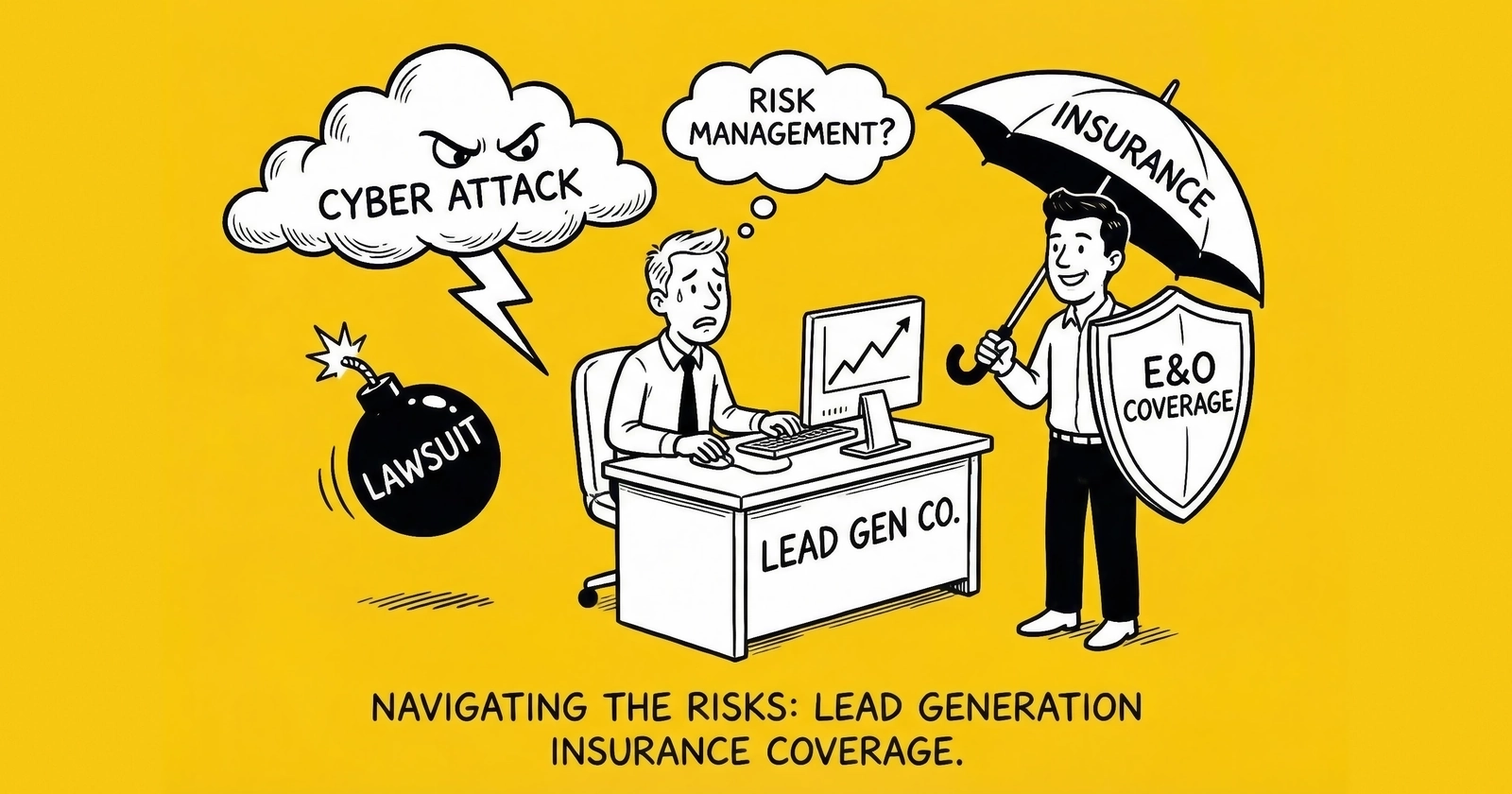
A comprehensive guide to understanding the full spectrum of insurance coverage lead generation companies need, from general liability and E&O to cyber insurance, TCPA-specific policies, and specialty coverage that protects your operation from existential threats.
Introduction: Beyond TCPA - The Complete Insurance Picture
Most lead generation operators think about insurance in one dimension: TCPA coverage. Given that 507 TCPA class actions were filed in Q1 2025 alone, with average settlements exceeding $6.6 million, that focus is understandable. But TCPA exposure, as significant as it is, represents only one category of risk that can destroy a lead generation business.
A data breach exposing 100,000 consumer records. A client alleging your leads contained fraudulent information that cost them millions in wasted sales costs. An employee injured while working remotely. A former partner claiming you stole proprietary lead generation methods. A vendor contract dispute that escalates into litigation. Each of these scenarios requires different insurance coverage, and many lead generation operators discover too late that their existing policies contain gaps wide enough to sink their companies.
The lead generation business model creates unique risk exposures that standard business insurance was not designed to address. You handle sensitive consumer data. You make representations about lead quality and consent status. You operate in a heavily regulated environment with shifting compliance requirements. Your revenue depends on technology systems that can fail. Your business relationships involve complex contractual obligations with both lead sources and buyers.
This guide examines the complete insurance landscape for lead generation businesses. The goal is not to make you an insurance expert but to ensure you understand what coverage you need, what questions to ask your broker, and what gaps might exist in your current protection. Those who build sustainable businesses are those who approach insurance as infrastructure investment rather than grudging expense.
The Risk Landscape: What Lead Generation Businesses Actually Face
Before evaluating specific insurance products, understand the categories of risk your business faces. Each category may require different coverage approaches.
Regulatory and Compliance Risk
The lead generation industry operates under multiple overlapping regulatory frameworks. TCPA liability dominates the conversation, but it is not the only regulatory exposure.
TCPA and State Telemarketing Laws. The federal TCPA creates exposure of $500 to $1,500 per violation, with no aggregate cap. State mini-TCPA laws like Florida’s FTSA and Oklahoma’s OTSA create additional exposure with their own penalty structures. FCC enforcement actions can result in civil penalties in the millions.
Data Privacy Regulations. California’s CCPA and CPRA, Virginia’s VCDPA, Colorado’s CPA, and other state privacy laws create compliance obligations for consumer data handling. Violations can result in regulatory enforcement, private lawsuits, and reputational damage.
Industry-Specific Regulations. Insurance lead generators must comply with state insurance marketing regulations. Mortgage leads implicate RESPA and state lending regulations. Medicare leads require CMS marketing compliance. Legal leads must navigate attorney advertising rules. Each vertical brings its own regulatory framework.
FTC Enforcement. The Federal Trade Commission has authority over unfair and deceptive trade practices, including advertising claims and consent practices. FTC enforcement actions can result in substantial civil penalties and injunctive relief.
Data Breach and Cyber Risk
Lead generation businesses are data businesses. You collect, store, transmit, and monetize consumer personal information. This creates multiple cyber risk exposures.
Data Breach Liability. A security incident exposing consumer data triggers notification obligations, regulatory scrutiny, potential lawsuits, and reputational damage. The average cost of a data breach in the United States reached $9.48 million in 2023, according to IBM’s Cost of a Data Breach Report. For companies handling sensitive financial or health information, costs can be significantly higher.
Ransomware and Business Interruption. If ransomware encrypts your lead management systems, you cannot operate. Lead generation is a real-time business – leads have no value if you cannot process, validate, and distribute them. Even brief system outages can cost tens of thousands of dollars in lost revenue and buyer relationship damage.
System Failures. Beyond malicious attacks, technology failures can disrupt operations. Server outages, database corruption, API failures with critical partners, and cloud service disruptions all create business interruption exposure.
Third-Party Vendor Incidents. Your exposure extends beyond your own systems. If your lead distribution platform vendor suffers a breach, your data may be compromised. If your consent verification provider has an outage, your compliance documentation may be affected.
Professional Liability and Errors & Omissions Risk
Lead generation involves representations about the quality, validity, and compliance status of the leads you sell. These representations create professional liability exposure.
Lead Quality Representations. When you sell leads, you implicitly or explicitly represent that those leads meet certain quality standards. Proper lead validation can reduce this exposure. If leads contain fraudulent information, invalid contact data, or insufficient consent documentation, buyers may bring claims for breach of contract, misrepresentation, or negligence.
Compliance Representations. Sellers often represent that leads are compliant with applicable regulations – that proper consent was obtained, that consumers were not on do-not-call lists, that disclosures met regulatory requirements. If those representations prove incorrect, buyers who face regulatory enforcement or litigation may seek recovery from you.
Advice and Consulting. Lead generation agencies often provide consulting services to clients on lead strategy, compliance approaches, and marketing optimization. Advice that leads to client losses can create professional liability claims.
Vendor Selection and Management. If you recommend vendors or platforms to clients and those vendors cause problems, clients may argue you were negligent in your recommendations.
General Liability Risk
Standard general liability exposures apply to lead generation businesses, though often in modified forms given the digital nature of operations.
Premises Liability. If you maintain physical office space, visitor injuries create exposure. Most lead generation operations have limited physical footprint, but office space, data centers, or event attendance create some exposure.
Advertising Injury. Claims of defamation, libel, copyright infringement, or invasion of privacy arising from advertising activities can create liability. Lead generation advertising, including comparison claims and testimonials, can generate these claims.
Personal Injury. Allegations of false arrest, malicious prosecution, or wrongful eviction are less common in lead generation but can arise in certain contexts.
Employment and Workers Compensation Risk
Even with lean staffing models common in lead generation, employment exposures exist.
Workers Compensation. Employees injured in the course of employment – including remote workers injured in home offices – trigger workers compensation obligations. For more on the unique risks faced by lead gen businesses, see our risk management framework. Coverage requirements vary by state, with most states mandating coverage for businesses with employees.
Employment Practices. Claims of discrimination, harassment, wrongful termination, or wage violations create exposure. As lead generation operations scale and add staff, employment practices become more significant.
Remote Work Complexities. Many lead generation businesses operate with distributed workforces. This creates multi-state compliance obligations and complicates workers compensation coverage, which typically must be secured in each state where employees work.
Contractual and Commercial Risk
Lead generation involves extensive contractual relationships with lead sources, distribution platforms, buyers, and vendors.
Contract Disputes. Disagreements over lead quality, pricing, payment terms, exclusivity provisions, and indemnification obligations generate disputes. Litigation costs can be significant even when you ultimately prevail.
Indemnification Obligations. Standard lead purchase agreements include indemnification provisions. If you indemnify buyers against TCPA claims or data breach claims, you are on the hook when those claims materialize.
Intellectual Property. Lead generation methods, proprietary scoring algorithms, and marketing approaches may involve intellectual property. Claims of infringement, misappropriation, or theft of trade secrets create exposure.
Directors and Officers Risk
If your lead generation business is a corporation or LLC with management structure, directors and officers face personal liability exposure.
Shareholder Claims. Investors or minority owners may bring claims alleging management breached fiduciary duties or engaged in self-dealing.
Regulatory Investigations. Individuals may face personal liability in regulatory enforcement actions, particularly for knowing violations.
Creditor Claims. In financial distress, creditors may pursue personal liability claims against officers.
Essential Insurance Coverage: The Core Policies
With the risk landscape mapped, examine the insurance products that address these exposures. Not every lead generation business needs every coverage type, but understanding what is available enables informed decisions about your insurance program.
General Commercial Liability Insurance
General commercial liability (CGL) insurance is the foundation of most business insurance programs. It covers third-party claims of bodily injury, property damage, and personal and advertising injury arising from your business operations.
What CGL Covers
Bodily Injury Liability. If someone is injured on your premises or as a result of your operations, CGL covers defense costs and settlements or judgments. For lead generation businesses with limited physical operations, this exposure is typically modest.
Property Damage Liability. If your operations damage someone else’s property, CGL provides coverage. Again, for digital businesses, this exposure is limited.
Personal and Advertising Injury. This coverage addresses claims of defamation, libel, slander, copyright infringement, or invasion of privacy arising from advertising. For lead generation businesses, this is often the most relevant CGL coverage.
What CGL Does Not Cover
CGL policies contain significant exclusions that limit coverage for typical lead generation risks.
Professional Services. CGL does not cover claims arising from the rendering of professional services. If a client claims your leads were defective or your advice was negligent, CGL is unlikely to respond.
Intentional Acts. Claims arising from intentional conduct are typically excluded. Many TCPA claims fall into this exclusion because the communications were intentional even if the violation was not.
Contractual Liability. CGL generally excludes liability assumed under contract beyond what would exist without the contract. Indemnification obligations are often not covered.
Expected or Intended Injury. Injuries the insured expected or intended are excluded. This exclusion is frequently litigated in TCPA coverage disputes.
Statutory Damages. Some CGL policies exclude statutory damages, fines, or penalties – which is precisely what TCPA exposure consists of.
CGL for Lead Generation
For lead generation businesses, CGL provides limited protection. It covers some advertising injury claims and general premises liability, but it does not address the core risks of data breaches, professional errors, or regulatory violations.
A standard CGL policy costs $500 to $3,000 annually for small lead generation operations, with premiums increasing based on revenue, employee count, and coverage limits. Most businesses carry $1 million per-occurrence and $2 million aggregate limits as a minimum.
CGL is necessary but not sufficient. It belongs in your insurance program as a foundation, but you should not expect it to cover your most significant exposures.
Errors and Omissions (Professional Liability) Insurance
Errors and omissions (E&O) insurance, also called professional liability insurance, covers claims arising from negligent acts, errors, or omissions in providing professional services. For lead generation businesses that provide services to clients, E&O is essential coverage.
What E&O Covers
Negligent Service Delivery. If you fail to deliver leads meeting contractual specifications, provide leads with deficient consent documentation, or make errors in lead validation that cause client harm, E&O coverage may respond.
Professional Advice Errors. If you advise clients on compliance, marketing strategy, or technology selection and that advice proves harmful, E&O may cover resulting claims.
Breach of Contract. Many E&O policies cover breach of contract claims arising from professional service delivery.
Defense Costs. E&O policies typically cover defense costs even for claims that ultimately prove unfounded. Given litigation costs, this defense coverage has significant value.
E&O Policy Considerations
Coverage Triggers. E&O policies are typically “claims-made,” meaning they cover claims made during the policy period regardless of when the error occurred. This differs from “occurrence” policies that cover events during the policy period regardless of when claims are made. With claims-made policies, maintaining continuous coverage is essential – a gap can leave you uninsured for errors made during a prior coverage period.
Retroactive Dates. Claims-made policies often include retroactive dates before which claims are not covered. If you switch insurers, ensure the new policy’s retroactive date extends back to cover your prior activities.
Prior Acts Coverage. Related to retroactive dates, prior acts coverage addresses claims arising from work performed before the policy inception. New policies may exclude prior acts or charge additional premiums for prior acts coverage.
Definition of Professional Services. Review how the policy defines covered professional services. Ensure lead generation, marketing services, compliance consulting, and other activities you perform are included.
E&O for Lead Generation
Lead generation agencies, consultants, and service providers should carry E&O coverage with limits appropriate for their client base and contract values. Typical limits range from $500,000 to $5 million, with premiums of $2,000 to $15,000 annually for smaller operations depending on revenue, coverage limits, and claim history.
E&O policies vary significantly in what they cover. Some explicitly include or exclude:
- TCPA and telemarketing liability
- Data breach notification costs
- Regulatory defense coverage
- Media liability (for advertising claims)
Review policy language carefully rather than assuming coverage exists.
Cyber Liability Insurance
Cyber liability insurance addresses data breach exposures, ransomware events, business interruption from cyber incidents, and related costs. For lead generation businesses built on consumer data, cyber coverage is increasingly essential.
First-Party Cyber Coverage
First-party coverage addresses your own losses from cyber incidents.
Breach Response Costs. When a breach occurs, you face immediate costs: forensic investigation to determine scope, legal counsel to navigate notification requirements, notification costs for affected consumers, credit monitoring services, and public relations expenses. First-party cyber coverage addresses these costs.
Business Interruption. If a cyber incident disables your systems, first-party coverage can reimburse lost income during the interruption period. For real-time lead businesses, even brief outages create significant revenue loss.
Ransomware and Extortion. Coverage may include ransom payments (where legal) and costs associated with ransomware recovery.
Data Restoration. Costs to recover or recreate data lost to cyber incidents are typically covered.
Third-Party Cyber Coverage
Third-party coverage addresses claims by others arising from your cyber incidents.
Privacy Liability. Claims by consumers whose data was exposed, including class actions seeking statutory damages under privacy laws.
Regulatory Defense and Penalties. Defense costs for regulatory investigations and, in some policies, civil penalties resulting from enforcement actions.
Network Security Liability. Claims arising from security failures that affect third parties – for example, if your systems are used to attack a partner’s network.
Media Liability. Some cyber policies include coverage for claims of defamation, copyright infringement, or other media-related claims arising from digital content.
Cyber Policy Considerations
Coverage Limits and Sublimits. Cyber policies often include aggregate limits with sublimits for specific coverage categories. A policy with $5 million aggregate might have only $500,000 sublimits for ransomware or regulatory penalties. Understand the sublimit structure before assuming adequate coverage.
Retroactive Coverage. Like E&O policies, cyber policies often contain retroactive date provisions limiting coverage to incidents discovered after a specified date.
Waiting Periods. Business interruption coverage often includes waiting periods – typically 8 to 24 hours – before coverage triggers. For lead generation businesses, even an 8-hour outage can have significant impact.
Vendor and Third-Party Incidents. Review how the policy addresses incidents at vendors or service providers that affect your data or operations.
Social Engineering Coverage. Funds transfer fraud through social engineering (phishing attacks that trick employees into wiring money) may require separate coverage or endorsements.
Cyber Insurance for Lead Generation
Given lead generation’s data-intensive nature, cyber coverage is close to essential for established operations. Coverage limits should reflect the volume of consumer data you handle and the potential scope of a serious incident.
Premiums for cyber insurance have increased substantially in recent years as ransomware and data breach incidents have become more frequent and costly. Small lead generation businesses may pay $3,000 to $10,000 annually for $1 million in coverage. Larger operations with higher limits pay proportionally more.
Underwriters increasingly require evidence of security practices as a condition of coverage. Common requirements include:
- Multi-factor authentication on critical systems
- Regular data backups with offline storage
- Employee security awareness training
- Endpoint detection and response software
- Incident response planning
TCPA and Telemarketing Liability Insurance
Given the volume and severity of TCPA litigation, specialized coverage addressing this specific exposure has emerged as a distinct product category.
What TCPA Coverage Provides
Statutory Damages Coverage. Unlike standard policies that may exclude statutory damages, TCPA-specific policies are designed to cover the $500 to $1,500 per-violation damages that constitute TCPA exposure.
Class Action Defense. TCPA policies anticipate class action litigation and provide defense cost limits adequate for extended class action defense – typically $500,000 to $1 million or more.
State Mini-TCPA Coverage. Better policies cover claims under state telemarketing laws like Florida’s FTSA and Oklahoma’s OTSA.
Regulatory Defense. Some policies cover FCC investigations and enforcement actions, including defense costs and potentially civil penalties.
TCPA Coverage Considerations
Exclusion Review. Ensure the policy does not contain exclusions that defeat its purpose – exclusions for intentional acts applied to communications, exclusions for statutory damages, or exclusions for marketing activities.
Limits Adequacy. TCPA exposure scales with communication volume. A company sending one million messages annually faces potential exposure in the tens of millions over the four-year statute of limitations. Coverage limits should reflect realistic exposure scenarios.
Defense Costs. Determine whether defense costs are within policy limits or in addition to limits. Defense costs within limits can substantially reduce available liability coverage.
Prior Acts. If switching to a new TCPA policy or obtaining coverage for the first time, understand how the policy addresses claims arising from communications made before policy inception.
TCPA Coverage for Lead Generation
For lead generation operations that make outbound calls, send text messages, or purchase leads for contact purposes, specialized TCPA coverage is strongly recommended. The cost of coverage – typically $15,000 to $100,000 annually depending on volume and limits – is modest relative to the exposure being addressed.
Standard business policies often do not cover TCPA claims reliably, making specialized coverage the prudent approach.
Directors and Officers Insurance
D&O insurance protects company leadership against personal liability arising from management decisions. For incorporated lead generation businesses, D&O coverage protects individuals against claims that might otherwise create personal financial exposure.
What D&O Covers
Shareholder and Investor Claims. If investors allege management breached fiduciary duties, D&O coverage provides defense and indemnification.
Regulatory Investigations. Personal liability in regulatory enforcement – including FCC, FTC, and state attorney general investigations – may trigger D&O coverage.
Employment Claims Against Individuals. When employees name individual managers in employment claims, D&O may provide coverage.
Creditor Claims. In financial distress, D&O covers claims by creditors that management decisions violated duties to creditors.
D&O Policy Considerations
Insuring Agreements. D&O policies typically include three insuring agreements: “Side A” covering individuals when the company cannot indemnify them, “Side B” reimbursing the company for indemnifying individuals, and “Side C” covering the entity itself (in public companies, primarily for securities claims).
Conduct Exclusions. D&O policies exclude coverage for fraud, criminal conduct, and knowing violations. These conduct exclusions are typically triggered only by final adjudication, meaning defense coverage is available until a court determination.
Prior Acts and Continuity. Claims-made coverage requires attention to retroactive dates and continuity between policies.
D&O for Lead Generation
D&O coverage is particularly important for lead generation businesses with outside investors, complex ownership structures, or significant regulatory exposure. Individual managers without D&O protection face personal liability for management decisions – a risk that can deter qualified individuals from joining leadership teams.
Premiums for private company D&O coverage range from $5,000 to $25,000 annually for smaller operations, depending on company size, industry, and coverage limits.
Workers Compensation Insurance
Workers compensation covers employee injuries occurring in the course of employment. Most states mandate coverage for businesses with employees, and even in states where coverage is optional, prudent businesses maintain it.
Coverage Requirements
State Mandates. Each state has its own workers compensation requirements. Most states require coverage for businesses with any employees; a few allow very small employers to opt out. Multi-state operations must comply with requirements in each state where employees work.
Remote Worker Considerations. Employees working from home are covered by workers compensation for work-related injuries. A home office injury occurring during work hours can create a valid claim. Coverage must extend to each state where remote employees are located.
Independent Contractor Questions. Workers compensation applies to employees, not independent contractors. However, misclassification of employees as contractors can create significant liability – if an injured worker is determined to be an employee, the business faces both the workers compensation claim and potential penalties for failure to maintain coverage.
Workers Compensation for Lead Generation
Lead generation businesses with employees – whether W-2 staff in an office or distributed remote workers – need workers compensation coverage appropriate for their workforce and locations. Premiums vary significantly by state and job classification, with office workers typically classified in lower-risk categories.
For businesses using significant contractor workforces, understanding the distinction between employees and contractors is essential to avoid misclassification exposure.
Employment Practices Liability Insurance
Employment practices liability insurance (EPLI) covers claims by employees alleging discrimination, harassment, wrongful termination, wage violations, or other employment-related wrongdoing.
What EPLI Covers
Discrimination Claims. Allegations of discrimination based on protected characteristics – race, gender, age, disability, religion, and others – trigger EPLI coverage.
Harassment Claims. Sexual harassment and hostile work environment claims are covered.
Wrongful Termination. Claims that termination was illegal – whether discriminatory, retaliatory, or in violation of contract – are covered.
Wage and Hour. Some policies cover wage and hour claims, though this coverage is often limited or excluded due to class action exposure in this area.
Retaliation. Claims that the employer retaliated against employees for protected activity – whistleblowing, filing complaints, or exercising legal rights – are covered.
EPLI for Lead Generation
As lead generation businesses grow and add staff, employment practices exposure increases. EPLI provides protection against claims that can be expensive to defend even when meritless.
Premiums range from $1,000 to $10,000 annually for smaller operations, scaling with employee count and coverage limits.
Industry-Specific Coverage Considerations
Beyond standard coverage types, lead generation businesses should consider industry-specific coverage needs based on their vertical focus and business model.
Media Liability Coverage
Lead generation involves content creation – advertising copy, landing pages, comparison claims, and marketing materials. Media liability coverage addresses claims arising from this content.
What Media Liability Covers
Defamation and Libel. Claims that your content defamed competitors or other parties.
Copyright Infringement. Claims that your content infringes copyrighted material – images, text, or other creative works.
Invasion of Privacy. Claims that your marketing invaded consumer privacy in ways beyond TCPA-specific violations.
Unfair Competition. Claims related to comparative advertising or competitive claims.
Media Coverage for Lead Generation
Lead generation businesses that create significant marketing content – particularly those that make comparison claims, publish reviews, or use user-generated content – should consider media liability coverage. This coverage is sometimes included within E&O or cyber policies; other times it requires a separate policy.
Vertical-Specific Regulatory Coverage
Certain lead generation verticals face enhanced regulatory exposure requiring specialized coverage consideration.
Insurance Leads. State insurance commissioner enforcement, producer licensing compliance, and Medicare marketing rules create exposure beyond federal TCPA. E&O policies for insurance lead generators should address insurance marketing regulatory exposure.
Mortgage Leads. RESPA compliance, state lending regulations, and CFPB oversight create mortgage-specific exposure. Coverage should address mortgage industry regulatory requirements.
Legal Leads. Attorney advertising rules and bar association oversight create unique compliance exposure. Legal lead generators need coverage that addresses bar complaint exposure and attorney advertising regulatory matters.
Healthcare Leads. HIPAA exposure for businesses handling protected health information requires cyber coverage that explicitly addresses HIPAA breach notification and penalty exposure.
Technology Platform Coverage
Lead generation businesses that operate technology platforms – lead distribution systems, marketplace platforms, or SaaS products – have additional considerations.
Technology E&O. Standard E&O may not cover technology product failures. Technology E&O specifically addresses claims arising from software or platform defects, failures, or security vulnerabilities.
Failure to Deliver. If your platform fails and clients suffer losses, technology E&O may cover resulting claims.
Intellectual Property Coverage. Technology businesses face intellectual property claims – patent infringement, trade secret misappropriation, and similar allegations. IP coverage can be included in technology E&O or require separate policies.
Building Your Insurance Program: Practical Steps
Understanding coverage options is the first step. Constructing an appropriate insurance program requires additional analysis and action.
Step 1: Risk Assessment
Before purchasing coverage, assess your actual risk profile.
Quantify Your Exposures. How many calls or texts do you make monthly? How many consumer records do you store? What is your annual revenue, and what contract values do you hold? What states do you operate in, and what vertical regulations apply?
Identify Contractual Requirements. Review your client and vendor contracts. What insurance coverage do they require you to maintain? What limits and certificate requirements apply?
Evaluate Your Risk Tolerance. Some businesses prefer to self-insure smaller risks and purchase coverage only for catastrophic exposures. Others prefer comprehensive coverage that minimizes out-of-pocket costs. Your risk tolerance affects coverage decisions.
Step 2: Coverage Gap Analysis
With your risk profile mapped, analyze gaps in your current coverage.
Review Existing Policies. Read your current policies – not just the declarations page, but the actual policy language. Understand what is covered and what is excluded.
Map Coverage to Risks. For each risk you identified, determine which policy (if any) provides coverage. Identify gaps where risks are uninsured or inadequately covered.
Prioritize Gaps. Not all gaps require immediate action. Prioritize based on likelihood and severity of potential claims.
Step 3: Broker Selection
Work with an insurance broker who understands lead generation and digital marketing businesses.
Industry Specialization. Generalist brokers may not understand lead generation risks or know which carriers offer appropriate coverage. Seek brokers with experience in marketing, telemarketing, or technology industries.
Market Access. Different brokers have access to different insurance markets. Specialty coverage like TCPA insurance may only be available through brokers with specific market relationships.
Service Capabilities. Beyond placing coverage, evaluate the broker’s claims assistance capabilities, coverage review services, and ongoing account management.
Step 4: Coverage Structure
Design a coverage structure that addresses your risks efficiently.
Deductibles and Retentions. Higher deductibles reduce premiums but increase out-of-pocket exposure. Choose deductibles you can afford if claims occur.
Limits Selection. Coverage limits should reflect realistic exposure scenarios. Underinsurance is common – businesses purchase limits based on premium cost rather than exposure analysis.
Coverage Layering. For larger risks, primary policies may be supplemented by excess layers that provide additional limits above the primary policy.
Policy Coordination. Multiple policies may overlap or create gaps. Ensure policies work together without unintended coverage disputes.
Step 5: Ongoing Management
Insurance is not a set-and-forget proposition.
Annual Review. Business changes – new verticals, increased volume, additional employees, new technology – affect your risk profile. Review coverage annually to ensure it remains appropriate.
Claims Reporting. Report potential claims promptly. Late reporting is a common cause of coverage disputes.
Policy Maintenance. Keep policies current. Lapses in coverage can leave you uninsured for claims that arise later.
Frequently Asked Questions
What insurance policies does a lead generation business absolutely need?
At minimum, most lead generation businesses should maintain general commercial liability coverage, errors and omissions (professional liability) coverage, and cyber liability coverage. If you make outbound calls or send text messages, specialized TCPA coverage is strongly recommended. If you have employees, workers compensation is mandatory in most states. The specific policies required depend on your business model, contract requirements, and risk profile. A $500,000 annual revenue affiliate marketer has different needs than a $10 million lead distribution platform, but both face significant exposures that require insurance protection.
Does my general liability policy cover TCPA lawsuits?
Probably not, or not reliably. General commercial liability policies often exclude TCPA claims through multiple provisions – intentional acts exclusions, statutory damages exclusions, and advertising activity exclusions can all defeat coverage. Some CGL policies have been found to cover TCPA claims under the personal and advertising injury coverage, but outcomes vary by policy language, jurisdiction, and claim facts. If TCPA exposure is material to your business, relying on CGL coverage is a significant gamble. Specialized TCPA coverage provides more reliable protection.
How much does comprehensive insurance coverage cost for a lead generation business?
Total insurance costs vary significantly based on business size, risk profile, and coverage limits. A smaller lead generation operation with $500,000 to $1 million in annual revenue might spend $15,000 to $40,000 annually on comprehensive coverage including CGL, E&O, cyber, and TCPA policies. Larger operations with higher limits and additional coverage needs may spend $50,000 to $200,000 or more. The relevant comparison is not the premium cost alone but the premium relative to the exposure being addressed – $50,000 in annual premiums providing protection against $10 million in potential class action liability represents sound risk management.
What is the difference between claims-made and occurrence policies?
Occurrence policies cover events that occur during the policy period, regardless of when claims are made. Claims-made policies cover claims made during the policy period, regardless of when the underlying event occurred (subject to retroactive date provisions). E&O and cyber policies are typically claims-made; CGL and workers compensation are typically occurrence. The distinction matters for coverage continuity – with claims-made policies, you must maintain coverage continuously or purchase “tail” coverage to protect against claims made after the policy ends for events during the policy period.
What cyber security measures do insurance companies require?
Cyber insurers increasingly require evidence of security practices as a condition of coverage. Common requirements include multi-factor authentication on email and critical systems, regular data backups stored offline or in separate environments, endpoint detection and response software, employee security awareness training, incident response planning, and vulnerability management programs. Failure to implement required security measures can result in coverage denials or policy rescissions. The specific requirements vary by insurer and coverage level, with higher limits typically requiring more robust security programs.
Should I purchase TCPA insurance if I only buy leads and do not generate them myself?
Yes, if you make any outbound contact to those leads. Lead buyers face TCPA liability for calls and texts they make, regardless of whether the underlying consent was captured by a third-party lead generator. Indemnification provisions in lead purchase agreements provide some protection, but that protection depends on vendor solvency and willingness to honor obligations. Your own TCPA coverage ensures protection regardless of vendor circumstances. Even if you believe your vendor’s consent capture is bulletproof, defense costs for meritless claims can be substantial, and insurance covers defense costs in addition to settlements or judgments.
How do I know if my current coverage is adequate?
Evaluate your coverage against your actual exposure. For TCPA coverage, calculate your monthly call and text volume, estimate the percentage that might have consent issues, and project potential exposure over the four-year statute of limitations. If your coverage limits are substantially below this exposure, you are underinsured. For cyber coverage, consider the volume of consumer data you hold and the costs associated with a serious breach – notification, forensics, business interruption, and potential lawsuits. For E&O coverage, consider your largest client relationships and the claims that could arise from service failures. If policy limits seem inadequate for realistic scenarios, increase coverage.
What happens when I file an insurance claim?
When you notify your insurer of a claim or potential claim, the insurer evaluates coverage and assigns claims handling resources. For liability claims, the insurer typically assigns defense counsel – often experienced attorneys who specialize in the relevant area. The insurer manages the defense within policy terms, with your cooperation as required by the policy. For first-party claims like data breach response, the insurer may provide access to pre-approved vendors for forensics, notification, and credit monitoring. Throughout the process, you have obligations to cooperate, provide information, and not prejudice the claim. Defense costs and settlements are paid according to policy terms, subject to deductibles and limits.
Do I need separate coverage if I operate in multiple states?
Some coverage types require state-by-state consideration. Workers compensation must comply with requirements in each state where employees work; for remote workforces, this can mean coverage in many states. TCPA liability is federal, but state mini-TCPA laws create additional exposure that specialty TCPA coverage should address. Data privacy laws vary by state, with California, Virginia, Colorado, and other states imposing distinct requirements. Your broker can help structure coverage that addresses multi-state operations, but you should explicitly discuss your operational footprint to ensure coverage applies where you operate.
Can vendors or clients require me to carry specific insurance?
Yes, and this is common. Lead buyers often require sellers to maintain E&O, cyber, and TCPA coverage with minimum limits. Platform providers may require coverage as a condition of access. Enterprise clients often require evidence of coverage through certificates of insurance before executing contracts. These contractual requirements often specify minimum coverage limits, required coverage types, and sometimes specific policy provisions like additional insured endorsements. Review your contracts to understand insurance requirements and ensure your coverage meets those requirements.
Key Takeaways
-
Lead generation businesses face unique risk exposures that standard business insurance does not adequately address. TCPA liability, data breach exposure, professional service claims, and regulatory compliance risks require specialized coverage beyond basic commercial policies.
-
Build a layered insurance program addressing multiple risk categories. Most lead generation businesses need general liability, errors and omissions, cyber liability, and often TCPA-specific coverage at minimum. Workers compensation, D&O, and EPLI add protection as businesses grow.
-
Standard policies often exclude lead generation’s most significant risks. TCPA claims, statutory damages, and intentional communication activities may be excluded from CGL and E&O policies. Review policy language rather than assuming coverage exists.
-
Coverage limits should reflect actual exposure, not just premium affordability. Calculate realistic worst-case scenarios – class action TCPA exposure, major data breach costs, significant client claims – and ensure limits provide meaningful protection.
-
Work with brokers who understand lead generation and digital marketing. Generalist brokers may lack access to specialty markets and understanding of industry-specific risks. Industry-specialized brokers provide better coverage matching and claims advocacy.
-
Insurance is infrastructure, not expense. Those who build sustainable lead generation businesses treat insurance as essential business infrastructure that enables risk-taking, satisfies contractual requirements, and protects against existential threats.
-
Review coverage annually and report claims promptly. Business changes affect risk profiles; coverage must evolve accordingly. Prompt claims reporting prevents coverage disputes from late notification.
This article provides general information about insurance for lead generation businesses. It is not insurance or legal advice. Coverage availability, terms, and premiums vary by insurer, jurisdiction, and business circumstances. Consult with qualified insurance professionals and legal counsel to evaluate your specific coverage needs.
Information current as of late 2025. Insurance markets and regulatory requirements change; verify current availability and requirements with your insurance professionals.