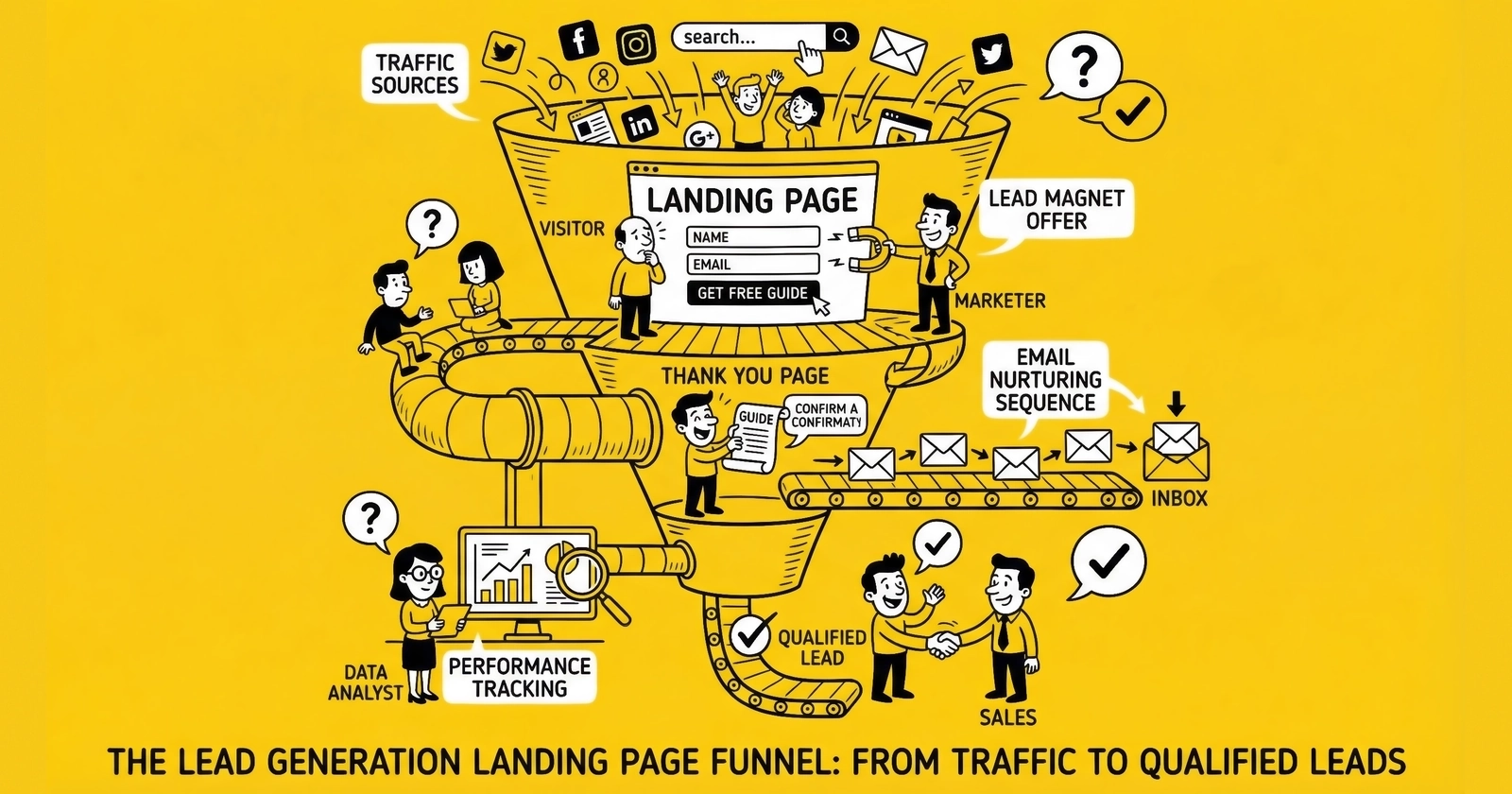
A comprehensive framework for designing, building, and optimizing landing page funnels that convert traffic into qualified leads – with funnel architecture, conversion benchmarks, and the multi-step strategies that separate profitable operations from expensive experiments.
Your traffic is bleeding out before it reaches the form.
Somewhere between the ad click and the lead submission, you are losing 85-97% of visitors. They arrived with intent. They had a problem your offer solves. They clicked – a signal of genuine interest. Then they saw your landing page, made a split-second judgment, and disappeared forever.
The difference between a 3% conversion rate and a 12% conversion rate is not traffic quality. It is funnel architecture. Those who build systematic landing page funnels – properly structured sequences of pages, forms, and qualification steps – convert the same traffic at 3-4x the rate of operators who throw up single pages and hope for the best.
This is the complete guide to building landing page funnels for lead generation. By the end, you will understand the five funnel architectures that work across verticals, the multi-step form strategies that deliver 86% conversion improvements, the technical infrastructure that prevents leakage, and the optimization frameworks that compound improvement over time.
What Is a Landing Page Funnel?
A landing page funnel is a structured sequence of pages and interactions designed to guide visitors from initial interest to qualified lead submission. Unlike a single landing page, a funnel recognizes that conversion is a process, not an event – and that different visitors require different amounts of persuasion, qualification, and trust-building before they commit.
The Funnel Concept
The funnel metaphor reflects the reality of lead generation economics. From initial traffic to qualified lead, the pool of potential conversions narrows at each step.
Consider one thousand visitors entering at the top. They clicked your ad or found your organic listing, demonstrating some degree of interest. Of these, 400-600 become engaged visitors who stay past the first 3 seconds – they scanned your headline, assessed relevance, and decided to explore. The pool narrows further to 150-300 form starters who begin interacting with your form, typing in a ZIP code or selecting an option as commitment begins. From there, 30-120 complete the submission process, providing contact information and clicking submit. Finally, 15-80 pass your validation and qualification criteria to become qualified leads – the leads you can actually monetize.
A landing page funnel optimizes every stage of this narrowing process. The goal is not just more leads – it is more qualified leads at sustainable acquisition costs.
Single Page vs. Multi-Step Funnel
A single landing page places all persuasion elements and form fields on one page. Visitors see everything simultaneously – value proposition, trust signals, objection handling, and form fields.
A multi-step funnel distributes these elements across multiple pages or form steps, revealing content progressively as visitors demonstrate commitment.
The data is clear on which approach wins. Research across lead generation verticals shows multi-step forms converting at 13.85% compared to 4.53% for single-step equivalents – an 86% improvement. The funnel approach reduces perceived complexity, leverages commitment psychology, and enables strategic question sequencing that single pages cannot achieve.
Why Funnels Outperform Single Pages
Several mechanisms explain the performance differential.
Progressive commitment drives the primary effect. Each step forward represents invested effort, and visitors who have completed two steps feel psychologically compelled to continue – abandoning would “waste” their prior investment. This connects to reduced visual intimidation: a form with 15 visible fields triggers immediate resistance, but the same 15 fields distributed across 4 steps appear manageable. Perceived effort drops even when actual effort remains constant.
Strategic sequencing amplifies these effects. Funnels allow low-friction questions first (preferences, needs) and high-friction questions later (phone, email), while single pages cannot control the order in which visitors encounter form fields. Multi-step structures also enable qualification and segmentation, routing visitors to different paths based on their answers, showing relevant content to qualified prospects and screening out non-buyers before they waste sales resources.
Finally, funnels provide space for trust building. They create natural opportunities to address objections, display testimonials, and build credibility between steps – something single pages accomplish only through cluttered design.
The Five Funnel Architectures for Lead Generation
Not all lead generation funnels are identical. The optimal architecture depends on your vertical, traffic temperature, and lead value. Here are the five proven architectures and when each applies.
Architecture 1: The Direct Response Funnel
The simplest effective funnel. A single landing page with a multi-step form embedded directly. No intermediate pages, no complex branching – just traffic to form to lead.
The structure consists of a landing page with above-fold value proposition, a multi-step form of 3-5 steps, and a thank you page with next-step instructions.
This architecture works best for simple offers requiring minimal education, lower-value leads in the $15-40 CPL range, high-volume operations prioritizing efficiency, and warm traffic from retargeting campaigns. Conversion benchmark: 5-12% of page visitors complete the form.
Consider the auto insurance comparison example. Visitors arrive from paid search, see a headline promising rate comparison, complete a 4-step form covering ZIP, vehicle, driver info, and contact details, then receive quotes.
Architecture 2: The Education-First Funnel
For complex or high-consideration products, visitors need education before they are ready to provide contact information. This architecture leads with value, establishes expertise, then requests the lead.
The structure flows from a content page explaining the problem and solution, to a secondary page with comparison, calculator, or tool, to a lead capture page with multi-step form, and finally to a thank you page.
This approach excels for high-consideration purchases like solar, mortgage, and major home improvements. It serves complex products requiring explanation, cold traffic unfamiliar with your offering, and high-value leads that justify additional page development. Conversion benchmark: 3-8% of landing page visitors become leads, with higher qualification rates offsetting lower volume.
The solar installation example illustrates this well. Visitors land on a page explaining how solar saves money, interact with a savings calculator, then complete a form to get a custom quote for their specific home.
Architecture 3: The Quiz Funnel
Quiz funnels disguise qualification as engagement. Visitors answer questions that feel like they are receiving personalized recommendations while simultaneously providing data that qualifies and segments them.
The structure begins with a quiz landing page featuring an engaging hook, progresses through 5-10 quiz questions using multiple choice or interactive formats, delivers a results page with personalized recommendation, captures leads to “access” full results, and concludes with a thank you page.
Quiz funnels excel with audiences skeptical of traditional lead forms and products requiring personalization or matching. They perform particularly well with social and display traffic where engagement matters, and they are effective for building email lists for longer nurture sequences. Conversion benchmark: 20-40% quiz completion rate, with 40-60% lead capture of those who complete.
The Medicare plan matching example demonstrates the pattern. Visitors take a “Find Your Perfect Plan” quiz answering questions about their health needs, prescription drugs, and budget preferences, then provide contact info to receive personalized plan recommendations.
Architecture 4: The Multi-Path Funnel
When your offer serves multiple distinct segments, a single funnel path wastes resources showing irrelevant content to mismatched visitors. Multi-path funnels route visitors to segment-specific experiences.
The structure begins with a segmentation page for product type, customer type, or need selection. This routes to segment-specific landing pages with segment-appropriate forms and customized thank you pages.
Multi-path funnels work well for multiple product lines or verticals, distinct customer segments with different needs, operations selling leads to different buyer types, and testing multiple value propositions simultaneously. Conversion benchmark: Variable by segment, with aggregate rates improving 20-40% over single-path alternatives because each visitor sees relevant content.
The home services example illustrates this architecture. The initial page asks “What do you need help with?” Roofing, HVAC, plumbing, and electrical each route to dedicated landing pages with segment-specific value propositions, testimonials, and forms.
Architecture 5: The Application Funnel
For high-value leads requiring extensive qualification – mortgage, legal, financial services – the funnel functions more like an application process than a marketing page. Visitors expect thoroughness; brief forms signal lack of seriousness.
The structure includes a landing page establishing credibility and expectations, a multi-page application spanning 5-10+ pages, progress indicators throughout, a review page summarizing inputs, and a confirmation and next-steps page.
Application funnels suit high-value leads in the $100-500+ CPL range, products with complex qualification requirements, regulatory environments requiring disclosure documentation, and leads sold to sophisticated buyers who pay premium for qualification. Conversion benchmark: 2-5% of visitors complete the full application, but leads are worth 5-10x simple leads, making economics favorable.
The mortgage refinance example shows the application funnel in action. Visitors complete a comprehensive application covering income, assets, debts, property information, and goals. The thoroughness filters casual interest, producing leads that convert to loans at 3-5x the rate of simple quote requests.
Multi-Step Form Strategy: The 86% Conversion Advantage
The single highest-impact optimization for lead generation funnels is restructuring forms from single-page to multi-step. This section details exactly how to implement multi-step forms for maximum conversion.
Why Multi-Step Forms Work
Multi-step forms exploit well-documented psychological principles.
The foot-in-the-door effect provides the foundational mechanism. Research dating to Freedman and Fraser’s 1966 experiments shows that people who agree to small requests become significantly more likely to agree to larger subsequent requests. Multi-step forms apply this principle: a simple ZIP code entry on step one increases compliance with phone number requests on step four.
Robert Cialdini’s commitment and consistency principle explains why humans feel compelled to behave consistently with their past actions. Each completed step reinforces the visitor’s self-perception as someone completing this form. This combines with perceived effort reduction – fifteen fields on one page appear daunting while five steps with three fields each appear manageable, even though total effort is identical.
Sunk cost psychology completes the picture. Once visitors invest time answering questions, abandoning feels like wasting that investment. This psychology intensifies as progress increases.
The Research: Quantified Improvement
Industry research provides specific benchmarks. Multi-step forms convert at 13.85% versus 4.53% for single-step equivalents. Forms with 5 or fewer visible fields convert 120% better than longer alternatives. Step completion rates increase as visitors progress, reaching 85-95% on final steps. Progress indicators improve completion rates by 15-20%.
The Venture Harbour case study remains definitive: their consulting inquiry form moved from 0.96% to 8.1% conversion rate through restructuring alone – zero changes to traffic, offer, or page design.
Optimal Step Count
Testing reveals a clear pattern. Two steps provide minimal commitment building with only slight improvement over single-page forms. Three steps produce a strong commitment effect and work well for simple lead types. Four steps hit peak performance for most consumer lead generation, providing sufficient space for strategic sequencing. Five steps remain effective for high-consideration products like mortgage, insurance, and solar. Six or more steps produce diminishing returns as visitors begin to feel trapped rather than invested.
The general formula: divide total fields by 3-4 to determine optimal step count.
What to Ask on Each Step
Strategic question sequencing maximizes the psychological benefits of multi-step forms.
Step 1: Low-Friction Entry
The purpose of step one is simply to get visitors clicking. Engagement momentum matters more than data value at this stage.
The best questions for step one include ZIP code as a single field with low privacy concern, multiple-choice type selections, yes/no qualifying questions, and simple dropdown selections. Limit this step to 1-3 fields maximum, avoid text entry if possible, focus questions on needs rather than identity, and keep the visual design simple with a single call-to-action.
Step 2: Deeper Qualification
Step two collects data that enables routing and pricing. The best questions cover specific attributes like vehicle make/model or property type, timeline indicators, budget ranges if relevant, and current situation details.
This step typically includes 3-4 fields with a mix of dropdowns and simple text entry. The key is ensuring questions feel like customization, not interrogation.
Step 3: Contact Information
Step three crosses the threshold from anonymous browser to identified lead. This is where you request first name, last name, phone number, and email address, along with TCPA consent checkbox and disclosure.
Keep additional questions beyond contact info to a minimum. Ensure a clear value reminder is visible, display trust signals prominently, and position consent disclosure immediately above the submit button.
Step 4 and Beyond
Some lead types require additional qualification: mortgage income documentation, Medicare prescription needs, solar utility bills. Visitors who have already provided contact information are invested – additional questions feel like optimization rather than interrogation.
Progress Indicators
Progress indicators reduce anxiety and create completion motivation. Forms with clear progress indicators convert 15-20% higher than multi-step forms without them.
Effective formats include numbered steps like “Step 2 of 4,” visual progress bars showing advancement, descriptive steps such as “Your Vehicle > Your Coverage > Your Details,” and percentage complete indicators like “60% Complete.”
Numbered step indicators typically outperform percentage indicators because specificity helps visitors feel oriented.
Technical Infrastructure for Landing Page Funnels
A well-designed funnel requires technical infrastructure that prevents leakage, enables optimization, and ensures compliance.
Page Speed Optimization
Every second of page load delay costs conversions. Google research shows bounce probability increases 32% as load time goes from 1 to 3 seconds, and 90% at 5 seconds.
Speed benchmarks for landing page funnels include Time to First Byte under 200ms, Largest Contentful Paint under 2.5 seconds, total page weight under 1MB for mobile, and total load time under 3 seconds.
Speed optimization requires compressing images to WebP format, minimizing JavaScript execution, using Content Delivery Networks, enabling browser caching, and eliminating render-blocking resources. Mobile performance matters disproportionately – 70%+ of lead generation traffic arrives from mobile devices in most verticals.
Form Validation
Proper validation reduces abandonment while ensuring data quality.
Client-side validation provides immediate feedback, catching errors before submission frustration through email format validation, phone number format normalization, required field indicators, and real-time error messages.
Server-side validation ensures data quality regardless of browser behavior through phone number verification against carrier databases, email deliverability checking, ZIP code validation, duplicate detection, and bot and fraud screening.
Validation should guide correction, not block submission. Error messages like “Please enter a valid phone number” tell visitors what is wrong. Messages like “Phone numbers must be 10 digits” tell them how to fix it.
Tracking Architecture
You cannot optimize what you cannot measure. Landing page funnels require comprehensive tracking.
Essential tracking events include page views for each step, form field focus when visitors start typing, step completions at each transition, field-level abandonment showing which fields cause exits, form submission success, and post-submission events like thank you page interactions and calls-to-action.
Attribution tracking must capture traffic source to conversion mapping, campaign and ad group identification, keyword or targeting parameter capture, and device and browser information.
For implementation, use Google Tag Manager for event deployment, Google Analytics 4 for behavioral analysis, server-side tracking to recover iOS signal loss, and CRM integration for closed-loop reporting. Server-side tracking has become essential because browser-based tracking loses 20-40% of conversion data from ad blockers, iOS privacy restrictions, and cookie limitations. Server-side implementations recover this signal.
TCPA Compliance Infrastructure
For lead types that will receive phone calls or texts, TCPA compliance is not optional – it is existential.
Required consent elements include clear authorization language for calls/texts using automated technology, identification of who will call (seller identification), reference to the specific phone number provided, a statement that consent is not required for purchase, and revocation instructions.
For consent documentation, TrustedForm certificates create independent third-party records of what visitors saw when providing consent. Jornaya LeadiD provides an alternative documentation approach with additional intelligence. Both have been accepted by courts as evidence.
Technical implementation requires that consent checkboxes must start unchecked (pre-checked boxes are invalid), disclosure text must be immediately adjacent to the checkbox, font size must be minimum 12px desktop and 14px mobile, and documentation must be retained for at least 5 years. Many sophisticated lead buyers now require TrustedForm or Jornaya documentation as a purchase condition.
Mobile-First Funnel Design
Mobile traffic dominates lead generation. In consumer verticals like insurance, home services, and solar, mobile devices account for 70-85% of traffic. Designing for desktop and hoping mobile works produces poor conversion rates.
Mobile Design Requirements
Touch-friendly interaction demands minimum tap targets of 44x44 pixels, adequate spacing between elements of at least 16px, no horizontal scrolling under any circumstance, and primary actions reachable with one thumb.
Form optimization for mobile requires fewer fields per step than desktop (2-3 versus 3-4), full-width input fields and buttons, appropriate input types for keyboards (tel for phone, email for email), and smart autofill attributes.
Progress indicators on mobile need compact designs that preserve screen real estate. Consider that progress bars consuming 60+ pixels of vertical space represent 10% of available viewport on many phones.
Visual hierarchy should feature simplified layouts prioritizing conversion action, trust signals that reinforce without overwhelming, and clear, scannable headlines.
The Mobile Conversion Gap
Despite higher traffic volumes, mobile conversion rates typically lag desktop by approximately 1 percentage point industry-wide. This gap represents opportunity. Practitioners who close the mobile gap gain competitive advantage.
Common mobile conversion killers include slow page load on cellular connections, forms requiring horizontal scrolling, tiny tap targets causing mistaps, forms that do not work with mobile autofill, and progress indicators consuming too much space.
Test your funnels on actual mobile devices – not just browser simulations. Test on both iOS and Android. Test on older devices with smaller screens. Test on throttled connections simulating 3G speeds.
Cross-Device Funnel Optimization
Modern lead generation funnels must account for journeys that span multiple devices. A visitor might see an ad on mobile during their commute, research on a tablet at home, and complete the form on desktop at work. Understanding and optimizing for these cross-device journeys has become essential as single-device attribution becomes increasingly unreliable.
The Cross-Device Reality
Research from Google indicates that 90% of consumers use multiple devices to complete online tasks, with an average of three devices used per purchase journey. For lead generation, this manifests as visitors who begin exploration on one device and convert on another – often hours or days later.
The challenge is both technical and strategic. Technical limitations include cookie fragmentation across devices, privacy restrictions preventing deterministic matching, and session boundaries that reset with each device switch. Strategic challenges involve deciding whether to optimize for mobile discovery or desktop conversion, and how to attribute value across touchpoints.
Cross-Device Identity Resolution
Connecting visitors across devices requires identity resolution infrastructure. The approaches vary in accuracy and privacy compliance.
Deterministic matching connects devices through known identifiers – logged-in users, email addresses, or phone numbers provide explicit links. This approach is highly accurate but limited to visitors who authenticate on multiple devices. For most lead generation funnels, authentication happens only after conversion, limiting pre-conversion cross-device tracking.
Probabilistic matching uses statistical models to infer device connections based on behavioral and contextual signals. IP addresses, location patterns, browser fingerprints, and usage timing patterns feed models that predict which devices belong to the same household or individual. Accuracy ranges from 60-80% depending on signal quality and model sophistication.
First-party data strategies offer the most sustainable path. Encouraging email capture earlier in the journey – through content downloads, quote saves, or progress preservation – creates deterministic links that survive device switches. A visitor who saves their partial form progress receives an email link that reconnects them to their session regardless of which device they use to return.
Device-Specific Funnel Optimization
Rather than building one funnel optimized for the average visitor, sophisticated operations build device-aware experiences that account for different use contexts.
Mobile optimization focuses on discovery and initial engagement. Mobile visitors often research during fragmented moments – commutes, breaks, waiting rooms. Optimize for quick value communication and easy session preservation. Prominent “save progress” or “email my quote” options capture leads who cannot complete forms in their current context. Simplified qualification with the option to provide additional details later accommodates limited attention windows.
Desktop optimization emphasizes completion and detailed qualification. Desktop visitors typically have more time and attention for thorough form completion. Complex multi-step forms perform better on desktop where typing is easier and screen real estate allows progress visualization. High-value leads often prefer desktop for important financial decisions, making desktop an appropriate channel for longer application-style forms.
Tablet optimization occupies a middle ground. Tablet users often browse in relaxed home contexts with time for consideration but prefer touch-optimized interfaces. Forms should be full-width but not stretch across the entire landscape viewport. Touch targets should match mobile standards even when more screen space is available.
Session Continuity Infrastructure
Building funnels that preserve context across device switches requires specific technical capabilities.
Server-side session storage maintains form progress independent of browser cookies. When visitors authenticate or provide an email address, their session state persists on the server. Returning via email link, logged-in state, or manual lookup restores their position in the funnel with all previously entered data intact.
Progressive form completion allows partial submissions that capture value even from abandoned sessions. A visitor who completes the first two steps of a four-step form before abandoning has provided qualifying information worth preserving. Follow-up sequences can offer completion with pre-filled fields rather than requiring restart.
Magic link authentication enables passwordless session recovery. Visitors receive a one-click email link that logs them into their saved session without requiring password creation or memory. This approach reduces friction compared to traditional authentication while maintaining session continuity across devices.
Cross-device retargeting coordinates messaging across devices a visitor uses. A visitor who abandons on mobile should see desktop retargeting that acknowledges their prior engagement rather than treating them as a new prospect. Messaging like “Finish your quote” performs better than generic awareness ads for visitors already in the funnel.
Attribution Considerations
Cross-device journeys complicate conversion attribution. Last-click attribution on desktop ignores the mobile discovery that initiated the journey. First-click attribution on mobile ignores the desktop experience that closed the conversion.
Position-based attribution models that credit both first and last touches provide better representation of cross-device journeys. Allocating 40% credit to the first touch, 40% to the last touch, and 20% distributed among middle touches acknowledges both discovery and conversion.
Data-driven attribution models use machine learning to identify which touchpoints most influence conversion, weighting credit accordingly. These models can identify patterns like “mobile Facebook discovery followed by desktop direct return” and assign appropriate value to each component.
Incrementality testing remains the gold standard for understanding true channel contribution. Holdout tests that remove specific touchpoints from the journey and measure conversion impact reveal actual influence rather than positional correlation.
Conversion Rate Benchmarks by Vertical
Conversion rates vary dramatically by vertical, traffic source, and funnel architecture. These benchmarks provide context for evaluating your own performance.
Consumer Lead Generation Benchmarks
| Vertical | Cold Traffic | Warm Traffic | Retargeting |
|---|---|---|---|
| Auto Insurance | 3-6% | 8-15% | 15-25% |
| Home Insurance | 4-7% | 10-18% | 18-30% |
| Medicare | 2-5% | 6-12% | 12-20% |
| Mortgage | 2-4% | 5-10% | 10-18% |
| Solar | 2-5% | 6-12% | 12-22% |
| Legal (PI) | 1-3% | 4-8% | 8-15% |
| Home Services | 4-8% | 10-20% | 20-35% |
Traffic Source Benchmarks
| Traffic Source | Typical Conversion Rate |
|---|---|
| Branded Search | 12-25% |
| Non-Branded Search | 3-8% |
| Facebook (Cold) | 2-5% |
| Facebook (Retargeting) | 8-15% |
| Display (Cold) | 1-3% |
| Display (Retargeting) | 5-12% |
| Organic Search | 4-10% |
| 8-15% | |
| Direct/Referral | 10-20% |
Form Type Benchmarks
| Form Type | Average Conversion Rate |
|---|---|
| Single-Page Form | 4.53% |
| Multi-Step Form | 13.85% |
| Quiz Funnel | 20-40% completion, 40-60% conversion |
| Native Platform Forms | 7-12% |
Note that these benchmarks represent industry averages. Top performers exceed these rates by 50-100% through systematic optimization.
A/B Testing Framework for Funnel Optimization
Conversion optimization is not about copying best practices. It is about discovering what works for your specific audience through systematic experimentation.
What to Test First
Prioritize tests by impact multiplied by probability of success divided by effort.
High-priority tests should come first: single-step vs. multi-step format, number of visible fields per step, question sequence (low-friction first vs. high-value first), headline and value proposition, and form placement above-fold visibility.
Medium-priority tests follow: progress indicator style, trust signal selection and placement, submit button text and color, field labels (above field vs. inline), and mobile-specific optimizations.
Lower-priority tests round out your testing roadmap: field styling and borders, background colors, font choices, and placeholder text.
Statistical Rigor Requirements
The most common A/B testing mistake is declaring winners before achieving statistical significance.
Statistical significance means the observed difference is unlikely to be random chance. The standard threshold is 95% confidence – only a 5% probability the result is noise.
Sample size depends on baseline conversion rate (lower-converting funnels need larger samples), minimum detectable effect (smaller improvements require larger samples), and traffic volume (low-traffic funnels may require weeks or months). Calculate required sample size before launching any test. For guidance on statistical significance in A/B testing, see the dedicated guide.
The peeking problem presents a common trap: checking results daily and stopping when one variant “looks” like a winner dramatically inflates false positive rates. Set your required sample size in advance and commit to running tests to completion.
Testing Velocity
Optimization compounds. A 5% monthly improvement yields 79% annual improvement. Establish a testing cadence that treats optimization as ongoing.
For velocity targets, maintain a minimum of 2 tests per month, target 4-6 tests per month, and advanced operations run continuous testing with automated traffic allocation.
Process requirements include maintaining a test backlog of prioritized hypotheses, documenting results for both winners and losers, synthesizing learnings across tests, and cross-pollinating successful patterns to other funnels.
Research suggests only about one in eight A/B tests produces statistically significant results. Failed tests narrow the search space and inform future hypotheses.
Advanced Funnel Strategies
Once fundamentals are optimized, advanced strategies create additional competitive advantage.
Dynamic Content Personalization
Personalize funnel content based on traffic source, location, or behavior.
Traffic source personalization shows different headlines based on ad copy that drove the click, adjusts value propositions based on keyword intent signals, and displays relevant testimonials based on referring campaign.
Geographic personalization shows local phone numbers and addresses, displays region-specific pricing or offers, and features testimonials from nearby customers.
Behavioral personalization ensures returning visitors see streamlined forms with remembered data, high-engagement visitors receive more aggressive offers, and previous form abandoners see objection-handling content.
AI-Personalized Funnel Architecture
Machine learning has advanced funnel personalization beyond simple rule-based segmentation. AI systems can now predict optimal funnel configurations for individual visitors in real-time, adapting multiple elements simultaneously based on predicted conversion probability and lead quality.
Real-Time Path Selection
AI-powered funnels dynamically select which funnel architecture each visitor experiences. Rather than routing all visitors through the same four-step form, machine learning models evaluate visitor signals and predict which path will maximize expected value – the product of conversion probability and predicted lead quality.
A visitor showing high-intent signals (direct navigation, returning visit, high-value geographic market) might route to a streamlined three-step form optimized for speed. A visitor with lower intent signals but high potential value (from a premium traffic source, matching high-converting demographic patterns) might route to an educational funnel that builds commitment before requesting contact information.
The input signals include referring source and campaign, device and browser characteristics, geographic location and time of day, first-party data from cookies or login state, and any behavioral signals from the current session. Models trained on historical conversion data learn which signal combinations predict success for different funnel configurations.
Adaptive Form Sequencing
Within any funnel architecture, AI can optimize the specific question sequence for each visitor. Different visitors convert better with different approaches, and machine learning identifies patterns that human analysts might miss.
Some visitor segments convert better when asked about timeline first – the question primes them to imagine the future state and increases commitment. Others convert better when qualification questions come first – establishing that they meet criteria makes the subsequent contact request feel more exclusive. Still others perform best with contact information early – they prefer efficiency over gradual commitment building.
AI systems continuously test question sequences, measuring completion rates and downstream lead quality for each ordering. Over thousands of visitors, patterns emerge that segment-specific static A/B tests would take months to identify.
Predictive Step Count Optimization
The optimal number of funnel steps varies by visitor. AI models predict whether each visitor will convert better with fewer steps (reducing friction) or more steps (building commitment). This prediction considers the visitor’s predicted patience level based on behavioral signals, the complexity of qualification required for their specific situation, and their predicted lead value – high-value leads may justify longer qualification.
Implementation requires form infrastructure that supports dynamic step insertion or removal. A base form might include five potential steps, with AI deciding in real-time whether to show three, four, or all five to each visitor based on the predicted optimal configuration.
Content and Messaging Adaptation
Beyond structural personalization, AI adapts the content within each step. Headlines, subheadlines, testimonials, trust signals, and CTAs can all vary based on predicted resonance.
For visitors from competitive comparison searches, testimonials emphasizing differentiation perform better. For visitors from problem-aware searches, testimonials describing problem resolution resonate. For visitors from specific demographic segments, testimonials from similar people build trust more effectively.
AI systems manage these variations at scale, testing combinations across millions of permutations to identify optimal content configurations for each visitor cluster. What would require thousands of manual A/B tests happens continuously and automatically.
Implementation Requirements and Economics
AI-powered funnel personalization requires substantial infrastructure. Personalization platforms (Dynamic Yield, Optimizely, or custom implementations) provide the decision engine. Integration with form systems enables real-time configuration. Data pipelines feed visitor signals to models with sub-100ms latency. And machine learning infrastructure – either platform-provided or custom-built – trains and serves prediction models.
The economics favor high-volume operations. Platform costs range from $2,000-$20,000 monthly depending on sophistication and traffic volume. Implementation requires 2-4 months of engineering time for proper integration. Model training needs 3-6 months of historical data before predictions become reliable.
Operations processing 100,000+ monthly visitors typically see 20-35% conversion improvements from AI personalization – improvements that more than justify platform costs. Operations under 25,000 monthly visitors usually achieve better ROI from manual optimization and segment-specific static funnels.
Limitations and Failure Modes
AI personalization introduces complexity that can backfire without proper monitoring.
Model drift occurs when patterns that predicted conversion historically no longer apply. Traffic mix changes, market conditions shift, and competitor actions alter visitor expectations. Models require ongoing retraining and performance monitoring to catch degradation.
Overfitting to noise is common when models train on limited data. A spurious correlation – visitors from a specific browser converting well during one week – can cause models to over-weight that signal incorrectly. Regularization techniques and holdout validation help, but never eliminate the risk entirely.
Edge case failures happen when personalization logic produces poor experiences for atypical visitors. A model optimized for the 80% majority may actively harm conversion for the 20% who don’t fit predicted patterns. Fallback defaults and monitoring for segment-specific performance degradation catch these failures.
Transparency concerns arise when AI makes decisions that affect lead quality. If personalization routes certain visitor segments to simplified forms that capture less qualification data, downstream buyers may receive lower-quality leads. Clear documentation of what personalization does – and regular quality audits – maintain trust with lead buyers.
Exit Intent Optimization
When visitors move to leave, exit intent detection triggers last-chance conversion attempts.
Effective exit intent approaches include offering a reduced-field alternative form, displaying social proof or testimonials, presenting an alternative offer or content, and enabling save-and-return functionality.
Exit intent overlays typically recover 3-8% of abandoning visitors. The key is providing value, not just interruption – a popup that offers to save their progress is more effective than one that simply asks “Wait, are you sure?”
Post-Submission Optimization
The funnel does not end at form submission. Post-submission pages and communications affect lead quality and buyer satisfaction.
Thank you page optimization should set expectations for next contact, offer additional engagement opportunities, collect additional qualification data, and enable immediate scheduling or callback.
Confirmation communications should send immediate email confirmation, deliver SMS confirmation if consent permits, provide relevant content or resources, and reinforce next steps and timeline.
Post-submission engagement increases contact rates by 15-25% by priming leads to expect and answer follow-up calls.
Funnel-Level Retargeting
Build retargeting audiences at each funnel stage for customized re-engagement.
Retargeting segments include visitors who did not start the form, those who started but abandoned at step 1-2, those who abandoned at the contact information step, and those who submitted but did not complete additional qualification.
Each segment receives different messaging: early abandoners need more persuasion, late abandoners need objection handling, and partial completers need completion incentives.
Common Funnel Mistakes and How to Avoid Them
Avoid these errors that undermine funnel performance.
Mistake 1: Too Much Content Before the Form
Long sales pages work for course launches and high-ticket offers. They fail for lead generation where visitors want quick answers.
The symptom is high traffic with low form start rate. The fix: position the form above the fold, provide enough context to establish value, then capture the lead.
Mistake 2: Asking for Too Much Too Soon
Phone number on step one eliminates the commitment-building benefit of multi-step forms.
The symptom is step one completion rate below 60%. The fix: low-friction questions about needs first, contact information last.
Mistake 3: No Progress Indication
Without visible indicators, visitors cannot see the end. Anxiety prevents completion.
The symptom is conversion rates similar to single-page forms despite multi-step structure. The fix: add numbered steps or progress bars visible on every step.
Mistake 4: Mobile Afterthought
Designing for desktop and adapting for mobile produces poor conversion.
The symptom is mobile conversion rate 40-60% below desktop. The fix: design mobile-first, test on actual devices, reduce fields per step on mobile.
Mistake 5: Ignoring Page Speed
Slow pages kill conversion before visitors see your offer.
The symptom is high bounce rate with low time on page. The fix: target sub-3-second load times, compress images, minimize JavaScript, use CDNs.
Mistake 6: Inconsistent Design Across Steps
Different colors, layouts, and styles across steps erode confidence and create confusion.
The symptom is improved abandonment at step transitions. The fix: maintain consistent branding and interaction patterns throughout the funnel.
Mistake 7: No Field-Level Analytics
Without granular analytics, you cannot identify specific friction points.
The symptom is optimization based on hunches rather than data. The fix: implement event tracking for each field and step, use the data to guide testing priorities.
Mistake 8: Weak TCPA Consent
Inadequate consent language creates litigation exposure that can destroy your business.
The symptom is buyers rejecting leads, legal threats, or actual litigation. The fix: clear consent disclosures with seller identification, appropriate checkbox placement, and third-party documentation.
Frequently Asked Questions
What is a landing page funnel?
A landing page funnel is a structured sequence of pages and interactions designed to guide visitors from initial interest to qualified lead submission. Unlike single landing pages, funnels recognize that conversion is a process requiring progressive commitment building, qualification, and trust establishment.
How many steps should a lead generation funnel have?
Three to five steps typically optimize conversion for most lead types. Research shows multi-step forms convert 86% higher than single-page forms. Two steps provide insufficient commitment building, while six or more steps cause visitors to feel trapped. Divide your total required fields by 3-4 to estimate optimal step count.
What is a good conversion rate for a landing page funnel?
Conversion rates vary by vertical and traffic source. Cold traffic typically converts at 2-6%, warm traffic at 5-15%, and retargeting at 10-25%. Multi-step funnels average 13.85% conversion compared to 4.53% for single-page forms. Focus on improving your own baseline rather than chasing industry averages.
Should I use a multi-step form or a single-page form?
Use multi-step forms for any lead type requiring more than 4-5 fields. The 86% conversion improvement is consistent across verticals and traffic sources. Single-page forms work only for extremely simple lead types like newsletter signups where friction must be absolute minimum.
What questions should I ask on the first step of a multi-step form?
Start with low-friction questions that engage without triggering privacy concerns: ZIP code, multiple-choice type selection, yes/no qualifiers, or simple dropdowns. Questions about visitor needs feel consultative; immediate requests for contact information feel salesy. Save phone and email for later steps.
How do I improve mobile conversion rates for landing page funnels?
Design mobile-first with thumb-friendly tap targets (minimum 44x44 pixels), full-width buttons, appropriate input types for mobile keyboards, and fewer fields per step than desktop. Test on actual devices including older phones. Target sub-3-second load times. Mobile traffic often exceeds 70% in consumer verticals.
What is the best funnel architecture for high-value leads?
For leads worth $50-200+ (mortgage, legal, complex insurance), use Education-First or Application funnels with extensive qualification. High-value lead buyers pay premium for thoroughly qualified leads. The higher friction filters casual interest, producing leads that convert to customers at 2-3x the rate of simple quote requests.
How do I track funnel performance?
Implement event tracking for page views, form field focus, step completions, field-level abandonment, and submission success. Use Google Tag Manager with Google Analytics 4, supplemented by server-side tracking to recover signal lost to ad blockers and iOS privacy restrictions. Track cost per qualified lead and cost per customer, not just cost per lead.
What TCPA compliance is required for landing page funnels?
If leads will receive phone calls or texts using automated technology, you need Prior Express Written Consent including: clear authorization language, seller identification, reference to the specific phone number, statement that consent is not required for purchase, and revocation instructions. Implement TrustedForm or Jornaya for consent documentation.
How often should I A/B test my landing page funnel?
Maintain a testing velocity of at least 2-4 tests per month. Optimization compounds – 5% monthly improvement yields 79% annual improvement. Prioritize high-impact tests (multi-step vs. single-step, headline variations, form length) before lower-impact tests (colors, fonts, minor copy changes). Only one in eight tests typically produces significant results, so volume matters.
Key Takeaways
-
Multi-step forms convert 86% higher than single-page forms. The psychology of progressive commitment, reduced perceived effort, and strategic question sequencing explains the consistent differential across verticals and traffic sources.
-
Three to five steps optimize conversion for most lead types. Two steps provide insufficient commitment building; six or more steps cause visitors to feel trapped rather than invested.
-
Strategic field sequencing matters. Low-friction questions (preferences, needs) on early steps build commitment before high-friction questions (phone, email) on final steps. Never ask for contact information first.
-
Mobile traffic dominates. 70-85% of consumer lead generation traffic arrives from mobile devices. Design mobile-first, test on actual devices, and target sub-3-second load times.
-
Progress indicators increase completion by 15-20%. Visible indicators showing position and total journey reduce anxiety and leverage completion motivation.
-
Five funnel architectures serve different needs. Direct Response for simple offers, Education-First for complex products, Quiz for engagement-first acquisition, Multi-Path for segmented audiences, and Application for high-value leads requiring extensive qualification.
-
Server-side tracking is now essential. Browser-based tracking loses 20-40% of conversion data. Implement server-side tracking to recover signal from ad blockers and iOS privacy restrictions.
-
TCPA compliance requires specific infrastructure. Clear consent disclosures, unchecked checkboxes, seller identification, and third-party documentation (TrustedForm or Jornaya) are requirements for leads that will receive calls or texts.
-
Test continuously. A 5% monthly improvement compounds to 79% annual improvement. Prioritize high-impact tests, commit to statistical significance before declaring winners, and document all results.
-
Measure downstream metrics. Cost per lead is vanity; cost per qualified lead and cost per customer are reality. Optimize toward the metrics that determine actual profitability.
The difference between a struggling lead operation and a profitable one is rarely traffic quality. It is funnel architecture. Those who build systematic funnels – properly structured sequences with multi-step forms, strategic sequencing, and continuous optimization – convert the same traffic at rates their competitors cannot match. Every percentage point of conversion improvement compounds across every visitor, every traffic source, every dollar spent. Build the funnel correctly, and the economics transform.