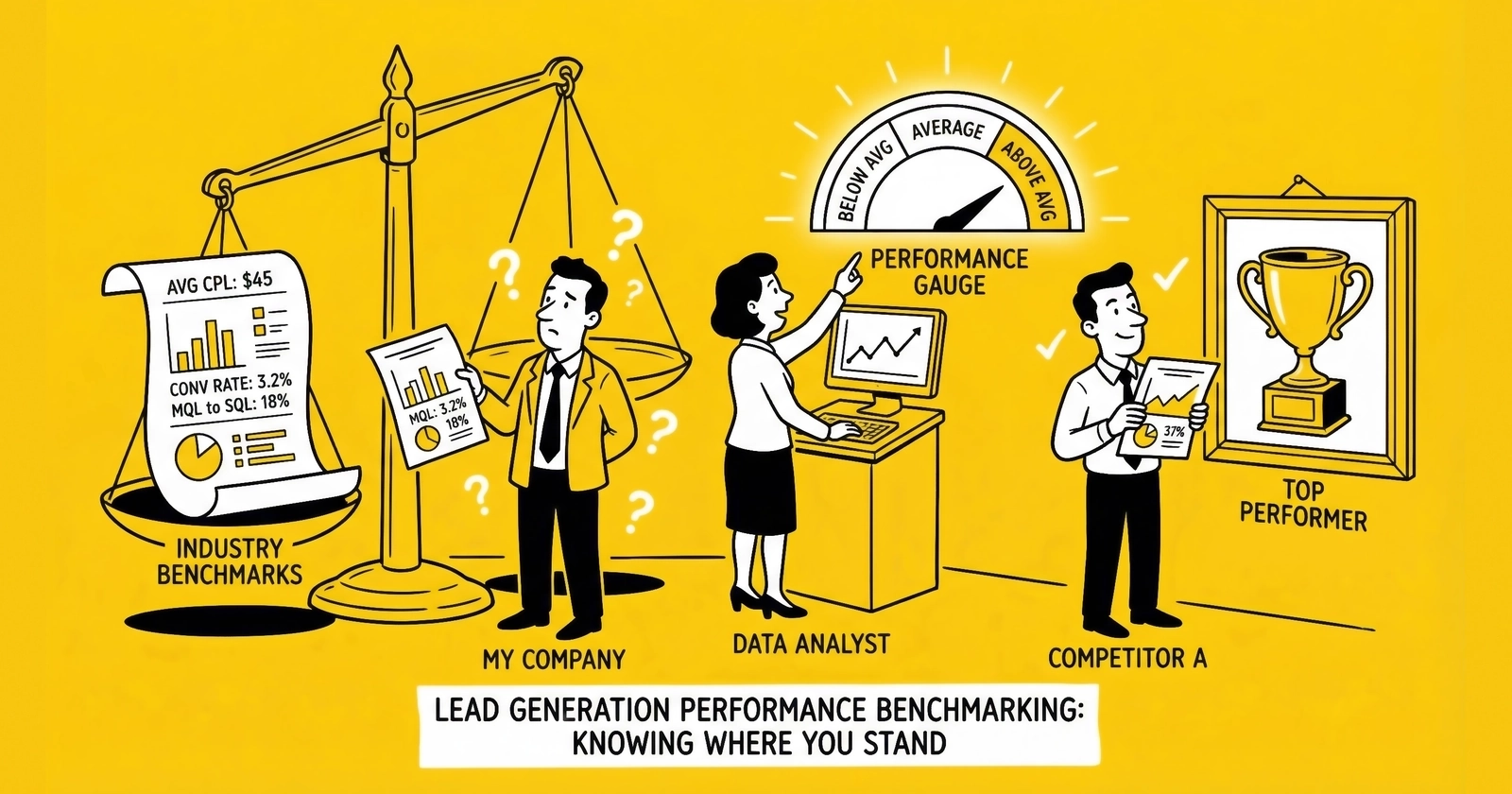
Systematic comparison of your lead generation metrics against industry standards transforms guesswork into strategic advantage. Here is how to benchmark effectively and continuously improve.
Why Performance Benchmarking Separates Winners from Strugglers
Most lead generation operators track their metrics in isolation. They know their cost per lead, their conversion rates, their return percentages. What they do not know is whether those numbers represent excellence, mediocrity, or impending failure.
Performance benchmarking against industry standards answers the question that internal metrics cannot: how do we compare?
An operator generating leads at $85 CPL might celebrate efficiency or panic about costs depending entirely on context. If the industry median for that vertical runs $130, they are outperforming. If competitors achieve $45, they are hemorrhaging margin on every transaction.
The difference between operators who scale profitably and those who plateau or fail often comes down to this single capability: systematic benchmarking that reveals where they stand, where opportunities exist, and where they must improve or exit.
This guide provides the complete framework for benchmarking your lead generation performance against industry standards. We will cover benchmark data sources, metric comparison methodologies, competitive analysis techniques, performance tier identification, and continuous improvement systems. By the end, you will have the infrastructure to know precisely where you stand and what to do about it.
The Foundation: Understanding Benchmark Data Sources
Before comparing your performance to anything, you must understand where benchmark data comes from and how reliable it is.
Primary Benchmark Sources
Industry benchmarks emerge from several distinct source types, each with strengths and limitations.
Platform-reported data comes directly from advertising platforms like Google, Meta, and LinkedIn. Google publishes industry benchmark reports through their Ads platform and research blogs. These numbers carry authority because they aggregate actual campaign performance across millions of advertisers. However, platform data tends toward optimism. Vendors have incentives to report favorable metrics that encourage continued spending. Google’s reported conversion rates typically run 10-20% higher than operators observe when they track through independent systems.
Industry research organizations like Forrester, Gartner, HubSpot, and Demand Gen Report publish annual benchmarking studies based on surveys and data partnerships. The 2024-2025 HubSpot State of Marketing report surveyed over 1,400 marketers globally. Demand Gen Report’s B2B Buyer Behavior studies provide conversion funnel benchmarks. These sources offer cross-platform perspective that individual vendors cannot provide. Limitations include sample bias (survey respondents may skew toward larger or more sophisticated operations) and reporting lag (studies published in 2025 often use 2024 data).
Public company filings from lead generation companies like MediaAlpha (MAX), EverQuote (EVER), QuinStreet (QNST), and LendingTree (TREE) provide verified financial data. MediaAlpha reported $864.7 million in revenue for 2024, representing 123% year-over-year growth. EverQuote generated $500.2 million in 2024 revenue with 74% year-over-year growth. These filings reveal actual unit economics at scale. However, public companies represent the industry’s largest players, whose economics differ from smaller companies.
Industry associations and conferences like LeadsCon and the Performance Marketing Association aggregate practitioner data. Conference presentations often include case studies with specific metrics. Association surveys capture working operator experience. The limitation is that conference speakers typically present success stories, not representative performance.
Peer networks and private communities provide real-time benchmark data from active operators. LinkedIn groups, Slack communities, and mastermind groups share current performance numbers. This data is current and operationally relevant but difficult to verify and subject to selection bias.
Data Reliability Framework
When evaluating any benchmark source, assess it against four criteria:
Recency. Benchmarks degrade quickly. Cost-per-lead data from 2023 is largely irrelevant for 2025 planning. Regulatory changes and evolving buyer requirements reshape economics overnight. Prioritize data from the past 12 months.
Sample size and composition. A benchmark derived from 50 advertisers differs from one derived from 50,000. More importantly, understand who is in the sample. Enterprise B2B benchmarks may not apply to small business targeting. Insurance carrier benchmarks differ from agency benchmarks.
Methodology transparency. How was the data collected? Self-reported surveys differ from platform-observed behavior. Aggregated means differ from medians. Ranges tell different stories than single figures. Reject benchmarks that do not explain their methodology.
Bias direction. Every source has incentives. Platform data skews optimistic. Vendor whitepapers favor their product category. Conference speakers present above-average results. Understanding the bias helps you calibrate appropriately.
Building Your Benchmark Library
Create a structured reference system for benchmark data you trust. For each vertical and metric category, document:
- Source and publication date
- Sample size and composition
- Key figures (minimum, median, maximum, or quartile ranges)
- Your confidence level in the data
- Refresh schedule (when to update)
A well-maintained benchmark library becomes your competitive intelligence foundation. Update it quarterly at minimum, monthly for rapidly changing verticals.
Core Metrics for Benchmarking
Performance benchmarking requires comparing the right metrics. Not all numbers deserve equal attention. Focus on the metrics that actually determine business outcomes.
Cost Metrics
Cost Per Lead (CPL) measures total acquisition cost divided by lead volume. This is the fundamental efficiency metric, with CPL benchmarks varying significantly by industry. Industry CPL varies dramatically by vertical:
| Vertical | Low Range | Median | High Range |
|---|---|---|---|
| Auto Insurance | $25 | $35-45 | $75 |
| Medicare | $35 | $55-65 | $100 |
| Mortgage | $25 | $75-100 | $250 |
| Solar | $30 | $100-150 | $350 |
| Personal Injury | $100 | $300-400 | $800+ |
| Home Services | $25 | $50-80 | $150 |
| B2B SaaS (SMB) | $75 | $125-180 | $250 |
| B2B SaaS (Enterprise) | $200 | $350-550 | $800+ |
When benchmarking CPL, segment by:
- Channel (Google typically runs higher CPL than Facebook but with higher intent)
- Lead type (exclusive vs. shared, real-time vs. aged)
- Geographic market (California solar leads command premiums that would be absurd in North Dakota)
- Quality tier (premium leads justify premium CPL)
Google Ads CPL rose from $66.69 in 2024 to $70.11 in 2025, a 5% increase that represents moderation from the prior year’s 25% spikes. Facebook CPL increased more dramatically, from $21.98 to $27.66, a 26% jump that reflects platform maturity and privacy impacts.
Cost Per Acquisition (CPA) extends beyond lead cost to include the full expense of acquiring a customer. If your lead costs $50, your contact rate is 50%, and your close rate is 10%, your CPA is $1,000. Compare CPA to customer lifetime value (LTV) for profitability assessment. The industry standard for sustainable economics is LTV-to-CPA ratio of 3:1 or better.
Blended Cost Metrics combine multiple cost elements. True CPL should include media spend, platform fees, validation costs, and labor allocation. Many practitioners undercount costs, reporting CPL 20-40% below actual. When comparing to benchmarks, ensure you are measuring apples to apples.
Quality Metrics
Return Rate measures the percentage of leads returned by buyers for quality issues. Industry benchmarks:
| Performance Tier | Return Rate |
|---|---|
| Premium | Below 5% |
| Above Average | 5-8% |
| Average | 8-12% |
| Below Average | 12-18% |
| Problem | Above 18% |
Return rates above 15% typically indicate systematic quality problems requiring immediate intervention. Each percentage point of return rate directly erodes gross margin.
Contact Rate tracks successful connection with leads. The industry considers 45-55% contact rates acceptable for auto insurance, with higher expectations for higher-intent verticals. Contact rates below 30% suggest data quality issues, timing problems, or fraudulent leads.
Conversion Rate measures progression through your funnel. Benchmark conversion rates vary by definition (form submission to validated lead, validated lead to sold lead, sold lead to customer). Industry standards for overall lead-to-customer conversion:
| Vertical | Typical Range |
|---|---|
| Auto Insurance | 5-12% |
| Mortgage | 1-3% |
| Solar | 3-8% |
| Legal (PI) | 2-5% |
| Home Services | 8-15% |
Top performers typically achieve 2-3x the conversion rates of average operators in their vertical.
Lead Score Accuracy compares predicted quality to actual outcomes. If your scoring model predicts 30% of leads as “high quality” but only 10% of those convert, the model underperforms. Effective scoring should produce at least 3x conversion rate differential between top-scored and bottom-scored leads.
Operational Metrics
Speed to Lead measures time from lead submission to first contact attempt. The industry benchmark is unambiguous: leads contacted within five minutes convert at dramatically higher rates than those contacted later. Velocify research shows 391% higher conversion for one-minute response times. The InsideSales.com study found 21x higher qualification rates for five-minute response.
| Response Time | Relative Performance |
|---|---|
| Under 1 minute | Excellent (reference) |
| 1-5 minutes | Very Good (80-90% of optimal) |
| 5-15 minutes | Good (60-70% of optimal) |
| 15-60 minutes | Average (40-50% of optimal) |
| Over 60 minutes | Poor (20-30% of optimal) |
System Uptime benchmarks at 99.9% for production lead distribution systems. Even 99% uptime means 87 hours of downtime annually, potentially losing thousands of leads during peak periods.
Processing Throughput capacity should exceed peak demand by 20-30% buffer. If your historical peak is 500 leads per hour, your systems should handle 650 without degradation.
Financial Metrics
Gross Margin by business position:
| Position | Benchmark Range |
|---|---|
| Direct Generator | 60-80% |
| Broker | 25-40% |
| Network | 12-20% (take rate) |
| Platform | 85-95% |
Brokers reporting 40% gross margins are typically neglecting return reserves, float costs, or processing expenses. After all costs, broker net margins typically run 15-18%.
Revenue Per Lead (RPL) benchmarks against sale price minus returns and adjustments. If you sell at $50 with 12% returns, your effective RPL is $44.
Earnings Per Lead (EPL) represents net profit after all costs. This is the metric that matters most. Target EPL of 15-20% of gross sale price for sustainable operations. Below 10% indicates margin erosion requiring intervention.
Conducting Competitive Analysis
Benchmarking against industry averages is useful. Benchmarking against your actual competitors is essential.
Identifying Your Competitive Set
Your competitive set includes operators targeting the same:
- Verticals and sub-verticals
- Geographic markets
- Buyer relationships
- Traffic channels
- Business model position (generator, broker, network)
A mortgage lead generator in California using Google Ads competes with other California mortgage generators on Google, not with Florida solar lead brokers on Facebook.
Competitive Intelligence Methods
Public company analysis. For publicly traded competitors, SEC filings reveal revenue, margins, growth rates, and sometimes unit economics. EverQuote’s 10-K filings detail their insurance vertical breakdown. QuinStreet reports segment performance by vertical. These numbers represent verified performance at scale.
Platform auction intelligence. Advertising platforms reveal competitor activity through:
- Auction Insights (Google Ads): impression share, overlap rate, position above rate
- Ad Library (Meta): active creatives and estimated spend
- Competitive research tools (SEMrush, SpyFu): keyword coverage and bid estimates
If competitors consistently achieve 70% impression share while you achieve 30%, they are likely outperforming on quality score, budget, or both.
Lead buyer feedback. Buyers work with multiple sources. They know which sources deliver premium quality and which disappoint. Building relationships with buyers that include quality feedback creates competitive intelligence. If a buyer shares that “Source X achieves 8% conversion rates while you achieve 5%,” you have identified a performance gap.
Industry network intelligence. Conferences, communities, and peer groups share competitive intelligence informally. Join relevant associations, attend industry events, and participate in practitioner communities.
Mystery shopping. Submit test leads through competitor funnels. Analyze their:
- Form design and qualification depth
- Response time and contact methodology
- Follow-up sequences and nurturing
- Consent capture and documentation
This reveals operational capabilities you can benchmark against.
Competitive Positioning Matrix
Map competitors on key dimensions to identify your positioning:
| Dimension | Your Position | Competitor A | Competitor B | Industry Average |
|---|---|---|---|---|
| CPL | $55 | $48 | $62 | $58 |
| Return Rate | 8% | 5% | 12% | 10% |
| Volume Capacity | 50K/mo | 200K/mo | 30K/mo | 75K/mo |
| Speed to Delivery | 2 sec | 5 sec | 15 sec | 8 sec |
| Vertical Depth | 3 verticals | 8 verticals | 2 verticals | 4 verticals |
This matrix reveals where you lead, where you lag, and where opportunity exists.
Competitive Gap Analysis
For each gap identified, assess:
Gap magnitude. Is Competitor A’s 5% return rate meaningfully better than your 8%, or within normal variance? A 3-percentage-point gap on return rates is significant. A $5 CPL difference might be noise.
Gap causation. Why does the gap exist? Competitor advantages might stem from:
- Superior traffic sources
- Better landing page optimization
- More sophisticated validation
- Stronger buyer relationships
- Lower overhead structure
- Greater scale economics
Gap closability. Can you close the gap, and at what cost? Some gaps require capital investment. Some require operational improvements. Some require strategic repositioning. Some gaps cannot be closed cost-effectively, signaling verticals or channels to exit.
Establishing Performance Tiers
Raw benchmarks gain meaning when organized into performance tiers. Knowing that average return rate is 10% matters less than knowing whether your 8% places you in the top quartile.
Creating Your Tier Framework
For each key metric, establish four or five performance tiers:
Tier 1: Elite (Top 10%) represents exceptional performance. Operators in this tier have sustainable competitive advantages. If you achieve elite performance, defend the position through continuous improvement.
Tier 2: Strong (Top 25%) represents above-average performance. Operators in this tier are well-positioned but face competition from those targeting elite status.
Tier 3: Average (25th-75th percentile) represents the competitive middle. Most practitioners cluster here. Differentiation is difficult, margins are thin, and commoditization pressure is constant.
Tier 4: Below Average (Bottom 25%) represents underperformance requiring attention. Operators in this tier face margin pressure and buyer relationship risk.
Tier 5: Critical (Bottom 10%) represents performance threatening business viability. Immediate intervention is required.
Sample Tier Frameworks by Metric
Cost Per Lead Performance Tiers (Insurance Vertical):
| Tier | CPL Range | Implication |
|---|---|---|
| Elite | Below $25 | Significant pricing power or efficiency advantage |
| Strong | $25-35 | Competitive position with healthy margins |
| Average | $35-55 | Standard performance, limited differentiation |
| Below Average | $55-80 | Margin pressure, optimization needed |
| Critical | Above $80 | Unsustainable without dramatic improvement |
Return Rate Performance Tiers:
| Tier | Return Rate | Implication |
|---|---|---|
| Elite | Below 5% | Premium source status with buyers |
| Strong | 5-8% | Above-average quality reputation |
| Average | 8-12% | Standard buyer relationships |
| Below Average | 12-18% | At risk of buyer churn |
| Critical | Above 18% | Immediate quality intervention required |
Speed to Lead Performance Tiers:
| Tier | Response Time | Implication |
|---|---|---|
| Elite | Under 30 seconds | Maximum conversion capture |
| Strong | 30 sec - 2 min | Strong performance |
| Average | 2-10 minutes | Acceptable but improvable |
| Below Average | 10-30 minutes | Conversion leakage significant |
| Critical | Over 30 minutes | Losing majority of potential conversions |
Composite Scoring
Individual metrics tell partial stories. Composite scores reveal overall positioning.
Create a weighted composite score based on metrics most critical to your business:
| Metric | Weight | Your Score | Weighted Score |
|---|---|---|---|
| CPL Tier | 25% | 3 (Average) | 0.75 |
| Return Rate Tier | 25% | 2 (Strong) | 0.50 |
| Conversion Rate Tier | 20% | 3 (Average) | 0.60 |
| Speed to Lead Tier | 15% | 4 (Below Avg) | 0.60 |
| Margin Tier | 15% | 2 (Strong) | 0.30 |
| Composite Score | 100% | 2.75 |
A composite score of 2.75 indicates overall above-average positioning with specific improvement opportunities (Speed to Lead in this example).
Recalculate composite scores monthly or quarterly to track performance trajectory.
Continuous Improvement Systems
Benchmarking without action is academic exercise. The purpose of performance comparison is driving improvement.
The Improvement Loop
Effective continuous improvement follows a structured cycle:
1. Measure and Compare. Calculate current metrics. Compare against tier frameworks. Identify gaps.
2. Prioritize Gaps. Not all gaps deserve equal attention. Prioritize based on:
- Impact on business outcomes (revenue, margin, sustainability)
- Effort required to close
- Time to impact
- Dependencies on other improvements
A return rate gap that costs $50,000 monthly deserves more attention than a CPL gap costing $5,000, even if the CPL fix is easier.
3. Diagnose Root Causes. Surface-level metrics obscure underlying causes. If return rates exceed benchmarks, why?
- Data quality issues at capture?
- Inadequate validation?
- Traffic source problems?
- Misaligned buyer expectations?
- Timing or freshness issues?
Root cause diagnosis prevents superficial fixes that fail.
4. Design Interventions. For each prioritized gap, design specific interventions:
- What will change?
- Who is responsible?
- What resources are required?
- What is the expected impact?
- How will success be measured?
- What is the timeline?
5. Implement and Monitor. Execute interventions while monitoring for intended and unintended effects. Major changes should roll out gradually, not simultaneously.
6. Measure Results. After sufficient time for impact, measure results against expectations. Did the intervention close the gap? Did it create new problems?
7. Standardize or Iterate. Successful interventions become standard practice. Failed interventions trigger another diagnostic cycle.
Improvement Prioritization Framework
When multiple gaps compete for attention, use this prioritization matrix:
| Gap | Impact (1-5) | Effort (1-5) | Time to Impact | Priority Score |
|---|---|---|---|---|
| Return rate | 5 | 3 | 4 weeks | 8.3 |
| Speed to lead | 4 | 2 | 2 weeks | 8.0 |
| CPL efficiency | 3 | 4 | 8 weeks | 6.0 |
| Conversion rate | 4 | 5 | 12 weeks | 5.6 |
Priority Score = Impact × (6 - Effort) / Normalized Time Factor
Higher scores indicate higher priority. Quick wins (high impact, low effort, fast results) should typically precede long-term projects.
Benchmark Review Cadence
Different metrics require different review frequencies:
Daily: Volume, immediate quality indicators, system performance. Daily review catches acute problems before they compound.
Weekly: CPL trends, conversion rates by source, return rates by buyer. Weekly analysis reveals patterns that daily noise obscures.
Monthly: Margin analysis, competitive positioning, composite scores. Monthly review provides sufficient data for statistically meaningful conclusions.
Quarterly: Strategic benchmarking, tier positioning, improvement cycle review. Quarterly sessions connect operational metrics to strategic direction.
Annually: Full benchmark library refresh, competitive set reassessment, strategic planning. Annual review ensures benchmarks remain current and relevant.
Building the Benchmarking Culture
Sustainable improvement requires organizational commitment, not just individual effort.
Transparency. Share benchmark comparisons broadly. Teams that see how they compare to industry standards are more motivated to improve than teams operating in information vacuums.
Accountability. Assign ownership for each key metric. The person responsible for return rates should know the benchmark, know current performance, and own the improvement plan.
Celebration. Recognize improvements that move the needle. When return rates drop from 12% to 8%, celebrate the achievement. Positive reinforcement sustains effort.
Learning from failure. Not every improvement initiative succeeds. Create psychological safety to acknowledge failures, diagnose causes, and try again.
Vertical-Specific Benchmarking Considerations
While the frameworks above apply universally, each vertical has specific benchmarking nuances.
Insurance Vertical Benchmarks
Insurance lead generation benchmarks require segmentation by sub-vertical, as economics differ dramatically:
| Sub-Vertical | CPL Range | Return Rate Benchmark | Conversion Benchmark |
|---|---|---|---|
| Auto | $25-65 | 8-15% | 5-12% |
| Medicare | $30-100 | 10-18% | 6-10% |
| Health (ACA) | $30-80 | 10-20% | 5-10% |
| Life | $25-65 | 8-15% | 3-8% |
| Home | $35-80 | 10-18% | 4-10% |
Medicare benchmarks require enrollment period context. Annual Enrollment Period (October 15 - December 7) sees premium CPL spikes of 50-100% above off-season. Open Enrollment Period (January 1 - March 31) runs intermediate pricing. Comparing your October CPL to July benchmarks produces misleading conclusions.
Insurance buyer economics drive acceptable CPL. Progressive Insurance spent $3.5 billion on advertising in 2024. Carrier loss ratios directly affect acquisition appetite. When carriers are profitable, lead demand increases. When loss ratios spike, demand contracts.
Mortgage Vertical Benchmarks
Mortgage benchmarks are inseparable from interest rate environment:
| Rate Environment | Purchase CPL | Refinance CPL | Volume Impact |
|---|---|---|---|
| Falling rates | $40-100 | $15-50 | Refi dominates |
| Stable low | $50-120 | $30-75 | Both active |
| Rising rates | $60-150 | $75-200+ | Purchase only |
| Stable high | $50-130 | Minimal | Purchase-only market |
In the high-rate environment of 2024-2025, refinance volume collapsed while purchase activity maintained. Benchmarking your refinance performance against 2021 low-rate standards produces meaningless comparisons.
Geographic variation is extreme. Loan amounts in San Francisco versus Des Moines differ by multiples, affecting acceptable CPL proportionally.
Solar Vertical Benchmarks
Solar benchmarking requires geographic and policy segmentation:
| State Tier | CPL Range | Key Factors |
|---|---|---|
| Tier 1 (CA, HI, MA) | $150-300+ | High electricity costs, strong policy |
| Tier 2 (TX, FL, AZ, NJ) | $100-175 | Growing markets, good economics |
| Tier 3 (CO, NC, VA) | $75-125 | Developing markets |
| Tier 4 (OH, PA, GA) | $50-90 | Emerging opportunities |
| Tier 5 (ND, SD, WY) | $25-60 | Limited solar economics |
The 8.5x spread between California and North Dakota lead values reflects genuine economic differences, not performance variation.
Policy changes dramatically affect benchmarks. The Inflation Reduction Act extended the 30% federal Investment Tax Credit through 2032 for commercial projects. However, residential solar ITC provisions face uncertainty beyond 2025. NEM 3.0 in California reduced export compensation by 75%, significantly impacting California lead values. Benchmark against current policy environment, not historical data.
Legal Vertical Benchmarks
Legal lead benchmarks segment by case type:
| Case Type | CPL Range | Return Rate | Conversion |
|---|---|---|---|
| Auto Accident (PI) | $250-600 | 15-25% | 5-15% |
| Medical Malpractice | $400-800+ | 20-30% | 3-8% |
| Workers Comp | $100-250 | 15-20% | 8-15% |
| Mass Tort | $50-400 | 10-25% | 10-30% (varies by campaign) |
Legal leads accept higher CPL because case values justify the investment. A personal injury case settling for $100,000 with 33% contingency fee generates $33,000 in attorney revenue. A $500 lead that converts at 5% produces $1,650 cost per signed case, with potential revenue 20x that cost.
Mass tort benchmarks are campaign-specific. A mature mass tort campaign with depleted inventory has different economics than an emerging campaign with fresh plaintiff pools.
B2B Vertical Benchmarks
B2B benchmarking requires understanding buying committee dynamics:
| Metric | SMB Target | Mid-Market | Enterprise |
|---|---|---|---|
| CPL | $75-180 | $150-350 | $300-800 |
| Sales Cycle | 2-4 weeks | 4-12 weeks | 3-12 months |
| Buying Committee Size | 1-3 | 4-7 | 6-12+ |
| Touch Points to Close | 5-10 | 10-25 | 25-50+ |
Enterprise B2B benchmarks that measure single-touch conversion rates miss the reality that 6-10 stakeholders are involved in purchase decisions. Multi-touch attribution and account-based metrics are more relevant than traditional lead conversion benchmarks.
Technology for Benchmarking
Effective benchmarking requires systems that collect, analyze, and present comparison data.
Essential Analytics Infrastructure
Unified data collection. Benchmarking requires consistent measurement across sources, channels, and time periods. Disparate data systems prevent accurate comparison. Invest in data infrastructure that creates a single source of truth for performance metrics.
Attribution clarity. Multi-touch journeys complicate metric calculation. A lead touched by Facebook, retargeted on Google, and converted through email requires clear attribution methodology. Use consistent attribution models when comparing against benchmarks.
Segmentation capability. Aggregate metrics hide performance variation. Your 8% return rate might average 5% from Source A and 15% from Source B. Segment-level analysis reveals where you actually lead or lag.
Recommended Tool Categories
Business Intelligence Platforms (Looker, Tableau, Power BI) enable custom dashboarding with benchmark overlays. Build views that display current performance against target benchmarks with clear variance indicators.
Lead Distribution Analytics (native reporting in boberdoo, LeadsPedia, Phonexa) provide purpose-built metrics for lead operations. These platforms track ping/post acceptance rates, buyer-level performance, and routing efficiency.
Competitive Intelligence Tools (SEMrush, SpyFu, SimilarWeb) reveal competitor advertising activity, keyword coverage, and traffic estimates. Use for competitive benchmarking inputs.
Industry Benchmark Databases (various subscription services) aggregate benchmark data across verticals. Evaluate against methodology and recency requirements.
Dashboard Design for Benchmarking
Effective benchmark dashboards include:
Current vs. benchmark visualization. Gauge charts or progress bars showing current performance against target. Green/yellow/red indicators for quick assessment.
Trend lines with benchmark bands. Time-series charts showing metric trajectory with benchmark range overlaid. Reveals whether you are improving toward or deteriorating away from targets.
Tier distribution. Show what percentage of your sources, campaigns, or buyers fall into each performance tier. A portfolio with 60% of sources in Tier 3 or below needs attention.
Gap prioritization view. Rank order of gaps by impact, with assigned ownership and improvement status.
Frequently Asked Questions
How often should I update my benchmarks?
Refresh benchmark data quarterly at minimum. For rapidly changing verticals (insurance during AEP, mortgage during rate shifts), monthly updates are appropriate. Your internal metrics should compare against the most recent reliable benchmark data available.
What if my performance is below average across all metrics?
Below-average performance across the board indicates systemic issues requiring fundamental reassessment. Options include: significant operational restructuring, vertical pivot to areas with better fit, exit from the business. The worst response is continuing with marginal improvements that never close the gap.
How do I benchmark when I am the first entrant in a new vertical?
New verticals lack established benchmarks. Use adjacent vertical benchmarks as proxies (a new home services category might benchmark against established home services data). Set internal improvement targets based on cost and margin requirements rather than competitive comparison. As the vertical matures, contribute to establishing industry benchmarks.
Should I share benchmark comparisons with my team?
Yes. Transparency about performance versus industry standards motivates improvement better than vague encouragement. Teams that understand they are in Tier 4 on return rates have context for why the improvement initiative matters. Celebrate when comparisons are favorable; diagnose and act when they are not.
How reliable are self-reported benchmark surveys?
Self-reported data carries bias. Respondents may round favorably, misremember, or cherry-pick. Surveys also suffer from selection bias (operators who respond may differ systematically from those who do not). Use survey-based benchmarks directionally rather than precisely. Prefer platform-observed or verified financial data when available.
What benchmarks matter most for lead buyers versus generators?
Lead buyers should prioritize: conversion rate benchmarks, speed-to-lead benchmarks, and cost-per-acquisition benchmarks. These metrics determine ROI on lead purchases.
Lead generators should prioritize: CPL benchmarks, return rate benchmarks, and sell-through rate benchmarks. These metrics determine margin sustainability.
Both should track contact rate benchmarks as this metric affects both sides of the transaction.
How do I benchmark when competitors are private?
Most competitors in lead generation are private companies that do not disclose performance. Use proxy methods: platform auction intelligence reveals relative positioning, buyer feedback provides quality comparisons, mystery shopping reveals operational capabilities. Industry-wide benchmarks provide comparison even without specific competitor data.
Should I pay for premium benchmark data services?
Premium benchmark services make sense when: the data is demonstrably more accurate or current than free alternatives, the time savings from consolidated data justifies the cost, the decision stakes are high enough to warrant the investment. Start with free sources (platform data, public reports, peer networks) and upgrade if gaps persist.
How do I handle benchmark data that conflicts across sources?
Conflicting data is common. When sources disagree: assess methodology differences that might explain variance, weight sources by reliability and recency, use ranges rather than single figures, note confidence levels in your benchmark library. A range of $50-80 CPL with medium confidence is more useful than a false-precise $65 from questionable data.
What is the biggest benchmarking mistake operators make?
The biggest mistake is benchmarking aggregate metrics when segment-level variation matters more. An operator with 8% average return rate might feel satisfied until they realize 40% of their volume comes from a source with 15% returns, subsidized by a source at 3%. Segment-level benchmarking reveals actionable improvement opportunities that aggregate comparisons obscure.
Key Takeaways
Benchmark data quality matters as much as benchmark data itself. Prioritize recent, methodologically transparent, appropriately scoped data over impressive-looking figures from unreliable sources. Build a benchmark library you trust and update it systematically.
Compare against your actual competitive set, not generic industry averages. Your relevant benchmarks depend on your verticals, geographies, channels, and business model position. A California solar lead generator has different benchmarks than a Florida mortgage broker.
Organize benchmarks into performance tiers for actionable context. Knowing your return rate is 8% matters less than knowing that puts you in Tier 2 (Strong) for your vertical. Tier frameworks enable prioritization and celebration.
Benchmarking without action is worthless. The purpose of comparison is identifying improvement opportunities and executing against them. Build continuous improvement systems that close gaps through structured intervention cycles.
Review cadence should match metric volatility. Daily review for operational metrics, weekly for trend analysis, monthly for strategic comparison, quarterly for comprehensive assessment. Different metrics need different attention frequencies.
Segment-level benchmarking reveals what aggregate comparison hides. Your overall performance may look acceptable while specific sources, channels, or geographies dramatically underperform. Drill into segments to find where the real opportunities and problems exist.
Those who win benchmark continuously. Performance comparison is not an annual planning exercise. It is an ongoing discipline that keeps you aware of your competitive position and focused on improvement priorities.
Statistics and regulatory information current as of late 2025. Industry benchmarks shift continuously based on platform changes, regulatory developments, and market dynamics. Verify current conditions before making significant investment or strategic decisions.