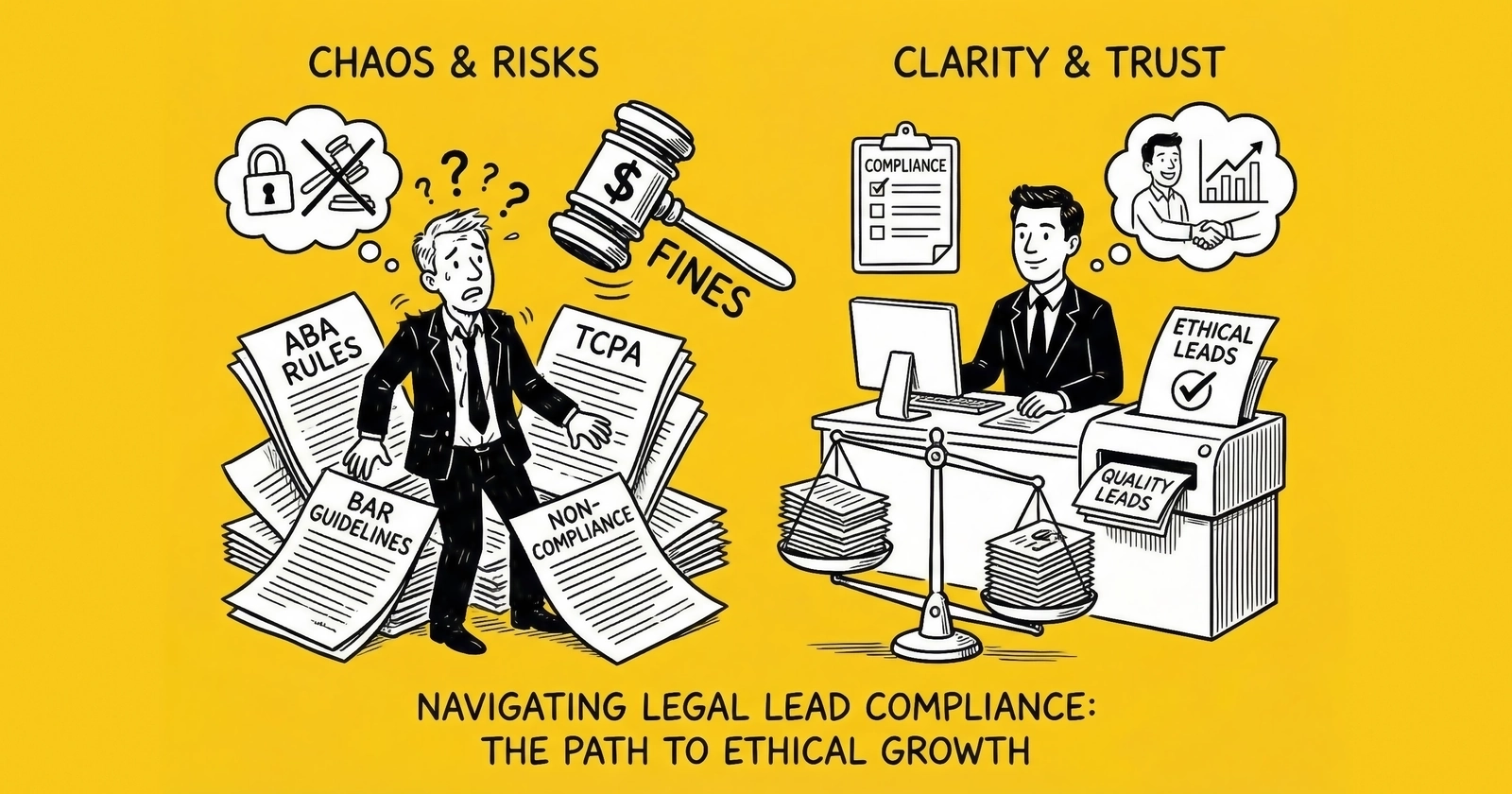
Understanding the state-by-state patchwork of bar rules, solicitation restrictions, and advertising requirements that separate legitimate legal lead generation from criminal liability.
A lead generator launches a personal injury campaign in Texas. The creative looks identical to what worked in California – targeted Facebook ads, compelling landing page, standard intake form. Within three months, the Texas State Bar has opened an investigation. The attorney buying those leads faces potential disbarment. The lead generator faces criminal barratry charges with penalties up to $50,000 per violation.
This is the reality of legal lead compliance: what works in one state can constitute a crime in another.
Legal lead generation commands the highest CPLs in the industry – $200 to $800+ for personal injury, $500 to $5,000+ for signed mass tort retainers. These economics attract operators from every corner of the lead generation world. But the vertical operates under ethical frameworks that predate digital marketing by decades, enforced by state bar associations with the power to end attorney careers and by prosecutors who can file criminal charges against lead generators who cross certain lines.
Understanding attorney advertising rules by state is not optional compliance overhead. It is the price of admission to a vertical where a single misstep can result in voided contracts, criminal prosecution, and complete business destruction. The ethics guidelines from state bar associations provide the foundation for all compliance decisions.
This guide maps the regulatory landscape: the foundational bar rules that govern attorney advertising, the state-by-state variations that create compliance complexity, the distinction between permitted advertising and prohibited solicitation, and the practical frameworks for building compliant operations. Whether you are generating legal leads, buying them, or building the technology that connects the two, this framework determines what you can and cannot do.
The Foundation: ABA Model Rules and State Implementation
Every state bar association maintains rules of professional conduct governing how attorneys may advertise their services and communicate with potential clients. Most state rules derive from the American Bar Association Model Rules of Professional Conduct, but the operative word is “derive” – each state has adopted modifications that create meaningful compliance variations.
Model Rules 7.1 Through 7.5: The Framework
The ABA Model Rules provide the conceptual framework that shapes state-level implementation:
Model Rule 7.1: Communications Concerning a Lawyer’s Services
A lawyer shall not make a false or misleading communication about the lawyer or the lawyer’s services. A communication is false or misleading if it contains a material misrepresentation of fact or law, or omits a fact necessary to make the statement considered as a whole not materially misleading.
This rule applies directly to lead generation advertising. Claims about case outcomes, settlement values, attorney qualifications, or firm capabilities must be accurate and verifiable. The “material misrepresentation” standard catches exaggerated marketing claims that would be acceptable in other industries.
Model Rule 7.2: Communications Concerning a Lawyer’s Services: Specific Rules
This rule permits lawyers to communicate information regarding services through any media. It establishes the baseline that attorney advertising is constitutionally protected commercial speech – but protected speech still operates within regulatory constraints.
For lead generators, this rule establishes three key provisions. Lawyers may pay the reasonable costs of advertisements or communications permitted under the rules, creating the economic foundation for paid lead generation. They may also pay for leads from a lawyer referral service if the service is approved by an appropriate regulatory authority – a provision that becomes increasingly relevant under California’s SB 37. Perhaps most importantly for compliance, the name and contact information of at least one lawyer or law firm responsible for the content must appear in any advertisement, which affects how lead generation creative must be structured.
Model Rule 7.3: Solicitation of Clients
This rule draws the critical line that determines whether lead generation activities are legal or criminal. Lawyers may not solicit professional employment by live person-to-person contact when a significant motive for the lawyer’s doing so is pecuniary gain. The rule carves out narrow exceptions for contact with other lawyers, persons who have family, close personal, or prior business or professional relationships with the lawyer or law firm, and persons who routinely use the type of legal services involved for business purposes.
The implications for lead generators are significant. Advertising to the general public is permitted. Direct solicitation of specific individuals known to need legal services for a particular matter is prohibited.
Model Rule 7.4: Communication of Fields of Practice and Specialization
Lawyers may communicate that they practice in particular fields but may not state or imply that they are specialists unless certified by an organization approved by an appropriate authority. Lead generation creative that positions attorneys as “specialists” or “experts” without proper certification exposes both generator and attorney to discipline.
Model Rule 7.5: Firm Names and Letterheads
This rule governs how law firms can be named and identified. For lead generators, the relevant provision is that advertising must not be false or misleading about the nature of the firm, its services, or the attorneys involved.
How States Modify the Model Rules
While most states base their rules on the ABA Model Rules, modifications range from minor wording changes to fundamentally different regulatory approaches. Understanding these variations is essential for multi-state operations.
Adoption Patterns
States fall into three general categories. Some states like Arizona, Delaware, and Missouri adopt Model Rules with minimal modification, creating near-complete alignment with the ABA framework. Major legal markets including Texas, Florida, California, and New York often have extensive custom provisions that depart significantly from the model language. The largest category consists of states taking hybrid approaches – adopting the Model Rule structure while adding state-specific disclosure requirements, filing obligations, or enforcement mechanisms.
Common Modification Areas
| Modification Type | States with Notable Variations |
|---|---|
| Pre-filing/review requirements | Texas (advertising review committee) |
| Waiting periods for solicitation | Florida (30-day rule), multiple states |
| Specific disclosure mandates | Texas, Florida, New York, California |
| Testimonial restrictions | Varies significantly by state |
| Specialization claims | Different certification standards by state |
| Electronic communication rules | Evolving rapidly across all states |
State-by-State Analysis: Major Legal Markets
Legal lead generation concentrates in states with large populations, active plaintiff bars, and high case values. Understanding the specific requirements in these markets is essential for any operator generating meaningful volume.
Texas: The Strictest Regime
Texas maintains some of the nation’s strictest attorney advertising rules, backed by both bar discipline and criminal prosecution authority. The Texas Disciplinary Rules of Professional Conduct govern attorney advertising through Rules 7.01 through 7.07, with implementation guidance from the State Bar of Texas Advertising Review Committee.
Pre-approval and Filing
Texas Rule 7.07 requires attorneys to file most advertisements with the Advertising Review Committee within ten days of first dissemination. This filing requirement covers television and radio advertisements, print advertisements, electronic communications (including websites in certain circumstances), and direct mail solicitations. The committee reviews advertisements for compliance and can order modifications or cessation of non-compliant materials. Lead generators working with Texas attorneys must ensure their marketing materials can satisfy committee review.
Labeling Requirements
Texas mandates specific labeling for attorney advertising. The phrase “ATTORNEY ADVERTISEMENT” or “ADVERTISEMENT” must appear prominently in all qualifying materials. Direct mail must include “SOLICITATION” on the envelope and at the beginning of the letter, while electronic communications must include appropriate labels matching their format.
Disclosure Requirements
Texas Rule 7.02(a) requires extensive disclosures in attorney advertisements. Any advertisement that includes a statement about results obtained must include a disclaimer that past results do not guarantee similar outcomes. Fee advertisements stating an amount for a particular service must disclose whether the client will be responsible for any expenses in addition to the fee. When actors are used to portray clients, that fact must be disclosed.
Testimonial Restrictions
Testimonials and endorsements face specific restrictions under Texas rules. They must be from actual clients based on actual experiences – no fabricated reviews or paid actors presenting as clients. The testimonial cannot imply that the advertising attorney can achieve results similar to past cases, and it must include disclaimers about case-specific factors affecting outcomes.
The Barratry Statute
Texas Penal Code Section 38.12 makes barratry – solicitation prohibited by professional conduct rules – a criminal offense. The statute was updated in 2025 specifically to address digital solicitation. Repeat violations constitute a third-degree felony, with civil penalties ranging from $10,000 to $50,000 per violation. Contracts procured through barratry are voidable, meaning clients can recover all fees paid. Attorneys knowingly accepting improperly solicited cases face disbarment.
Implications for Lead Generators
Lead generators operating in Texas must ensure all advertising complies with Texas disclosure and labeling requirements, which often means creating Texas-specific versions of creative materials. Any activity that could be characterized as targeting specific accident victims must be avoided entirely. Coordination with attorney buyers on advertising review committee filings is essential, as is maintaining documentation demonstrating that lead generation activities constitute advertising rather than solicitation. Most critically, operators must understand that criminal liability – not just civil penalties – applies to prohibited conduct in Texas.
Florida: The 30-Day Rule and Active Enforcement
Florida Bar Rules Regulating the Florida Bar, Subchapter 4-7, create a framework that balances relative flexibility with aggressive enforcement.
The 30-Day Cooling-Off Period
Florida Rule 4-7.18 prohibits attorneys from sending targeted written communications to prospective clients within 30 days of an accident, disaster, or other event that gives rise to potential legal claims. This “30-day rule” directly affects how legal lead generators can use accident data sources. The following table illustrates what activities are permitted within and after the waiting period.
| Activity | Within 30 Days | After 30 Days |
|---|---|---|
| General advertising (TV, radio, display) | Permitted | Permitted |
| Targeted direct mail to accident victims | Prohibited | Permitted with disclosures |
| Online advertising to general audience | Permitted | Permitted |
| Responding to consumer-initiated contact | Permitted | Permitted |
What Triggers the 30-Day Rule
The prohibition applies when the attorney knows or reasonably should know that the person has been involved in a specific accident, disaster, incident, or event. Lead generators using police reports, hospital data, or news event information to target specific individuals must implement waiting period compliance.
Disclosure Requirements
Florida requires specific disclosures in attorney advertising. The name of at least one lawyer responsible for the content must appear, along with the geographic location of the lawyer or law firm. When results are referenced, disclaimers indicating that case outcomes vary must be included.
Testimonial Standards
Client testimonials are permitted in Florida with appropriate disclaimers. Advertisements must disclose if the person giving the testimonial was compensated for their participation. The testimonial must include language indicating it does not guarantee similar results for other clients, and it cannot contain statements that are misleading or false.
Objective Verifiability Standard
Florida Rule 4-7.2 requires that claims in attorney advertisements be “objectively verifiable.” Superlative statements like “the best lawyer” or “top-rated attorney” face scrutiny unless supported by objective third-party verification. This affects lead generation creative that makes comparative claims.
Active Enforcement
The Florida Bar maintains active enforcement through its Attorney Consumer Assistance Program (ACAP), which investigates advertising complaints. Notable enforcement patterns include discipline for misleading outcome claims, sanctions for 30-day rule violations, and enforcement actions against attorneys using non-compliant lead sources.
Implications for Lead Generators
Operators generating Florida leads must implement 30-day waiting periods before delivering leads generated from accident-specific targeting. All marketing materials must meet Florida’s objective verifiability standard, avoiding unsubstantiated superlatives. Maintaining compliance documentation for all Florida-destined leads is essential, particularly because Florida attorneys face active enforcement and will scrutinize lead sources accordingly before purchasing.
California: Relatively Permissive but Disclosure-Heavy
California Rules of Professional Conduct Rules 7.1 through 7.5 create a framework that is more permissive than Texas or Florida but imposes extensive disclosure requirements.
No Pre-Approval Requirement
Unlike Texas, California does not require pre-approval of attorney advertising. However, advertising materials must be retained for at least two years and produced upon State Bar request.
Labeling Requirements
Communications labeled as advertising must be clearly identified. The specific format is less prescribed than Texas, but the requirement for clear identification of advertising materials is enforced.
Testimonial Treatment
California permits client testimonials with appropriate disclaimers. The standard approach includes disclaimers stating that past results do not guarantee future outcomes, the outcome of individual cases depends on factors unique to each case, and case results referenced are not typical or guaranteed.
Dramatization Disclosure
If advertising uses actors, stock photos, or recreations, California requires disclosure that the depictions are dramatizations, not actual events or clients.
Runner and Capper Statute
California Business and Professions Code Section 6151 defines a “runner” or “capper” as any person acting for consideration as an agent for an attorney in the solicitation or procurement of business. Violations carry criminal penalties including fines up to $15,000, potential jail time, and contract voidability – meaning clients can recover all fees paid if procured through runners.
The Solicitation vs. Advertising Line
California draws the critical distinction between advertising – communications directed to the general public or a segment thereof, which are permitted – and solicitation – communications directed to a specific person known to need legal services for a particular matter, which face significant restrictions.
Implications for Lead Generators
California offers greater flexibility in advertising approach compared to Texas, with no pre-approval requirements and less prescriptive labeling formats. However, operators must maintain advertising archives for two years minimum and avoid any activity that could constitute “running” or “capping.” All disclaimers must meet California requirements for results-based claims, and targeting must focus on audiences rather than identified individuals with specific legal needs.
California Senate Bill 37 (Signed October 2025)
SB 37 creates unprecedented compliance requirements for legal lead generation in California, fundamentally restructuring the market.
Private Right of Action
SB 37 grants consumers the right to sue lead generators directly for violations, with statutory damages ranging from $5,000 to $100,000 per violation. Attorney’s fees are recoverable by prevailing plaintiffs, and class action potential significantly increases exposure for non-compliant operators.
Compliance Options
Lead generators must choose one of two paths to operate legally in California. The first option is becoming a State Bar Certified Lawyer Referral Service, which requires a minimum of 20+ participating attorneys, subjects the operation to State Bar audits and oversight, imposes annual certification and reporting requirements, and creates operational complexity significantly higher than traditional lead generation.
The second option is pre-assignment to specific attorneys. Under this model, operators must know which attorney will receive the lead before capture – effectively eliminating the aggregator model entirely. Operators cannot collect leads first and sell to the highest bidder; the approach requires a fundamentally different business model built around pre-established law firm relationships.
Market Impact
The legislation is reshaping California’s legal lead generation landscape. Many lead generation companies are exiting California operations entirely rather than restructuring. Affiliate networks are limiting California inventory, while marketing aggregators are restructuring to pre-assignment models. Large law firms with in-house marketing capabilities gain advantage under the new framework, while small firms lose access to affordable lead generation channels. Signed retainer business models may become dominant as a result.
Compliance Timeline
Enforcement begins in 2026, but prudent practitioners are restructuring California operations now.
Implications for Lead Generators
Before continuing California operations, operators must evaluate whether the volume justifies restructuring costs. Those committed to the California market should consider State Bar certification and begin building pre-assignment relationships with specific law firms. Operators unable or unwilling to restructure should implement geographic filtering to exclude California entirely. All operators should monitor for similar legislation in other states.
New York: Aggressive Enforcement with Complex Requirements
New York Rules of Professional Conduct Rules 7.1 through 7.5 create a framework marked by aggressive enforcement and detailed requirements.
Advertising Definition
New York defines “advertisement” broadly to include any public or private communication made by or on behalf of a lawyer about the lawyer’s services. This expansive definition captures most lead generation activities.
Content Requirements
New York Rules require that attorney advertisements not include paid endorsements without disclosure. They must include the principal address and phone number of the law firm and must not include statements about quality that compare lawyers’ services unless the comparison can be substantiated.
Direct Solicitation Restrictions
New York Rule 7.3 restricts solicitation with detailed provisions. Written or electronic communications to prospective clients require “ATTORNEY ADVERTISING” at the top of each page. The mailing must be filed with the attorney disciplinary committee within three days, and retention requirements extend to three years from date of last dissemination.
Enforcement Patterns
The New York disciplinary system actively investigates attorney advertising. The Department of Financial Services has also pursued enforcement actions against lead generators whose marketing materials were deemed too specific about case outcomes or attorney qualifications.
Implications for Lead Generators
Operators targeting New York must ensure all communications comply with labeling requirements and coordinate with attorney buyers on filing obligations. Given active enforcement, conservative compliance standards are essential. Comparative quality claims that cannot be substantiated should be avoided entirely.
State Comparison Matrix
The following matrix summarizes key compliance requirements across major legal markets.
| Requirement | Texas | Florida | California | New York |
|---|---|---|---|---|
| Pre-filing required | Yes (10 days) | No | No | Yes (3 days) |
| Waiting period for solicitation | Varies by context | 30 days | Case-by-case | Varies |
| ”ADVERTISEMENT” labeling | Required | Required | Required | Required |
| Testimonials permitted | Yes, with restrictions | Yes, with disclaimers | Yes, with disclaimers | Yes, with restrictions |
| Criminal penalties for violations | Yes (barratry) | Limited | Yes (runner/capper) | Limited |
| Advertising review committee | Yes | No | No | No |
| Enforcement intensity | Very high | High | Moderate | High |
The Critical Distinction: Advertising vs. Solicitation
The line between advertising and solicitation is the central compliance challenge in legal lead generation. Understanding this distinction determines whether your operations are legal or criminal.
What Constitutes Advertising (Generally Permitted)
Advertising reaches the general public without targeting specific individuals known to need legal services. Lead generation fits the advertising category when three conditions are met.
First, targeting is based on characteristics, not circumstances. Demographic targeting by age, location, or income level is permitted. Interest-based targeting – users who have shown interest in legal topics – is permitted. Keyword targeting of users searching for legal-related terms and contextual targeting of users viewing legal-related content both fall within advertising boundaries.
Second, consumers initiate the relationship. This occurs when they visit a website in response to advertising, complete a form to request information, call a phone number from an advertisement, or click on a search or display advertisement. The consumer takes the affirmative step toward contact.
Third, communication is not directed at identified individuals. General advertising reaches whoever encounters it. There is no targeting based on specific events that happened to specific people. The audience is defined by characteristics, not by legal circumstances.
What Constitutes Solicitation (Generally Prohibited)
Solicitation involves targeting specific individuals known to need legal services for a particular matter. Two categories of activity typically trigger solicitation concerns.
The first is targeting based on identified legal events. This includes contacting accident victims identified from police reports, reaching out to individuals who posted about accidents on social media, messaging people identified from hospital records or court filings, and using trigger data that identifies specific individuals with specific legal circumstances.
The second is direct outreach to identified individuals. This encompasses cold-calling individuals known to have been in accidents, in-person contact with accident victims or their families, real-time electronic messaging to identified potential clients, and direct mail to individuals identified from event-specific data (subject to waiting periods in some states).
The key test is simple: Do I know that this specific person was involved in a specific event that creates a potential legal claim? If yes, direct outreach likely constitutes solicitation. If you are reaching an audience defined by characteristics rather than specific circumstances, you are likely in advertising territory.
The Gray Areas
Digital marketing creates gray areas that require careful navigation.
Retargeting presents the first common gray area. Showing ads to users who previously visited your legal lead generation site is generally acceptable – they initiated contact by visiting your site. However, showing ads to users identified from external data about their legal circumstances is more problematic and may cross into solicitation territory.
Lookalike audiences raise similar questions. Building lookalike audiences from users who completed forms is generally acceptable because the seed audience came from voluntary engagement. Building lookalike audiences from lists of accident victims would be problematic because the foundation is event-specific targeting.
Social media targeting requires careful distinction. Targeting users interested in “personal injury lawyers” is advertising – you are reaching an interest-defined audience. Targeting specific individuals who posted about accidents on social media is solicitation – you are reaching identified individuals with known legal circumstances.
Search advertising generally falls within permitted advertising territory. Responding to search queries means the user initiated the interaction by searching. However, targeting users based on data indicating they were recently in accidents requires more careful analysis, as the targeting mechanism shifts from consumer-initiated to operator-identified.
Practical Compliance Frameworks
Building compliant legal lead generation operations requires systematic approaches to the key compliance challenges.
Advertising Archive Requirements
Most states require retention of advertising materials. The following table outlines retention periods and format requirements by material type.
| Material Type | Retention Period | Format Requirements |
|---|---|---|
| Landing pages | 3-5 years | Screenshots with timestamps |
| Ad creative | 3-5 years | Original files plus deployment records |
| Forms and disclosures | 3-5 years | Version-controlled archives |
| Email communications | 3-5 years | Complete headers and content |
| Call recordings | Per state requirements | Complete recordings with metadata |
The best practice is to implement automated archiving systems that capture all consumer-facing materials at deployment, with version tracking and timestamp documentation.
Consent Documentation
Legal leads require robust consent documentation that serves both TCPA compliance and bar rule requirements. Understanding how TrustedForm and Jornaya certificates work is essential.
Essential Elements
Every consent record must include clear identification of the advertising nature of the communication, disclosure of what information will be shared and with whom, a consumer signature or affirmative consent mechanism, timestamp and IP address for electronic consent, and a record of the disclosures presented at time of consent.
Additional Documentation for Legal Leads
Beyond standard consent elements, legal leads require acknowledgment that information may be shared with attorneys, understanding that communication is for marketing purposes, and documentation of the opt-out mechanism for future communications.
State-Specific Compliance Logic
Multi-state operations require state-specific compliance logic built into operational workflows.
Implementation Approach
The process begins with identifying the state associated with each lead, typically based on consumer location. State-specific rules for disclosures, waiting periods, and restrictions must then be applied based on that identification. Leads should route only to attorneys licensed in the appropriate state, and state-specific documentation requirements must be maintained throughout the lead lifecycle.
Texas-Specific Requirements
Texas operations require ensuring advertising materials meet Texas labeling requirements, coordinating with buyers on advertising review committee filings, and maintaining enhanced documentation given the criminal liability exposure unique to Texas barratry laws.
Florida-Specific Requirements
Florida operations require implementing 30-day waiting period tracking for accident-specific leads, flagging leads that may trigger waiting period requirements, and documenting compliance with timing restrictions before delivery.
California-Specific Requirements
California operations require maintaining two-year minimum advertising archives, documenting the advertising (not solicitation) nature of lead generation activities, and ensuring all disclaimers meet California requirements for results-based claims.
Working with Attorney Buyers
Attorney buyers face personal discipline for advertising violations. Building trust requires demonstrating compliance across three dimensions.
Compliance Documentation
Provide buyers with documentation of your advertising methods, including archived copies of creative and landing pages. Proactively document that leads were generated through permitted advertising rather than prohibited solicitation, creating a paper trail that protects both parties.
Contractual Protections
Contracts should include compliance representations that define permitted and prohibited lead generation methods. Establish audit rights that allow buyers to verify compliance, and create indemnification provisions that allocate responsibility for compliance violations appropriately.
Ongoing Communication
Alert buyers to any compliance concerns promptly – they need to know before regulators do. Coordinate on state-specific requirements, particularly when expanding into new markets. Update buyers on changes to advertising methods or sources, as modifications may affect their compliance obligations.
Common Compliance Violations and Consequences
Understanding what goes wrong helps you avoid the same mistakes.
Violation Category 1: Solicitation Through Digital Means
A lead generator obtains police report data or scrapes social media for accident posts, then targets these identified individuals with advertising or direct outreach. This pattern emerges because identified accident victims are highly motivated prospects with attractive conversion economics. Operators from other verticals often do not understand the legal distinction between advertising and solicitation.
The consequences are severe. Texas imposes criminal barratry charges with penalties up to $50,000 per violation and felony charges for repeat offenses. California creates runner/capper liability with fines up to $15,000 and potential jail time. Contracts procured through solicitation are voided, allowing clients to recover all fees paid. Attorneys involved face discipline up to and including disbarment, while the lead generation business is typically destroyed entirely.
Violation Category 2: Misleading Results Claims
Lead generation creative includes statements like “We’ve recovered $500 million for our clients” or “Average settlement: $1.2 million” without appropriate context or disclaimers. This pattern occurs because results-based claims convert well, and operators want to differentiate their attorney clients. The distinction between permitted claims and misleading claims is not always clear.
The consequences cascade across multiple enforcement channels. Attorney clients face bar discipline, while Texas advertising review committees order cessation and modification of non-compliant materials. The FTC may pursue enforcement for deceptive advertising, and state consumer protection agencies may take parallel action. Perhaps most damaging in the short term, attorneys terminate relationships with lead sources that expose them to regulatory risk.
Violation Category 3: Waiting Period Violations
A lead generator obtains leads from accident-related sources and delivers them to Florida attorneys within the 30-day cooling-off period. This happens because speed-to-contact drives conversion, operators are unaware of state-specific waiting periods, and systems do not track incident dates for compliance purposes.
The consequences include bar discipline for Florida attorneys, loss of buyer relationships, potential civil liability, and reputation damage that affects all buyer relationships – not just those in Florida.
Violation Category 4: Inadequate Labeling and Disclosure
Marketing materials fail to include required “ATTORNEY ADVERTISEMENT” labeling, fee disclosures, or outcome disclaimers. This pattern emerges because disclosure requirements vary by state, operators design for conversion optimization rather than compliance, and state-specific requirements are not incorporated into creative development.
The consequences range from advertising review committee rejection in Texas to bar discipline for attorney clients. All non-compliant materials must be modified, and attorneys may refuse to purchase leads from sources that have demonstrated compliance failures.
Technology and Compliance Integration
Building compliance into your technology stack reduces risk and creates operational efficiency.
Compliance-First Form Design
Legal lead forms should capture information that supports compliance verification. Essential fields include consumer location for state-specific rule application, source of awareness indicating how they learned about the service, date of incident for waiting period compliance, and consent documentation with timestamp.
Compliance validation should occur in real-time. This includes verification of geographic location, incident date capture for waiting period calculation, consent flows that document all disclosures presented, and archive generation for all form submissions.
State Routing Logic
Lead distribution systems should incorporate state-specific compliance rules. Before routing any lead, the system should verify that the buyer is licensed in the lead’s state, apply state-specific waiting periods before delivery, match disclosure requirements to state rules, and document compliance status at time of delivery.
A simplified implementation might follow this logic:
IF lead.state = "Florida" AND lead.incident_date < today - 30 days
  THEN route_eligible = true
ELSE IF lead.state = "Florida" AND lead.incident_date >= today - 30 days
  THEN route_eligible = false, flag = "FL_waiting_period"
Audit Trail Requirements
Maintain comprehensive audit trails that document compliance. Each trail should include the advertising creative associated with each lead, consent documentation at time of capture, state-specific compliance checks performed, delivery timestamp and buyer acknowledgment, and any waiting period calculations applied.
Retention should extend to a minimum of three years for all elements, with five years recommended given litigation windows and statute of limitations periods. Organize records for rapid retrieval upon regulatory inquiry.
Emerging Issues in Legal Lead Compliance
The regulatory landscape continues to evolve. Stay aware of these developing areas.
Digital Solicitation Enforcement
State bars are increasingly focused on digital solicitation – the use of digital channels to target identified individuals known to need legal services. Texas’s 2025 barratry statute update specifically addressed electronic communications targeting identified accident victims.
The trend direction is clear. More states are likely to clarify that digital targeting of identified individuals constitutes prohibited solicitation, regardless of the medium used. Operators should ensure their targeting methodology does not involve identified individuals with specific legal circumstances and should document their targeting approach to demonstrate compliance with solicitation restrictions.
AI and Automated Communications
As AI tools become more prevalent in lead generation, questions arise about automated communications with potential legal clients. Currently, limited specific guidance exists on AI-generated legal marketing communications.
The likely development path is that bar associations will require disclosure when AI generates communications about legal services. The distinction between advertising and solicitation will apply regardless of whether communications are human-generated or AI-generated. Operators should implement disclosure practices for AI-generated content and ensure AI tools do not engage in prohibited solicitation activities.
Cross-Border Practice and Lead Generation
Legal leads often originate in states where the attorney is not licensed. The practice of law across state lines raises additional compliance considerations.
Under the current framework, attorneys must be licensed in states where they practice. Lead generation advertising in states where the attorney is not licensed may create unauthorized practice issues. Operators should ensure leads are routed only to attorneys licensed in the appropriate state and verify buyer licensing before delivery.
Frequently Asked Questions
1. What are the main attorney advertising rules that apply to legal lead generation?
The ABA Model Rules of Professional Conduct (Rules 7.1-7.5) provide the foundation, with each state adopting modified versions. Key rules include Rule 7.1 (prohibiting false or misleading communications), Rule 7.2 (governing advertising generally), Rule 7.3 (restricting solicitation of clients), and Rule 7.4 (governing specialization claims). Lead generators must comply with the specific state rules applicable to each state where they generate leads and where buyer attorneys are licensed. Texas, Florida, California, and New York maintain particularly detailed requirements with active enforcement. Understanding state-specific variations is essential because the same advertising approach may be compliant in one state and constitute a crime in another.
2. What is the difference between attorney advertising and prohibited solicitation?
Advertising reaches the general public without targeting specific individuals known to need legal services. It includes search ads, display advertising, television commercials, and marketing to audiences defined by demographics or interests. Solicitation involves direct communication with specific individuals known to need legal services for a particular matter – such as contacting accident victims identified from police reports or messaging individuals who posted about legal problems on social media. The critical test: do you know that a specific person was involved in a specific event creating a potential legal claim? If yes, direct outreach likely constitutes prohibited solicitation. Advertising based on audience characteristics rather than individual circumstances remains permitted.
3. How does the Florida 30-day rule affect legal lead generation?
Florida Rule 4-7.18 prohibits attorneys from sending targeted written communications to prospective clients within 30 days of an accident, disaster, or other event giving rise to potential legal claims. This affects lead generators using accident data sources to identify and target potential clients. General advertising (TV, radio, display ads to broad audiences) remains permitted within the 30-day period. Responding to consumer-initiated contact is also permitted. The restriction applies specifically to targeted communications to individuals known to have been involved in specific events. Lead generators must implement waiting period tracking for Florida-destined leads generated from accident-specific targeting and deliver those leads only after the 30-day period has elapsed.
4. What are the Texas barratry laws and how do they apply to lead generators?
Texas Penal Code Section 38.12 makes barratry – solicitation prohibited by professional conduct rules – a criminal offense with severe penalties. For lead generators, this means criminal liability for activities that constitute prohibited solicitation on behalf of attorneys. Penalties include third-degree felony charges for repeat violations, civil penalties of $10,000 to $50,000 per violation, and criminal fines. The statute was updated in 2025 specifically to address digital solicitation, making clear that electronic communications targeting identified individuals known to need legal services constitute prohibited solicitation. Contracts procured through barratry are voidable, and attorneys knowingly accepting improperly solicited cases face disbarment. Lead generators operating in Texas face criminal exposure, not just civil penalties.
5. Do legal leads require specific disclosures or labeling?
Yes. Most states require attorney advertising to include specific disclosures and labeling. Texas requires “ATTORNEY ADVERTISEMENT” labeling prominently displayed, along with disclaimers for results-based claims and fee disclosures. Florida requires the name and location of responsible attorneys plus outcome disclaimers for results references. New York requires “ATTORNEY ADVERTISING” at the top of written communications and filing with the disciplinary committee. California requires advertising identification and testimonial disclaimers. Lead generation creative must incorporate these state-specific requirements, which may require different versions of advertising materials for different state markets. Failure to include required disclosures can result in bar discipline for attorney buyers and termination of buyer relationships.
6. How do I ensure my leads are compliant with attorney advertising rules?
Build compliance into your operations through systematic processes. First, structure lead generation activities as advertising (targeting audiences) rather than solicitation (targeting identified individuals). Second, implement state-specific compliance logic that applies appropriate rules based on consumer location and buyer licensing. Third, maintain comprehensive advertising archives (screenshots, creative files, form versions) for the required retention periods (typically 2-5 years). Fourth, document consent with timestamps and records of all disclosures presented. Fifth, coordinate with attorney buyers on compliance requirements and provide documentation of your advertising methods. Sixth, implement waiting period compliance for states like Florida with cooling-off requirements. Regular compliance audits and legal counsel review provide additional protection.
7. What documentation should I maintain for legal lead compliance?
Maintain comprehensive documentation including: advertising creative archives (all versions of landing pages, ads, forms with deployment dates), consent records (timestamp, IP address, disclosures presented, consumer acknowledgment), lead source documentation (how each lead was generated, targeting methods used), state compliance records (waiting period calculations, state-specific rule application), buyer delivery records (timestamp, buyer acknowledgment, compliance status at delivery), and audit trails (all compliance checks performed, any flags or exceptions). Retain documentation for a minimum of three years, with five years recommended given litigation windows and statute of limitations periods. Organize records for rapid retrieval upon regulatory inquiry or legal discovery requests.
8. Can I use testimonials in legal lead generation advertising?
Most states permit testimonials with appropriate disclaimers, though requirements vary significantly. Texas allows testimonials but prohibits statements implying the attorney can achieve similar results and requires disclaimers. Florida permits testimonials with disclosure of any compensation and disclaimers about case outcome variability. California allows testimonials with past-results-do-not-guarantee-future-outcomes disclaimers. New York permits testimonials with restrictions on paid endorsements and comparative claims. General best practices: use only actual client testimonials, disclose any compensation, include disclaimers that outcomes vary by case, avoid statements implying similar results are likely. Some states have more restrictive requirements – verify specific state rules before deploying testimonial-based creative.
9. What happens if my lead generation activities violate attorney advertising rules?
Consequences vary by violation type and state but can be severe. For lead generators: criminal charges (barratry in Texas, runner/capper in California), civil penalties ($10,000-$50,000 per violation in some states), voided contracts (clients can recover fees paid), business destruction (loss of buyer relationships, inability to operate in affected markets). For attorney buyers: bar discipline ranging from private reprimand to public censure to suspension to disbarment, malpractice exposure if clients were harmed, financial penalties, reputation damage. The severity depends on whether violations are deemed inadvertent or willful, the number of violations, and whether prohibited solicitation was involved. Criminal liability attaches to the most serious violations, particularly in Texas and California.
10. How do state bar rules differ for mass tort versus personal injury lead generation?
Mass tort and personal injury lead generation face the same fundamental rules but with different practical implications. Personal injury typically involves individual plaintiffs with distinct accidents – solicitation concerns focus on targeting identified accident victims. State waiting periods (like Florida’s 30-day rule) apply directly to accident-specific targeting. Mass tort involves multiple plaintiffs alleging harm from the same product or event – once litigation is widely publicized, advertising to potential claimants is generally treated as public interest communication rather than prohibited solicitation. However, mass tort advertising faces heightened disclosure requirements for settlement value claims and outcome expectations. Multi-jurisdictional complexity is greater in mass tort because plaintiffs nationwide may be represented by attorneys in multiple states, requiring compliance with every state’s bar rules simultaneously. Mass tort lead generators must be particularly careful about accuracy of qualification claims and settlement value representations.
Key Takeaways
-
Attorney advertising rules vary significantly by state, with the same approach being compliant in California and criminal in Texas. Multi-state operations require state-specific compliance logic and documentation.
-
The distinction between advertising (permitted) and solicitation (prohibited) is the central compliance challenge. Advertising targets audiences defined by characteristics. Solicitation targets identified individuals known to need legal services. Crossing this line creates criminal liability in states like Texas and California.
-
Texas maintains the strictest regime with pre-filing requirements, advertising review committee oversight, and criminal barratry penalties up to $50,000 per violation with felony charges for repeat offenses.
-
Florida’s 30-day rule prohibits targeted communications to accident victims within 30 days of the incident. Lead generators using accident data sources must implement waiting period compliance.
-
California’s runner and capper statute creates criminal liability for those who solicit business on behalf of attorneys, with penalties including fines up to $15,000, potential jail time, and contract voidability.
-
Documentation requirements are extensive. Maintain advertising archives for 3-5 years, consent records with timestamps, state compliance verification, and audit trails for all leads generated.
-
Attorney buyers face personal discipline for advertising violations. Building trust requires compliance documentation, transparent advertising methods, and coordination on state-specific requirements.
-
Emerging issues include digital solicitation enforcement, AI-generated communications, and cross-border practice considerations. The regulatory trend is toward stricter enforcement of solicitation restrictions in digital channels.
Conclusion
Legal lead compliance is not an administrative checkbox. It is the foundation that determines whether your legal lead generation business can exist at all.
The economics of legal leads – $200-$800+ CPLs for personal injury, $500-$5,000+ for signed mass tort retainers – attract operators from across the lead generation industry. Those economics are real. So are the consequences for operators who do not understand the ethical framework governing this vertical.
State bar rules predate digital marketing by decades. They were designed to prevent ambulance chasing, protect vulnerable individuals from predatory solicitation, and maintain the integrity of the legal profession. Those objectives do not change because the ambulance chaser now uses Facebook instead of showing up at hospitals.
Those who thrive in legal lead generation build compliance into their business models from the beginning. They understand the distinction between advertising and solicitation. They implement state-specific compliance logic. They maintain documentation that demonstrates their operations fall on the permitted side of the line. And they work with attorney buyers who value quality and compliance over volume and price.
The legal lead vertical rewards operators who respect its complexity. The CPLs justify the investment in doing it right. The consequences for getting it wrong – criminal charges, voided contracts, destroyed businesses – make compliance non-negotiable.
Build compliant operations or do not build at all. There is no middle ground.
Regulatory information current as of late 2025. State bar rules vary by jurisdiction and change over time. This article provides general information and does not constitute legal advice. Consult with an attorney specializing in legal ethics and attorney advertising for jurisdiction-specific guidance.