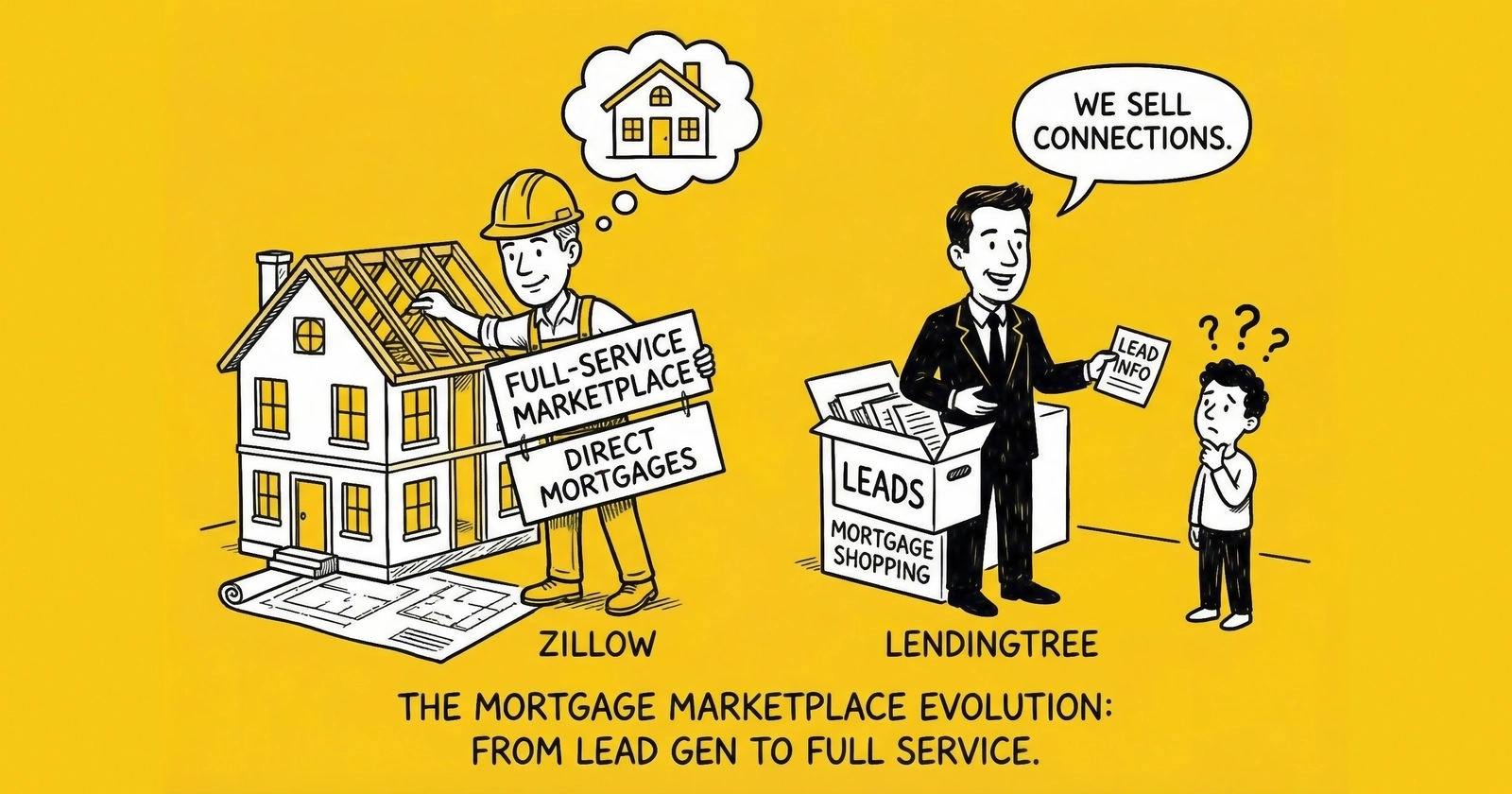
Inside the business models, pricing structures, and lender relationships that power the two dominant mortgage lead platforms – and what their strategies reveal about the future of mortgage distribution.
Understanding the Mortgage Marketplace Landscape
When a consumer searches for mortgage rates online, they’re entering an ecosystem that processes billions of dollars in lead transactions annually. Two companies dominate this landscape through fundamentally different approaches: LendingTree pioneered the mortgage comparison marketplace model in 1998, while Zillow leveraged its real estate dominance to build what has become an increasingly vertically integrated mortgage operation.
The distinction matters for anyone operating in mortgage lead generation. LendingTree remains primarily a marketplace – connecting borrowers with a network of over 500 lenders and taking a percentage of each transaction. Zillow has evolved from marketplace toward integration, with Zillow Home Loans increasingly competing with the third-party lenders who once relied on the platform for leads.
Together, these companies process hundreds of thousands of mortgage inquiries monthly, shaping pricing expectations, quality standards, and distribution patterns across the entire mortgage lead ecosystem. Understanding how they operate reveals both the opportunities and constraints that govern mortgage lead economics in 2025.
This article examines the business models, pricing structures, lender relationships, and competitive dynamics that define these platforms – providing the operational intelligence you need to navigate the mortgage marketplace whether you’re generating leads, buying them, or building technology to connect the two.
LendingTree: The Original Comparison Marketplace
LendingTree invented online mortgage lead distribution when Doug Lebda founded the company in 1996, launching its consumer marketplace two years later with the tagline “When banks compete, you win.” That founding insight – that consumers benefit from lender competition while lenders benefit from efficient borrower access – remains the core of LendingTree’s business model 27 years later.
How the LendingTree Business Model Works
LendingTree operates as a multi-sided marketplace connecting consumers seeking financial products with lenders seeking customers. The company generates revenue primarily through fees charged to lenders for consumer introductions – either on a per-lead basis or through advertising arrangements.
The mechanics work as follows: A consumer visits LendingTree.com or a partner site and completes a loan request form providing information about their financial situation, property, and desired loan terms. LendingTree’s platform matches this request against its network of over 500 lender partners, presenting the consumer with multiple offers. Lenders pay LendingTree for the introduction, whether on a cost-per-lead or cost-per-click basis depending on the program.
LendingTree’s revenue divides across several segments. Their Home segment – which includes mortgage, home equity, and reverse mortgage products – represents the core of the legacy business. Insurance, consumer lending (personal loans, credit cards), and small business lending round out the portfolio.
LendingTree Financial Performance and Market Position
LendingTree reported approximately $672.5 million in revenue for 2023 across all segments. The Home segment has faced significant pressure from rate-sensitive market conditions – when 30-year fixed rates exceeded 7% in 2023-2024, mortgage origination volume collapsed from its 2021 peak of $4.51 trillion to approximately $1.50 trillion.
By Q2 2025, LendingTree’s Home segment showed meaningful recovery, generating $40.4 million in quarterly revenue – up 25% year-over-year. Home equity products proved particularly resilient, with that segment reaching $30.3 million in Q2 2025 revenue, growing 38% year-over-year.
The home equity performance illustrates a crucial marketplace adaptation. When traditional refinance economics broke down (homeowners with sub-4% mortgages won’t refinance into 6%+ rates), LendingTree pivoted emphasis toward products that remained viable. Homeowners needing cash increasingly chose second mortgages or HELOCs rather than refinancing their entire primary loan – and LendingTree captured this demand shift.
LendingTree connects approximately 30 million borrowers annually with its lender network. This scale creates genuine network effects: more consumers attract more lenders, and more lenders create better offers that attract more consumers. However, this network effect also creates dependency – when consumer demand contracts (as it does during rate spikes), lender participation becomes less valuable, creating a reinforcing negative cycle.
The Lender Network Economics
LendingTree’s network includes over 500 lender partners, ranging from major national banks to regional credit unions to digital-first mortgage originators. This diversity provides consumers with competitive offers while ensuring LendingTree maintains leverage in pricing negotiations – no single lender represents enough volume to dictate terms.
Lender participation comes in several forms:
-
Direct lead purchase represents the traditional model. Lenders bid on leads matching their criteria (loan type, credit score range, geography), paying per lead received. Pricing varies dramatically based on lead quality, exclusivity, and market conditions. Exclusive mortgage leads through LendingTree typically cost $50-$150, with purchase leads in premium markets commanding the high end.
-
Rate table advertising allows lenders to display their rates on LendingTree’s comparison pages, paying for visibility and resulting clicks or leads. This model works well for lenders seeking brand exposure alongside lead generation.
-
Custom programs provide enterprise lenders with tailored arrangements including dedicated account management, custom filtering, and specialized integration.
Why Lenders Use LendingTree Despite the Competition
The fundamental question for any lender evaluating LendingTree is whether the leads justify their cost. The answer depends on conversion economics that vary by lender capability.
A consumer requesting quotes through LendingTree receives multiple offers – typically three to five from different lenders. This creates immediate competition: the lead costs money, but so does losing to a competitor who responds faster or offers better terms.
Industry research shows leads contacted within one minute convert at 391% higher rates. For LendingTree leads, where the consumer explicitly requested multiple quotes and expects multiple contacts, speed becomes even more critical. The first lender to call establishes the relationship and frames the comparison.
Lenders accept this competition because LendingTree provides something difficult to replicate independently: access to high-intent borrowers at scale. Building comparable organic search traffic or paid advertising reach requires years of investment and expertise most originators lack. LendingTree’s CPL, while meaningful, often beats what lenders could achieve acquiring the same quality leads through direct marketing.
The math typically works as follows: If a lender converts 3% of LendingTree leads at $100 CPL, their cost per acquisition is approximately $3,333 per funded loan. On a $3,500-$5,000 average commission, that represents viable economics – though tight margins that demand operational excellence.
Zillow: From Real Estate Listings to Integrated Mortgage
Zillow’s entry into mortgage represents a fundamentally different strategy than LendingTree’s marketplace approach. Where LendingTree connects consumers with multiple competing lenders, Zillow has increasingly positioned its own Zillow Home Loans subsidiary to compete directly with third-party partners.
Zillow’s Real Estate Dominance Creates Mortgage Opportunity
Zillow commands over two-thirds of online real estate traffic according to company data, with approximately 224 million unique users annually visiting Zillow and its partner sites. This traffic represents unmatched access to homebuyers – people actively searching for properties who will need financing to complete their purchases.
The strategic logic is straightforward: capture consumers at the property search stage, then guide them toward mortgage products. A buyer browsing listings on Zillow represents purchase intent far more valuable than someone responding to a generic mortgage advertisement.
Zillow monetizes this traffic through several channels:
-
Zillow Premier Agent connects buyers viewing listings with real estate agents who pay for the introduction. This remains Zillow’s largest revenue driver.
-
Mortgage advertising and leads through programs like Custom Quotes allows lenders to reach buyers at the property search stage.
-
Zillow Home Loans originates mortgages directly, keeping both the lead value and the origination revenue in-house.
The Zillow Home Loans Vertical Integration Play
Zillow acquired Mortgage Lenders of America in 2018 and rebranded it as Zillow Home Loans. Initially, this subsidiary operated primarily as a refinance-focused lender. The strategic pivot toward purchase mortgages – where Zillow’s real estate traffic provides unique advantage – accelerated dramatically in 2023-2024.
The results have been remarkable. In Q2 2024, Zillow Home Loans purchase volume reached $759 million, up from $340 million the prior year – a 125% increase while the broader market declined 9%. By Q2 2025, home purchase volume exceeded $1.1 billion, representing nearly 50% year-over-year growth.
This vertical integration creates strategic tension. Third-party lenders who historically relied on Zillow’s marketplace for leads now compete with Zillow Home Loans for the same borrowers. The platform that sends them leads also wants to capture those borrowers directly.
For third-party lenders, this raises fundamental questions about Zillow’s incentives. When a consumer requests mortgage information through Zillow, does the platform prioritize its own Zillow Home Loans offer over third-party options? How does the consumer experience differ for Zillow’s own products versus competitors?
Zillow maintains that its marketplace remains open and competitive. Third-party lenders can still access Custom Quotes programs and receive leads through various channels. However, the strategic direction is clear: Zillow wants to capture mortgage revenue, not just advertising revenue, from its traffic.
Zillow’s Pricing Structure for Lenders
Zillow’s Custom Quotes program offers third-party lenders access to mortgage shoppers through rate table advertising and lead generation. Pricing varies by market, loan type, and competitive dynamics.
Typical per-lead costs through Zillow range from $75-$150 depending on:
-
Geography: Premium coastal markets (San Francisco, Los Angeles, New York) command higher pricing than lower-volume markets.
-
Loan type: Purchase leads generally cost more than refinance leads in the current rate environment, reflecting higher borrower intent and value.
-
Competition level: Markets with more participating lenders see higher pricing as demand exceeds supply.
Zillow Connect serves early-stage buyers with limited homebuying experience, providing opportunities for lenders to establish relationships before competitors. This program targets consumers earlier in their journey – potentially lower immediate conversion rates but valuable for relationship building.
The Strategic Implications of Zillow’s Integration
Zillow’s move toward vertical integration represents a broader trend in lead marketplaces: platforms that achieve traffic dominance often seek to capture more of the transaction value rather than simply connecting parties.
For mortgage lead generators operating outside these platforms, Zillow’s integration creates both threat and opportunity:
-
The threat: Zillow’s traffic dominance means fewer consumers reach independent lead generators through organic real estate search paths. As Zillow captures more mortgage transactions directly, the available market for third-party lead providers shrinks.
-
The opportunity: Lenders frustrated with competing against their platform provider seek alternative lead sources. Independent generators who can deliver quality leads without the conflict inherent in Zillow’s model may find receptive buyers willing to pay premium pricing for that independence.
Comparing the Two Models: Marketplace vs. Integration
LendingTree and Zillow represent opposite ends of a strategic spectrum that defines platform competition in mortgage and beyond.
The Marketplace Model (LendingTree Approach)
-
Core proposition: Connect consumers with multiple lenders, take a percentage, and remain neutral about which lender wins.
-
Lender relationship: Partners who depend on the platform for lead flow but trust that the platform doesn’t compete directly for their customers.
-
Consumer experience: Explicitly comparative – submit one request, receive multiple offers, choose the best.
-
Revenue model: Transaction fees, advertising, and lead sales without the overhead of mortgage origination operations.
-
Advantages: Lower capital intensity, broader lender participation, clearer value proposition to both sides of the market.
-
Disadvantages: Vulnerable to disintermediation if lenders find alternative borrower access, limited ability to capture downstream transaction value.
The Integration Model (Zillow Approach)
-
Core proposition: Own the consumer relationship from property search through mortgage close, capturing value at each stage.
-
Lender relationship: Mixed – third-party lenders remain platform customers but also compete with the platform’s own lending operation.
-
Consumer experience: Increasingly channeled toward integrated solutions that simplify the home purchase process.
-
Revenue model: Advertising revenue plus origination revenue plus potential for servicing income and cross-sell.
-
Advantages: Captures more value per transaction, creates tighter customer relationships, benefits from coordinated experience.
-
Disadvantages: Higher capital intensity, conflicts with partners, regulatory complexity of operating as a lender.
Which Model Wins?
Neither model is inherently superior – each optimizes for different strategic objectives.
LendingTree’s marketplace approach maximizes lender participation and minimizes capital requirements. The platform can remain profitable through market cycles without the balance sheet exposure that mortgage origination creates. However, LendingTree captures a relatively small percentage of each transaction’s total value.
Zillow’s integration approach captures more value but requires operational excellence in mortgage origination – a capability that has challenged many technology companies. The strategy also risks alienating third-party lenders whose participation makes the marketplace valuable in the first place.
The competitive dynamic suggests eventual market segmentation: some lenders will accept the integrated model and work within Zillow’s ecosystem, while others will seek independent lead sources that don’t also compete for their borrowers. Both LendingTree’s marketplace and independent lead generators benefit from this dynamic.
How Lenders Evaluate Platform Partnerships
For mortgage originators deciding where to purchase leads, platform evaluation requires understanding both the quantitative economics and qualitative relationship factors.
Lead Quality Metrics That Matter
-
Contact rate: What percentage of leads answer the phone? Industry benchmarks run 30-40% for mortgage leads, but platform performance varies. Fresh leads with verified phone numbers should achieve the higher end; aged or recycled leads fall toward the lower end.
-
Application rate: Of leads contacted, how many complete mortgage applications? This measures both lead intent and lender sales capability. Expect 15-30% of contacts to apply with quality leads and competent sales teams.
-
Pull-through rate: Of applications, how many fund? This depends primarily on lender operations rather than lead source – 65-75% is typical for purchase mortgages with properly qualified leads.
-
Overall conversion: The end-to-end metric from lead to funded loan. Strong operations achieve 2-4%; weak operations see 1% or below. Track this by source to identify which platforms deliver leads that actually close.
Cost Considerations Beyond CPL
Raw CPL tells only part of the story. Smart lenders calculate true cost per acquisition (CPA) that includes:
-
Lead purchase cost: The headline CPL number from the platform.
-
Returns and credits: Leads that don’t meet criteria or prove uncontactable often qualify for credits or refunds. Track net CPL after returns.
-
Contact costs: Sales team time, dialer fees, and multiple contact attempts all add to acquisition cost.
-
Opportunity cost: Leads that don’t convert still consume sales capacity that could address other opportunities.
For a lender paying $100 CPL with 3% conversion, the true CPA is approximately $3,333 per funded loan before accounting for additional operational costs. If sales team compensation, technology, and overhead add another $500 per funded loan, total CPA approaches $3,800.
On an average commission of $4,000-$5,000 per funded mortgage, those economics work – but barely. The margin between $3,800 CPA and $4,000 commission leaves little room for error. This is why lead quality and conversion optimization matter so much: a 1-percentage-point improvement in conversion transforms the economics from marginal to comfortable.
Platform Relationship Factors
Beyond raw economics, lenders consider qualitative factors:
-
Integration quality: How easily do leads flow into existing CRM and dialer systems? Custom integrations cost development time and ongoing maintenance.
-
Support responsiveness: When disputes arise or systems fail, how quickly does the platform respond? Lead generation operates 24/7; support should match.
-
Exclusivity options: Can lenders purchase exclusive leads in specific geographies or product categories? Exclusivity typically costs 2-3x shared lead pricing but eliminates competition.
-
Data transparency: Does the platform provide granular performance data by lead source, campaign, and time period? Detailed data enables optimization; aggregate data leaves lenders guessing.
-
Contract flexibility: Can arrangements scale up or down with market conditions? Minimum volume commitments that made sense when rates were 3% become painful when rates hit 7% and demand collapses.
Competitive Dynamics in the Mortgage Marketplace Space
LendingTree and Zillow don’t operate in isolation. Understanding the broader competitive landscape reveals positioning opportunities and threats.
Other Major Platforms
Bankrate (owned by Red Ventures) commands premium positioning through comprehensive mortgage content and rate comparison tools. The platform generates approximately 4 million monthly mortgage page views, attracting high-intent consumers who arrive with financial research completed. Lenders consistently report strong conversion rates despite higher costs because Bankrate consumers demonstrate clear intent and financial sophistication.
NerdWallet approaches mortgage lead generation through educational content and comparison tools. Their focus on first-time buyers navigating mortgage decisions for the first time makes the platform particularly valuable during purchase-heavy markets. Lead costs typically run lower than Bankrate, reflecting less exclusive positioning but still solid intent signals.
Redfin generates approximately 50 million monthly visitors through its real estate listing platform, partnering with Mortgage Research Center to connect this traffic with mortgage opportunities. The platform’s focus on tech-savvy consumers yields leads comfortable with digital processes but often demanding on rate comparison.
Credit Karma and Experian leverage credit-checking behavior to identify mortgage-ready consumers. Because these platforms already have credit data, leads come pre-qualified with credit score information – reducing originator workload while commanding premium pricing for the data enrichment.
Independent Lead Generators
Beyond the major platforms, thousands of independent lead generators produce mortgage volume through paid media campaigns, content marketing, and specialized landing pages. These operators range from sophisticated affiliate marketers spending millions on Google and Facebook ads to regional content sites targeting specific geographic markets.
Independent generators offer advantages for some lender scenarios:
-
Flexibility: Custom filtering, geographic targeting, and credit tier selection often exceed what major platforms offer.
-
Pricing: Without platform overhead, independent generators sometimes offer competitive CPLs – particularly in less competitive markets the major platforms underserve.
-
Exclusivity: Independent generators more readily offer truly exclusive leads that never see platform distribution.
-
Relationship: Direct relationships with lead generators enable faster problem resolution and more responsive optimization than platform account management.
The trade-off is volume consistency and quality verification. Major platforms invest heavily in fraud prevention, consent verification, and lead validation. Independent generators vary widely in these capabilities – some match or exceed platform quality, while others cut corners that create compliance exposure for buyers.
Rate Sensitivity Creates Market Swings
The mortgage lead marketplace is uniquely rate-sensitive. When 30-year fixed rates dropped toward 3% in 2020-2021, refinance demand exploded and every platform saw volume surge. When rates crossed 7% in 2023-2024, refinance evaporated and even purchase volume contracted.
These swings affect competitive dynamics significantly:
-
During refinance booms: Lead supply exceeds lender capacity to process. Prices compress despite volume because platforms compete for limited lender budget. Speed to market with new refinance leads becomes the key differentiator.
-
During high-rate periods: Lead supply contracts dramatically while remaining lenders compete fiercely for scarce purchase leads. Platforms that maintained purchase-focused positioning (like Zillow) outperform refinance-focused competitors.
-
During transitions: Rate changes trigger rapid shifts in consumer behavior. Platforms that detect and respond to these shifts first capture disproportionate volume.
Understanding where we are in the rate cycle – and how each platform positions for the current environment – helps lenders allocate lead spend more effectively.
The Role of Technology in Mortgage Marketplaces
Both LendingTree and Zillow invest heavily in technology that makes their marketplaces more efficient, more valuable, and harder to replicate.
Consumer-Facing Technology
-
Rate comparison engines help consumers evaluate offers across multiple dimensions – rate, fees, monthly payment, total cost over loan life. The sophistication of these tools affects conversion: consumers who understand their options and feel confident in their decisions complete more applications.
-
Pre-qualification tools let consumers check loan eligibility without hard credit pulls. This reduces friction in the shopping process while generating valuable lead data for platform distribution.
-
Mobile optimization has become table stakes as mobile mortgage shopping now exceeds desktop in many demographics. Platforms that provide seamless mobile experiences capture more of this growing segment.
Lender-Facing Technology
-
Lead routing systems match consumer requests with appropriate lenders based on licensing, capacity, pricing, and performance. Sophisticated routing maximizes match quality while ensuring leads reach lenders equipped to convert them.
-
Real-time bidding in ping/post systems lets lenders bid on individual leads based on their specific characteristics. A lender might pay $150 for a 740-credit-score purchase lead in California but only $60 for a 680-credit-score refinance in Ohio. This granularity optimizes platform revenue while ensuring lenders pay appropriate prices for different lead qualities.
-
Performance analytics help lenders understand which platform features, lead types, and campaigns deliver results. Platforms that provide granular, actionable data earn lender loyalty by demonstrating clear ROI.
-
Integration APIs connect platform lead flow with lender CRM, dialer, and origination systems. Seamless integration reduces manual handling, accelerates response time, and improves conversion.
Compliance Technology
Mortgage lead generation operates under RESPA (Real Estate Settlement Procedures Act) and state licensing requirements that create unique compliance obligations.
-
Consent verification through TrustedForm, Jornaya, and similar services documents the lead capture event – what the consumer saw, what they agreed to, and when they clicked submit. Major platforms integrate these services and provide consent certificates to lenders as compliance documentation.
-
Licensing validation ensures leads route only to properly licensed originators. A California borrower’s lead can only go to a lender licensed in California. Platform routing systems must validate this before distribution.
-
RESPA compliance affects how platforms structure lender relationships. Section 8 prohibits giving or receiving “any thing of value” in exchange for referrals of settlement service business. Platforms must ensure their arrangements constitute legitimate marketing services rather than prohibited referral fees.
Strategic Implications for Market Participants
Understanding how LendingTree and Zillow operate creates strategic insight for participants across the mortgage ecosystem.
For Lead Generators
-
Platform positioning matters. Leads that flow to LendingTree or Zillow face competition from massive traffic pools. Generating leads for direct lender relationships – bypassing these platforms – can command premium pricing from buyers who prefer independence.
-
Quality differentiation creates value. The major platforms handle enormous volume with standardized processes. Generators who deliver superior contact rates, better consent documentation, or more complete qualification data stand out from platform commoditization.
-
Geographic specialization offers opportunity. LendingTree and Zillow focus resources on major markets. Smaller MSAs and rural areas receive less attention, creating opportunities for generators who develop expertise in underserved markets.
For Lenders and Originators
-
Diversify lead sources. Depending entirely on one platform creates vulnerability. When that platform changes policies, raises prices, or starts competing directly (as Zillow does through Zillow Home Loans), concentrated dependence becomes dangerous.
-
Track economics by source. Aggregate lead performance metrics obscure which sources actually deliver. Track contact rate, conversion rate, and CPA by platform and campaign. Cut underperformers quickly; expand what works.
-
Speed wins. Across all platforms, leads contacted within five minutes convert at dramatically higher rates. Invest in technology and processes that enable immediate response regardless of lead source.
For Technology Providers
-
Integration drives adoption. Platforms and lenders both seek technology that reduces friction. Distribution systems, CRM platforms, and compliance tools that integrate seamlessly with major marketplace APIs capture more market share.
-
Compliance infrastructure is essential. RESPA requirements, state licensing validation, and consent verification are non-negotiable. Technology providers who make compliance easier – not just possible – differentiate meaningfully.
For Investors and Acquirers
-
Rate cycle exposure is real. Mortgage lead businesses show dramatic revenue swings tied to rate movements. LendingTree’s Home segment performance tracks mortgage origination volume almost exactly. Valuation should account for cycle positioning, not just current results.
-
Integration vs. marketplace is a strategic choice. Zillow’s integration approach captures more per-transaction value but requires operational complexity. LendingTree’s marketplace approach is more capital-efficient but captures smaller margin. Different business models suit different investment theses.
Future Directions for Mortgage Marketplaces
Several trends will shape mortgage marketplace competition over the coming years.
Increased Integration Pressure
Zillow’s success with vertical integration will attract imitators. Platforms with consumer traffic may increasingly seek to capture mortgage origination revenue rather than simply connecting parties. This pressures pure marketplace models like LendingTree to demonstrate why connection alone justifies their margin.
Technology-Enabled Speed Optimization
Response time advantages will become more pronounced as AI-powered systems enable near-instantaneous lead handling. Lenders who automate initial qualification, rate provision, and appointment scheduling will convert more leads than those relying on manual processes. Platforms may increasingly provide or require such automation as table stakes for participation.
Regulatory Evolution
FCC consent requirements, state privacy laws, and potential RESPA clarifications will reshape lead generation compliance. Platforms that build robust compliance infrastructure – and pass that protection to lender partners – will command premium positioning as regulatory scrutiny increases.
Consumer Experience Centricity
Platforms that deliver genuinely superior consumer experiences will capture more market share. Transparency about how the marketplace works, clear presentation of competitive offers, and simplified application processes all affect where consumers choose to shop for mortgages.
Frequently Asked Questions
How does LendingTree make money from mortgage leads?
LendingTree generates revenue by charging lenders for consumer introductions – either on a per-lead basis or through advertising arrangements. When a consumer submits a mortgage request, LendingTree’s platform matches it against its network of over 500 lender partners. Lenders pay LendingTree for leads that meet their criteria, with pricing typically ranging from $50-$150 for exclusive mortgage leads depending on credit quality, loan type, and geography. LendingTree reported Home segment revenue of $40.4 million in Q2 2025, representing a 25% year-over-year increase despite challenging rate conditions.
How does Zillow Home Loans differ from Zillow’s mortgage marketplace?
Zillow operates both a marketplace connecting consumers with third-party lenders and its own Zillow Home Loans subsidiary that originates mortgages directly. The marketplace allows third-party lenders to purchase leads and advertise rates to Zillow’s massive real estate traffic (over 224 million annual visitors). Zillow Home Loans, by contrast, competes for those same borrowers directly. In Q2 2025, Zillow Home Loans originated over $1.1 billion in home purchase volume – nearly 50% more than the prior year – demonstrating the company’s shift toward vertical integration.
What is the typical cost per lead for mortgage leads through LendingTree or Zillow?
Mortgage lead costs through these platforms typically range from $50-$150 for exclusive leads, with significant variation based on geography, loan type, and credit quality. California coastal markets command premium pricing (often $100-$150+), while smaller markets may run $50-$75. Shared leads – where multiple lenders receive the same consumer inquiry – cost less (typically $20-$60) but create immediate competition for the borrower’s attention. Though the FCC’s one-to-one consent rule was vacated by the Eleventh Circuit in January 2025, industry practice has shifted distribution toward exclusive leads as many sophisticated buyers require one-to-one consent regardless of regulatory minimums.
What conversion rates should lenders expect from marketplace leads?
Realistic benchmarks for quality marketplace leads: 30-40% contact rate (percentage of leads successfully reached by phone), 15-30% application rate from contacts, 65-75% pull-through from application to funded loan, and 2-4% overall lead-to-funded conversion. These rates assume operational excellence – sub-five-minute response times, professional sales processes, and competitive rate offerings. Lenders with slower response or weaker follow-up see significantly lower conversion. The math is unforgiving: at $100 CPL and 3% conversion, cost per acquisition exceeds $3,300 per funded loan.
How has the rate environment affected marketplace lead economics in 2024-2025?
Elevated rates have compressed refinance volume while maintaining purchase activity – fundamentally reshaping marketplace economics. Traditional refinance demand collapsed as homeowners with sub-4% mortgages from 2020-2021 had no incentive to refinance into 6%+ rates. Purchase leads maintained value (life circumstances force home purchases regardless of rates), while home equity products emerged as a growth segment. LendingTree’s home equity revenue grew 38% year-over-year in Q2 2025, demonstrating platform adaptation. The refinance share of total originations reached 26% by late 2024 – improved from cycle lows but far below refinance-dominant periods.
Does Zillow’s vertical integration create conflicts with third-party lenders?
Yes, this represents a strategic tension that affects lender platform decisions. Third-party lenders participating in Zillow’s marketplace programs now compete directly with Zillow Home Loans for the same borrowers. Some lenders have reduced Zillow participation, seeking alternative lead sources without this conflict. Zillow maintains that its marketplace remains open and competitive, but the strategic direction is clear: the company wants to capture mortgage revenue, not just advertising revenue. This dynamic has created opportunities for independent lead generators and marketplace platforms (like LendingTree) that don’t compete with their partners.
What RESPA compliance considerations affect mortgage marketplace participation?
RESPA Section 8 prohibits giving or receiving “any thing of value” in exchange for referral of settlement service business. For marketplace participation, this creates several compliance considerations. Lead purchases must constitute legitimate marketing services, not disguised referral payments. Pricing must reflect reasonable market value for services provided. Arrangements that tie compensation to loan production volume face heightened scrutiny. Both platforms and lenders should maintain documentation demonstrating that marketing arrangements reflect actual services performed. Violations can result in fines ranging from $5,000 to $25,000 per day plus potential criminal liability.
How important is response speed for marketplace leads?
Response speed is the single most important factor determining marketplace lead conversion. Research consistently shows leads contacted within one minute have 391% higher conversion rates. The first responder wins 78% of the time. For marketplace leads – where the consumer explicitly requested multiple quotes and expects multiple contacts – speed becomes even more critical. The lender who calls first establishes the relationship, answers initial questions, and frames the comparison. Technology infrastructure supporting sub-minute response is essential for competitive marketplace participation.
What alternatives exist to LendingTree and Zillow for mortgage leads?
Major alternatives include Bankrate (premium positioning, approximately 4 million monthly mortgage page views), NerdWallet (first-time buyer focus, educational approach), Redfin (approximately 50 million monthly visitors through real estate listings), and Credit Karma/Experian (credit-pre-qualified leads). Beyond platforms, thousands of independent lead generators produce mortgage volume through paid media and content marketing. Independent generators offer greater flexibility, potentially lower pricing, and relationships without platform conflicts – though quality and compliance capabilities vary widely. Most sophisticated lenders diversify across multiple sources rather than depending on any single platform.
How do lenders decide between marketplace lead sources?
Smart lenders evaluate platforms based on: true cost per acquisition (not just CPL, but CPA after returns, contact costs, and conversion), contact and conversion rates by source, integration quality with existing systems, support responsiveness, exclusivity options, data transparency, and contract flexibility. The calculation matters more than platform brand: if Platform A charges $80 CPL with 4% conversion ($2,000 CPA) and Platform B charges $100 CPL with 2.5% conversion ($4,000 CPA), Platform A delivers superior economics despite lower headline pricing. Track performance by source and allocate budget toward what actually converts.
Key Takeaways
-
LendingTree and Zillow represent fundamentally different strategic approaches: LendingTree operates as a neutral marketplace connecting consumers with 500+ lenders. Zillow increasingly competes with its own Zillow Home Loans subsidiary against third-party lenders using the platform – a conflict that affects partner relationships and creates opportunities for independent lead sources.
-
Mortgage lead costs through major platforms typically range $50-$150 for exclusive leads. Geographic variation is substantial – California coastal markets command premiums that would be irrational in Midwest markets. Though the FCC’s one-to-one consent rule was vacated in January 2025, buyer-driven consent preferences have shifted distribution toward exclusive leads as the practical default.
-
Rate sensitivity dominates marketplace economics. When rates crossed 7% in 2023-2024, refinance volume collapsed while purchase demand contracted. LendingTree adapted by emphasizing home equity products (growing 38% year-over-year). Zillow’s focus on purchase-stage homebuyers provided relative resilience.
-
Speed-to-contact determines conversion more than any other factor. Leads contacted within five minutes convert at dramatically higher rates. For marketplace leads where consumers expect multiple contacts, first-responder advantage is even more pronounced. Technology enabling sub-minute response is essential.
-
Lender diversification protects against platform dependency. Concentrated reliance on any single platform creates vulnerability when policies change or platforms begin competing directly. Track conversion by source, cut underperformers quickly, and maintain relationships across multiple lead channels.
-
RESPA compliance affects marketplace participation. Section 8’s anti-kickback provisions require that lead purchases constitute legitimate marketing services with documentation of services performed and fair market value compensation. Both platforms and participants should maintain compliance infrastructure.
-
The future points toward increased integration. Zillow’s success capturing origination revenue will attract imitators. Platforms with consumer traffic may increasingly seek to capture transaction value rather than simply connecting parties. This pressures pure marketplace models while creating opportunities for independent lead sources without platform conflicts.
-
Technology capabilities determine competitive position. Real-time bidding, consent verification, licensing validation, and CRM integration all affect which lenders can effectively participate in marketplace lead flow. Operations lacking this infrastructure cannot compete with those who have invested.
Market data and platform information current as of late 2025. Revenue figures based on public filings and reported earnings. Platform pricing, policies, and competitive dynamics evolve continuously – verify current conditions before making significant business decisions. This article provides general information and does not constitute legal or financial advice.