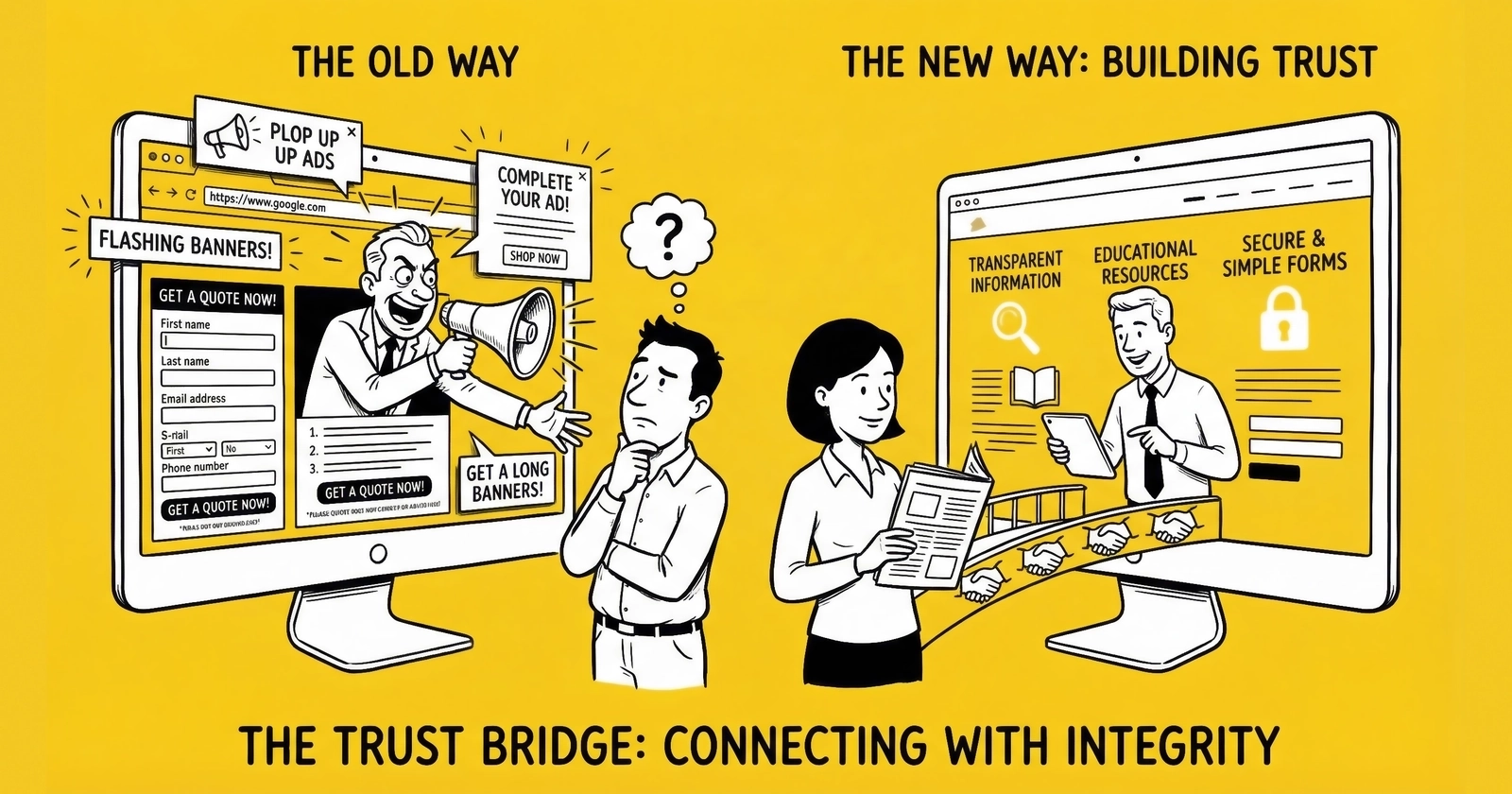
Master the art of generating high-quality life insurance leads through trust-based strategies. This comprehensive guide covers CPL benchmarks, conversion optimization, compliance requirements, and the psychological frameworks that transform skeptical prospects into engaged clients.
The life insurance industry faces a fundamental paradox. Consumers know they need coverage. Over 100 million Americans acknowledge being underinsured or lacking life insurance entirely. Yet when they encounter lead generation forms promising quotes and comparisons, skepticism often overrides need. The product requires thinking about mortality. The sales process has earned a reputation for pressure tactics. And the digital experience frequently fails to address either concern.
This creates both challenge and opportunity for lead generators who understand trust dynamics.
Life insurance leads operate differently than auto or home insurance. The purchase decision is emotionally weighted, the sales cycle extends weeks or months, and the relationship between agent and client matters more than in transactional verticals. Practitioners who treat life insurance leads like commodity auto leads will struggle. Those who engineer trust into every touchpoint will find a vertical with exceptional unit economics and sustainable competitive advantage.
This guide provides the strategic framework for life insurance lead generation that actually works. Not the aggressive tactics that produce form fills but alienate prospects. Not the compliance-minimum approaches that create liability. The trust-centered methodology that converts skeptical consumers into clients who stay, refer, and represent genuine lifetime value.
Understanding the Life Insurance Lead Market
The life insurance lead generation market operates at different dynamics than higher-frequency insurance verticals. Understanding these differences is essential before investing in traffic, forms, or buyer relationships.
Market Size and Structure
The U.S. life insurance industry generates approximately $170 billion in annual premiums across individual and group policies. The lead generation segment serving this market represents an estimated $400-600 million in annual transaction value, smaller than auto insurance but with distinct characteristics that create opportunity for specialized operators.
Two factors constrain life insurance lead generation volume compared to auto insurance. First, shopping frequency is dramatically lower. Consumers compare auto insurance quotes annually or whenever rates increase. Life insurance purchases typically happen only a few times per lifetime, triggered by major life events such as marriage, childbirth, home purchase, or reaching milestone ages. This lower frequency limits the addressable market at any given moment.
Second, the product complexity creates friction that discourages casual shopping. Auto insurance quotes require vehicle and driver information that consumers readily provide. Life insurance underwriting involves health history, lifestyle factors, and coverage calculations that consumers find more invasive and confusing. Many consumers who express interest never complete the quoting process.
Yet these constraints create advantages for capable operators. Lower competition per lead means sustainable margins without the race-to-the-bottom pricing seen in auto. Longer sales cycles favor relationship-based selling where quality leads shine. And the complexity that discourages casual shoppers also discourages casual competitors.
Life Insurance Sub-Verticals
Life insurance encompasses several distinct sub-verticals, each with unique lead generation dynamics.
Term Life Insurance represents the largest lead generation opportunity by volume. These policies provide coverage for specified periods, typically 10, 20, or 30 years, and appeal to consumers seeking affordable protection during peak earning and family-raising years. Term life leads typically convert through digital quoting experiences that provide rate comparisons based on age, health class, and coverage amount.
Whole Life and Universal Life (permanent insurance) generates lower lead volume but higher value per lead. These policies combine death benefits with cash value accumulation, requiring more sophisticated explanation and longer sales processes. Leads for permanent insurance typically require agent consultation rather than pure digital conversion.
Final Expense Insurance targets seniors seeking coverage for burial and end-of-life costs, typically with face values between $5,000 and $50,000. This sub-vertical has distinct demographics, messaging requirements, and compliance considerations. Final expense leads often perform best as phone leads or live transfers given the demographic’s preferences for voice communication.
Mortgage Protection Insurance markets coverage tied to home purchases, positioning life insurance as protecting the family home rather than abstract financial security. These leads often originate from mortgage-related traffic sources and convert well when presented at the moment of home purchase commitment.
Each sub-vertical requires different lead generation strategies, form designs, and buyer relationships. Practitioners who attempt to treat all life insurance leads identically underperform those who specialize or at least segment their approaches appropriately.
The Trust Imperative in Life Insurance
Life insurance operates in a trust deficit. Decades of aggressive sales tactics, policy churning scandals, and opaque pricing have created consumer skepticism that affects every interaction. A 2024 LIMRA study found that only 34% of consumers trust life insurance companies to act in their best interest, compared to 52% for banks and 61% for healthcare providers.
This trust deficit directly impacts lead generation performance. Consumers who distrust the industry are less likely to complete forms requesting personal information. Those who do complete forms are more likely to screen calls, ignore follow-up, and ultimately fail to convert. The same lead that would convert at 12% in auto insurance might convert at 5-8% in life insurance, in part due to trust barriers.
Why Trust Matters More Than Price
In commoditized verticals like auto insurance, price drives most purchase decisions. Consumers comparing identical coverage from State Farm and GEICO choose primarily on premium. Life insurance operates differently.
First, the product itself is not easily compared. Policy structures, riders, underwriting criteria, and company financial strength create meaningful differences that consumers struggle to evaluate. A $500,000 term policy from Company A is genuinely different from a $500,000 term policy from Company B in ways that matter but require explanation.
Second, the purchase involves long-term commitment. A 30-year term policy creates a three-decade relationship with the insurer. Consumers implicitly evaluate whether the company will be solvent, the claims process will be fair, and the relationship will be supportable across that timeframe.
Third, the stakes are existential. Life insurance exists to protect families at their most vulnerable moment. The consumer isn’t just buying financial product; they’re buying peace of mind about their family’s security after they’re gone. That emotional weight makes trust essential in ways that property insurance never approaches.
The Trust Framework for Lead Generation
Building trust in life insurance lead generation requires systematic attention across five dimensions.
Transparency means clearly communicating what happens with submitted information. Who will contact them? How quickly? What will the conversation involve? Consumers distrust forms that promise “free quotes” without explaining the process that follows. Transparent disclosure of the multi-company comparison process, agent contact expectations, and data handling builds confidence.
Credibility means demonstrating legitimate expertise and authority. This includes carrier partnerships displayed prominently, industry certifications and licenses, years in business, and consumer testimonials from verifiable sources. Generic “get your quote today” messaging fails the credibility test. Specific claims like “Compare rates from 40 A-rated carriers” pass it.
Security means protecting personal information visibly. Life insurance forms collect sensitive health information that consumers reasonably worry about. SSL certificates, privacy policy links, HIPAA-compliant data handling disclosures, and third-party security certifications all contribute to perceived security.
Empathy means acknowledging the emotional weight of life insurance decisions. Copy that treats life insurance as purely financial product misses the psychological reality consumers experience. Messaging that recognizes the difficulty of contemplating mortality while framing coverage as an act of love and responsibility resonates more authentically.
Control means giving consumers agency in the process. Options to request callbacks at specific times, choose communication channels, or opt out of certain contacts all reduce the feeling of surrendering control to an aggressive sales machine. The perception of control reduces resistance even when consumers never exercise the options provided.
CPL Benchmarks and Unit Economics
Understanding life insurance lead economics helps you price appropriately, select traffic sources wisely, and set realistic conversion expectations.
Current CPL Ranges
Life insurance leads trade across a wider price range than most verticals, reflecting the diversity of lead types and quality tiers.
| Lead Type | CPL Range | Typical Conversion | Primary Use Case |
|---|---|---|---|
| Shared form leads | $20-45 | 4-7% | Volume-focused operations |
| Exclusive form leads | $50-125 | 8-14% | Quality-focused agents |
| Live transfers | $100-200 | 15-25% | High-conversion operations |
| Final expense leads | $25-60 | 6-10% | Senior market specialists |
| Aged leads (30-90 days) | $3-15 | 3-6% | Supplemental volume |
These benchmarks reflect 2025 pricing through established intermediaries and direct publisher relationships. Actual prices vary based on geographic targeting, demographic filters, health profile indicators, and coverage amount requirements.
The wide range within each category reflects quality differentiation. A $50 exclusive lead might include minimal verification, basic consent documentation, and general health indicators. A $125 exclusive lead might include phone verification, TrustedForm certification, detailed health questionnaire responses, and real-time delivery. The conversion rate differential typically justifies the price premium.
The Unit Economics Calculation
Life insurance lead buying profitability depends on understanding the full conversion math.
Consider an agency purchasing exclusive leads at $75 each for term life insurance. With a 50% contact rate and 10% conversion rate (of contacts), 100 leads produce 5 policies at $1,500 cost per acquisition.
Whether $1,500 CPA is profitable depends on commission structure and retention patterns. First-year commissions on term life typically run 50-100% of first-year premium. For a $500,000 policy with $50 monthly premium ($600 annually), first-year commission of 80% yields $480. Renewal commissions of 5% annually add approximately $150 over a typical 10-year policy persistence.
Total commission value over policy lifetime: approximately $630 at a 4% discount rate. At $1,500 CPA, the unit economics appear negative.
But this calculation misses crucial factors. Cross-selling opportunities add significant value, with term life clients often adding auto, home, or disability coverage. Referrals from satisfied clients add value at zero acquisition cost. Some term clients eventually convert to permanent insurance with higher commission values. And policies sometimes increase in value through coverage additions over time.
Sophisticated agencies track fully-loaded customer lifetime value (LTV) rather than just policy-level returns. When cross-sell, referral, and upgrade value is included, life insurance LTV can reach $2,000-4,000 per client, making the $1,500 CPA quite profitable.
Contact Rate Challenges
Life insurance leads face particular contact rate challenges that differ from other verticals. The topic’s emotional weight makes consumers more likely to avoid calls once the initial shopping impulse passes. The longer consideration cycle means leads “cool off” faster. And the prevalence of health-related qualification questions creates anxiety about what the call might reveal.
Industry benchmarks show life insurance contact rates of 35-45% for fresh leads, notably lower than the 45-55% typical in auto insurance. This differential makes speed-to-contact even more critical. A life insurance lead contacted within 60 seconds has dramatically higher contact probability than one contacted at five minutes, and the gap widens compared to auto insurance.
The psychological explanation is straightforward. A consumer who just completed a life insurance form is still in “shopping mode,” still thinking about protection, still emotionally engaged with the topic. An hour later, they’ve moved on to other activities and the uncomfortable topic has faded from active consideration. Breaking back through to re-engage them with mortality planning requires more effort.
Building Trust Through Landing Page Design
The landing page is where trust begins or fails. Every element either builds confidence or triggers skepticism. In life insurance, where trust deficits are structural, page design carries exceptional weight.
Above-the-Fold Trust Signals
The content visible before scrolling must accomplish four things in seconds: establish relevance, communicate value, build credibility, and present a clear next step.
For life insurance specifically, above-the-fold design should include:
Clear company identification. Anonymous comparison sites trigger more skepticism in life insurance than auto. Consumers want to know who they’re dealing with before sharing health information. Company name, established date, and licensing information should be immediately visible.
Carrier logos. Displaying logos of A-rated carriers you work with builds immediate credibility. “Compare rates from 40+ top-rated insurers including Prudential, Northwestern Mutual, and State Farm” communicates legitimacy that vague “top insurance companies” messaging cannot.
Security indicators. SSL lock icon, Norton or McAfee security badges, and HIPAA-compliant data handling notices address privacy concerns specific to life insurance’s health data collection.
Empathetic value proposition. “Protect your family’s future with coverage that fits your budget” outperforms “Get cheap life insurance quotes.” The former acknowledges the emotional reality; the latter trivializes it.
Realistic time commitment. “Compare personalized rates in 5 minutes” sets appropriate expectations for the health questionnaire process. Over-promising “instant quotes” that actually require detailed health information creates friction when reality differs from expectation.
Form Design for Sensitive Information
Life insurance forms collect information consumers consider private: health conditions, medications, family medical history, smoking status, hazardous activities. The form design must acknowledge this sensitivity while still capturing the data needed for accurate quoting.
Multi-step progression works especially well in life insurance. Starting with low-sensitivity questions (age, coverage amount, term length) builds commitment before reaching health questions. Research indicates multi-step forms convert 86% better than single-page equivalents, and the differential may be even larger in life insurance where the sensitive questions benefit from progressive commitment.
Question framing affects response accuracy. “Have you been treated for any of the following conditions in the past 10 years?” elicits more honest responses than “Do you have any health problems?” The former feels like a reasonable qualification question; the latter feels like an attempt to catch problems.
Explain why you’re asking. A brief note like “We ask about health to match you with carriers whose underwriting fits your profile” transforms invasive questions into helpful qualification. Consumers who understand the purpose are more comfortable responding honestly.
Provide context for sensitive categories. When asking about tobacco use, note that “Some carriers offer competitive rates for occasional cigar smokers” so consumers don’t assume any tobacco use disqualifies them. This encourages honest disclosure rather than omission.
Mobile Optimization for Considered Purchases
Life insurance shopping often begins on mobile but converts on desktop. Consumers researching protection during commutes or waiting rooms start the process on phones but prefer completing health questionnaires and reviewing quotes on larger screens.
This pattern suggests mobile landing pages should optimize for engagement and lead capture rather than full-funnel completion. Capture email and basic information on mobile; provide easy continuation mechanisms for desktop completion. “Save my progress and email me a link to finish” acknowledges the cross-device journey rather than fighting it.
Mobile form fields need special attention for life insurance. Date of birth entry should use native date pickers, not manual text fields that frustrate thumb-typing. Coverage amount selection should use slider or preset options rather than requiring numeric entry. Height and weight can use incremental selectors that minimize typing.
Content Marketing for Trust Building
Content marketing serves life insurance lead generation differently than direct-response advertising. While ads capture existing demand, content builds the trust that makes captured demand convert. In a trust-deficit vertical, this investment compounds over time.
Educational Content That Converts
The most effective life insurance content addresses consumer confusion while positioning your forms as the natural next step.
“How much life insurance do I need?” calculators provide immediate value while collecting the information needed for quoting. The consumer receives personalized coverage recommendations; you receive age, income, dependents, and debt information that feeds directly into lead qualification.
Term vs. permanent insurance explainers address a fundamental consumer confusion point. Clear, unbiased explanation of when each makes sense builds trust while helping consumers self-qualify for appropriate product categories.
Underwriting process guides reduce anxiety about what happens after form submission. Many consumers fear that requesting quotes triggers credit checks, medical exams, or immediate agent pressure. Content explaining the actual process reduces resistance.
Life stage-specific content targets high-intent moments. “Life insurance when buying a home,” “Coverage after having your first child,” and “Reviewing your policy at 40” all address triggers that create shopping behavior.
The key distinction is between content that sells and content that helps. Content that helps builds trust; trust converts to leads over time at lower cost than pure paid acquisition.
SEO Strategy for Life Insurance
Life insurance keywords present both opportunity and challenge. The high commercial intent keywords (“life insurance quotes,” “term life insurance rates”) face intense competition from carriers, aggregators, and well-established comparison sites. Newer operators cannot realistically compete for these terms through SEO alone.
The opportunity lies in long-tail, intent-rich keywords that larger competitors overlook or cannot serve effectively.
Condition-specific queries like “life insurance with diabetes,” “coverage after heart attack,” or “life insurance for smokers” attract consumers with specific underwriting concerns that generic sites address poorly. Content specifically addressing these concerns builds trust with audiences who expect rejection.
Demographic-specific queries like “life insurance for single mothers,” “coverage for military families,” or “best policy for small business owners” attract consumers seeking relevant advice rather than generic quotes.
Question-based queries like “does life insurance cover suicide,” “how long until life insurance pays out,” or “can you have multiple life insurance policies” attract information-seekers who may convert after their questions are answered.
Building topical authority in your chosen long-tail categories compounds over time. A site that becomes the authoritative resource for “life insurance with diabetes” attracts organic traffic, builds backlinks, and establishes credibility that transfers to conversion.
Email Nurture for Long Sales Cycles
Life insurance’s extended consideration period makes email nurture essential. A consumer who requests quotes today may not purchase for weeks or months. The agents and companies who maintain helpful contact during that period win the eventual sale.
Welcome sequences should provide immediate value beyond confirming lead receipt. Send the promised rate comparison, include a coverage guide relevant to their profile, and set expectations for next steps. The goal is demonstrating helpfulness before asking for anything.
Nurture sequences over 4-8 weeks should mix educational content with conversion opportunities. Not every email should push for a call. Content about understanding policy features, choosing beneficiaries, or reviewing coverage needs builds trust while maintaining top-of-mind presence.
Trigger-based emails respond to engagement signals. If a lead revisits your quote comparison tool, send a follow-up addressing common questions at that stage. If they click a link about term vs. permanent, follow up with relevant comparison content.
Re-engagement sequences address leads who’ve gone cold. After 60-90 days without engagement, a sequence acknowledging the delay while offering fresh value can reactivate 5-15% of apparently lost leads.
The key metric is engagement depth, not just open rates. A 20% open rate with 3% click-through indicates weak content. A 35% open rate with 15% click-through indicates content that builds trust and moves prospects toward conversion.
Compliance Requirements for Life Insurance Leads
Life insurance lead generation operates under multiple regulatory frameworks. Understanding these requirements protects against liability while building the trust infrastructure that improves conversion.
TCPA Compliance in Life Insurance
The Telephone Consumer Protection Act applies to life insurance leads just as it does to other verticals, with some particular considerations.
Prior Express Written Consent (PEWC) requirements apply when using automated dialing systems or prerecorded messages to contact leads. This consent must be clear, conspicuous, not a condition of purchase, and specific to the sellers authorized to call.
Life insurance forms must include consent language identifying who will contact the consumer. Language like “By submitting this form, you consent to receive calls and texts from [Your Company] and our licensed insurance partners regarding life insurance options, using automated technology, at the number provided” satisfies basic requirements when implemented with proper visibility and affirmative consent actions.
TrustedForm certification or equivalent documentation is essential for life insurance leads given the extended consideration period. A consumer who receives a call months after form submission may genuinely not remember providing consent. Third-party certificates documenting the consent event provide litigation defense that internal records cannot match.
Revocation handling must comply with April 2025 FCC rules requiring response within 10 business days. Life insurance’s long nurture cycles make revocation management particularly important, as leads may remain in sequences for months.
TCPA litigation intensity continues increasing. In 2024, 2,788 TCPA cases were filed, representing a 67% year-over-year increase. Average settlements exceed $6.6 million. Compliance is not optional.
State Insurance Regulations
Life insurance marketing faces state-specific requirements beyond TCPA.
Licensing requirements vary by state regarding who can discuss coverage, provide quotes, or take applications. Lead generators typically do not need insurance licenses for pure lead generation, but forms that provide coverage recommendations, compare specific policy features, or calculate premiums may cross into activities requiring licensure.
Advertising regulations govern how life insurance products can be marketed. Many states require specific disclosures, prohibit certain claims, and mandate that marketing materials receive carrier or state approval before use. Forms that discuss specific policy features or make rate claims must comply with applicable state advertising rules.
Senior-specific regulations apply to final expense and Medicare-related life insurance marketing. Several states impose additional requirements for marketing to consumers over 65, including required disclosures, prohibited practices, and enhanced consent requirements.
Operating nationally requires understanding the most restrictive applicable requirements. Consulting with insurance compliance counsel before launching campaigns prevents costly remediation.
Health Information Protections
Life insurance forms collecting health information may trigger additional regulatory considerations.
HIPAA does not directly apply to most lead generators since they are not covered entities under healthcare law. However, carriers receiving leads may require HIPAA-compliant handling, and consumers expect health information to receive appropriate protection regardless of technical legal requirements.
State health privacy laws may impose requirements beyond federal minimums. California, Colorado, and other states have enacted privacy legislation with specific provisions for health-related data.
Data security requirements apply to sensitive health information under various frameworks. Encrypting health data in transit and at rest, limiting access to necessary personnel, and maintaining audit trails for data access all represent baseline expectations.
The trust-building value of visible security practices exceeds compliance requirements. Consumers sharing health information feel more comfortable when security measures are prominently displayed.
Agent Relationship Building
Life insurance leads ultimately convert through human relationships. Building effective agent networks and supporting their success creates sustainable lead generation businesses.
What Agents Need from Lead Providers
Understanding agent perspectives reveals what makes lead relationships work.
Lead quality matters more than volume for most agents. An agent who purchases 50 leads monthly cannot absorb 200 poor-quality leads at lower CPL. They need leads that answer the phone, remember requesting information, and have genuine coverage needs. Quality metrics including contact rate, appointment rate, and conversion rate matter more than volume metrics.
Exclusive distribution commands premium pricing because it eliminates the race-to-call dynamics that frustrate agents. When an agent knows they’re the only one contacting a lead, they can invest time in relationship building rather than speed dialing. Many life insurance agents specifically refuse shared leads despite lower CPL.
Consistent delivery enables staffing and scheduling. Agents who receive leads sporadically cannot maintain efficient operations. Predictable daily or weekly volumes allow appropriate follow-up sequences and call scheduling.
Real-time delivery maximizes contact rates given life insurance’s rapid lead cooling. Leads delivered through API or immediate notification dramatically outperform batch delivery methods.
Return policies for genuinely invalid leads build trust in the lead source relationship. Reasonable return windows (24-72 hours) for leads with disconnected numbers, explicit duplicates, or clear fraud signals create confidence that quality standards are enforced.
Performance feedback helps lead generators improve. Agents who report which sources, demographics, or lead types convert best enable optimization that benefits both parties. Building feedback mechanisms into the relationship creates continuous improvement loops.
Agent Onboarding and Support
New agent relationships require structured onboarding to succeed.
Expectation setting prevents early disappointment. Provide realistic contact rate, conversion rate, and close rate benchmarks based on your lead type. Agents who expect 80% contact rates will be disappointed with 45%, even if 45% is above industry average for the lead type.
System training ensures agents can receive and work leads effectively. CRM integration, delivery notification setup, and return request procedures all require explanation before leads start flowing.
Best practices sharing helps agents maximize lead value. Speed-to-contact importance, recommended follow-up sequences, and effective opening scripts for your specific lead type can dramatically improve agent outcomes.
Ongoing communication maintains relationship health. Regular check-ins, performance reviews, and responsiveness to concerns prevent relationship deterioration. The agents who feel supported become your best long-term customers and referral sources.
Building Agent Networks
Scaling life insurance lead distribution requires building networks of qualified agent buyers.
Carrier relationships provide access to agent networks. Major life insurance carriers maintain networks of captive and independent agents who purchase leads through various channels. Relationships with carrier marketing departments can create distribution opportunities, though these typically require established quality track records.
Agency aggregators serve as efficient distribution points. Insurance Marketing Organizations (IMOs) and Field Marketing Organizations (FMOs) aggregate hundreds of agents under umbrella agreements. Relationships with these organizations enable scale without managing hundreds of individual agent relationships.
Direct agent recruitment builds loyal buyer bases over time. Agents discovered through industry events, referrals, or direct outreach often become the most consistent buyers because the relationship was established personally.
Geographic diversity in your agent network provides resilience. Over-concentration in a few states creates vulnerability when local market conditions change. Building national or at least regional coverage protects against localized demand fluctuations.
Live Transfers and Phone Leads
Phone-based leads deserve special attention in life insurance, where conversion rates dramatically exceed form leads and the consultative sales process benefits from voice communication.
Live Transfer Economics
Live transfers, where consumers are connected directly to agents while still in shopping mode, command premium pricing because they deliver premium performance.
Typical live transfer pricing for life insurance ranges from $100-200 depending on qualification depth, coverage amount, and health profile. This represents 2-4x the cost of exclusive form leads.
The performance differential often justifies the premium. Live transfer contact rates approach 100% by definition. Conversion rates of 15-25% significantly exceed the 8-14% typical for exclusive form leads. The net cost per sale may actually be lower despite higher per-lead pricing.
For operations with strong phone sales capability, live transfers represent the highest-efficiency acquisition channel. The entire follow-up infrastructure required for form leads becomes unnecessary. Speed-to-contact concerns disappear. Agent time focuses on consultation and closing rather than dialing and voicemail.
Transfer Quality Standards
Not all live transfers are equal. Quality standards distinguish valuable transfers from expensive disappointments.
Pre-qualification depth affects transfer quality dramatically. A transfer that confirms only “interested in life insurance” provides less value than one that verifies age, coverage amount, health class, and intent to purchase within defined timeframes. More qualification raises transfer price but improves conversion.
Consumer awareness that they’re being transferred to a specific agent or company matters. Blind transfers where consumers don’t understand who they’re speaking with convert poorly and generate complaints.
Transfer completion requires the consumer to actually connect with the receiving agent. Abandoned transfers, dropped calls, and voicemail deliveries should not be billable at full transfer rates. Clear contractual provisions regarding transfer completion standards prevent disputes.
Recording and documentation of the transfer event provides protection for both parties. Disputes about what was said during qualification, whether the consumer was aware of the transfer, or what consent was obtained all resolve more easily with recorded evidence.
Building Transfer Programs
Operating a live transfer program requires different infrastructure than form lead generation.
Call center operations or contracted transfer partners handle the initial consumer contact and qualification before transfer. This requires trained staff, quality monitoring, and scheduling coverage during calling hours.
Routing technology must match transfers to appropriate agents based on licensing, availability, and capacity. An agent in California cannot accept transfers for Nevada residents they’re not licensed to serve. An agent on another call cannot accept an immediate transfer. The routing system must handle these constraints dynamically.
Performance tracking at the transfer and agent level enables optimization. Which qualification scripts produce highest conversion? Which agents convert best from transfers? Which time slots perform above average? Detailed tracking enables continuous improvement.
Technology Infrastructure
Effective life insurance lead generation requires technology infrastructure supporting compliance, speed, and quality.
Consent Capture and Documentation
Consent documentation is non-negotiable infrastructure for life insurance lead generation.
TrustedForm provides independent third-party certification of the consent event. The JavaScript snippet captures a visual recording of exactly what the consumer saw and what they clicked. When litigation arrives years later, this certificate provides objective evidence that would otherwise devolve into he-said-she-said disputes.
Implementation requires installing the TrustedForm JavaScript on all lead capture pages, adding a hidden field to capture the certificate URL with each lead, claiming and storing certificates before the 90-day expiration, and retaining certificates for at least five years given the TCPA statute of limitations.
Jornaya provides alternative consent documentation with additional lead intelligence features. The LeadiD system tracks lead lifecycle and consumer shopping behavior across the network, providing fraud detection and quality signals beyond basic consent capture.
Many sophisticated operations run both TrustedForm and Jornaya simultaneously, capturing both certificates for maximum documentation flexibility. The combined cost of approximately $0.30-0.60 per lead is negligible compared to the protection provided.
Lead Validation and Verification
Lead validation prevents paying for invalid leads and protects agent relationships from frustration.
Phone validation confirms the number provided is real, active, and capable of receiving calls. Line type detection distinguishes mobile from landline, enabling appropriate communication channel selection. Carrier lookup identifies potential porting or reassignment issues.
Email validation verifies syntax, domain validity, and deliverability. Life insurance’s email nurture importance makes email validation particularly valuable for maintaining deliverability across extended sequences.
Address verification confirms physical addresses exist and match the format expected by carriers and agents. USPS validation services standardize addresses and flag potential issues.
Fraud detection identifies patterns suggesting fabricated leads. Bot detection, duplicate identification, and velocity checks flag leads requiring additional review before billing or distribution.
Speed-to-Contact Infrastructure
Life insurance’s rapid lead cooling makes delivery speed critical infrastructure.
Real-time API delivery provides leads to agents within seconds of form submission. Batch delivery methods that aggregate leads for periodic transmission add minutes or hours of delay that directly reduce contact rates.
Agent notification systems alert receiving agents immediately upon lead arrival. Push notifications, SMS alerts, and CRM integration ensure agents know leads have arrived even when not actively monitoring lead queues.
Click-to-call functionality eliminates dialing delay once agents receive leads. A single click from lead notification to initiated call removes 10-15 seconds of friction that accumulates across every lead.
Predictive dialing integration for call center operations enables immediate outreach as leads arrive. Modern dialers can prioritize fresh leads above aged inventory, ensuring speed-to-contact optimization.
Performance Optimization
Continuous optimization separates profitable life insurance lead operations from struggling ones.
Metrics That Matter
Not all metrics deserve equal attention. Focus on the indicators that predict long-term success.
Cost per sale (CPS) measures true acquisition efficiency. CPL comparisons between sources are meaningless without conversion data. A $100 lead that converts at 15% ($667 CPS) outperforms a $50 lead converting at 5% ($1,000 CPS) despite costing twice as much per lead.
Source-level conversion tracks which traffic sources, creatives, and landing pages produce leads that actually convert. Aggregate averages hide enormous variation. Understanding source-level performance enables optimization that broad metrics cannot.
Contact rate measures reachability before conversion can happen. Low contact rates may indicate lead quality issues, delivery speed problems, or caller ID/reputation issues. Diagnosing root causes requires segmented analysis.
Appointment set rate tracks the intermediate conversion between contact and sale. Agents who contact leads but rarely set appointments may need script optimization or additional training. Leads with high contact but low appointment rates may have qualification or intent issues.
Agent retention indicates lead quality indirectly. Agents who stop buying did so for a reason. Exit interviews and retention analysis reveal quality issues before they become widespread.
A/B Testing for Life Insurance
Systematic testing improves performance over time, but life insurance’s lower volume requires appropriate methodology.
Statistical significance requirements are more demanding with lower lead volumes. A landing page test that would achieve significance in one week for auto insurance might require four weeks for life insurance. Running tests to appropriate sample sizes prevents false conclusions.
High-impact elements deserve testing priority. Headlines, trust signals, form length, and call-to-action copy all significantly impact conversion. Testing button colors when headlines remain unoptimized wastes limited testing capacity.
Question ordering in multi-step forms significantly affects completion rates. Testing whether health questions perform better at step three versus step four can improve overall form conversion.
Trust signal placement and selection deserves ongoing testing. Which carrier logos resonate most? Where should security badges appear? Does a specific testimonial outperform another? These elements directly affect the trust that drives life insurance conversion.
Traffic Source Optimization
Different traffic sources produce life insurance leads with different quality profiles.
Search traffic from Google Ads delivers high intent but at premium CPCs. Insurance keywords rank among the most expensive advertising categories. The leads convert well but require careful bid management to maintain profitable unit economics.
Social media traffic from Facebook and Instagram enables demographic and interest targeting but delivers lower intent. Consumers scrolling through feeds are not actively shopping for life insurance. Messaging must interrupt and educate before converting.
Native advertising through platforms like Taboola and Outbrain provides scale at moderate CPCs. The editorial-style placement can build trust when content is genuinely valuable, but quality varies significantly by publisher network.
SEO traffic from organic search provides the best long-term economics but requires sustained content investment. Building ranking authority for life insurance keywords takes 12-24 months of consistent effort. The payoff is leads at near-zero marginal cost once authority is established.
Referral and affiliate traffic through partner networks provides variable quality depending on partner standards. Careful source-level tracking identifies which partners produce converting leads versus which produce volume without quality.
Frequently Asked Questions
What is the average cost per lead for life insurance in 2025?
Life insurance lead pricing ranges from $20-200 depending on lead type, exclusivity, and qualification depth. Shared form leads average $20-45, exclusive form leads $50-125, and live transfers $100-200. Final expense leads for senior markets typically run $25-60. These benchmarks reflect pricing through established intermediaries, with actual costs varying based on geographic targeting, health profile indicators, and coverage amount requirements. Aged leads (30-90 days old) price at $3-15, approximately 10-20% of fresh lead costs.
What conversion rate should I expect from life insurance leads?
Industry benchmarks show 35-45% contact rates and 5-14% conversion rates depending on lead type. Exclusive leads convert at 8-14%, shared leads at 4-7%, and live transfers at 15-25%. These rates are lower than auto insurance (8-12% typical) due to life insurance’s emotional weight, longer consideration cycle, and more complex purchase decision. Speed-to-contact dramatically affects results, with leads contacted within 60 seconds converting at significantly higher rates than those contacted later.
How quickly should I contact life insurance leads?
Contact life insurance leads within 60 seconds of receipt whenever possible. Research shows leads contacted within one minute convert at 391% higher rates. For life insurance specifically, the cooling effect is pronounced because consumers move away from the uncomfortable topic of mortality planning quickly. If immediate contact is not possible, automated text or email acknowledgment within seconds can maintain engagement until phone contact occurs.
How do I build trust with life insurance lead forms?
Build trust through transparency, credibility, security, empathy, and control. Display carrier logos from A-rated insurers prominently. Include security badges and privacy certifications visibly. Use empathetic messaging that acknowledges the emotional weight of protection decisions. Explain clearly what happens after form submission. Provide consent language that honestly describes who will contact the consumer. Avoid aggressive urgency tactics that trigger skepticism. Progressive form structures that explain why health questions are asked improve both completion rates and lead quality.
What compliance requirements apply to life insurance leads?
Life insurance leads must comply with TCPA consent requirements, state insurance advertising regulations, and potentially health information protections. Prior Express Written Consent is required for automated calling, with clear disclosure of who will contact the consumer. TrustedForm or equivalent consent documentation is strongly recommended given the 4-year TCPA statute of limitations. State insurance regulations may require specific disclosures, prohibit certain claims, or require carrier approval of marketing materials. Health information collection may trigger additional state-level privacy requirements even though HIPAA does not directly apply to most lead generators.
Should I buy exclusive or shared life insurance leads?
Choose exclusive leads if you prioritize conversion rate and relationship-based selling. Choose shared leads only if you have call center infrastructure for rapid response and can compete on speed. Life insurance’s consultative sales process favors exclusive distribution more than transactional verticals. The 2-3x price premium for exclusive leads is often offset by conversion rates 50-100% higher than shared leads. Most successful life insurance agents and agencies prefer exclusive leads despite higher CPL because the net cost per sale is often lower and the client relationship starts more positively.
How do I generate life insurance leads through content marketing?
Develop educational content addressing consumer confusion points: coverage calculation, term vs. permanent insurance, underwriting process explanation, and life-stage specific guidance. Optimize for long-tail keywords that larger competitors overlook, such as condition-specific queries like “life insurance with diabetes” or demographic-specific queries like “coverage for single parents.” Build interactive tools like coverage calculators that provide immediate value while capturing qualification information. Distribute through SEO, email, and social channels. The timeline to meaningful organic traffic is typically 12-24 months, but resulting leads cost 75-90% less than paid acquisition once authority is established.
What makes a high-quality life insurance lead?
High-quality life insurance leads share several characteristics: verified contact information that is accurate and reachable, documented TCPA-compliant consent, genuine purchase intent within a reasonable timeframe, accurate health and demographic information supporting underwriting, realistic coverage amount expectations, and recency (ideally contacted within minutes of form submission). Quality indicators include TrustedForm certification, phone validation, behavioral signals suggesting genuine shopping behavior, and responses to health questionnaire questions that indicate informed interest rather than casual curiosity.
How do I work with aged life insurance leads effectively?
Aged leads require different strategies than fresh leads. Lead with value rather than urgency since the immediate shopping moment has passed. Acknowledge the time gap honestly: “I’m following up on your previous insurance inquiry to see if you were able to find the coverage you needed.” Use multi-channel sequences combining phone, email, and text across 2-3 weeks. Expect lower contact rates (30-40%) and conversion rates (3-6%) but dramatically lower costs per sale given 80-90% price discounts. Segment aged leads by original source quality and work higher-potential segments more intensively.
What technology do I need for life insurance lead generation?
Essential technology includes consent capture (TrustedForm and/or Jornaya), lead validation services (phone, email, address verification), real-time delivery infrastructure (API-based distribution), CRM integration for tracking and follow-up, and TCPA compliance tools (DNC suppression, revocation handling). For phone-based operations, add call recording, dialer integration, and caller ID management. The total technology investment typically runs $0.30-0.80 per lead for consent and validation, plus platform and infrastructure costs. This investment is non-negotiable given TCPA litigation exposure exceeding $6.6 million per average settlement.
Key Takeaways
-
Life insurance lead generation operates in a trust-deficit environment where 66% of consumers distrust insurance companies, making trust-building strategies essential rather than optional. Every element of your landing pages, forms, and follow-up sequences must systematically address skepticism.
-
CPL ranges from $20-200 depending on lead type, with exclusive leads ($50-125) converting at 8-14% and live transfers ($100-200) converting at 15-25%. Unit economics depend on fully-loaded customer lifetime value including cross-sell, referral, and upgrade value, which can reach $2,000-4,000 per client.
-
Speed-to-contact is even more critical in life insurance than other verticals because the topic’s emotional weight causes faster lead cooling. Leads contacted within 60 seconds convert at dramatically higher rates, and the 35-45% contact rate typical for life insurance reflects both quality and speed factors.
-
Multi-step forms with progressive commitment outperform single-step forms by even larger margins in life insurance, where health-related questions benefit from the trust built through earlier low-friction questions. Explaining why you ask each question transforms invasive feeling into helpful qualification.
-
Content marketing provides exceptional ROI in life insurance because educational content addresses the confusion and anxiety that prevent purchase decisions. Long-tail SEO targeting condition-specific and demographic-specific queries builds authority that larger competitors cannot easily replicate.
-
TCPA compliance requirements including TrustedForm certification, proper consent language, and 10-day revocation handling are non-negotiable infrastructure. With 2,788 TCPA cases filed in 2024 and average settlements exceeding $6.6 million, compliance investment protects against existential risk.
-
The trust framework across transparency, credibility, security, empathy, and control provides systematic methodology for differentiating in a vertical where most practitioners fail to address consumer skepticism effectively. Trust engineering is not soft marketing psychology; it is hard infrastructure that directly improves conversion economics.
Statistics and regulatory information current as of 2025. Market conditions, compliance requirements, and industry benchmarks evolve continuously. Verify current data and consult qualified legal counsel before making significant investment decisions.