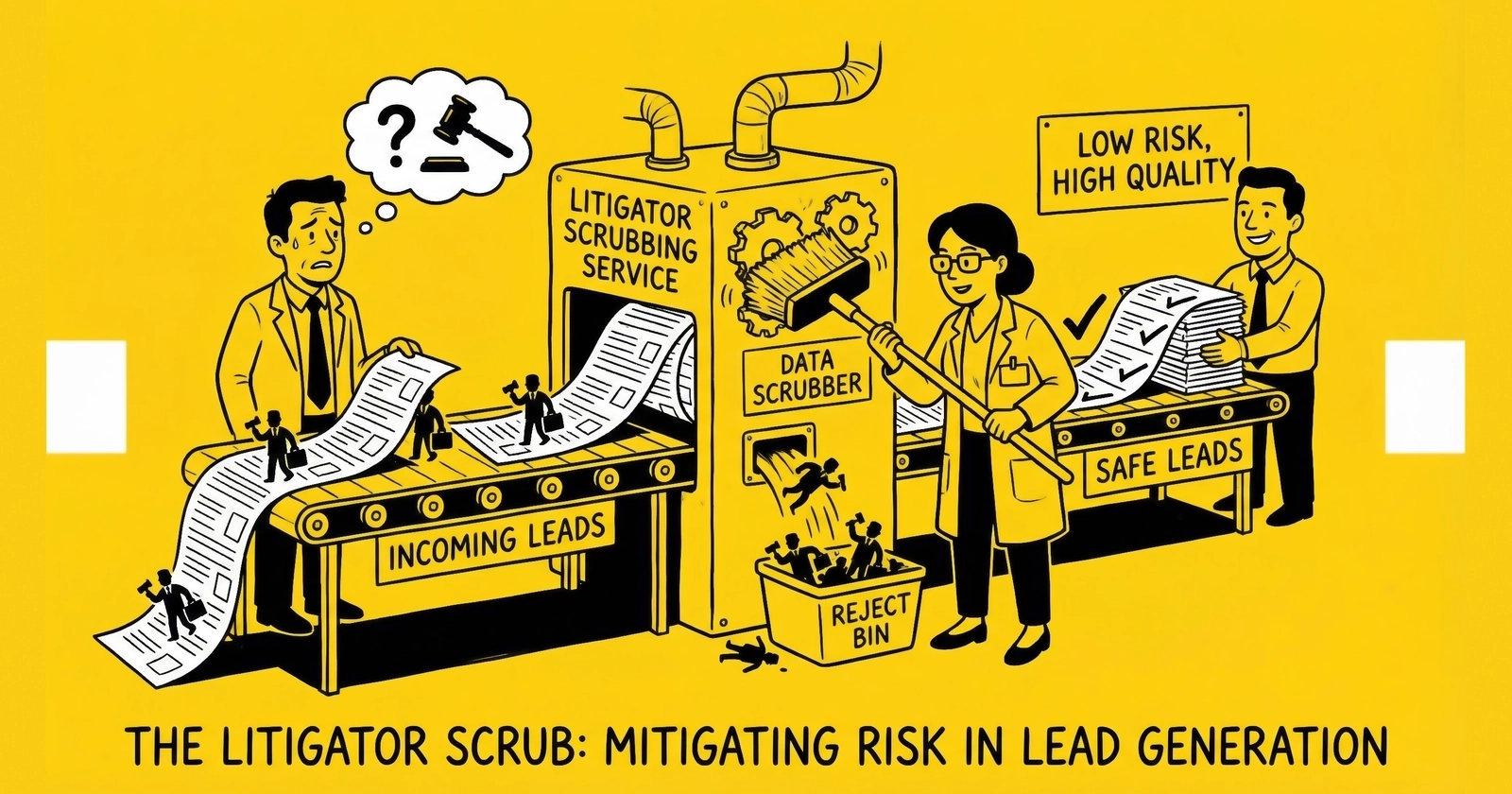
A comprehensive evaluation of TCPA litigator suppression platforms for lead generation professionals navigating an era where 31-41% of class actions originate from serial plaintiffs who have turned TCPA lawsuits into a business model.
The demand letter arrives on a Tuesday morning. The plaintiff’s name is vaguely familiar. A quick search reveals why: this individual has filed 47 TCPA lawsuits over the past three years. The claims are formulaic. The settlement demands are calibrated to defense cost economics. And the phone number your system dialed belongs to one of 35 cell phones this person maintains specifically to generate litigation opportunities.
You have just encountered a professional TCPA plaintiff.
In 2024, 2,788 TCPA cases were filed, representing a 67% increase over the prior year. By September 2025, class action filings were running 97% ahead of 2024’s pace. Average settlements exceed $6.6 million. And somewhere between 31% and 41% of these lawsuits originate from repeat plaintiffs who actively seek to receive non-compliant communications as their primary source of income.
This is not conspiracy theory. This is documented reality with names, court testimony, and judicial findings.
Litigator scrubbing services have emerged as essential infrastructure for lead generation operations. These platforms maintain databases of known TCPA plaintiffs, professional litigators, and their associated phone numbers. By screening your calling lists against these databases before making contact, you can identify and exclude high-risk numbers before they become high-cost lawsuits.
This guide provides a comprehensive analysis of litigator scrubbing services: how they work, which platforms are available, their effectiveness, limitations, and integration into your broader TCPA compliance strategy. Every operator making outbound calls or texts needs to understand this landscape.
Understanding the Serial Plaintiff Problem
Before evaluating solutions, you need to understand the problem in its full dimension.
The Professional TCPA Plaintiff Ecosystem
Serial TCPA plaintiffs are not random consumers who received unwanted calls and sought legal recourse. They are sophisticated practitioners who have built systems for generating litigation opportunities. Their tactics are documented in court records and judicial opinions.
Melody Stoops, who has appeared as a plaintiff in numerous TCPA cases, testified in court that she maintained 35 cell phones to support her “business” of being a TCPA plaintiff. Thirty-five separate phone lines, each a potential lawsuit waiting to happen.
Kenneth Johansen testified in his case against Bluegreen Vacations that he had been a plaintiff in approximately 60 previous TCPA class actions and generates roughly $60,000 annually from TCPA litigation settlements. The court in that case found he had “deceptively” prolonged calls to bolster his damage claims and denied class certification.
These are not isolated examples. Industry analysis of 2024 TCPA filings found that 31% of cases were filed by individuals who had previously filed TCPA suits. Other methodologies, using broader definitions of “repeat plaintiff,” place this figure as high as 41%. Some individual plaintiffs have filed dozens or even hundreds of lawsuits over their litigation careers.
Common Professional Plaintiff Tactics
Understanding how serial plaintiffs operate helps you understand what litigator scrubbing is designed to prevent.
Multiple phone lines. Professional plaintiffs maintain numerous phone numbers, often including prepaid phones, VoIP lines, and accounts across multiple carriers. Each number increases the surface area for receiving non-compliant calls. Some plaintiffs rotate numbers through different lead generation forms, waiting for marketing calls to generate.
Consent-then-challenge. A plaintiff provides consent through forms with potential deficiencies, then later challenges the validity of that consent in litigation. This tactic exploits the gap between consent capture and consent documentation, targeting operations without robust TrustedForm or Jornaya verification.
Time-zone exploitation. Some plaintiffs strategically position themselves in time zones where calling hour calculations become complex. A plaintiff in a location where carriers disagree on time zone assignment can claim a call at 9:05 PM local time violated the 9 PM cutoff.
Reassigned number scenarios. Plaintiffs obtain phone numbers recently assigned to different individuals, then sue when calls intended for the prior number holder arrive. The caller had valid consent from the original owner, but the new owner is a professional plaintiff.
Prolonging calls. As demonstrated in the Johansen case, some plaintiffs deliberately extend call duration to increase statutory damage claims. A call that would have been disconnected in 30 seconds becomes a 15-minute conversation, with damages calculated per call rather than per second.
Form manipulation. Some plaintiffs actively seek out lead generation forms with compliance deficiencies, complete them to generate leads, then wait for the resulting marketing calls to build their case.
The Economics of Serial Litigation
Professional plaintiffs operate on straightforward economics. A single TCPA violation carries statutory damages of $500, trebling to $1,500 if the violation was willful. A plaintiff who receives 10 allegedly non-compliant calls has individual exposure of $5,000 to $15,000 against each caller.
Most defendants settle quickly. Defense costs start at $40,000 to $50,000 for cases resolved early and can exceed $500,000 for cases proceeding through trial. When a defendant faces $50,000 in guaranteed defense costs to dispute a $10,000 claim, settlement becomes economically rational.
Serial plaintiffs understand this math. They calibrate their demands to fall below the economic threshold where defendants would fight. A demand for $3,000 to $8,000 often settles within weeks. The plaintiff moves on to the next case. At 60 cases over several years, as Johansen testified, the income stream becomes substantial.
This creates a sustainable business model that perpetuates litigation volume. The 97% year-over-year increase in TCPA class actions through September 2025 is not accidental. It reflects a mature plaintiff ecosystem with proven economics.
How Litigator Scrubbing Works
Litigator scrubbing services address this problem by identifying known plaintiffs before you contact them.
Data Collection Methods
Litigator databases are compiled from multiple sources:
-
Federal court filings. All TCPA lawsuits filed in federal courts appear in the Public Access to Court Electronic Records (PACER) system. Scrubbing services monitor these filings, extracting plaintiff names, phone numbers alleged in complaints, and associated attorney information.
-
State court filings. Many TCPA cases are filed in state courts, which maintain separate filing systems. Comprehensive services monitor state court records in major TCPA jurisdictions including Florida, California, Texas, Illinois, and New York.
-
Pre-litigation demand letters. Not all disputes result in lawsuits. Some services track demand letters sent to industry participants, identifying individuals who threatened litigation even if no case was filed.
-
Attorney databases. TCPA plaintiff attorneys are themselves a signal. Phone numbers associated with known plaintiff attorneys, their firms, and their staff are flagged.
-
Industry reporting. Some services incorporate reports from member companies about individuals who have sent demand letters or threatened litigation.
-
Settlement records. Individuals who have received settlements in prior TCPA cases are often flagged, as settlement creates precedent for future claims.
Database Contents
A comprehensive litigator database includes:
-
Named plaintiffs. Individuals who have filed TCPA lawsuits, with case details and filing dates.
-
Phone numbers. All phone numbers associated with known plaintiffs, including numbers alleged in complaints and numbers discovered through investigation.
-
Attorney associations. Phone numbers linked to TCPA plaintiff attorneys and their firms.
-
Demand letter senders. Individuals who have threatened litigation without filing suit.
-
Address data. Physical addresses associated with known plaintiffs for matching purposes.
-
Historical records. The full history of each individual’s litigation activity, enabling assessment of patterns.
Industry estimates suggest comprehensive databases contain 50,000 to 600,000 entries, depending on how broadly “litigator” is defined. The Contact Center Compliance database reportedly contains over 50,000 known litigator phone numbers. Other services cite databases exceeding 600,000 names when including attorneys, demand letter senders, and associated parties.
Matching and Screening Process
Litigator scrubbing operates through real-time or batch matching:
-
Pre-campaign scrubbing. Before launching a calling campaign, you submit your call list to the scrubbing service. The service compares your numbers against the database and returns a list of flagged numbers to exclude.
-
Real-time API integration. For operations requiring immediate decisions, API integration enables number-by-number lookup at the moment a lead enters your system or before a call is placed. Latency typically runs under 200 milliseconds.
-
Batch processing. High-volume operations may submit daily or weekly files for batch processing, receiving flagged number lists for exclusion from calling queues.
-
Score-based flagging. Some services provide risk scores rather than binary flags, enabling nuanced decisions about contact. A number with minimal litigation history might receive a different treatment than a number associated with a 60-case plaintiff.
Integration Points
Litigator scrubbing integrates at multiple points in the lead flow:
-
Lead distribution platforms. Major platforms including boberdoo, LeadsPedia, LeadExec, and Lead Prosper offer native or documented integrations with litigator scrubbing services. Leads can be automatically screened before distribution.
-
Dialing platforms. Predictive dialers and calling systems can integrate scrubbing as a pre-call filter, preventing flagged numbers from entering dialing queues.
-
CRM systems. Customer relationship management platforms can incorporate litigator flags in lead records, enabling manual review or automatic suppression.
-
Lead generation forms. Some operations screen at the moment of lead capture, rejecting leads from flagged numbers before they enter the system.
Major Litigator Scrubbing Providers
Several vendors compete in the litigator scrubbing market. Each offers distinct capabilities, pricing models, and integration options.
Contact Center Compliance (Litigator Scrub)
Overview: Contact Center Compliance Corporation, founded by industry veteran Tom Herd, offers comprehensive DNC and litigator scrubbing services. The company’s Litigator Scrub product specifically addresses TCPA plaintiff identification.
Database: The database contains over 50,000 known litigator phone numbers, compiled from federal and state court filings, demand letters, and industry reporting. Contact Center Compliance monitors court filings daily, updating the database as new cases are filed.
Features:
- Daily database updates from court filings
- Real-time API for instantaneous lookups
- Batch processing for high-volume operations
- Integration with DNCScrub for combined DNC and litigator screening
- Comprehensive compliance reporting
- Training and compliance consultation services
Integration: DNCScrub and Litigator Scrub integrate with major dialing platforms and CRM systems. API documentation enables custom integration for operations with proprietary systems.
Pricing: Contact Center Compliance uses volume-based pricing. Contact for current rates based on lookup volume and service level requirements.
Strengths: Established reputation, comprehensive database, integration with DNC scrubbing, and educational resources including training programs. The combined DNC and litigator offering creates operational efficiency.
Considerations: Smaller database than some competitors who count attorneys and associated parties. Focus on documented plaintiffs rather than broader “high-risk” categorization.
PossibleNOW (TCPA Litigator Database)
Overview: PossibleNOW, a Georgia-based compliance technology company, offers the TCPA Litigator Database as part of its broader compliance platform.
Database: PossibleNOW’s database tracks TCPA plaintiffs across federal and state courts. The company monitors filings continuously and updates the database accordingly.
Features:
- Comprehensive plaintiff tracking across jurisdictions
- Integration with PossibleNOW’s DNCSolution platform
- Enterprise preference management integration
- API access for real-time lookups
- Reporting and analytics on suppression activity
Integration: Native integration with PossibleNOW’s compliance suite. API integration available for external systems.
Pricing: Enterprise pricing; contact PossibleNOW for current rates.
Strengths: Integration with broader preference management and compliance infrastructure. Suitable for enterprise operations with comprehensive consent and preference requirements.
Considerations: Enterprise focus may be more than smaller operations require. Pricing typically reflects enterprise positioning.
WebRecon (Litigator Alert)
Overview: WebRecon LLC has become the industry standard for TCPA litigation monitoring and statistics. The company tracks TCPA filings comprehensively and publishes the litigation statistics cited throughout industry analysis. WebRecon’s Litigator Alert service leverages this data for plaintiff identification.
Database: WebRecon’s database derives from their comprehensive TCPA litigation tracking. The company monitors federal and state court filings across all jurisdictions and has the most detailed picture of TCPA litigation patterns available.
Features:
- Real-time filing monitoring
- Litigation alert notifications for named companies
- Plaintiff and attorney tracking
- Comprehensive litigation analytics
- Industry benchmarking data
Integration: API access for integration with calling systems and CRMs.
Pricing: Contact WebRecon for current pricing.
Strengths: The definitive source for TCPA litigation data. Statistical accuracy that comes from tracking every TCPA case filed. Litigation alerts for company name monitoring.
Considerations: Primary focus is litigation monitoring and analytics rather than pure list scrubbing. Best suited for operations that want comprehensive litigation intelligence alongside plaintiff identification.
Gryphon (Gryph Platform)
Overview: Gryphon Networks offers the Gryph platform for sales communication compliance. The platform includes litigator screening alongside broader TCPA compliance features.
Database: Gryphon maintains databases for DNC compliance, litigator identification, and related compliance functions.
Features:
- Integrated compliance platform for calls and texts
- Litigator screening as part of comprehensive compliance
- Real-time call blocking and guidance
- Consent management integration
- Analytics and reporting
- AI-powered compliance coaching
Integration: Native platform for Gryphon users; API integration for external systems.
Pricing: Platform pricing based on seats and volume; contact Gryphon for current rates.
Strengths: Integrated platform addressing multiple compliance requirements. Real-time guidance during calls rather than just pre-call screening. Particularly strong for operations with sales teams making live calls.
Considerations: Full platform may be more than operations need if only seeking litigator screening. Pricing reflects comprehensive platform positioning.
TCPA Litigator List
Overview: Several vendors offer products under variations of the “TCPA Litigator List” name. These products compile litigator data from court filings and industry sources.
Database: Databases vary by vendor. Some vendors cite lists exceeding 600,000 names when including plaintiffs, attorneys, and associated parties.
Features: Features vary by vendor, typically including batch processing, API access, and standard suppression functionality.
Pricing: Varies by vendor; typically competitive pricing for basic suppression services.
Strengths: Cost-effective options for basic litigator screening. Competition keeps pricing reasonable.
Considerations: Quality and update frequency vary. Verify data sources and update schedules before committing.
Blacklist Alliance
Overview: Blacklist Alliance provides DNC and litigator suppression services with a focus on real-time compliance.
Database: Blacklist Alliance maintains databases for DNC compliance, litigator screening, and wireless number identification.
Features:
- Real-time API scrubbing
- DNC and litigator combined screening
- Wireless number identification
- Integration with major dialing platforms
- Compliance reporting
Integration: Documented integrations with Retreaver, LeadExec, and other platforms.
Pricing: Volume-based pricing; contact for current rates.
Strengths: Combined DNC and litigator offering. Strong real-time API performance.
Considerations: Smaller vendor than some competitors. Verify database completeness for your specific needs.
Trestle (Real Contact)
Overview: Trestle provides data enrichment and compliance services including litigator identification through its Real Contact product.
Database: Trestle’s database includes litigator risk scores and TCPA litigation history for phone numbers.
Features:
- Litigator risk scoring (not just binary flags)
- TCPA litigation history
- Data enrichment alongside compliance
- Phone number validation and carrier lookup
- API and batch access
Integration: Integration with LeadExec and other platforms documented.
Pricing: Per-lookup pricing; contact for volume discounts.
Strengths: Risk scoring enables nuanced decision-making. Combined data enrichment and compliance value.
Considerations: May be more than needed if only seeking simple suppression.
Provider Comparison Matrix
| Feature | Contact Center Compliance | PossibleNOW | WebRecon | Gryphon | Blacklist Alliance |
|---|---|---|---|---|---|
| Database Size | 50,000+ numbers | Comprehensive | Industry leading | Comprehensive | Not disclosed |
| Update Frequency | Daily | Continuous | Real-time | Continuous | Daily |
| Real-Time API | Yes | Yes | Yes | Yes | Yes |
| Batch Processing | Yes | Yes | Yes | Yes | Yes |
| DNC Integration | Yes (DNCScrub) | Yes (DNCSolution) | No | Yes | Yes |
| Platform Focus | Compliance specialist | Enterprise | Analytics | Sales platform | DNC/Litigator |
| Litigation Analytics | Limited | Limited | Comprehensive | Limited | Limited |
| Training Resources | Yes | Yes | Limited | Yes | Limited |
Effectiveness Analysis
The critical question: do litigator scrubbing services actually reduce litigation exposure?
What Scrubbing Can Prevent
Litigator scrubbing is effective against known plaintiffs using known numbers. If Kenneth Johansen’s phone numbers are in the database and you screen your lists before calling, you will not call those numbers. The lawsuit he would have filed will not occur.
This protection is meaningful. With 31-41% of TCPA cases originating from repeat plaintiffs, eliminating known litigators from your calling lists removes a substantial portion of your litigation exposure.
The math supports the investment. A single avoided lawsuit saves $40,000 to $50,000 in minimum defense costs, or $5,000 to $25,000 in nuisance settlement. Annual litigator scrubbing costs typically run a few thousand dollars depending on volume. One avoided case pays for years of service.
What Scrubbing Cannot Prevent
Litigator scrubbing has fundamental limitations that operators must understand.
-
First-time plaintiffs. No database contains people who have not yet filed a lawsuit. A consumer who receives their first non-compliant call and decides to sue will not appear in any litigator database. As the plaintiff bar actively recruits new plaintiffs through advertising and referral networks, first-time filers represent a growing portion of litigation.
-
New phone numbers. Serial plaintiffs who acquire new phone numbers not yet associated with their litigation history will not be flagged. Some plaintiffs deliberately rotate numbers to avoid detection.
-
Legitimate complaints. Litigator scrubbing identifies people who have previously sued. It does not identify whether your call to a person is actually compliant. A person with no litigation history who receives a genuinely non-compliant call has every right to sue.
-
Class actions. Even if you successfully avoid calling known litigators, a single non-compliant call to a legitimate consumer can become a class action representing thousands of consumers. The named plaintiff may not be a serial litigator; the damages come from the class.
-
State mini-TCPA claims. Some litigator databases focus on federal TCPA filings. Plaintiffs who have sued only under state laws like Florida’s FTSA may not appear in federal-focused databases.
Measured Effectiveness
Industry data on scrubbing effectiveness is limited, but available evidence suggests meaningful risk reduction.
Operations implementing litigator scrubbing report reduced demand letter volume and litigation frequency. The reduction is not elimination, given the limitations noted above, but it is measurable.
The most rigorous approach combines litigator scrubbing with comprehensive compliance. Scrubbing removes known high-risk numbers. Proper consent documentation, TrustedForm certification, DNC suppression, and calling hour compliance address the remaining exposure. Neither approach alone is sufficient; together, they provide layered protection.
Cost-Benefit Analysis
Consider a mid-size lead operation making 50,000 calls per month:
Without scrubbing:
- Estimated 0.5% of calls reach litigator-associated numbers: 250 calls monthly
- If 1% of those calls generate litigation: 2-3 lawsuits annually
- Defense/settlement cost per case: $25,000 average
- Annual litigation exposure: $50,000-$75,000
With scrubbing:
- Scrubbing cost: $200-$500 monthly (depending on volume and service)
- Litigator-associated calls prevented: 250 monthly
- Lawsuits avoided: Estimated 80% reduction based on known plaintiff identification
- Annual litigation savings: $40,000-$60,000
Net benefit: $35,000-$55,000 annually in reduced litigation exposure.
These are illustrative figures. Actual results vary based on industry vertical, calling practices, and compliance infrastructure. But the directional economics are clear: scrubbing costs represent a small fraction of the litigation exposure it mitigates.
Integration Best Practices
Effective litigator scrubbing requires proper integration into your operations.
When to Screen
-
At lead acquisition. Screen leads when they enter your system. If a lead comes from a known litigator, reject it before it enters your distribution flow. This prevents selling a toxic lead to a buyer who will call it.
-
Before distribution. If you are a lead aggregator distributing leads to buyers, screen before distribution. Passing litigator leads to buyers exposes them to litigation and exposes you to indemnification claims.
-
Before calling. If you are the caller, screen immediately before dialing. Real-time API integration ensures the most current database is queried.
-
All of the above. Comprehensive operations screen at multiple points. A lead that was clean when acquired may become flagged if the associated person files a lawsuit before you call.
Integration Architecture
-
Real-time API. For operations requiring immediate decisions, integrate scrubbing via API into your lead routing or dialing workflow. Query the database in real-time and receive instant responses. Typical API latency is under 200 milliseconds.
-
Batch processing. For high-volume operations, batch processing is more efficient. Submit your call lists daily or before each campaign. Receive flagged number lists for suppression. This approach trades real-time currency for processing efficiency.
-
Hybrid approach. Many operations combine batch pre-processing with real-time verification. Batch screen the full list, then real-time verify at point of call for numbers acquired since the last batch.
Handling Flagged Numbers
When a number is flagged, you have several options:
-
Automatic suppression. The safest approach: flagged numbers never enter calling queues. No human decision required; no possibility of “just this once” exceptions that become litigation.
-
Review queue. Some operations route flagged numbers to human review. This allows investigation of false positives but creates process complexity and exception risk.
-
Score-based handling. If your service provides risk scores rather than binary flags, you might suppress high-risk numbers while permitting low-risk ones with additional verification.
-
Complete exclusion. Remove flagged numbers from all future marketing, not just current campaigns. A number flagged today should not become callable next month.
Documentation Requirements
Document your scrubbing activities for compliance defense:
-
Suppression logs. Maintain records of numbers suppressed, dates of suppression, and the scrubbing service used. These logs demonstrate good-faith compliance efforts.
-
Database update verification. Document that your database was current when screening occurred. If litigation arises from a number that was recently added to databases, your documentation shows you used the best available data at the time.
-
Policy documentation. Written policies requiring litigator scrubbing demonstrate systematic compliance rather than ad hoc efforts.
Combining Scrubbing with Comprehensive Compliance
Litigator scrubbing is one layer of a comprehensive compliance strategy. It is not a substitute for proper consent documentation, DNC suppression, or calling hour compliance.
The Compliance Stack
Effective TCPA compliance requires multiple layers:
-
Layer 1: Consent Documentation. TrustedForm or Jornaya certification documenting valid prior express written consent. This is your primary defense in any litigation.
-
Layer 2: DNC Suppression. Screening against federal and state Do Not Call registries plus internal suppression lists. A separate requirement from litigator scrubbing.
-
Layer 3: Litigator Suppression. Screening against known plaintiff databases. Reduces exposure to serial litigators.
-
Layer 4: Reassigned Number Checking. Querying the FCC’s Reassigned Numbers Database or commercial equivalents to identify numbers that have changed ownership.
-
Layer 5: Time-Zone Management. Automated controls preventing calls outside permitted hours based on recipient time zone.
-
Layer 6: Revocation Handling. Systems ensuring opt-out requests are honored within 10 business days per April 2025 FCC rules.
Why Each Layer Matters
Consent documentation addresses the most common litigation theory: that the consumer never consented to receive calls. Without documentation, you cannot prove consent existed.
DNC suppression addresses calls to registered numbers, a separate violation category from consent issues.
Litigator suppression reduces exposure to serial plaintiffs but does not make non-compliant calls compliant.
Reassigned number checking addresses calls to numbers that have changed hands, where original consent is no longer valid.
Time-zone management prevents calls outside permitted hours, another separate violation category.
Revocation handling ensures you stop calling when consent is withdrawn.
Each layer addresses a distinct risk. Omitting any layer leaves exposure that the other layers do not cover.
The Compliance Technology Stack
A complete compliance technology stack includes:
| Function | Purpose | Key Providers |
|---|---|---|
| Consent Verification | Document PEWC | TrustedForm, Jornaya |
| DNC Suppression | Prevent calls to registered numbers | DNCScrub, DNC.com |
| Litigator Suppression | Identify serial plaintiffs | Contact Center Compliance, PossibleNOW, Gryphon |
| Reassigned Number Checking | Avoid calls to new owners | FCC RND, Neustar |
| Time-Zone Management | Prevent off-hours calls | Integrated in dialing platforms |
| Call Recording | Document call content | Integrated in dialing platforms |
ROI Calculation Framework
Quantifying the return on litigator scrubbing investment helps justify the expense and calibrate investment levels.
Input Variables
Call volume. Monthly number of outbound calls or leads contacted.
Litigator hit rate. Percentage of numbers in your lists that match litigator databases. Industry averages suggest 0.3% to 1.0% for typical consumer lists.
Litigation conversion rate. Percentage of litigator contacts that result in demand letters or lawsuits. Estimates range from 1% to 10% depending on compliance practices.
Average settlement cost. Cost to resolve a TCPA demand or lawsuit. Ranges from $3,000 for quick nuisance settlements to $50,000+ for contested cases.
Defense cost avoided. Minimum defense costs for cases that would have been litigated without scrubbing. Typically $40,000-$50,000.
Scrubbing service cost. Monthly or per-lookup cost for the scrubbing service.
Sample ROI Calculation
For an operation making 100,000 calls monthly:
Without scrubbing:
- Estimated litigator contacts: 500 (0.5% hit rate)
- Estimated lawsuits from contacts: 5 (1% litigation rate)
- Annual lawsuits: 60
- Average resolution cost: $15,000 (mix of settlements and defended cases)
- Annual litigation cost: $900,000
With scrubbing:
- Scrubbing cost: $500/month = $6,000 annually
- Litigator contacts prevented: 400 (80% of known litigators identified)
- Lawsuits prevented: 48 (80% reduction)
- Remaining lawsuits: 12 (from unknown litigators and first-time filers)
- Annual litigation cost: $180,000
- Annual savings: $720,000
ROI: 120:1 ($720,000 savings / $6,000 cost)
Even with conservative assumptions, the ROI on litigator scrubbing is compelling. The math supports investment for any operation with meaningful call volume.
Limitations and Considerations
Honest evaluation requires acknowledging what litigator scrubbing cannot do.
Database Completeness
No database is complete. Plaintiffs who have sued only in state courts that are not monitored, plaintiffs using phone numbers not yet associated with their litigation history, and first-time plaintiffs are all absent from litigator databases.
Vendors make different claims about database size. A vendor citing 600,000 entries may include attorneys, staff, and associated parties. A vendor citing 50,000 may count only documented plaintiffs. The number matters less than the methodology and update frequency.
False Positives
Litigator databases may flag numbers that no longer belong to the associated plaintiff, or numbers that share characteristics with litigator patterns but belong to legitimate consumers. Aggressive suppression may exclude some valid marketing targets.
The business impact of false positives is typically minimal. You lose the opportunity to market to a small number of leads. The litigation cost of false negatives (contacting actual litigators) far exceeds the marketing cost of false positives.
Database Currency
A database that was current last week may be missing plaintiffs who filed this week. Update frequency matters. Services updating daily provide better protection than services updating monthly.
When evaluating providers, ask about update frequency and methodology. Real-time monitoring of court filings is superior to periodic manual updates.
Jurisdictional Coverage
Some services focus on federal TCPA filings. State mini-TCPA claims in Florida, Oklahoma, and other states may not be comprehensively tracked. If you make calls to consumers in states with active mini-TCPA litigation, verify your service covers state court filings in those jurisdictions.
Over-Reliance Risk
The greatest risk is treating litigator scrubbing as a substitute for comprehensive compliance. Scrubbing removes known bad actors. It does not make your underlying practices compliant.
An operation that scrubs litigator numbers but fails to document consent, ignores DNC requirements, or calls outside permitted hours will still face litigation. The plaintiffs will simply be first-time filers rather than serial litigators.
Scrubbing is one layer of defense. It must be combined with proper consent documentation, DNC compliance, and operational controls.
Frequently Asked Questions
What is a litigator scrubbing service and how does it work?
A litigator scrubbing service maintains a database of phone numbers associated with known TCPA plaintiffs, serial litigators, plaintiff attorneys, and individuals who have sent demand letters. When you submit your calling list to the service, it compares your numbers against this database and flags matches for suppression. This prevents you from calling people with a documented history of TCPA litigation, eliminating a substantial portion of your litigation exposure. Services operate through batch file processing or real-time API integration, with typical API response times under 200 milliseconds.
What percentage of TCPA lawsuits come from serial litigators?
Industry analysis indicates that between 31% and 41% of TCPA cases are filed by individuals who have previously filed TCPA lawsuits. The exact percentage depends on methodology and definitions. Some individual plaintiffs have filed 60 or more TCPA lawsuits over their litigation careers, generating substantial income from settlements. One professional plaintiff testified to maintaining 35 cell phones specifically to support her “business” of being a TCPA plaintiff. This concentration of litigation among repeat filers makes litigator scrubbing an effective risk reduction strategy.
How much does litigator scrubbing cost?
Pricing varies by provider, volume, and service level. Typical costs range from a few hundred to a few thousand dollars monthly for mid-size operations. Per-lookup pricing for real-time API access typically runs fractions of a cent per lookup at volume. The economics are compelling: a single avoided lawsuit saves $25,000 to $50,000 in defense and settlement costs, while annual scrubbing costs for most operations run under $10,000. One prevented case pays for years of service.
Which litigator scrubbing service is best?
The optimal choice depends on your operational needs. Contact Center Compliance (Litigator Scrub) offers comprehensive coverage combined with DNC scrubbing and training resources. PossibleNOW provides enterprise-scale compliance infrastructure beyond just litigator screening. WebRecon offers the industry’s definitive litigation analytics and tracking. Gryphon provides an integrated sales communication platform with litigator screening as one component. Blacklist Alliance offers combined DNC and litigator suppression with strong real-time API performance. Evaluate based on database completeness, update frequency, integration options, and pricing for your volume.
Can litigator scrubbing guarantee I will not get sued?
No. Litigator scrubbing reduces exposure to known serial plaintiffs but cannot eliminate litigation risk entirely. First-time plaintiffs who have never previously sued will not appear in any database. Serial plaintiffs using newly acquired phone numbers may not be flagged. And consumers who receive genuinely non-compliant calls have every right to sue regardless of their litigation history. Litigator scrubbing is one layer of a comprehensive compliance strategy that must also include proper consent documentation, DNC suppression, and operational compliance with calling hour and revocation requirements.
How often are litigator databases updated?
Update frequency varies by provider. The best services monitor federal and state court filings daily or in real-time, adding new plaintiffs as cases are filed. Some services update less frequently, potentially weekly or monthly. When evaluating providers, ask specifically about update methodology and frequency. A database that was current last month may be missing plaintiffs who filed last week. Real-time monitoring of court filings provides the most current protection.
Should I use litigator scrubbing in addition to TrustedForm and DNC suppression?
Yes. These services address different risk vectors. TrustedForm documents consent, providing your primary defense against claims that the consumer never consented. DNC suppression prevents calls to numbers registered on Do Not Call lists, a separate violation category. Litigator scrubbing identifies people with litigation history who are more likely to sue if contacted. Each addresses distinct risks. A comprehensive compliance strategy includes all three layers plus time-zone management, reassigned number checking, and revocation handling.
How do I integrate litigator scrubbing with my dialing platform?
Most major dialing platforms and lead distribution systems offer native or documented integrations with litigator scrubbing services. Common integration approaches include real-time API calls that query the database before each dial, batch file processing that screens your call list before campaign launch, and lead-level filtering that suppresses flagged leads before they enter distribution. Consult your dialing platform documentation for available integrations, or contact scrubbing service vendors for API documentation to build custom integration.
What happens if I call a flagged number by mistake?
If a flagged number enters your calling queue due to timing gaps between database updates and your screening, or due to integration failures, you may contact a known litigator. The outcome depends on whether your underlying compliance is sound. If you have proper consent documentation (TrustedForm certificate), DNC compliance, and calling hour compliance, you may still have a defensible position. If your compliance is deficient, the litigator will exploit those deficiencies. This underscores why litigator scrubbing supplements but does not replace comprehensive compliance.
Is litigator scrubbing legal and ethical?
Yes. Litigator scrubbing uses publicly available court records and associated data to make informed marketing decisions. There is no legal prohibition against choosing not to call people with litigation history. Courts have not found litigator screening to be discriminatory or otherwise improper. From an ethical standpoint, you are simply exercising informed judgment about marketing targets based on publicly available information about their demonstrated willingness to litigate.
How does litigator scrubbing compare to consent verification for litigation defense?
These tools serve different purposes and are not substitutes for each other. Consent verification (TrustedForm, Jornaya) documents that the consumer provided valid consent, which is your primary defense in any TCPA litigation. Litigator scrubbing identifies people likely to sue and prevents you from contacting them. Consent verification helps you win cases that are filed. Litigator scrubbing helps you avoid cases being filed in the first place. Both are valuable; neither alone is sufficient.
Key Takeaways
-
31-41% of TCPA lawsuits originate from serial plaintiffs who have turned TCPA litigation into a business model, with some individuals filing 60+ cases and earning $50,000-$60,000 annually from settlements.
-
Litigator scrubbing services maintain databases of known TCPA plaintiffs, their phone numbers, associated attorneys, and demand letter senders. By screening your calling lists against these databases, you can identify and exclude high-risk numbers before contact.
-
Major providers include Contact Center Compliance (Litigator Scrub), PossibleNOW, WebRecon, Gryphon, and Blacklist Alliance. Each offers distinct capabilities, pricing models, and integration options. Evaluate based on database completeness, update frequency, and compatibility with your operations.
-
The economics are compelling. A single avoided lawsuit saves $25,000-$50,000 in defense and settlement costs. Annual scrubbing costs typically run a few thousand dollars. ROI calculations consistently show 50:1 to 150:1 returns on scrubbing investment.
-
Scrubbing cannot prevent all litigation. First-time plaintiffs, serial plaintiffs using new phone numbers, and legitimate consumers who receive genuinely non-compliant calls will not be flagged. Scrubbing reduces exposure to known litigators; it does not eliminate litigation risk.
-
Litigator scrubbing is one layer of comprehensive compliance. It must be combined with proper consent documentation (TrustedForm/Jornaya), DNC suppression, reassigned number checking, time-zone management, and revocation handling. No single layer provides complete protection.
-
Integration best practices include screening at lead acquisition, before distribution, and before calling. Real-time API integration provides the most current protection. Document your scrubbing activities for compliance defense.
-
When evaluating providers, ask about database size, data sources, update frequency, and jurisdictional coverage. A database that misses state court filings or updates infrequently provides inferior protection regardless of price.
-
The investment decision is straightforward. For any operation making material outbound call volume, the cost of litigator scrubbing is trivial compared to the litigation exposure it mitigates. The question is not whether to implement scrubbing, but which service best fits your operational requirements.
This article provides general information about litigator scrubbing services and TCPA compliance. It is not legal advice. TCPA requirements change frequently through FCC rulemaking and court decisions. Consult qualified TCPA counsel for guidance on your specific compliance requirements.
Statistics and service information current as of December 2025. Sources include WebRecon TCPA litigation data, court records, and vendor documentation. Service features, pricing, and capabilities may change. Contact vendors directly for current information.
Related Resources: