# LiveRamp's CAPI Hub Wires ChatGPT Ads to the Identity Graph – Attribution-Engineering Implications for Lead Generators
> **Canonical:** https://www.leadgen-economy.com/blog/liveramp-capi-hub-chatgpt-measurement-lead-attribution/
> **Published:** 2026-06-25
> **Author:** Alex Paddington
> **Source:** LeadGen Economy – https://www.leadgen-economy.com
---
*A server-side rail to ChatGPT measurement was the missing piece. LiveRamp installed it ten days before Cannes – and three weeks after Publicis bought the installer.*
---
## The Plumbing That Closed the ChatGPT Attribution Loop
On June 10, 2026, LiveRamp Chief Connectivity and Ecosystem Officer Travis Clinger published the blog post that wired the Conversions API Hub into OpenAI's ChatGPT advertising surface. The announcement was technical, short, and unsensational. It also closed the single biggest measurement gap in the AI-distributed advertising stack: the inability to attribute downstream conversions to ChatGPT ad exposures with anything approaching server-side fidelity.
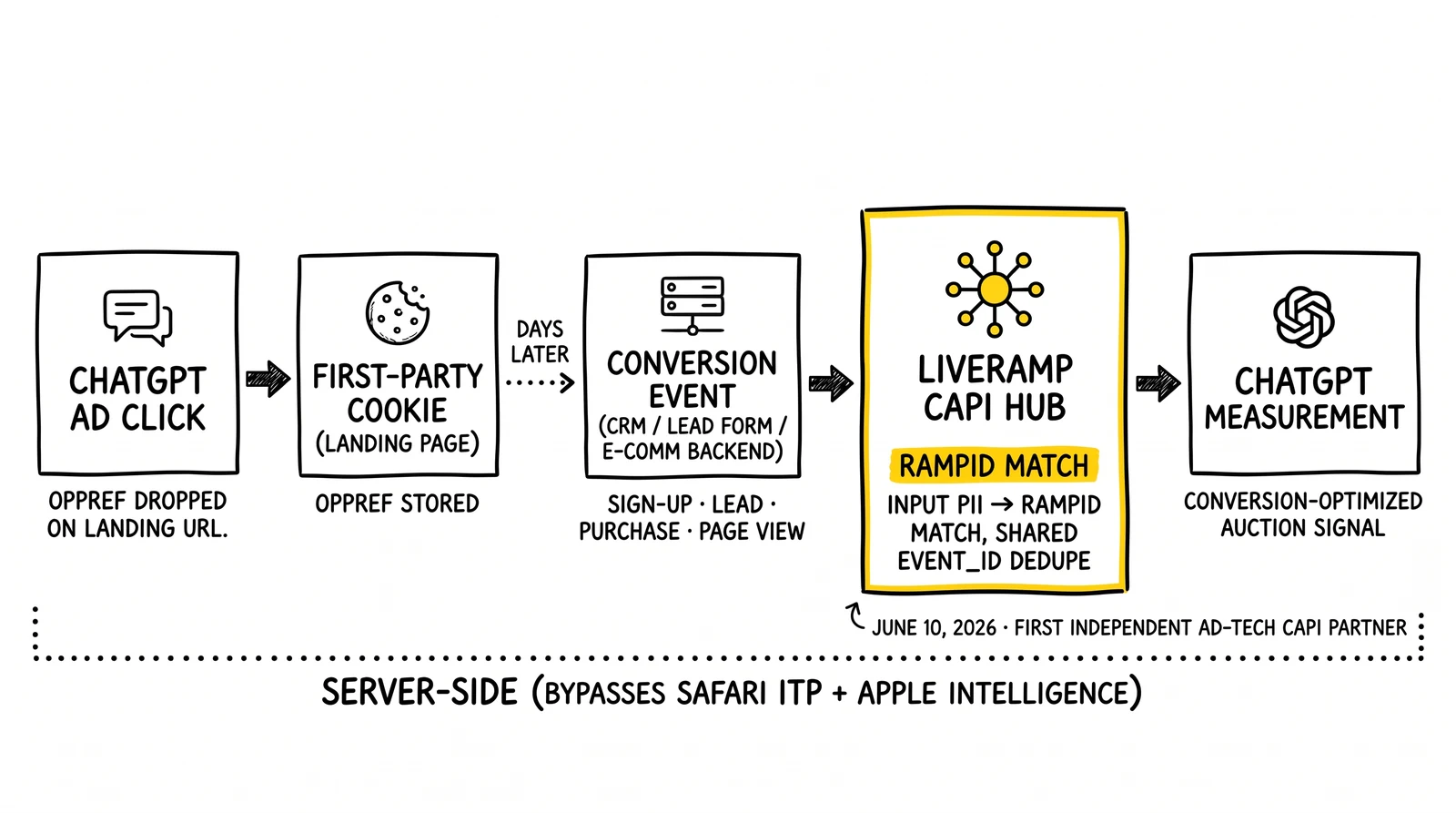
LiveRamp became the first independent ad-tech CAPI partner integrated into OpenAI's measurement surface. According to PPC.land's documentation review, the supported conversion event types are purchases, sign-ups, leads, and page views. The architecture sends events server-to-server from the advertiser's own infrastructure through LiveRamp into ChatGPT, mapped to RampID and deduplicated against OpenAI's oppref identifier – a privacy-preserving token captured from landing-page URLs and stored in a first-party cookie.
What that means in operator terms: a person who clicked a ChatGPT ad, hit a landing page, and converted later (signed up for a quote, requested a Medicare consultation, completed a mortgage pre-qualification) can now be tied back to that ChatGPT exposure deterministically, without depending on browser JavaScript that Safari's Intelligent Tracking Prevention and Apple Intelligence's private-relay intermediation are degrading by an estimated 30-40 percent.
RampID is the load-bearing match that closes the ChatGPT exposure-to-conversion loop server-side – bypassing the 30-40 percent pixel-attribution loss from Apple Intelligence and Safari ITP.
The integration matters less for the technology than for the timing. ChatGPT advertising entered self-serve in the UK on June 17, 2026, with conversion-optimized auctions launched June 5. Criteo's ChatGPT Ads reseller program, announced at Cannes Lions 2026, activated more than 2,000 brands with 4x spend lift and 2-3x CTR versus comparable formats – facts cataloged in [the channel-map analysis on ChatGPT ads at Cannes](https://www.leadgen-economy.com/blog/chatgpt-ads-cannes-2026-criteo-2000-brands-lead-gen/). Without server-side measurement, that inventory would have been bought blind. LiveRamp installed the rail just before the inventory needed it.
The complication: Publicis Groupe announced the $2.167 billion LiveRamp acquisition on May 17, 2026 – three weeks before the OpenAI integration went live. The CAPI Hub is now the marquee asset of an identity-resolution vendor being absorbed by an advertising holding company that competes with WPP, Omnicom-IPG, Havas, and Dentsu for the same buyer panels. WPP CEO Cindy Rose used Cannes Lions 2026 to announce that her agency would discontinue LiveRamp following the takeover. The neutrality story has a deadline.
---
## How the Integration Actually Works
The technical architecture is what separates LiveRamp's CAPI Hub from platform-specific server-side rails like Meta CAPI or Google's enhanced conversions. Operators who have been hand-wiring each one of those should pay attention.
### The data path, end to end
A ChatGPT ad click drops a URL parameter on the landing page. OpenAI's oppref identifier captures that parameter and stores it in a first-party cookie on the destination site. When the visitor later converts – signs a lead form, requests a quote, completes a purchase – the advertiser's own server-side infrastructure fires a conversion event to LiveRamp's CAPI Hub with the conversion metadata, a shared event_id, and identity attributes (typically a hashed email or hashed phone number).
LiveRamp matches those identity attributes to a RampID using its identity graph. RampID is the deterministic person-level identifier LiveRamp has built for years and licensed to enterprises for offline-to-online matching across the open advertising ecosystem. Once the match is made, the CAPI Hub translates the event into the destination-platform-expected format and routes it to ChatGPT measurement. Deduplication against pixel-fired events relies on the shared event_id.
The architecture bypasses browser JavaScript, ad blockers, and ITP. That is the structural reason the CAPI rail outperforms pixel-only measurement in 2026.
### Why the Hub model matters versus point-to-point CAPI
Every major ad platform now offers its own server-side conversion rail. Meta CAPI rolled out a free one-click setup in Events Manager in April 2026, which finally killed the "too technical" excuse for direct CAPI integration. Google has been pushing enhanced conversions as the default for years. TikTok and Pinterest have similar offerings. Each one requires a separate integration on the advertiser side: separate identifiers, separate dedupe logic, separate engineering ownership.
LiveRamp's CAPI Hub is a one-to-many architecture. The advertiser sends events to one endpoint – LiveRamp – with input PII. LiveRamp matches the PII to RampID, then translates to whatever identifier each destination platform expects: Meta's email hash, Google's GCLID-paired enhanced conversion, OpenAI's oppref-paired event, and so on. Documentation cited by LiveRamp's own programs page enumerates Meta, Google Store Sales Improvements, and Google Campaign Manager 360 as supported destinations; ChatGPT joined June 10, 2026; DIRECTV Advantage joined April 16, 2026 as the first MVPD CAPI integration.
For an aggregator already paying LiveRamp for cross-domain identity match – a category that includes most large insurance aggregators, mortgage marketplaces, and home-services lead distributors – adding ChatGPT measurement is marginal cost. For an aggregator who would have to onboard LiveRamp specifically to access the ChatGPT rail, the calculus is different. LiveRamp licensing fees are not trivial. The Hub's value scales with the number of destinations an operator routes through it.
### What the supported event types tell operators
Purchases, sign-ups, leads, page views. Those are the four event types PPC.land documentation cites for the ChatGPT CAPI integration. Three of the four – purchases, sign-ups, leads – map directly to performance marketing's bottom-funnel auction signals. Sign-ups and leads are the operator-relevant categories for lead generation.
OpenAI's conversion-optimized auction campaigns launched June 5, 2026 – five days before the LiveRamp integration. Conversion-optimized auctions reward advertisers who provide a clean conversion signal; advertisers without a CAPI rail are bidding into the same auction with degraded signals and losing the optimization premium. The LiveRamp integration is what makes ChatGPT auction campaigns viable for lead generators who do not have native pixel implementations or who want signal recovery beyond what the pixel provides.
The dark funnel reframe is direct. As [the self-reported-attribution analysis](https://www.leadgen-economy.com/blog/dark-funnel-self-reported-attribution-incrementality-2026/) lays out, Refine Labs measured a 90 percent gap between software-reported and customer self-reported attribution across 620 conversions. Server-side CAPI rails do not close that entire gap – most of the dark funnel is conversations and content consumption that no rail measures – but they close the platform-attributable portion of it. Without LiveRamp's CAPI Hub on ChatGPT, ChatGPT-sourced leads sit entirely in the dark funnel. With it, the platform-attributable portion of those leads gets a deterministic signal.
---
## The Identity Graph Underneath: Why RampID Carries the ChatGPT Rail
RampID is the load-bearing component of the integration. It is also the asset Hightouch is trying to carve out of the Publicis deal. Operators evaluating whether to wire up ChatGPT measurement through LiveRamp need to understand both halves.
### What RampID does, in operator terms
RampID is a deterministic person-level identifier. LiveRamp builds it by ingesting authoritative customer records – typically from data partners and direct enterprise integrations – and resolving them into a stable identifier that persists across devices, sessions, and channels. When an advertiser sends a hashed email or hashed phone number to LiveRamp, the match is to a RampID. The RampID then unlocks downstream activation: routing audiences to ad platforms, attaching conversion events to the right person, enabling cross-domain measurement.
For the ChatGPT integration specifically, RampID is what links the advertiser-side conversion event (CRM-sourced) to the OpenAI-side ad exposure (oppref-sourced). Without that match, the conversion event has no clear path back to a campaign signal. Pixel-based attribution would attempt the same match probabilistically – through device fingerprinting, IP-based heuristics, or simple time-window correlation – and lose accuracy at every step.
The deterministic-versus-probabilistic distinction matters more for verticals where conversion latency is high. A consumer who clicks a ChatGPT ad on a phone, gets distracted, and converts three days later on a desktop will not be matched by IP-based probabilistic methods. RampID, if both touchpoints reconcile to the same person, will match deterministically.
### The Hightouch carve-out scenario
On June 16, 2026, Axios reported that Hightouch had made an $800 million to $1.2 billion unsolicited offer – combining cash, stock, and debt – for RampID and LiveRamp Connect specifically. The offer is a carve-out structure, not a full-company counter-bid against Publicis. The deadline was June 26, 2026, which falls within days of this article's publish window. Hightouch was last valued at $2.75 billion after its April 2026 Series D led by Goldman Sachs and Bain Capital Ventures.
Three scenarios are live:
- Publicis closes the full deal as announced, absorbing RampID into the agency holding company.
- Publicis accepts the Hightouch carve-out, keeping LiveRamp's measurement and data-collaboration network minus the identity graph.
- The Hightouch offer expires unaccepted, and the original deal closes intact.
For operators using the ChatGPT CAPI rail, the carve-out scenario is the one that fragments the architecture. If RampID ends up at Hightouch and the CAPI Hub stays at Publicis-LiveRamp, the identity-matching layer that powers the Hub now operates under a separate vendor. Contractual continuity, SLAs, and integration responsibility get re-papered. Operators should not bet single-channel infrastructure on the carve-out outcome without a fallback identity rail.
### The neutrality question after Publicis closes
LiveRamp CEO Scott Howe addressed the neutrality concern directly in his Marketing Dive interview: "Whatever assurance [agencies] need that we're going to continue to be neutral – of course we are." That commitment is genuine, but commitments under prior ownership are not enforceable under new ownership unless contractually papered. WPP's discontinuation announcement signals what the competitive logic dictates. Forrester analysts Jay Pattisall and Joe Stanhope, quoted in [the Publicis-LiveRamp acquisition analysis](https://www.leadgen-economy.com/blog/publicis-liveramp-2-2-billion-identity-resolution-lead-aggregators/), warned that absorption is the inevitable path in agency M&A.
For aggregators routing identity through RampID into multi-buyer panels, the post-close question is not whether LiveRamp's stated intent is neutral. It is whether the contractual and technical infrastructure preserves neutrality when commercial incentives push the other way. Aggregators should audit:
- Identity-vendor change-of-control terms in current LiveRamp contracts.
- Switching cost to alternative graphs (ID5, UID2.0, The Trade Desk's UID, Hightouch's potential standalone offering).
- Whether ping-post routing logic depends on RampID matching that would break under a vendor switch.
- Whether buyer-panel customers have made parallel discontinuation noises.
None of those audits is urgent for next quarter. All of them affect per-lead CPL pricing 12 months out.
---
## Where the Integration Fits in the 2026 Attribution Stack
The CAPI Hub does not replace anything in the cookieless attribution stack. It adds one server-side rail to an already crowded set of attribution layers. Operators should understand where it slots.
### The four-layer attribution model in 2026
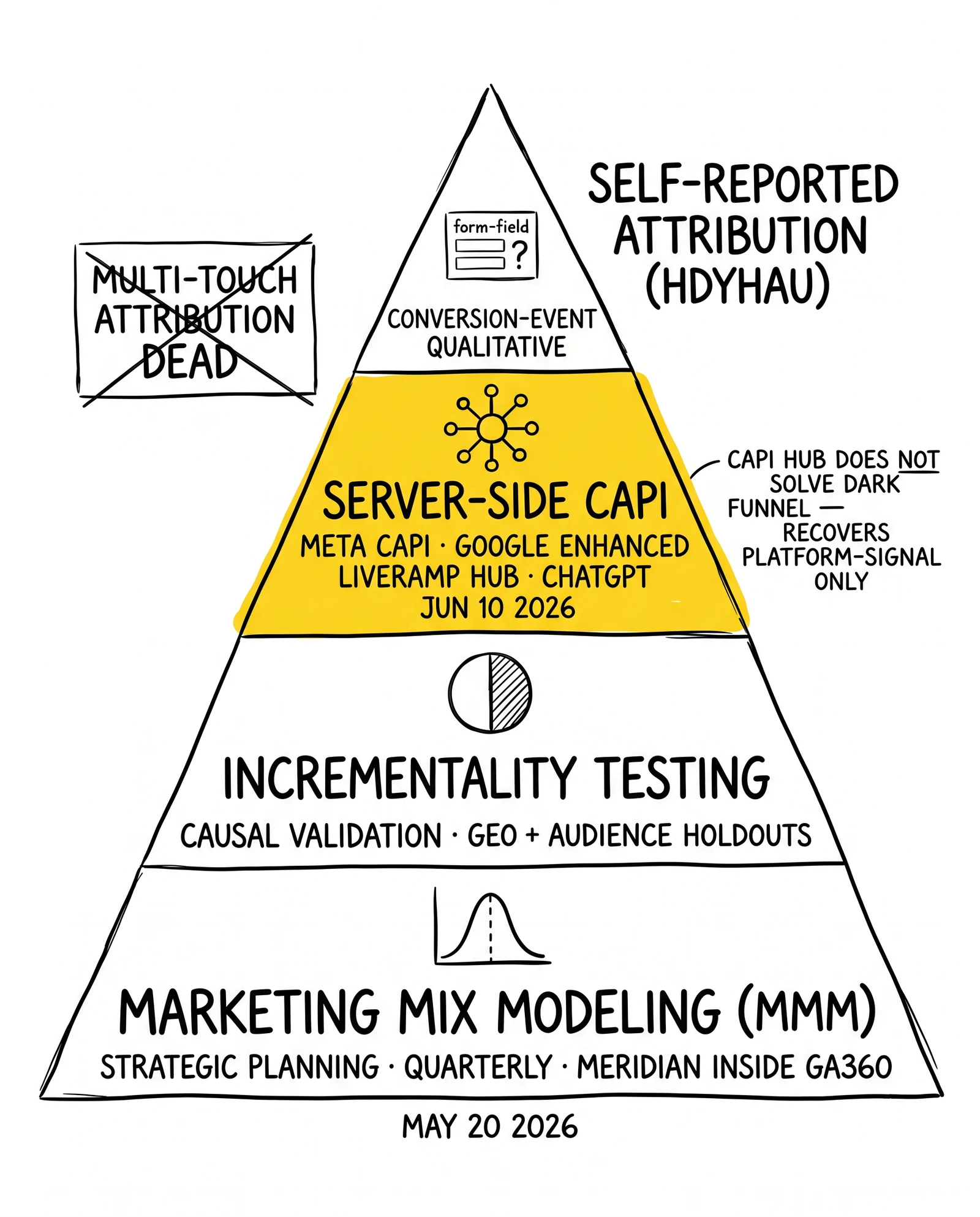
The [cookieless attribution stack analysis](https://www.leadgen-economy.com/blog/cookieless-attribution-stack-mmm-incrementality/) lays out the model that has emerged after Privacy Sandbox's October 2025 retirement, iOS 14.5 ATT (which cut mobile attribution coverage 70-85 percent), and the gradual collapse of multi-touch attribution from 90+ percent coverage to 30-60 percent. The four layers are:
- **Marketing Mix Modeling (MMM)** – strategic budget planning, channel-level lift, used quarterly. Google Meridian moved inside GA360 on May 20, 2026.
- **Incrementality testing** – causal validation through geo and audience holdouts. Used campaign-level and quarterly.
- **Server-side conversion APIs** – tactical signal recovery for in-platform optimization. Used continuously per platform.
- **Self-reported attribution** – buyer-side qualitative signal. Used at conversion event capture.
LiveRamp's CAPI Hub is a server-side conversion API. It fits in layer three. It does not replace MMM, does not substitute for incrementality testing, and does not capture self-reported attribution. What it does is improve the platform-side signal that feeds into in-platform optimization – which then changes the bidding behavior of the auction the operator participates in.
The CAPI Hub solves the platform-attributable signal-recovery layer only – it does not close the dark funnel, but it makes ChatGPT conversion-optimized auctions winnable for operators routing identity through RampID.
The compound effect matters. ChatGPT conversion-optimized auctions reward advertisers who provide a clean conversion signal. If LiveRamp's CAPI rail surfaces leads and sign-ups that the pixel alone would have missed, the auction algorithm learns faster and bids more aggressively for similar user profiles. Operators without the rail are bidding into the same auction with worse signal and either pay more for the same lead or lose impression share.
### The ChatGPT-specific signal recovery math
Apple Intelligence intermediation and Safari ITP degrade pixel-based attribution by an estimated 30-40 percent on iOS traffic. ChatGPT's iOS app share is substantial – the platform processed queries for "nearly one billion people" according to LiveRamp's announcement, with iOS over-indexed in the affluent-consumer cohort that matters most to insurance, mortgage, and financial services lead generators.
A first-order estimate: an operator running ChatGPT conversion-optimized auctions on pixel-only attribution misses 30-40 percent of iOS conversions, which depending on user mix means 15-30 percent of total platform conversions go unattributed. Adding the CAPI Hub recovers most of that gap – not all, since some sessions never carry the oppref through to the conversion event. Industry benchmarks for Meta CAPI integration cite 17.8 percent lower cost per result. The ChatGPT-specific number is unknown so far, but the structural mechanism is the same.
### How the rail interacts with the dark funnel
Server-side conversion APIs do not solve the dark funnel. The dark funnel is buyers who research, evaluate, and shortlist without leaving measurable signal on any platform. 6sense's November 2025 Buyer Experience Report found 60 percent of B2B buying journeys are in the dark; 95 percent of deals close with Day-1 shortlist vendors. CAPI rails operate on traffic that has already been captured by a platform – they recover attribution on visible signal, not invisible signal.
What the LiveRamp-ChatGPT integration changes is the visible-signal recovery rate on ChatGPT specifically. The dark funnel remains. Self-reported attribution remains the only direct measurement of the dark funnel. Operators should not interpret the CAPI rail as a solution to attribution generally; it solves one specific measurement gap on one specific platform.
---
## Lead-Generation Vertical Implications
The CAPI Hub's value to lead-gen operators differs sharply by vertical. The differences are driven by conversion latency, compliance gating, and the existing identity-vendor stack.
### Insurance aggregators: the marginal-cost scenario
Large insurance aggregators – those routing leads into MediaAlpha, EverQuote, QuoteWizard, and direct carrier integrations – typically already license LiveRamp for cross-domain identity match. RampID is used inside their ping-post systems to deduplicate consumer records and route to the buyer with the highest live bid. Adding the ChatGPT CAPI rail to that existing license is marginal cost: the engineering effort to send conversion events from the lead form to LiveRamp's CAPI endpoint is days of work, not weeks.
The complication is gating. ChatGPT advertising remains gated for insurance specifically – Fair Housing concerns for auto insurance demographics, state-by-state insurance advertising compliance, and the carrier-specific approval pipeline. Until ChatGPT inventory opens to insurance, the CAPI integration is theoretical for the vertical. The expected gating timeline is Q3-Q4 2026 for the largest carriers; Tier 2 and smaller carriers may wait longer.
The bigger immediate win is in adjacent verticals. Auto loans, refinance, personal loans – verticals where the major lead aggregators are also already on LiveRamp – can wire up the ChatGPT rail now and start optimizing inside conversion-optimized auctions.
### Mortgage marketplaces: high latency, high CAPI value
LendingTree, Zillow Premier Agent, Bankrate, NerdWallet – the mortgage marketplaces face the canonical CAPI use case. Mortgage lead conversion happens days to weeks after click. The borrower fills a form, then talks to a loan officer, then takes a credit pull, then signs a rate lock. Each step is a separate event the marketplace can capture in its CRM. Pixel-based attribution drops most of these events because the user has long since closed the browser tab where the original ChatGPT click occurred.
Server-side CAPI events at each stage of the funnel – quote request, credit pull, application submission, funding – give ChatGPT auction algorithms the deep-funnel signal needed to optimize toward the high-value conversion rather than the form fill. LendingTree's Q1 2026 earnings reported revenue of $327.3 million (+37 percent YoY) with the Insurance segment up 51 percent to $221.9 million. Mortgage-segment revenue growth correlates with the marketplace's ability to drive bottom-funnel conversion at acceptable CPL. The CAPI rail directly improves that ability.
### Home services: the unit-economics fit
Home services – HVAC, roofing, plumbing, solar – runs on lower-ticket conversions but higher consumer urgency. The buyer who searches "HVAC repair emergency" on ChatGPT is a high-intent immediate-conversion lead. Day-one ChatGPT advertising verticals at Cannes 2026 included exactly these: HVAC, plumbing, roofing, financial services. The CAPI Hub for these verticals captures the lead form fill as the primary conversion event and feeds it into conversion-optimized auctions. Home-services aggregators not already on LiveRamp face the same buy-versus-build question as any new CAPI customer.
### Medicare AEP: the offline-conversion case
Medicare Advantage agents will face the largest single-vertical AEP cycle in years starting October 15, 2026 – UnitedHealthcare, Humana, and Aetna all announced 2026 plan exits affecting hundreds of thousands of beneficiaries. Brokers running ChatGPT advertising into the displaced-beneficiary cohort need to attribute phone-call closures days after click. That is precisely the offline-conversion use case the CAPI architecture handles. Hashed phone numbers from CRM-side closures match to RampID, which matches to the original oppref-carrying session.
Medicare AEP is a high-frequency, narrow-window selling cycle. CMS CY2027 commission bumps ($114→$130 initial, $57→$65 renewal) and the elimination of the 48-hour SOA waiting period change the lead-to-sale timing economics. Operators bidding into ChatGPT auctions for AEP traffic should treat CAPI measurement as table stakes – not a competitive advantage but the floor.
### Legal lead gen: the Colorado complication
Colorado Senate Bill 26-174, signed June 3, 2026 and effective August 12, 2026, classifies legal lead generation as a deceptive trade practice with $20,000-$50,000 civil penalties per violation and a private right of action. The compliance posture for ChatGPT-sourced legal leads into Colorado is essentially "do not bid." For the broader legal mass-tort vertical, the CAPI rail's role is the same as any other ad platform: it measures conversions that get past compliance gating. The compliance gating itself is the binding constraint.
---
## The Decision Frame for Operators
Three decisions confront a lead-gen operator evaluating the LiveRamp-ChatGPT CAPI integration in mid-2026:
### Decision 1 – Is LiveRamp already in the stack?
If yes, the CAPI Hub addition to ChatGPT is marginal cost. Engineering wires up event forwarding from the lead form or e-commerce backend to LiveRamp's existing CAPI endpoint. The ChatGPT destination is one more output in LiveRamp's identity matching. The decision is operational, not strategic: when does engineering get the work in, and which advertiser-side conversion events have priority. This is the dominant scenario for most large insurance, mortgage, and home-services aggregators.
If no, the calculus is harder. LiveRamp's licensing model is enterprise-priced. Adding the vendor specifically to access one new ad platform's measurement rail rarely pencils. The alternative is to wait for OpenAI to roll out a native pixel-plus-CAPI offering equivalent to Meta's free one-click implementation. OpenAI has not announced such a path, but the precedent suggests the platform will eventually offer one. Operators in this position should evaluate the time horizon – if ChatGPT-sourced traffic is currently negligible, the wait carries little cost; if ChatGPT is already 10+ percent of paid acquisition, the cost of waiting compounds.
### Decision 2 – How much ChatGPT exposure does the operator have today?
The integration is most valuable for operators already running material ChatGPT spend. Criteo's reseller program activated more than 2,000 brands with 4x spend lift and 2-3x CTR. ChatGPT's UK self-serve rolled out June 17. Conversion-optimized auctions launched June 5. The infrastructure to spend at scale is in place; the optimization rail is in place. The operators getting compounding returns are those with both.
For operators not yet running ChatGPT campaigns, the CAPI integration is not the trigger event. The trigger event is whether ChatGPT inventory pencils relative to existing Google, Meta, and TikTok rails. Once it does, the CAPI rail is the next infrastructure decision.
### Decision 3 – How does the Publicis-Hightouch outcome affect the bet?
Three scenarios were laid out earlier: Publicis closes intact, Publicis accepts Hightouch carve-out, Hightouch offer expires. Each one affects the medium-term risk profile of betting infrastructure on LiveRamp's CAPI Hub.
The Publicis-intact scenario carries the neutrality risk. Operators routing identity through Publicis-owned RampID may face WPP-style discontinuation announcements from their buyer-panel customers. The risk is concentrated in verticals where one or two non-Publicis holding companies own most of the buyer relationships – financial services, automotive, CPG. For pure-lead-gen aggregators selling into direct enterprise carrier and lender accounts, the risk is muted.
The Hightouch carve-out scenario fragments the architecture. The CAPI Hub stays at Publicis-LiveRamp; RampID moves to Hightouch. Existing CAPI customers face a re-papering question. Hightouch has been a composable-CDP vendor with strong technical credibility; absorbing RampID would make it a major identity player overnight. The operational disruption is real, but the post-disruption state may be more durable than the original deal.
The offer-expires scenario reverts to the original deal mechanics and resolves the immediate question – but the neutrality concerns remain in play through the regulatory approval window into late 2026.
Operators making infrastructure bets within the next quarter should not assume any one of these scenarios will resolve in their favor. The hedge is parallel investment in at least one non-LiveRamp identity rail (UID2.0 or ID5 are the leading candidates) so that vendor switching costs do not become structural.
---
## What the Integration Says About Where Attribution Is Heading
Two structural signals are embedded in the LiveRamp-ChatGPT announcement, both of which extend beyond the immediate measurement rail.
### Signal 1 – Server-side is winning the attribution architecture
Browser-based pixels are degrading. Apple Intelligence private relay, Safari ITP, Firefox Total Cookie Protection, Edge's tracker blocking – each one cuts a percentage off pixel accuracy. Conversion rails are migrating server-side because that is the only path that survives the privacy stack. Meta CAPI's free one-click rollout, Google's enhanced conversions emphasis, TikTok's events API, and now LiveRamp's multi-platform Hub all confirm the trajectory. By end of 2026, server-side will not be a measurement enhancement; it will be the baseline. Pixel-only operators will be at a structural disadvantage in any conversion-optimized auction.
### Signal 2 – Identity graphs are becoming infrastructure layers
RampID under LiveRamp, UID2.0 under The Trade Desk, ID5 as independent, Hightouch's prospective acquisition target – all of these are identity graphs trying to become the cross-platform translation layer between advertisers and platforms. The CAPI Hub model is the natural product expression: one advertiser-side integration, many platform destinations, identity matching as the load-bearing primitive.
The question for the next 18 months is how many such graphs the market sustains. Concentration into one or two dominant graphs creates the same neutrality questions LiveRamp is facing under Publicis. Fragmentation into many graphs creates operational overhead for advertisers who have to integrate with multiple. The likely outcome is two to three graphs that survive at scale, each with a sponsoring commercial structure – agency holding company, ad-tech demand platform, or independent CDP vendor.
Operators should pay attention to which graph their primary buyer-panel customers commit to. That is the single highest-leverage question for the medium-term identity infrastructure decision.
---
## Key Takeaways
- LiveRamp announced its CAPI Hub integration with ChatGPT advertising on June 10, 2026, making it the first independent ad-tech CAPI partner connected to OpenAI's conversion measurement surface. Supported event types are purchases, sign-ups, leads, and page views.
- The architecture routes server-side conversion events from advertiser infrastructure through RampID to ChatGPT, deduplicated against OpenAI's oppref identifier captured from landing-page URLs. The rail bypasses browser JavaScript, ad blockers, and Safari ITP.
- The Hub model is one-to-many: one advertiser-side integration routes events to multiple destinations (Meta, Google, ChatGPT, DIRECTV) with identifier translation per platform. This favors operators already paying for LiveRamp; the math is harder for operators who would onboard LiveRamp solely to access ChatGPT measurement.
- Publicis announced the $2.167 billion LiveRamp acquisition on May 17, 2026, with closing targeted for end of 2026. Hightouch's $800M-$1.2B unsolicited carve-out offer for RampID and LiveRamp Connect on June 16 introduces a structural variable. WPP CEO Cindy Rose announced at Cannes 2026 that the agency would discontinue LiveRamp post-close.
- Mortgage and Medicare AEP are the highest-fit verticals for CAPI Hub adoption because of conversion latency – quote-to-fund or click-to-phone-closure happens days after the ChatGPT click, where pixel-based attribution loses the connection.
- Insurance lead aggregators face ChatGPT compliance gating that delays the rail's vertical value into Q3-Q4 2026. The CAPI infrastructure decision can be made now; the activation is gated separately.
- Server-side conversion APIs solve platform-attributable signal recovery only – they do not address the dark funnel that captures 60 percent of B2B buying journeys and 95 percent of Day-1 shortlist behavior. The CAPI rail is one layer in a four-layer 2026 attribution stack alongside MMM, incrementality testing, and self-reported attribution.
- Operators should hedge identity-vendor concentration by investing in a parallel non-LiveRamp identity rail (UID2.0, ID5) before the Publicis-Hightouch outcome resolves.
- The post-Publicis neutrality question is contractual, not aspirational. LiveRamp customers should audit change-of-control clauses, switching costs, and ping-post routing dependencies on RampID matching.
- The structural trajectory is server-side attribution winning over pixel-based attribution by end of 2026. Operators who delay CAPI infrastructure investment will face conversion-optimized auction disadvantages that compound through Q4.
---
## Sources
- [LiveRamp Blog – Unlocking Better Performance Optimization and Measurement for Marketers in ChatGPT (June 10, 2026)](https://liveramp.com/blog/unlocking-better-performance-optimization-and-measurement-for-marketers-in-chatgpt)
- [PPC.land – LiveRamp CAPI Hub Now Connects ChatGPT Ads: Here's What It Measures (June 2026)](https://ppc.land/liveramp-capi-hub-now-connects-chatgpt-ads-heres-what-it-measures/)
- [Marketing Dive – ChatGPT Ads Get Measurement Boost from New LiveRamp Partnership (June 2026)](https://www.marketingdive.com/news/chatgpt-ads-get-measurement-boost-from-new-liveramp-partnership/822416/)
- [Marketing Dive – LiveRamp CEO Dishes on OpenAI Partnership, Looming Publicis Acquisition (May 2026)](https://www.marketingdive.com/news/liveramp-ceo-dishes-on-openai-partnership-looming-publicis-acquisition/823481/)
- [PR Newswire – DIRECTV Empowers Advertisers to Connect Real-Time Outcomes Through LiveRamp's CAPI Hub (April 16, 2026)](https://www.prnewswire.com/news-releases/directv-empowers-advertisers-to-connect-real-time-outcomes-to-ad-spend-through-liveramps-conversions-api-capi-hub-302743915.html)
- [LiveRamp Documentation – Conversions API Programs (2026)](https://docs.liveramp.com/connect/en/conversions-api-programs.html)
- [Publicis Groupe – Press Release on LiveRamp Acquisition (May 17, 2026)](https://www.publicisgroupe.com/en/news/press-releases/publicis-to-acquire-liveramp-to-accelerate-data-co-creation-for-smarter-agents)
- [PPC.land – ChatGPT Ads Go Live in Japan and South Korea, UK Gets Self-Serve (June 17, 2026)](https://ppc.land/chatgpt-ads-go-live-in-japan-and-south-korea-and-uk-gets-self-serve/)