# McLaughlin v. McKesson at One Year – The Junk-Fax Case That Quietly Detonated FCC Deference Across the TCPA
> **Canonical:** https://www.leadgen-economy.com/blog/mclaughlin-v-mckesson-tcpa-one-year-update/
> **Published:** 2026-06-25
> **Author:** Alex Paddington
> **Source:** LeadGen Economy – https://www.leadgen-economy.com
---
*One year after the Supreme Court decided McLaughlin v. McKesson, the TCPA's FCC-interpretation overlay has been quietly disassembled – eight district-court rulings, a deregulatory FCC, and a 19 percent Q1 2026 filing surge define the new compliance terrain.*
---
## A Junk-Fax Case That Wasn't Really About Junk Faxes
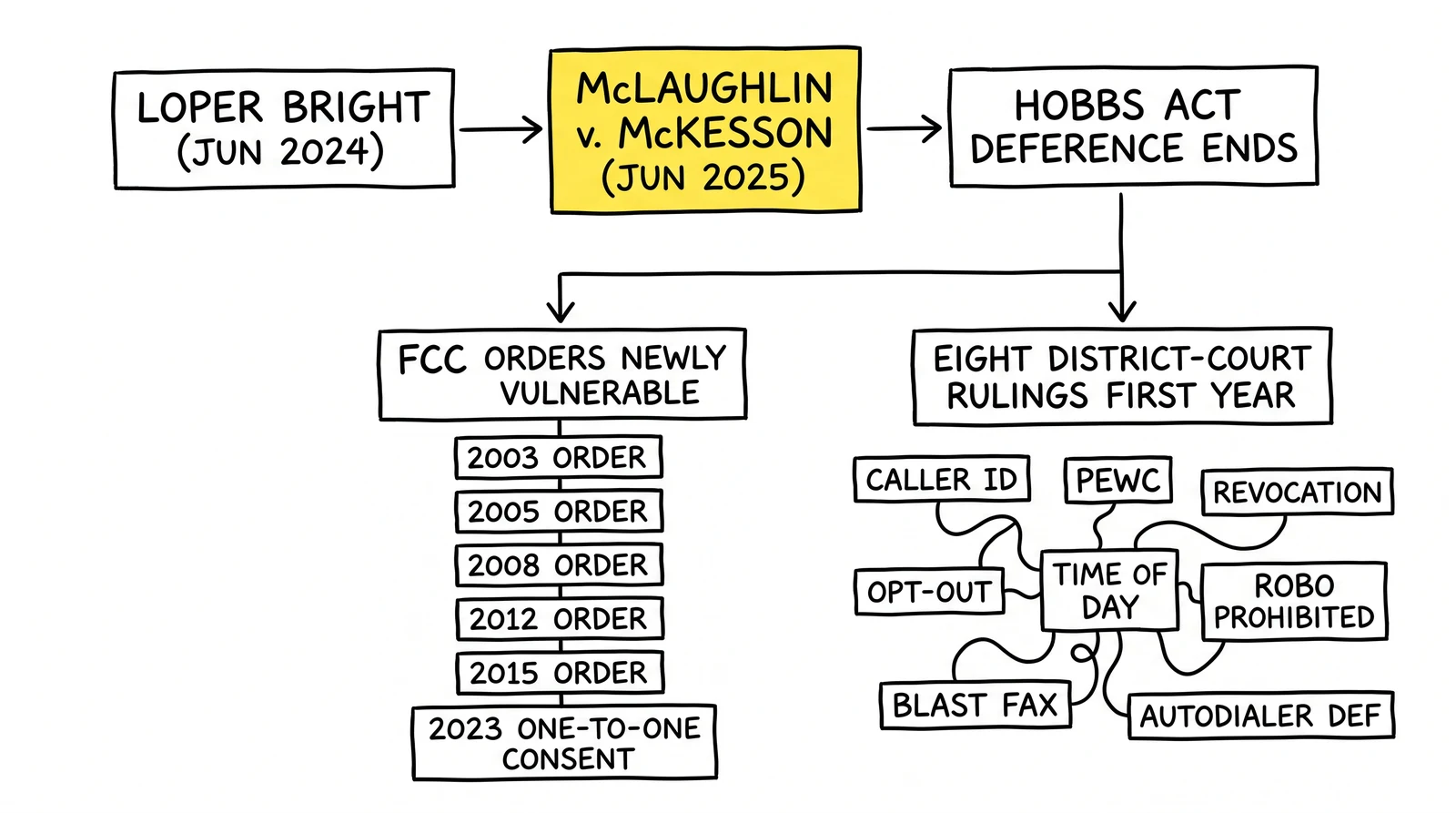
On June 20, 2025, the Supreme Court decided *McLaughlin Chiropractic Associates, Inc. v. McKesson Corp.*, 606 U.S. 146 (2025), No. 23-1226. The facts were old. McKesson Corporation's subsidiary sent unsolicited fax advertisements to medical practices in 2009 and 2010. McLaughlin Chiropractic Associates filed a class action in the Northern District of California in 2014 under the Junk Fax Prevention Act amendments to the Telephone Consumer Protection Act. The class included recipients on traditional fax machines and recipients receiving the faxes through online fax services. Mid-litigation, in December 2019, the FCC's Consumer and Governmental Affairs Bureau issued the Amerifactors declaratory ruling (DA 19-1247), holding that an online fax service is not a "telephone facsimile machine" under 47 U.S.C. § 227. The district court treated Amerifactors as binding under the Hobbs Act, granted summary judgment to McKesson on the online-fax claims, and decertified the corresponding class.
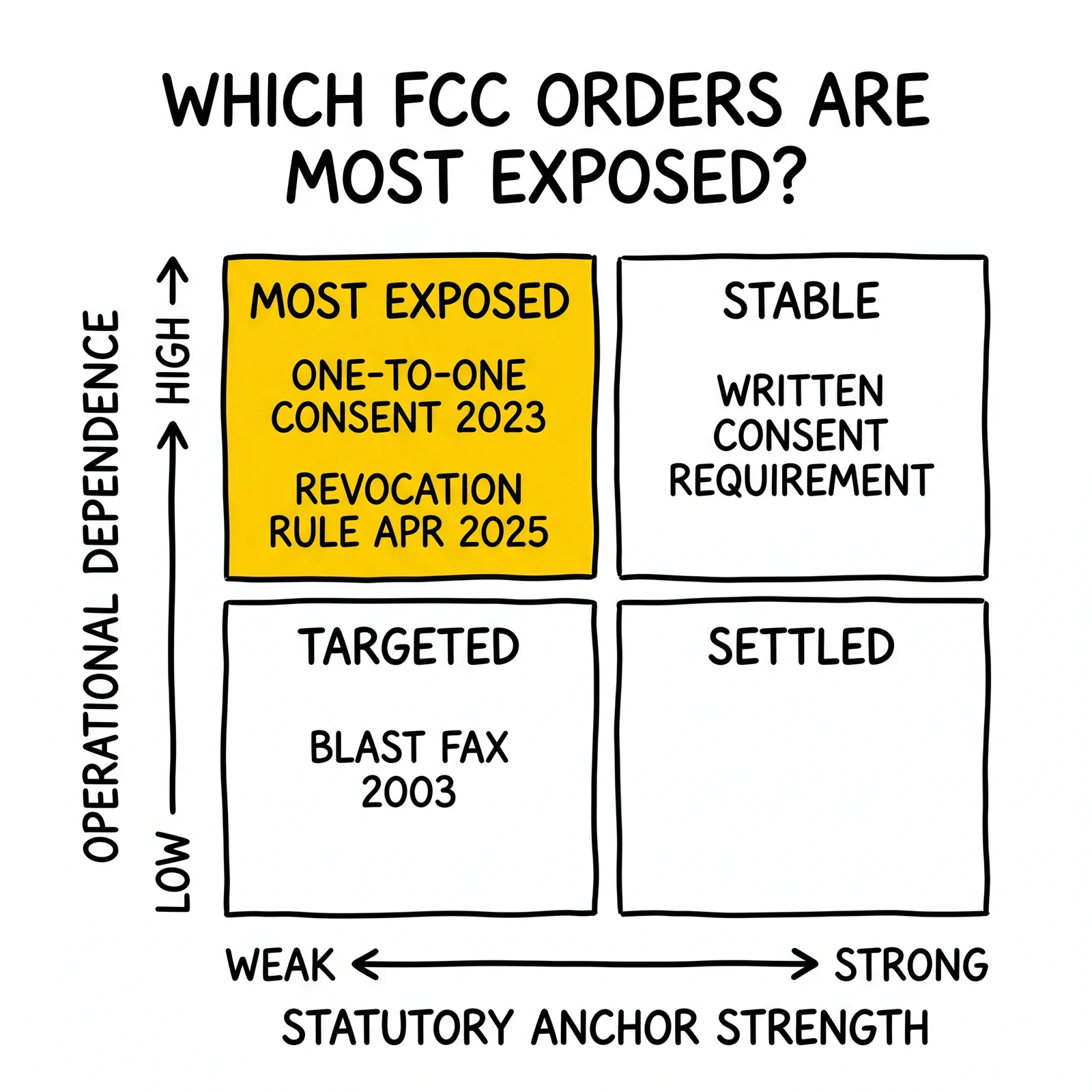
McLaughlin's reach is the eight district-court rulings since – not the holding itself. The FCC orders most exposed are the ones plaintiff firms will keep testing.
The Supreme Court reversed 6-3. Justice Brett Kavanaugh, writing for himself, Chief Justice Roberts, Justice Thomas, Justice Alito, Justice Gorsuch, and Justice Barrett, held that the Hobbs Act does not bind district courts in civil enforcement proceedings to a federal agency's interpretation of a statute. District courts, the majority concluded, must "independently determine the [statute's] meaning under ordinary principles of statutory interpretation" while "affording appropriate respect" – not binding deference – "to the agency's interpretation." Justice Kagan, joined by Justices Sotomayor and Jackson, dissented.
The narrow holding was about online faxes. The doctrinal reset is about every FCC order that has ever interpreted the TCPA. As of June 2026 – one year after the decision – at least eight published federal district-court opinions have applied McLaughlin to reinterpret core TCPA provisions, the FCC has formalized a "Delete, Delete, Delete" deregulatory posture rolling back many of its own most aggressive interpretations, and Q1 2026 TCPA class-action filings ran 19 percent above Q1 2025 with February and March 2026 setting consecutive records. The compliance terrain that lead-generation operators built on FCC orders as safe harbors has been quietly disassembled. This article maps where the rebuild is happening and where the next round of exposure has shifted.
The FCC interpretive overlay was load-bearing for two decades of TCPA compliance design. McLaughlin moved it to persuasive authority. The rebuild is still in progress.
---
## The Doctrinal Arc – Loper Bright, McLaughlin, and the End of Hobbs Act Deference
To understand why McLaughlin's narrow holding has had such an outsized downstream effect, the doctrinal sequence matters.
The Hobbs Act, formally the Administrative Orders Review Act of 1950 (28 U.S.C. § 2342 et seq.), routes pre-enforcement review of certain federal agency orders, including FCC orders, exclusively to the federal courts of appeals. For decades, the dominant reading of the Hobbs Act treated this exclusive review channel as also stripping district courts of the power to revisit FCC orders in subsequent civil enforcement litigation. If a regulated party had failed to petition a court of appeals within the Hobbs Act's 60-day window, the FCC's interpretation became, in effect, federal law for purposes of any later case in which that interpretation came into play. Lead-generation compliance design assumed this. Every TCPA training program treated the FCC's interpretive orders – the 2003 Report and Order extending "calls" to text messages, the 2012 prior-express-written-consent order, the 2015 omnibus order on revocation and reassigned numbers, the 2019 Amerifactors order on online faxes – as effectively binding.
Two Supreme Court decisions in successive Terms dismantled this assumption.
### Loper Bright, June 2024
*Loper Bright Enterprises v. Raimondo*, 144 S. Ct. 2244 (2024), decided one year before McLaughlin, overruled *Chevron U.S.A. Inc. v. NRDC*, 467 U.S. 837 (1984). The Court held that federal courts may not defer to an executive agency's interpretation of the law merely because the underlying statute is ambiguous. Statutory interpretation, the Court held, is a judicial function, and the Administrative Procedure Act requires courts to exercise that function independently. The decision's downstream effect on every regulatory regime built on agency-interpretation deference was foreseeable. The TCPA – with decades of FCC interpretive overlays on a brief statutory text drafted in 1991 – was identified within months as one of the regimes most exposed to judicial reinterpretation.
Loper Bright did not automatically free TCPA litigation. The Hobbs Act's separate review channel – distinct from Chevron deference – still arguably bound district courts to FCC orders that had survived their 60-day petition window. That argument is what McKesson Corporation made in defending the Amerifactors-based summary judgment.
### McLaughlin, June 2025
The Court took up the question in McLaughlin. The case had been argued January 21, 2025 – six months after Loper Bright. The question presented was specific: whether the Hobbs Act required the district court to defer to the FCC's Amerifactors interpretation. Justice Kavanaugh's majority opinion framed the answer through a three-tier statutory framework. Some statutes expressly preclude pre-enforcement review of agency orders outside the designated channel. Some statutes expressly authorize review elsewhere. Some statutes – like the Hobbs Act – are silent on whether the channel is exclusive. When a statute is silent, the majority held, the default rule favors judicial independence. District courts evaluating liability in subsequent civil enforcement actions are not reviewing the agency order; they are applying the underlying statute. The two functions are doctrinally distinct.
The dissent, authored by Justice Kagan, argued the majority misread the Hobbs Act's structure. By Justice Kagan's reading, the Act's express channeling of pre-enforcement review to the courts of appeals necessarily implied that subsequent civil enforcement courts were bound by the agency's order on questions the courts of appeals had not reached. The majority's three-tier framework, the dissent argued, was an invention. The 6-3 split mirrored the structure of recent administrative-law cases – the same six justices who joined Loper Bright joined McLaughlin's majority, and the same three justices dissented in both.
### The footnote that mattered
The most operationally significant element of McLaughlin's majority opinion may not be the holding but a footnote. The majority signaled that FCC orders interpreting the TCPA could be challenged not only as persuasive but also as procedurally vulnerable under the Administrative Procedure Act in private litigation contexts, even where no Hobbs Act petition had been filed. The footnote is the basis for the Washington Legal Foundation's November 17, 2025 analysis by Aaron C. Tifft of Hall Estill, which described the decision as a "seismic shift" precisely because of the implication that long-settled FCC orders could be relitigated on procedural grounds inside private TCPA suits. That door is now formally open.
---
## What the Decision Actually Held – and Did Not Hold
The majority opinion's specific holding can be stated tightly. The Hobbs Act does not bar district courts in civil enforcement proceedings from independently determining the meaning of statutes that an agency has previously interpreted, when the agency's interpretation arrives as an order rather than as a formal rule with notice-and-comment procedures. District courts owe such orders "appropriate respect" – a phrase the Court did not define beyond contrasting it with binding deference. The Court's holding does not invalidate any specific FCC order; it shifts the orders' legal status from binding to persuasive.
Several things the decision did not hold are equally important.
McLaughlin did not invalidate the TCPA. The statute – 47 U.S.C. § 227 – remains in full force. The TCPA's § 227(b) autodialer and prerecorded-voice prohibitions, § 227(c) privacy protections through the Do-Not-Call Registry, § 227(d) technical and procedural standards, and the Junk Fax Prevention Act's opt-out notice requirement under § 227(b)(1)(C) all remain enforceable.
McLaughlin did not reach any specific TCPA interpretive question on the merits. The Court remanded to the Ninth Circuit and ultimately back to the Northern District of California, where the question of whether faxes received through online fax services fall within the TCPA's coverage will now be answered through ordinary statutory interpretation rather than through deference to Amerifactors. As of mid-2026 the district court had not yet issued its decision on remand.
McLaughlin did not address whether McLaughlin is retroactive. The doctrinal logic implies that every district court hearing a TCPA case now must conduct independent statutory interpretation, regardless of when the FCC interpretation at issue was issued. Practical application has been retroactive – the eight published district-court rulings applying McLaughlin have not distinguished between pre- and post-2025 FCC orders.
McLaughlin did not establish a circuit split on what "appropriate respect" requires. The Court provided no operational test for how much weight a district court should give an FCC order. District courts have therefore been free to adopt a range of postures from skeptical to deferential – and have done so. The Stockdale opinion's textualist methodology and the contrary Wilson v. Skopos Financial opinion (D. Or., July 21, 2025) – same day as Jones v. Blackstone, opposite outcome on the same question – illustrate the range.
---
## The Eight District-Court Rulings That Define McLaughlin's First Year
Eight published federal district-court rulings between July 2025 and April 2026 have applied McLaughlin directly to TCPA questions. Seven of the eight reached the same substantive conclusion on the text-as-call question under § 227(c)(5). One – Wilson v. Skopos Financial – reached the opposite conclusion on the same day as the first of the seven, illustrating that McLaughlin's independent-interpretation requirement produces convergent results only when district courts also adopt textualist methodology.
The most-exposed quadrant – one-to-one consent and the revocation rule – is where plaintiff firms will keep retesting. Programs that price in stability there are mispricing risk.
The compliance-relevant cluster is the seven-case line holding that text messages are not telephone calls under § 227(c)(5). The site has previously analyzed the second half of this line – Stockdale through Irvin – in [TCPA Texts Not Calls](https://www.leadgen-economy.com/blog/tcpa-texts-not-calls-irvin-sonic-dnc-split/). The McLaughlin-anniversary cut is broader: how the cases trace back to the doctrinal sequence, and how the cluster operates as a proof of concept for the broader independent-interpretation regime.
### Jones v. Blackstone Medical Services (C.D. Ill., July 21, 2025, 792 F. Supp. 3d 894)
The first published district-court application of McLaughlin to the text-as-call question came one month after the Supreme Court's decision. Judge Sue E. Myerscough of the Central District of Illinois dismissed the § 227(c)(5) claims in Jones v. Blackstone Medical Services, holding that the private right of action under § 227(c)(5) extends only to "telephone calls." The opinion engaged the FCC's 2003 Report and Order treating texts as calls and concluded that, following McLaughlin, the order's interpretive overlay was no longer binding. The plaintiff appealed to the Seventh Circuit; that appeal remained pending as of June 2026.
### Wilson v. Skopos Financial (D. Or., July 21, 2025) – the opposite conclusion
The same day as Jones, the District of Oregon reached the opposite conclusion on the same statutory question. The Wilson court applied independent interpretation as McLaughlin required and concluded that text messages do constitute calls under § 227(c)(5). The two opinions illustrate the operational reality of post-McLaughlin TCPA litigation: independent interpretation produces convergent results only where district courts also share interpretive methodology. Where they do not, McLaughlin produces a circuit-split pattern at the district-court level.
### Davis v. CVS Pharmacy (N.D. Fla., August 26, 2025, 797 F. Supp. 3d 1270)
The Northern District of Florida became the second district to hold texts are not calls under § 227(c)(5), in a CVS Pharmacy marketing-text class action. The opinion's most-quoted line – "no ordinary person would think of a text message as a 'telephone call'" – captures the textualist methodology now driving the line.
### Sayed v. Naturopathica Holistic Health (M.D. Fla., October 24, 2025, 2025 WL 2997759)
The Middle District of Florida joined the line in late October 2025 with the Sayed opinion. Naturopathica's wellness-products SMS marketing program generated the underlying complaint. The opinion cited Jones, Davis, and the broader doctrinal frame.
### Radvansky v. Kendo Holdings (N.D. Ga., February 12, 2026)
The first Northern District of Georgia ruling on the text-as-call question. The case involved a beauty-products retailer's text-marketing campaign. The court dismissed the § 227(c)(5) claim while allowing the § 227(b) autodialer claim to proceed. The case was appealed to the Eleventh Circuit shortly thereafter; the appeal is the case that will determine whether the no-private-right-of-action rule binds federal district courts across Florida, Georgia, and Alabama.
### Radvansky v. 1-800-Flowers.com (N.D. Ga., February 17, 2026, 2026 WL 456919)
Five days later, a different Northern District of Georgia judge reached the same conclusion in a parallel case involving the same plaintiff and a different defendant. The 1-800-Flowers opinion is the most-cited authority in the subsequent line, partly because of its detailed textual analysis of § 227(c) and partly because it consolidated the contrast with § 227(b)'s broader language.
### Stockdale v. Skymount Property Group (N.D. Ohio, March 3, 2026, 2026 WL 591842)
Judge Patricia A. Gaughan of the Northern District of Ohio issued the most extended textualist analysis of the post-McLaughlin line. The Stockdale opinion's significance is its Sixth Circuit location – an eventual Sixth Circuit decision on the question would create a separate appellate-level holding parallel to whatever the Eleventh Circuit produces in Radvansky.
### James v. Smarter Contact, LLC (M.D. Fla., March 31, 2026, 2026 WL 879244)
The Middle District of Florida's second ruling on the question came from Judge Kathryn Kimball Mizelle in a case that Troutman Amin LLP defended. The opinion's most-quoted line – "[b]ecause a 'telephone call' as understood in 1991 did not encompass a text message" – anchored the originalist textualism that has come to define the post-McLaughlin line.
### Irvin v. Sonic Industries Services (N.D. Ga., April 20, 2026, 2026 WL 1098403)
The eighth and most recent published ruling came from the Northern District of Georgia, the third such ruling from that district. By the time the Eleventh Circuit hears Radvansky-Kendo, the entire trial bench in the Northern District of Georgia will have aligned around the no-private-right-of-action rule.
### What the cluster proves
The seven-case line is not the only application of McLaughlin – but it is the cluster that most clearly demonstrates the decision's operational reach. Pre-McLaughlin, the FCC's 2003 Report and Order extending § 227(c) to texts was binding under the Hobbs Act in every district court. Post-McLaughlin, the same order is persuasive at most. Seven district courts in less than a year have read the order out of their TCPA analysis. Fifteen others have read it back in. The variance is exactly what McLaughlin's independent-interpretation regime produces.
---
## The FCC Orders Most Exposed to Reinterpretation
The Amerifactors order on online faxes was McLaughlin's direct target, but it is the easy case. Online faxes are a minor TCPA exposure surface, and most lead-generation compliance programs barely engage with them. The interesting question for operators is which other FCC orders are now genuinely exposed.
The cluster most closely watched as of mid-2026 includes the following orders, each of which has either been challenged in post-McLaughlin litigation, signaled for FCC rollback in the Delete-Delete-Delete posture, or both.
### The 2003 Report and Order on text-as-call interpretation
The FCC's July 2003 Report and Order, *Rules and Regulations Implementing the Telephone Consumer Protection Act of 1991*, 18 FCC Rcd. 14014, extended the TCPA's coverage to text messages. That interpretation is what the seven post-McLaughlin district-court rulings on § 227(c)(5) have read out of the analysis. The interpretation remains binding in roughly fifteen federal districts that have ruled the other way. The Eleventh Circuit's pending Radvansky decision will determine whether the rejection becomes binding across Florida, Georgia, and Alabama.
### The 2012 prior express written consent expansion
In its 2012 omnibus order, the FCC required prior *express written* consent – rather than the statute's bare prior express consent – for autodialed or prerecorded marketing calls and texts to wireless numbers. The "written" requirement is an FCC interpretive overlay on statutory text that uses only "prior express consent." McLaughlin opens the door to challenging the written requirement in private TCPA litigation. As of mid-2026 no published district-court opinion has done so, but defense counsel at multiple TCPA firms have signaled that the argument is now available.
### The 2015 omnibus order on revocation and reassigned numbers
The FCC's 2015 omnibus order set out the framework for revocation of prior express consent ("any reasonable manner") and addressed the called-party question for reassigned numbers. The reassigned-number safe harbor was substantially supplanted by the Reassigned Numbers Database that became operational in November 2021. The revocation framework is now under direct FCC reconsideration in the Delete-Delete-Delete FNPRM. The 2015 order's coverage of consent-revocation modalities is the most actively litigated FCC TCPA interpretation post-McLaughlin.
### The 2024 consent revocation order – § 64.1200(a)(10)
The FCC's 2024 order codified the so-called revocation-all rule at 47 C.F.R. § 64.1200(a)(10) – requiring that a consumer's opt-out from one business unit apply to all robocalls and robotexts from the same caller. The order's effective date was repeatedly postponed. As of January 2026, via FCC DA 26-12, the effective date sits at January 31, 2027. The site has previously analyzed the operational implications in [FCC Global Revocation Rule](https://www.leadgen-economy.com/blog/fcc-global-revocation-rule-january-2027/). The McLaughlin-relevant point is structural: even if the FCC lets the rule take effect, McLaughlin means district courts can independently interpret § 227(b)'s underlying statutory text rather than treating the FCC's revocation-all reading as binding.
### Marketing versus informational message distinction
The TCPA does not define "marketing." The FCC built the marketing-versus-informational distinction through interpretive guidance over decades, treating the distinction as the threshold question for whether prior express written consent applies. Post-McLaughlin, district courts can reconsider how much weight that distinction commands. CompliancePoint's June 2025 analysis flagged this as one of the most operationally significant exposed areas.
### Opt-out notice content for fax advertisements
McKesson's underlying violation was the alleged failure to include the statutory opt-out notice on its fax advertisements. The FCC's implementing rules for opt-out notice content under § 227(b)(2)(D) have been the subject of multiple petitions for reconsideration. The remand in McLaughlin itself will likely reach the opt-out notice question on textualist grounds.
### Quiet-hours coverage
The TCPA prohibits telephone solicitations between 9 p.m. and 8 a.m. local time at the called party's location. The FCC has applied the prohibition to text messages through its interpretive overlay. A pending FCC petition specifically challenges whether general prior express written consent supersedes the quiet-hours prohibition. Post-McLaughlin, both the text-coverage and the consent-override questions are subject to independent district-court analysis.
---
## The FCC's Delete-Delete-Delete Posture as Parallel Track
McLaughlin coincided with a regulatory shift. The FCC under its 2025-2026 chair launched a "Delete, Delete, Delete" deregulatory initiative – a Notice of Proposed Rulemaking and broader rulemaking posture signaling rollback of expansive TCPA-adjacent interpretations. On October 29, 2025, the FCC released a Further Notice of Proposed Rulemaking specifically reconsidering the consent revocation framework. The FNPRM addressed thirteen petitions dating from 2012 to 2021 that had accumulated in the Commission's queue without resolution.
The FCC's posture matters because it reduces the probability of regulatory pushback against the district-court reinterpretations. In a different administrative environment, the 2003 text-as-call interpretation might have been re-promulgated through formal rulemaking – restoring its persuasive weight even after McLaughlin. The current FCC is not going to do that. The 2025-2026 Commission has clearer-than-usual incentives to roll back the most aggressive TCPA-adjacent interpretations rather than litigate them order-by-order.
### Specific Delete-Delete-Delete moves
The most operationally significant Delete-Delete-Delete moves through mid-2026 include:
The revocation-all rule under § 64.1200(a)(10) was postponed from April 11, 2026 to January 31, 2027 via FCC DA 26-12 issued January 6, 2026. The FNPRM signals the Commission may withdraw the rule before it takes effect.
The one-to-one consent rule was deleted from the Commission's published rules following the Eleventh Circuit's January 24, 2025 vacatur in *Insurance Marketing Coalition v. FCC*. The deletion was procedural – the rule had already been vacated – but the Commission's choice not to defend the rule on remand was a signal of broader posture.
The Commission's October 2025 FNPRM specifically proposed to streamline the consent revocation framework, allowing operators to require specific opt-out language for cross-business-unit revocation in narrower contexts than the 2024 order had contemplated.
### Where Delete-Delete-Delete and McLaughlin reinforce each other
The two tracks reinforce. Where McLaughlin enables district courts to independently interpret the TCPA, Delete-Delete-Delete signals that the FCC will not aggressively defend its prior interpretive overlays. The combined effect is faster doctrinal movement than either track alone would produce. The 2003 text-as-call interpretation, for instance, is not just being read out of district-court analysis under McLaughlin; the Commission itself has signaled openness to formally reconsidering it. That is what produces seven district-court rulings in less than a year on a question that produced almost no contrary authority for two decades.
### Where the two tracks diverge
The tracks do not always reinforce. The most important divergence is on the surviving § 227(b) autodialer regime. The FCC has not signaled any intent to retreat from broad § 227(b) coverage of wireless text messages or from the ATDS framework that survived *Facebook v. Duguid*, 141 S. Ct. 1163 (2021). District courts independently interpreting § 227(b) post-McLaughlin will mostly read it the same way the FCC has – because the statutory text in § 227(b) is broader than the text in § 227(c). The deregulatory posture does not extend to a regulatory retreat on autodialer enforcement, and McLaughlin does not produce a textualist case for reading § 227(b) narrowly. Lead-generation operators relying on § 227(b) compliance posture should not read the convergent McLaughlin / Delete-Delete-Delete signal as a retreat from autodialer regulation. It is not.
---
## TCPA Litigation Statistics – Why Filings Are Up Despite the Defense-Friendly Shift
The first-order intuition would be that McLaughlin's defense-friendly shift should reduce TCPA filings. The data show the opposite. Per WebRecon's monthly tracking, Q1 2026 federal TCPA filings ran 19 percent above Q1 2025. February 2026 set a record at 211 class actions filed. March 2026 set another record at 220 class actions and 283 total TCPA filings. April 2026 figures, per Troutman Amin LLP's independent tracking, ran at similar volumes. Filing volume is up substantially despite McLaughlin.
Three mechanisms explain the apparent paradox.
### First: § 227(b) autodialer claims survive intact
The post-McLaughlin district-court line has been careful to distinguish § 227(c) text coverage from § 227(b) text coverage. Each of the seven texts-not-calls rulings allowed the § 227(b) autodialer claim to proceed. Plaintiff firms have responded by filing on overlapping theories – § 227(b) for the autodialer violation and § 227(c) for the DNC violation – and accepting that the § 227(c) claim may fail in some districts while the § 227(b) claim survives. The aggregate filing rate stays high because the underlying claim base has not contracted.
### Second: state mini-TCPA exposure has expanded
Florida's Telephone Solicitation Act, Oklahoma's Telephone Solicitation Act, Maryland's Stop the Spam Calls Act, Washington's Consumer Electronic Mail Act, and the cluster of Connecticut, Pennsylvania, and Massachusetts statutes each create state-level private rights of action that survive whatever happens to federal § 227(c). Many of the filings counted in WebRecon's federal TCPA totals are hybrid actions with state-mini-TCPA companion claims. The state claims remain intact regardless of McLaughlin. The site's [TCPA Texts Not Calls analysis](https://www.leadgen-economy.com/blog/tcpa-texts-not-calls-irvin-sonic-dnc-split/) covers the state-mini-TCPA exposure surface in detail.
### Third: serial-plaintiff economics
The structural drivers of TCPA filings – high statutory damages ($500 per violation, trebled to $1,500 for willful violations), the absence of an injury-in-fact bar at the pleading stage in many circuits, and the established serial-plaintiff infrastructure – have not been affected by McLaughlin. The infrastructure that produced 1,800+ TCPA class actions in 2025 is intact. Filings continue because the case economics are intact, even if the merit prospects of certain claim categories have narrowed.
### What the filing data implies for compliance reserves
The implication for compliance reserves is counterintuitive. Operators that had been provisioning for a McLaughlin-driven reduction in TCPA exposure should reconsider. The exposure surface has shifted, not contracted. The § 227(c) text-coverage line creates real dismissal opportunities in seven federal districts. The § 227(b) autodialer claims that survive are the higher-value claims – they reach a broader claim base and carry the same statutory damages. The aggregate settlement-economics math has not improved nearly as much as the doctrinal headlines suggest.
---
## What Compliance Programs Should Actually Change
Lead-generation compliance programs built before June 2025 generally treat FCC orders as load-bearing. The compliance posture for prior express written consent, marketing-versus-informational categorization, opt-out notice content, revocation processing, and quiet-hours respect rests on FCC interpretive guidance rather than on independent statutory interpretation. McLaughlin requires a refresh.
### Document the textualist basis for each compliance decision
The first change is documentation. For each compliance decision currently grounded in an FCC order, the program should add a textualist memorandum explaining how the same compliance posture would be defended under independent statutory interpretation. This is not a one-time exercise. It is a refresh of the program's underlying legal architecture so that, when a district court asks how the compliance decision aligns with § 227's plain text, defense counsel has a ready answer that does not require the court to accept the FCC's overlay as binding.
The areas where this matters most: the marketing-versus-informational classification system, the prior-express-written-consent disclosure language, the consent-revocation processing rules, and the opt-out notice content for any surviving fax operations.
### Refresh forum-selection clauses
Pre-McLaughlin forum-selection clauses in click-consent forms were typically drafted for arbitration enforceability rather than for selecting defense-friendly TCPA forums. Post-McLaughlin, the choice of district matters more – a § 227(c)(5) text claim that would survive in the Ninth Circuit may not survive in the Eleventh, Sixth, or Seventh Circuits depending on appellate outcomes. Forum-selection clauses now have a substantive defense value. The site has previously covered the click-consent form architecture in [the Dahdah v. Rocket Mortgage form audit](https://www.leadgen-economy.com/blog/dahdah-rocket-mortgage-click-consent-form-audit/), which set out the multi-factor conspicuousness test that controls click-wrap enforceability under the Sixth Circuit's January 2026 opinion. The Dahdah framework now interacts with McLaughlin: click-wrap enforceability creates the arbitration pathway that bypasses the district-court McLaughlin question entirely, where arbitration is enforceable.
### Treat state mini-TCPA as the load-bearing surface
The single most important compliance-program adjustment is the recognition that, where federal § 227(c) protections are receding under McLaughlin and the Delete-Delete-Delete posture, state mini-TCPA statutes have moved into the load-bearing role. Florida's FTSA is the most active. Oklahoma's OTSA, Maryland's SB 90, Washington's CEMA, and the Northeast cluster (Connecticut, Massachusetts, Pennsylvania) each carry separate private rights of action. The Maryland regime, in particular, codifies an 8 a.m. to 8 p.m. window that is narrower than the federal 8 a.m. to 9 p.m. window and has been enforced through serial-plaintiff litigation throughout 2025-2026.
Multistate exposure is increasingly the dominant TCPA-adjacent risk surface. The site's [Multistate AG TCPA Enforcement playbook](https://www.leadgen-economy.com/blog/multistate-ag-cid-tcpa-enforcement-72-hours/) covers the parallel state-AG enforcement vector, which compounds the multistate private-litigation exposure.
### Audit settlement reserves on a § 227(c) versus § 227(b) basis
Settlement reserves traditionally treat TCPA exposure as a single line item. Post-McLaughlin, the reserve should disaggregate by statutory subsection. Section 227(c) text claims warrant lower reserves in districts that have adopted the no-private-right-of-action rule. Section 227(b) autodialer claims warrant unchanged reserves regardless of district. State mini-TCPA claims warrant separate state-by-state reserves. The aggregate reserve may not move, but the composition should – and reporting to finance and senior management should reflect the new structure.
### Watch for the next vulnerable FCC order to drop
The Amerifactors order on online faxes was the first FCC interpretation read out under McLaughlin. The 2003 text-as-call interpretation under § 227(c) is the second. The most likely next-order-to-fall candidates are the 2012 prior-express-written-consent expansion and the marketing-versus-informational classification. Compliance leaders should treat each of these interpretations as "at risk" – not as a license to ignore them, but as a signal that the compliance posture defending the program should not rely on the FCC's overlay alone.
The site's [TCPA Compliance Guide for Lead Generators](https://www.leadgen-economy.com/blog/tcpa-compliance-guide-lead-generators/) covers the operational mechanics of compliance program implementation. The McLaughlin overlay does not replace that operational foundation. It adds a documentary layer on top.
---
## What Comes Next – The Two-Year Doctrinal Horizon
Three pending events will define the next twelve to twenty-four months of post-McLaughlin TCPA jurisprudence.
### The Eleventh Circuit's Radvansky decision
The Eleventh Circuit's pending decision in Radvansky v. Kendo Holdings will be the first federal appellate ruling applying McLaughlin to the § 227(c)(5) text-coverage question. An affirmance of the district-court no-private-right-of-action ruling would make the rule binding across Florida, Georgia, and Alabama – three of the highest-density TCPA filing states. A reversal would split the question between district courts within the Eleventh Circuit and create the conditions for a Supreme Court petition. Either outcome will accelerate the question's progression to the Supreme Court.
### Sixth Circuit and Seventh Circuit appellate posture
The Sixth Circuit's potential review of Stockdale-line cases and the Seventh Circuit's review of Jones v. Blackstone Medical Services will produce parallel appellate-level holdings. The most likely outcome is a multi-circuit split – some circuits affirming the no-private-right-of-action rule, others rejecting it – that creates the predicate for Supreme Court review on a roughly two-to-four-year horizon. Lead-generation operators should expect the question to land at the Supreme Court before the end of the decade, with a meaningful probability that the Court applies the same textualist methodology that produced McLaughlin and resolves the split in favor of the no-private-right-of-action reading.
### FCC formal action on the 2003 text-as-call interpretation
The FCC under its Delete-Delete-Delete posture has signaled openness to reconsidering the 2003 Report and Order's text-as-call interpretation. A formal NPRM proposing to rescind or narrow that interpretation would be one of the most consequential TCPA-adjacent regulatory moves of the past decade. Industry indications as of mid-2026 suggest the Commission may issue such an NPRM by Q1 2027 – and the existence of the post-McLaughlin district-court line provides political cover for the Commission to do so. The combined effect of FCC retreat and district-court reinterpretation would functionally eliminate § 227(c) text coverage in the federal system, with state mini-TCPA regimes as the surviving exposure surface.
### The interaction with KYA and agentic-commerce regimes
A subtler but important horizon question is how McLaughlin's independent-interpretation regime interacts with the emerging KYA (Know Your Agent) and AP2 frameworks that the site has covered separately in [KYA: The Identity Layer That Supplements TCPA Consent](https://www.leadgen-economy.com/blog/know-your-agent-kya-tcpa-replacement-compliance/). The agentic-commerce compliance stack is being built on a layer of consent and identity verification that is itself FCC-independent – there is no FCC order specifying how agent-originated lead capture intersects with prior express written consent. The architecture is being built textualist-first because there is no other choice. McLaughlin formalizes that posture for the rest of the TCPA stack. Going forward, every TCPA compliance question will be answered the way agentic-commerce compliance questions are already being answered: by independent statutory interpretation, with FCC orders cited but not relied upon.
---
## Key Takeaways
- McLaughlin Chiropractic Associates, Inc. v. McKesson Corp., 606 U.S. 146 (2025), held 6-3 on June 20, 2025 that the Hobbs Act does not bind district courts in civil enforcement proceedings to FCC interpretations of the TCPA, requiring independent statutory interpretation with only appropriate respect for the agency. Implication: every FCC TCPA order has moved from controlling authority to persuasive footnote.
- Eight published federal district-court rulings between July 2025 and April 2026 have applied McLaughlin directly to TCPA questions; seven of the eight read text messages out of § 227(c)(5)'s private right of action. Implication: a circuit-split-in-waiting will reach the Supreme Court on a two-to-four-year horizon.
- The FCC's Delete-Delete-Delete deregulatory posture reinforces McLaughlin's defense-friendly shift by signaling selective retreat from the most aggressive TCPA-adjacent interpretations rather than re-promulgating them through formal rulemaking. Implication: the doctrinal direction is one-way for at least the current FCC term.
- Q1 2026 federal TCPA filings ran 19 percent above Q1 2025 despite the defense-friendly doctrinal shift; February 2026 (211 class actions) and March 2026 (220 class actions, 283 total filings) set records. Implication: McLaughlin has reshaped the substance of TCPA exposure without contracting its volume.
- Section 227(b) autodialer claims survive intact in every post-McLaughlin district-court ruling; § 227(c) text-coverage claims survive only in the roughly fifteen districts that have ruled the other way. Implication: settlement reserves should disaggregate by statutory subsection rather than treat TCPA exposure as a single line item.
- State mini-TCPA regimes – FTSA, OTSA, Maryland SB 90, Washington CEMA, and the Northeast cluster – have moved into the load-bearing role for SMS exposure as federal § 227(c) protections recede. Implication: compliance program priority for state-mini-TCPA registration, consent capture, and quiet-hours adherence has substantially increased.
- The FCC orders most exposed to follow-on McLaughlin challenges include the 2012 prior-express-written-consent expansion, the marketing-versus-informational classification framework, the 2015 omnibus order on revocation, and the quiet-hours coverage interpretation. Implication: compliance programs should document the textualist basis for each affected program decision.
- The Eleventh Circuit's pending Radvansky decision and parallel Sixth and Seventh Circuit appellate review will determine whether the texts-not-calls rule becomes binding across the highest-density TCPA filing states by 2027. Implication: forum-selection clauses now have substantive defensive value beyond arbitration enforceability.
- Justice Kavanaugh's majority signaled in a footnote that long-settled FCC orders could be relitigated on Administrative Procedure Act procedural grounds inside private TCPA suits, even where no Hobbs Act petition was filed. Implication: the universe of vulnerable FCC interpretations is larger than the headline holding suggests.
- The doctrinal direction is convergent with the broader administrative-law shift after Loper Bright: TCPA compliance is the leading edge of a wider unwinding of FCC interpretive deference that will eventually reach every regulatory regime built on agency orders rather than statutory text. Implication: lead-generation compliance programs anchored to FCC orders should expect more, not fewer, similar resets in adjacent areas of telecom and consumer-protection law.
---
## Sources
- [McLaughlin Chiropractic Associates, Inc. v. McKesson Corp., 606 U.S. 146 (2025) – Supreme Court Slip Opinion (June 20, 2025)](https://www.supremecourt.gov/opinions/24pdf/23-1226_1a72.pdf)
- [SCOTUSblog Case File – McLaughlin Chiropractic Associates v. McKesson Corp., No. 23-1226](https://www.scotusblog.com/cases/case-files/mclaughlin-chiropractic-associates-inc-v-mckesson-corporation/)
- [After McLaughlin v. McKesson: A Seismic Shift in TCPA Litigation and Jurisprudence – Washington Legal Foundation (Aaron C. Tifft, Hall Estill, Nov 17, 2025)](https://www.wlf.org/2025/11/17/publishing/after-mclaughlin-v-mckesson-a-seismic-shift-in-tcpa-litigation-and-jurisprudence/)
- [McLaughlin v. McKesson – What the Supreme Court's Decision Means for TCPA Litigation & Compliance – Manatt, Phelps & Phillips LLP](https://www.manatt.com/insights/newsletters/client-alert/mclaughlin-v-mckesson-what-the-supreme-court-s-decision-means-for-tcpa-litigation-compliance)
- [Supreme Court Decides McLaughlin Chiropractic Associates v. McKesson Corp. – Faegre Drinker Biddle & Reath LLP](https://www.faegredrinker.com/en/insights/publications/2025/6/supreme-court-decides-mclaughlin-chiropractic-associates-v-mckesson-corp)
- [McLaughlin v. McKesson: Rebalancing the Scales Between Agency and Judicial Interpretation of the TCPA – Womble Bond Dickinson](https://www.womblebonddickinson.com/us/insights/alerts/mclaughlin-v-mckesson-rebalancing-scales-between-agency-and-judicial-interpretation)
- [ANOTHER ONE: Troutman Amin, LLP Secures Complete Dismissal With Prejudice – TCPAWorld (April 6, 2026)](https://tcpaworld.com/2026/04/06/another-one-troutman-amin-llp-secures-complete-dismissal-with-prejudice-and-the-texts-arent-calls-momentum-keeps-building/)
- [SCOREBOARD: Latest Status of the Texts vs Calls Argument Under the TCPA – TCPAWorld (March 4, 2026)](https://tcpaworld.com/2026/03/04/scoreboard-here-is-the-latest-status-of-the-texts-vs-calls-argument-under-the-tcpa/)
- [The Death of Deference? TCPA Litigation after Loper Bright and McLaughlin Chiropractic – American Bar Association Section of Litigation](https://www.americanbar.org/groups/litigation/resources/newsletters/consumer/death-deference-tcpa-litigation-loper-bright-mclaughlin-chiropractic/)
- [RECORD SETTING: TCPA Class Actions Hit a Record in March 2026 – National Law Review (May 11, 2026)](https://natlawreview.com/article/record-setting-tcpa-class-actions-hit-record-march-2026-year-date-numbers-only-19)
- [FCC DA 26-12 – Limited Waiver of TCPA Consent Revocation Rule (January 6, 2026)](https://docs.fcc.gov/public/attachments/DA-26-12A1.pdf)
- [FCC DA 19-1247 – Amerifactors Declaratory Ruling (December 9, 2019)](https://docs.fcc.gov/public/attachments/DA-19-1247A1_Rcd.pdf)
- [SCOTUS McLaughlin Ruling Cracks Open FCC TCPA Interpretations – CompliancePoint](https://www.compliancepoint.com/marketing-compliance/scotus-mclaughlin-ruling-cracks-open-fcc-tcpa-interpretations/)
- [Jones v. Blackstone Medical Services Slip Copy – TCPABlog (July 21, 2025)](https://tcpablog.com/wp-content/uploads/2025/07/JONES-v-BLACKSTONE-MEDICAL.pdf)
- [Ohio Federal Court Rules TCPA's DNC Provision Doesn't Permit Text Message Lawsuits – TCPABlog (Stockdale v. Skymount, March 2026)](https://tcpablog.com/2026/ohio-federal-court-rules-tcpas-dnc-provision-doesnt-permit-text-message-lawsuits/)