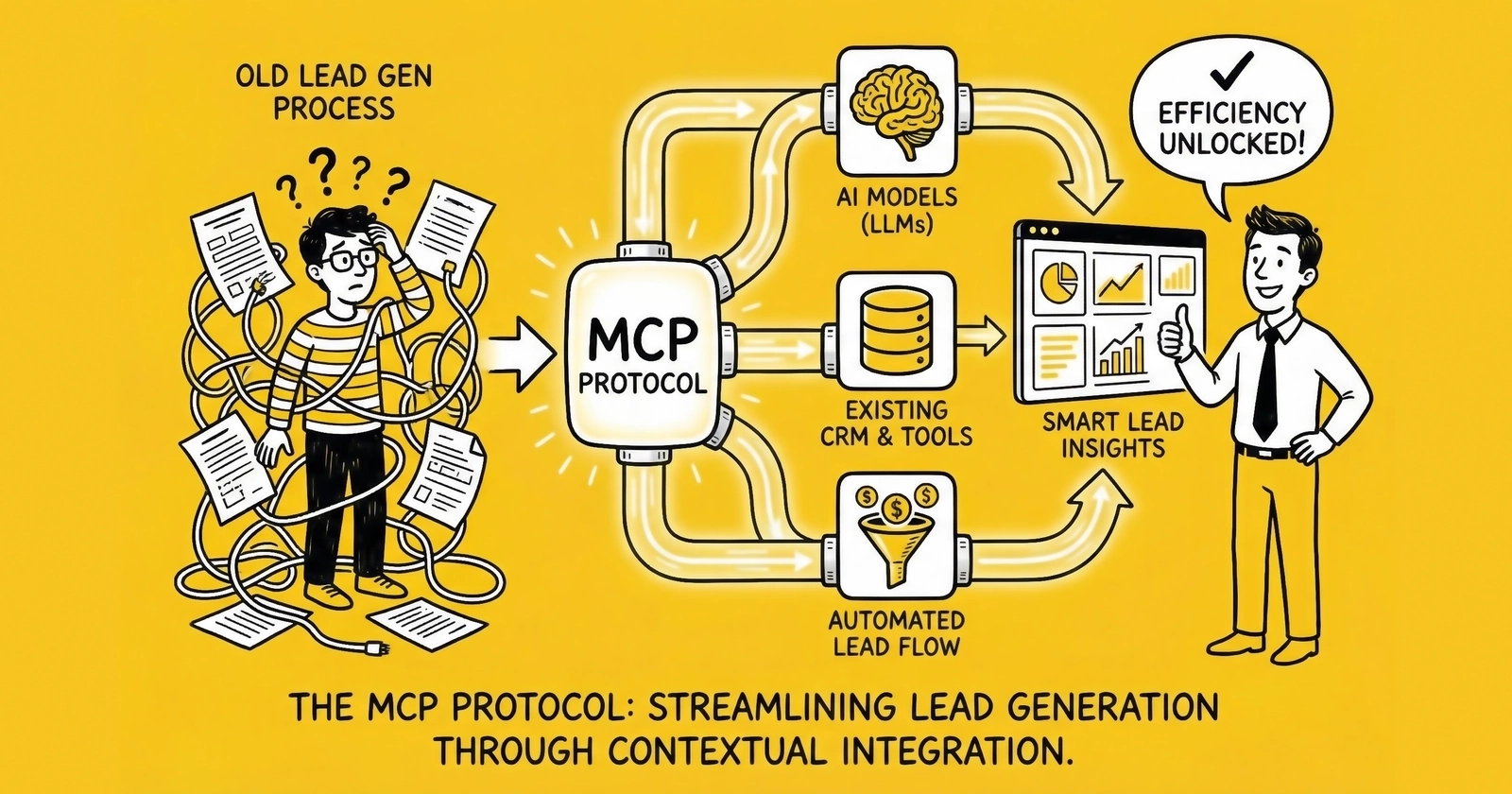
How MCP enables AI-powered lead generation – CRM integration, automated routing, compliance verification, and multi-system orchestration through a universal protocol.
The Model Context Protocol (MCP), introduced by Anthropic in November 2024, has become the universal standard for connecting AI systems to external data sources and tools – with 97 million+ monthly SDK downloads and backing from Anthropic, OpenAI, Google, and Microsoft. For lead generation operators, MCP represents the infrastructure layer that enables AI agents to access CRMs, trigger workflows, query databases, and orchestrate complex operations through a single standardized interface. As the ecosystem grows from an estimated $1.2 billion to $4.5 billion with projections suggesting 90% of organizations will use MCP by end of 2025, understanding this protocol isn’t optional for operators building AI-enhanced lead generation systems.
MCP is an open-source standard that defines how AI applications communicate with external systems. Think of it as “USB-C for AI applications” – a universal connector enabling any AI model to communicate with any tool through a single, standardized interface. For foundational concepts about MCP architecture, see our guide on MCP as a universal AI data connector.
Before MCP, each AI-to-tool integration required custom development. Connecting Claude to Salesforce required different code than connecting it to HubSpot, which required different code than connecting to a database. Every new integration meant new development work.
MCP eliminates this fragmentation. Once an MCP server exists for a system (CRM, database, API), any MCP-compatible AI client can connect to it. The result: dramatically reduced integration complexity and a growing ecosystem of pre-built connectors.
Core Architecture
MCP uses a client-server model:
- MCP Clients: AI applications (Claude, ChatGPT, custom agents) that initiate requests and consume capabilities
- MCP Servers: External systems that expose resources, tools, and prompts through the MCP standard
- Transport Layer: Communication mechanism (typically stdio for local connections or HTTP/WebSockets for remote connections)
This architecture decouples AI applications from specific integrations, enabling flexible composition of capabilities.
Key Features
MCP exposes three primary capability types:
- Resources: Data that servers expose to clients – files, database records, API responses, or any structured information. For lead generation: lead records, customer profiles, campaign data, compliance logs.
- Tools: Functions that servers expose for clients to execute, with defined inputs and outputs. For lead generation: lead creation, routing decisions, compliance checks, notification triggers.
- Prompts: Templated conversation starters or instructions that enable specialized workflows. For lead generation: qualification scripts, compliance verification procedures, escalation protocols.
Additional features include:
- Sampling: Allows clients to request model responses from servers
- Roots: Defines initial context or file system access boundaries
- Elicitation: Enables servers to request information from clients interactively
The Industry Convergence
MCP’s significance comes from unprecedented industry alignment:
- November 2024: Anthropic releases MCP as open standard with Python and TypeScript SDKs
- March 2025: OpenAI officially adopts MCP across products including ChatGPT desktop
- April 2025: Google DeepMind confirms MCP support in upcoming Gemini models
- May 2025: Microsoft and GitHub join MCP steering committee at Build 2025
- December 2025: Linux Foundation establishes Agentic AI Foundation (AAIF) with MCP as founding contribution, alongside contributions from Block and OpenAI
This convergence of Anthropic, OpenAI, Google, and Microsoft ensures MCP will continue dominating AI connectivity conversation. It’s difficult to identify other protocols gaining such unanimous support from influential tech giants.
Ecosystem Growth
One year after launch:
- 97M+ monthly SDK downloads
- 8M+ MCP server downloads (up from ~100K at launch)
- 5,800+ available MCP servers
- 300+ MCP clients
- Major deployments at Block, Bloomberg, Amazon, and hundreds of Fortune 500 companies
Lead Generation Applications
MCP enables sophisticated AI capabilities for lead generation operations:
1. CRM Integration
MCP servers exist for major CRM platforms, enabling AI agents to:
HubSpot Integration:
- List and create contacts
- Get recent engagements
- Manage company records
- Update lead properties
- Trigger workflows
Salesforce Integration:
- Query lead and opportunity records
- Create and update contact information
- Access custom objects
- Execute SOQL queries
- Manage campaigns
Example workflow: An AI agent receives an inbound lead inquiry, uses MCP to query Salesforce for existing records, creates a new lead if none exists, enriches with available data, assigns to appropriate sales rep based on territory rules, and sends confirmation – all through standardized MCP calls rather than custom integration code.
2. Lead Routing and Distribution
MCP enables AI-powered lead distribution:
- Database access: Query lead databases, buyer capacity, pricing rules, and historical performance
- Routing logic: Execute sophisticated matching algorithms considering buyer preferences, capacity, quality scores, and real-time bidding
- Multi-system coordination: Coordinate across CRM, distribution platform, compliance systems, and notification services
Example workflow: Lead captured via web form triggers AI agent that uses MCP to check TrustedForm compliance status, query buyer availability and bid prices, select optimal buyer based on quality-adjusted yield, route lead through distribution platform, update CRM with routing decision, and trigger appropriate notifications – orchestrating five systems through unified protocol.
3. Compliance Verification
MCP enables automated compliance workflows:
- TrustedForm integration: Query certificate validity, consent language verification, certificate metadata
- TCPA documentation: Access call recordings, consent timestamps, form submission records
- Audit trail generation: Compile compliance documentation from multiple systems into unified reports
Example workflow: Before lead delivery, AI agent uses MCP to verify TrustedForm certificate validity, check consent language against buyer requirements, confirm lead isn’t on DNC registry, generate compliance summary, and proceed with delivery only if all checks pass.
4. Data Enrichment
MCP connects AI to enrichment sources:
- Firmographic data: Company size, industry, revenue, employee count
- Contact data: Title, department, decision-making authority
- Intent signals: Research behavior, content consumption, competitive engagement
Example workflow: AI agent receives basic lead information, uses MCP to query firmographic database, append company details, check intent data providers for buying signals, score lead based on enriched profile, and update CRM with complete record.
5. Multi-Channel Communication
MCP enables coordinated outreach:
- Email systems: Draft and send personalized messages, track engagement
- SMS platforms: Send text notifications, manage opt-outs
- Phone systems: Trigger callbacks, log call outcomes
- Chat platforms: Initiate conversations, respond to inquiries
Example workflow: AI agent identifies high-priority lead, uses MCP to draft personalized email via email system, schedule SMS reminder, create task for sales call, and log all activities to CRM – coordinating four channels through standardized interface.
6. Analytics and Reporting
MCP connects AI to analytics infrastructure:
- Performance data: Lead volumes, conversion rates, revenue metrics
- Quality metrics: Contact rates, return rates, compliance issues
- Operational data: Response times, processing volumes, system health
Example workflow: AI agent generates weekly performance report by querying lead database for volume metrics, analytics platform for conversion data, financial system for revenue numbers, and compliance system for issue counts – assembling comprehensive report from four data sources.
Building with MCP
Available SDKs
Official SDKs support rapid development:
- Python SDK: Full MCP implementation for Python applications
- TypeScript SDK: JavaScript/TypeScript support for Node.js and browser environments
- Additional languages: Community SDKs for Go, Rust, Java, and others
Pre-Built Servers
Existing MCP servers accelerate integration:
Databases: PostgreSQL, MySQL, SQLite, MongoDB CRMs: HubSpot, Salesforce (community implementations) Communication: Slack, Email, SMS platforms Storage: Google Drive, Dropbox, local file systems Search: Brave Search, web scraping Development: GitHub, GitLab, code execution environments
Building Custom Servers
For proprietary systems, custom MCP servers expose capabilities:
Custom MCP Server Structure:
├── Resources (data exposure)
│   ├── Lead database queries
│   ├── Campaign configurations
│   └── Compliance records
├── Tools (action execution)
│   ├── Create lead
│   ├── Route lead
│   ├── Verify compliance
│   └── Trigger notification
└── Prompts (workflow templates)
    ├── Lead qualification flow
    ├── Compliance verification
    └── Escalation protocol
Building custom servers requires:
- Defining resources, tools, and prompts
- Implementing server logic in Python or TypeScript
- Handling authentication and authorization
- Deploying server infrastructure
- Connecting MCP clients
Function Chaining
MCP supports calling multiple tools in sequence, enabling sophisticated automation:
Example multi-step workflow:
- Capture: Receive lead data from web form
- Enrich: Query firmographic database (Tool 1)
- Score: Calculate lead quality score (Tool 2)
- Verify: Check compliance status (Tool 3)
- Route: Select optimal buyer (Tool 4)
- Distribute: Deliver lead to buyer (Tool 5)
- Document: Log transaction details (Tool 6)
- Notify: Alert relevant parties (Tool 7)
This orchestration – previously requiring custom code for each integration – executes through standardized MCP calls.
Enterprise Deployment Considerations
Integration Architecture
Enterprise MCP deployment typically involves:
- MCP Hub: Central infrastructure managing multiple MCP servers
- Server Portfolio:
- CRM server (Salesforce, HubSpot)
- Database server (lead database, analytics)
- Communication servers (email, SMS, voice)
- Compliance servers (TrustedForm, consent verification)
- Financial servers (billing, payments)
- Client Applications:
- AI agents for automated workflows
- Chat interfaces for user interaction
- Monitoring systems for oversight
Security Requirements
MCP deployment requires security attention:
Authentication: MCP specification supports OAuth 2.1, but many implementations lack authentication. Enterprise deployment must enforce authentication between clients and servers.
Authorization: Define which clients can access which servers and capabilities. Not all AI agents should access all systems.
Data protection: Ensure sensitive data (lead PII, financial information) is protected in transit and at rest.
Audit logging: Log all MCP interactions for compliance and security monitoring.
Network isolation: Consider network segmentation between MCP infrastructure and public internet.
Known Vulnerabilities
Security researchers have identified MCP vulnerabilities:
Tool poisoning: Malicious instructions embedded in prompts can cause AI agents to perform unintended actions. Agents with access to internal tools and data could be manipulated to extract sensitive data.
Lookalike tools: Malicious servers could present tools that mimic trusted tools, intercepting data intended for legitimate systems.
Unauthenticated servers: Research scanning 2,000 internet-exposed MCP servers found all lacked authentication – meaning anyone could access tool listings and potentially exfiltrate data.
Prompt injection: Combining tools can create vulnerabilities where one tool’s output manipulates another tool’s behavior.
Mitigation strategies:
- Implement authentication on all MCP servers
- Limit internet exposure of MCP infrastructure
- Review and approve MCP servers before deployment
- Monitor MCP traffic for anomalous patterns
- Implement input validation on all tool inputs
Implementation Roadmap
Practical path to MCP-enabled lead generation:
Phase 1: Assessment (Weeks 1-4)
- Inventory current systems (CRM, database, communication tools)
- Identify high-value integration opportunities
- Evaluate existing MCP servers for relevant systems
- Assess custom development requirements
- Define security requirements
Phase 2: Foundation (Weeks 5-8)
- Deploy MCP infrastructure (client and server environment)
- Implement authentication and authorization
- Connect first system (typically CRM) via existing MCP server
- Test basic resource access and tool execution
- Establish monitoring and logging
Phase 3: Expansion (Weeks 9-16)
- Add additional MCP servers (database, communication, compliance)
- Develop custom servers for proprietary systems
- Build initial AI agent workflows
- Test multi-tool orchestration
- Refine security controls
Phase 4: Production (Weeks 17+)
- Deploy AI agents to production workflows
- Monitor performance and errors
- Iterate on workflows based on results
- Expand to additional use cases
- Scale infrastructure as needed
ROI Considerations
MCP investment delivers returns through:
Integration Cost Reduction
Before MCP: Each AI-to-system integration requires custom development
- CRM integration: $20,000-50,000 development cost
- Database integration: $15,000-30,000 development cost
- Communication integration: $10,000-25,000 per channel
- Maintenance: 20-30% of development cost annually
With MCP: Standardized integrations using existing servers
- Pre-built server deployment: $5,000-15,000
- Custom server development: $15,000-30,000 (reusable)
- Maintenance: 10-15% of deployment cost annually
Capability Acceleration
MCP enables capabilities previously impractical:
- Multi-system orchestration that would require extensive custom integration
- AI agents that coordinate across CRM, compliance, distribution, and notification systems
- Real-time decision-making incorporating data from multiple sources
- Automated workflows replacing manual multi-system processes
Ecosystem Benefits
As MCP ecosystem grows:
- More pre-built servers reduce integration costs
- Community improvements enhance capabilities
- Industry adoption ensures long-term viability
- Competitive necessity as competitors adopt
The Future: Agentic AI Foundation
The December 2025 establishment of the Agentic AI Foundation (AAIF) under the Linux Foundation signals MCP’s evolution from vendor-led specification to industry infrastructure:
- Founding contributions:
- Anthropic’s Model Context Protocol (MCP)
- Block’s goose
- OpenAI’s AGENTS.md
- Governance: Neutral foundation ensuring transparent, collaborative evolution
- Implications:
- MCP will continue evolving with industry input
- Competitive neutrality encourages broader adoption
- Foundation governance provides stability for enterprise investment
For lead generation operators, AAIF establishment validates MCP as safe long-term infrastructure investment.
Lead Generation-Specific Considerations
Compliance Integration
Lead generation’s regulatory environment makes compliance automation particularly valuable:
- TCPA consent verification: MCP servers can verify consent documentation before lead delivery, following lead quality control frameworks
- TrustedForm integration: Query certificate validity, metadata, consent language
- DNC checking: Automated registry queries before outbound contact
- Audit trail generation: Compile documentation from multiple systems
- State-specific rules: Apply mini-TCPA requirements based on lead geography
Real-Time Operations
Lead generation’s time-sensitivity benefits from MCP’s real-time capabilities:
- Ping-post integration: AI agents can participate in real-time bidding by querying buyer availability and pricing through MCP
- Immediate routing: Multi-system coordination happens in seconds rather than minutes
- Instant compliance: Verification occurs during routing rather than after delivery
Quality Management
MCP enables sophisticated quality workflows:
- Multi-source scoring: Combine firmographic, behavioral, and historical data for lead scoring
- Buyer feedback integration: Feed conversion outcomes back into scoring models using sales team lead quality feedback loops
- Anomaly detection: Monitor for fraud patterns across multiple data sources
- Performance attribution: Track lead outcomes across complex multi-touch journeys
Conclusion
The Model Context Protocol represents the most significant infrastructure development for AI-powered operations since the emergence of large language models themselves. With unified backing from Anthropic, OpenAI, Google, and Microsoft, and governance through the Linux Foundation’s Agentic AI Foundation, MCP will define how AI systems connect to enterprise infrastructure for the foreseeable future.
For lead generation operators, MCP enables capabilities that would otherwise require prohibitive custom development: multi-system orchestration, real-time compliance verification, intelligent routing, and automated quality management. Organizations scaling lead generation operations find MCP infrastructure increasingly essential for growth. The 97 million monthly SDK downloads and 5,800+ available servers demonstrate that MCP adoption isn’t speculative – it’s happening now.
The question for operators isn’t whether to adopt MCP, but how quickly they can implement it before competitors capture the efficiency and capability advantages it provides. In an industry where speed, compliance, and intelligent automation determine survival, MCP represents essential infrastructure for AI-enhanced lead generation operations.
Key Takeaways
-
MCP provides a universal “USB-C for AI” standard that replaces fragmented custom integrations between AI systems and enterprise tools with a single protocol.
-
Major AI providers have unified behind MCP: OpenAI, Google, Microsoft, and Anthropic all support the protocol, ensuring it will dominate AI connectivity infrastructure.
-
Lead generation applications span the full operational stack: CRM integration, automated lead routing, compliance verification, and multi-system workflow orchestration.
-
Over 5,800 MCP servers and 300 MCP clients are now available, including pre-built integrations for Salesforce, HubSpot, databases, and communication tools.
-
Security vulnerabilities require careful attention: authentication gaps and tool poisoning mean enterprise deployment requires OAuth 2.1, network isolation, and server approval workflows.
-
97 million+ monthly SDK downloads within one year demonstrates MCP has moved from specification to production infrastructure.
-
The Linux Foundation’s Agentic AI Foundation (AAIF) now governs MCP alongside OpenAI’s AGENTS.md and Block’s goose, validating it as safe long-term infrastructure investment.
-
Integration cost reduction is substantial: pre-MCP custom integrations cost $20-50K per system; MCP deployment uses pre-built servers ($5-15K) or reusable custom servers ($15-30K).
-
Real-time lead operations benefit most from MCP: ping-post integration, immediate compliance verification, and instant routing decisions all execute through standardized protocol calls.
-
Comprehensive deployment takes 4-6 months from assessment through production, with single-system integration achievable in 4-8 weeks.
Understanding the Model Context Protocol
What MCP Is
Frequently Asked Questions
How does MCP differ from traditional API integrations?
Traditional API integrations require custom code for each AI-to-system connection. MCP standardizes these connections: once an MCP server exists for a system, any MCP client can connect without custom development. This means an AI agent can connect to five different systems (CRM, database, email, SMS, compliance) through identical MCP calls rather than five different integration codebases. The result is dramatically reduced development time and maintenance burden.
What MCP servers already exist for lead generation systems?
Pre-built MCP servers exist for HubSpot (contact and company management), various databases (PostgreSQL, MySQL, MongoDB), communication platforms (Slack, email), and file storage systems. Community servers provide Salesforce connectivity. Custom servers are typically needed for proprietary lead distribution platforms, specific compliance services (like TrustedForm), and industry-specific databases. The ecosystem is growing rapidly – check current server availability before assuming custom development is required.
How do we address MCP security vulnerabilities?
Enterprise MCP deployment requires security measures beyond default implementations: implement OAuth 2.1 authentication on all servers, limit network exposure (avoid internet-exposed MCP servers), review and approve servers before deployment, monitor MCP traffic for anomalies, validate all tool inputs, implement least-privilege access (clients only access servers they need), and maintain audit logs. The security concerns are real but addressable with proper implementation.
What’s the typical timeline to deploy MCP for lead generation?
Initial deployment (single system integration) typically requires 4-8 weeks including assessment, infrastructure setup, and testing. Comprehensive deployment (multiple systems, custom servers, production AI agents) requires 4-6 months. Timeline depends heavily on existing infrastructure, custom development requirements, and security implementation depth. Start with highest-value integration (typically CRM) to demonstrate value before expanding.
Should we wait for MCP to mature before adopting?
Waiting carries competitive risk. MCP has achieved industry consensus with backing from all major AI providers, establishment under Linux Foundation governance, and 97M+ monthly SDK downloads. The protocol is production-ready and deployed at Fortune 500 companies. Waiting for further maturation while competitors implement means falling behind in AI capabilities. The appropriate strategy is careful implementation with security attention, not delayed adoption.
What skills does our team need for MCP implementation?
MCP implementation requires several skill sets: Python or TypeScript development for building custom MCP servers, understanding of your existing systems’ APIs and data models, security expertise for authentication and authorization configuration, and operational knowledge for monitoring and maintenance. For lead generation specifically, you’ll also need compliance expertise to ensure MCP-triggered actions maintain TCPA and consent requirements. Many organizations partner with implementation consultants for initial deployment, then build internal capability for ongoing management.