# Meta's One-Click CAPI Killed the 'Too Technical' Excuse – How Lead-Gen Sites Are Recovering 30-40% of Conversion Attribution in Q2 2026
> **Canonical:** https://www.leadgen-economy.com/blog/meta-one-click-capi-lead-gen-attribution-recovery/
> **Published:** 2026-06-25
> **Author:** Alex Paddington
> **Source:** LeadGen Economy – https://www.leadgen-economy.com
---
*A free button inside Events Manager just deleted the most popular excuse in paid lead-gen – and the operators who keep pretending CAPI is too technical are about to discover the bidder no longer agrees.*
---
## A Free Button That Rewires the Bidder
On April 15, 2026, Meta dropped a button inside Events Manager labeled, in effect, *click here to run server-side tracking*. The official rollout name is one-click Conversions API. The practical effect is that the single most-cited reason small and mid-market lead-gen advertisers gave for staying on Pixel-only attribution – *we do not have engineering bandwidth for CAPI* – stopped being a reason at the moment of the click. No server. No CAPI Gateway instance. No developer ticket. No ongoing maintenance. Meta covers the cost. AdExchanger called it the *easy button for CAPI* in its April 17 coverage. PPC Land reported the rollout as a no-code Conversions API path live across global Events Manager instances by April 27.
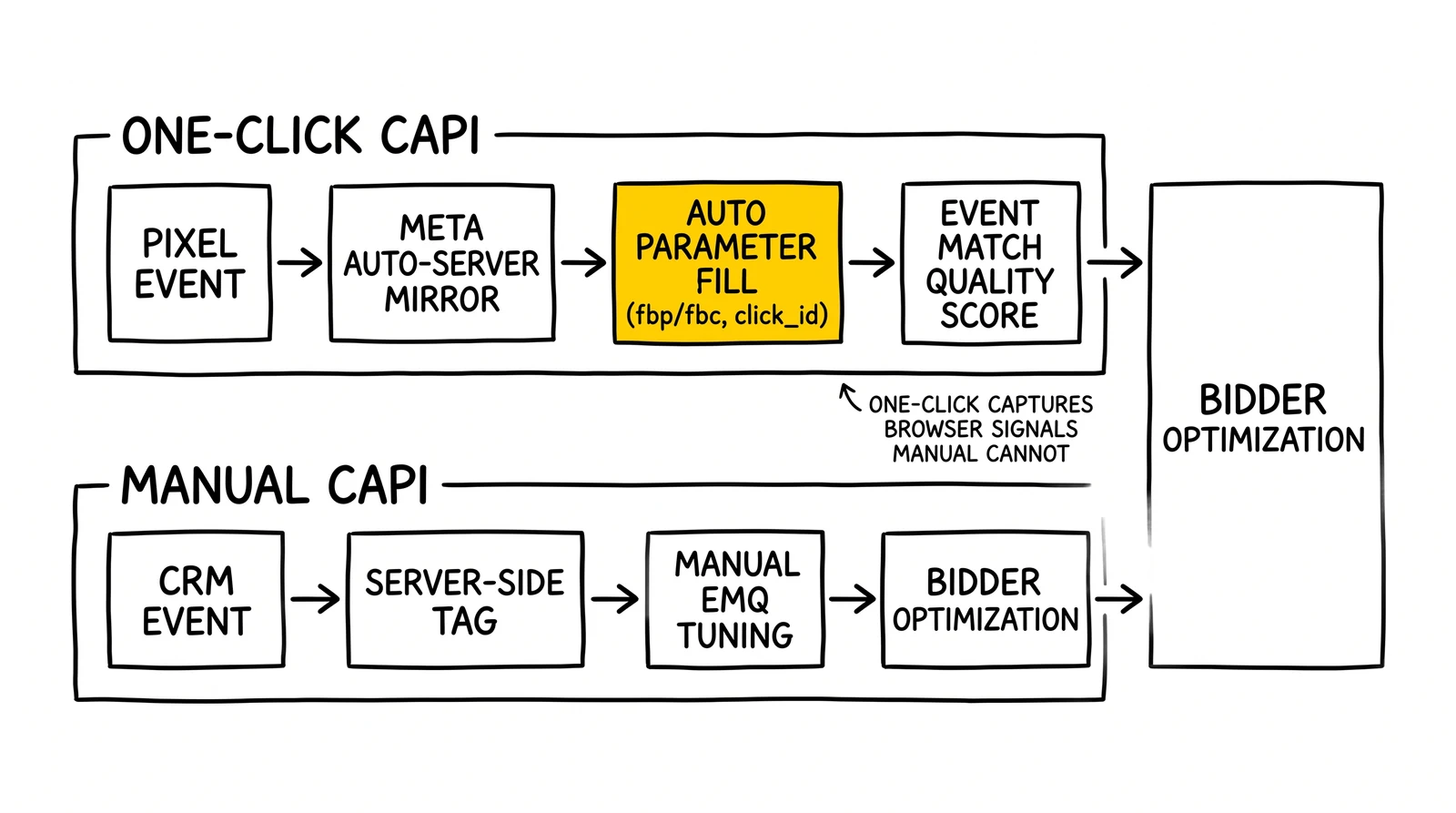
One-Click's parameter auto-fill recovers the browser-side fbp/fbc and click_id signals manual CAPI misses – and that is what raises EMQ enough for the bidder to optimize.
The deadline pressure behind the launch is not subtle. Meta's own published figure says advertisers with CAPI configured for web events run 17.8% lower cost per result than the non-CAPI comparison cohort. That gap is now the bidder's default expectation. Operators sitting outside it are paying a premium they no longer need to pay, and the algorithm is optimizing the rest of the auction against a competitor signal set that includes the events they cannot see. The next CFO meeting that asks why Meta CPL drifted 15-20% above the agency benchmark has a fresh, unflattering answer if CAPI is still off.
The structural pressure is heavier still. Safari Intelligent Tracking Prevention caps Pixel-set first-party cookies on fbclid-bearing pages at 24 hours and purges all storage after 30 days of inactivity. Firefox blocks third-party tracking by default. Roughly 31% of internet users globally and 42% of 18-34 year olds run ad blockers, per the figures cited in the existing [Facebook CAPI lead-generation implementation guide](https://www.leadgen-economy.com/blog/facebook-capi-lead-generation-implementation/). Apple's App Tracking Transparency, launched in April 2021, knocked iOS install attribution from 80% to 27% within the first eighteen months. Apple Intelligence – the on-device generative layer shipped in iOS 18 – now summarizes a growing share of ads before the user even taps. The cumulative effect: brand-side teams measuring Meta lead-gen on the Pixel alone are optimizing against 40-60% of the actual conversion volume. The other 40-60% happens, generates revenue, and teaches the bidder nothing.
This article unpacks what one-click CAPI does, what it does not do, where it breaks for lead-gen accounts, and what the parameter coverage, deduplication discipline, and attribution-window math look like once the button is on.
---
## What One-Click CAPI Actually Does – And What It Skips
The one-click setup connects the Pixel that already runs on the advertiser's domain to Meta's server-side ingestion pipeline. The mechanism is straightforward: when the Pixel fires a standard web event in the browser, Meta also writes the same event server-side from its own infrastructure, using the page context, the fbp and fbc cookies, and any advanced matching parameters the Pixel collected. The event arrives twice – once from the browser, once from Meta's server-side relay – and Meta's deduplication engine collapses the pair into a single attribution record using the event_id.
The scope is bounded. The one-click path covers the five standard web events Meta has supported in the Pixel since 2018: PageView, ViewContent, AddToCart, Purchase, and Lead. The Lead event is the load-bearing one for paid lead-gen accounts running on-site forms – quote tools, gated downloads, multi-step intake flows. The four other events are commerce-shaped, but the underlying recovery mechanism works for any advertiser running them.
Outside the one-click scope sits the harder work. Custom events – the brand-specific funnel stages that map to MQL, SQL, qualified lead, or vertical-specific milestones like *prequalified* – still require a developer-built CAPI integration. Offline conversion uploads – closed-won deals, policy bind, loan-fund – still flow through the offline conversion file upload path or a CRM Integration CAPI. Multi-platform routing – sending the same conversion to Meta, Google, TikTok, and LinkedIn from a single server-side tagging container – is also outside the one-click scope and requires a server-side GTM or equivalent. The one-click button does not replace these workflows; it raises the floor under the accounts that previously had nothing at all.
### The Quiet Default Inside the Click
Meta also bundles an AI-powered Pixel enrichment feature with the same April 2026 release. The enrichment automatically extracts more page and product information into the events the Pixel fires – product categories, content metadata, page-context signals – so the bidder has a denser signal to optimize against. The enrichment is enabled by default when one-click CAPI is enabled. Operators paying attention to data minimization principles should review the enrichment scope before consenting; Zenda's April 2026 analysis frames the dual rollout as *more signal for everyone, but mostly for Meta*, a reading that holds up under inspection. The signal advantage flows to Meta's optimization stack before it flows to the advertiser's reporting.
The deduplication contract is the other quiet default. Meta's matching window holds for approximately 48 hours and uses the event_id as the primary deduplication key. The one-click setup writes consistent event_ids automatically because the same Pixel fires both halves of the pair. Advertisers with a pre-existing CAPI implementation – a CAPI Gateway, a server-side GTM container, a partner-managed pipeline like Stape or Addingwell – sit in a different position. Turning on one-click on top of that stack creates two server-side pipelines. The event_ids may match; they may not. Meta deduplicates the matches and double-counts the mismatches. Reported conversions inflate by 30-100% in the worst-case configurations, according to the implementation guides that cover the failure mode. The operator decision is binary: keep the higher-EMQ path, disable the other.
---
## Why Lead-Gen Sites Need This More Than E-Commerce Does
Server-side tracking is often discussed as a recovery play for e-commerce – Shopify stores, DTC brands, subscription products. The lead-gen case is sharper. The Pixel and CAPI architecture was originally tuned for short-cycle, single-session conversions where the click-to-checkout window closes inside an hour. Lead-gen conversions sit further down a longer funnel. The form fill is the conversion event, but the revenue event – policy bind, loan fund, contract signed, install scheduled – happens days, weeks, or months later. Every layer of attribution decay between the click and the form fill compounds the signal loss on the revenue side.
### Where Browser Signal Disappears in Lead-Gen Funnels
The lead-gen path that hurts most is the iOS Safari user who taps a Meta ad, lands on a quote tool, fills the multi-step form, and submits. Safari's WebKit ITP caps the fbc cookie on that landing page at 24 hours from the fbclid arrival. The user does not always finish in one session. A second visit the following day, even on the same device, lands with no fbc cookie because Safari purged it. The Pixel's Lead event fires, but without the click-through identifier the match-back to the original ad impression is degraded. CAPI does not solve the cookie expiration directly – the cookie is still gone – but capturing the fbclid into a hidden form field on the first visit and persisting it server-side gives the CAPI Lead event a fbc value to send back even when the browser has lost it.
The lead-gen path that fails entirely is the iOS user who lands on the quote tool from a Meta ad, abandons mid-form, and returns later via search. The Pixel has no event to fire because there is no form completion in the first session. The user reconverts through a different channel that gets the credit. CAPI cannot recover that conversion either, but it can recover the upstream PageView and ViewContent events the Pixel did fire, which feed the bidder's optimization signal even when the conversion itself goes to another channel. This is the structural reason lead-gen accounts running on a 7-day click window see the CAPI recovery numbers tilt high – the bidder learns from the upstream signal even when the downstream conversion does not match back.
### Ad-Blocker Demographics Skew Toward Lead-Gen Audiences
The 42% ad-blocker prevalence figure inside 18-34 year olds matters more in lead-gen than in commerce because the high-CPL verticals – fintech, life insurance, EdTech, mortgage – over-index on exactly that demographic. Younger high-earners running uBlock Origin, AdGuard, or Brave see the Pixel blocked entirely on the landing page. CAPI fires from the advertiser server, which the browser blocker cannot touch. The recovery rate in those verticals trends toward the 40% ceiling rather than the 30% floor, which is why operators in fintech and EdTech are reporting EMQ-tuned CAPI implementations producing CPL reductions closer to 25-30% rather than the 17.8% headline figure.
---
## Event Match Quality – The Score That Determines Recovery
The 17.8% CPL improvement and the 30-40% conversion recovery are Meta's averaged figures across implementations. Individual account performance tracks Event Match Quality – Meta's 1-10 score for how well each server-side event matches to a real Facebook user. EMQ below 6 is unusable; the bidder discounts the events heavily and the optimization gain disappears. EMQ at 8 is the target for lead-gen Lead events. EMQ at 9-10 is achievable for purchase-equivalent events where the customer has logged in or provided full PII.
### What Moves EMQ From 3 to 8
Five parameters drive the bulk of EMQ score improvement on Lead events. The hashed lowercase email is the single highest-weight identifier; including it on every Lead event moves accounts from the 3-5 range into the 6-7 range in a single deployment. The fbc cookie, captured from the _fbc browser cookie or reconstructed from the fbclid URL parameter, adds 1-2 points by tying the server event to the originating ad click. The fbp cookie – the Facebook Pixel browser ID – adds another half-point by linking the event to the long-running Pixel identity on the advertiser's domain. Hashed phone, first name, last name, city, state, zip, and country fill out the parameter set and push the score toward 8.5+.
The hashing matters. Meta requires SHA-256 hashing with lowercase normalization and whitespace trimming on every PII parameter – email, phone, name, location. A capitalized email submitted unhashed, or hashed without lowercasing first, produces a mismatch against Meta's hashed user graph and the parameter contributes zero to EMQ. The one-click setup performs the hashing automatically when the Pixel captures the values via Advanced Matching. Custom CAPI pipelines must implement the hash chain correctly or lose the EMQ contribution silently.
### The fbp and fbc Cookie Discipline
The fbp cookie is set by the Pixel automatically on the advertiser's primary domain and lasts 90 days under normal conditions. It survives across sessions and stitches the lead form fill to the user's earlier Pixel-tracked browsing on the same domain. The fbc cookie is created when a Meta ad URL containing the fbclid parameter lands on the site; the Pixel reads the parameter, writes it as a first-party cookie, and the cookie persists alongside the fbp.
Lead-gen sites break the cookie discipline in three predictable ways. The first is hosting the form on a subdomain different from the Pixel-tagged main site – a form at quote.example.com loading from a Pixel on www.example.com cannot read the parent's fbp cookie unless the cookie is set with a domain attribute that covers both subdomains. The second is third-party form builders – Unbounce, Instapage, Leadpages – that load the lead form inside an iframe; the form cannot access the parent page's fbc cookie without explicit postMessage relay. The third is the multi-step form flow that loses the fbclid between page transitions because the parameter is not propagated through internal navigation.
The durable fix is to capture fbclid into a hidden form field on the landing page, persist it through the form flow as a hidden state value, and ship it to the server alongside the lead payload. The server then reconstructs the fbc cookie value for the CAPI Lead event from the stored fbclid. The Meta CAPI Lead Setup walkthrough Meta publishes for CRM Integration users codifies this pattern; it applies equally to on-site Lead events through the one-click path.
---
## Deduplication – The 48-Hour Contract
CAPI does not replace the Pixel. It runs alongside it. Meta's deduplication engine collapses the matched pair into a single attribution record using the event_id as the primary key, with the event_name and the event_time as secondary signals. The deduplication window holds for approximately 48 hours from the first event arrival.
The one-click setup writes consistent event_ids automatically because the same Pixel instance generates both halves of the pair. Custom implementations must enforce the consistency themselves. The canonical pattern is to generate a UUID on the client when the Pixel fires the Lead event, pass the UUID into the form submission payload, and use the same UUID as the event_id when the server fires the CAPI Lead event. A mismatch – different UUIDs, different event_names, server-side event fired outside the 48-hour window – produces two events that Meta cannot collapse. Reported conversions double-count.
The deduplication failure modes inflate reporting by 30-100% in the worst cases documented by implementation guides. A 50% inflation on a $50 CPL account looks, in reporting, like a $33 CPL – the bidder optimizes against the inflated event count, the agency reports the cosmetically better number, and the actual cost per real lead does not move. Account managers who notice the CPL improvement first and the EMQ score second walk straight into this trap. The diagnostic discipline is to check Events Manager's deduplication report before celebrating the CPL drop.
### CAPI Gateway, Partner Integrations, and the Stack-On Trap
Advertisers running a CAPI Gateway, a partner-managed CAPI integration through Stape or Addingwell, or a server-side GTM container with a Facebook tag now face a decision the April 2026 release forces on them: leave the existing pipeline alone, or turn on one-click on top.
Turning on one-click without disabling the existing pipeline creates two server-side event sources for the same browser Pixel. If both sources write the same event_id from a shared upstream – the Pixel – Meta's deduplication collapses the triple into a single attribution record. If the event_ids differ – because the existing pipeline uses its own ID generation logic – Meta sees three events, deduplicates two, and double-counts the third. The Seresa published guidance against enabling one-click on top of an existing CAPI Gateway codifies the working principle: pick the higher-EMQ path, run it alone, and disable the other. A mature server-side integration with custom parameters, offline conversion uploads, and CRM event ingestion typically beats one-click on EMQ and feature scope. A stock implementation that only forwards standard web events with default parameters does not.
---
## Attribution Windows – The 2026 Defaults Reshape Lead-Gen Math
Meta deprecated the 7-day view-through and 28-day view-through attribution windows on January 12, 2026. The remaining defaults are 7-day click-through, 1-day engage-through, and 1-day view-through for web conversion campaigns. On March 3, 2026, Meta further tightened the definition of click-through: only an actual link click that sends the user to a website, app, lead form, or other destination counts; passive engagements no longer qualify as clicks. The combined effect compresses the attribution math in ways the bidder is already adapting to.
### Why 1-Day Click Often Beats 7-Day Click for Lead-Gen
The 7-day click window remains the platform default for conversion campaigns, but the lead-gen case for tightening to 1-day click is strong. A user who clicks a Meta ad for a free download or a quote tool and does not convert within 24 hours is rarely a Meta-attributed conversion when they reconvert later; they returned through a different channel – search, direct, email, podcast mention – and the original ad earned the credit cosmetically without earning it causally. The 1-day window cuts the cosmetic credit, narrows the attributed conversion to the high-intent same-session converters, and tightens the optimization signal the bidder learns from.
Considered-purchase categories sit on the opposite side of the trade-off. A mortgage refinance or a Medicare Advantage quote genuinely runs a 3-7 day consideration cycle, and the 7-day window captures the real return-and-convert pattern. The line that separates the two is conversion-event volume per attributed click; high-volume free-form-fill accounts gain more from the tighter window than considered-purchase accounts that need the lookback to capture genuine return visits.
### Engage-Through and View-Through After the Cuts
The 1-day engage-through window now does heavier lifting than it did before the 7-day view cut. Engagement – a video three-second view, a profile click, a post like, a comment – counts as an attribution touch if the user converts within 24 hours. For lead-gen accounts running heavy video creative on Reels or in-feed video, the engage-through credit lands more conversions than the view-through credit ever did under the deprecated 7-day window. Operators who measured success on 7-day view conversions through 2025 are reading lower attributed conversions in 2026 not because the campaigns got worse but because the window that used to capture them is gone.
The 1-day view-through credit is now the longest passive-attribution path. For lead-gen accounts running impression-heavy upper-funnel placements – feed video served to cold audiences – the view-through window catches the same-day reconvert that does not get an engagement touch. The CAPI signal feeds this window the same way it feeds the click window; a recovered Lead event on a CAPI server fires inside the 1-day view-through window the same as a Pixel-fired Lead event would.
---
## What Lead-Gen Aggregators and Pure-Play Performance Accounts Should Do Differently
The one-click rollout's clearest beneficiaries are mid-market lead-gen advertisers – SMB agencies, vertical-focused operators, single-product DTC brands running form-based conversion campaigns. The lead-gen aggregator case is different. Aggregators running Meta as a top-of-funnel traffic source to their own intake forms, with downstream ping-post distribution to a carrier or buyer panel, face two stack decisions one-click does not solve.
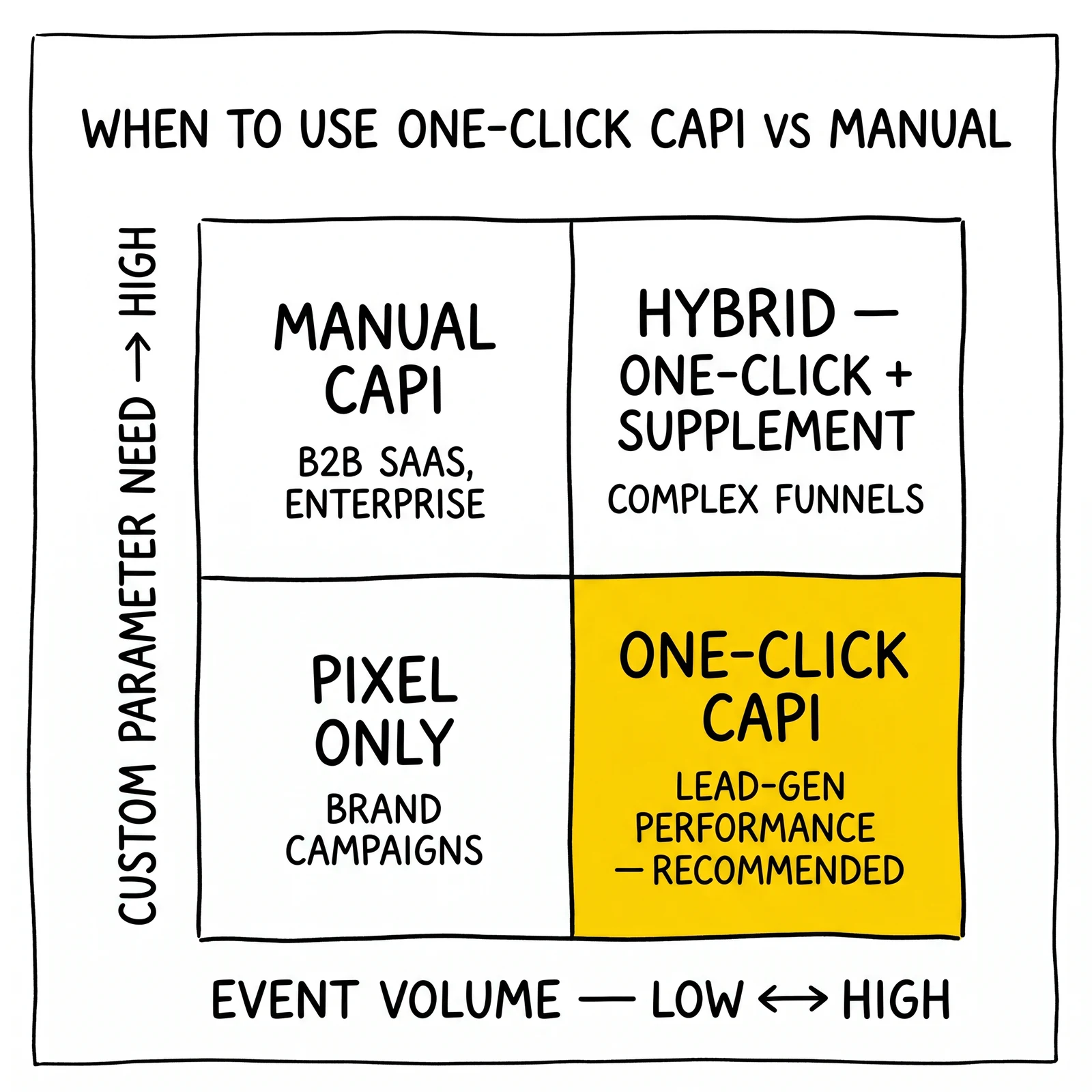
High-volume lead-gen performance accounts with basic parameters are exactly the configuration One-Click was built for. Manual CAPI is only worth the cost when custom params change conversion math.
The first is the offline conversion path. The aggregator's Meta Lead event fires when the user submits the intake form. The revenue event – buyer accepts the lead, lead converts to bound policy, intake firm collects the commission – happens days to weeks later in a CRM or a buyer-side system the Pixel cannot see. One-click CAPI does not ship downstream CRM events; the aggregator still needs an offline conversion upload pipeline or a CRM Integration CAPI to push the bind event back to Meta for revenue-side optimization. The downstream signal is what tells the bidder which lead source actually monetizes, and it requires a real integration regardless of how convenient one-click made the upstream Lead event.
The second is the multi-buyer attribution problem. An aggregator running ping-post distribution sells the same intake into multiple buyer panels; some buyers pay on accept, some pay on call, some pay on close. The revenue per lead varies by buyer outcome, and the optimal Meta bid varies by the expected revenue mix. One-click CAPI delivers a single Lead event with no buyer-side enrichment. Aggregators that want to optimize Meta against actual revenue per intake need to enrich the CAPI Lead event with buyer-mix data or accept a margin tax on undifferentiated bidding. The pattern is covered in the existing [cookieless attribution stack analysis](https://www.leadgen-economy.com/blog/cookieless-attribution-stack-mmm-incrementality/), which frames CAPI as the tactical recovery layer underneath a strategic MMM and incrementality layer the aggregator needs separately.
Pure-play performance accounts – agencies running $50K-$500K monthly Meta spend for clients with form-fill conversions – sit in the simpler spot. One-click delivers most of the recovery for most of the accounts, and the EMQ tuning sits inside the Pixel's Advanced Matching configuration plus a hidden-field fbclid capture on the lead form. The accounts that move beyond one-click are the ones with custom funnel stages, multi-platform attribution requirements, or offline revenue signals – the same accounts that needed a developer-built CAPI before April 2026 still need one after.
---
## What Apple Intelligence Does to the Math the Bidder Cannot See
The April 2026 one-click rollout closes a gap the iOS 14.5 ATT release opened in 2021. Apple Intelligence, layered on top through 2025-2026, is opening a fresh gap one-click does not close. The mechanism is a step further upstream than ATT.
ATT degraded the IDFA – the device-level identifier Meta used to deterministically match users across apps. CAPI does not need IDFA because it routes through the advertiser's first-party data and Meta's user graph. The recovery rail works around the ATT damage.
Apple Intelligence operates earlier. The on-device generative layer summarizes promotional content – ads, emails, search results – before the user sees the full surface. Some iOS users now see an ad summarized by Apple Intelligence in a system surface and never click through; they ask Siri for the product or service later and convert through a different channel entirely. Meta never sees the click, never sees the conversion, and cannot CAPI the event because there is no advertiser-server event to fire. Smart Reply filters promotional email before the user opens it; Siri 2.0 search intercepts product queries that previously routed to Google or directly to a brand site.
The mitigation has two parts. The first is CAPI for the events that do fire – the lead-gen Pixel still tracks the Lead events that happen on-site, and CAPI still recovers the share of those events the browser stack would suppress. The second is incrementality testing, geo-experiments, and MMM that validate the lift the Meta spend caused even when the platform's reported attribution cannot prove it. The methods covered in the existing [cookieless attribution stack](https://www.leadgen-economy.com/blog/cookieless-attribution-stack-mmm-incrementality/) and [dark funnel attribution](https://www.leadgen-economy.com/blog/dark-funnel-self-reported-attribution-incrementality-2026/) analyses become load-bearing the same year one-click CAPI removed the engineering excuse for tactical recovery. CAPI is necessary; it is no longer sufficient.
---
## Implementation Order – What to Do in the First Two Weeks
Operators who have not enabled one-click CAPI face a sequenced implementation rather than a single button click. The button is the start, not the end.
The first 48 hours: enable one-click in Events Manager, confirm the Lead event is firing from both the Pixel and the CAPI server, check the Events Manager deduplication report for event_id matches, and pull the EMQ score for the Lead event. A score below 6 on day two indicates the parameter coverage is incomplete; a score at 6-7 indicates the standard advanced-matching parameters are flowing but the fbc and external_id parameters need work; a score at 8+ indicates the implementation is in production shape.
The first week: implement fbclid capture on the lead form landing page as a hidden field, persist the value through any multi-step flow, and post it to the server with the lead payload. Update the CAPI Lead event to include fbc reconstructed from the fbclid when the browser cookie is missing. Verify EMQ moves into the 7-8 range. Compare reported lead volume against CRM lead volume to detect deduplication failures; a 30%+ inflation in reported leads signals a duplicate pipeline that needs reconciliation.
The first two weeks: audit attribution-window settings against actual time-to-convert in the CRM. Lead-gen accounts with most conversions inside 24 hours of click should tighten to 1-day click; accounts with genuine 3-7 day consideration patterns should keep the 7-day default. Enable the AI Pixel enrichment if data minimization policy permits; review the parameter list against any data processing agreements with downstream buyers. Set up offline conversion uploads or a CRM Integration CAPI to push downstream revenue events back to Meta if the account monetizes beyond the on-site Lead event.
The first month: run a holdout test to validate CAPI is causing the CPL improvement the headline figure promises. Geo-incrementality, brand-search lift, or a simple time-series before-and-after comparison all work. The 17.8% figure is Meta's average across accounts; individual account lift varies 10-30% depending on EMQ, audience mix, and the share of iOS traffic. A 5% lift indicates an implementation problem; a 25% lift indicates the parameter coverage is hitting the EMQ ceiling.
---
## Key Takeaways
- Meta launched one-click Conversions API inside Events Manager on April 15, 2026, eliminating the server build, developer dependency, and ongoing maintenance that kept most small and mid-market lead-gen advertisers on Pixel-only attribution.
- The one-click scope covers PageView, ViewContent, AddToCart, Purchase, and Lead – the on-site lead-form path for paid lead-gen. Custom events, offline conversions, multi-platform routing, and CRM-stage events still require a developer-built CAPI integration.
- Meta reports 17.8% lower cost per result for accounts with CAPI on for web events versus accounts without. Lead-gen operators implementing the full stack typically recover 30-40% of conversions otherwise lost to iOS, Safari, Firefox, and ad blockers.
- Event Match Quality drives the recovery rate. EMQ below 6 is unusable; EMQ at 8 is the lead-gen target; the hashed lowercase email plus the fbc cookie typically move accounts from 3-5 to 7-8 in a single deployment.
- The fbp and fbc cookie discipline matters as much as the CAPI rollout itself. Multi-step forms, third-party form builders, and subdomain mismatches break the fbc inheritance silently; capturing fbclid into a hidden form field and reconstructing fbc server-side is the durable fix.
- Deduplication requires a matching event_id, event_name, and event firing inside the 48-hour window. Mismatched IDs or duplicate server-side pipelines from a legacy CAPI Gateway can inflate reported conversions by 30-100%, producing a cosmetically lower CPL without actual cost improvement.
- Attribution windows compressed in 2026 – 7-day view and 28-day view were deprecated January 12, and click-through now requires an actual link click. Lead-gen accounts with most conversions inside 24 hours should consider tightening to 1-day click; considered-purchase verticals like mortgage and Medicare benefit from keeping the 7-day default.
- Apple Intelligence opens a fresh attribution gap upstream of CAPI's reach. CAPI recovers events that fire; it cannot recover users who see an Apple Intelligence-summarized ad, never click, and convert later through Siri or search. Incrementality testing and MMM become load-bearing alongside CAPI in the 2026-2027 measurement stack.
- Aggregators running ping-post distribution still need offline conversion uploads or CRM Integration CAPI to ship downstream revenue events back to Meta; the one-click upstream Lead event alone produces undifferentiated bidding that taxes margin on multi-buyer panels.
- Operators with a mature CAPI Gateway, partner-managed integration, or server-side GTM container should not stack one-click on top. Pick the higher-EMQ path, disable the other, and run a clean deduplication audit before any reporting cycle the CFO will read.
---
## Sources
- [Meta Is Launching An Easy Button For CAPI (AdExchanger, April 2026)](https://www.adexchanger.com/platforms/meta-is-launching-an-easy-button-for-capi/)
- [Meta's free one-click Conversions API is now live - no developer needed (PPC Land, April 2026)](https://ppc.land/metas-free-one-click-conversions-api-is-now-live-no-developer-needed/)
- [Meta Conversions API Documentation (Meta for Developers)](https://developers.facebook.com/docs/marketing-api/conversions-api/)
- [Conversions API for CRM Integration (Meta for Developers)](https://developers.facebook.com/documentation/ads-commerce/conversions-api/conversion-leads-integration)
- [Meta Business Help Center - Conversions API](https://www.facebook.com/business/help/2041148702652965)
- [Meta Simplifies CAPI and the Pixel With One Click (Zenda, April 2026)](https://zenda.com.ar/en/blog/meta-simplifies-capi-and-the-pixel-with-one-click)
- [Meta One-Click CAPI: Why WooCommerce Stores Should Skip It (Seresa, 2026)](https://seresa.io/blog/facebook-conversions-api/metas-one-click-capi-just-went-live-dont-click-it-if-you-already-have-one)
- [Meta Attribution Change 2026: What Changed and What to Check (Dataslayer, January 2026)](https://www.dataslayer.ai/blog/meta-ads-attribution-window-removed-january-2026)
- [Apple App Tracking Transparency (Apple Developer)](https://developer.apple.com/app-store/user-privacy-and-data-use/)
- [WebKit Full Third-Party Cookie Blocking and More](https://webkit.org/blog/10218/full-third-party-cookie-blocking-and-more/)