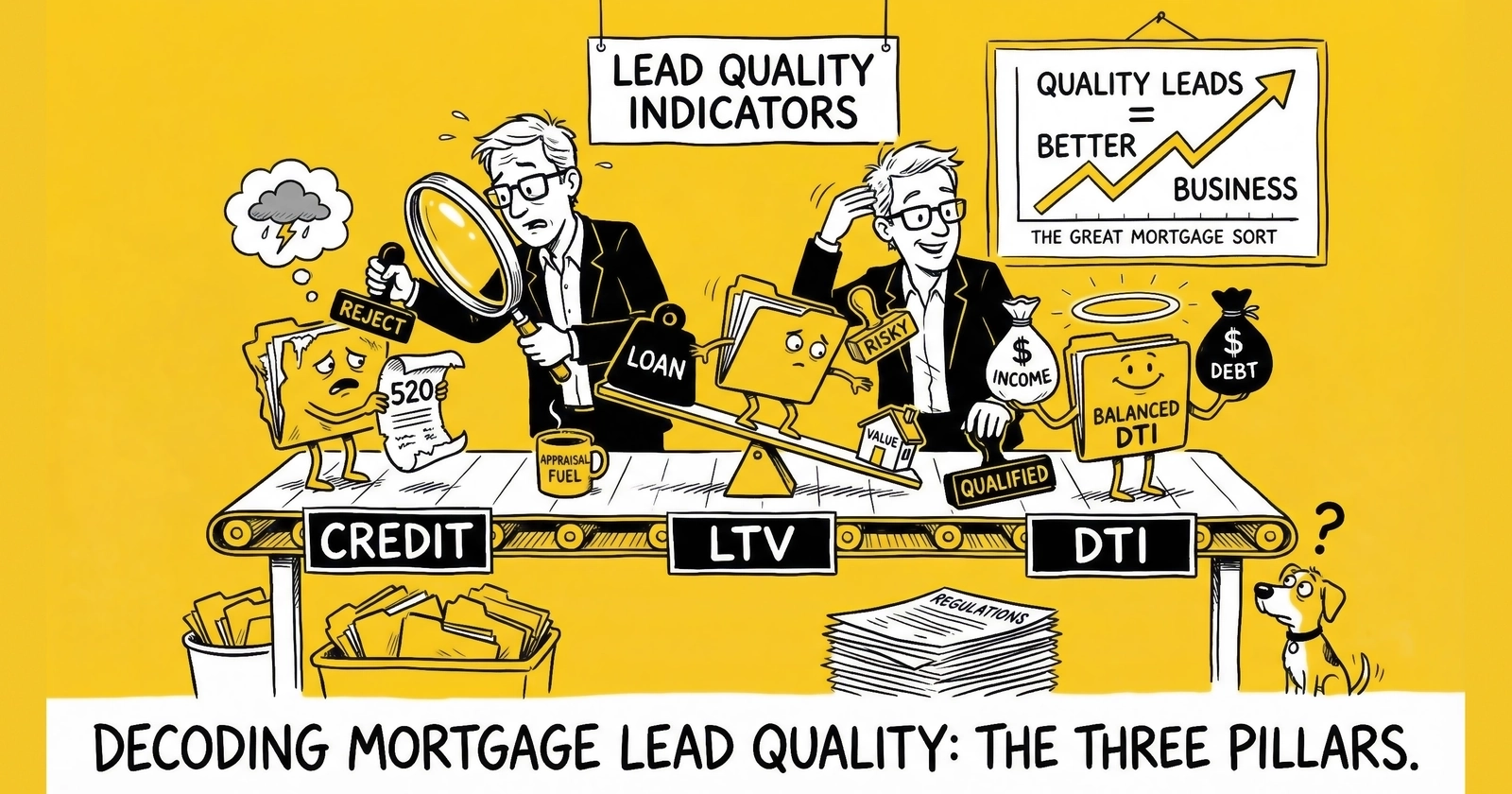
The difference between a $200 mortgage lead that converts and a $50 lead that gets returned comes down to three numbers. Here is how to evaluate, price, and optimize for the quality indicators that actually predict funded loans.
The Three Numbers That Define Mortgage Lead Quality
Every mortgage lead contains dozens of data points. Name, address, phone, email, property type, loan purpose, timeline, employment status. Buyers track contact rates, return rates, and conversion percentages. Generators obsess over validation scores and consent documentation. All of these matter for operational success.
But three numbers determine whether a lead represents a borrower who will actually close a loan: credit score, loan-to-value ratio, and debt-to-income ratio.
These metrics define lending eligibility. A borrower with 760 credit, 70% LTV, and 32% DTI will close. Lenders compete for that borrower. A lead representing a 580 credit score, 95% LTV, and 52% DTI faces an uphill qualification battle regardless of how quickly the originator calls back.
The mortgage lead quality conversation begins with understanding what these numbers mean, why they matter, and how they translate into lead value. Practitioners who master this framework price leads accurately, route them effectively, and build sustainable buyer relationships. Those who treat all mortgage leads as interchangeable commodities lose money on every transaction.
This guide examines each quality indicator in depth: what determines it, how lenders evaluate it, what thresholds matter for qualification, and how lead generators should incorporate these factors into pricing, routing, and buyer negotiations. The mortgage market of 2024-2025 rewards precision. Here is how to achieve it.
Credit Score: The Primary Quality Gate
Credit score is the single most predictive quality indicator for mortgage leads. Before any other qualification consideration, lenders ask one question: what is the borrower’s credit score? The answer determines product eligibility, interest rate pricing, approval probability, and ultimately whether the lead converts to a funded loan.
Understanding Credit Score Tiers
Credit scoring in mortgage lending follows tiered structures that create distinct borrower categories. While the exact cutoffs vary by lender and product type, the following framework represents industry-standard tier definitions:
Exceptional Credit: 800-850
Borrowers in this range represent the top 20-21% of the U.S. population with credit scores. They qualify for every conventional loan product, receive the best available interest rates, and face minimal underwriting scrutiny. For lead generators, these borrowers convert at the highest rates and generate the fewest returns. Leads representing 800+ credit scores command premium pricing not because they are rare but because they are nearly frictionless – approval rates approach 95% when other factors align. Loan officers love these files because they close.
Very Good Credit: 740-799
This tier represents approximately 25% of consumers who qualify for conventional loans with excellent terms. Rate differentials versus exceptional credit are minimal, typically 0.125% to 0.25% higher, and approval rates remain strong at 80-90% when income and assets verify.
The 740 threshold holds particular significance because many lenders use it as the cutoff for their best pricing tiers. A borrower at 739 might pay 0.25% higher interest than one at 740. For lead quality purposes, 740+ represents “prime” territory where conversion rates are strong and returns are low.
Good Credit: 670-739
Approximately 21% of consumers fall in this range. Borrowers qualify for most conventional products but may face rate premiums and additional documentation requirements. The 680 threshold often determines qualification for certain programs.
Leads in this tier require more careful routing. Some buyers specialize in near-prime borrowers and convert these leads effectively. Others focus on higher-credit borrowers and struggle with 670-699 applicants. Understanding buyer profiles prevents mismatches.
Fair Credit: 580-669
This tier represents about 17% of consumers, and conventional lending options become limited. FHA loans, which require minimum 580 scores for 3.5% down payment, become the primary product. Some borrowers in this range qualify for VA loans (no VA-mandated minimum, though most lenders require 580-620) or USDA loans.
Lead quality in this tier varies dramatically. A 660 borrower with stable income and 20% down payment may qualify conventionally with manual underwriting, while a 585 borrower with recent derogatory credit faces significant qualification challenges. Context matters.
Poor Credit: Below 580
Approximately 16% of consumers have scores below 580. Conventional lending is generally unavailable, and FHA loans require 10% down payment at 500-579 – though most lenders set 580 floors anyway. Subprime lenders may offer products at 3-5% rate premiums, but volume in this segment has collapsed since 2008.
Leads representing sub-580 credit rarely convert through standard channels. Specialized buyers exist, but pricing reflects the challenge. A $20 lead for a 550-credit borrower may be appropriately priced given expected conversion rates.
Credit Score Requirements by Loan Program
Different loan programs establish different minimum score requirements. Understanding these thresholds helps generators route leads to buyers offering appropriate products.
| Loan Program | Minimum Credit Score | Common Lender Overlays |
|---|---|---|
| Conventional (Fannie/Freddie) | 620 | Many lenders require 640-660 |
| FHA | 500 (10% down) / 580 (3.5% down) | Most lenders require 580-620 |
| VA | No VA minimum | Most lenders require 580-640 |
| USDA | 640 recommended | Some allow 580+ with manual UW |
| Jumbo | Varies (typically 700+) | Many require 720+ |
| Non-QM | Varies (often 600+) | Credit events accepted |
Lender overlays represent additional requirements beyond agency minimums. Fannie Mae accepts 620 credit for conventional loans, but many lenders require 640 or 660 for their own risk management purposes. These overlays affect which buyers can convert which leads.
The Rate Impact of Credit Score
Credit score directly affects the interest rate borrowers pay. This pricing relationship creates economic incentives that cascade through the entire lead generation chain.
Current rate differentials (late 2025 mortgage market) demonstrate the magnitude:
| Credit Score Range | Typical Rate Premium Over Best Rate |
|---|---|
| 760-850 | Base rate (best available) |
| 740-759 | +0.125% to +0.25% |
| 720-739 | +0.25% to +0.375% |
| 700-719 | +0.375% to +0.625% |
| 680-699 | +0.625% to +0.875% |
| 660-679 | +0.875% to +1.25% |
| 640-659 | +1.25% to +1.75% |
| 620-639 | +1.75% to +2.5% |
On a $400,000 loan, each 0.25% rate difference translates to approximately $60-65 per month or $720-780 annually. Over a 30-year term, the total interest difference between a 760-credit borrower and a 660-credit borrower can exceed $75,000.
This matters for lead quality because borrowers understand rates. A consumer with 650 credit shopping for mortgages will receive quotes substantially higher than advertised “from” rates. Some become discouraged and abandon the process. Others cannot afford the higher payments and fail to qualify. The conversion path from inquiry to funded loan is longer and more uncertain.
Credit Score Distribution in Lead Populations
Self-reported credit scores on lead forms correlate imperfectly with actual pulled credit. Borrowers overestimate their scores by an average of 40-60 points. A lead claiming “excellent credit” may actually pull 680. A lead indicating “good credit” might pull 620.
This discrepancy creates the return problem that plagues lower-quality lead sources. Borrowers believe they qualify for advertised rates, submit inquiries, then discover their actual credit situation differs from their perception. Originators pull credit, discover qualification challenges, and in some cases return the lead.
Sophisticated lead generators address this through credit-indicator questions beyond simple tier selection. Asking about recent late payments, collections, bankruptcies, or foreclosures provides signal about actual credit health. A borrower claiming 700+ credit who also indicates a recent collection is flagging inconsistency worth investigation.
Pricing Leads by Credit Tier
Credit score should be the primary driver of lead pricing. The economics are straightforward: higher-credit leads convert at higher rates and generate lower returns. This justifies premium pricing.
Benchmark pricing differentials by stated credit tier:
| Stated Credit Score | Price Index (vs. Base) | Conversion Rate Index |
|---|---|---|
| 760+ | 120-140% | 130-150% |
| 720-759 | 110-120% | 115-130% |
| 680-719 | 100% (Base) | 100% |
| 640-679 | 75-85% | 70-85% |
| 600-639 | 50-65% | 50-65% |
| Below 600 | 25-40% | 30-45% |
A $60 base-price lead at 680-719 credit becomes $72-84 at 760+ credit and $30-39 below 600. These differentials reflect conversion probability differences that buyers experience in practice.
Buyers who purchase leads without credit-tier pricing suffer adverse selection. Generators route their highest-credit leads to premium buyers willing to pay for quality, while commodity buyers receive lower-credit leads at the same price. This dynamic explains why some buyers claim “your leads don’t convert” while others report strong performance on the same source.
Loan-to-Value Ratio: The Risk Assessment Metric
Loan-to-value ratio measures the loan amount relative to property value. It represents the percentage of the property’s value being financed. A borrower purchasing a $400,000 home with $80,000 down payment needs a $320,000 loan: 80% LTV.
LTV matters because it measures borrower equity stake and lender risk. Lower LTV means more borrower equity, less lender exposure to property value declines, and lower default probability. Higher LTV means less equity cushion and greater lender risk.
Understanding LTV Thresholds
Critical LTV thresholds affect qualification, pricing, and product availability:
80% LTV: The Magic Number
The 80% LTV threshold determines mortgage insurance requirements. Borrowers with less than 20% down payment (LTV above 80%) must pay private mortgage insurance (PMI) on conventional loans or the mortgage insurance premium (MIP) on FHA loans, adding 0.5% to 1.5% annually to housing costs.
For lead quality purposes, LTV under 80% indicates a borrower with significant equity – either from a larger down payment on purchase loans or from accumulated equity on refinance loans. These borrowers face fewer qualification hurdles and lower ongoing costs.
90% LTV
At 90% LTV, mortgage insurance costs increase meaningfully above the 80% threshold. Lender risk appetite begins narrowing, and some investors avoid loans above 90% LTV entirely.
95% LTV
The 95% LTV threshold represents the conventional lending limit for many programs. Borrowers at this level can obtain conventional financing but face the highest mortgage insurance costs and most stringent qualification requirements. Credit score requirements often increase for 95% LTV loans.
96.5% LTV (FHA)
FHA loans allow 3.5% down payments for borrowers with 580+ credit scores, translating to 96.5% LTV. This is the highest-leverage program for most borrowers, and qualification requires meeting all FHA requirements including upfront and annual MIP.
97% LTV
Fannie Mae’s HomeReady and Freddie Mac’s Home Possible programs allow 97% LTV for eligible borrowers meeting income and property location requirements. These represent maximum-leverage conventional options.
100% LTV (VA and USDA)
VA loans for eligible veterans and USDA loans in eligible rural areas allow 100% financing. These borrowers have zero down payment, meaning any property value decline immediately pushes them underwater. However, default rates on VA loans remain below conventional averages due to VA oversight and borrower characteristics.
LTV Impact on Qualification and Pricing
LTV affects both qualification probability and loan pricing. Higher LTV creates compounding challenges:
The following table illustrates how mortgage insurance costs scale with LTV:
| LTV Range | Conventional PMI Range (Annual) | Impact on Payment |
|---|---|---|
| 80.01-85% | 0.30-0.55% | $100-183/month on $400K |
| 85.01-90% | 0.45-0.75% | $150-250/month on $400K |
| 90.01-95% | 0.65-1.05% | $217-350/month on $400K |
| 95.01-97% | 0.90-1.50% | $300-500/month on $400K |
These costs reduce borrower purchasing power significantly. A borrower who qualifies at 80% LTV might not qualify at 95% LTV on the same property because the higher payment pushes their DTI ratio over limits.
LTV also affects interest rates directly. Loan-level price adjustments (LLPAs) imposed by Fannie Mae and Freddie Mac add costs to higher-LTV loans that lenders typically pass through as rate increases. A 95% LTV loan might carry a 0.25-0.50% higher rate than an 80% LTV loan, all else equal.
LTV in Purchase vs. Refinance Context
LTV interpretation differs significantly between purchase and refinance leads.
Purchase Leads
LTV on purchase leads reflects down payment capacity. A purchase lead indicating 80% LTV suggests the borrower has 20% down payment available – either from savings, gift funds, or proceeds from selling another property. This demonstrates financial capacity and commitment.
However, stated purchase LTV depends on the target property price, which the borrower may not have finalized. A borrower indicating 90% LTV on their dream $500,000 home might have $50,000 available for down payment. If they adjust to a $400,000 property, they’re at 87.5% LTV. Context matters.
Purchase lead LTV also signals price sensitivity. Borrowers with larger down payments have more flexibility on purchase price and terms. Those stretching to 97% LTV have no margin for negotiation setbacks or appraisal gaps.
Refinance Leads
LTV on refinance leads reflects current equity position. This is more concrete than purchase LTV because it’s based on existing property and loan values.
Refinance LTV depends on current home value – which has fluctuated significantly in recent years. A homeowner who bought at 95% LTV in 2019 may now have 70% LTV due to appreciation. Conversely, a 2022 buyer in a cooling market might be at or above original purchase LTV.
For refinance leads, LTV also determines available programs. Rate-and-term refinancing typically allows up to 95% LTV. Cash-out refinancing limits are often 80% LTV conventional, though FHA allows up to 85% LTV cash-out.
Evaluating LTV in Lead Quality
LTV quality assessment requires context beyond the raw number. Understanding the indicators at each quality level helps generators price and route leads appropriately.
Premium LTV indicators include LTV under 70% (substantial equity or large down payment), stable or declining LTV trends (paying down principal while property appreciates), conventional financing eligibility within standard limits, and no mortgage insurance requirement thanks to staying under 80%.
Standard LTV indicators describe borrowers with LTV between 70-85%, standard down payment range of 10-20%, mortgage insurance required but affordable, and LTV within program limits for their target product.
Challenging LTV indicators emerge when LTV exceeds 90%, down payment falls under 5%, mortgage insurance costs become significant, the borrower approaches program limits or requires specialty programs, and potential appraisal gap risk exists.
Red flag LTV indicators demand particular attention: LTV above 97% on purchase (limiting program options), underwater or near-underwater status on refinance (negative equity), cash-out refinancing pushing LTV to limits, and inconsistent LTV claims such as stating 80% LTV while simultaneously claiming “minimal down payment.”
LTV and Current Market Conditions
The 2024-2025 housing market creates specific LTV considerations. Home prices remain elevated in most markets after the 2020-2022 run-up, though appreciation has moderated significantly. Some markets have seen 5-10% price corrections from peaks.
For purchase leads, current conditions mean that down payments represent larger absolute dollar amounts even at the same LTV percentages, affordability constraints push more buyers toward high-LTV programs, and competition has eased, reducing appraisal gap risks in most markets.
For refinance leads, the equity picture varies significantly by purchase vintage:
| Purchase Timing | Typical Current LTV Position |
|---|---|
| Pre-2020 | 50-70% LTV (substantial equity) |
| 2020-early 2021 | 60-80% LTV (strong equity) |
| Late 2021-early 2022 | 80-95% LTV (moderate equity) |
| 2022-2023 | 85-100%+ LTV (minimal or negative equity) |
| 2024-2025 | 90-97% LTV (limited equity) |
This distribution affects refinance lead quality significantly. Leads from borrowers who purchased in 2020-2021 with low rates face a different calculation: they have equity but their current rates are likely better than any refinance offer. Leads from 2022-2023 purchasers have rate-reduction opportunity but limited equity for cash-out.
Debt-to-Income Ratio: The Qualification Ceiling
Debt-to-income ratio measures monthly debt obligations against monthly gross income. It answers the question: what portion of income goes to debt payments? DTI is the qualification constraint that stops otherwise-creditworthy borrowers from obtaining loans.
Understanding DTI Calculation
DTI ratios in mortgage lending come in two forms:
Front-End DTI (Housing Ratio)
Front-end DTI measures proposed housing payment against gross income. Housing payment includes principal, interest, property taxes, homeowners insurance, mortgage insurance (if applicable), and HOA dues. The calculation is straightforward: Monthly Housing Payment divided by Gross Monthly Income. A borrower with $8,000 monthly gross income and $2,000 total housing payment has 25% front-end DTI.
Back-End DTI (Total Debt Ratio)
Back-end DTI measures total monthly debt obligations – housing payment plus all other debts – against gross income. Other debts include auto loans, student loans, credit card minimum payments, personal loans, child support, and any other recurring obligations. The formula is (Housing Payment + Other Debts) divided by Gross Monthly Income. A borrower with $8,000 monthly income, $2,000 housing payment, and $1,000 in other monthly debts has 37.5% back-end DTI.
Back-end DTI is the primary qualification constraint in modern mortgage lending. While front-end ratios provide supplementary information, back-end DTI determines approval.
DTI Limits by Loan Program
Each loan program establishes maximum DTI thresholds. Exceeding these limits means automatic denial unless compensating factors apply.
Conventional Loans (Fannie/Freddie)
Conventional loans set a standard maximum of 43-45% back-end DTI, though borrowers with strong compensating factors can reach up to 50%. Desktop Underwriter (DU) approval is required, and compensating factors include strong credit (720+), substantial reserves, and lower LTV.
FHA Loans
FHA loans set a standard maximum of 43% back-end DTI, but manual underwriting allows 50% with compensating factors. Some lenders permit up to 56.99% with automated approval. FHA remains more lenient than conventional lending for borrowers with challenged credit.
VA Loans
VA loans have no hard DTI cap, but 41% serves as the guideline. Residual income calculation matters more than DTI for VA underwriting. Loans above 41% DTI are reviewed for compensating factors, though most lenders impose their own 50-55% caps.
USDA Loans
USDA loans are stricter than other government programs with a front-end maximum of 29% and back-end maximum of 41%. Income limits also apply, further restricting eligibility.
Non-QM Loans
Non-QM loans often allow higher DTI (50%+), offer bank statement programs for self-employed borrowers, and provide asset depletion calculations. Pricing reflects the additional risk these products carry.
The 43% Threshold
The 43% DTI threshold holds regulatory significance. The Consumer Financial Protection Bureau (CFPB) defines Qualified Mortgage (QM) status partly based on DTI. Loans exceeding 43% DTI (with some exceptions) may not meet QM safe harbor provisions, exposing lenders to additional liability.
This regulatory framework makes 43% a hard line for many lenders. Even when automated underwriting systems approve loans at 45% or 48% DTI, some lenders maintain 43% internal policies for risk management.
For lead quality purposes, self-reported DTI below 43% represents a borrower likely to qualify across most lending options. DTI above 43% introduces qualification uncertainty that affects conversion probability.
DTI Calculation Complications
DTI appears straightforward but involves complexities that affect lead qualification.
Income Verification Challenges
Self-employed borrowers often cannot use their full income for DTI purposes. Lenders use net income (after business expenses) from tax returns, which is typically 30-50% lower than gross receipts. A self-employed borrower claiming $150,000 annual income might qualify based on $90,000 for DTI purposes.
Commission and bonus income require two-year averaging and documentation of continuity. A borrower who just started a commission-based job may not be able to use that income. Similarly, part-time and second-job income typically requires two-year history. A borrower working a side job for six months cannot include that income.
Debt Complexities
Student loan payments present particular challenges. Federal loans in income-driven repayment plans may show $0 monthly payments, but lenders often impute 0.5% or 1% of the balance as the qualifying payment. A $100,000 student loan balance might impute a $500-$1,000 monthly payment for DTI purposes.
Co-signed debts appear on the borrower’s credit and affect DTI unless the primary borrower can document 12 months of payment history. Child support and alimony obligations factor into DTI calculations as well. Business debts for self-employed borrowers may or may not count depending on business structure and documentation.
Payment Shock Considerations
Borrowers moving from renting to owning often experience significant payment increases. A borrower paying $1,500 rent who qualifies for a $2,800 mortgage payment faces 87% payment shock. Some lenders view high payment shock as a risk factor even when DTI falls within limits.
DTI and Lead Quality Assessment
DTI self-reporting on lead forms tends to be unreliable. Borrowers underestimate their obligations or overestimate their qualifying income. The gap between stated and actual DTI often exceeds 5-10 percentage points.
Premium DTI indicators include stated DTI under 35%, single income source with W-2 employment, minimal non-mortgage debts, stable employment history, and conservative housing budget relative to income.
Standard DTI indicators describe borrowers with stated DTI between 35-43%, mixed income types (base plus commission), moderate debt load, and DTI at limits but within program guidelines.
Challenging DTI indicators emerge when stated DTI reaches 43-50%, the borrower is self-employed or has complex income, the existing debt load is high, recent income increases have not yet seasoned, and stated DTI approaches program limits.
Red flag DTI indicators demand careful evaluation: stated DTI above 50%, inconsistency between income and purchase price, multiple income sources with limited history, high fixed obligations (alimony, child support), and student loan balances disproportionate to income.
The DTI Compression Problem
Current market conditions create a specific DTI challenge. With mortgage rates in the 6-7% range, payment amounts have increased substantially from the 3% rate environment of 2020-2021.
On a $400,000 loan, the impact is dramatic: at 3% rate, principal and interest run $1,686/month, while at 6.5% rate, that same loan requires $2,528/month – an $842 monthly difference representing a 50% higher payment.
This $842 monthly difference translates directly to DTI. A borrower who qualified at 38% DTI in 2021 might be at 48% DTI on the same income and loan amount today. The same borrower profile converts at lower rates in current markets because more applicants exceed DTI limits.
For lead generators, this means that 2024-2025 mortgage leads face higher DTI rejection rates than historical norms. Leads that would have converted readily at 3% rates fail at 6.5% rates. Quality assessment must account for this environmental shift.
Integrating the Three Indicators
Credit score, LTV, and DTI don’t operate independently. They interact to determine qualification probability, product eligibility, and loan pricing. Understanding these interactions enables sophisticated lead quality assessment.
The Qualification Matrix
Borrowers must clear all three hurdles. Failing any one creates problems:
| Scenario | Credit | LTV | DTI | Likely Outcome |
|---|---|---|---|---|
| Strong on all | 760 | 75% | 32% | Easy approval, best pricing |
| Strong credit, stretched on others | 760 | 92% | 44% | Approvable but premium pricing |
| Moderate across board | 690 | 85% | 40% | Standard approval path |
| Credit challenged | 620 | 85% | 38% | Limited programs, rate premium |
| LTV challenged | 720 | 97% | 36% | Mortgage insurance, specific programs |
| DTI challenged | 720 | 80% | 48% | Reduced loan amount or denial |
| Multiple challenges | 650 | 92% | 45% | Difficult qualification, limited options |
| All challenged | 610 | 95% | 47% | Very limited options, high denial risk |
This matrix reveals why composite lead scoring outperforms single-metric assessment. A 620-credit lead at 70% LTV and 35% DTI may convert better than a 720-credit lead at 95% LTV and 46% DTI.
Compensating Factors
Lending guidelines allow flexibility when borrowers show strength in one area that offsets weakness in another.
For higher LTV, compensating factors include higher credit scores (740+), lower DTI (under 36%), substantial liquid reserves (6+ months), and strong employment history. These factors demonstrate that despite minimal equity, the borrower carries low risk in other dimensions.
For higher DTI, underwriters look for higher credit scores (740+), lower LTV (under 80%), substantial reserves, minimal payment shock, and housing expense ratio under 30%. Strong performance in these areas suggests the borrower can handle elevated debt obligations.
For lower credit, compensating factors focus on lower LTV (under 75%), lower DTI (under 36%), strong reserves, large down payment source, and extended employment tenure. These indicators suggest past credit challenges do not reflect current financial stability.
Understanding compensating factors helps route leads appropriately. A 660-credit borrower with 60% LTV and $100,000 in reserves is a different prospect than a 660-credit borrower at 95% LTV with minimal savings.
Product Steering Based on Quality Indicators
Different products suit different borrower profiles. Lead routing should consider optimal product fit:
| Profile | Best Product Fit |
|---|---|
| 740+ credit, under 80% LTV, under 43% DTI | Conventional |
| 680-739 credit, under 90% LTV, under 43% DTI | Conventional |
| 620-679 credit, under 96.5% LTV, under 43% DTI | FHA |
| 580-619 credit, under 96.5% LTV, under 50% DTI | FHA |
| Eligible veteran, any credit, any LTV, under 50% DTI | VA |
| Rural location, under 640 credit, income-eligible | USDA |
| Self-employed, bank statement income | Non-QM |
| Recent credit event, higher rates acceptable | Non-QM |
Buyers specializing in different products have different quality preferences. An FHA-focused lender evaluates 620-credit leads differently than a jumbo-focused lender. Matching leads to appropriate buyers improves conversion for everyone.
Building Quality-Based Pricing Models
Mortgage lead pricing should reflect quality indicator differences. Treating all leads the same guarantees adverse selection and buyer frustration.
Tiered Pricing Frameworks
Credit-based pricing forms the foundation of tiered lead pricing – a concept explored further in our guide to understanding lead quality scores. The following structure demonstrates how credit tier should drive base pricing:
| Credit Tier | Multiplier | Example (Base $60) |
|---|---|---|
| 760+ (Prime Plus) | 1.35x | $81 |
| 720-759 (Prime) | 1.15x | $69 |
| 680-719 (Near Prime) | 1.00x | $60 |
| 640-679 (Non-Prime) | 0.80x | $48 |
| 600-639 (Subprime) | 0.55x | $33 |
| Below 600 | 0.35x | $21 |
LTV-based adjustments layer on top of credit pricing. LTV under 70% adds $8-12 to lead price, 70-80% adds $3-5, 80-90% represents the base, 90-95% reduces price by $5-8, and LTV over 95% reduces price by $10-15.
DTI-based adjustments complete the pricing picture. DTI under 30% adds $5-8, 30-38% adds $2-3, 38-43% represents the base, 43-48% reduces price by $5-8, and DTI over 48% reduces price by $12-18.
These adjustments combine to create significant price differentiation. A lead with 750 credit (1.15x), 75% LTV (+$4), and 35% DTI (+$2) on a $60 base calculates to $60 x 1.15 + $4 + $2 = $75. A lead with 660 credit (0.80x), 92% LTV (-$6), and 46% DTI (-$6) on a $60 base calculates to $60 x 0.80 - $6 - $6 = $36. This $39 price difference (2x spread) reflects the conversion rate differential buyers experience.
Dynamic Pricing Considerations
Quality-based pricing should adjust for market conditions across three dimensions.
Rate environment impact creates significant variation. In low-rate environments (under 5%), DTI constraints ease, leading to higher conversion on marginal leads. In high-rate environments (over 6.5%), DTI constraints tighten, reducing marginal lead value.
Geographic factors affect the economics of each funded loan. High-cost markets (CA, NY, HI) mean higher loan amounts and more revenue per funded loan, justifying higher CPLs. Moderate markets (TX, AZ, FL) warrant standard pricing. Lower-cost markets (Midwest, rural) reduce per-loan revenue, requiring lower CPLs to maintain margin.
Product mix shifts value depending on the rate cycle. Purchase leads command premiums over refinance in stable-rate environments, refinance leads command premiums when rates are dropping, and home equity leads maintain value in elevated-rate environments as homeowners tap equity rather than refinance.
Buyer-Specific Quality Requirements
Different buyers have different quality preferences based on their operational capabilities and product focus.
Large retail banks prefer 680+ credit and are well-capitalized for jumbo lending. They tend to be less competitive on FHA/VA and require extensive documentation. These buyers work best with prime conventional leads.
Mortgage brokers offer flexibility on credit tiers and access to multiple wholesale lenders, making them competitive across programs. They may have capacity constraints, but their wholesale relationships allow creative solutions.
FHA/VA specialists accept lower credit scores and have expertise in challenging files. They show less interest in prime conventional but dominate government programs where their experience produces better outcomes.
Non-QM lenders accept credit events and non-traditional income, offering higher rate products that fill gaps other lenders cannot serve. Their specialized underwriting handles self-employed borrowers, recent bankruptcies, and other non-standard situations.
Routing leads to buyers aligned with lead quality characteristics improves conversion rates and reduces returns – a principle that applies whether you’re working with exclusive or shared lead models.
Self-Reported vs. Verified Indicators
A persistent challenge in mortgage lead quality assessment is the gap between self-reported and verified information. Borrowers overestimate credit scores, underestimate debts, and miscalculate DTI. Generators must account for this variance.
Credit Score Accuracy
Studies consistently show borrowers overestimate their credit scores by 40-80 points on average. The distribution of overestimation:
| Actual Score | Average Self-Report | Overestimation |
|---|---|---|
| 780+ | 800+ | 20-30 points |
| 720-779 | 760-790 | 40-60 points |
| 680-719 | 730-760 | 50-70 points |
| 640-679 | 700-740 | 60-80 points |
| 600-639 | 660-710 | 60-90 points |
| Below 600 | 640-680 | 60-100+ points |
Lower-score borrowers show greater overestimation, likely because they are less familiar with credit scoring mechanics or more optimistic about their improvement from past problems.
Implications for Lead Quality
When a lead indicates “Excellent Credit (750+),” actual scores may range from 680-800+. When a lead indicates “Good Credit (680-750),” actual scores may range from 620-760.
Quality-conscious generators add qualifying questions that reveal credit health beyond tier selection. Questions like “Have you had any late payments in the past 12 months?”, “Do you have any accounts currently in collections?”, and “Have you experienced bankruptcy or foreclosure in the past 7 years?” provide signal that raw tier selection cannot. Negative answers to these questions correlate with higher actual credit scores regardless of stated tier.
LTV Verification Challenges
LTV accuracy depends on property value estimates. For refinance leads, borrowers often overestimate their home’s current value based on peak market conditions, neighbor sale prices, or optimism.
Market volatility compounds this issue. A homeowner who believes their property is worth $500,000 based on 2022 comps may find 2024-2025 appraisals at $450,000-475,000. This 5-10% variance can shift a borrower from 78% LTV to 85% LTV – the difference between no mortgage insurance and $300/month in PMI.
For purchase leads, LTV depends on the target purchase price, which may not be finalized. Borrowers shopping in the $400,000 range might end up purchasing at $350,000 or $450,000, changing LTV calculations.
Verification Approaches
Requiring property address enables automated valuation model (AVM) estimates during lead capture. This provides more accurate LTV assessment than borrower estimates, though AVMs have their own accuracy limitations (typically +/- 5-10%).
DTI Calculation Errors
Self-reported DTI is frequently inaccurate for several reasons. Borrowers use net income instead of gross income (understating income by 25-35%), omit debts they don’t consider significant (student loans in deferment, co-signed debts), underestimate housing costs (forgetting taxes, insurance, HOA), and include income that won’t qualify (new job, irregular income).
A borrower who calculates their DTI at 38% may actually be at 48% when properly computed. This difference means the difference between easy qualification and potential denial.
Improving DTI Accuracy in Lead Capture
Rather than asking borrowers to calculate DTI, capture component information: annual income (gross, before taxes), proposed housing payment or target purchase price, monthly car payments, monthly student loan payments, monthly credit card minimum payments, and monthly other debt payments (personal loans, child support, etc.). This data enables generator-side DTI calculation with consistent methodology.
Quality Indicators and Conversion Rates
The ultimate validation of quality indicators is conversion performance. Leads with premium indicators should convert at higher rates, experience lower returns, and generate more funded loans per hundred leads purchased.
Conversion Benchmarks by Quality Tier
Credit-based conversion variance demonstrates why quality-based pricing matters. The following table shows how conversion metrics track with credit tier:
| Credit Tier | Contact Rate | Application Rate | Funding Rate | Overall Conversion |
|---|---|---|---|---|
| 760+ | 65-75% | 40-50% | 80-90% | 5-7% |
| 720-759 | 60-70% | 35-45% | 75-85% | 4-6% |
| 680-719 | 55-65% | 30-40% | 70-80% | 3-5% |
| 640-679 | 50-60% | 25-35% | 60-75% | 2-4% |
| 600-639 | 45-55% | 20-30% | 50-65% | 1-3% |
| Below 600 | 40-50% | 15-25% | 40-55% | 0.5-2% |
These benchmarks illustrate why credit-based pricing matters. A 760+ lead converting at 6% versus a sub-600 lead converting at 1% represents a 6x conversion advantage. Even if the premium lead costs 3-4x more, the cost per funded loan is lower.
Composite quality impact shows similar patterns. Leads with all three indicators in premium ranges convert at the top of benchmark ranges. Leads with mixed indicators convert at mid-range. Leads with all indicators challenged convert at the bottom.
| Quality Profile | Conversion Range | Price Justification |
|---|---|---|
| All Premium | 5-8% | 1.5-2x base price |
| Mixed (2 premium, 1 standard) | 4-6% | 1.2-1.4x base price |
| All Standard | 3-5% | Base price |
| Mixed (2 standard, 1 challenged) | 2-4% | 0.7-0.9x base price |
| Multiple Challenged | 1-3% | 0.4-0.6x base price |
Return Rate Correlation
Quality indicators also predict return rates. Challenged leads generate more returns because lower credit borrowers more frequently fail verification, high LTV borrowers face appraisal shortfalls, high DTI borrowers discover qualification issues, and multiple challenges compound rejection probability.
Expected return rates track closely with quality tier:
| Quality Profile | Expected Return Rate |
|---|---|
| All Premium | 3-6% |
| Mixed Premium/Standard | 5-10% |
| All Standard | 8-14% |
| Standard/Challenged Mix | 12-18% |
| Multiple Challenged | 18-30% |
Return rates above 15% destroy profitability. Even at standard pricing, a 20% return rate means refunding $12 of every $60 lead sold while still paying acquisition costs.
Practical Implementation for Lead Generators
Translating quality indicator theory into operational practice requires systematic approaches to data capture, validation, routing, and pricing.
Data Capture Best Practices
Credit Score Questions
Two approaches work for credit score capture. The first, direct tier selection, asks “What is your estimated credit score?” with options like 750+ Excellent, 700-749 Good, 650-699 Fair, 600-649 Below Average, and Under 600 Needs Work.
The second approach uses behavior-based qualification, asking “Have you experienced any of the following in the past 7 years?” with checkboxes for bankruptcy, foreclosure, vehicle repossession, accounts in collections, multiple 30+ day late payments, or none of the above.
Option B provides more accurate quality signals because it identifies specific credit events rather than relying on borrower score estimation.
LTV Information
For purchase leads, capture target purchase price range, down payment amount available, and down payment source (savings, gift, sale of property).
For refinance leads, capture estimated current home value, current mortgage balance(s), and property address (which enables AVM lookup for verification).
DTI Components
Capture annual household income (before taxes), employment type (W-2, self-employed, retired), current monthly rent/mortgage payment, monthly car payment(s), monthly student loan payment(s), monthly credit card minimum payments, monthly other debt payments, and monthly child support/alimony paid.
This component capture enables accurate DTI calculation regardless of borrower math errors.
Validation and Enrichment
Credit Validation
Soft credit pulls at lead capture provide accurate score information but add $0.50-2.00 cost per lead and create compliance considerations. This approach works for high-value leads where accuracy justifies cost.
Credit indicator services match borrower information against credit bureau data to estimate score ranges without formal pulls. They offer lower cost but less precision than actual pulls.
Property Valuation
Automated Valuation Model (AVM) services estimate property value based on address, costing $0.10-0.50 per lookup. Accuracy varies by market and property type (typically +/- 5-10% in established areas, wider variance in rural or unique properties). Multiple AVM sources can be triangulated for improved accuracy.
Income and Debt Verification
Income verification services (Plaid, Finicity, etc.) can verify income through bank account access, as covered in our income and employment verification guide. This adds significant friction to lead capture but dramatically improves quality for high-intent borrowers willing to complete verification.
Routing Logic
Quality indicators should drive lead distribution across three primary tiers.
Tier 1 routing covers premium leads with 720+ credit, under 85% LTV, and under 40% DTI. These leads route to premium buyers paying top rates, receive priority distribution and fastest delivery, and command highest exclusivity requirements.
Tier 2 routing handles standard leads showing 680-719 credit OR 85-95% LTV OR 40-45% DTI. These route to the standard buyer network with competitive distribution and standard exclusivity terms.
Tier 3 routing addresses challenged leads with under 680 credit OR over 95% LTV OR over 45% DTI. These route to specialty buyers (FHA specialists, non-QM lenders) at lower pricing with higher volume requirements, and may include alternative programs.
Product-specific routing overlays these tiers for special situations. VA-eligible borrowers route to VA specialists regardless of credit. Rural addresses route to USDA-capable lenders. Self-employed borrowers route to bank statement program specialists. Those with recent credit events route to non-QM specialists.
Buyer Communication
Transparent quality metrics build buyer trust.
Pre-purchase information should include quality tier distribution of leads being delivered, historical conversion rates by tier (if available), and credit score, LTV, and DTI distributions. This enables buyers to set realistic expectations before committing to volume.
Ongoing reporting should provide monthly quality summaries, return analysis by quality indicator, conversion feedback when available, and quality trend analysis. This transparency demonstrates commitment to mutual success and helps buyers optimize their operations.
Buyers who understand lead quality characteristics set appropriate expectations and build sustainable economics.
Frequently Asked Questions
What credit score is needed to qualify for a mortgage in 2025?
Minimum credit score requirements vary by loan program. Conventional loans through Fannie Mae and Freddie Mac require 620 minimum, though many lenders set overlays at 640-660. FHA loans accept 580 for 3.5% down payment (500 with 10% down, but few lenders go below 580). VA loans have no VA-mandated minimum, but most lenders require 580-620. For lead quality purposes, credit scores below 620 significantly limit options, 620-680 restricts to government programs, and 680+ opens full conventional lending.
How does LTV affect mortgage approval?
LTV affects approval through mortgage insurance requirements, pricing adjustments, and program eligibility. Loans above 80% LTV require private mortgage insurance (PMI) on conventional loans or mortgage insurance premium (MIP) on FHA, adding 0.5-1.5% annually to housing costs. Higher LTV also triggers loan-level price adjustments (LLPAs) that increase interest rates by 0.25-0.75%. At 95%+ LTV, only specific programs (FHA, VA, USDA, HomeReady/Home Possible) remain available. LTV under 80% provides the most flexibility, best pricing, and no mortgage insurance.
What is the maximum DTI for a mortgage?
Maximum DTI varies by program and compensating factors. Conventional loans typically cap at 43-45% back-end DTI, with automated underwriting systems approving up to 50% with strong compensating factors (high credit, substantial reserves, low LTV). FHA allows up to 56.99% DTI with automated approval and strong factors. VA has no hard cap but uses 41% as a guideline combined with residual income requirements. The 43% threshold matters for Qualified Mortgage (QM) regulatory status. In practice, DTI above 45% creates significant qualification uncertainty.
How accurate are self-reported credit scores on lead forms?
Self-reported credit scores overestimate actual scores by 40-80 points on average. Borrowers with lower actual scores show greater overestimation. A lead claiming “Excellent Credit (750+)” may actually pull anywhere from 680-800+. Quality-conscious lead generators supplement tier selection with behavior-based questions (recent late payments, collections, bankruptcies) that better predict actual credit health. For pricing and routing, assume self-reported scores are 50-75 points higher than actual and build quality tiers accordingly.
Should mortgage leads be priced differently based on credit score?
Absolutely. Credit score is the strongest predictor of conversion and return rates. A 760+ credit lead may convert at 5-7% while a sub-620 lead converts at 1-2%. This 3-5x conversion difference justifies meaningful price premiums for higher-credit leads. A typical pricing structure might price 760+ leads at 130-140% of base, 720-759 at 115%, 680-719 at base, 640-679 at 75-80%, and sub-620 at 40-50% of base. Buyers paying flat pricing for mixed-credit leads experience adverse selection as generators route premium leads to quality-paying buyers.
What LTV is considered low-risk for mortgage leads?
LTV under 80% is considered low-risk because it eliminates mortgage insurance requirements and provides meaningful equity cushion. LTV under 70% indicates substantial equity (30%+ down payment or accumulated equity), reducing lender exposure significantly. For refinance leads, low LTV also correlates with property ownership longevity and stability. However, low LTV alone doesn’t guarantee quality – a borrower with 60% LTV but 55% DTI and 640 credit still faces qualification challenges. LTV is one factor in composite quality assessment.
How do DTI thresholds affect lead conversion?
DTI thresholds create qualification ceilings that directly affect conversion. Leads with self-reported DTI under 40% have straightforward qualification paths. DTI between 40-45% requires some underwriting flexibility but remains approvable for most programs. DTI above 45% enters territory where qualification becomes uncertain, documentation requirements increase, and denial risk rises substantially. Current elevated rates (6-7% range) have compressed DTI headroom compared to 3% rate environments, meaning the same income qualifies for significantly less loan amount. Leads captured in 2024-2025 face stricter effective DTI constraints than historical norms.
What compensating factors help borderline mortgage applicants qualify?
Compensating factors allow underwriters to approve borrowers who exceed standard limits. For high LTV: higher credit scores (740+), lower DTI (under 36%), substantial reserves (6+ months payments). For high DTI: higher credit scores, lower LTV (under 80%), substantial reserves, minimal payment shock. For lower credit: lower LTV, lower DTI, strong reserves, large down payment. Lead generators can capture compensating factor indicators – reserves, employment tenure, down payment source – to identify borderline leads with approval potential that raw credit/LTV/DTI might miss.
How should lead generators verify property values for LTV calculation?
Automated Valuation Models (AVMs) provide property value estimates from address data at $0.10-0.50 per lookup. Multiple AVM sources can be triangulated for improved accuracy. AVM accuracy is typically +/- 5-10% in established areas with recent comparable sales, but wider in rural areas or for unique properties. For high-value leads, desktop appraisals or broker price opinions provide more accurate values at higher cost ($50-150). Self-reported values consistently run 5-15% higher than actual appraisals. Building AVM lookups into lead capture enables more accurate LTV calculation than borrower estimates.
What quality indicators matter most for FHA versus conventional leads?
FHA and conventional programs weight quality indicators differently. Conventional loans emphasize credit score heavily – borrowers under 680 face significant rate premiums or denial. LTV matters for mortgage insurance costs but conventional accepts up to 97% LTV. DTI caps are stricter (43-50% maximum).
FHA is more forgiving on credit (580 minimum is functional) but has its own constraints. All FHA loans require mortgage insurance regardless of LTV. DTI can reach 56.99% with automated approval. However, FHA has property condition requirements that can derail transactions.
For routing: 620-679 credit leads are FHA candidates. 680+ credit with under 80% LTV are conventional candidates. High DTI regardless of credit may need FHA’s more lenient limits. Effective multi-buyer distribution strategies can optimize these product-specific routing decisions.
Key Takeaways
The three core quality indicators define mortgage lead value. Credit score, loan-to-value ratio, and debt-to-income ratio together determine whether a borrower will qualify, what products are available, and what pricing applies. Leads with all three indicators in premium ranges convert at 5-8%. Leads with multiple challenged indicators convert at 1-3%.
Credit score is the primary quality gate. Before considering LTV or DTI, lenders evaluate credit. A 740+ credit score opens conventional lending with best pricing. A 580-619 score limits options to FHA with significant rate premiums. Credit also predicts contact rates, application rates, and return rates beyond just qualification.
The 80% LTV threshold matters significantly. Loans above 80% LTV require mortgage insurance adding 0.5-1.5% annually to housing costs. This affects qualification, affordability, and borrower willingness to proceed. For refinance leads, current equity position determines product eligibility and cash-out availability.
DTI has become the binding constraint in elevated-rate environments. With rates at 6-7%, payment amounts have increased 50%+ from 2020-2021 levels. The same borrower profile that qualified easily at 3% rates may exceed DTI limits at current rates. Lead quality assessment must account for this tightened qualification environment.
Self-reported indicators overstate quality. Borrowers overestimate credit scores by 40-80 points, overestimate property values by 5-15%, and miscalculate DTI by 5-10 percentage points. Quality-based pricing and routing should assume variance from stated values.
Tiered pricing reflects conversion reality. A 760+ credit lead at 1.35x base price and a sub-600 credit lead at 0.35x base price both represent fair value when conversion rates differ by 3-5x. Flat pricing creates adverse selection that harms buyer relationships.
Composite assessment outperforms single-metric evaluation. A borrower with 660 credit but 65% LTV and 32% DTI may outperform a 740-credit borrower at 95% LTV and 48% DTI. Quality scoring should weight all three indicators and identify compensating factors.
Product-appropriate routing improves conversion. FHA specialists convert 620-679 credit leads better than conventional lenders. VA specialists provide optimal outcomes for eligible veterans. Non-QM lenders serve self-employed borrowers that conventional channels cannot. Matching leads to buyer capabilities benefits everyone.
Transparency builds sustainable buyer relationships. Buyers who understand lead quality characteristics, expected conversion ranges, and return profiles set appropriate expectations. Quality reporting – return analysis by tier, conversion feedback when available – demonstrates commitment to mutual success.
Quality investment pays returns. Enhanced validation, component-based data capture, AVM integration, and quality-based routing add operational complexity. But the resulting higher conversion rates, lower return rates, and premium pricing capability generate returns that exceed the investment many times over.
The mortgage lead quality conversation extends well beyond validation. Practitioners who master credit score, LTV, and DTI dynamics – understanding what these numbers mean for qualification, how to capture accurate information, and how to price and route accordingly – build sustainable advantages in a market where precision matters more than ever.