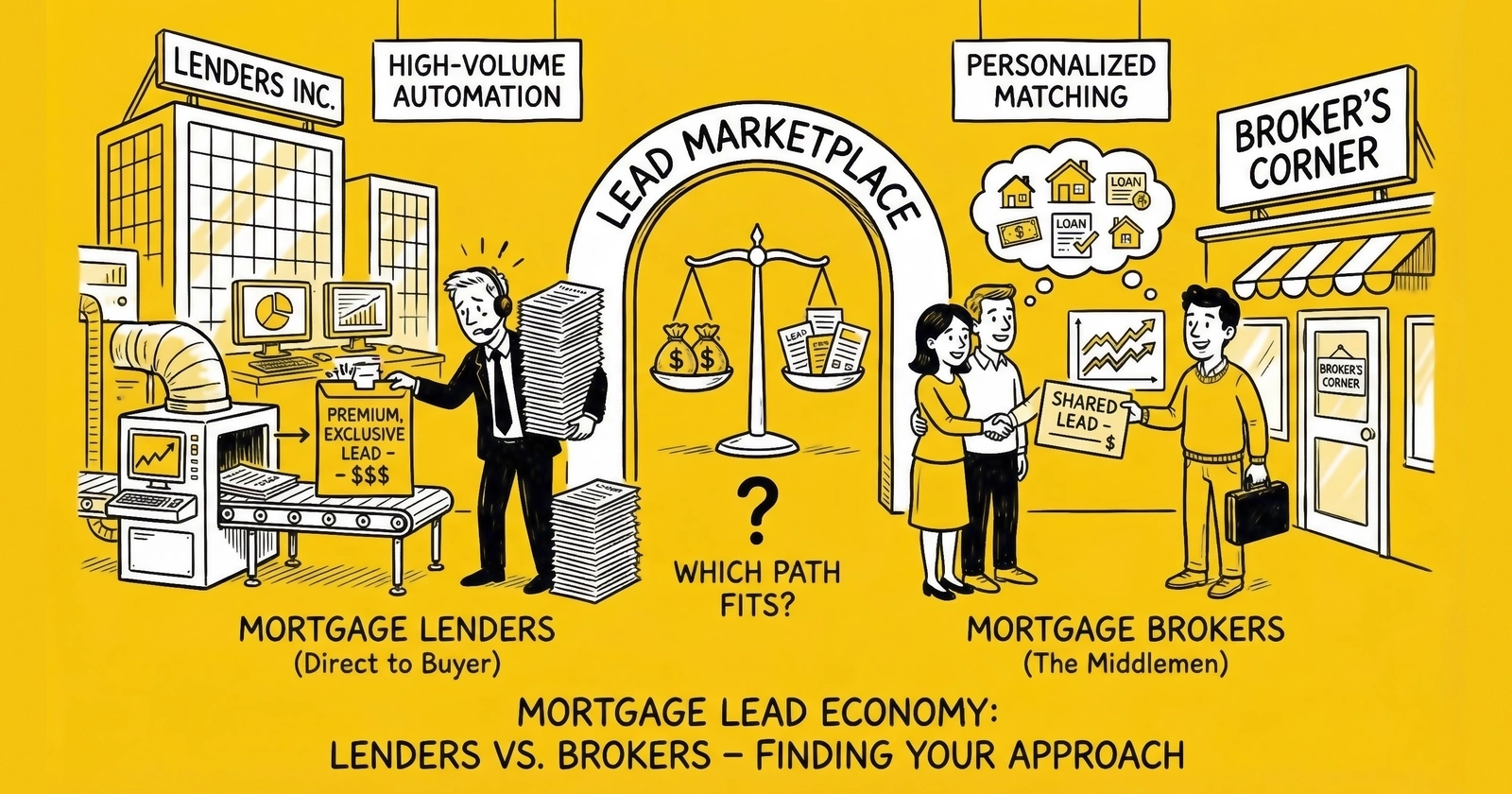
Direct lenders and mortgage brokers purchase the same product but operate by different rules. Understanding these distinctions determines whether you build lasting partnerships or burn through buyers who never quite fit your operation.
The Two Worlds of Mortgage Lead Buying
The mortgage lead you generated this morning could go to a national bank with a billion-dollar marketing budget and a 500-person call center. Or it could go to an independent broker working from a home office who personally calls every lead and builds relationships over coffee meetings.
Both buyers want the same thing: consumers ready to discuss financing a home purchase or refinance. Both will evaluate your leads on contact rates, conversion rates, and cost-per-acquisition economics. Both need TCPA-compliant consent documentation that protects them from regulatory exposure.
But the similarities end there.
The national lender processes thousands of leads daily through sophisticated technology stacks, negotiates pricing through procurement departments, and makes vendor decisions based on performance data analyzed to the third decimal place. The independent broker purchases 30-80 leads monthly, decides on suppliers based on personal relationships and last month’s results, and expects responsive service when issues arise.
If you generate or broker mortgage leads, you will eventually sell to both. Those who thrive understand that these buyers require different integration approaches, accept different pricing structures, and define success through different metrics. What delights a lender buyer frustrates a broker buyer, and vice versa.
This guide provides the operational intelligence for working with both buyer types: the economic frameworks that govern their purchasing decisions, the technical requirements for integration, the relationship dynamics that determine partnership longevity, and the pricing strategies that maximize revenue across your buyer portfolio.
Understanding the Mortgage Lead Buyer Landscape
The North American mortgage lead market represents approximately $5.6 billion in annual transaction value, making it one of the largest consumer lead verticals alongside auto insurance. This demand flows through two primary channels: direct lenders purchasing leads for their in-house sales operations, and mortgage brokers purchasing leads to grow their pipeline and commission income.
The mortgage broker sector alone comprises over 20,780 businesses in the United States, generating approximately $26.6 billion in revenue with 10.3% annual growth since 2019. This fragmented buyer base creates persistent demand for lead generation services because most originators lack the marketing scale to generate sufficient volume independently.
Understanding how these channels differ begins with recognizing their common ground. Both buyer types want leads that convert to funded mortgages at acceptable cost-per-acquisition ratios. Both require proper consent documentation and compliance with RESPA, state licensing requirements, and TCPA regulations. Both evaluate quality through measurable metrics.
The differences emerge in how they pursue these common goals, and in the scale, sophistication, and relationship dynamics that shape their purchasing behavior.
The Direct Lender Channel
Direct lenders include banks (Wells Fargo, Chase, Bank of America), non-bank mortgage companies (Rocket Mortgage, United Wholesale Mortgage, loanDepot), and credit unions with mortgage divisions. These organizations purchase leads to feed their own sales teams.
Direct lender buyers share defining characteristics:
Scale of operation. Major lenders process thousands to tens of thousands of leads daily. Rocket Mortgage alone has historically processed over $300 billion in mortgage originations since its founding. A single lender might purchase more leads in one day than a mid-sized broker purchases in a year.
Technology infrastructure. Lenders operate sophisticated sales technology stacks: predictive dialers that initiate calls within seconds of lead receipt, AI-powered lead scoring systems, CRM platforms integrated with loan origination software, and real-time analytics dashboards tracking performance across dozens of dimensions. They expect lead providers to integrate seamlessly through well-documented APIs.
Procurement-driven relationships. Lender lead purchasing typically flows through formalized vendor management processes. Contracts specify performance requirements, service level agreements, and penalty structures. Relationship decisions involve multiple stakeholders, including marketing, sales operations, compliance, and procurement, each with different priorities.
Data-driven optimization. Lenders measure everything. They track conversion by source, geography, time of day, lead score, loan type, and credit tier. They know within weeks whether a lead source performs and will adjust volume allocations or terminate relationships based on the data.
Price sensitivity at volume. While individual lead prices may run lower than what brokers pay, aggregate spend is massive. A penny per lead difference at lender volume translates to substantial annual savings. Procurement teams negotiate aggressively.
The Mortgage Broker Channel
Independent mortgage brokers represent the other end of the buyer spectrum. These are licensed professionals who work with multiple lender partners to find the best rates and products for their clients, earning commission on each funded loan.
Broker buyers share their own defining characteristics:
Human-scale operation. Most independent brokers purchase 20-100 leads monthly. Larger broker shops with multiple loan officers might buy 200-500 leads monthly across their team. Even substantial broker networks operate at fractions of lender volume.
Variable technology adoption. Some brokers run sophisticated operations with integrated CRMs, automated follow-up sequences, and performance tracking systems. Others work from spreadsheets and handwritten notes. Lead providers cannot assume any particular technology capability.
Relationship-driven purchasing. Brokers often choose lead providers based on personal relationships, referrals from colleagues, or past experiences. The decision-maker is typically the broker-owner or lead loan officer, not a procurement committee.
Quality over volume preferences. Brokers generally prefer exclusive leads at higher prices over shared leads at lower prices. They lack call center infrastructure to compete on speed with major lenders and instead compete through personalized service, rate shopping across multiple lenders, and relationship building.
Flexible pricing expectations. Broker buyers accept higher per-lead pricing than lenders because they are not negotiating at lender volume. They evaluate lead costs against their own close rates and commission structures, which typically run 1-2.75% of loan amount depending on loan type and market conditions.
Economic Differences: What Each Buyer Will Pay
Lead pricing strategies must account for fundamentally different economics between lender and broker buyers. Understanding these economics helps you position appropriately and avoid the margin destruction that comes from misaligned pricing.
Lender Pricing Economics
Direct lenders evaluate leads on fully loaded cost-per-acquisition metrics that account for contact rates, conversion rates, and customer lifetime value. Their pricing tolerance reflects their operational efficiency and downstream economics.
Typical lender pricing ranges for mortgage leads:
| Lead Type | Shared Leads | Exclusive Leads | Live Transfers |
|---|---|---|---|
| Purchase | $25-50 | $50-90 | $100-175 |
| Refinance | $20-45 | $40-80 | $85-150 |
| Home Equity | $20-40 | $35-70 | $75-130 |
These prices reflect several lender advantages:
Speed-to-contact capability. Lenders with dedicated response teams and predictive dialers contact leads within 30-90 seconds of receipt. Industry research shows leads contacted within one minute convert at 391% higher rates. Leads reached within five minutes show 100x better outcomes than those contacted after 30 minutes. This speed advantage means lenders extract more value from each lead, supporting their pricing discipline.
Conversion efficiency. With optimized sales processes, extensive product training, and sophisticated call routing based on loan officer specialization, lenders typically convert at higher rates than individual brokers. A lender achieving 4-5% lead-to-funded conversion can pay less per lead than a broker converting at 2.5-3% while maintaining similar unit economics.
Volume leverage. Lenders purchasing 3,000-10,000 leads daily command pricing power that smaller buyers cannot match. Their volume represents must-have demand for lead generators. Losing a lender relationship can mean losing a significant percentage of revenue overnight.
Data feedback loops. Lenders provide detailed conversion data that helps lead generators optimize quality. This feedback creates value for generators, partially offsetting lower pricing.
Broker Pricing Economics
Independent brokers operate with different constraints and opportunities that support different pricing structures:
Typical broker pricing ranges for mortgage leads:
| Lead Type | Shared Leads | Exclusive Leads | Live Transfers |
|---|---|---|---|
| Purchase | $35-65 | $65-150 | $125-225 |
| Refinance | $30-55 | $55-120 | $100-180 |
| Home Equity | $25-50 | $50-100 | $90-160 |
Brokers pay more per lead for several reasons:
Exclusive distribution value. Brokers strongly prefer exclusive leads because they cannot compete with lender call centers on speed. The premium for exclusivity, often 2-3x shared lead pricing, reflects genuine competitive advantage. When a broker is the only person calling a prospect, they have time to build rapport, explain options, and establish trust.
Relationship-based sales. Brokers build relationships that lenders struggle to replicate. A broker who writes a purchase mortgage today often captures the refinance years later, plus referrals to friends and family. This relationship equity increases the value of each initial lead beyond what the first transaction suggests.
Higher per-loan compensation. Broker compensation typically runs 1-2.75% of loan amount, with 2-2.25% being common for purchase transactions. On a $400,000 loan, that is $8,000-9,000 in commission. Even at 2.5% close rates, $150 per exclusive lead generates strong unit economics: ($400,000 x 2.0% commission x 2.5% close rate) = $200 revenue per lead against $150 cost.
Rate shopping advantage. Brokers work with multiple wholesale lenders, enabling them to shop rates and find optimal products. This product flexibility translates to higher approval rates on leads that direct lenders might decline.
The Pricing Strategy Implications
Smart lead generators serve both channels with differentiated pricing:
Premium exclusive inventory routes to brokers at $80-150 per lead for purchase and $60-120 for refinance. These leads feature verified contact information, documented consent certificates, and no competition for the prospect’s attention.
Volume shared inventory routes to lender call centers at $35-60 per lead for purchase and $25-50 for refinance. These leads may sell to 3-5 buyers simultaneously, with lenders competing on speed-to-contact.
Aged and recycled inventory serves specialized nurturing operations at $8-25 per lead, extracting residual value from leads that did not convert initially. Brokers with strong nurture sequences often find value in aged leads at appropriate pricing.
This tiered approach maximizes yield across your lead inventory while serving buyers at their preferred price points – a strategy that also applies to exclusive vs shared lead decisions.
Technical Integration Requirements
The technology requirements for lender versus broker relationships differ substantially. Lender integrations demand significant development investment but enable high-volume, high-efficiency operations. Broker integrations are simpler but require flexibility across diverse buyer systems.
Lender Integration Requirements
Major mortgage lenders expect lead generators to meet demanding technical specifications:
Real-time API delivery. Lenders require leads delivered via API within seconds of capture. Batch file delivery is generally unacceptable for fresh leads. Lenders need real-time transmission to capitalize on their speed-to-contact advantage. A lead that arrives three minutes after capture has already lost significant value.
Ping/post capability. Many lender relationships operate through ping/post protocols. You ping the lender with partial lead data (property ZIP code, estimated home value, loan type, credit tier), receive a bid based on their current demand and capacity, then post the full lead data to the winning bidder. This real-time auction model requires sophisticated technical infrastructure and sub-second response times.
Field mapping precision. Lender APIs expect specific data formats. Date fields must follow particular conventions. Phone numbers require specific formatting. State codes must match their system conventions. Property addresses need standardization. Field mapping errors cause integration failures, rejected leads, and damaged buyer relationships.
Error handling and retry logic. Lender systems experience occasional downtime. Your integration must implement intelligent retry logic with exponential backoff, circuit breaker patterns, and failover to secondary buyers when primary endpoints are unavailable.
Authentication and security. Lenders require secure API authentication, typically OAuth 2.0 or API key-based authentication. IP whitelisting, encryption in transit (TLS 1.2 or higher), and data security compliance documentation are typically required.
Performance reporting integration. Some lenders provide conversion feedback through APIs, enabling closed-loop optimization. They report which leads contacted, which converted to applications, and which funded. Supporting these feedback mechanisms requires additional development but enables quality improvement.
Compliance documentation delivery. Lenders increasingly require TrustedForm or Jornaya certificates transmitted with each lead. Certificate URLs must be valid, accessible, and stored for the lender’s retention requirements (often 5+ years).
The timeline to establish lender integration typically spans 4-8 months from initial conversation to live traffic. Technical due diligence, legal review, compliance certification, integration development, testing, and pilot programs all require time. Plan resource allocation accordingly.
Broker Integration Requirements
Broker integrations are technically simpler but operationally more varied:
Portal access. Many brokers prefer web portal delivery where leads appear in a dashboard they access via browser. Portal systems should support mobile access (brokers often work from phones between client meetings), lead assignment across loan officer rosters if applicable, and activity tracking.
Basic CRM integration. Brokers using platforms like Velocify, Encompass, or general-purpose CRMs like HubSpot may request direct integration. These integrations are typically simpler than lender APIs but require supporting multiple destination platforms.
Email or batch delivery. Some brokers accept leads via email notification or daily batch files. While less sophisticated, this delivery method serves brokers without technical resources for API integration. Email delivery should include formatted lead details ready for immediate action.
Click-to-call functionality. Brokers value portal features that enable immediate calling. One-click dial from the lead record, call logging, and integration with telephony systems where available. Speed matters even for brokers who cannot match lender response times.
Flexible field presentation. Brokers care less about rigid field formatting than about seeing all relevant lead information clearly. Display fields in human-readable formats rather than system-optimized codes. Show the property address as a formatted address, not separate fields for street, city, state, ZIP.
SMS and notification options. Brokers want immediate awareness of new leads. SMS alerts, push notifications, or integration with their existing communication tools enable faster response even when away from their desk.
The timeline to onboard broker buyers is typically 1-2 weeks, dramatically faster than lender relationships. The lower technical bar enables rapid relationship development.
Platform Selection Considerations
Supporting both buyer types requires distribution platform capabilities including multi-buyer routing based on lead characteristics and buyer capacity, delivery method flexibility (API for lenders, portal for brokers, batch for specialized buyers), return handling for different patterns, and consent certificate management. Leading platforms like boberdoo (starting around $450/month plus per-lead fees), LeadsPedia, and Phonexa support these requirements, as detailed in our lead distribution platform comparison, though configuration complexity and pricing vary.
Relationship Dynamics and Sales Cycles
Building relationships with lenders versus brokers follows different patterns. Understanding these dynamics helps you allocate sales resources appropriately and set realistic expectations for new business development.
Lender Relationship Development
Establishing lender relationships is a lengthy process requiring significant upfront investment:
Long sales cycles. Expect 6-12 months from initial outreach to first lead delivery. Lenders evaluate vendors thoroughly before committing purchasing authority. Multiple stakeholders must approve new vendor relationships, including marketing (source quality), operations (integration capability), compliance (TCPA and RESPA), procurement (commercial terms), and legal (contract provisions).
Formal vendor qualification. Lenders require documentation of your compliance practices, technology infrastructure, data security measures, and business stability. Vendor questionnaires running 50-100 questions are common. SOC 2 compliance or similar security certification may be required. Site visits happen for significant relationships.
Contract negotiation. Lender contracts specify service level agreements, performance benchmarks, pricing structures with volume tiers, return policies with specific windows and reasons, indemnification requirements, data retention obligations, and termination conditions. Legal review on both sides extends timelines.
Pilot program structure. Most lenders begin with limited pilot programs before committing to volume. A pilot might include 500-1,500 leads over 30-60 days, with performance evaluation determining whether the relationship expands, continues at pilot scale, or terminates. Pilot performance thresholds are typically specified upfront: minimum contact rates, maximum return rates, and conversion benchmarks.
Ongoing performance review and concentration risk. Lenders conduct regular business reviews examining metrics and negotiating terms. A single lender relationship may represent 25-40% of your revenue. Losing that relationship creates immediate financial stress, but diversification requires the long sales cycles multiplied across several prospects.
Broker Relationship Development
Broker relationships develop faster but require different approaches:
Short sales cycles. Broker decision-makers often approve new lead sources within days or weeks. The decision authority sits with the broker-owner or managing loan officer. One person, one decision, one timeline.
Relationship-based selling. Brokers choose lead providers based on trust, referrals, and personal connection. Conference networking at events like the National Association of Mortgage Brokers annual conference, industry meetups, and referral programs drive broker customer acquisition more effectively than formal RFP processes.
Low-barrier trial programs. Brokers typically start with small volume, often 25-50 leads, to evaluate quality before scaling. Low minimum commitments reduce the risk of testing new sources. Many brokers will try a new provider for a few hundred dollars before committing to ongoing relationships.
Hands-on support expectations. Broker buyers expect accessible customer service with response within hours, not days. Automated ticketing systems frustrate broker customers accustomed to personal service.
Loyalty and volume fragmentation. Brokers satisfied with quality and service develop loyalty that transcends price competition. However, serving brokers means managing many small relationships, and a portfolio of 50 brokers purchasing 60 leads monthly creates different challenges than 5 lenders purchasing 10,000 leads monthly.
Most sustainable lead businesses serve both segments, balancing lender volume with broker margin while managing the distinct operational requirements of each.
Contract Terms and Negotiation Differences
Contract structures vary dramatically between lender and broker relationships. Understanding typical terms helps you negotiate effectively.
Lender Contract Characteristics
Lender contracts reflect the formal procurement processes of larger organizations:
Volume commitments. Lenders may require minimum volume commitments, expecting you to deliver a specified number of leads monthly. Missing commitments can trigger contract review or termination. Conversely, volume caps may limit your upside if quality proves strong.
Performance benchmarks. Contracts often specify minimum acceptable metrics: contact rates above 60%, return rates below 10%, conversion rates meeting specified thresholds. Failure to meet benchmarks triggers review periods with potential termination.
Pricing tiers. Lender pricing typically includes volume-based tiers. Higher volume means lower per-lead pricing, with breaks at 5,000, 10,000, 25,000 leads monthly or similar thresholds. Pricing is often negotiated annually based on prior year performance.
Return policies. Lender return policies specify acceptable return reasons (duplicate, invalid contact, filter mismatch, compliance issues), return windows (typically 5-10 days), and return rate caps. Returns above cap may trigger pricing adjustments or relationship review.
Indemnification provisions. Lenders require indemnification for TCPA claims arising from your lead generation practices, RESPA violations, state licensing issues, and other regulatory exposure. This transfers litigation risk from lender to generator, making robust compliance essential.
Term and termination. Initial terms often run 12 months with automatic renewal. Termination requires 30-90 day notice. Performance termination clauses allow either party to exit if metrics fall below specified thresholds.
Data retention requirements. Contracts specify how long you must retain lead data and consent documentation, typically 5-7 years. You must produce documentation upon request, often within 48-72 hours.
Audit rights. Lenders may reserve the right to audit your lead generation practices, reviewing landing pages, consent flows, traffic sources, and documentation systems. Audit failures can terminate relationships.
Broker Contract Characteristics
Broker agreements are typically simpler and more flexible:
No volume commitments. Brokers rarely commit to minimum volumes. Relationships operate on an as-needed basis, with brokers purchasing what their current pipeline requires.
Flexible pricing. Broker pricing is often set by standard rate cards rather than individually negotiated. Volume discounts may apply but are simpler: 10% off above 100 leads monthly, for example.
Simple return policies. Broker returns typically allowed for clear quality issues: disconnected phones, wrong numbers, consumers denying requesting information. Return windows are often shorter (24-72 hours) but more flexible in practice.
Minimal formal terms. Many broker relationships operate without formal contracts, governed by terms of service accepted upon account creation. Where contracts exist, they are typically 2-5 pages rather than the 20-40 page documents common with lenders.
Easier exit. Either party can typically end broker relationships with minimal notice. No long-term commitments, no termination penalties, no complex unwind provisions.
Less formal compliance requirements. While brokers need compliant leads, the documentation and audit requirements are less formalized. Brokers trust their suppliers rather than contractually specifying every compliance detail.
Quality Requirements and Return Policies
Lenders and brokers evaluate lead quality differently and have different return patterns. Understanding these differences helps you manage quality expectations and avoid disputes.
Lender Quality Standards
Lenders impose rigorous quality requirements backed by contractual enforcement:
Validation requirements. Lenders require phone validation (carrier lookup, line type verification, connectivity testing), email validation (format, domain, deliverability), and address verification (USPS CASS certification, geocoding) before accepting leads. Leads failing validation are rejected at delivery or returned immediately.
TCPA consent documentation. TrustedForm or Jornaya certificates are typically required. Lenders may specify exact consent language that must appear on lead capture forms. Though the FCC’s one-to-one consent rule was vacated by the Eleventh Circuit in January 2025, many lenders still require consent identifying the specific lender. Non-compliant consent creates TCPA liability that lenders will not accept.
RESPA compliance. Lead generation arrangements must comply with RESPA Section 8 anti-kickback provisions. Lenders scrutinize arrangements that might constitute prohibited referral payments. Documentation demonstrating legitimate marketing services helps protect both parties.
Fraud detection. Lenders monitor for fraud indicators: bot traffic patterns, velocity anomalies, synthetic identity markers, duplicate submissions across sources. Sources generating fraudulent leads face immediate termination and potential clawback of previously paid leads.
Return rate thresholds. Lender contracts typically specify maximum acceptable return rates, often 8-12% depending on lead type and exclusivity. Sustained return rates above threshold trigger relationship review or termination. Some contracts include financial penalties for excess returns.
Quality scoring. Lenders may implement quality scores based on their conversion data, adjusting bid prices or volume allocations based on source-level performance. Sources with declining quality scores see demand reduction before formal termination.
Compliance audits. Lenders periodically audit lead generation practices, reviewing landing pages, consent flows, traffic sources, and documentation systems. Audit failures, even for issues that never caused specific lead problems, can terminate relationships.
Broker Quality Standards
Broker quality expectations are less formalized but equally important to relationship success:
Contact quality. Brokers care intensely about reaching consumers. Leads with working phone numbers that answer calls represent quality. Leads with disconnected numbers, wrong numbers, or persistent non-answers represent failure, regardless of validation status at time of sale.
Information accuracy. Brokers quote based on lead form data. When consumer situations differ from form submissions (different property value, different loan amount, different credit situation), quoting becomes difficult and conversion probability drops. Accurate lead information supports broker success.
Timeliness. Brokers purchasing exclusive leads expect freshness. A lead marked as real-time that actually originated hours earlier frustrates brokers who invest in rapid response. Transparency about lead age builds trust.
Geographic precision. Mortgage brokers are licensed by state. A lead for a property in California has zero value to a broker licensed only in Texas. Precise geographic targeting and filtering prevents wasted leads.
Intent verification. Brokers value leads where consumer intent is clear. Someone who completed a multi-step form with detailed information signals higher intent than someone who clicked one button. Brokers often prefer fewer leads with stronger intent over more leads with questionable motivation.
Managing Return Rate Differences
Lender returns tend to be systematic (validation failures, duplicate detection, filter mismatches) with consistent rates once integration stabilizes. Broker returns tend to be circumstantial (contact problems, disputed quality) with rates varying by individual performance and market conditions.
Successful return management requires clear return policies documented in agreements (24-72 hours for brokers, 5-10 days for lenders), rapid return processing with credits and reroutings, return rate monitoring by source, and return reason analysis distinguishing valid quality issues from buyer performance issues.
Compliance Considerations by Buyer Type
Compliance requirements apply to all mortgage lead generation, but lender and broker buyers have different risk tolerances and different compliance infrastructure expectations.
Lender Compliance Requirements
Lenders face substantial regulatory exposure given their volume and visibility. They impose strict compliance requirements on lead sources:
One-to-one consent. Though the FCC’s one-to-one consent rule was vacated by the Eleventh Circuit in January 2025, lenders increasingly require consent identifying the specific entity authorized to contact the consumer. Blanket consent to marketing partners may not satisfy lender requirements regardless of regulatory minimums.
Consent language approval. Lenders may require approval of exact consent language appearing on lead capture forms. Changes to consent language may require re-approval before continuing lead delivery. Legal review of new language can take weeks.
TrustedForm or Jornaya certification. Independent consent verification is typically mandatory. Lenders require certificates validating that consumers actually completed forms and saw required disclosures. Certificate costs of $0.50-1.50 per lead are standard and must be built into your economics.
Consent documentation retention. Lenders require lead generators to retain consent documentation for extended periods, typically 5-7 years, and to produce documentation promptly if TCPA claims or regulatory inquiries arise. Documentation must be retrievable within 24-72 hours.
RESPA compliance verification. Lenders scrutinize lead generation arrangements for RESPA Section 8 issues. Marketing services agreements, real estate referral arrangements, and other partnerships involving settlement service providers receive particular attention.
State licensing verification. Lenders may require evidence that your lead generation practices do not constitute unlicensed mortgage origination. Taking applications, quoting rates, or discussing specific loan terms could require licensing. Keep lead capture activities clearly within marketing boundaries.
Indemnification provisions. Lender contracts typically require lead generators to indemnify for TCPA claims, RESPA violations, and other regulatory issues arising from lead generation practices. This transfers litigation risk from lender to generator.
Compliance audits. Lenders audit compliance practices periodically, reviewing consent flows, landing pages, disclosure language, and documentation procedures. Audit failures create relationship risk beyond specific lead quality issues.
Broker Compliance Expectations
Brokers have similar concerns but less formal enforcement. They may request consent certificates for specific leads, expect return rights for compliance deficiencies, and face personal liability for TCPA violations. Brokers who experience TCPA claims become highly sensitive to lead source compliance, making your compliance infrastructure a selling point.
The investment in compliance infrastructure required for lender relationships (TrustedForm/Jornaya, consent language standardization, documentation retention, compliance monitoring) benefits broker relationships as well, providing competitive advantage against less sophisticated lead generators.
Response Time Economics: A Critical Difference
Speed-to-contact matters for all mortgage lead buyers, but the dynamics differ substantially between lenders and brokers. Understanding these differences helps you position appropriately with each buyer type.
Major lenders route leads directly to predictive dialers that initiate outbound calls within 30-90 seconds of receipt, with dedicated response teams staffing call centers from early morning through late evening, seven days a week. Research consistently shows leads contacted within one minute convert at 391% higher rates. Lenders understand this data and build operations around it.
Independent brokers face structural speed limitations. Many work alone, handling client files, processing underwriting conditions, and managing all aspects of their business. Lead response competes with other demands. They often lack predictive dialers and automated response systems. Leads received at 7 PM may wait until the next morning.
Implications for lead generators: Brokers cannot win speed competitions against lender call centers when receiving shared leads. This is precisely why brokers prefer exclusive leads: exclusivity gives them time to respond without competing. Selling shared leads to brokers often destroys their ROI because lenders reach the consumer first.
The Exclusivity Premium
The speed differential explains broker willingness to pay exclusivity premiums of 2-3x shared lead pricing:
| Lead Type | Shared to Lender | Exclusive to Broker | Broker Premium |
|---|---|---|---|
| Purchase | $40 | $100 | 2.5x |
| Refinance | $35 | $85 | 2.4x |
| Home Equity | $30 | $70 | 2.3x |
Brokers are not paying for abstract exclusivity. They are paying for the time to respond effectively. Exclusivity transforms the lead from a speed race they will lose into a relationship opportunity they can win.
Lead generator strategy: Segment your inventory. Premium leads with verified contact information and strong intent signals route to broker buyers at exclusive pricing. Volume leads route to lender buyers in shared distribution. This approach maximizes yield while serving each buyer type appropriately.
Building a Diversified Buyer Portfolio
Sustainable mortgage lead businesses serve both lender and broker buyers, balancing the advantages of each channel while managing distinct risks.
Lender advantages: Volume capacity (thousands of leads weekly that would require dozens of broker relationships), predictable contractual demand, performance feedback enabling quality optimization, and market validation (major lender relationships signal quality to the broader market).
Broker advantages: Higher margins per lead (a portfolio generating $8 margin per lender lead and $35 margin per broker lead needs both channels), relationship stability less vulnerable to procurement-driven vendor switching, inventory optimization through tiered distribution, revenue diversification (30 broker relationships diversify better than 3 lender relationships), and rate cycle opportunity (brokers often remain active when lender budgets contract).
Portfolio Balance Considerations
The optimal mix depends on your operational capabilities: volume-oriented operations may target 60-75% lender, margin-oriented operations may target 40-50% lender with the balance to brokers, and diversification-focused operations limit any single buyer to 15-20% of revenue.
Market conditions affect optimal mix. When lender demand is strong (falling rates, high refinance volume), lender channels offer growth opportunity. When lender budgets contract (rising rates, reduced origination volume), broker channels provide stability. Practitioners who maintain both channels navigate cycles more effectively.
Managing Channel Conflict
Serving both channels creates potential conflicts around exclusivity expectations (brokers expect genuine exclusivity), quality perception (separate routing by quality tier, not buyer availability), and pricing transparency (position pricing based on value delivered, not pure lead cost). Clear lead routing logic, honest buyer communication, and consistent quality standards minimize conflict risk.
Frequently Asked Questions
What is the difference between selling mortgage leads to lenders versus brokers?
Direct lenders purchase leads at high volume (thousands daily) through sophisticated technology integrations, with lower per-lead pricing offset by massive scale. Independent brokers purchase leads at lower volume (20-100 monthly) through simpler delivery methods, paying premium prices for exclusive distribution and personal service. Lenders require real-time API delivery, ping/post capability, and formal vendor contracts with lengthy negotiation periods. Brokers accept portal access, email delivery, and relationship-based purchasing with rapid onboarding. Understanding these differences enables appropriate positioning for each buyer type.
How much do mortgage lenders pay for leads compared to brokers?
Lenders typically pay $25-50 for shared purchase leads and $50-90 for exclusive leads at volume. Brokers typically pay $35-65 for shared leads and $65-150 for exclusive purchase leads. Live transfers command $100-175 from lenders and $125-225 from brokers. The pricing difference reflects lender advantages in volume negotiation and operational efficiency (sub-minute response times, higher conversion rates), while brokers pay premiums for exclusivity that gives them time to compete effectively and for service quality.
How long does it take to establish a mortgage lender lead buying relationship?
Lender relationships typically require 4-8 months from initial outreach to first lead delivery. This timeline includes vendor qualification (1-2 months), legal and contract negotiation (1-3 months), technical integration and testing (2-3 months), and pilot evaluation (1-2 months). Multiple stakeholders, including marketing, operations, compliance, procurement, and legal, must approve new vendor relationships. Plan resource allocation and revenue expectations accordingly.
What technical requirements do mortgage lenders have for lead delivery?
Lenders require real-time API delivery within seconds of lead capture, ping/post auction capability with sub-second response times, precise field mapping to their data formats, OAuth 2.0 or API key authentication, encryption in transit, and intelligent error handling with retry logic. Integration development typically requires 2-4 months of engineering work. Additional requirements may include IP whitelisting, security compliance documentation, SOC 2 certification, and conversion feedback integration.
Do mortgage brokers require the same lead quality as lenders?
Both buyer types want leads that convert, but they measure quality differently. Lenders emphasize systematic validation (phone verification, email verification, address standardization), fraud detection, documented consent compliance, and return rate thresholds specified in contracts. Brokers emphasize practical contact quality (can they reach the consumer?), information accuracy (does the lead match reality?), and timeliness (is the lead fresh?). Both require TCPA-compliant consent documentation, though lender requirements tend to be more formally specified with audit provisions.
Why do mortgage brokers prefer exclusive leads over shared leads?
Brokers cannot compete with lender call centers on speed-to-contact. Major lenders contact leads within 30-90 seconds using predictive dialers and dedicated response teams. Independent brokers may take 30 minutes to several hours. When leads are shared between lenders and brokers, lenders win the speed race and contact the consumer first. Exclusive leads eliminate this competition, giving brokers time to respond thoughtfully and build relationships rather than racing against call center efficiency. The exclusivity premium of 2-3x shared pricing reflects this genuine competitive advantage.
What return rates should I expect from lenders versus brokers?
Lender return rates typically stabilize at 8-12% once integration is established, with returns driven primarily by validation failures, duplicate detection, and filter mismatches. Broker return rates vary more widely (5-18%) based on individual broker performance, market conditions, and rate environment. Clear return policies specifying acceptable reasons, return windows (5-10 days for lenders, 24-72 hours for brokers), and evidence requirements help manage returns from both buyer types.
How should I price mortgage leads for lender versus broker buyers?
Price lenders based on volume, competitive positioning, and your cost structure, recognizing that lender volume represents must-have demand worth pricing competitively. Price brokers based on value delivered: exclusivity commands 2-3x shared pricing, verified contact information supports premium positioning, and responsive service justifies margin that covers higher support costs. Tier your inventory with premium leads to brokers at higher prices and remaining inventory to lenders at volume pricing. This maximizes yield while serving each buyer type appropriately.
What compliance requirements differ between lender and broker relationships?
Lenders impose stricter formal compliance requirements: one-to-one consent language, TrustedForm or Jornaya certification, consent documentation retention (5-7 years), RESPA compliance verification, compliance audits, and indemnification provisions in contracts. Brokers have similar concerns but less formal enforcement. The compliance infrastructure required for lender relationships typically exceeds broker requirements, but once built, benefits all buyer relationships through reduced regulatory risk and competitive differentiation from less sophisticated providers.
Should I focus on lenders or brokers when building a mortgage lead business?
Most sustainable mortgage lead businesses serve both channels. Lenders provide volume capacity, predictable demand, and performance feedback through detailed conversion data. Brokers provide margin quality (higher profit per lead), relationship stability (less vulnerable to procurement switching), and revenue diversification (many relationships versus few). The optimal mix depends on your operational capabilities and strategic priorities. Consider targeting 50-60% lender and 40-50% broker for balanced diversification, adjusting based on your specific advantages and market conditions. Practitioners who maintain both channels navigate rate cycles more effectively than those concentrated in either.
Key Takeaways
-
Lenders and brokers purchase the same product but operate by fundamentally different rules. Lenders buy at massive scale with sophisticated technology, lower per-lead pricing, and formal procurement processes requiring 4-8 month sales cycles. Brokers buy at human scale with simpler delivery, premium pricing for exclusivity, and relationship-based purchasing enabling rapid onboarding.
-
Pricing strategies must reflect buyer economics. Lenders paying $40 for shared leads command pricing through volume leverage and speed-to-contact advantages. Brokers paying $100 for exclusive leads pay for genuine competitive advantage: time to respond without racing lender call centers.
-
Technical integration requirements differ substantially. Lenders require real-time API delivery, ping/post capability, and months of integration development. Brokers accept portal access, email delivery, and can be onboarded in days. Support both delivery methods from a unified platform.
-
Relationship development follows different timelines. Lender relationships require 6-12 months from first contact to first lead, with multiple stakeholder approvals and contract negotiations. Broker relationships develop in days or weeks based on personal trust. Allocate sales resources accordingly.
-
The speed differential explains exclusivity premiums. Lenders contact leads within seconds. Brokers may take hours. Shared leads become speed competitions that brokers lose. Exclusivity gives brokers time to compete through relationship quality rather than call center efficiency.
-
Quality expectations vary but compliance requirements are universal. Lenders impose formal quality standards with contractual enforcement and audit rights. Brokers emphasize practical contact quality. Both require TCPA-compliant consent. Build to the highest standard and apply it universally.
-
Diversification across both channels provides strategic stability. Lender relationships provide volume and predictability. Broker relationships provide margin and diversification. Balance the portfolio based on your capabilities and risk tolerance.
-
Contract structures differ dramatically. Lender contracts specify volume commitments, performance benchmarks, extensive indemnification, and termination provisions across 20-40 pages. Broker agreements are often simple terms of service with flexible arrangements. Negotiate accordingly.
-
Rate cycles affect buyer behavior differently. Major lenders adjust budgets based on market conditions and corporate strategy. Individual brokers make independent decisions based on their pipeline needs. Maintaining both channels provides resilience through market transitions.
-
Relationship quality determines longevity. Technical excellence, consistent quality, responsive problem resolution, and genuine understanding of buyer business create partnerships that survive market disruptions. Transaction-focused relationships fail when competition intensifies or conditions change.
Market data and regulatory information current as of late 2025. Mortgage rates, lead pricing, and compliance requirements change continuously. Validate current conditions through industry sources before making significant business decisions. This article provides general information and does not constitute legal advice. Consult qualified professionals for specific compliance questions regarding RESPA, TCPA, and state licensing requirements.