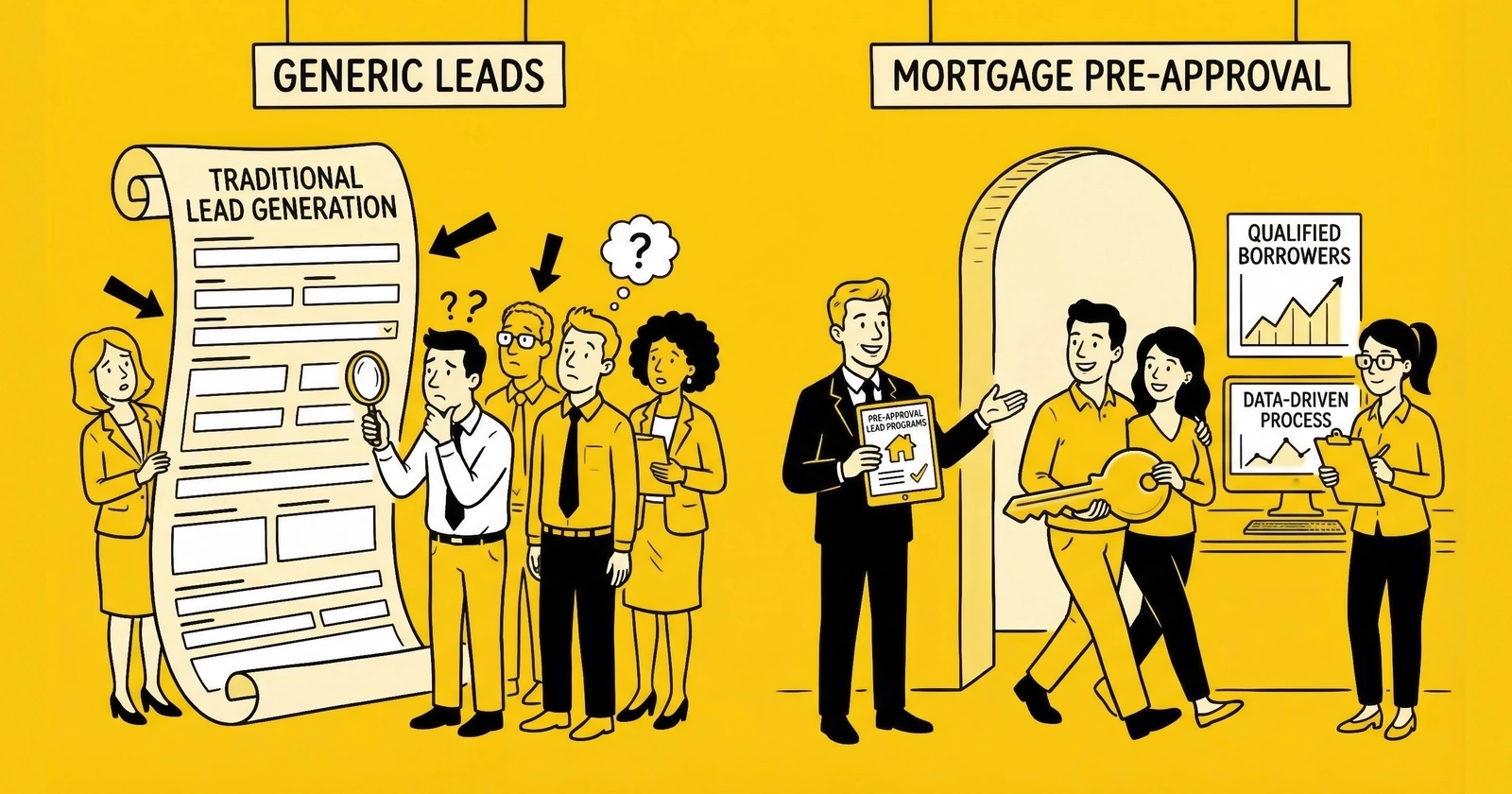
Pre-approved buyers convert at 3-5x the rate of unqualified leads. Here is how to build, source, and monetize pre-approval programs that command premium pricing while delivering superior outcomes for lenders.
Why Pre-Approval Changes the Lead Economics Equation
The mortgage industry has a conversion problem. Average lead-to-funded-loan conversion rates hover between 2-4%, meaning 96-98 of every 100 leads generate cost without revenue. The economics are brutal: at $100 per lead and 3% conversion, customer acquisition cost runs $3,333 before a single loan dollar funds.
Pre-approval programs fundamentally reshape this equation – a dynamic that’s clearly visible in mortgage CPL trends.
When a consumer obtains mortgage pre-approval, they demonstrate three things simultaneously: they have sufficient income and creditworthiness to qualify for financing, they are seriously considering a purchase in the near term, and they have already invested time in the process. These signals correlate with dramatically higher conversion rates – industry data shows pre-approved buyers convert to funded loans at 15-25% rates, compared to 2-4% for raw inquiry leads.
For lead generators, this creates a strategic opportunity. Pre-approval leads command premium pricing – often 2-4x standard purchase lead costs – because they deliver proportionally better economics to buyers. A lender paying $300 for a pre-approved lead converting at 18% achieves better unit economics than paying $75 for an unqualified lead converting at 2%.
The challenge lies in building pre-approval programs that actually work. Many practitioners misunderstand what pre-approval means, conflate it with pre-qualification, or lack the technology and lender partnerships to execute effectively. This guide walks through the operational reality of pre-approval lead programs – the mechanics, the technology requirements, the conversion benefits, and the compliance considerations that separate successful programs from expensive failures.
Pre-Approval vs. Pre-Qualification: The Critical Distinction
The mortgage industry uses “pre-approval” and “pre-qualification” somewhat interchangeably in marketing, but they represent fundamentally different levels of buyer verification. Understanding this distinction matters for lead generation economics because it affects both pricing and conversion expectations.
Pre-Qualification: The Lighter Touch
Pre-qualification represents a preliminary assessment of borrower eligibility based on self-reported information. The consumer provides income, debt, and asset information – typically through an online form or brief phone conversation – and receives an estimate of how much they might qualify to borrow.
Minimal Verification
The lender relies on what the consumer reports without pulling credit or verifying income documentation. A consumer claiming $150,000 annual income receives a pre-qualification letter based on that stated figure.
Quick Turnaround
Pre-qualification can happen in minutes through automated systems. No underwriter involvement, no document collection, no waiting.
Non-Binding Estimate
The pre-qualification letter explicitly states that actual approval requires verification. It represents an educated guess, not a commitment.
Limited Market Credibility
Real estate agents and sellers increasingly discount pre-qualification letters because they have learned – often through failed transactions – that pre-qualified buyers frequently cannot actually close.
From a lead generation perspective, pre-qualification has value for initial engagement and funnel building. Consumers who complete pre-qualification forms demonstrate intent. But these leads don’t command the premiums associated with true pre-approval because conversion rates don’t improve proportionally.
Pre-Approval: The Substantive Assessment
Pre-approval involves actual underwriting verification of borrower qualifications. The lender pulls credit, reviews income documentation, examines debt obligations, and assesses the borrower against real lending criteria. The resulting pre-approval letter represents a conditional commitment – the lender is prepared to fund, subject to property appraisal and continued qualification at closing.
Credit Verification
The lender pulls credit reports from all three bureaus, examines payment history, calculates debt-to-income ratios, and identifies potential issues that could affect approval.
Income Documentation
Borrowers submit pay stubs, W-2s, tax returns, or other documentation verifying income claims. Self-employed borrowers may need to provide business financial statements.
Asset Verification
Bank statements and investment account records confirm down payment availability and reserve requirements.
Underwriting Review
An actual underwriter – human or increasingly AI-assisted – reviews the complete file against lending guidelines and issues a determination.
Conditional Commitment
The pre-approval letter represents a real commitment: if the borrower finds a property meeting specified parameters and continues to meet qualification criteria, the loan will fund.
Market Credibility
Real estate agents prefer working with pre-approved buyers because they can actually close. Sellers accept offers from pre-approved buyers with greater confidence, sometimes accepting lower prices in exchange for closing certainty.
The processing time for genuine pre-approval ranges from 24-72 hours for straightforward applications to a week or more for complex situations involving self-employment, multiple income sources, or credit issues requiring explanation.
The Conversion Impact
The distinction between pre-qualification and pre-approval translates directly to conversion metrics.
| Lead Type | Typical Conversion Rate | Average Time to Close | Lead Cost Range |
|---|---|---|---|
| Raw Inquiry | 2-4% | 90-120 days | $50-$150 |
| Pre-Qualified | 5-8% | 60-90 days | $75-$175 |
| Pre-Approved | 15-25% | 30-60 days | $150-$400 |
| Pre-Approved + Active Shopper | 25-40% | 14-45 days | $250-$500+ |
These ranges vary by geography, loan type, and market conditions. California coastal markets command premiums across all categories. VA and FHA pre-approvals may convert differently than conventional. Purchase intent signals (actively working with an agent, viewing properties) compound the value of pre-approval status.
The economic logic is straightforward: a lender paying $300 for a pre-approved lead converting at 20% spends $1,500 per funded loan in lead cost. The same lender paying $100 for raw inquiry leads converting at 2.5% spends $4,000 per funded loan. Pre-approval leads cost more and deliver dramatically better economics.
Instant Decisioning Technology: The Infrastructure Requirement
The viability of pre-approval lead programs depends on technology infrastructure that didn’t exist a decade ago. Traditional pre-approval required days of document collection, manual verification, and underwriter review. This timeline made pre-approval at the lead generation stage impractical – by the time pre-approval completed, the consumer had likely engaged with competitors.
Modern instant decisioning technology compresses this timeline to minutes, enabling pre-approval or conditional approval during the initial consumer interaction.
How Instant Decisioning Works
Instant decisioning systems integrate multiple data sources and automated underwriting logic to deliver real-time credit decisions.
Credit Bureau Integration
The system initiates a soft pull – which doesn’t affect consumer credit scores – or a hard pull with consumer authorization to retrieve credit data. Modern systems use tri-merge credit files combining Experian, Equifax, and TransUnion data.
Income Verification Services
Platforms like The Work Number (operated by Equifax), Plaid, and Finicity provide automated income and employment verification. The consumer authorizes access to payroll records or bank accounts, and the system retrieves actual income data rather than relying on self-reported figures.
Asset Verification
Bank aggregation services connect to consumer accounts to verify down payment funds and reserves. The verification is real-time and documented – not a phone conversation where the consumer claims to have $50,000 saved.
Automated Underwriting Systems
Fannie Mae’s Desktop Underwriter (DU) and Freddie Mac’s Loan Prospector (LP) analyze the complete borrower profile against GSE lending guidelines. These systems return automated findings – Approve/Eligible, Approve/Ineligible, Refer with Caution, or other designations – within seconds.
Proprietary Decisioning Engines
Many lenders layer their own decisioning logic on top of AUS systems, incorporating additional criteria, pricing overlays, and portfolio considerations.
Document AI
Emerging systems use machine learning to extract data from uploaded documents – pay stubs, bank statements, tax returns – without manual data entry. The document upload triggers automated parsing and integration into the decisioning flow.
The Consumer Experience
From the consumer perspective, instant decisioning enables a streamlined pre-approval experience:
- Consumer completes initial application (5-10 minutes of data entry)
- Consumer authorizes credit pull, income verification, and asset verification
- System retrieves and processes data (30-120 seconds)
- Consumer receives conditional approval, denial, or request for additional information
- If approved, consumer receives pre-approval letter specifying loan amount, rate range, and conditions
The entire process can complete in under 15 minutes for straightforward applications. Complex situations – self-employment, irregular income, credit issues – may require additional documentation and human underwriter review, but the initial assessment still happens rapidly.
Technology Providers and Platforms
Several technology categories support instant decisioning implementation.
Point-of-Sale Systems
Platforms like Blend, Roostify, Maxwell, and Encompass Consumer Connect provide the consumer-facing application interface with integrated verification services. These systems handle the consumer interaction while connecting to backend underwriting engines.
Verification Services
The Work Number, Plaid, Argyle, Finicity, and Truework provide income and employment verification. Yodlee and similar platforms handle bank account aggregation for asset verification.
Automated Underwriting
Desktop Underwriter and Loan Prospector remain the dominant automated underwriting systems, with proprietary engines from major lenders supplementing GSE systems.
Credit Bureaus
Experian, Equifax, and TransUnion provide credit data through various API integrations. Specialty credit products like mortgage credit reports (tri-merge files with score models optimized for mortgage lending) provide enhanced data.
Document Processing
Ocrolus, Inscribe, and similar platforms use AI to extract data from uploaded documents, reducing manual data entry and accelerating processing.
For lead generators considering pre-approval programs, the technology question is whether to build proprietary infrastructure, partner with lenders who have the technology, or use white-label solutions that provide the consumer experience while routing to technology-enabled lender partners.
Implementation Approaches
Lead generators have several options for incorporating instant decisioning into their programs.
Lender Partnership Model
The lead generator captures initial consumer interest and routes qualified prospects to lender partners who handle pre-approval through their own technology. The lead generator receives commission or premium pricing for pre-approval-ready leads.
White-Label Integration
Some technology providers offer white-label pre-approval flows that lead generators can embed in their own consumer experiences. The technology operates under the lead generator’s brand while connecting to lender underwriting systems.
Hybrid Approach
Lead generators capture comprehensive application data through their own forms, perform soft credit pulls and initial screening, then route qualified leads to lenders for final underwriting and pre-approval issuance.
Full Integration
Larger lead generators with lending licenses may operate their own pre-approval programs, using licensed loan officers to issue pre-approval letters and then either funding loans in-house or selling closed loan pipelines to correspondent lenders.
Each approach involves different capital requirements, licensing considerations, and operational complexity. The partnership model offers lowest barrier to entry; full integration requires substantial infrastructure and licensing but captures maximum value.
Building a Pre-Approval Lead Program: Operational Framework
Launching a successful pre-approval lead program requires coordinated development across consumer experience, technology infrastructure, lender partnerships, and compliance frameworks. The following section walks through operational requirements.
Consumer Acquisition and Qualification
The consumer funnel for pre-approval leads differs from standard mortgage lead generation because you need consumers willing to engage with a more substantive process.
Targeting Intent Signals
Pre-approval prospects demonstrate active purchase consideration. Effective targeting focuses on consumers actively searching real estate listings, renters in markets with rising rent-to-own ratios, and those displaying life event signals such as engagement, new job, or growing family. Past inquirers who have not yet transacted represent warm prospects, and referrals from real estate agents seeking qualified buyers provide particularly high-intent candidates.
Setting Expectations in Creative
Pre-approval requires more consumer engagement than a simple inquiry form. Effective advertising emphasizes the value exchange: “Get pre-approved and shop with confidence” rather than “Get a quick rate quote.” Consumers who understand they are entering a substantive process convert better through the full funnel.
Form Design for Qualification
Pre-approval applications collect more data than standard lead forms. Expect completion rates 30-50% lower than simple inquiry forms, but lead quality and conversion rates that more than compensate. Essential data fields span contact information (name, email, phone), property details (purchase price range, target geography, timeline), employment and income (employer, position, tenure, income), assets and down payment (savings, investments, available funds), credit self-assessment (excellent/good/fair/poor range), current housing status (renting, owning, living with family), and consent for credit pull and verification.
Multi-step forms improve completion rates by collecting basic information before requesting sensitive data. The consumer invests effort before encountering credit authorization requests, creating commitment momentum.
Credit Pre-Screening
Many pre-approval programs incorporate soft credit pulls early in the flow to qualify consumers before substantive engagement. A consumer with 520 credit score likely cannot obtain conventional pre-approval – identifying this early prevents wasted processing cost.
Soft pulls don’t affect consumer credit scores and don’t require the same consent documentation as hard pulls. They provide sufficient data to screen out clearly unqualified consumers while preserving the full application for qualified prospects.
Lender Partnership Development
Pre-approval programs require lender partners capable of instant decisioning and willing to purchase pre-approval leads at premium pricing.
Partner Selection Criteria
Technology capability ranks highest – partners must have automated underwriting integration, digital verification services, and workflow systems that can process pre-approval applications within minutes or hours, not days. Appetite for pre-approval volume matters because some lenders prefer raw leads they can work through their own pre-qualification and pre-approval processes, while others specifically seek pre-approved or pre-qualified leads that reduce their processing burden.
Geographic coverage requires that lenders hold licenses in states where you generate leads; NMLS verification confirms current licensing status. Competitive rate offerings ensure that pre-approved consumers who shop rates before committing receive pricing that maintains the conversion advantage. Capacity and response time complete the picture – partners must respond to leads within minutes to capture the speed advantage that pre-approval provides, as a pre-approved lead waiting 24 hours for lender contact loses much of its value.
Partnership Structures
Exclusive pre-approval leads command premium pricing – $200-$500+ depending on geography, loan amount, and credit quality. The lender receives the full consumer relationship with no competition from other lenders.
Performance-based arrangements tie payment to outcomes. The lead generator receives base payment plus bonus for applications, approvals, or funded loans. This aligns incentives but requires transparency into lender conversion data – an arrangement that benefits from understanding lead quality scoring.
Revenue share on funded loans provides maximum upside but requires trust, tracking infrastructure, and longer payment cycles. Typical shares range from 25-50 basis points on funded loan amount.
Subscription or retainer models provide stable revenue for volume commitments. Lenders pay monthly fees for guaranteed lead flow, with per-lead pricing adjusting based on volume and quality metrics.
Quality Assurance and Verification
Pre-approval leads command premium pricing only if they deliver genuine pre-approval quality. Verification processes must confirm that leads meet claimed standards.
Pre-Approval Documentation
Leads should include or facilitate access to credit report data (scores, tradelines, derogatory items), income verification results (employer, tenure, income amount), asset verification results (account balances, down payment availability), automated underwriting findings (DU/LP approval status), and the pre-approval letter issued by the underwriting lender.
Quality Metrics to Track
Contact rate should exceed 40% for genuine pre-approvals, and application submission rate should exceed 50%. Approval confirmation rate should exceed 80% – these consumers were already approved – while pull-through to funded loan should exceed 60%. Time to close should average 30-45 days, faster than raw leads.
Return Policies
Pre-approval leads may warrant tighter return policies than raw leads. If a consumer was genuinely pre-approved, returns should be limited to specific circumstances: contact information invalid (phone disconnected, email bounces), consumer explicitly not in market (changed circumstances, already purchased), or material misrepresentation (income or assets falsified).
Returns based on “lead quality” should be rare for genuine pre-approvals because the verification process should have confirmed qualification.
Technology Infrastructure Requirements
Operating a pre-approval lead program at scale requires technology infrastructure beyond standard lead generation.
Application Platform
Consumer-facing forms must collect comprehensive application data, handle consent capture, and integrate with verification services.
Credit Integration
API connections to credit bureaus enable soft pull screening and hard pull processing. Systems must handle credit data securely and comply with FCRA requirements.
Verification Service Connections
Integrations with income verification (The Work Number, payroll connections), employment verification, and bank account aggregation provide asset verification.
Underwriting Connectivity
Direct integration with DU/LP or relationships with lenders who can provide underwriting results through API complete the verification chain.
Document Management
Secure storage and transmission handles sensitive consumer documents – pay stubs, bank statements, tax returns.
Lead Delivery
Real-time delivery to lender partners with complete data packages ensures value preservation. Pre-approval leads lose value rapidly, so delivery must be instantaneous.
Compliance Infrastructure
Consent capture, disclosure delivery, data security, and documentation retention systems must meet TCPA, FCRA, RESPA, and state regulatory requirements.
The technology investment is substantial. Many lead generators partner with technology providers or operate through lender partnerships rather than building proprietary infrastructure.
The Conversion Advantage: Why Pre-Approval Matters for Lenders
Understanding why lenders pay premium prices for pre-approved leads helps structure programs that deliver value and command sustainable pricing.
Speed to Close
Pre-approved leads close faster because the time-consuming verification work is already complete. A consumer submitting a raw inquiry today might take 90-120 days to reach closing – 60 days or more to obtain pre-approval, then 30-45 days from contract to close.
A pre-approved consumer can move to contract immediately upon finding a property. The lender already has credit, income, and asset verification on file. The remaining process – property appraisal, title work, final underwriting – compresses into 21-30 days.
Faster closing delivers multiple benefits. Interest rate risk decreases with less time for rates to move adversely. Pipeline fallout drops because consumers have less time to change minds or find competitors. Capacity utilization improves as more loans flow through the same processing team. Customer satisfaction rises because consumers prefer faster closings.
Reduced Processing Cost
Pre-approval shifts verification work from the lender’s staff to the lead generation program. The lender receives a consumer with verified credit profile, documented income, confirmed assets, and automated underwriting approval.
Lender processors focus on property-specific tasks – ordering appraisals, clearing title, coordinating closing – rather than chasing documents and verifying borrower information.
The cost savings are substantial. Industry estimates suggest mortgage processing costs $2,000-$4,000 per loan for full-service origination. Pre-approved leads reduce this cost by 20-40% through eliminated redundant verification and reduced touch points.
Competitive Positioning
Pre-approved consumers are better buyers in competitive real estate markets. They can make stronger offers because sellers prefer pre-approved buyers, move faster with no pre-approval delay when making offers, negotiate more effectively because closing certainty has value, and win bidding situations when competing against unqualified buyers.
Lenders who work with pre-approved consumers develop relationships with real estate agents who prefer sending clients to lenders that can close. This creates a referral flywheel beyond the direct lead economics.
Higher Conversion Rates
The most direct benefit: pre-approved consumers convert to funded loans at dramatically higher rates. Instead of 2-4% conversion typical of raw leads, pre-approval programs deliver 15-25% or higher.
At $100 CPL with 3% conversion, cost per funded loan is $3,333. At $300 CPL with 20% conversion, cost per funded loan is $1,500.
The math works decisively in favor of pre-approval despite the higher per-lead cost.
Better Credit Quality
Pre-approval programs screen out unqualified consumers before they reach lenders. The population of pre-approved leads skews toward better credit profiles because consumers with credit issues either don’t complete the process or receive denials.
Better credit quality translates to higher approval rates on submitted applications, better pricing with higher revenue per funded loan, lower default risk supporting better long-term portfolio performance, and simpler processing with fewer conditions and less document chasing.
Pre-Approval Program Models: Choosing Your Approach
Lead generators have multiple options for structuring pre-approval programs, each with different operational requirements, capital needs, and economic outcomes.
Model 1: Referral to Pre-Approval Partners
The simplest approach routes qualified consumers to lender partners who handle pre-approval internally.
How It Works
The lead generator captures consumer interest through standard lead generation, then initial qualification filters identify consumers likely to qualify for pre-approval. Qualified consumers route to lender partners who process pre-approval applications, and the lead generator receives premium payment for qualified referrals.
Advantages
This model requires minimal technology investment and no licensing requirements beyond standard lead generation. It leverages lender pre-approval capabilities while maintaining lower operational complexity.
Disadvantages
The tradeoffs include less control over consumer experience and lower per-lead pricing since you are selling potential, not verified pre-approvals. The model depends on lender partner execution and offers limited insight into conversion performance.
Economics
Leads command modest premium over raw leads – perhaps $100-$175 versus $50-$100 for unqualified leads. The premium reflects initial qualification but not verified pre-approval status.
Model 2: Soft Pull Screening with Partner Pre-Approval
This enhanced approach incorporates soft credit pulls to verify consumer qualification before routing.
How It Works
The lead generator captures comprehensive application data, then a soft credit pull verifies credit qualification. Consumers passing the credit screen are flagged as “pre-approval ready” and route to lender partners for formal pre-approval. The lead generator receives premium for credit-verified leads.
Advantages
Verified credit data increases lead quality and supports higher per-lead pricing than unverified leads. Lender partners achieve better conversion rates, and the technology stack remains relatively simple.
Disadvantages
Soft pull costs ($1-3 per pull) add to lead generation expense, and consumer consent requirements apply for credit access. This is not a complete pre-approval – income and asset verification still required – and final underwriting depends on lender partners.
Economics
Leads with soft pull verification command $125-$225 depending on credit tier. Premium credit profiles (740+) may command higher pricing.
Model 3: White-Label Pre-Approval Integration
The lead generator embeds lender pre-approval technology in their own consumer experience.
How It Works
The lead generator operates a consumer-facing application under its own brand while white-label technology handles credit, income, and asset verification. Automated underwriting runs through partner lender systems, the consumer receives a pre-approval letter from the partner lender, and the pre-approved lead delivers to the lender partner with complete documentation.
Advantages
This model provides full pre-approval verification while the lead generator maintains the consumer relationship. Premium pricing for verified pre-approvals creates a differentiated product in competitive markets.
Disadvantages
Technology integration complexity increases substantially, and operations depend on white-label provider reliability. Licensing considerations apply for offering pre-approval under your own brand, and operational cost per lead runs higher.
Economics
Genuine pre-approved leads command $200-$400+ depending on loan amount, geography, and credit quality.
Model 4: Licensed Lender Operation
The lead generator operates as a licensed lender, issuing pre-approval letters directly.
How It Works
The lead generator holds mortgage lending licenses (MLO, broker, or lender) and employs licensed loan officers who process pre-approval applications. Pre-approval letters issue under the lead generator’s own lending authority. Pre-approved consumers either fund through the lead generator or route to correspondent lenders, with revenue flowing through loan origination or premium lead sale.
Advantages
This model captures maximum value with complete control over consumer experience. The operation can originate loans directly or sell the pre-approved pipeline, achieving the highest per-lead or per-loan economics.
Disadvantages
Significant licensing and compliance requirements apply, along with capital requirements for lending operations. Staffing with licensed mortgage loan originators adds complexity, and full regulatory oversight from state regulators and the CFPB increases operational risk.
Economics
Revenue reaches either full origination (typical net income $1,000-$3,000 per funded loan) or premium pricing for licensed pre-approvals ($300-$500+).
Compliance Framework for Pre-Approval Programs
Pre-approval programs operate within the same regulatory framework as all mortgage lead generation, with additional considerations related to credit access, disclosure requirements, and the pre-approval relationship.
TCPA and Consumer Contact
All standard TCPA requirements apply to pre-approval lead generation. Prior express written consent is required for marketing calls and texts. Though the FCC’s one-to-one consent rule was vacated by the Eleventh Circuit in January 2025, many sophisticated lenders require specific seller identification in consent. Calling hour restrictions and DNC compliance remain mandatory, along with consent documentation and retention.
Pre-approval applications create additional consent considerations. Consumers providing comprehensive application data authorize contact regarding their application. This creates a business relationship that may affect consent requirements for ongoing marketing.
Fair Credit Reporting Act (FCRA)
Pre-approval programs involving credit pulls must comply with FCRA requirements.
Permissible Purpose
Credit reports can only be accessed for permissible purposes. Consumer-initiated credit applications qualify. Accessing credit without proper authorization violates FCRA.
Adverse Action Notices
Consumers denied pre-approval based on credit information must receive adverse action notices explaining the denial and their rights. Notices must include credit bureau contact information and adverse action reasons.
Consumer Disclosure
Consumers have rights to access their credit information and dispute inaccuracies. Pre-approval programs must facilitate these rights.
Disposal Requirements
Credit information must be properly disposed of when no longer needed. This includes secure deletion of electronic records and destruction of physical documents.
RESPA Considerations
Pre-approval programs must navigate RESPA Section 8 prohibitions on referral fees.
The pre-approval itself is permissible – lenders can offer pre-approval services as part of legitimate mortgage origination. However, lead generator compensation structures require care. Payment for leads must reflect fair market value for marketing services, not disguised referral fees for mortgage business.
Affiliated business arrangements add complexity. If the lead generator has ownership or affiliate relationships with the pre-approving lender, additional RESPA disclosure requirements apply. Marketing services agreements between lead generators and real estate professionals, builders, or other settlement service providers require RESPA compliance review.
State Licensing Requirements
Pre-approval program licensing depends on the specific model.
Lead generators selling leads to licensed lenders generally don’t require mortgage licensing themselves – they are providing marketing services. Lead generators with staff who discuss loan terms, take applications, or offer rates may require mortgage broker or loan originator licensing depending on state definitions of “loan origination.” Lead generators operating as lenders and issuing pre-approval letters require full mortgage lender or broker licensing through NMLS.
The line between permissible lead generation and activities requiring licensure varies by state. California, for example, has specific regulations around lead generation and third-party origination. Consult mortgage compliance counsel before launching pre-approval programs.
Data Security and Privacy
Pre-approval programs collect sensitive consumer data requiring robust security.
The Gramm-Leach-Bliley Act (GLBA) requires financial institutions to implement information security programs protecting consumer data. Pre-approval programs handling financial data may be subject to GLBA requirements. State privacy laws including CCPA (California) and emerging state frameworks create specific requirements around consumer data collection, use, and disclosure.
Industry standards such as SOC 2 certification, encryption requirements, and secure data handling practices demonstrate appropriate security controls. Vendor management extends these requirements to third-party technology providers handling consumer data. Contracts should include data protection requirements and breach notification obligations.
Geographic and Market Considerations
Pre-approval program economics vary significantly by geography and market conditions.
Market-Specific Pricing
Pre-approval lead value correlates with loan amount and market competitiveness.
High-Value Markets
California coastal, Northeast metros, and select Western markets see average loan amounts exceeding $500,000. Pre-approval leads command $300-$500+ amid intense lender competition for qualified buyers. Higher originator revenue per funded loan justifies premium CPL.
Mid-Tier Markets
Midwest metros, Southeast growth markets, and Mountain West feature average loan amounts of $250,000-$400,000. Pre-approval leads typically command $175-$300 with moderate competition and established lender presence. These markets balance volume and per-loan economics.
Value Markets
Smaller metros, rural areas, and lower-cost regions show average loan amounts under $250,000. Pre-approval leads may command $100-$200 with less lender competition but also lower lender margins. Economics focus on volume.
Geographic premiums should reflect actual buyer economics. A lender earning $4,000 on a California jumbo loan tolerates higher CPL than one earning $1,500 on a Kansas conventional loan.
Market Condition Sensitivity
Pre-approval lead value fluctuates with market conditions.
Hot Markets
When inventory is limited and bidding competitive, pre-approval becomes essential for buyers to compete. Premium value accrues to genuine pre-approvals, and real estate agents actively seek pre-approved buyer referrals. Conversion rates improve as pre-approval becomes table stakes.
Cooling Markets
With rising inventory and increased buyer leverage, pre-approval becomes less critical for offer acceptance. Premiums compress as urgency decreases, and focus shifts to rate shopping over buying power. Conversion rates may decline as buyers wait for better conditions.
Rate Transition Periods
Rate drops trigger refinance demand, which represents a different product category. Rate increases reduce purchase volume and the buyer pool. Pre-approval value depends on purchase market activity, so operators should maintain flexibility to shift program focus with conditions.
Seasonal Patterns
Mortgage activity follows predictable seasonal patterns affecting pre-approval program planning.
Spring peak (March-May) brings highest purchase activity, maximum pre-approval demand, and premium pricing. Summer sustained (June-August) maintains continued activity as families complete moves before the school year. Fall transition (September-November) sees declining activity as the holiday slowdown approaches. Winter trough (December-February) represents lowest activity with limited pre-approval demand and reduced pricing.
Successful programs adjust marketing spend, staffing, and pricing expectations seasonally. Building inventory during spring peak provides volume for summer fulfillment; managing costs during winter preserves margins through the trough.
Technology Integration Deep Dive
Building or selecting technology for pre-approval programs requires understanding the integration landscape and operational workflows.
Core System Components
Consumer Application Interface
The front-end must collect comprehensive data while maintaining reasonable completion rates. Progressive disclosure – revealing additional fields as the consumer advances – improves completion versus presenting all fields simultaneously.
Mobile optimization is non-negotiable. Over 60% of mortgage research begins on mobile devices. Applications that require desktop completion lose significant potential volume.
Credit Bureau Connectivity
Major credit bureaus (Experian, Equifax, TransUnion) offer various API products including consumer credit reports (individual bureau or tri-merge), soft inquiry products for pre-screening without score impact, prequalification tools for consumer-facing credit access, and identity verification overlays.
Most pre-approval programs use tri-merge mortgage credit reports that combine data from all three bureaus with mortgage-optimized scoring models. Integration typically requires reseller relationships or direct bureau partnerships.
Income and Employment Verification
The Work Number (Equifax) remains the dominant income verification source, covering approximately 60% of U.S. employees through payroll data partnerships. Alternatives include Plaid for bank connection deposit verification, Argyle for payroll system connectivity, Truework for employer verification with consumer-initiated fallback, and document upload with AI extraction for self-employed or uncovered employers.
No single source covers all consumers. Robust programs implement waterfall verification – try automated sources first, fall back to document collection for gaps.
Asset Verification
Bank aggregation services connect directly to consumer accounts. Plaid, Yodlee, Finicity, and MX provide account connectivity, with verification confirming balance, transaction history, and source of funds across checking, savings, investment, and retirement accounts.
Integration challenges include bank connectivity coverage (not all institutions participate) and consumer trust (some hesitate to grant account access). Alternative approaches accept document upload with AI extraction.
Automated Underwriting Integration
Fannie Mae’s Desktop Underwriter (DU) and Freddie Mac’s Loan Prospector (LP) provide automated underwriting decisions. Integration options include direct integration (requires Fannie/Freddie approval and technology certification), lender partner pass-through (submit via partner lender systems), and third-party platforms (LOS providers with embedded AUS connectivity).
AUS integration is complex and typically requires lender partnership or licensing rather than lead generator direct access.
Document Management
Pre-approval processes generate and store sensitive documents including credit reports, pay stubs and W-2s, bank statements, pre-approval letters, and consent documentation.
Systems must handle secure storage, transmission, and access control. Retention policies balance compliance requirements (maintain records) with data minimization principles (delete when no longer needed).
Integration Architecture Patterns
Point-to-point integration connects individual systems directly. This approach is simpler for initial implementation but creates maintenance burden as the number of integrations grows.
Integration platform approaches use middleware (Zapier, Tray.io, custom integration layer) to coordinate data flow between systems. This is more scalable but adds infrastructure cost.
All-in-one platforms like Blend, Roostify, or Maxwell provide pre-built integrations across verification services, credit bureaus, and lender systems. This reduces integration burden but creates platform dependency.
For most lead generators, partner lender technology or white-label platform solutions offer the fastest path to market. Building custom infrastructure only makes sense at substantial scale with long-term commitment to pre-approval as a core product.
Frequently Asked Questions
What is the difference between mortgage pre-approval and pre-qualification?
Pre-qualification represents a preliminary estimate based on self-reported information – the consumer says they earn $120,000 and have $50,000 saved, and the lender provides an estimated borrowing range. No verification occurs. Pre-approval involves actual underwriting verification: the lender pulls credit, confirms income through payroll records or tax returns, verifies assets through bank statements, and issues a conditional approval letter. Pre-qualification takes minutes and carries limited credibility; pre-approval takes hours to days and represents a genuine conditional commitment. Pre-approved buyers convert at 15-25% rates compared to 2-4% for raw leads, which explains the significant price premium for pre-approval leads.
What technology is required to offer instant mortgage decisioning?
Instant decisioning requires integrated technology across several categories: a consumer application platform for data collection; credit bureau connectivity for credit data retrieval (soft or hard pulls); income verification services like The Work Number or Plaid; asset verification through bank aggregation services; automated underwriting system integration (Desktop Underwriter or Loan Prospector); and document management for secure storage of verification results. Most lead generators implement instant decisioning through white-label technology partnerships or lender partner integrations rather than building proprietary systems. Building from scratch requires significant capital, technical expertise, and compliance infrastructure.
How much more do pre-approved leads cost compared to standard mortgage leads?
Pre-approved leads typically command 2-4x the cost of raw inquiry leads. Where standard purchase leads might cost $50-$150, pre-approved leads range from $150-$500 depending on geography, loan amount, and credit tier. California coastal markets with high loan amounts command the highest premiums. Despite the higher per-lead cost, pre-approved leads often deliver better unit economics: at 20% conversion versus 3% for raw leads, the cost per funded loan is substantially lower with pre-approvals. Lenders pay premiums because pre-approved leads require less processing, close faster, and convert at dramatically higher rates.
What conversion rate improvement do pre-approved leads provide?
Industry benchmarks show raw mortgage leads converting to funded loans at 2-4% rates. Pre-qualified leads improve to 5-8%. Genuinely pre-approved leads with verified credit, income, and assets convert at 15-25%. Pre-approved leads from consumers actively shopping properties with real estate agents can exceed 25-40% conversion. The improvement stems from multiple factors: pre-approved consumers are committed to purchasing, have demonstrated qualification, and have invested significant time in the process. They also have market advantages – sellers prefer pre-approved buyers – which facilitates transaction completion.
Do lead generators need special licensing for pre-approval programs?
Licensing requirements depend on the specific activities performed. Lead generators who capture consumer information and route to licensed lenders for pre-approval processing generally do not require mortgage licensing – they’re providing marketing services. Lead generators whose staff discusses specific loan terms, provides rate quotes, or takes loan applications may require mortgage loan originator licensing depending on state definitions. Lead generators operating as lenders and issuing pre-approval letters directly require full mortgage broker or lender licensing through NMLS. The boundary between permissible marketing and regulated origination varies by state; consult mortgage compliance counsel before launching programs.
What compliance requirements apply to pre-approval lead programs?
Pre-approval programs face the standard mortgage lead generation compliance framework – TCPA for consumer contact (with many sophisticated buyers requiring one-to-one consent regardless of regulatory minimums), RESPA Section 8 for referral fee prohibitions, and state licensing requirements. Additional considerations include Fair Credit Reporting Act (FCRA) compliance for credit access, adverse action notice requirements for consumers denied pre-approval, data security requirements under GLBA and state privacy laws, and disclosure requirements if affiliated business arrangements exist. Programs involving soft or hard credit pulls have specific consent and permissible purpose requirements under FCRA.
How should pre-approval leads be priced for different geographic markets?
Pre-approval lead pricing should reflect buyer economics rather than arbitrary geographic markups. High-value markets like California coastal metros justify premiums because average loan amounts exceed $500,000, generating higher originator revenue that supports higher lead costs. Lenders earning $4,000+ on a California jumbo loan tolerate $400+ CPL when conversion rates justify the math. Mid-tier markets with $250,000-$400,000 loans support $175-$300 CPL. Lower-cost markets with smaller loan amounts may support $100-$200 CPL. The calculation: (Revenue per funded loan) x (Expected conversion rate) x (Target ROI factor) = Maximum sustainable CPL.
What verification services are needed for instant income and asset verification?
Comprehensive income verification requires multiple sources because no single service covers all consumers. The Work Number (Equifax) covers approximately 60% of U.S. employees through payroll data partnerships. Plaid and similar bank aggregation services verify income through deposit analysis. Argyle provides direct payroll system connectivity. Truework offers employer verification with consumer-directed fallback for uncovered employers. For self-employed borrowers, document upload with AI extraction handles tax returns and business financials. Asset verification uses bank aggregation services (Plaid, Yodlee, Finicity, MX) that connect directly to consumer accounts. Robust programs implement waterfall verification – automated sources first, document fallback for gaps.
How do consent requirements affect pre-approval lead programs?
Though the FCC’s one-to-one consent rule was vacated by the Eleventh Circuit in January 2025, many sophisticated lenders require specific seller identification in consent disclosures. Pre-approval lead programs should ensure consent language identifies specific lenders who may contact the consumer rather than broad categories of “mortgage lenders” or similar language. This particularly affects shared lead models where the same lead might go to multiple lenders. Exclusive pre-approval leads are less affected since consent specifies a single lender partner. Programs should review consent language and potentially restructure distribution models to satisfy buyer requirements.
What are the main models for structuring a pre-approval lead program?
Four primary models exist: (1) Referral to pre-approval partners – route qualified consumers to lenders who handle pre-approval, earning modest premium over raw leads; (2) Soft pull screening with partner pre-approval – add credit verification before routing, earning $125-$225 per credit-verified lead; (3) White-label pre-approval integration – embed lender technology in your consumer experience, earning $200-$400+ for complete pre-approvals; (4) Licensed lender operation – operate as licensed mortgage lender issuing pre-approvals directly, capturing full origination revenue or premium lead pricing at $300-$500+. Each model involves different technology requirements, licensing considerations, and economics. Most lead generators start with partnership models and evolve toward integration as volume and commitment justify infrastructure investment.
Key Takeaways
-
Pre-approved buyers convert at 15-25% rates compared to 2-4% for raw leads. The verification investment pays for itself through dramatically improved conversion economics, faster closing timelines, and reduced processing costs for lender partners.
-
The distinction between pre-qualification and pre-approval matters significantly for pricing. Pre-qualification (self-reported data, no verification) commands modest premiums. Pre-approval (verified credit, income, and assets with automated underwriting) justifies 2-4x premium pricing over raw leads.
-
Instant decisioning technology enables pre-approval at the lead generation stage. Integration of credit bureaus, income verification services, asset verification, and automated underwriting systems compresses what was once a multi-day process into minutes.
-
Four program models offer different tradeoffs. Referral partnerships require minimal infrastructure but capture limited value. White-label integration provides full pre-approval value with moderate complexity. Licensed lender operations maximize economics but require significant compliance and capital investment.
-
Pre-approval lead pricing should reflect buyer economics. High-value markets with large loan amounts justify $300-$500+ CPL. Lower-value markets may only support $100-$200 CPL. The math: (Revenue per loan) x (Conversion rate) x (Target ROI factor) = Maximum sustainable CPL.
-
Compliance requirements compound for pre-approval programs. Standard TCPA, RESPA, and licensing requirements apply, plus FCRA considerations for credit access, adverse action notices for denials, and enhanced data security requirements for sensitive consumer information.
-
Geographic and seasonal variation significantly affects program economics. Spring peaks, California premiums, and market condition sensitivity all influence lead value. Successful programs adjust marketing, pricing, and capacity to match demand cycles.
-
Speed-to-contact remains critical even for pre-approved leads. Pre-approval indicates qualification, not commitment. Consumers who receive pre-approval from multiple sources choose based on subsequent experience. Response time and service quality still determine conversion.
-
Technology infrastructure requirements are substantial. Most lead generators implement through lender partnerships or white-label platforms rather than building proprietary systems. Custom builds only make sense at significant scale with long-term commitment.
-
Pre-approval creates competitive advantage in hot markets. When inventory is limited and bidding competitive, pre-approved buyers win. Real estate agents prefer working with pre-approved buyers, creating referral opportunities beyond direct lead economics.
Market data, technology references, and regulatory information current as of December 2025. Pre-approval program economics, technology capabilities, and compliance requirements evolve continuously. Verify current conditions through industry sources before significant investment decisions. This article provides general information and does not constitute legal, financial, or compliance advice. Consult qualified professionals for specific questions.