A complete guide to applying native advertising platforms for lead generation, with real CPL benchmarks, content strategies, and scaling tactics that work outside the walled gardens.
Google and Facebook own 50% of digital advertising spend. When those platforms become expensive, restrictive, or both, smart lead generators look elsewhere.
Native advertising represents a $100+ billion global market that most lead generators ignore. Those who figure it out access premium publisher inventory – CNN, Forbes, The Weather Channel – at CPCs between $0.30 and $2.00. That is 65-85% cheaper than Google Search for many verticals.
But native is not a cheaper version of paid search. It requires different content, different landing pages, and different conversion expectations. Get it right, and you have a scalable traffic source that diversifies your acquisition risk. Get it wrong, and you burn through budget on curiosity clicks that never convert.
This guide covers everything lead generation professionals need to know: platform selection, CPL benchmarks, content requirements, landing page strategy, compliance frameworks, and scaling tactics.
What Is Native Advertising?
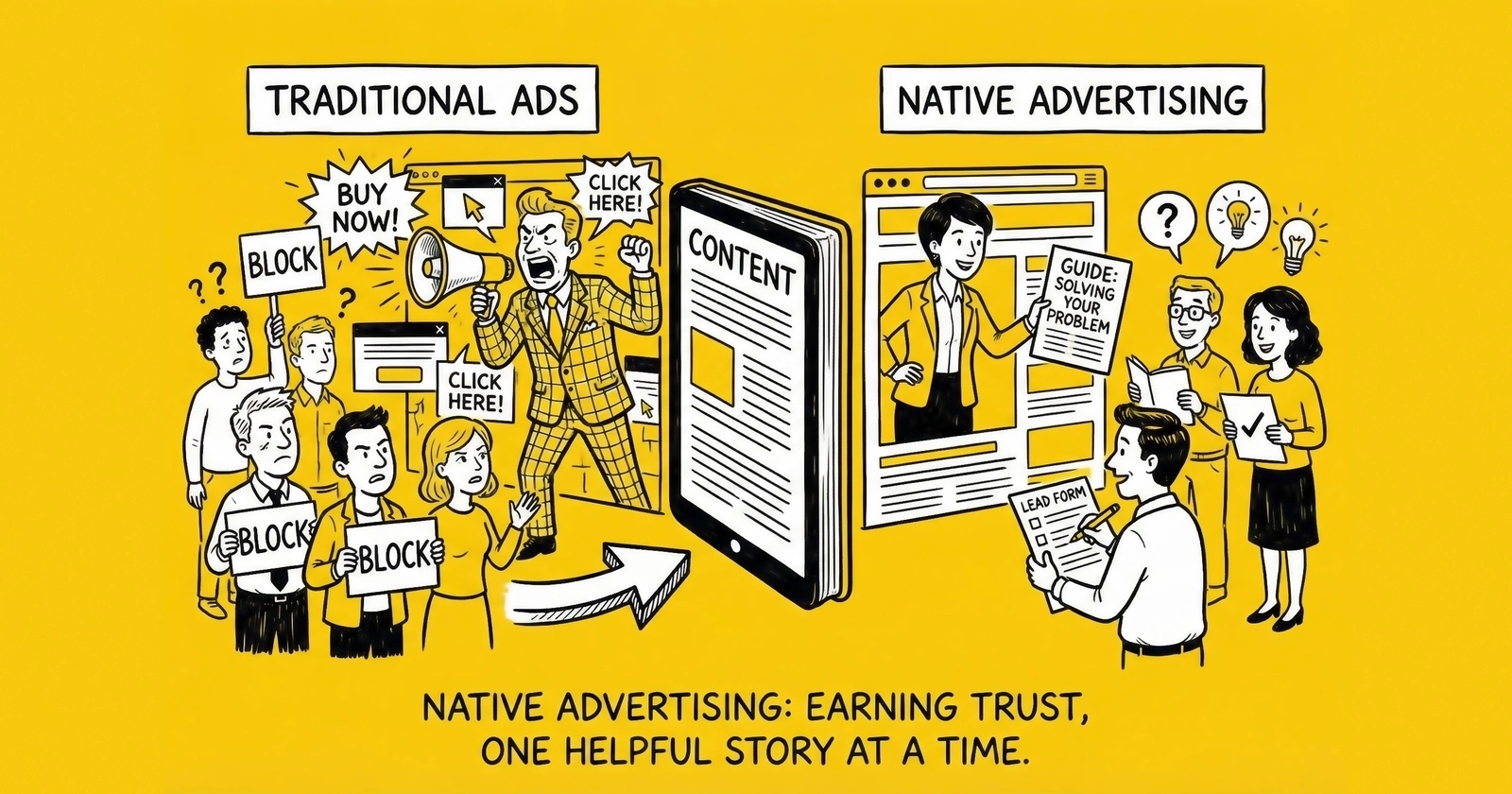
Native advertising is paid content that matches the form and function of the platform where it appears. Unlike display ads – which sit in designated ad slots and scream “advertisement” – native ads blend into the surrounding editorial content.
When you scroll through a news article and see “Recommended For You” or “Sponsored Content” at the bottom, those are native ads. They look like article links. They function like article links. The only difference is that an advertiser paid to place them there.
Native Ad Formats for Lead Generation
Content Recommendation Widgets
The most common native format. Platforms like Taboola and Outbrain place these widgets on premium publisher sites. Typical placement: end of article, sidebar, or mid-article break.
The format consists of a headline (25-70 characters), thumbnail image (usually 1200x628 or similar), brand/advertiser disclosure, and publisher site context showing where the ad appears.
In-Feed Native Ads
Ads that appear within a publisher’s content feed, mimicking the appearance of organic content. Common on social platforms and content aggregators. These integrate smoothly with the user’s scrolling experience.
Sponsored Content
Full-length articles or videos created by the advertiser, published on the host platform. Highest editorial burden, but also highest engagement. These work well for complex products requiring education.
Why Native Works for Lead Generation
Native advertising solves three problems that plague other channels:
Problem 1: Ad Blindness
Consumers have trained themselves to ignore banner ads. Average display ad CTR: 0.1%. Native ads achieve 0.2-0.4% CTR – double to quadruple the engagement – because they integrate with content consumption patterns. Users process native ads as content recommendations rather than interruptions.
Problem 2: Platform Dependency
When 80% of your traffic comes from Meta and Google, you are one policy change away from business disruption – a core principle of lead source diversification. Native diversifies acquisition across hundreds of publisher sites. If one publisher drops your campaign, others continue running.
Problem 3: Cost Escalation
Google Search CPCs increase 10-15% annually in competitive verticals. Native CPCs have remained relatively stable because inventory continues expanding as publishers adopt content recommendation widgets.
Major Native Advertising Platforms
Four platforms dominate the native advertising space for lead generation. Each has distinct strengths, minimum requirements, and ideal use cases.
Taboola
Taboola is the largest native advertising platform by reach, claiming 500+ million daily active users across 9,000+ premium publisher properties. Major partners include USA Today, Bloomberg, NBC, and The Weather Channel.
Key Statistics
- Global reach: 1.4 billion unique users monthly
- Publisher network: 9,000+ sites
- Monthly page views: 500 billion+
- Minimum campaign spend: Typically $500-$1,000/day for performance campaigns
Performance Benchmarks
- CPC range: $0.30-$1.50
- CTR range: 0.15-0.50%
- Conversion rates: 2-8% on well-optimized landing pages
Strengths for Lead Generation
Taboola offers the largest premium publisher inventory with advanced audience targeting including interest, demographic, and behavioral segments. The platform provides strong retargeting capabilities and Attentive mode that tracks scroll depth and engagement. Smart Bid algorithms optimize toward CPA goals once sufficient conversion data accumulates.
Best Verticals
Insurance (particularly Medicare and life), solar, legal, and financial services perform well. High-consideration purchases where consumers research extensively benefit from Taboola’s content-driven approach.
Account Requirements
Taboola requires advertiser approval and reviews all creatives. Expect 24-48 hour review cycles. Financial and insurance advertisers need additional compliance documentation.
Outbrain
Outbrain invented the content recommendation widget and remains the second-largest platform. The company merged with Taboola in 2024, though the platforms continue operating independently. Outbrain reaches over 240 million unique monthly users in the US.
Key Statistics
- US reach: 240+ million monthly unique users
- Publisher network: CNN, MSN, The Washington Post, Fox News
- Focus: Premium publishers with strong brand safety scores
Performance Benchmarks
- CPC range: $0.40-$2.00
- CTR range: 0.20-0.60%
- Generally higher CPC but higher lead quality than Taboola
Strengths for Lead Generation
Outbrain’s premium publisher focus delivers higher-income audiences. Strict content quality standards reduce low-quality competitor ads. Conversion Bid Strategy enables CPA-optimized bidding, and the platform shows strong mobile performance with engagement-based pricing available.
Best Verticals
Financial services, insurance, B2B lead generation, education, and high-consideration consumer services. The premium publisher mix delivers audiences with higher purchasing power.
Account Requirements
Similar to Taboola, Outbrain reviews all advertisers and creatives. Editorial standards are stricter – clickbait or misleading headlines get rejected.
MGID
MGID is a global native platform with strong presence in emerging markets and a more permissive content policy. For US lead generation, MGID offers competitive CPCs on a smaller publisher network.
Key Statistics
- Global reach: 850+ million monthly unique users
- Publisher network: 32,000+ websites globally
- Founded: 2008 (original native ad pioneer)
Performance Benchmarks
- CPC range: $0.15-$0.80
- CTR range: 0.10-0.35%
- Higher volume, lower average quality than premium platforms
Strengths for Lead Generation
MGID delivers lower CPCs than Taboola/Outbrain (often 30-50% cheaper) with a faster approval process (12-24 hours). More flexible content guidelines allow testing approaches that premium platforms might reject. Selective bidding by publisher site enables granular optimization.
Best Verticals
Health and wellness, supplements, insurance comparison, finance, and home services. MGID works well for advertisers with broad geographic targeting and aggressive CPL targets.
Considerations
Publisher quality varies more widely. Not all inventory meets premium brand safety standards. Requires more hands-on optimization to maintain quality.
Revcontent
Revcontent positions itself as a premium alternative with strict publisher quality standards. Smaller than Taboola/Outbrain but higher average publisher quality.
Key Statistics
- Monthly reach: 250+ billion content recommendations
- Publisher partners: Newsweek, Weather.com, Sports Illustrated, Tribune Publishing
- Focus: US-centric premium publishers
Performance Benchmarks
- CPC range: $0.25-$1.00
- CTR range: 0.20-0.50%
- Often delivers best cost-per-conversion for mid-tier budgets
Strengths for Lead Generation
Premium publisher inventory with strong brand safety, higher engagement rates due to selective publisher onboarding, ROAS-focused optimization, strong customer support for mid-market advertisers, and typically fewer competing advertisers per placement.
Best Verticals
Insurance, finance, home services, and B2B. Revcontent’s premium focus works well for advertisers who need brand-safe placement.
Platform Comparison Summary
| Platform | Reach | CPC Range | Best For | Minimum Budget |
|---|---|---|---|---|
| Taboola | Largest (500M+ daily) | $0.30-$1.50 | Scale, broad targeting | $500+/day |
| Outbrain | Premium (240M monthly US) | $0.40-$2.00 | Premium audiences | $500+/day |
| MGID | Global (850M monthly) | $0.15-$0.80 | Cost efficiency | $100+/day |
| Revcontent | Mid-tier (250B recs) | $0.25-$1.00 | Premium on budget | $200+/day |
Native vs. Display vs. Search: When to Use Each
Each traffic channel serves a different purpose. Understanding where native fits in your acquisition stack prevents misallocated budget.
Search Advertising (Google/Bing)
Intent level: High. Users are actively searching for solutions.
Best for: Bottom-of-funnel capture. When someone searches “auto insurance quotes,” they want to buy now.
Limitations: Expensive ($4-50+ CPC depending on vertical). Limited scale at any given CPC. High competition.
Use search when: You need high-intent leads immediately and have the budget to compete.
Display Advertising
Intent level: Low. Users are not actively seeking your product.
Best for: Retargeting audiences who have already visited your site. Brand awareness at scale.
Limitations: Low CTR (0.05-0.10%). Banner blindness. Poor conversion rates on cold traffic.
Use display when: You have retargeting audiences or need cheap impressions for awareness.
Native Advertising
Intent level: Medium. Users are consuming content, not actively shopping – but open to discovery.
Best for: Top and mid-funnel lead generation. Reaching audiences during research and consideration phases.
Advantages: Cheaper than search, higher engagement than display. Access to premium publisher audiences.
Use native when: You have content that educates and converts. You need diversification beyond Google/Meta.
The Acquisition Funnel Mapping
| Funnel Stage | Primary Channel | Native Role |
|---|---|---|
| Awareness | Social, Native, Display | Primary driver |
| Consideration | Native, SEO, Content | Primary driver |
| Decision | Search, Retargeting | Supporting role |
| Purchase | Search, Direct | Minimal role |
Native advertising excels at filling the top of the funnel with consumers who are researching but not yet ready to buy. These consumers require nurturing – which is why landing page strategy matters so much.
CPL Benchmarks for Native Advertising
Native advertising CPL benchmarks vary widely by vertical, landing page quality, and optimization level. These ranges reflect what experienced practitioners achieve after initial testing and optimization.
Insurance Verticals
| Sub-Vertical | CPL Range (Native) | CPL Range (Search) | Native Savings |
|---|---|---|---|
| Medicare Advantage | $20-$45 | $40-$80 | 40-50% |
| Auto Insurance | $15-$40 | $30-$75 | 40-60% |
| Life Insurance | $25-$60 | $50-$150 | 50-60% |
| Health Insurance | $18-$35 | $35-$70 | 45-55% |
| Home Insurance | $20-$50 | $45-$100 | 50-55% |
Medicare and life insurance perform exceptionally well on native. The audience (typically 55+) reads content on news sites where native ads appear. The educational approach matches how these consumers research.
Financial Services
| Sub-Vertical | CPL Range (Native) | CPL Range (Search) | Native Savings |
|---|---|---|---|
| Mortgage | $25-$70 | $60-$200+ | 55-65% |
| Refinance | $30-$80 | $75-$250+ | 60-70% |
| Personal Loans | $15-$40 | $30-$100 | 50-60% |
| Debt Relief | $20-$50 | $40-$120 | 50-60% |
Mortgage and refinance show the largest CPL savings on native. Rate-sensitive consumers research extensively, and native’s content-driven approach captures them during that research phase.
Home Services
| Sub-Vertical | CPL Range (Native) | CPL Range (Search) | Native Savings |
|---|---|---|---|
| Solar | $30-$80 | $75-$200 | 60-65% |
| Roofing | $20-$60 | $50-$150 | 60% |
| HVAC | $25-$70 | $60-$180 | 55-60% |
| Windows | $20-$55 | $45-$120 | 50-55% |
Solar leads are particularly effective on native. Homeowners research solar for months before deciding. Capturing them early in the research phase with educational content yields high-quality leads at significant savings.
Legal Verticals
| Sub-Vertical | CPL Range (Native) | CPL Range (Search) | Native Savings |
|---|---|---|---|
| Personal Injury | $150-$400 | $300-$1,000+ | 50-60% |
| Mass Torts | $100-$300 | $200-$800 | 50-65% |
| Workers Comp | $80-$200 | $150-$500 | 45-55% |
Legal remains expensive on all channels, but native offers substantial savings. Mass tort campaigns perform especially well – specific conditions (Camp Lejeune, AFFF exposure) can be targeted with informational content.
Factors That Impact Native CPL
Landing Page Quality: A well-designed advertorial that educates and pre-qualifies can achieve 2-3x the conversion rate of a direct lead form. This alone can cut CPL by 50%.
Headline Quality: Top-performing headlines achieve 0.4-0.6% CTR. Average headlines get 0.1-0.2%. That 3x difference in CTR translates directly to CPL.
Image Selection: Authentic images outperform stock photos by 30-50% on CTR. Human faces typically outperform objects.
Geographic Targeting: Broad geographic targeting (national) typically achieves lower CPCs but may not match buyer geographic requirements. Local campaigns cost more per click but convert higher.
Content Requirements: The Advertorial Approach
Native advertising fails when treated like display advertising. The users clicking native ads expect content, not a sales pitch.
Why Advertorials Outperform Direct Landing Pages
When a user clicks a native ad, they are on a content consumption journey. They were reading a news article. They clicked a headline that promised more information. If they land on a form asking for personal information, the experience breaks.
The data is clear:
- Direct landing pages on native traffic: 1-3% conversion rate
- Advertorial pre-landers: 4-10% conversion rate on advertorial, then 15-30% on form
- Net result: Advertorial approach delivers 30-50% more leads per click
Advertorial Structure That Converts
Length: 800-1,500 words. Long enough to provide value, short enough to maintain attention.
Headline: Matches the native ad headline. Consistency prevents bounce.
Opening Hook: Address the reader’s problem or curiosity in the first two sentences.
Problem Agitation: Expand on the challenge the reader faces. Build emotional connection.
Solution Introduction: Present your solution as the logical answer. Do not hard-sell.
Social Proof: Include testimonials, statistics, expert quotes, or case studies.
Soft CTA (Mid-Article): A button or link for ready-to-act readers.
Strong CTA (End): Clear call to action with the form or next step.
Advertorial Content Types by Vertical
Insurance
- “New Law Helps [State] Residents Save on Auto Insurance”
- “Seniors: Don’t Miss Medicare Open Enrollment Deadline”
- “5 Things Your Insurance Agent Won’t Tell You”
Solar
- “How Homeowners Are Eliminating Electric Bills in 2025”
- “Federal Solar Tax Credit: What Changes in 2026”
- “Solar Myths vs. Reality: What the Numbers Actually Show”
Finance
- “Interest Rates Expected to Shift: What Homeowners Should Know”
- “New Debt Relief Programs Available in [State]”
Legal
- “Camp Lejeune Families: Deadline for Claims Approaching”
- “AFFF Firefighting Foam Linked to Cancer – Are You Eligible?”
Landing Page Strategy for Native Traffic
Native traffic requires a different landing page approach than search traffic. The psychological state of the visitor differs fundamentally.
The Two-Step Conversion Model
Step 1: Advertorial (Pre-Lander)
Purpose: Transform curious clicker into informed prospect.
Elements:
- Editorial-style design (matches news site experience)
- Educational content that builds trust
- Soft selling that positions your offer as the solution
- Mid-page CTA for ready prospects
- End-of-article strong CTA for those who read through
Step 2: Lead Form
Purpose: Capture qualified lead information.
Elements:
- Minimal fields (phone, email, zip code for first step)
- Multi-step form for additional qualification
- Progress indicator showing completion status
- Trust signals (SSL, privacy statement, partner logos)
- Clear value proposition restated
Landing Page Performance Benchmarks
| Metric | Direct Form | Advertorial + Form | Improvement |
|---|---|---|---|
| Page 1 Conversion | 2-4% | 5-10% | +100-150% |
| Form Conversion | N/A (single step) | 20-35% | N/A |
| Lead Quality Score | 60-70 | 75-85 | +15-20% |
The advertorial approach delivers significantly higher lead quality. Leads who read 800+ words of content before filling out a form are more informed and more committed.
Mobile Optimization
70%+ of native traffic comes from mobile devices. Landing pages must be built mobile-first.
Mobile Requirements:
- Load time under 3 seconds (ideally under 2)
- Tap-friendly buttons (minimum 44px height)
- Single-column layout
- Large, readable fonts (16px minimum)
- Click-to-call integration
Page Speed Impact:
- 3-second load: 20-30% conversion drop
- 5-second load: 40-50% conversion drop
- 7+ seconds: 60%+ abandonment
Native users are less patient than search users. They clicked out of curiosity, not urgent need. Slow pages kill native campaigns.
Compliance and Editorial Guidelines
Native advertising operates under both legal requirements and platform-specific policies. Violations can result in campaign suspension, account bans, or regulatory action.
Platform Content Policies
Universal Prohibited Content: Misleading claims or fake news, malware or phishing, illegal products or services, discrimination or hate speech, counterfeit goods.
Category-Specific Restrictions
Insurance: Claims must be substantiated. “Save up to 40%” requires documentation. State-specific regulations must be followed.
Finance: APR disclosure requirements apply. TILA and state lending regulations govern claims.
Health: FDA guidelines apply. No unsubstantiated cure claims. Supplements require appropriate disclaimers.
Legal: Attorney advertising rules vary by state. “Free consultation” claims must be honored. Mass tort claims must match actual eligibility criteria.
Headline Best Practices
Approved Patterns
- “New Program Helps [State] Residents Save on [Product]”
- “[Year] [Product] Guide: What [Audience] Need to Know”
- “How [Audience] Are [Achieving Benefit]”
Rejected Patterns
- “You Won’t Believe…” (clickbait)
- “Doctors Hate This…” (misleading)
- “Weird Trick…” (clickbait)
- Fake urgency without basis
FTC Disclosure Requirements
Advertorials must be clearly marked as “Advertisement” or “Sponsored Content” at the top. Disclosure must be clear and conspicuous, near the headline (not buried in footer), and in readable font size.
TCPA Compliance on Native Leads
Native lead generation requires the same TCPA compliance as any other source:
Prior Express Written Consent (PEWC)
- Clear, conspicuous consent language on the form
- Specific identification of parties who may call
- Disclosure that automated calls/texts may be used
- Consent cannot be a condition of purchase
Documentation
- TrustedForm or Jornaya consent certificates
- Session recordings of form completion
- IP address and timestamp logging
- Retention for 5+ years
Measuring Native Performance
Primary Metrics
Cost Per Click (CPC): What you pay for each click. Native CPCs typically range from $0.15-$2.00.
Click-Through Rate (CTR): Percentage of impressions that become clicks. Benchmark: 0.15-0.50%.
Conversion Rate (CVR): Percentage of clicks that become leads. Benchmark: 2-8% depending on funnel.
Cost Per Lead (CPL): Total cost to generate one lead.
Attribution Challenges
Native traffic presents unique attribution challenges, as explored in our multi-touch attribution guide. Native platforms count view-through conversions (user saw ad, converted later via different channel), which inflates reported performance. Use platform data for directional trends, but trust your own tracking for true attribution.
Native often touches consumers early in their journey. A user might see a native ad on Monday, click and read the advertorial, search your brand on Wednesday, and convert via Google. Your attribution model determines whether native looks profitable.
Recommended Approach: Use a 7-day click window and ignore view-through conversions for performance evaluation.
A/B Testing Framework
Headline Testing: Test 5-10 headline variations per campaign. Winners typically achieve 2-3x the CTR of losers. Rotate losers out weekly.
Image Testing: Test 3-5 images per headline. Authentic images typically beat stock. Human faces typically beat objects.
Landing Page Testing: Test advertorial length (short vs. long), CTA placement, and form field count. Changes here impact conversion rate 20-50%. For detailed methodology, see our guide to A/B testing lead generation forms.
Platform-Specific Optimization: The NATIVE Framework
While native platforms share core mechanics, each platform requires tailored optimization approaches. The NATIVE framework provides platform-specific tactics for Taboola and Outbrain that go beyond basic setup.
N – Navigating Taboola’s Algorithm
Taboola’s algorithm prioritizes engagement metrics differently than other platforms. Understanding these priorities enables strategic optimization.
Taboola Ranking Factors (Weighted by Importance):
| Factor | Weight | Optimization Approach |
|---|---|---|
| CTR (Click-Through Rate) | 35-40% | Headline and image testing at scale |
| Engagement Score | 20-25% | Time on page, scroll depth, bounce rate |
| Conversion Rate | 15-20% | Landing page optimization |
| Publisher Fit | 10-15% | Site category targeting |
| Bid Amount | 10-15% | Strategic bidding by segment |
Taboola-Specific Optimization Tactics:
Attentive Audience Targeting: Taboola’s Attentive Audiences feature identifies users who demonstrate high engagement patterns. Enable this feature and bid 15-25% higher for Attentive segments – these users typically convert at 2x the rate of standard audiences.
SmartBid Calibration: Taboola’s SmartBid algorithm requires a learning period of 15-25 conversions per campaign before optimization kicks in. During learning, expect CPLs 30-50% above target. Do not pause campaigns prematurely – allow the algorithm to learn.
Publisher Blocking Strategy: After accumulating 50-100 clicks per publisher, block sites with CTR below 0.10% or conversion rates below 1%. Taboola’s broad network includes lower-quality inventory that drags down campaign performance if not actively managed.
Taboola Headline Formula:
High-performing Taboola headlines follow specific patterns:
| Pattern | Example | Typical CTR |
|---|---|---|
| State + Year + Topic | ”California Seniors: 2026 Medicare Changes” | 0.35-0.50% |
| Question + Benefit | ”Paying Too Much for Auto Insurance?“ | 0.30-0.45% |
| Number + Action | ”5 Ways Homeowners Are Eliminating Electric Bills” | 0.25-0.40% |
| Authority + Discovery | ”Experts Reveal Hidden Solar Incentives” | 0.20-0.35% |
Image Optimization for Taboola:
- Authentic images outperform stock photos by 40-60%
- Human faces (not models) increase CTR by 20-35%
- Avoid text overlays – they reduce approval rates and performance
- Test image crops aggressively – small framing changes produce 50%+ CTR variance
A – Advancing on Outbrain
Outbrain’s premium publisher focus requires different optimization compared to Taboola’s volume approach.
Outbrain Quality Signals:
Outbrain weights quality signals more heavily than Taboola, which affects campaign structure decisions.
| Quality Factor | Outbrain Emphasis | Taboola Emphasis |
|---|---|---|
| Content quality | Very high | Moderate |
| Landing page experience | Very high | High |
| Publisher brand safety | Very high | Moderate |
| Historical advertiser performance | High | Moderate |
| Bid competitiveness | Moderate | High |
Outbrain-Specific Tactics:
Conversion Bid Strategy (CBS): Outbrain’s CPA optimization tool. Unlike Taboola’s SmartBid, CBS requires 30-40 conversions for optimal learning. Set initial bids 20% above target CPA to ensure sufficient volume during learning.
Interest Targeting Granularity: Outbrain offers more granular interest categories than Taboola. Layer interests rather than relying on broad targeting:
- First layer: Demographic (age, income indicators)
- Second layer: Content interest (finance, health, home)
- Third layer: Behavioral (recent searchers, in-market signals)
Premium Publisher Emphasis: Outbrain’s premium publishers (CNN, Washington Post, Fox News) often deliver 30-50% better conversion rates than network average. Create separate campaigns targeting premium inventory with higher bids.
Outbrain Headline Constraints:
Outbrain limits headlines to 70 characters (vs. Taboola’s 150), requiring tighter copywriting:
| Character Count | Optimization Approach |
|---|---|
| 50-60 characters | Optimal for most placements |
| 60-70 characters | Acceptable, may truncate on mobile |
| 70+ characters | Will be rejected |
High-Performing Outbrain Headlines:
- Keep under 60 characters for mobile safety
- Lead with benefit, not curiosity
- Avoid superlatives that trigger editorial review
- Use state specificity when possible (“NY Homeowners” vs. “Homeowners”)
T – Testing Velocity Requirements
Native advertising requires higher testing velocity than search due to creative fatigue dynamics.
Minimum Testing Framework:
| Campaign Phase | Headlines Active | Images Active | Test Frequency |
|---|---|---|---|
| Launch (Week 1-2) | 10-15 | 5-8 | Daily review |
| Optimization (Week 3-4) | 8-12 | 4-6 | 3x weekly |
| Mature (Week 5+) | 5-8 | 3-5 | Weekly |
| Refresh (Every 60-90 days) | 15-20 | 8-10 | Reset testing |
Creative Testing Protocol:
- Launch with variety: Start campaigns with 10+ headlines and 5+ images
- Allow learning period: Run each creative for minimum 1,000 impressions before judging
- Kill decisively: Pause creatives below 70% of top performer CTR
- Clone winners: Create 3-5 variations of top headlines (different angles, word order)
- Rotate images: Swap images on winning headlines to extend creative life
- Track fatigue: Monitor CTR trends – pause when declining 20%+ from peak
Headline Variation Techniques:
| Original | Variation Type | New Version |
|---|---|---|
| ”Seniors: New Medicare Rule Saves Money” | Question format | ”Are You Missing This Medicare Savings Rule?" |
| "Seniors: New Medicare Rule Saves Money” | State-specific | ”CA Seniors: New Medicare Rule Saves Money" |
| "Seniors: New Medicare Rule Saves Money” | Year addition | ”2026 Medicare Rule Helping Seniors Save" |
| "Seniors: New Medicare Rule Saves Money” | Authority frame | ”Medicare Experts: This Rule Saves Seniors Money” |
I – Intent Signal Optimization
Native audiences are in content-consumption mode, not purchase mode. Optimization must account for different intent levels.
Intent Segmentation Strategy:
| Intent Level | Audience Signal | Bidding Approach | Landing Page Approach |
|---|---|---|---|
| High | Recent search behavior, in-market | Bid premium (20-30% above base) | Direct to form after short intro |
| Medium | Interest-based targeting | Standard bid | Full advertorial with mid-page CTA |
| Low | Broad demographic | Bid discount (20-30% below base) | Long-form content with bottom CTA |
Platform Intent Signals:
Taboola Intent Signals:
- Taboola Select (premium engaged users)
- Attentive Audiences (high-engagement behavior)
- Recent Converters (users who converted on similar offers)
Outbrain Intent Signals:
- Outbrain Interest Graph (content consumption patterns)
- Lookalike Audiences (similar to converters)
- Custom Audiences (CRM upload retargeting)
V – Vendor Publisher Management
Publisher quality varies dramatically within native networks. Active publisher management significantly impacts performance.
Publisher Analysis Framework:
| Metric | Threshold for Action | Action |
|---|---|---|
| CTR below 0.08% | After 500 impressions | Block publisher |
| Conversion rate below 0.5% | After 20 clicks | Block publisher |
| Bounce rate above 85% | After 50 sessions | Block publisher |
| Time on page below 15 seconds | After 50 sessions | Block publisher |
Publisher Tier Strategy:
Create three publisher tiers with different bid modifiers:
Tier 1 – Premium (bid +20-30%):
- Major news sites (CNN, Fox, MSNBC)
- Financial publications (Bloomberg, MarketWatch)
- Health/lifestyle (WebMD, Healthline)
Tier 2 – Standard (base bid):
- Regional news sites
- Niche interest publications
- Mid-tier lifestyle sites
Tier 3 – Value (bid -20-30%):
- Content aggregators
- Smaller niche sites
- International publishers with US traffic
Publisher Whitelisting:
After 4-6 weeks of broad testing, create whitelist campaigns targeting only top-performing publishers. Typical results:
- 30-50% CPL reduction vs. broad targeting
- 20-30% volume reduction (acceptable trade-off)
- More consistent daily performance
E – Economic Model Calibration
Native economics differ from search. Proper calibration prevents incorrect optimization decisions.
Native vs. Search Economic Comparison:
| Metric | Native Typical | Search Typical | Implication |
|---|---|---|---|
| CPC | $0.30-$1.50 | $2-$15+ | Native needs higher volume |
| CTR | 0.15-0.50% | 2-8% | Native needs more impressions |
| CVR (click to lead) | 2-8% | 8-20% | Native requires better landing pages |
| Lead quality score | 75-85 | 80-95 | Native needs advertorial qualification |
| Contact rate | 70-85% | 65-80% | Native often higher (pre-qualified) |
True CPL Calculation for Native:
Native CPL requires accounting for unique cost factors:
| Cost Component | Typical Range | Example (1,000 leads) |
|---|---|---|
| Media spend | Base cost | $35,000 ($35 CPL) |
| Advertorial hosting | $50-$200/month | $150 |
| Creative production | $500-$2,000/month | $1,000 |
| Platform fees | Included in CPC | $0 |
| Compliance (TrustedForm) | $0.15-$0.30/lead | $225 |
| Returns (8-12%) | $2.80-$4.20/lead | $3,500 |
| True CPL | $39.88 |
Native’s lower media CPL often results in comparable true CPL to search when all costs are included. The advantage lies in diversification and scale potential, not necessarily lower absolute cost.
Break-Even Analysis:
Calculate native break-even before scaling:
- Determine buyer acceptance rate: What percentage of leads will buyers accept? (Target: 85%+)
- Calculate effective revenue per lead: Sale price × acceptance rate
- Add all costs: Media + creative + compliance + returns
- Calculate margin: Revenue – costs
Example:
- Sale price: $42/lead
- Acceptance rate: 88%
- Effective revenue: $36.96
- Total cost: $39.88
- Margin: -$2.92 (unprofitable at current optimization)
This analysis reveals whether optimization or pricing adjustment is needed before scaling.
Scaling Native Campaigns
Scaling native advertising differs from scaling search or social. The dynamics of inventory, creative fatigue, and platform algorithms require specific approaches.
The Scaling Sequence
Phase 1: Validation ($50-100/day)
Objective: Prove the funnel works. Run traffic to a single platform. Test 10+ headlines and 5+ images. Identify winning combinations. Success threshold: CPL within 30% of target, with positive ROAS.
Phase 2: Optimization ($100-500/day)
Objective: Maximize efficiency before scale. Kill underperforming creatives. Add new variations of winners. Test landing page improvements. Success threshold: CPL at or below target, consistent ROAS.
Phase 3: Horizontal Expansion ($500-2,000/day)
Objective: Expand within the platform. Add new targeting segments (different demographics, interests). Test new publisher categories. Success threshold: Maintain CPL while increasing volume 3-5x.
Phase 4: Platform Expansion ($2,000-10,000/day)
Objective: Diversify across platforms. Launch proven creatives on secondary platforms (MGID, Revcontent). Adapt to platform-specific requirements. Success threshold: 2+ platforms delivering at target CPL.
Managing Creative Fatigue
Native ads fatigue faster than search ads. Users see them repeatedly in content feeds.
Fatigue Indicators: CTR declining week-over-week, CPC increasing to maintain position, CPL creeping up despite stable conversion rate.
Fatigue Prevention: Rotate 5-10 active creatives per campaign. Add 2-3 new creatives weekly. Pause creatives when CTR drops 30% from peak. Complete creative overhaul every 60-90 days.
Geographic Optimization
Match geographic targeting to buyer requirements:
- Broad national: cheapest CPC, lowest qualification
- State-level: moderate CPC, matches many buyer requirements
- DMA-level: higher CPC, matches local service areas
- Zip code-level: highest CPC, precise targeting
Running national when buyers need specific states wastes budget on unmarketable leads.
Frequently Asked Questions
What is native advertising for lead generation?
Native advertising for lead generation uses content-style ads on premium publisher websites to capture consumer information. Unlike banner ads, native ads blend with surrounding editorial content, appearing as “recommended” or “sponsored” articles. Users click expecting informational content, land on advertorials that educate them about a product or service, then complete lead forms. This approach captures consumers during research phases at 40-60% lower cost than search advertising.
How do Taboola and Outbrain differ for lead generation?
Taboola offers the largest reach (500+ million daily users) and more flexible content policies, making it better for scale and testing. Outbrain focuses on premium publishers with stricter editorial standards, delivering higher-income audiences at slightly higher CPCs. For lead generation, many practitioners start with Taboola for volume, then add Outbrain for quality. After the 2024 merger, the platforms remain operationally separate.
What CPL should I expect from native advertising?
Native advertising CPLs run 40-65% lower than search advertising for most verticals. Medicare leads average $20-45 on native vs. $40-80 on search. Auto insurance runs $15-40 vs. $30-75. Solar averages $30-80 vs. $75-200. Legal leads show the biggest savings: personal injury at $150-400 on native vs. $300-1,000+ on search. These benchmarks assume optimized campaigns – initial testing typically runs 30-50% higher.
Do I need an advertorial for native traffic?
Yes, advertorials significantly outperform direct landing pages for native traffic. Users clicking native ads expect content, not immediate sales pitches. Advertorials (800-1,500 word educational articles) achieve 5-10% conversion rates compared to 2-4% for direct forms. More importantly, leads from advertorial funnels score 15-20% higher on quality metrics.
What are the minimum budgets for native platforms?
Taboola and Outbrain typically require $500-1,000 per day for performance campaigns to gather sufficient data for optimization. MGID and Revcontent accept smaller budgets starting at $100-200 per day. However, meaningful testing requires $2,000-5,000 total spend to validate a funnel – budget for 50-100 conversions before judging campaign viability.
How do native advertising compliance requirements differ from other channels?
Native advertising requires the same TCPA consent documentation as other channels, plus additional FTC disclosure requirements. Advertorials must be clearly marked as “Advertisement” or “Sponsored Content” at the top of the page. All claims must be substantiated – particularly for insurance, finance, and legal. Platform-specific policies add another layer: Taboola and Outbrain reject clickbait headlines and misleading claims. Budget 24-48 hours for creative review.
How long before native campaigns become profitable?
Expect 4-8 weeks from launch to profitability for most campaigns. Week 1-2: Initial testing, high CPLs, gathering data. Week 3-4: Optimization, killing losers, scaling winners. Week 5-8: Refinement, improving landing pages, achieving target CPLs. Campaigns not showing positive trends by week 4 typically have fundamental issues requiring strategic changes rather than continued optimization.
Can I run the same creatives across all native platforms?
You can use the same creative concepts, but platform-specific adaptation improves performance. Taboola allows longer headlines (up to 150 characters); Outbrain limits to 70 characters. Image size requirements vary. More importantly, audience quality differs – headlines that work on MGID’s broader inventory may underperform on Outbrain’s premium sites.
How do I measure native advertising attribution accurately?
Use first-party tracking with 7-day click windows. Ignore view-through conversions for performance measurement – they inflate results. Implement UTM parameters for every native link. Use TrustedForm or Jornaya to document lead source. Track leads through to buyer feedback. Native’s true value often appears in downstream metrics: leads from native frequently show higher contact rates because the advertorial pre-qualifies intent.
What is the biggest mistake advertisers make with native?
Treating native like display advertising – using hard-sell landing pages, ignoring content quality, and measuring only last-click conversions. Native works because users are in content-consumption mode, not shopping mode. Advertisers who invest in quality advertorials, test headlines systematically, and evaluate full-funnel performance see 2-3x better results than those who just “run some native ads.”
Key Takeaways
-
Native advertising offers 40-65% lower CPLs than search for most lead generation verticals, with Medicare, solar, and legal showing the largest savings.
-
Content drives native success. Advertorials that educate before selling achieve 5-10% conversion rates vs. 2-4% for direct landing pages – and deliver higher quality leads.
-
The big four platforms serve different needs. Taboola for scale, Outbrain for premium audiences, MGID for cost efficiency, Revcontent for mid-market premium. Most practitioners run two or more.
-
Creative fatigue is real. Rotate 5-10 headline/image combinations per campaign, add new creatives weekly, and plan complete overhauls every 60-90 days.
-
Compliance has multiple layers. FTC disclosure requirements for advertorials, platform content policies, and TCPA consent documentation all apply. Budget 24-48 hours for creative review.
-
Scale follows validation. Prove the funnel at $50-100/day before expanding to $500-2,000/day. Horizontal expansion (new segments, publishers) comes before platform expansion.
-
Attribution requires discipline. Use 7-day click windows, ignore view-through conversions, and track leads through to buyer feedback for true performance measurement.
Native advertising represents a major diversification opportunity for lead generators over-dependent on Google and Meta. Those who master content-driven acquisition on these platforms access premium audiences at a fraction of search costs. The learning curve is real, but so is the payoff.