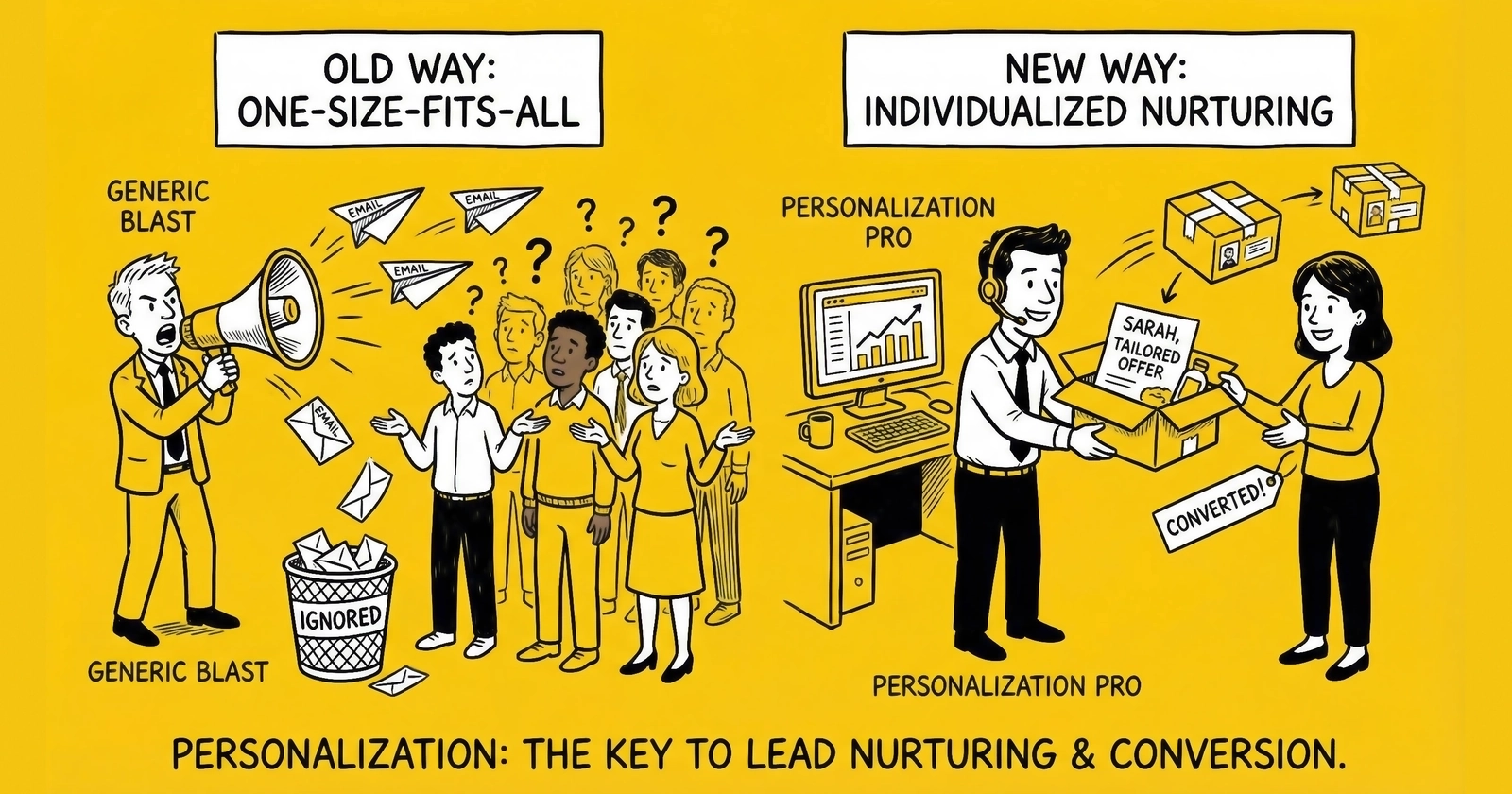
How personalized lead nurturing drives 72% conversion improvement and 47% larger purchases – implementation strategies for email, content, and automation.
Companies that excel at lead nurturing generate 50% more sales-ready leads at 33% lower costs. Yet only 35% of B2B marketers have an established lead nurturing strategy in place, and far fewer achieve true personalization. The gap between knowing personalization matters and executing it effectively represents both a challenge and an opportunity: personalization in lead nurturing can boost conversion rates by 63%, and aligning content with a prospect’s buyer journey stage drives 72% conversion improvement. For lead generation operators watching 79% of marketing leads fail to convert due to poor follow-up, personalized nurturing isn’t a nice-to-have. It’s the difference between generating leads and generating revenue.
The fundamental challenge of lead generation is that most leads aren’t ready to buy when captured. They’re researching, comparing, evaluating – anywhere in a buying cycle that stretches weeks or months. Without nurturing, these leads disappear into competitor funnels.
The Cost of Poor Follow-Up
The statistics are stark: 79% of marketing leads never convert into sales, and the primary cause is lack of effective lead nurturing. This isn’t lead quality failure – it’s follow-up failure. Leads that could become customers instead go cold, pursue alternatives, or lose interest entirely.
Consider the economics:
- Lead acquisition cost: $50-200 per lead (varies by vertical)
- Leads lost to poor nurturing: 79%
- Wasted acquisition investment: 79% of your lead gen spend
For an operator spending $100,000 monthly on lead acquisition, poor nurturing wastes $79,000 in purchased leads. Effective nurturing doesn’t cost money – it recovers money already spent.
Why Personalization Matters
Generic nurturing performs poorly because it treats all leads identically. But leads differ across multiple dimensions:
- Awareness stage: Some leads know exactly what they need; others are still defining the problem
- Purchase timeline: Some buy this week; others buy in six months
- Decision criteria: Some prioritize price; others prioritize features or service
- Information needs: Some need technical depth; others need executive summaries
- Communication preferences: Some respond to email; others engage via text or phone
Personalization acknowledges these differences and delivers relevant content to each lead based on their specific context. The result: dramatically higher engagement and conversion.
The Personalization Performance Gap
Research consistently demonstrates personalization’s impact:
| Metric | Generic Communication | Personalized Communication | Improvement |
|---|---|---|---|
| Reply rates | Baseline | 4-10x higher | 300-900% |
| Open rates | Industry average | 44.30% | Varies |
| Subject line response | Standard | +30.5% boost | 30.5% |
| Click-through rate | 3% | 8% | 167% |
| Conversion rates | Baseline | +63% | 63% |
| Sales-ready leads | Baseline | +50% at 33% lower cost | 50% volume, 33% cost reduction |
Why Most Companies Fail at Personalization
Despite clear ROI evidence, most companies fail to personalize effectively:
Data fragmentation: Customer data lives in multiple systems – CRM, email platform, website analytics, call recordings – that don’t integrate. Without unified data, personalization becomes impossible.
Manual processes: Only 5% of marketers have fully automated nurturing workflows. Manual personalization doesn’t scale, so companies default to generic communication.
Content limitations: Personalization requires content variants. Companies with limited content libraries can’t personalize because they have nothing to personalize with.
Strategic absence: Only 35% of B2B marketers have established lead nurturing strategies. Without strategy, personalization efforts lack direction.
Technology gaps: 66% of companies use marketing automation, but having automation doesn’t mean using it effectively. Many automation implementations remain basic.
McKinsey’s 5D Framework for Personalization
McKinsey’s personalization framework identifies five essential components: Data, Decisioning, Design, Distribution, and Measurement.
Data
Personalization begins with data infrastructure:
Customer data platform (CDP): Unifies data from multiple sources into single customer views. Without unified profiles, personalization fragments across channels.
Promotion history: What offers has this lead seen? What responses occurred? Previous engagement shapes future relevance.
Content engagement: Which content has this lead consumed? What topics interest them? Content history reveals preferences.
Behavioral signals: Website visits, email opens, content downloads, search queries – behavioral data indicates intent and timing.
Transaction data: For existing customers, purchase history enables relevant upsell and cross-sell personalization.
For lead generation, the data foundation requires capturing and integrating: lead source, capture form data, website behavior, email engagement, phone interactions, and buyer stage indicators.
Decisioning
Data enables personalization; decisioning determines what to do with it:
Propensity models: Predict likelihood of specific actions (purchase, response, engagement) based on lead characteristics and behavior.
Content propensity: Predict which content will resonate with specific leads based on similar lead patterns.
Timing models: Predict optimal engagement timing based on historical response patterns.
Channel models: Predict preferred communication channel (email, SMS, phone) based on previous engagement.
Offer propensity: Predict which offers will drive response, optimizing promotion strategy per lead.
Decision engines combine propensity outputs to select optimal next action for each lead at each moment.
Design
Design encompasses content creation and offer management:
Content production: Creating content variants for different segments, stages, and preferences. GenAI accelerates content creation 50x versus manual approaches, enabling personalization scale previously impossible.
Offer management: Cataloging, managing, and delivering targeted offers across channels. Offers should be flexible – tiered discounts, time-limited promotions, category-specific deals – to enable personalization.
Asset management: Centralized digital asset management (DAM) ensures content discoverability, proper versioning, and consistent deployment.
Distribution
Distribution delivers personalized content through appropriate channels:
Journey orchestration: Coordinating touchpoints across email, SMS, phone, web, and advertising to create coherent experiences rather than disconnected touches.
Real-time delivery: Processing customer signals instantly to optimize message and channel selection in the moment.
Template systems: Dynamic modular templates that render personalized content without manual intervention.
Cross-platform integration: Connecting multiple vendor systems (email, SMS, CRM, analytics) into unified workflows.
Measurement
Measurement validates ROI and enables optimization:
Incrementality testing: Measuring true personalization impact by comparing treated groups to control groups.
Content effectiveness: Analyzing which content drives engagement and conversion, enabling optimization.
Attribution: Understanding which touchpoints contribute to conversion across multi-touch journeys.
Real-time dashboards: Providing visibility for campaign optimization without waiting for periodic reports.
Lead Nurturing Personalization Strategies
Practical personalization strategies for lead generation nurturing:
1. Buyer Stage Personalization
Aligning content with buyer journey stage drives 72% conversion improvement. Map content to stages:
Awareness Stage (Problem Identification)
- Content: Educational content about the problem space
- Tone: Informative, not salesy
- Goal: Establish expertise, build trust
- Examples: Industry reports, trend analysis, problem definition articles
Consideration Stage (Solution Evaluation)
- Content: Comparison guides, case studies, solution overviews
- Tone: Helpful, consultative
- Goal: Position your solution favorably
- Examples: Competitor comparisons, customer success stories, ROI calculators
Decision Stage (Purchase Facilitation)
- Content: Pricing, implementation details, risk reduction
- Tone: Direct, action-oriented
- Goal: Remove purchase barriers
- Examples: Free trials, demos, guarantees, testimonials
Leads receiving stage-appropriate content progress faster than those receiving mismatched content.
2. Behavioral Trigger Personalization
Behavioral triggers enable real-time personalization based on lead actions:
Website behavior:
- Pricing page visits → Send pricing-related content or sales outreach
- Specific feature page views → Content about that feature
- Return visits after dormancy → Re-engagement sequence
- Cart abandonment → Recovery messaging
Email engagement:
- Opens without clicks → Refine content or subject lines
- Clicks on specific topics → More content on that topic
- Non-engagement → Channel switch (email to phone)
- Link-specific clicks → Related content or offer
Content consumption:
- Whitepaper download → Follow-up sequence on that topic
- Video completion → Next video in series
- Webinar registration → Pre-event preparation sequence
- Multiple content pieces on same topic → Sales-readiness signal
3. Segment-Based Personalization
Segment leads into groups with similar characteristics, then personalize by segment:
Industry segments:
- Insurance leads receive insurance-specific content and case studies – see our guide on insurance lead nurturing and converting cold leads
- Mortgage leads receive mortgage-specific examples
- Solar leads receive solar industry statistics
Company size segments:
- Enterprise leads receive enterprise-appropriate content (scalability, integration)
- SMB leads receive SMB-appropriate content (value, simplicity)
Role-based segments:
- Decision-makers receive ROI and strategic content
- Technical evaluators receive specification and integration content
- End-users receive usability and feature content
Geographic segments:
- Regional compliance considerations
- Local case studies and references
- Time-zone-appropriate send timing
4. Lead Score-Based Personalization
Lead scores indicate sales-readiness; personalize accordingly:
Low scores (early stage):
- Educational content focus
- Longer nurture sequences
- Lower outreach frequency
- Automated communication primarily
Medium scores (progressing):
- Solution-focused content
- Increasing frequency
- Mix of automated and personal outreach
- Case studies and social proof
High scores (sales-ready):
- Decision-stage content
- High-touch personal outreach
- Sales team engagement
- Offers and incentives to close
5. Historical Engagement Personalization
Previous interactions shape current personalization:
Content history:
- Leads who consumed specific content receive related content
- Leads who completed series receive next-level content
- Content format preferences (video vs. text) inform future delivery
Communication history:
- Channel that previously worked → prioritize that channel
- Timing that previously worked → maintain similar timing
- Content themes that resonated → continue those themes
Purchase history (existing customers):
- Previous purchases inform cross-sell relevance
- Purchase recency affects messaging urgency
- Customer lifetime value influences investment level
Email Nurturing Best Practices
Email remains the #1 channel for lead nurturing, with 69% of marketers relying on it. Optimizing email nurturing delivers outsized impact:
Subject Line Personalization
Hyper-personalized subject lines achieve 30.5% higher open rates:
Elements to personalize:
- First name (basic but effective)
- Company name (shows research)
- Industry or vertical
- Specific interest/topic
- Previous interaction reference
- Geographic reference
Examples:
- Generic: “Check out our new features”
- Personalized: “[First Name], here’s how [Company] can reduce lead response time”
- Hyper-personalized: “[First Name], your [Industry] competitors are using this approach”
Content Personalization
Personalized email content generates 4-10x more replies:
Content elements to personalize:
- Opening paragraph (acknowledge context)
- Body content (relevant to segment/stage)
- Case studies (same industry/size)
- Statistics (relevant to their situation)
- Call-to-action (appropriate for stage)
- Signature (appropriate sender)
Timing Personalization
Optimal send timing varies by lead:
Factors influencing timing:
- Time zone (obvious but often missed)
- Historical engagement patterns
- Industry norms (B2B vs. B2C)
- Day of week preferences
- Urgency level
Testing approach:
- Start with industry benchmarks
- Test variations (time of day, day of week)
- Monitor per-lead patterns
- Optimize based on individual behavior
Sequence Personalization
Lead nurturing sequences (drip campaigns) benefit from personalization. For detailed implementation guidance on building effective sequences, see our email drip campaigns guide for lead nurturing.
Sequence length: Longer for early-stage leads, shorter for sales-ready leads
Sequence pacing: Faster for high-intent leads, slower for early-stage leads
Exit conditions: Leads who convert, respond, or reach thresholds should exit sequences
Branch logic: Different paths based on engagement (engaged leads get different content than disengaged)
Multi-Channel Nurturing
While email dominates, multi-channel nurturing improves results:
SMS Nurturing
SMS complements email with immediacy and visibility:
Best applications:
- Time-sensitive offers
- Appointment reminders
- Short-form updates
- Re-engagement for email non-responders
Personalization opportunities:
- First name
- Timing based on preference
- Content based on interests
- Frequency based on engagement
Performance: SMS achieves higher open rates (98%+) but requires consent and restraint to avoid annoyance.
Phone Outreach
Phone remains powerful for high-value leads:
Personalization elements:
- Talking points based on lead intelligence
- Timing based on optimal contact windows
- Approach based on buyer persona
- Content based on stage and interests
AI enhancement: AI can provide call scripts personalized to lead data, suggested objection handling, and recommended next steps.
Retargeting
Advertising retargeting nurtures leads across the web:
Personalization opportunities:
- Ad creative based on viewed content
- Messaging based on buyer stage
- Offers based on engagement level
- Frequency based on recency
Integration: Retargeting works best when coordinated with email and other channels, not as isolated touchpoint.
Automation: The Personalization Enabler
Companies using automated lead nurturing see 451% increase in qualified leads. Automation doesn’t replace personalization – it enables personalization at scale.
Automation Capabilities
Marketing automation platforms enable:
Behavioral triggers: Automatic responses to specific actions (form submissions, page visits, email clicks)
Scoring automation: Automatic lead scoring based on engagement and attributes
Sequence automation: Drip campaigns that run without manual intervention
Content selection: Dynamic content based on lead attributes
Channel coordination: Multi-channel orchestration across email, SMS, web
For guidance on platform selection and implementation, see our comprehensive marketing automation guide covering Mailchimp, Marketo, and alternatives.
Implementation Reality
Despite automation’s benefits:
- 66% of companies use marketing automation
- But only 5% have fully automated nurturing workflows
- 91% of marketers say automation is essential for multi-channel nurturing
The gap between having automation and using it effectively represents significant opportunity.
Getting Started with Automation
Phase 1: Foundation
- Implement basic email sequences for common scenarios
- Set up lead scoring with simple criteria
- Connect CRM and email platform
Phase 2: Behavioral
- Add behavioral triggers (page visits, email engagement)
- Implement branching logic based on behavior
- Add exit conditions for conversion
Phase 3: Personalization
- Add dynamic content based on lead attributes
- Implement segment-specific sequences
- Add multi-channel coordination
Phase 4: Optimization
- A/B test content, timing, and sequences
- Implement AI-powered recommendations
- Continuous improvement based on performance data
AI’s Role in Nurturing Personalization
AI transforms nurturing personalization capabilities:
Current AI Applications
80% of marketers using AI report improved lead quality and conversion rates. Current applications include:
Predictive lead scoring: AI models predict conversion likelihood more accurately than rule-based scoring
Content recommendations: AI determines optimal content for each lead based on similar-lead patterns
Send time optimization: AI predicts optimal engagement timing per lead
Subject line generation: AI creates personalized subject lines at scale
Content generation: GenAI creates content variants for personalization
Future Direction
By 2026, 89% of marketing experts expect up to 75% of email strategy operations to be fully AI-driven. Emerging capabilities include:
Autonomous optimization: AI continuously tests and optimizes without manual intervention
Real-time personalization: AI selects content in the moment of engagement
Predictive content creation: AI generates content based on predicted needs
Cross-channel orchestration: AI coordinates touchpoints across all channels automatically
Measuring Nurturing Personalization ROI
Effective measurement validates investment and guides optimization:
Key Metrics
Engagement metrics:
- Open rates (personalized vs. generic)
- Click-through rates
- Response rates
- Content consumption depth
Conversion metrics:
- Lead-to-MQL conversion rate
- MQL-to-SQL conversion rate
- SQL-to-customer conversion rate
- Conversion velocity (time to convert)
Revenue metrics:
- Revenue per lead (nurtured vs. non-nurtured)
- Average deal size (nurtured vs. non-nurtured)
- Customer lifetime value impact
- Cost per qualified lead
Benchmarking
| Metric | Industry Average | Top Performers |
|---|---|---|
| Email open rate | 39.64% | 50%+ |
| Nurture email CTR | 8% | 12%+ |
| Lead-to-customer conversion | ~21% | 35%+ |
| Response rate lift (personalized) | 4-10x | 10x+ |
A/B Testing Framework
Continuous testing improves results:
Elements to test:
- Subject lines (personalized vs. generic)
- Content variants (different topics, formats)
- Timing (send time, day of week)
- Sequence structure (length, pacing)
- Calls-to-action (wording, placement)
- Personalization depth (none vs. light vs. deep)
Testing approach:
- Test one element at a time
- Statistical significance before conclusions
- Document learnings systematically
- Apply findings across campaigns
Implementation Roadmap
Practical path to personalized lead nurturing:
Month 1-2: Foundation
- Audit current nurturing processes
- Map buyer journey stages
- Define lead segments
- Inventory existing content
- Assess technology capabilities
- Identify quick wins
Month 3-4: Basic Personalization
- Implement segment-based sequences
- Add name personalization to emails
- Create stage-specific content tracks
- Set up behavioral triggers
- Implement lead scoring
- Begin A/B testing
Month 5-6: Advanced Personalization
- Add dynamic content based on attributes
- Implement multi-channel coordination
- Deploy predictive analytics
- Create content for micro-segments
- Add AI-powered recommendations
- Expand testing program
Month 7+: Optimization
- Continuous performance analysis
- Expand personalization depth
- Add new segments and triggers
- Implement AI automation
- Scale successful approaches
- Measure and report ROI
Conclusion
Personalization in lead nurturing isn’t optional – it’s the difference between generating leads and generating revenue. The 72% conversion lift from buyer-stage alignment, the 4-10x reply rate improvement from personalized emails, and the 50% more sales-ready leads from effective nurturing represent recoverable value that most organizations currently leave on the table.
The path forward requires investment in data foundation, automation infrastructure, and content creation. But the economics are clear: with 79% of leads failing to convert due to poor follow-up, and personalized nurturing driving dramatically better results, the question isn’t whether personalization is worth the investment. It’s how quickly you can capture the value your competitors are missing.
The 5% of marketers with fully automated, personalized nurturing workflows aren’t just more efficient – they’re converting leads their competitors can’t. In lead generation, where every lead represents sunk acquisition cost, nurturing personalization is where lead investment becomes lead revenue.
Key Takeaways
-
Lead nurturing emails achieve 10x response rates compared to standalone email blasts (8% CTR versus 3% for general sends), demonstrating the compound value of sustained engagement.
-
Companies using automated lead nurturing see a 451% increase in qualified leads while reducing cost per lead by 33% – efficiency and effectiveness compound together.
-
Personalized emails generate 4-10x more replies than generic blasts, with hyper-personalized subject lines achieving 30.5% higher open rates.
-
Nurtured leads make 47% larger purchases than non-nurtured leads, directly impacting revenue per lead and lifetime value.
-
Only 5% of marketers have fully automated their nurturing workflows, creating substantial competitive opportunity for those who invest in infrastructure.
-
79% of marketing leads never convert into sales due to lack of effective nurturing – not lead quality failure, but follow-up failure.
-
McKinsey’s 5D personalization framework (Data, Decisioning, Design, Distribution, Measurement) provides the operational blueprint for systematic personalization at scale.
-
Buyer-stage alignment drives 72% conversion improvement – the single highest-impact personalization factor is matching content to where prospects are in their journey.
-
Email remains the most effective nurturing channel with $42 ROI per $1 invested, but multi-channel coordination (email + SMS + retargeting) amplifies results.
-
Personalization ROI improves with data quality: first-party behavioral data enables the segmentation that powers effective personalization – invest in data infrastructure first.
The Lead Nurturing Imperative
Frequently Asked Questions
How much personalization is enough for lead nurturing?
Start with segment-based personalization (industry, company size, buyer stage) before attempting individual-level personalization. Segment personalization captures most of the benefit with manageable complexity. Add individual personalization elements (name, company, specific interests) as content and automation capabilities mature. The goal is relevance, not necessarily uniqueness – content that feels relevant to a segment can outperform generic content even without individual-level customization.
What’s the minimum content library needed for personalized nurturing?
Effective personalized nurturing requires content mapped to at least three buyer stages (awareness, consideration, decision) for each major segment. For a company with three segments, this means minimum nine content pieces – though more enables better personalization. Content can include blog posts, guides, case studies, videos, and emails. Start with your most valuable segment and expand. Content gaps are better addressed than ignored.
How do we personalize nurturing without seeming creepy?
Personalization becomes creepy when it reveals surveillance without providing value. Safe personalization uses information the lead has explicitly provided (form data, stated interests) or information that’s clearly behavioral (you visited our pricing page, so here’s pricing information). Avoid referencing information that seems invasive (we noticed you also visited three competitor sites). Always ensure personalization serves the lead’s interests, not just your sales objectives.
Should we nurture all leads or focus resources on high-potential leads?
Segment your nurturing investment by lead quality. High-potential leads warrant more frequent, more personalized, and potentially more expensive (human) outreach. Lower-potential leads receive automated nurturing that maintains relationship without consuming resources. The 47% larger purchase size from nurtured leads applies across quality tiers, but ROI is highest when personalization investment matches lead potential.
How long should a lead nurturing sequence run?
Sequence length depends on typical sales cycle. For 30-day sales cycles, 4-6 week sequences may suffice. For 6-month cycles, nurturing should extend accordingly. Build exit conditions for conversion, explicit disinterest, or hard bounces. Leads who complete sequences without converting should enter maintenance nurturing (lower frequency) rather than being abandoned. The goal is staying present until the lead is ready to buy – which may be months after initial capture.
How do we measure the ROI of lead nurturing personalization?
Calculate personalization ROI by comparing metrics between personalized and non-personalized cohorts: conversion rate difference, average deal size difference (nurtured leads make 47% larger purchases), sales cycle length difference, and cost per acquisition difference (effective nurturing reduces CPL by 33%). Track incrementally: if personalization costs $10,000 monthly in tools and content, and produces $50,000 in additional revenue through improved conversion and larger deals, ROI is 400%. Focus on revenue impact, not engagement metrics alone.