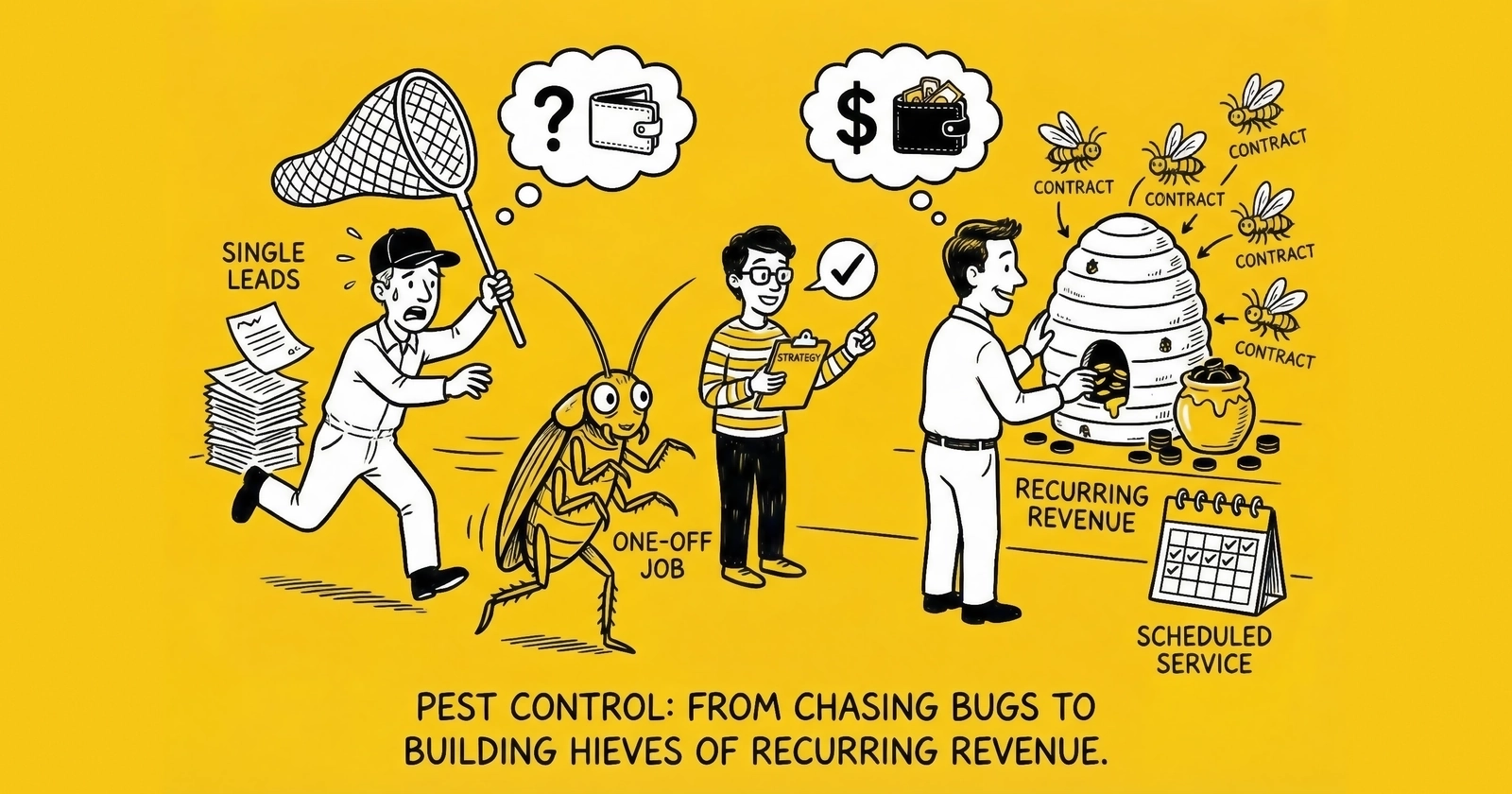
The pest control vertical operates on fundamentally different economics than most home services. Smart practitioners build subscription businesses, not one-time transactional lead flows. Here is how to capture, qualify, and monetize pest control leads for maximum lifetime value.
The pest control industry presents a unique opportunity in lead generation: customers who need you once typically need you forever. A homeowner who discovers termites today will need annual inspections for decades. A restaurant that calls for a roach problem requires ongoing service to maintain health department compliance. This recurring revenue dynamic transforms the economics of pest control leads in ways that escape operators treating it as another home services vertical.
The U.S. pest control market reached approximately $24 billion in 2024 and continues growing at 5-6% annually. The residential segment represents roughly half that market, with commercial pest management capturing the balance. More important than market size is market structure: the industry is dominated by subscription and service agreement models, with the largest players deriving 80-90% of revenue from recurring customers rather than one-time treatments.
This guide provides the complete framework for pest control lead generation with an emphasis on recurring revenue: industry economics, lead type segmentation, seasonal demand patterns, qualification strategies, contractor partnerships, pricing models, and the subscription-focused approach that separates profitable operations from commodity lead sellers. Every recommendation is grounded in the recurring revenue model that defines this vertical.
Industry Economics: Why Pest Control Leads Are Different
Understanding the economic structure of pest control companies reveals why lead generation strategy must differ from other home services verticals. This is not a transactional business. It is a relationship business with transaction triggering points.
The Recurring Revenue Model
The pest control industry operates on a fundamentally different business model than most home services. Consider the contrast:
HVAC model: Emergency call, one-time repair, customer leaves until next problem. Roofing model: Major project, one-time installation, customer gone for 20+ years. Pest control model: Initial treatment, monthly or quarterly service, customer retained for years.
This distinction matters enormously for lead valuation. An HVAC lead might generate one $500 service call. A pest control lead that converts to a recurring customer generates $50-100 per month, potentially for 5-10 years. The lifetime value difference is 10-20x.
Major pest control companies report customer retention rates of 75-85% annually. A customer acquired today has a 75% probability of paying next year, a 56% probability of paying in two years, a 42% probability of paying in three years, and so on. The compounding value of retained customers makes initial customer acquisition economics far more favorable than they appear at face value.
Major Industry Players and Their Lead Strategies
Rollins (Orkin, HomeTeam Pest Defense, Clark Pest Control) generated $3.4 billion in revenue in 2023, with Orkin representing the largest residential brand in the industry. The company operates approximately 400 branches and grows through both organic lead generation and aggressive acquisition of regional pest control companies. Rollins invests heavily in brand advertising that drives direct consumer inquiries, supplemented by third-party lead purchasing for specific service categories and geographic territories.
Rentokil (Terminix, Ehrlich, Western Pest Services) became the world’s largest pest control company after acquiring Terminix in 2022. The combined entity operates in 80+ countries with North American revenue exceeding $2 billion. Terminix historically purchased significant third-party lead volume, particularly for termite services where urgent demand creates qualified buyer opportunities.
Aptive Environmental represents the fastest-growing pest control company in North America, reaching $550+ million in revenue primarily through direct sales (door-to-door) combined with digital lead generation. Aptive’s model demonstrates that aggressive customer acquisition economics work when the focus is recurring revenue rather than one-time treatments.
ABC Home and Commercial Services operates as the largest regional player, dominating Texas and adjacent states. The company generates leads primarily through local marketing, referral programs, and strategic geographic expansion rather than national third-party lead purchasing.
These major players establish benchmarks for what leads are worth. Companies like Aptive have demonstrated willingness to pay $200-400 in customer acquisition cost knowing the lifetime value justifies the investment. National brands purchasing leads at scale have sophisticated attribution systems that track actual customer lifetime value, allowing them to pay premium prices for leads that convert to subscriptions.
Service Type Economics
Different pest control services have distinct economics that affect lead value:
| Service Type | Initial Treatment | Monthly Recurring | Typical Duration | LTV Range |
|---|---|---|---|---|
| General pest (residential) | $150-$300 | $45-$75 | 3-5 years | $2,000-$4,500 |
| Termite (subscription) | $500-$2,000 | $25-$50 (annual inspection) | 10-20 years | $1,000-$3,000 |
| Rodent control | $200-$500 | $50-$100 | 1-3 years | $800-$3,600 |
| Mosquito/tick | $100-$200 | $75-$150 (seasonal) | 3-7 months/year | $600-$1,200/season |
| Commercial pest | $500-$3,000 | $200-$1,000 | 5-10 years | $12,000-$120,000 |
| Wildlife removal | $300-$1,500 | None typically | One-time | $300-$1,500 |
The lifetime value disparity drives lead pricing strategy. A general pest lead that converts to a monthly subscription customer has 5-10x the value of a one-time wildlife removal lead. Lead generators who understand this can price accordingly and build relationships with buyers focused on subscription conversion rather than one-time revenue.
Lead Types and Pricing Benchmarks
Pest control leads segment into distinct categories based on urgency, pest type, and service model. Understanding these segments enables appropriate pricing and routing strategies.
Emergency vs. Planned Service Leads
Emergency leads occur when homeowners discover active infestations requiring immediate attention. A customer who wakes up to a kitchen full of ants, sees a rat in the garage, or discovers termite damage has urgent motivation to act. These leads convert at premium rates because the customer cannot wait.
Emergency lead characteristics:
- Urgency keywords: “emergency,” “same day,” “immediate,” “near me now”
- Conversion rate: 25-40% for contacted leads
- Price tolerance: Higher, willing to pay premium for fast response
- Subscription potential: High, because the problem creates ongoing concern
Planned service leads come from homeowners considering preventive treatment, annual inspections, or service plan enrollment. These leads represent lower urgency but often higher long-term value because the customer is thinking about ongoing protection rather than crisis response.
Planned service characteristics:
- Search behavior: Research-oriented, comparison shopping
- Conversion rate: 15-25% for contacted leads
- Price sensitivity: Higher, comparing multiple quotes
- Subscription potential: Very high, already thinking preventively
CPL Benchmarks by Pest Type
Lead pricing varies significantly by pest type, reflecting both urgency and treatment economics:
| Pest Category | Exclusive CPL | Shared CPL | Live Transfer | Close Rate (Exclusive) |
|---|---|---|---|---|
| General pest | $25-$50 | $10-$25 | $40-$75 | 18-28% |
| Termite | $75-$175 | $30-$75 | $100-$200 | 15-25% |
| Bed bugs | $50-$125 | $25-$60 | $75-$150 | 20-35% |
| Rodent | $35-$75 | $15-$35 | $50-$100 | 20-30% |
| Mosquito/tick | $20-$45 | $8-$20 | $30-$60 | 15-25% |
| Wildlife | $40-$100 | $20-$50 | $60-$125 | 12-20% |
| Commercial | $100-$300 | $50-$150 | $150-$400 | 10-18% |
The termite category commands premium pricing because treatment costs range from $1,500 to $5,000+, and ongoing termite protection plans generate decades of recurring revenue. A termite lead that converts represents $500-$2,500 in initial treatment revenue plus $200-$500 annually for protection plans. This economic structure supports CPLs that would be unjustifiable in other pest categories.
Bed bug leads also command premiums due to treatment complexity and customer desperation. Bed bug infestations create significant psychological distress, driving urgent action and reduced price sensitivity. Treatment costs of $1,000-$4,000 support higher lead pricing.
Commercial pest control leads price highest on an absolute basis but lowest relative to customer value. A commercial account generating $500/month in recurring revenue has a 5-year value of $30,000, justifying customer acquisition costs of $1,500-$3,000 (5-10% of LTV). Commercial leads require more qualification but deliver dramatically higher lifetime value.
Geographic Pricing Variation
Pest control lead pricing varies by geography based on pest prevalence, market competition, and service pricing:
| Region | CPL Index | Key Pest Drivers |
|---|---|---|
| Southeast (FL, GA, AL, SC) | 115-130 | Termites, palmetto bugs, humidity pests |
| Gulf Coast (TX, LA, MS) | 110-125 | Termites, fire ants, mosquitoes |
| Southwest (AZ, NM, NV) | 90-105 | Scorpions, spiders, rodents |
| California | 120-140 | Termites, rodents, diverse pest pressure |
| Pacific Northwest (WA, OR) | 85-95 | Rodents, ants, moderate pest pressure |
| Midwest (OH, MI, IL, IN) | 80-95 | Seasonal pests, lower year-round demand |
| Northeast (NY, PA, NJ, MA) | 95-110 | Rodents, bed bugs, seasonal pests |
The Southeast and Gulf Coast command premium lead prices due to year-round pest pressure, particularly termites. Subterranean termites cause an estimated $5 billion in property damage annually in the United States, with the highest concentration in warm, humid climates. Florida, Georgia, and Texas represent the largest pest control markets by revenue.
Seasonal Demand Patterns
Pest control demand follows predictable seasonal patterns that smart lead generators exploit for budget optimization and margin improvement.
Annual Demand Cycle
Spring (March-May): Peak Season Onset Pest activity increases as temperatures rise, driving the highest lead volume period for most markets. Ants, termites (swarming season), and general crawling insects generate the most demand.
Spring characteristics:
- Volume: 30-40% above annual average
- CPL pressure: Moderate to high as competition increases
- Conversion: Strong, homeowners motivated by emerging problems
- Budget allocation: 120-140% of monthly average
Summer (June-August): Sustained High Demand Peak season for mosquitoes, ticks, wasps, and outdoor pest services. General pest leads remain improved. Some termite demand declines after spring swarm season.
Summer characteristics:
- Volume: 25-35% above annual average
- CPL pressure: High in mosquito/tick markets, moderate elsewhere
- Conversion: Strong for outdoor services, moderate for indoor pests
- Budget allocation: 115-130% of monthly average
Fall (September-November): Transition Period Rodent leads increase as mice and rats seek indoor shelter before winter. General pest demand declines. This period offers CPL arbitrage opportunities as competition retreats while meaningful demand persists.
Fall characteristics:
- Volume: 10-20% below annual average
- CPL pressure: Lower, creating margin opportunities
- Conversion: Strong for rodent services, moderate otherwise
- Budget allocation: 90-110% of monthly average
Winter (December-February): Low Season Minimal outdoor pest activity in most markets. Rodent services peak. Bed bug leads remain consistent year-round due to travel and indoor transmission patterns.
Winter characteristics:
- Volume: 25-40% below annual average
- CPL pressure: Lowest of year
- Conversion: Strong for active leads (higher urgency)
- Budget allocation: 70-85% of monthly average
Regional Seasonal Variations
Seasonal patterns differ by geography:
Sun Belt (Florida, Arizona, Texas): Year-round pest pressure with less pronounced seasonality. Winter volumes remain 75-85% of peak summer levels. Termite activity is continuous rather than concentrated in spring swarm season.
Northern states (Michigan, Minnesota, Wisconsin): Extreme seasonality with winter volumes dropping 50-60% below summer peaks. The short season concentrates demand into 5-6 months, creating intense competition followed by extended quiet periods.
Coastal markets (California, Pacific Northwest): Moderate seasonality with consistent rodent and ant pressure year-round. Less termite urgency outside subterranean species zones.
Weather-Driven Demand Spikes
Pest control demand responds to specific weather events:
Heavy rainfall drives ant and termite activity above ground, triggering swarm events and homeowner awareness. Lead volume can spike 50-100% following significant rain events in termite-prone areas.
Flooding creates rodent displacement, pushing rats and mice into residential structures. Post-flood periods see 2-3x normal rodent lead volume for 2-4 weeks.
Extended heat waves increase mosquito, tick, and outdoor pest activity. Demand for outdoor pest services spikes during sustained temperatures above 85 degrees.
Mild winters allow pest populations to survive and emerge earlier in spring, accelerating seasonal demand onset by 2-4 weeks.
Sophisticated lead generators monitor weather patterns and adjust bidding and budget allocation accordingly. A spring thunderstorm system moving through Georgia might justify 30% bid increases on termite keywords starting 24-48 hours before expected impact.
Lead Generation Strategies for Recurring Revenue
The subscription-focused approach to pest control leads requires different strategies than transactional lead generation. The goal is not just to generate leads but to generate leads that convert to long-term customers.
Qualification for Subscription Potential
Not all pest control leads have equal subscription potential. Qualifying leads for recurring revenue probability improves buyer economics and justifies premium pricing.
Homeownership status is fundamental. Renters rarely control pest control decisions and cannot commit to service agreements. Homeowners make long-term property decisions that align with subscription services.
Property age and type affects pest susceptibility. Older homes (20+ years) have more entry points and pest history. Single-family homes represent better subscription candidates than apartments or condos where association decisions may override individual choices.
Prior pest control history indicates subscription readiness. Homeowners who previously had pest control service understand the value and are more likely to maintain ongoing relationships. Those experiencing pest control for the first time may need more education.
Household composition correlates with service duration. Families with children tend to maintain pest control services longer due to health and safety concerns. Empty nesters and retirees represent stable, long-term customers with established routines.
Income and home value indicate ability to sustain subscription payments. Higher-value homes correlate with higher subscription conversion and longer retention.
Qualification questions that surface these factors improve lead quality for subscription-focused buyers:
- “Do you currently have a pest control service?” (Prior history)
- “How long have you lived in your current home?” (Stability indicator)
- “Have you had pest problems before, or is this new?” (Property susceptibility)
- “Are you looking for ongoing protection or a one-time treatment?” (Subscription intent)
Landing Page Optimization for Subscription Leads
Landing pages should prime visitors for subscription thinking rather than one-time transaction:
Framing language matters. “Protect your home year-round” converts better to subscriptions than “Get rid of pests now.” The framing establishes the ongoing relationship from first contact.
Service plan prominence. Feature monthly protection plans alongside one-time pricing. Many visitors are unaware that subscription options exist and cost less per treatment than one-time services.
Annual savings calculations. Show the math: “Annual plan at $50/month saves $200 versus individual treatments.” This positions the subscription as the smart financial choice.
Guarantee language. Money-back guarantees and “pest-free guarantee” messaging reduce subscription commitment anxiety. Visitors who might hesitate at $600/year find $50/month with a satisfaction guarantee more accessible.
Testimonials focused on ongoing protection. Customer quotes emphasizing “peace of mind,” “haven’t seen a bug in years,” and “automatic protection” reinforce the subscription value proposition.
Traffic Source Selection for Quality
Different traffic sources deliver different subscription conversion potential:
Search (Google Ads): High intent, emergency-weighted. Strong for initial conversion but variable subscription rates. Emergency customers may not see value in ongoing service once immediate problem resolves. CPL typically $30-$80 for general pest, $75-$200 for termite.
Local Service Ads (Google Guaranteed): Similar to search with added trust signal. LSA leads tend to convert well to subscriptions because the Google Guaranteed badge establishes credibility that supports ongoing relationships. CPL typically $25-$70.
Facebook/Meta: Lower intent but controllable demographics. Targeting homeowners aged 35-65 in single-family homes generates leads with higher subscription potential than untargeted campaigns. CPL typically $15-$40, but requires more nurturing.
Content marketing/SEO: Highest subscription potential because visitors who research pest prevention are thinking proactively about ongoing protection. These leads cost more to generate (content investment, time to rank) but convert to subscriptions at 30-50% higher rates than paid search. Effective CPL $15-$35 when content investment is amortized.
Referral programs: Existing subscribers referring new customers deliver the highest subscription conversion rates. These referrals understand and already value the subscription model. Referral incentives ($25-$50 credit) generate leads with 40-60% subscription conversion versus 20-30% for paid advertising.
Direct mail in service areas: Pest control companies with geographic density can target neighborhoods surrounding existing customers. These campaigns generate leads with strong subscription potential because they target similar demographics and property types. Response rates of 0.5-1.5% with CPLs of $50-$100 are typical.
Multi-Step Forms for Subscription Qualification
Form design affects both conversion rate and lead quality. Multi-step forms increase completion rates while gathering qualification data:
Step 1: Pest identification “What pest problem are you experiencing?” [Ants] [Termites] [Rodents] [Spiders] [Mosquitoes/Ticks] [Other]
Step 2: Property information “What type of property needs treatment?” [Single family home] [Townhouse/Condo] [Apartment] [Commercial property]
Step 3: Service timing “When do you need service?” [Emergency - today/tomorrow] [This week] [Within 2 weeks] [Just researching options]
Step 4: Service preference “What type of service are you interested in?” [One-time treatment] [Ongoing protection plan] [Not sure - want to learn more]
Step 5: Contact information [Name, phone, email, address]
This structure achieves multiple objectives: higher completion rates (commitment escalation through easy initial questions), qualification data for routing and pricing, and subscription intent identification before leads reach buyers.
Working with Pest Control Companies: Building Profitable Partnerships
Pest control company relationships determine long-term success in this vertical. Understanding buyer motivations and operations enables partnership structures that benefit both parties.
Buyer Types and Preferences
National brands (Orkin, Terminix, Aptive) have sophisticated lead buying operations. They purchase across broad geographies, have strict quality requirements, and value consistency over variability. These buyers typically want:
- High-volume capacity
- Strict compliance documentation
- Real-time delivery via API
- Uniform lead format across all sources
- Predictable quality metrics
Working with nationals means meeting their system requirements and accepting lower per-lead margins in exchange for volume and payment reliability.
regional companies dominate specific markets with 3-10 state footprints. They often seek exclusive arrangements in their territories, pay premium prices for quality leads, and value relationship over transaction. These buyers typically want:
- Territory exclusivity
- Flexible delivery methods
- Collaboration on quality optimization
- Direct communication channels
- Quality over volume
Building exclusive regional relationships creates competitive moats and premium pricing power.
Local operators represent small businesses with 5-50 employees serving single markets. They need fewer leads, cannot absorb large volumes, and convert best with leads delivered during business hours when sales staff can respond immediately. These buyers typically want:
- Low volume, high quality
- Immediate delivery with phone notification
- Flexible purchasing (no minimums)
- Transparent quality feedback
- Personal relationship with lead source
What Buyers Actually Value
Beyond basic lead quality, pest control buyers value specific attributes that may justify premium pricing:
Subscription intent identification. A lead that includes “interested in ongoing protection” converts to recurring revenue at 40-60% higher rates than unqualified leads. Buyers will pay 20-30% premiums for subscription-intent leads.
Pest type specificity. “Pest problem” is less valuable than “termite concern” or “rodent issue.” Specific pest identification enables proper routing and sets appropriate customer expectations. Termite-specific leads route to termite sales specialists, improving conversion.
Property qualification data. Knowing the property is a single-family home, built in 1985, and located in the buyer’s service area saves the buyer time and improves conversion rates. Pre-qualified leads justify premium pricing.
Contact rate verification. Leads where the phone number has been verified as reachable (through real-time phone lookup or SMS confirmation) contact at dramatically higher rates. Buyers pay premiums for verified-contact leads.
Speed of delivery. Leads delivered within 60 seconds of form completion contact and convert at 2-3x rates of leads delivered after 30 minutes. Real-time delivery infrastructure justifies premium pricing.
Pricing Models and Structures
Pest control lead pricing follows several models:
Per-lead pricing is most common. Prices range from $15-$50 for shared general pest leads to $150-$300 for exclusive termite or commercial leads. This model provides simplicity but does not align generator and buyer incentives around conversion.
Per-call pricing works for pay-per-call operations where the lead is a phone call rather than form submission. Prices typically run 1.5-2x form lead prices because calls demonstrate higher intent. Duration requirements (90-second minimum) prevent billing for wrong numbers.
Appointment setting involves pre-scheduling appointments rather than just delivering contact information. Prices run $100-$250 for general pest appointments, $200-$400 for termite appointments. The generator assumes more qualification burden but delivers higher-quality outcomes.
Revenue share aligns generator and buyer incentives around subscription conversion. Generator receives a percentage (typically 5-15%) of the customer’s first-year revenue. This model works best with trusted partners and proper tracking infrastructure.
Hybrid models combine base per-lead pricing with performance bonuses for subscription conversion. Generator receives $40 per lead plus $50 bonus for leads that convert to service plans. This aligns incentives while maintaining cash flow predictability.
Return Policies and Quality Standards
Pest control lead return rates typically run 10-20% for quality operations. Common return reasons and how to minimize them:
Invalid contact information (30-40% of returns): Implement real-time phone and email validation. Require phone number confirmation via SMS. Verify addresses exist and match claimed geography.
Outside service area (15-25% of returns): Maintain accurate service area maps for each buyer. Implement ZIP code filtering at form level. Regularly update territory definitions as buyers expand or contract.
Not a homeowner/decision maker (10-20% of returns): Add homeownership confirmation questions. For higher-value leads, implement property database verification.
Not interested/just browsing (10-15% of returns): Improve qualifying questions to filter low-intent visitors. Increase form friction appropriately for high-CPL lead types.
Duplicate lead (5-10% of returns): Implement cross-buyer deduplication. Maintain suppression lists across all active buyers. Define appropriate duplicate windows (typically 30-90 days).
Maintaining return rates below 15% establishes quality reputation and enables premium pricing. Buyers who trust lead quality accept higher prices and expand volume commitments.
Commercial Pest Control: The High-Value Segment
Commercial pest control leads represent the highest-value opportunity in the vertical, with lifetime values 10-50x residential leads. Understanding commercial requirements enables targeting and qualification strategies that capture this premium segment.
Commercial Segment Economics
Commercial pest control operates on different economics than residential:
| Segment | Monthly Service Value | Contract Duration | Lifetime Value |
|---|---|---|---|
| Restaurants | $200-$500 | 3-7 years | $7,200-$42,000 |
| Hotels | $500-$2,000 | 5-10 years | $30,000-$240,000 |
| Food processing | $1,000-$5,000 | 5-15 years | $60,000-$900,000 |
| Healthcare facilities | $300-$1,000 | 5-10 years | $18,000-$120,000 |
| Office buildings | $200-$800 | 3-7 years | $7,200-$67,200 |
| Multi-family housing | $500-$2,000 | 5-10 years | $30,000-$240,000 |
These values justify customer acquisition costs of $500-$5,000, translating to lead costs of $100-$500 for exclusive, qualified commercial leads.
Commercial Qualification Requirements
Commercial leads require more intensive qualification than residential:
Business type verification ensures the lead represents a legitimate commercial opportunity. Restaurant leads should verify food service license or health department information. Healthcare leads should confirm facility type and size.
Decision-maker identification is critical because commercial pest control purchases involve procurement processes. The maintenance manager, facilities director, or owner must be the contact. A receptionist or employee referral requires additional steps to reach the decision-maker.
Compliance requirements affect lead value. Food service establishments must maintain pest control documentation for health inspections. Healthcare facilities have JCAHO accreditation requirements. These compliance mandates make pest control non-optional, increasing conversion probability.
Current service status affects conversion timeline. Businesses under contract may not switch until contract expiration. Understanding contract timing enables appropriate follow-up sequencing.
Multi-location potential multiplies lead value. A restaurant owner with five locations represents 5x the value of a single-location operator. Qualification should surface multi-location opportunities.
Commercial Lead Sources
Commercial pest control leads originate from different sources than residential:
Google Search captures active seekers but volumes are lower than residential. Commercial-intent keywords include “commercial pest control,” “restaurant pest control,” and “food processing pest management.” CPL typically $75-$200.
LinkedIn advertising targets facility managers, operations directors, and business owners with pest control decision authority. Campaign costs run higher than consumer platforms but lead quality justifies investment. CPL typically $100-$300.
Industry publications and trade shows generate leads in specific verticals. Restaurant industry publications, hotel management conferences, and food processing trade shows provide access to qualified decision-makers. These leads cost more but convert at premium rates.
Referral programs work exceptionally well in commercial because business networks share vendor recommendations. A satisfied restaurant owner refers their business owner friends. Referral incentives ($100-$500 credit) generate high-value leads with strong conversion probability.
Direct sales remains common in commercial pest control. Sales representatives targeting specific business types or geographic territories generate their own leads through cold calling, door-to-door, and networking. Lead generators can support these efforts with appointment setting and lead qualification services.
Technology Integration and Automation
The pest control industry has undergone significant digital transformation in recent years, and lead generation operations that fail to integrate modern technology find themselves at a competitive disadvantage. From CRM automation to predictive routing, technology shapes both efficiency and conversion rates in ways that manual processes cannot match.
CRM Integration Requirements
Effective pest control lead operations require robust CRM systems that capture the full customer journey from initial inquiry through ongoing subscription management. The recurring revenue model that defines this industry demands tracking capabilities that extend far beyond simple lead capture.
Modern pest control CRMs should capture initial lead source and attribution data, service history and treatment records, subscription status and payment history, seasonal service scheduling, and communication logs across all touchpoints. This comprehensive data enables both operational efficiency and sophisticated buyer reporting that justifies premium lead pricing.
For lead generators selling to pest control companies, understanding buyer CRM capabilities affects lead delivery strategy. Buyers with mature CRM systems can accept real-time API delivery and provide feedback loops on lead quality. Buyers using basic systems may require email or portal-based delivery with manual tracking. The sophistication gap between buyers creates opportunities for lead generators who can adapt their delivery methods to match buyer capabilities.
Automation for Speed-to-Contact
The importance of rapid response applies equally to pest control and other home services verticals. Automated systems that trigger instant callbacks or SMS acknowledgments dramatically improve contact and conversion rates. When a homeowner discovers ants marching across their kitchen counter, they want to know help is coming within minutes, not hours.
Effective automation sequences for pest control leads include immediate SMS acknowledgment confirming receipt of the inquiry, automated callback initiation within 60 seconds during business hours, after-hours appointment scheduling via automated systems, and follow-up sequences for leads not reached on first attempt.
Lead generators who provide real-time delivery through webhooks or API integration enable this automation. Those relying on batch file delivery or email-based distribution handicap their buyers and see lower conversion rates reflected in quality feedback.
Predictive Analytics for Lead Routing
Advanced operations apply predictive models to route leads based on conversion probability. Factors including pest type, property characteristics, time of inquiry, and geographic location all influence which buyer or sales representative is most likely to convert a given lead.
For multi-buyer distribution, predictive routing optimizes both conversion and revenue. A termite lead in a high-value zip code routes to buyers with strong termite sales teams and appropriate pricing. A general pest lead in a price-sensitive market routes to buyers competing on volume rather than premium service.
These models require historical conversion data across enough volume to train effectively. Lead generators building predictive capabilities should capture granular outcome data from buyers through feedback loops, return reason categorization, and conversion reporting.
Emerging Trends and Market Evolution
The pest control industry continues evolving in ways that affect lead generation strategy. Understanding where the market is heading helps operators position for future success rather than optimizing for conditions that may not persist.
Consolidation and Private Equity Interest
The pest control industry has attracted significant private equity investment, driving consolidation that reshapes the buyer landscape. Regional players who once operated independently now frequently belong to larger portfolio companies with centralized lead purchasing operations.
This consolidation creates both challenges and opportunities for lead generators. On one hand, the number of independent buyers decreases as acquisitions combine previously separate operations. On the other hand, well-capitalized portfolio companies often seek to accelerate growth through aggressive lead purchasing, creating volume opportunities for generators who can demonstrate quality.
The consolidation trend also affects pricing power. Portfolio companies with multiple brands can compare lead performance across their holdings, creating pressure for generators to deliver consistent quality or face volume reductions across multiple relationships.
Technology-Enabled Pest Management
Emerging technologies are changing how pest control services are delivered, with implications for lead generation and customer expectations. Smart monitoring devices that detect pest activity and alert service providers are gaining adoption, particularly in commercial settings. These systems create new lead opportunities through manufacturer and dealer relationships.
Integrated pest management (IPM) approaches that emphasize prevention over treatment are becoming standard practice. Lead generation messaging that aligns with IPM principles resonates with environmentally conscious consumers and positions services as sophisticated rather than commoditized.
The rise of subscription-first service models continues accelerating. Consumers increasingly expect subscription options across service categories, and pest control fits naturally into this expectation. Lead qualification that surfaces subscription intent becomes more valuable as buyers prioritize customers who will generate recurring revenue rather than one-time treatment fees.
Climate and Geographic Shifts
Changing climate patterns are affecting pest distribution in ways that create new market opportunities. Warm-weather pests are expanding into previously unaffected regions, creating demand where pest control was historically a minor concern. Termite activity, in particular, is moving northward as average temperatures rise.
These shifts create opportunities for lead generators who recognize emerging markets before established players saturate them. A region with historically low termite pressure may see rapid demand growth as conditions change, creating first-mover advantages for generators who build presence before competition intensifies.
Conversely, some regions may see changes in pest pressure that affect lead economics. Monitoring climate and pest distribution data helps operators anticipate market shifts rather than react after they have already affected performance.
Frequently Asked Questions
What is a good cost per lead for pest control?
Cost per lead varies significantly by pest type, lead quality, and delivery method. General pest exclusive leads typically range $25-$50. Termite leads command $75-$175 due to higher treatment values. Bed bug leads run $50-$125 reflecting treatment complexity and customer urgency. Shared leads cost 40-60% less than exclusive leads but convert at proportionally lower rates. The relevant metric is cost per acquisition (CPA), not cost per lead. A $75 exclusive lead converting at 25% yields a $300 CPA. A $30 shared lead converting at 10% yields the same $300 CPA but requires more volume to achieve.
How does pest control seasonality affect lead generation strategy?
Pest control demand follows predictable seasonal patterns. Spring and summer represent peak periods with volumes 25-40% above annual averages. Fall provides arbitrage opportunities as competition decreases while meaningful demand persists, particularly for rodent services. Winter represents the low season in most markets, with volumes 25-40% below peak levels. Smart practitioners shift budget allocation seasonally: 120-140% of average monthly budget in spring, 115-130% in summer, 90-110% in fall, and 70-85% in winter. Weather events create demand spikes that sophisticated practitioners exploit through real-time bid adjustments.
What makes pest control leads different from other home services?
The recurring revenue model fundamentally distinguishes pest control from most home services. Pest control companies derive 80-90% of revenue from subscription customers rather than one-time treatments. This transforms lead economics: a lead that converts to a subscription customer has lifetime value of $2,000-$5,000 versus $150-$300 for a one-time treatment. Lead generators who understand this dynamic can price leads appropriately and build relationships with buyers focused on subscription conversion. Qualification questions that identify subscription intent enable premium pricing and better buyer outcomes.
How should I price leads for different pest types?
Pricing should reflect the downstream economics of each pest category. Termite leads command premium prices ($75-$175 exclusive) because initial treatments range $1,500-$5,000 and ongoing protection plans generate decades of recurring revenue. Bed bug leads price at $50-$125 due to treatment complexity and customer urgency. General pest leads price lower ($25-$50) but volume is higher. Rodent leads ($35-$75) fall in between. Commercial leads command the highest absolute prices ($100-$300+) but lowest prices relative to customer lifetime value. Always calculate acceptable CPL based on buyer economics: maximum CPL = customer LTV x conversion rate x target ROI factor.
What conversion rates should pest control companies expect from purchased leads?
Conversion rates vary by lead quality, pest type, and buyer execution. Exclusive general pest leads typically convert at 18-28% when contacted within 5 minutes. Termite leads convert at 15-25% with longer decision cycles. Bed bug leads convert at 20-35% due to customer urgency. Rodent leads convert at 20-30%. Shared leads convert at 40-60% lower rates than exclusive leads due to competition and consumer fatigue from multiple calls. Commercial leads convert at 10-18% but require longer sales cycles and involve procurement processes. Speed-to-contact is the primary controllable variable: leads contacted within 5 minutes convert 3-5x better than leads contacted after 1 hour.
How do I qualify leads for subscription potential?
Qualification questions that surface subscription potential include: homeownership status (renters rarely subscribe), property age (older homes have more pest history), prior pest control experience (previous subscribers understand value), service preference (“one-time treatment” versus “ongoing protection”), and household composition (families with children maintain services longer). Form design should prime visitors for subscription thinking through framing language like “year-round protection” rather than “pest removal.” Leads expressing subscription interest convert to recurring customers at 40-60% higher rates than unqualified leads, justifying 20-30% price premiums.
What geographic markets offer the best pest control lead opportunities?
The Southeast and Gulf Coast (Florida, Georgia, Texas, Alabama, Louisiana) command premium lead prices due to year-round pest pressure, particularly termites. California leads price at premiums despite having moderate pest pressure due to population density and service pricing. Northern markets offer lower lead costs but face extreme seasonality with winter volumes dropping 50-60% below summer peaks. Geographic arbitrage opportunities exist: generating leads in lower-competition markets for buyers willing to service those areas provides margin advantages. Utility-level and ZIP code-level pricing optimization captures additional value in markets with heterogeneous pest pressure.
How important is speed-to-contact for pest control leads?
Speed-to-contact is the single most important controllable variable in lead conversion. Research consistently shows that leads contacted within 5 minutes convert at 3-5x the rate of leads contacted after 1 hour. For emergency pest leads (bed bugs, rodent sightings, termite swarms), response time expectations are even more compressed. Implementation requirements include: real-time lead delivery via API or webhook, push notifications to sales staff, SMS acknowledgment automation, and dedicated intake staffing during business hours. Lead generators who can guarantee sub-60-second delivery justify premium pricing because they enable the speed that converts.
What return rate should I expect for pest control leads?
Well-optimized pest control lead operations maintain return rates of 10-15%. Return rates above 20% indicate quality problems requiring attention. Common return reasons include: invalid contact information (30-40% of returns), outside service area (15-25%), not a homeowner/decision maker (10-20%), not interested (10-15%), and duplicate leads (5-10%). Minimizing returns requires: real-time phone and email validation, accurate service area mapping, homeownership verification for high-value leads, appropriate form friction to filter low-intent visitors, and cross-buyer deduplication systems. Return rate performance establishes quality reputation with buyers and enables premium pricing.
How do I build relationships with pest control companies to buy my leads?
Start with regional companies rather than nationals. Regional companies typically offer more flexibility, pay premium prices for quality, and value relationship over transaction. Identify potential buyers through Google searches for pest control in target markets, review site rankings, and industry association directories. Initial outreach should offer a limited trial (50-100 leads at discounted pricing) to demonstrate quality. Provide detailed quality metrics: contact rate, conversion rate, return rate, and subscription conversion if trackable. Weekly performance reviews during the trial period build trust. Transition to ongoing relationships with clear quality standards, defined return policies, and performance-based pricing adjustments.
What compliance requirements apply to pest control lead generation?
TCPA compliance is essential for pest control leads. Prior express written consent (PEWC) is required before any autodialed calls or pre-recorded messages. Consent language must clearly identify the pest control company (or companies) that may contact the consumer. Documentation via TrustedForm or similar consent certification provides evidence in case of disputes. State-specific regulations add complexity: California’s CCPA requires data handling disclosures, Florida has specific solicitation rules, and other states layer additional requirements. Commercial leads may trigger different consent frameworks. When selling leads to multiple buyers, ensure consent language covers all intended recipients. Compliance documentation should be retained for at least 5 years given the statute of limitations on TCPA claims.
Key Takeaways
-
Pest control operates on a recurring revenue model where 80-90% of company revenue comes from subscription customers. A lead converting to a monthly customer has lifetime value of $2,000-$5,000, justifying CPLs that would be impossible in transactional verticals.
-
Lead pricing varies dramatically by pest type. Termite leads command $75-$175 exclusive due to $1,500-$5,000 initial treatments and decades of recurring protection plan revenue. General pest leads run $25-$50 exclusive with lower per-treatment economics but higher volume.
-
Seasonality is predictable and exploitable. Spring and summer drive 25-40% above-average demand. Fall offers CPL arbitrage as competition retreats while rodent demand increases. Budget allocation should follow seasonal patterns rather than remain static.
-
Qualification for subscription intent matters. Leads expressing interest in ongoing protection convert to recurring customers at 40-60% higher rates. Homeownership, property age, and prior pest control experience predict subscription potential. Premium pricing is justified for subscription-qualified leads.
-
Speed-to-contact drives conversion. Leads contacted within 5 minutes convert 3-5x better than those contacted after 1 hour. Real-time delivery infrastructure and buyer notification systems are essential for maintaining lead value.
-
Commercial pest control represents the highest-value segment with customer lifetime values of $10,000-$200,000+. Higher lead costs ($100-$300) are justified by dramatically higher customer value. Commercial leads require more qualification but deliver premium returns.
-
Regional partnerships provide pricing power. Exclusive arrangements with strong regional companies enable premium pricing and stable relationships. National buyers offer volume but lower per-lead margins. Build a diversified buyer portfolio balancing both.
-
The recurring revenue focus changes everything. Operators who understand that pest control is a subscription business rather than a transactional business price leads appropriately, qualify for subscription intent, and build buyer relationships around lifetime value rather than single-transaction economics.
Pest control lead generation rewards operators who understand the subscription model that defines this industry. The customer acquired today generates revenue for years, not just one treatment. Build your operation around recurring revenue, qualify leads for subscription potential, and partner with buyers who share this focus. The economics reward the long-term approach.