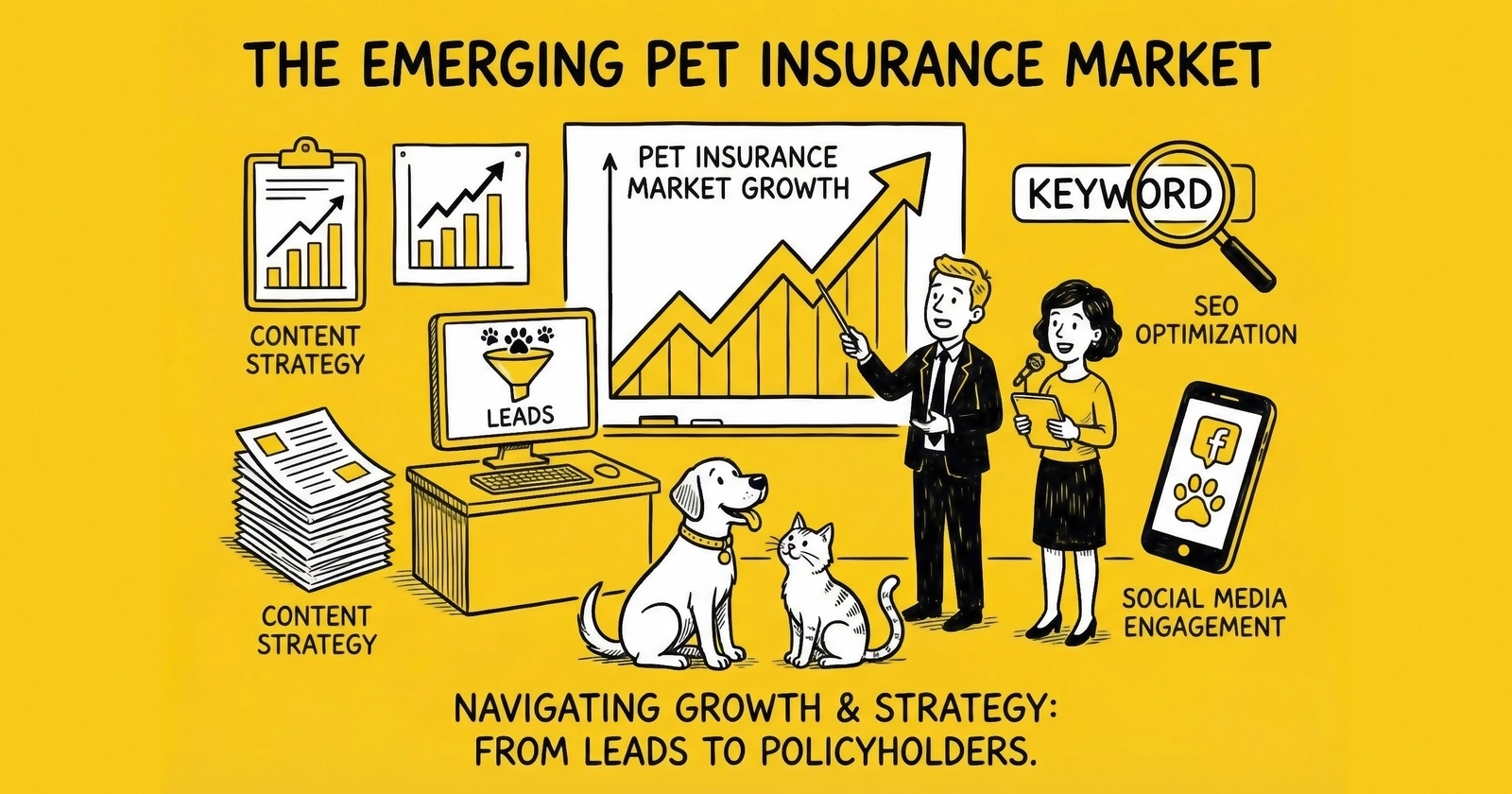
The pet insurance vertical represents one of the fastest-growing segments in lead generation, with market penetration at only 6% in a $152 billion pet industry. Master the targeting strategies, channel economics, and buyer landscape before this emerging market matures.
The economics of emerging verticals differ fundamentally from mature markets, and understanding those differences determines whether early entrants capture disproportionate returns or simply absorb the costs of market education while later entrants harvest the benefits. Pet insurance sits at a particular moment in its market lifecycle – past the proof-of-concept stage where viability remains uncertain, but before the saturation stage where every consumer recognizes the product category and every lead generation approach has been tested to exhaustion.
This timing creates specific opportunities. Consumer awareness is building rapidly, driven by veterinary cost inflation and the cultural shift toward pet humanization. Yet most pet owners still encounter the category for the first time when they search. They arrive without the skepticism that auto insurance shoppers have developed through decades of advertising exposure. They engage with content and convert at rates that mature vertical practitioners find remarkable.
The opportunities come with corresponding challenges. Buyer ecosystems remain less developed than established verticals. The number of carriers actively purchasing leads is smaller, creating concentration risk. CPL benchmarks are still volatile as the market finds equilibrium. Compliance frameworks specific to pet insurance continue evolving. Practitioners must navigate uncertainty that mature verticals have long since resolved.
For lead generators willing to accept that uncertainty, the potential rewards justify the investment. Early position in an emerging vertical creates relationships and capabilities that compound over time. Those who establish expertise now will have defensible advantages as the market grows toward its projected $8.6 billion U.S. market size by 2030.
A consumer searching “pet insurance for my dog” at 10 PM represents something unusual in the insurance lead economy: genuine intent without the conditioning that plagues mature verticals. Unlike auto insurance shoppers who have been bombarded with gecko advertisements for decades, pet insurance prospects are often researching the category for the first time. They are motivated by a specific trigger – a new puppy, a recent veterinary bill, or advice from their veterinarian – and they are ready to act.
This is what an emerging market looks like before it matures.
The U.S. pet insurance market reached $3.9 billion in premium volume during 2023, growing 17% year-over-year with nearly 5.7 million pets insured. The global pet insurance market hit $9.26 billion in 2023 and is projected to reach $18.26 billion by 2033 – a 7.03% CAGR that outpaces most established insurance verticals. The U.S. market alone is forecast to reach $5.3 billion in 2025, with projections extending to $8.6 billion by 2030.
Yet market penetration remains at approximately 6% of the 94 million U.S. households with pets. Compare this to auto insurance with near-universal coverage, or even health insurance with 90%+ penetration among eligible populations. Pet insurance has massive room to grow, and lead generators who establish positions now will benefit as the market expands.
This guide covers the complete pet insurance lead generation landscape: market dynamics, targeting strategies for pet owner demographics, channel-specific approaches, CPL benchmarks, compliance considerations, and the buyer ecosystem that determines monetization opportunity.
Market Overview: Why Pet Insurance Is Emerging Now
Pet insurance has existed in the United States since 1982, when Lassie the famous TV collie received the first policy. For decades, the market remained a niche product for affluent pet owners or those with specific breed concerns. The convergence of several trends is now driving mainstream adoption and creating substantial lead generation opportunity.
The Humanization of Pets
The most significant driver of pet insurance growth is the fundamental shift in how Americans view their animals. Pets are no longer animals that live in the backyard. They are family members who sleep in beds, have birthday parties, and receive medical care that would have been unthinkable a generation ago.
The American Pet Products Association reports that total U.S. pet industry spending reached $152 billion in 2024. This spending spans food, supplies, veterinary care, grooming, and other services – representing the economic manifestation of pets as family members. When Americans spend this much on their animals, insuring them against health emergencies becomes logical rather than unusual.
This cultural shift affects lead generation directly. Pet insurance advertising that emphasizes “protecting your family member” resonates with modern pet owners in ways that purely financial messaging does not. Understanding the emotional relationship between pet owners and their animals improves creative performance and lead quality.
Veterinary Cost Inflation
Veterinary medicine has advanced dramatically. Pets now receive MRIs, chemotherapy, joint replacements, and specialized surgeries that save lives but cost thousands of dollars. A cruciate ligament repair for a dog runs $3,000-5,000. Cancer treatment can exceed $10,000. Emergency surgery after a pet eats something it should not averages $2,000-5,000.
These costs create the financial protection need that drives insurance demand. When a veterinarian presents a $6,000 treatment option, the pet owner without insurance faces an impossible choice between financial hardship and the life of their pet. Insurance removes that impossible choice, and awareness of this reality drives shopping behavior.
Lead generators can leverage cost awareness in creative and landing page content. Specific procedure costs, emergency statistics, and “what if” scenarios resonate with prospects who may not have considered pet insurance until confronting potential financial exposure.
Low Market Penetration Creates Opportunity
With only 6% of U.S. households with pets currently holding insurance, the addressable market remains enormous. Most prospects are first-time buyers, which stands in stark contrast to auto insurance where consumers switch between established competitors. Pet insurance leads often represent consumers making their first-ever purchase decision in the category, creating opportunity for educational content that builds trust while capturing leads.
Category awareness is still building across the market. Many pet owners do not know pet insurance exists or have misconceptions about coverage and cost. Lead generation can serve an awareness function while capturing intent – something less possible in saturated verticals. This education-to-conversion pathway does not exist in mature markets where consumers already understand the product category.
Multiple purchase triggers exist throughout the year. New pet adoption, veterinary recommendations, pet aging, breed-specific concerns, and observing a friend’s experience all trigger shopping behavior. This creates year-round demand without the seasonal concentration that characterizes some insurance verticals. Perhaps most importantly, pet insurance prospects have not yet developed the caller ID avoidance and form abandonment patterns that plague auto insurance lead generation. Contact rates and conversion rates tend to exceed mature vertical benchmarks.
Market Structure and Major Players
The pet insurance market includes purpose-built carriers, insurance subsidiaries, and aggregation platforms. Trupanion leads the market with over 63,000 customer reviews and ratings averaging 4.8-4.9 stars. Their direct-to-consumer model and veterinary partnerships create substantial organic lead generation. Trupanion’s vertical integration extends from lead generation through claims processing, making them both a potential buyer and competitor.
Fetch (formerly Petplan) maintains approximately 27,500 reviews with 4.9-star ratings, competing in the premium comprehensive coverage segment. Embrace targets the high-touch consumer segment with approximately 20,000 reviews and wellness coverage options that expand beyond accident and illness. Nationwide leverages their brand recognition from other insurance lines to compete in pet insurance, with over 21,000 reviews demonstrating meaningful market presence. ASPCA Pet Health Insurance uses brand affiliation with the American Society for the Prevention of Cruelty to Animals to reach cause-oriented pet owners, with approximately 12,000 reviews.
For lead generators, this market structure means multiple potential buyers with different coverage approaches, pricing strategies, and lead quality requirements. The diversity creates arbitrage opportunities and reduces single-buyer dependency risk.
CPL Benchmarks: What Pet Insurance Leads Actually Cost
Pet insurance lead pricing reflects the emerging market status: higher than commoditized verticals but with better conversion economics. Understanding pricing tiers helps you evaluate lead sources and set realistic buyer expectations.
Exclusive Leads
Exclusive pet insurance leads sell to a single buyer, eliminating competition for consumer attention. The pricing range of $25-60 reflects quality differentiation across three tiers.
Basic exclusive leads at $25-35 include contact information, pet type (dog or cat), and basic intent signal. They may lack detailed pet information like breed, age, or health status, making them suitable for carriers with broad underwriting appetite. Qualified exclusive leads at $35-50 include pet demographics (breed, age, weight), current coverage status, and reason for shopping. These leads enable targeted quoting and better sales conversations. Premium exclusive leads at $50-60 provide full qualification including health history, specific coverage interests, and verified contact information. They may include veterinary relationship data or prior insurance experience.
Exclusive leads in pet insurance benefit from the lower competitive intensity of the vertical. Unlike auto insurance where consumers expect multiple calls, pet insurance shoppers often respond positively to single-carrier outreach when it is timely and relevant.
Shared Leads
Shared pet insurance leads sell to 2-5 buyers simultaneously at $12-25 per lead. Lower per-lead cost enables higher volume purchasing for operations with competitive quoting and rapid response capability.
Speed-to-contact matters even in emerging verticals. While the competitive pressure is less intense than auto insurance, the research on first-responder advantage still applies. Operations purchasing shared leads should target sub-2-minute response times to maximize conversion opportunity.
Share pool size affects economics significantly. A lead shared with 2 buyers costs more per-lead but yields better conversion than leads shared with 5 buyers. Negotiate share pool caps with lead sources to protect your investment. Shared lead pricing reflects the smaller buyer pool in pet insurance compared to auto or health. Fewer competitors bidding for the same leads keeps pricing below mature vertical levels.
Live Transfers
Live transfer leads connect pet owners directly to insurance representatives while shopping intent remains active. The consumer submits a form, a call center screens them for qualification, then transfers the warm call. Pet insurance live transfers command $60-100, lower than auto or Medicare due to smaller average customer lifetime value, but the economics work for carriers focused on acquisition efficiency.
The value proposition is compelling: near-certain contact because the consumer is already on the phone, pre-qualification for pet eligibility and coverage interest, higher conversion rates of 15-25% versus 8-12% for form leads, and better customer experience leading to improved retention. Live transfer pricing varies based on qualification depth, geographic targeting, and transfer timing (immediate versus scheduled callback).
Data Leads and Aged Leads
Aged pet insurance leads (30-90+ days old) and basic data leads price at the $5-15 tier. Fresh data leads at $15-25 typically convert at 8-12% and suit standard acquisition campaigns. Leads aged 30 days drop to $8-12 with 5-8% expected conversion, serving as supplemental volume. At 60 days, pricing falls to $5-8 with 3-5% conversion, useful for nurture campaigns. Leads aged 90+ days price at $3-5 with 2-4% conversion, best suited for systematic remarketing efforts.
Contact information degrades over time. Pet ownership may change – a pet passes away, an owner moves. Build degradation assumptions into aged lead economics to avoid overpaying for leads with diminishing conversion potential.
Understanding the Pet Owner Demographic
Successful pet insurance lead generation requires understanding who buys pet insurance and why. Demographics, psychographics, and trigger events all influence targeting strategy.
Demographic Profile of Pet Insurance Buyers
Pet insurance adoption skews younger than traditional insurance products. Millennials (ages 28-43 in 2024) represent the largest pet insurance buyer segment, followed by Gen X (ages 44-59). Boomers have lower adoption rates, though the segment represents growth opportunity as awareness increases.
Higher income correlates strongly with purchase behavior. Households with annual income above $75,000 demonstrate higher pet insurance adoption. This reflects both ability to pay premiums ($30-60 monthly for dogs, $15-35 for cats) and likelihood of pursuing expensive veterinary treatments that insurance covers. Urban and suburban concentration is pronounced, with metropolitan areas showing higher pet insurance penetration than rural regions. Access to specialty veterinary care, higher veterinary costs in urban markets, and demographic composition all contribute to this pattern.
Education level shows correlation as well. College-educated consumers demonstrate higher pet insurance adoption, which may reflect information-seeking behavior, risk awareness, or correlation with income levels. Geographic concentrations matter for targeting: California, New York, and Florida hold the largest insured pet populations, while Colorado, Washington, and Massachusetts show above-average penetration rates relative to total pet ownership. These states represent priority geographic targets for lead generation.
Psychographic Patterns
Beyond demographics, psychographic characteristics distinguish pet insurance buyers and inform creative messaging and targeting strategies.
Pet humanizers view their animals as family members and make decisions accordingly. They invest in premium pet food, regular veterinary care, training, and experiences for their pets. Pet insurance is a logical extension of their overall pet care philosophy. Messaging that acknowledges the family bond resonates deeply with this segment.
Risk-aware planners recognize that unexpected veterinary costs represent financial exposure. They approach pet insurance as financial planning rather than emotional decision-making. Value propositions emphasizing budgeting, predictability, and financial protection resonate with this segment more than emotional appeals about protecting “fur babies.”
First-time pet owners lack experience with veterinary costs and may underestimate potential expenses. Education-focused content that explains what veterinary care actually costs drives awareness and intent among this segment. They need to understand the problem before they can appreciate the solution.
Breed-conscious owners have researched their pet’s breed and understand hereditary health risks. Owners of breeds with known issues – hip dysplasia in German Shepherds, respiratory problems in Bulldogs, heart conditions in Cavalier King Charles Spaniels – demonstrate higher insurance consideration. Breed-specific targeting can be highly effective with this audience.
Recent adopters represent a concentrated purchase window. Pet insurance is most commonly purchased within the first year of pet ownership, with the highest conversion occurring in the first 90 days. Targeting new pet owners through adoption channels captures this high-intent window before the moment passes.
Purchase Trigger Events
Pet insurance shopping is rarely random. Specific triggers drive research and purchase intent, and understanding these triggers informs both targeting and creative strategy.
New pet acquisition is the primary trigger. Whether adopting from a shelter, purchasing from a breeder, or welcoming a gift, new pet ownership opens the insurance consideration window. Veterinary recommendation increasingly drives shopping as well. Veterinarians now commonly recommend pet insurance during wellness visits, and some veterinary practices partner with insurance carriers for direct enrollment.
Unexpected veterinary expense creates retroactive recognition. Pet owners who experience a $2,000+ emergency bill often purchase insurance immediately – though they learn that pre-existing conditions are not covered. This trigger creates high-intent but potentially frustrated prospects who may need education about coverage limitations.
Pet aging triggers consideration as owners recognize increasing health risks. Dogs and cats over age 7 face higher veterinary costs and more frequent health issues. Some owners wait too long and find premiums unaffordable, but the aging trigger still drives substantial search volume. Friend or family experience through observation of others’ veterinary emergencies or insurance claims creates awareness, with word-of-mouth remaining a significant driver in the pet insurance category. Life changes including marriage, home purchase, and children can also trigger pet insurance consideration as overall financial planning becomes more sophisticated.
Channel Strategies for Pet Insurance Lead Generation
Each marketing channel offers distinct advantages and challenges for pet insurance lead generation. Channel selection should reflect your buyer relationships, content capabilities, and operational infrastructure.
Search Engine Marketing
Pet insurance search intent spans informational queries (“what does pet insurance cover”), comparative queries (“best pet insurance for dogs 2025”), and transactional queries (“pet insurance quotes”). Matching content and landing pages to query intent improves conversion across all categories.
| Keyword Category | Example Terms | Approximate CPC | Intent Level |
|---|---|---|---|
| Brand + Insurance | ”Trupanion pet insurance” | $3-6 | High |
| Generic + Quote | ”pet insurance quotes” | $4-8 | High |
| Pet Type + Insurance | ”dog insurance,” “cat insurance” | $3-6 | High |
| Cost/Price | ”how much is pet insurance” | $2-4 | Medium |
| Comparison | ”best pet insurance” | $4-7 | High |
| Breed-specific | ”French Bulldog insurance” | $2-5 | Very High |
Target breed-specific keywords where cost-per-click is often lower and intent is extremely high. Owners searching for breed-specific insurance have already recognized their pet’s health profile and are actively shopping. Build landing pages matching query intent – information seekers who land on quote forms bounce. Create content funnels that capture email for nurture before pushing direct conversion.
Monitor carrier brand bidding, as major pet insurance carriers bid on their own brand terms and competitor brands, affecting CPC for comparison-oriented keywords. Use negative keywords aggressively, excluding “free pet insurance” (does not exist), “pet insurance jobs” (wrong intent), and specific disease terms that suggest pre-existing conditions.
Social Media Advertising
Facebook, Instagram, and TikTok offer pet-focused targeting that enables efficient reach. Facebook and Instagram provide multiple targeting dimensions including pet owners through interest-based targeting, recent pet adoption through behavior-based signals, pet breed interests, pet-related purchases, pet food and supply brand interests, and veterinary service interests.
Pet-focused creative featuring dogs and cats consistently outperforms generic insurance messaging. User-generated content style – photos that look like pet owners took them – often outperforms polished production. Carousel ads showcasing multiple pet types or coverage scenarios enable A/B testing within a single ad unit. Video content showing pet healthcare scenarios creates emotional engagement that static images cannot match.
Lead forms within Facebook (Lead Ads) can reduce friction but often produce lower-quality leads than landing page conversion. Test both approaches and optimize based on downstream conversion, not just CPL. The lower cost of Lead Ads means nothing if conversion rates collapse.
TikTok presents significant opportunity. The platform’s younger demographic aligns with millennial pet insurance buyer concentration. Short-form video content explaining pet insurance, showing claim experiences, or addressing common questions can drive both awareness and lead generation. The platform’s cost efficiency currently exceeds Facebook for many advertisers, though this may change as the platform matures and competition increases.
Content Marketing and SEO
Pet insurance content marketing serves both lead generation and brand building. The relatively low competition in organic search creates opportunity for content-driven operations that invest in quality educational material.
High-value content topics include procedure-specific cost content (“How much does [procedure] cost for dogs/cats”), breed-specific health content (“[Breed] health issues and common problems”), educational fundamentals (“What does pet insurance cover”), comparison content (“Pet insurance vs. savings account”), review and comparison content (“Best pet insurance for [breed]”), and coverage explanations (“Pet insurance waiting periods explained,” “Pre-existing conditions and pet insurance”).
Top-of-funnel content captures search traffic from informational queries. Email capture through content upgrades – breed-specific health guides, cost comparison tools, coverage checklists – enables nurture sequences that convert over time. Middle-of-funnel content addresses specific questions and objections through comparison content, coverage explanations, and cost breakdowns that move prospects toward purchase decision. Bottom-of-funnel content focuses on quote request and immediate conversion through provider comparisons, review content, and direct calls-to-action.
Partnership and Affiliate Channels
Pet insurance lends itself to partnership distribution through established pet industry relationships that provide access to high-intent audiences.
Veterinary partnerships enable point-of-care marketing when pet owners are most receptive. Some insurance carriers have exclusive veterinary relationships; others work through affiliate structures that allow lead generators to participate. Pet adoption organizations including shelters and rescue groups often provide insurance information to adopters. Partnership programs that offer trial coverage or enrollment discounts create high-intent leads within the critical first-90-days window.
Pet retailer partnerships with stores like Petco and PetSmart provide access to pet owners during product purchases. These retailers have their own insurance offerings, creating competitive dynamics but also demonstrating channel viability. Breeder partnerships for purebred dogs and cats enable targeting of owners who have already made significant investments in their pets and are likely to continue investing in health protection. Pet services partnerships including groomers, trainers, and boarding facilities serve pet owners with demonstrated willingness to spend on their animals.
Native Advertising and Display
Native advertising through platforms like Taboola, Outbrain, and similar networks can drive pet insurance leads at CPLs competitive with social media.
Content-style headlines that address common questions or concerns outperform direct sales messaging. “What Every Dog Owner Should Know About Emergency Vet Bills” outperforms “Get Pet Insurance Quotes Now” because it matches the editorial context where native ads appear.
Landing page alignment with native traffic expectations matters significantly. Users clicking editorial-style headlines expect content, not immediate quote forms. Content landing pages with embedded lead capture often outperform direct quote pages for native traffic. Publisher targeting enables focus on pet-related content sites where audience relevance is highest – exclude news and finance sites where pet insurance messaging lacks context.
Lead Qualification and Quality Indicators
Pet insurance lead quality depends on accurate pet information, ownership verification, and intent signals. Understanding quality indicators helps you set pricing, filter leads appropriately, and maintain buyer relationships.
Essential Qualification Fields
Pet type and species is the foundational field. Dogs and cats represent the vast majority of insurable pets. Some carriers also cover exotic pets, birds, or horses – but these represent specialty segments with limited buyer demand.
Pet breed significantly affects insurability and premium pricing. Mixed-breed dogs generally qualify for coverage, but breed verification affects rate calculation. Certain breeds – brachycephalic breeds like Bulldogs, giant breeds like Great Danes – face higher premiums or coverage limitations.
Pet age determines eligibility and pricing. Most carriers will not issue new policies for pets over 10-14 years old. Pets under 2 years old command the lowest premiums and longest coverage runway, making them the most valuable prospects for carriers.
Pet health status including any known conditions affects both conversion and buyer acceptance. Pre-existing conditions are universally excluded from coverage. Leads indicating current health issues may still have value for accident-only coverage but will not convert to comprehensive policies for those conditions.
Current coverage status identifies whether the prospect already has pet insurance (switching opportunity) or is a new buyer (category conversion). Switching leads require competitive positioning; new buyer leads require category education. ZIP code determines plan availability and pricing, as some carriers do not cover all geographies and state regulations affect coverage options and premium calculations.
Quality Indicators and Red Flags
Certain patterns indicate high-quality leads worth premium pricing: complete pet information including breed, age, and name; specific coverage questions or concerns; clear trigger event such as a new pet or veterinary recommendation; engaged form completion with reasonable time on page; and verified contact information.
Red flags that suggest low-quality or fraudulent leads include generic or missing pet information, extremely old pets (15+ years) where coverage options are limited, phone numbers with obvious patterns or mismatched area codes, form completion times under 20 seconds on detailed forms, multiple submissions from the same IP address, and pre-existing condition disclosure that limits coverage options.
Validation and Verification
Pet insurance lead validation differs from other verticals in important ways. Phone validation through carrier lookup and line type verification works identically to other verticals, with landline, mobile, and VoIP identification helping prioritize contact attempts. Email validation through syntax, domain, and deliverability checks follows standard practices. Address verification through USPS standardization confirms lead geography and enables state-specific pricing.
Pet verification is more challenging. Unlike auto insurance where VIN verification is possible, pet information relies on consumer-provided data. Veterinary record verification is not available to lead generators, making accurate qualification fields and consistency checks the primary quality indicators.
Buyer Landscape and Distribution Strategy
The pet insurance buyer ecosystem includes carriers, general agencies, and digital platforms. Understanding buyer characteristics helps you position leads effectively and build sustainable relationships.
Direct Carrier Relationships
Major pet insurance carriers maintain internal lead acquisition teams and work with external lead generators. Volume requirements typically start at 500-1,000 leads monthly for meaningful relationships. Geographic targeting is based on state regulatory approval and market focus. Quality standards are enforced through return policies and performance monitoring.
The sales cycle tends to be longer than working with aggregators, typically 3-6 months for relationship establishment. However, carrier relationships provide stable demand with quarterly or annual volume commitments once established. Carriers want consistent volume they can staff against, predictable quality with low return rates, compliant consent documentation, demographic and geographic data for underwriting, and exclusive or limited-share distribution.
General Agencies and Aggregators
General agencies and insurance aggregators purchase pet insurance leads for distribution to carrier partners or their own agent networks. They are often more flexible on volume minimums than carriers and may purchase across multiple insurance verticals. General agencies can provide quicker relationship ramp-up with payment terms typically at 30-45 days. They may offer less per-lead than direct carrier relationships, but the faster onboarding and flexibility often compensate.
General agencies serve as effective entry points for lead generators building pet insurance operations. Starting with agency relationships while pursuing direct carrier contracts provides immediate monetization and market learning.
Digital Insurance Platforms
InsurTech platforms including Lemonade, Pumpkin, and newer entrants operate digitally-native models with different lead generation approaches. They are technology-forward with API integration expectations and often focused on specific demographic segments. They may have different data requirements than traditional carriers and can offer quicker decision-making on partnerships. Pricing may be more volatile as platforms adjust growth strategies, but these relationships provide valuable diversification.
Building a Balanced Buyer Portfolio
Successful pet insurance lead operations diversify across buyer types. Target 40-50% of volume through direct carrier relationships for stability and premium pricing. Allocate 30-40% to general agency relationships for flexibility and volume absorption. Reserve 10-20% for digital platform relationships for testing and diversification.
This distribution protects against single-buyer dependency while maintaining negotiating leverage through demonstrated ability to route volume to alternatives.
Seasonality and Market Timing
Pet insurance lead generation exhibits seasonal patterns driven by pet acquisition timing, financial planning cycles, and carrier marketing activity.
Monthly Demand Patterns
January brings the New Year’s resolution effect, driving research and purchase intent. Pet owners who delayed decisions during holidays often act in early January, and carrier marketing spend increases accordingly. February through March shows steady demand at moderate levels, with tax refund season in February-March supporting premium payment for new policies.
April and May mark when spring adoption season begins. Shelters and breeders see increased activity, creating downstream insurance demand. “Kitten season” brings a surge in cat adoptions that translates to lead volume. June through August represents peak pet adoption season for dogs and cats alike. Vacation-related pet boarding also creates insurance awareness as owners research care options and recognize their attachment to their pets.
September and October see moderate demand during the back-to-school period. Open enrollment season for employer benefits may create pet insurance spillover interest. November and December bring holiday pet gifting that drives adoption spikes. Christmas puppies and kittens create concentrated new-owner lead opportunity in late December through January.
Weekly and Daily Patterns
Pet insurance lead volume follows consumer research patterns. Tuesday through Thursday typically delivers highest volume with engaged prospects. Weekends show lower volume with potentially different quality characteristics. Evening hours from 6-10 PM represent peak consumer research time when people are home from work and thinking about personal matters. Mobile traffic increases on weekends and evenings, which has implications for landing page design and form length.
Carrier Budget Cycles
Carrier marketing budgets typically operate on calendar-year or fiscal-year cycles. Understanding budget patterns helps predict demand. Q1 often sees refreshed budgets and aggressive buying as carriers pursue new-year targets. Q4 may see budget exhaustion or year-end spending acceleration depending on how the year has progressed. Mid-year budget reviews can create sudden demand shifts that affect buying behavior. New carrier market entries or expansions create buying opportunities for lead generators positioned to provide quality volume quickly.
Landing Page Optimization for Pet Insurance
The conversion path for pet insurance prospects differs fundamentally from mature insurance verticals. Pet owners researching coverage for the first time need education before they need quotes. Landing pages that skip the educational component and push immediately to form submission often see abandonment rates 30-40% higher than those that guide visitors through a brief discovery process.
Educational Content Integration
Effective pet insurance landing pages incorporate educational elements that address common questions while maintaining conversion momentum. Rather than presenting a wall of form fields, successful pages lead with value: a brief explanation of what pet insurance covers, average claim amounts, and the peace of mind that comes from knowing a $5,000 emergency will not force impossible decisions.
The most effective approach segments landing page content by visitor intent. Top-of-funnel visitors arriving from informational searches need longer-form content explaining the category before seeing conversion elements. Bottom-of-funnel visitors clicking “pet insurance quotes” expect efficient quote request flows. Matching page structure to search intent reduces bounce rates and improves lead quality simultaneously.
Visual Elements That Convert
Pet-focused imagery performs significantly better than generic insurance imagery on landing pages. Testing across multiple campaigns reveals that authentic photos of dogs and cats consistently outperform stock photography by 15-25% in conversion rate. Images showing veterinary care scenarios create emotional engagement that reinforces the protection value proposition.
Video content has emerged as particularly effective for pet insurance landing pages. Short testimonial videos from pet owners who filed successful claims create social proof that text testimonials cannot match. Similarly, brief explainer videos covering how pet insurance works serve the educational function while keeping visitors engaged longer on the page.
Form Design Considerations
Pet insurance forms require different field sequencing than other insurance products. Leading with pet information rather than personal contact details maintains engagement through the pet humanization dynamic. Visitors are more willing to share details about their beloved pet than to immediately provide phone numbers.
Progressive disclosure through multi-step forms converts at higher rates than single-page forms in this vertical. The first step captures pet type, breed, and age. The second step gathers coverage preferences. The third step collects contact information. This structure pre-qualifies leads while maintaining momentum through the commitment and consistency principle.
Mobile optimization carries particular importance for pet insurance landing pages. Many pet insurance shopping sessions begin on mobile devices, often triggered by a veterinary bill or experience that prompts immediate research. Forms that frustrate mobile users lose prospects at the moment of highest intent.
Creative Strategies and Messaging Frameworks
The pet insurance market’s emerging status creates creative latitude unavailable in mature verticals. While auto insurance messaging has been refined through decades of billion-dollar advertising campaigns, pet insurance creative remains open territory for testing and differentiation.
Emotional Versus Financial Messaging
Testing reveals that emotional messaging centered on the pet-owner bond consistently outperforms purely financial messaging. However, the optimal approach combines both elements. The emotional hook captures attention and creates engagement; the financial proof points provide rational justification for the purchase decision.
Headlines emphasizing protection of family members resonate more strongly than those emphasizing financial savings. “Protect your best friend from unexpected health costs” outperforms “Save money on veterinary bills” by meaningful margins across most audiences. The family framing connects to how modern pet owners view their animals, while savings messaging can inadvertently suggest the product is about cheapness rather than value.
Breed-Specific Creative
Breed-specific creative allows precise targeting that generic pet messaging cannot achieve. A French Bulldog owner responds more strongly to an ad featuring a French Bulldog and mentioning breed-specific health concerns than to generic dog imagery. The relevance signal improves both click-through rate and downstream conversion.
This approach requires creative development across multiple breed categories, but the performance improvement justifies the investment. Building creative libraries for the 20-30 most popular dog breeds and top cat breeds covers the vast majority of the addressable market while enabling personalized messaging that creates immediate connection.
Urgency and Trigger-Based Messaging
Pet insurance purchasing correlates strongly with trigger events, and creative that acknowledges these triggers performs well. Messaging around new pet acquisition, seasonal health risks, or the reality of unexpected veterinary expenses connects with prospects experiencing relevant life moments.
Urgency messaging requires careful calibration. Excessive pressure tactics damage brand perception and reduce lead quality. However, factual urgency around pre-existing condition limitations (pets must be enrolled before conditions develop to receive coverage) creates legitimate motivation that informed prospects appreciate rather than resent.
Compliance Considerations
Pet insurance lead generation operates under general consumer protection regulations without the specialized compliance requirements of health insurance (CMS) or financial services (state licensing). However, standard lead generation compliance applies and should not be neglected.
TCPA Requirements
The Telephone Consumer Protection Act governs how leads can be contacted. For autodialed calls or texts, Prior Express Written Consent is required. Consent must be clear and conspicuous and must identify specific seller(s) authorized to call. Though the FCC’s one-to-one consent rule was vacated in January 2025, many sophisticated buyers require seller-specific consent.
Consent documentation best practices include implementing TrustedForm or Jornaya certificates, capturing IP address, timestamp, and user agent, recording exact consent language displayed, and retaining documentation for 5+ years.
Pet insurance lead generation benefits from lower litigation exposure than auto insurance or financial services, but TCPA compliance remains essential. The 2024 increase in TCPA filings (2,788 cases, up 67% year-over-year) affects all lead generation verticals regardless of perceived risk level.
State Insurance Regulations
Pet insurance regulation varies by state. Lead generators typically do not need insurance licenses for pure lead generation, but some states regulate “pet insurance” terminology and coverage descriptions. Advertising claims about coverage require accuracy regardless of licensing status. California requires specific pet insurance disclosures, some states mandate certain coverage provisions, and rate filing requirements vary by state.
FTC Advertising Standards
Federal Trade Commission standards for advertising truthfulness apply to pet insurance lead generation. Claims about coverage must be accurate, pricing representations must reflect actual costs, testimonials require disclosure when compensated, and comparison claims require substantiation. These requirements are not unique to pet insurance but apply across all advertising.
Unit Economics and Performance Benchmarks
Understanding realistic performance expectations helps you evaluate lead sources, optimize operations, and project profitability.
Contact and Conversion Rates
Pet insurance leads typically show higher contact rates than mature verticals. Exclusive real-time leads achieve 55-65% contact rates. Shared real-time leads reach 50-58%. Shared delayed leads hit 45-52%. Aged leads (30+ days) fall to 35-45%.
Higher contact rates reflect less consumer conditioning against sales outreach and genuine interest in the category. Pet owners who submit forms generally expect and accept follow-up contact, unlike auto insurance shoppers who have learned to avoid calls.
Conversion rates (of contacted leads) exceed most insurance verticals as well. Exclusive leads convert at 15-20%. Shared leads convert at 10-14%. Live transfers achieve 18-28%. Aged leads convert at 6-10%. These rates reflect first-time buyer psychology – less price shopping, fewer incumbent relationships to overcome – and genuine need recognition from pet owners who research insurance because they actually need it.
Customer Lifetime Value
Pet insurance customer LTV depends on retention, premium levels, and policy duration. Average monthly premiums run $40-70 for dogs and $25-45 for cats, translating to annual premium value of $500-800. Average retention rates of 80-88% annually exceed auto insurance where switching is common. Average policy duration of 4-7 years creates customer LTV of $1,800-4,500.
Higher retention rates create better LTV economics than switching-heavy verticals. Pet owners who experience successful claims develop strong carrier loyalty that persists for years.
Unit Economics Calculation
Combining these metrics reveals acquisition economics that justify investment.
For an exclusive lead example: 100 leads at $40 each equals $4,000 spend. A 58% contact rate produces 58 conversations. A 17% conversion rate yields 9.9 sales. Cost per sale: $404.
For a shared lead example: 100 leads at $18 each equals $1,800 spend. A 52% contact rate produces 52 conversations. A 12% conversion rate yields 6.2 sales. Cost per sale: $290.
Against customer LTV of $2,500-4,000, both models produce sustainable acquisition economics with 6:1 to 10:1 LTV-to-CAC ratios.
Future Market Trajectory
Understanding where pet insurance is heading helps you position operations for long-term success rather than short-term extraction.
Penetration Growth Projections
Current 6% market penetration leaves substantial growth runway. Industry projections suggest 10-12% penetration by 2028, 15-18% penetration by 2033, and convergence toward European penetration levels (25%+) over the next decade.
This growth translates directly to lead generation demand. As more carriers invest in customer acquisition, lead demand will increase faster than lead supply, supporting pricing.
Carrier Market Entry
New entrants continue joining the pet insurance market, including InsurTech platforms launching pet-specific products, traditional carriers adding pet insurance to product portfolios, and pet industry companies (retailers, veterinary chains) launching insurance offerings. Each new entrant creates incremental lead demand. Unlike mature markets where demand concentrates among established players, pet insurance buyer diversity continues expanding.
Product Evolution
Pet insurance products are evolving beyond basic accident and illness coverage. Wellness coverage adding routine care – vaccinations, dental cleaning, preventive medications – expands policyholder value and retention. Telehealth integration providing virtual veterinary consultations differentiates policies and creates engagement touchpoints.
Embedded insurance at point of pet acquisition (breeder, shelter, retailer) changes distribution dynamics and may affect third-party lead generation. Subscription models from InsurTech players reframe insurance as ongoing service rather than traditional policy, potentially changing how consumers think about and shop for coverage.
Implications for Lead Generators
Market trajectory suggests sustained demand growth as carrier competition intensifies, CPL appreciation as buyer demand increases, and quality differentiation becoming more important as volume grows. Technology integration including real-time bidding and programmatic distribution is arriving in the vertical, and compliance requirements may potentially tighten as the market matures.
Operators who build quality-focused, compliance-first operations now will be positioned for the market’s maturation rather than disrupted by it.
Building a Pet Insurance Lead Generation Operation
Practitioners entering the pet insurance vertical face strategic decisions that determine long-term success. The path from market entry to sustainable operation requires deliberate choices about positioning, capability development, and growth trajectory.
Entry Strategy Options
Content-First Entry
Building content assets around pet health, veterinary costs, and insurance education creates organic traffic that converts into leads over time. This approach requires 6-12 months before meaningful volume materializes but builds defensible assets with improving economics over time. Organizations with content capabilities and patience often find this path most sustainable.
The content portfolio should span educational fundamentals (what pet insurance covers), breed-specific health concerns, cost comparison tools, and decision-making frameworks. Internal linking creates topical authority that search algorithms reward. Email capture through content upgrades enables nurture sequences that convert research-phase visitors into leads over time.
Paid Traffic Entry
Immediate volume through paid search, social media, and native advertising requires capital but generates leads within days of campaign launch. The challenge is achieving positive ROI before the learning phase burns through budget. Organizations with media buying expertise and sufficient capital to weather early optimization often prefer this path.
Expect CPLs above target during the first 30-60 days as campaigns optimize. Budget for learning costs rather than treating early performance as indicative of steady-state economics. Test multiple channels simultaneously to identify which perform best for specific buyer requirements.
Partnership Entry
Applying existing relationships with veterinary practices, shelters, pet retailers, or other pet-industry participants provides access to high-intent audiences without building traffic acquisition capabilities from scratch. This approach requires relationship development but can yield exclusive lead sources that paid traffic cannot replicate.
Partnership entry works best for organizations with existing pet industry connections or those willing to invest in business development before lead generation volume materializes.
Capability Development Priorities
Regardless of entry strategy, certain capabilities determine whether pet insurance lead generation operations scale successfully.
Buyer Relationship Development
The pet insurance buyer ecosystem remains smaller than mature verticals, making each relationship proportionally more important. Invest in understanding buyer requirements, optimizing lead quality for specific buyers, and building the trust that enables favorable terms and reliable demand.
Start with general agency relationships that provide immediate monetization and market learning. Pursue direct carrier relationships as volume and quality demonstrate capability. Diversify across buyer types to reduce concentration risk.
Quality Infrastructure
Lead quality systems determine buyer acceptance rates and long-term relationship health. Phone validation, email verification, and fraud detection capabilities should be established before scaling volume. The temptation to prioritize volume over quality creates technical debt that compounds over time as buyer relationships deteriorate.
Compliance Foundation
TCPA consent documentation, TrustedForm or Jornaya integration, and state-specific disclosure requirements should be addressed from the beginning rather than retrofitted after problems emerge. The cost of compliance infrastructure is modest compared to the exposure that non-compliance creates.
Growth Trajectory Planning
Pet insurance lead generation operations typically evolve through predictable phases:
Phase 1: Proof of Concept (Months 1-3)
Establish basic lead generation capability, secure initial buyer relationships, and demonstrate positive unit economics on small volume. Success means converting leads at acceptable rates and building confidence that the model works.
Phase 2: Optimization (Months 4-6)
Refine traffic sources, improve conversion rates, and strengthen buyer relationships. Volume grows gradually while economics improve. The focus shifts from proving viability to optimizing performance.
Phase 3: Scale (Months 7-12)
Expand volume across proven channels, add new buyers to reduce concentration, and build operational infrastructure for larger scale. This phase requires capital investment but should generate positive returns as established economics apply to larger volume.
Phase 4: Diversification (Year 2+)
Expand into adjacent opportunities – cross-selling other insurance products, geographic expansion, or vertical integration into buyer relationships. The pet insurance foundation supports broader business development.
Frequently Asked Questions
What is the average cost per lead for pet insurance?
Pet insurance lead pricing ranges from $12-60+ depending on distribution model and quality tier. Shared leads average $12-25, exclusive leads $25-60, and live transfers $60-100. Aged leads (30+ days old) drop to $5-15. These benchmarks reflect 2024-2025 pricing as the market continues developing. CPLs are lower than mature verticals like auto insurance but are expected to increase as carrier competition intensifies.
What is the current pet insurance market size and growth rate?
The U.S. pet insurance market reached $3.9 billion in premium volume during 2023 and is projected to reach $5.3 billion in 2025. The market is growing at approximately 17% annually, with the global market forecast to reach $18.26 billion by 2033 (7.03% CAGR). With only 6% of U.S. households with pets currently holding insurance, substantial growth runway remains.
What demographics should I target for pet insurance leads?
Target millennials (ages 28-43) who represent the largest pet insurance buyer segment, followed by Gen X. Focus on households with income above $75,000, urban and suburban locations, and college-educated consumers. Geographic concentrations in California, New York, Florida, Colorado, and Washington show above-average penetration. Psychographically, target pet humanizers who view pets as family members and risk-aware planners who recognize financial exposure.
When do consumers most often shop for pet insurance?
Primary trigger events include new pet acquisition (especially first 90 days of ownership), veterinary recommendations, unexpected veterinary expenses, pet aging, and observing others’ experiences. Seasonally, spring and summer represent peak adoption seasons with corresponding insurance demand. Holiday pet gifting creates a December-January spike. New Year’s resolution effect drives January research behavior.
How do pet insurance conversion rates compare to other verticals?
Pet insurance leads typically convert at 10-18% (of contacts) compared to 8-12% for mature verticals like auto insurance. Higher conversion reflects first-time buyer psychology with less price shopping, genuine need recognition, and less consumer conditioning against sales outreach. Contact rates of 50-60% also exceed many other verticals.
What qualification fields matter most for pet insurance leads?
Essential fields include pet type (dog or cat), breed, age, and ZIP code for plan availability. Pet health status and current coverage status help with routing and sales approach. High-quality leads include complete pet information, specific coverage questions, clear trigger events, and verified contact information. Red flags include generic pet information, extremely old pets (15+ years), and form completion times under 20 seconds.
Who are the major pet insurance lead buyers?
Major carriers include Trupanion, Fetch, Embrace, Nationwide, and ASPCA Pet Health Insurance. General agencies purchase for distribution to carrier partners. InsurTech platforms including Lemonade and Pumpkin operate digitally-native models. Build diversified buyer portfolios with 40-50% carrier relationships, 30-40% agency relationships, and 10-20% digital platform relationships.
What channels work best for pet insurance lead generation?
Search marketing captures high-intent traffic through breed-specific and quote-oriented keywords. Social media (Facebook, Instagram, TikTok) offers pet-focused targeting at CPLs competitive with or below search. Content marketing through educational content about veterinary costs and breed-specific health issues captures early-funnel prospects. Partnership channels through veterinary practices, shelters, and pet retailers reach pet owners at high-intent moments.
What compliance requirements apply to pet insurance leads?
TCPA requirements apply including Prior Express Written Consent for autodialed calls or texts. Standard consent documentation practices (TrustedForm, Jornaya, timestamp and IP capture) are recommended. State-specific insurance regulations vary, with California requiring specific pet insurance disclosures. FTC advertising standards require accurate coverage and pricing representations. Pet insurance has lower specialized compliance burden than Medicare or health insurance.
What is the customer lifetime value for pet insurance?
Average pet insurance customer LTV ranges from $1,800-4,500 depending on pet type, premium level, and retention. Dogs average $40-70 monthly premium ($500-800 annually), cats average $25-45 monthly ($300-540 annually). Retention rates of 80-88% annually exceed auto insurance switching rates. Average policy duration of 4-7 years creates multi-year commission streams. These LTV figures support cost-per-acquisition of $300-500 while maintaining healthy returns.
Key Takeaways
Pet insurance represents the fastest-growing segment in insurance lead generation with 17% annual market growth, $5.3 billion U.S. market projected for 2025, and only 6% current penetration leaving massive expansion runway.
Lead pricing reflects emerging market dynamics, with exclusive leads at $25-60, shared leads at $12-25, and live transfers at $60-100. CPL appreciation is expected as carrier competition intensifies.
Target millennials and Gen X with household income above $75,000 in metropolitan areas, focusing on first-time pet owners within 90 days of acquisition, pet humanizers, and breed-conscious owners researching specific health risks.
Higher conversion rates than mature verticals characterize this market. Contact rates of 50-60% and conversion rates of 10-18% reflect first-time buyer psychology and genuine category interest without the consumer conditioning that plagues auto and health insurance.
Multiple channels work effectively, including search marketing for high-intent traffic, social media for pet-focused targeting, content marketing for education-first funnels, and partnerships with veterinary practices and adoption organizations.
Customer LTV of $1,800-4,500 supports sustainable acquisition economics with LTV-to-CAC ratios of 6:1 to 10:1, retention rates exceeding 80% annually, and policy duration averaging 4-7 years.
The market is maturing but not yet mature. New carrier entrants continue expanding buyer demand, product evolution creates differentiation opportunities, and compliance requirements remain lighter than regulated verticals. Practitioners who establish quality-focused, compliance-first pet insurance lead generation now will benefit as the market grows rather than scrambling to compete in a matured vertical.
Statistics and pricing benchmarks current as of late 2024 through early 2025. The pet insurance market is evolving rapidly – verify current data before making significant investment decisions. Market penetration, carrier participation, and regulatory requirements continue developing as this emerging vertical matures.