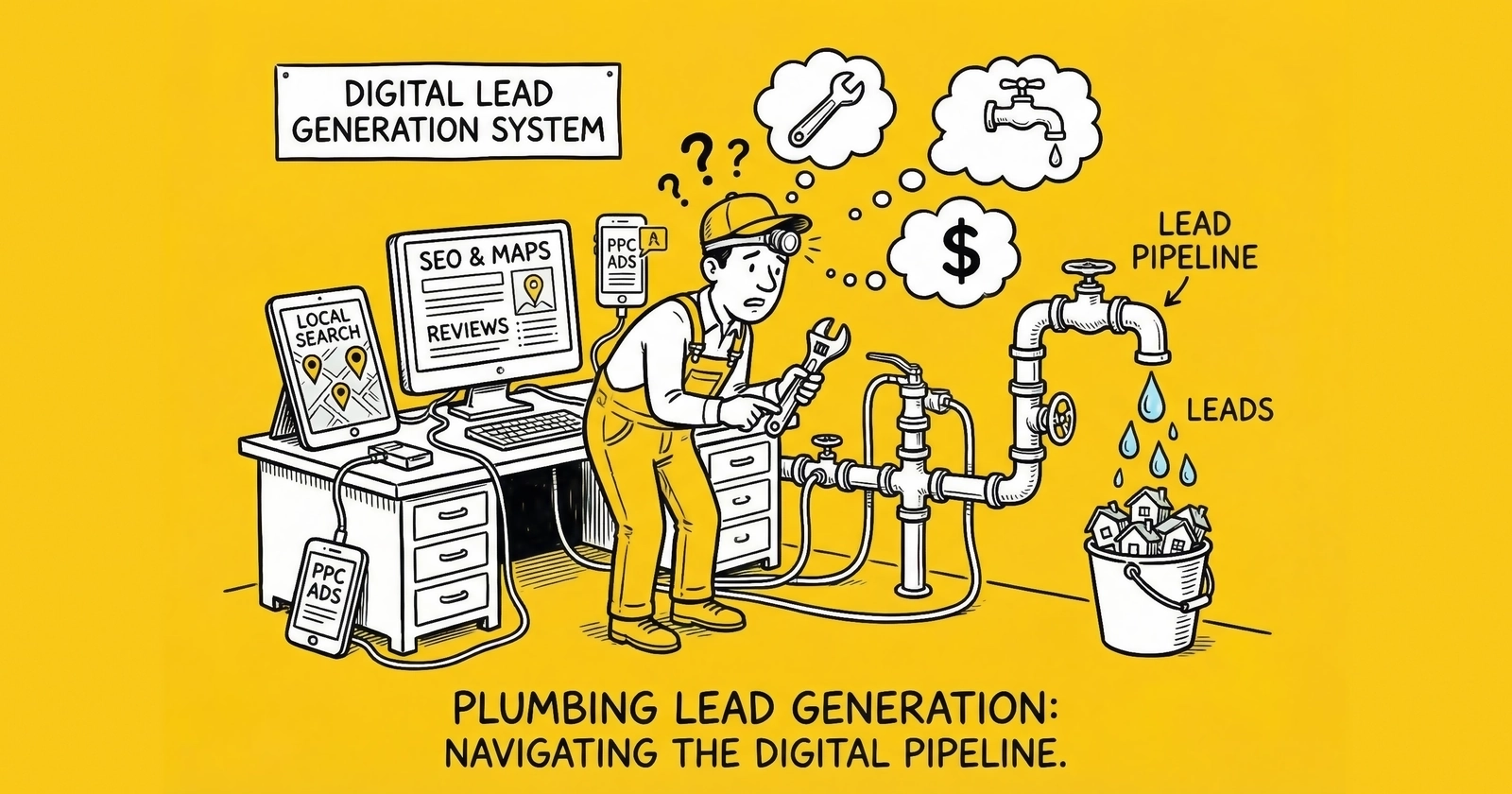
Plumbing contractors who master lead generation spend less time chasing work and more time doing it. This guide provides the complete framework for generating consistent, profitable plumbing leads.
Plumbing lead generation operates on a fundamental truth that separates thriving contractors from those struggling to fill their schedules: the emergency call that arrives at 2 AM is worth three times what you pay for it, but only if you answer before your competitor does.
The plumbing industry represents a $169.8 billion market in the United States as of 2026, with approximately 132,000 plumbing businesses competing for residential and commercial work. Those businesses employ roughly 764,000 workers across the country, serving a demand that never stops growing. Every home, every business, every new construction project needs plumbing. The question is not whether demand exists. The question is whether customers can find you when their toilet overflows, their water heater fails, or their kitchen sink backs up at the worst possible moment.
This guide provides everything local plumbing contractors need to generate consistent, high-quality leads: digital marketing strategies that work in 2026, Google Local Services Ads optimization, Google Business Profile tactics, reputation management, marketplace platforms, emergency versus scheduled lead dynamics, and the economics that determine whether your lead generation investment pays off or drains your budget.
The contractors who win in this market understand that lead generation is not an expense. It is an investment with measurable returns. A $40 lead that converts to a $400 service call represents a 10x return. A $75 lead that leads to a $12,000 water heater replacement plus future maintenance contracts represents returns that compound for years. The math works, but only for operators who approach lead generation systematically rather than sporadically.
Plumbing Industry Market Dynamics 2024-2026
Understanding the market context helps you make informed decisions about where to invest your lead generation budget and how to position your business against competitors.
Market Size and Growth
The plumbing industry reached an estimated $169.8 billion in 2025, reflecting 2.0% growth from the prior year. Industry revenue has expanded at a compound annual growth rate (CAGR) of 3.2% over the past five years, with projections suggesting continued growth at 1.7% annually through 2030, reaching approximately $185 billion.
This growth is driven by several factors working in combination. Federal infrastructure investments are funding lead pipe replacement projects across thousands of municipalities. A documented shortage of 3.7 million housing units creates sustained residential construction demand. Aging plumbing systems in existing homes require increasingly frequent repair and replacement. Emergency repair and maintenance services remain recession-resistant because plumbing failures cannot be ignored.
Labor Market Reality
The plumbing industry faces a persistent labor shortage that affects lead generation strategy in important ways. Wage increases have pressured profitability even as revenue grows. Contractors who cannot hire enough technicians face a capacity ceiling that limits how many leads they can actually service.
This labor dynamic has implications for lead generation. Purchasing more leads than you can service wastes money and damages your reputation when customers wait days for callbacks. The optimal lead volume matches your actual service capacity, not your aspirational capacity.
Competitive Landscape
The 132,000 plumbing businesses in the United States range from solo operators working out of trucks to large regional companies with dozens of technicians. This fragmentation creates opportunity for contractors who market effectively, because most competitors do not.
Research indicates that 90% of consumers use the internet to find local businesses, yet many plumbing contractors invest minimally in digital presence. The contractors who optimize their Google Business Profile, run effective paid advertising, and maintain strong review profiles capture disproportionate market share.
Lead Pricing Benchmarks
Plumbing lead costs vary significantly based on lead type, geographic market, and competitive intensity. Current benchmarks:
| Lead Type | Price Range | Typical Conversion Rate |
|---|---|---|
| Exclusive (standard service) | $25-$75 | 15-25% |
| Exclusive (emergency) | $50-$120 | 25-40% |
| Shared (2-4 buyers) | $15-$35 | 8-15% |
| Live transfer | $60-$150 | 35-55% |
| Scheduled appointment | $75-$175 | 40-60% |
| Aged leads (30+ days) | $3-$12 | 3-8% |
These ranges reflect national averages. Metropolitan areas with high competition (New York, Los Angeles, Chicago) trend toward the high end. Smaller markets with fewer competitors trend lower. Emergency leads during extreme weather events or widespread infrastructure failures can exceed typical ranges.
Digital Marketing Strategies for Plumbers
Effective digital marketing for plumbing contractors balances multiple channels, each serving different purposes in the lead generation ecosystem.
Website Foundation
Your website serves as the hub for all digital marketing efforts. More than 64% of website traffic comes from mobile devices, making mobile optimization non-negotiable. A potential customer searching “plumber near me” from their phone while standing in a flooded basement will not tolerate a slow-loading or poorly formatted site.
Website Essentials for Plumbing Lead Generation
Speed determines whether visitors stay or leave. Pages should load in under 3 seconds on mobile connections, which requires compressing images, minimizing code, and using fast hosting. A potential customer standing in a flooded basement will not wait for slow pages to render.
Click-to-call functionality is non-negotiable for emergency services. Place your phone number prominently at the top of every page with tap-to-call enabled. Emergency plumbing customers want to call immediately, not navigate through contact forms.
Dedicated service pages convert better than generic service lists. Create individual pages for each major service – drain cleaning, water heater repair, sewer line replacement, garbage disposal installation – allowing you to target specific search queries and provide relevant information that moves visitors toward action.
Service area pages capture local search intent effectively. If you serve multiple cities or neighborhoods, create location-specific pages. “Plumber in [City Name]” searches convert well when they land on pages mentioning that specific location with relevant local details.
Trust signals reduce the hesitation that prevents conversions. Display licensing information, insurance verification, years in business, and manufacturer certifications prominently. Feature your best Google reviews on your website, as social proof from real customers carries significant weight with visitors evaluating their options.
Search Engine Optimization
Local SEO drives organic traffic that costs nothing per click once established. However, ranking for competitive plumbing keywords requires sustained effort over 12-24 months.
Google Business Profile Optimization
Google Business Profile optimization forms the foundation of local SEO. Complete every field – business categories, services offered, service area, hours of operation, photos of your team and work, and regular posts. Google rewards complete, active profiles with better visibility in the Local Pack, the map results that appear at the top of local searches.
On-Page Optimization
On-page optimization requires using relevant keywords naturally in your page titles, headers, and content. “Emergency drain cleaning in [City]” should appear on your drain cleaning page, not stuffed awkwardly into unrelated content. Each service page should target specific search queries your potential customers actually use.
Local Citations
Local citations build authority through consistent business information across the web. Ensure your business name, address, and phone number (NAP) appear identically across directories: Yelp, BBB, Angi, HomeAdvisor, industry directories, and local chamber of commerce listings. Inconsistencies confuse search engines and reduce ranking potential.
Content Marketing
Content marketing establishes expertise and captures informational search traffic. Blog posts answering common questions (“Why is my water heater making noise?”, “How to prevent frozen pipes”) attract visitors who may become customers. Target 1-2 new pieces of content monthly to build a library of helpful resources that demonstrates your knowledge.
Review Generation
Review generation affects both SEO and conversion rates. More reviews with higher ratings improve Local Pack rankings while simultaneously convincing visitors to choose you over competitors. Aim for 5-10 new reviews monthly with a 4.5+ star average to maintain competitive positioning.
Pay-Per-Click Advertising
Paid search through Google Ads provides immediate visibility for keywords where organic ranking would take months or years to achieve. Plumbing is among the most competitive (and expensive) industries for paid search.
Keyword Strategy
Keyword strategy should focus on high-intent, service-specific terms. “Emergency plumber near me” and “24 hour plumbing service” indicate urgent need and convert well because searchers are ready to hire. Broader terms like “plumbing” or “plumber” attract research-phase searchers who may not convert, wasting budget on clicks that generate no revenue.
Cost-Per-Click Benchmarks
Cost-per-click benchmarks for plumbing keywords range from $4-$15 depending on market competitiveness and keyword specificity. Emergency and repair keywords command premium prices because they signal immediate purchase intent. Maintenance and installation keywords cost less but may require longer nurture sequences to convert.
Ad Copy Best Practices
Ad copy should emphasize speed (“Available Now”), trust (“Licensed & Insured”), and differentiation (“Same-Day Service Guaranteed”). Include your phone number in call extensions so mobile users can call directly from search results without visiting your website. Test multiple ad variations to identify messaging that resonates with your specific market.
Landing Page Optimization
Landing pages dedicated to each ad group convert better than sending traffic to your homepage. A user who clicks “water heater repair” should land on a page specifically about water heater repair with a clear call to action and prominent phone number. Generic pages force visitors to search for relevant information, increasing abandonment rates.
Budget Allocation
Budget allocation should match your capacity and margin requirements. Start with $50-$100 daily, track results rigorously, and scale spending on campaigns that deliver acceptable cost per lead. Pause underperforming campaigns rather than spreading budget too thin across marginally effective keywords.
Google Local Services Ads for Plumbers
Google Local Services Ads (LSA) have become the fastest-growing lead source for plumbing contractors. These ads appear at the very top of Google search results, above traditional paid ads, with the “Google Guaranteed” badge that builds immediate trust.
How Google LSA Works
Unlike traditional pay-per-click advertising where you pay for each click regardless of outcome, LSA operates on a pay-per-lead model. You only pay when a customer contacts you directly through the ad, whether by phone call or message.
The Google Guarantee badge requires completing a verification process including background checks on business owners and field technicians, license verification, and insurance confirmation. Once approved, your ads display the green checkmark badge that signals to customers Google has vetted your business. This trust signal significantly improves click-through rates compared to non-verified competitors.
Lead pricing for plumbing LSA typically ranges $25-$75 per lead, varying by market competitiveness and job type. Emergency leads may cost more due to higher intent and value; routine maintenance leads may cost less but convert at lower rates.
Optimizing LSA Performance
Complete profile setup affects both ad visibility and conversion rates. Add all services you offer, specify your service area precisely, upload professional photos, and respond to every review. Incomplete profiles receive less visibility and convert visitors at lower rates.
Review quantity and quality directly impact LSA ranking. Google prioritizes businesses with more reviews and higher ratings, displaying them more prominently in search results. The LSA platform has its own review system separate from your Google Business Profile, though GBP reviews also influence overall credibility.
Response time tracking matters more than many contractors realize. Google monitors how quickly you respond to leads and may reduce visibility for businesses that leave leads unanswered. Aim to respond to every lead within 5 minutes during business hours to maintain strong platform standing.
Dispute invalid leads when appropriate to manage costs effectively. If you receive leads with wrong numbers, outside your service area, or for services you do not offer, submit disputes through the LSA dashboard. Google credits valid disputes, reducing your effective cost per lead. Review your lead quality weekly and dispute anything that does not meet the platform’s lead quality standards.
Budget Management
LSA budgets work differently than traditional Google Ads. You set a weekly budget maximum, and Google paces delivery to stay within that limit. During high-demand periods, you may hit budget limits quickly; during slow periods, you may not spend the full budget.
Budget recommendations scale with operational capacity. Small operations with 1-2 trucks should start at $150-$300 weekly, providing enough volume to test performance without overwhelming limited capacity. Medium operations with 3-5 trucks can invest $300-$600 weekly, capturing more market share while maintaining service quality. Larger operations with 6+ trucks often spend $600-$1,500+ weekly, maximizing lead volume to keep multiple crews busy.
Monitor your cost per lead and cost per booked job weekly. If LSA delivers leads at acceptable CPA, increase budget gradually to capture more volume. If costs exceed acceptable thresholds, review your profile optimization, response times, and review quality before reducing spend.
Advanced Google LSA Optimization: The PLUMBER Framework
Google Local Services Ads represent the highest-ROI lead source for most plumbing contractors, yet the majority of operators run basic campaigns without strategic optimization. The PLUMBER framework provides a systematic approach to maximizing LSA performance through tactics that go beyond standard setup.
P – Profile Precision Engineering
Your LSA profile determines both visibility and conversion rate. Every field and setting requires strategic optimization beyond basic completion.
Service Category Optimization:
Google LSA allows plumbers to select specific service categories that determine which searches trigger your ads. Strategic selection significantly impacts lead quality and cost.
| Service Category | Search Volume | Competition | Recommended Priority |
|---|---|---|---|
| Plumber | Highest | Very High | Always include |
| Drain Cleaning Service | High | High | Always include |
| Water Heater Repair Service | Medium-High | Medium | Always include |
| Water Heater Installation Service | Medium | Medium | Include if offered |
| Sewer Contractor | Medium | Lower | Include – premium leads |
| Gas Plumber | Medium | Lower | Include if licensed |
| Leak Detection Service | Medium | Medium | Include – premium leads |
| Pipe Repair Service | Medium | Medium | Include |
Counter-intuitive tactic: Some contractors see improved results by excluding the generic “Plumber” category and focusing on specific services. This reduces total lead volume but often improves lead quality by filtering out price-shoppers who click the first generic option. Test this approach if your conversion rate from LSA leads falls below 15%.
Bio Optimization:
Your business bio appears when users expand your listing. Optimized bios include:
- Specific years in business (establishes credibility)
- License numbers and certifications
- Service area mention (confirms geographic relevance)
- Unique value proposition (differentiator from competitors)
- Emergency availability mention (if offered)
Example of optimized bio structure:
“Serving [County] homeowners since [Year]. Licensed ([License#]), bonded, and insured. We specialize in emergency repairs, drain cleaning, water heater replacement, and complete repiping. Same-day service available. Our technicians arrive in marked vehicles with all equipment needed for most repairs.”
L – Lead Response Velocity Systems
Google tracks and scores your response performance. Contractors with faster response times receive algorithmic preference in LSA rankings.
Response Time Tiers and Impact:
| Response Time | Google’s Assessment | Ranking Impact | Conversion Impact |
|---|---|---|---|
| Under 5 minutes | Excellent | Positive boost | 391% vs. 30+ min |
| 5-15 minutes | Good | Neutral | Strong |
| 15-30 minutes | Acceptable | Slight negative | Moderate |
| 30-60 minutes | Poor | Negative impact | Declining |
| Over 60 minutes | Very Poor | Significant penalty | Lost opportunity |
Infrastructure for Sub-5-Minute Response:
- Dedicated LSA phone line: Route LSA calls to a line monitored by dedicated intake staff, not your general business line
- Mobile alerts: Configure the LSA app to send push notifications to multiple devices (owner, office manager, backup)
- Message response automation: Set up templated SMS responses triggered automatically within 60 seconds of message leads
- After-hours protocol: Use an answering service with authority to schedule appointments for leads arriving outside business hours
- Escalation chain: Define backup responders when primary contact is unavailable
Advanced Response Script:
When calling LSA leads, use this framework:
Opening: “Hi [Name], this is [Your Name] from [Company]. I see you reached out about [service category from LSA]. What’s happening with your plumbing today?”
This approach:
- Confirms their identity and that they submitted the inquiry
- References the specific service they requested (building relevance)
- Opens with a question that gets them talking about their problem
- Avoids the robotic “How can I help you?” that signals telemarketing
U – Utilization of Review Mechanics
LSA has its own review ecosystem separate from Google Business Profile. Strategic review management requires understanding both systems.
LSA Review Optimization Tactics:
Request timing matters: Ask for reviews 24-48 hours after job completion, not immediately. Customers who have had time to verify the repair works leave more detailed, positive reviews.
Review response pattern: Respond to every LSA review within 24 hours. Response rate affects visibility. Even simple responses (“Thank you for the kind words, [Name]. We appreciate your business!”) count.
Review content coaching: When requesting reviews, prime customers for specific content that helps LSA performance:
“If you have a moment to leave us a review on Google, it would really help. If you could mention the specific service we did [drain cleaning, water heater, etc.], that helps other homeowners with similar problems find us.”
This coaching produces reviews with service keywords that improve LSA relevance for those searches without violating Google’s policies against incentivized reviews.
Review velocity targets by competitive tier:
| Market Competition | Minimum Monthly Reviews | Target Monthly Reviews |
|---|---|---|
| High (major metro) | 8-10 | 15-20 |
| Medium (mid-size city) | 5-8 | 10-15 |
| Lower (suburban/rural) | 3-5 | 6-10 |
M – Message Lead Conversion System
Message leads (text-based inquiries through LSA) convert differently than phone calls. Most contractors lose message leads by treating them like phone leads.
Message Lead Reality:
- Message leads expect text-based communication, not immediate phone calls
- Calling a message lead often goes to voicemail – they reached out via text for a reason
- Response time is measured in minutes, not hours
- First response should be text, followed by phone only if needed
Optimized Message Lead Sequence:
Minute 0-5 (Automated): “Thanks for reaching out to [Company]! We received your message about [service category]. Someone will respond with more details shortly. If this is an emergency, call us directly at [number].”
Minute 5-15 (Personal Response): “[Name], this is [Tech/Office] from [Company]. I saw your message about [issue]. Can you tell me more about what’s happening? Photos help if you can send them.”
If no response after 1 hour: “Hi [Name], following up on your plumbing request. We have availability [today/tomorrow]. Would [time] work for a service call? If you’re still comparing options, happy to answer any questions.”
If no response after 4 hours: Phone call attempt, then final text: “Tried to reach you by phone. Let us know when you’d like to schedule – we hold same-day slots for requests like yours.”
Message Lead Conversion Benchmarks:
| Metric | Poor | Acceptable | Good | Excellent |
|---|---|---|---|---|
| First response time | >30 min | 15-30 min | 5-15 min | <5 min |
| Response to booking | <10% | 10-20% | 20-30% | >30% |
| Messages to phone conversion | <15% | 15-25% | 25-35% | >35% |
B – Bid Mode Selection Strategy
LSA offers different bidding modes that dramatically affect lead cost and volume. Most plumbers use default settings without understanding the trade-offs.
Bidding Mode Comparison:
| Mode | How It Works | Best For | Risk Level |
|---|---|---|---|
| Maximize Leads | Google optimizes for volume within budget | New accounts, testing | Lower cost, variable quality |
| Target CPA | You set maximum cost per lead | Established accounts with conversion data | Higher cost control, may limit volume |
| Manual CPA (where available) | Set bids by job type | Advanced optimization | Requires ongoing management |
Bid Mode Progression Strategy:
Weeks 1-4: Use Maximize Leads mode to gather data. Accept that some leads will be expensive as the algorithm learns.
Weeks 5-8: Analyze actual conversion rates by job type. Calculate true cost per booked job.
Week 9+: Switch to Target CPA mode with targets set based on your actual data, not Google’s suggestions.
Job Type Bid Stratification:
Different job types warrant different CPA targets based on average ticket value:
| Job Type | Avg Ticket | Target CPA | Max Acceptable CPA |
|---|---|---|---|
| Emergency drain clearing | $275 | $35-45 | $55 |
| Water heater repair | $350 | $45-55 | $70 |
| Water heater replacement | $2,500 | $75-100 | $150 |
| Repiping | $8,000 | $150-200 | $300 |
| Sewer line replacement | $12,000 | $200-300 | $500 |
E – Exception Management and Dispute Process
Mastering the LSA dispute process significantly impacts effective cost per lead. Most contractors do not dispute invalid leads, leaving money on the table.
Disputable Lead Categories:
| Category | Criteria | Dispute Success Rate |
|---|---|---|
| Wrong number | Phone number doesn’t work | 90%+ |
| Wrong service area | Customer clearly outside your geography | 85%+ |
| Wrong service type | Request for service you don’t offer | 80%+ |
| Spam/robocall | Automated or marketing call | 75%+ |
| Duplicate | Same customer, same issue within 14 days | 70%+ |
| Job already completed | Customer had work done by someone else | 50-60% |
Dispute Process Best Practices:
- Review leads daily: Check every lead within 24 hours of receipt
- Document everything: Record calls, save texts, note timestamps
- Submit promptly: Disputes submitted within 5 days have higher success rates
- Provide evidence: Include specific details – “Customer stated address was [address], which is outside our service area of [counties]”
- Track outcomes: Monitor which dispute types succeed and adjust strategy
Expected Dispute Rate:
Healthy LSA accounts should dispute 5-12% of leads. Below 5% suggests you’re missing disputable leads. Above 15% suggests potential targeting issues that need profile adjustment.
R – Revenue Optimization Through Service Expansion
LSA allows targeting by specific services. Expanding services strategically increases lead volume and revenue.
Service Expansion Analysis Framework:
Before adding a service category:
- Do you have the capability? Proper licensing, equipment, trained technicians
- What’s the market demand? Check Google Trends for search volume
- What’s the competition? Count LSA competitors for that service in your area
- What’s the margin? Higher-margin services justify higher CPL targets
High-Value Service Additions for Plumbers:
| Service to Add | Investment Required | Lead Value | Competition Level |
|---|---|---|---|
| Gas line repair | Gas license, equipment | High | Often low |
| Leak detection | Specialized equipment | High | Medium |
| Hydro jetting | Jetter equipment | High | Medium |
| Trenchless repair | Specialized equipment | Very high | Low |
| Water filtration | Training, inventory | Medium | Low |
Geographic Service Area Optimization:
LSA allows service area definition by zip code. Optimize by:
- Including zip codes where you already have customers (reduces travel time)
- Testing adjacent zip codes one at a time (measure CPL impact)
- Excluding zip codes with high competition or low-value demographics
- Creating separate campaigns for different service areas if pricing varies by location
Google Business Profile Optimization
Your Google Business Profile (GBP) is arguably the most important digital asset for local plumbing lead generation. It appears in Google Maps, the Local Pack on search results, and influences both organic visibility and LSA performance.
Profile Completeness
Google rewards complete profiles with better visibility in search results. Every field you leave empty represents a missed opportunity to match relevant searches and convince potential customers to contact you.
Your business name should be your actual registered business name. Avoid keyword stuffing (“ABC Plumbing - 24 Hour Emergency Plumbers Near You”) which violates Google guidelines and risks suspension. Google actively penalizes profiles that attempt to manipulate rankings through name modifications.
Categories determine which searches display your profile. Select your primary category (Plumber) and add relevant secondary categories such as Drain Cleaning Service, Water Heater Repair Service, and Sewer Contractor. Each category expands your visibility for related searches.
Services should include every offering with detailed descriptions. List each service you provide so Google can match your business to specific queries. A homeowner searching for “garbage disposal installation” will find you only if that service appears in your profile.
Service area definition requires precision. Define the cities, zip codes, or radius where you actually operate. Showing up for areas you do not serve wastes impressions and frustrates potential customers who discover you are unavailable.
Hours must stay accurate, especially for emergency services. If you offer 24/7 service, indicate that clearly. Customers who call after hours based on your listed availability and reach voicemail become negative reviews.
Attributes provide additional differentiation opportunities. Select relevant options including veteran-owned, women-owned, emergency service available, online appointments, and other applicable designations that may influence customer decisions.
Visual Content
Photos significantly impact GBP performance. Businesses with photos receive 42% more requests for driving directions and 35% more website clicks than those without. Visual content humanizes your business and builds trust before customers ever contact you.
Include professional headshots of owners and technicians so customers know who will arrive at their home. Branded service vehicles demonstrate professionalism and make your trucks recognizable in the community. Before/after images of completed work showcase your quality and capability. Interior photos of your shop or office establish credibility, while team photos create connection. Equipment and technology images demonstrate your investment in proper tools.
Add new photos monthly to signal an active, engaged business. Google favors profiles with fresh content, and regular updates improve your ranking potential while showing customers you remain actively engaged in your business.
Google Posts
Google Posts allow you to publish updates that appear directly on your GBP listing, providing another touchpoint with potential customers.
Seasonal promotions work particularly well – announce water heater tune-ups before winter or drain cleaning specials before the holiday cooking season. New service announcements inform customers about expanded capabilities. Hiring announcements signal business growth and success. Tips and advice posts demonstrate expertise while providing value. Community involvement posts connect your business to local identity.
Post weekly to maintain freshness signals. Posts expire after 7 days, so regular posting is necessary to maintain visibility. Develop a simple content calendar to ensure consistent updates without overwhelming your schedule.
Review Management
Reviews are the single most important factor in GBP conversion. Research indicates that 80% of prospective customers check online reviews before contacting a business, and the average consumer reads 10 reviews before making a decision.
Generating Reviews
Reviews do not accumulate automatically – you must ask consistently and make the process easy. Ask every satisfied customer for a review, as most will not leave one unprompted regardless of satisfaction. Send follow-up texts or emails with direct links to your GBP review page within 24 hours of job completion when the positive experience remains fresh. Make requesting reviews part of your technicians’ standard workflow rather than leaving it to chance. Target 5-10 new reviews monthly at minimum to maintain competitive positioning.
Responding to Reviews
Respond to every review, positive and negative, within 24-48 hours. For positive reviews, thank reviewers specifically and mention the service they received to reinforce keywords. Address negative reviews professionally by acknowledging the concern, apologizing for their experience, and offering to resolve the issue offline. Never argue with reviewers publicly – your response is written for future customers reading the exchange, not the original reviewer.
Review Quality Signals
Reviews mentioning specific services help Google understand what you offer and match your profile to relevant searches. A review saying “they fixed my water heater quickly” provides more ranking value than “great service.” Recent reviews carry more weight than old ones, making consistent generation essential. Your response rate affects how Google perceives your customer service commitment, potentially influencing visibility.
The DRAIN Framework: Digital Revenue Acquisition and Integration for Plumbing Contractors
While individual marketing tactics can generate leads, sustainable plumbing business growth requires systematic integration of digital marketing channels. The DRAIN framework provides a methodology for building comprehensive lead generation systems that work together rather than in isolation.
D – Digital Presence Audit and Foundation Assessment
Before investing in new lead generation channels, contractors must assess their current digital foundation. Weak foundations limit returns on all subsequent marketing investments.
Digital Foundation Diagnostic Matrix:
| Component | Minimum Viable | Competitive Standard | Market Leader |
|---|---|---|---|
| Website mobile speed | Under 4 seconds | Under 2.5 seconds | Under 1.5 seconds |
| GBP completeness | 70% of fields | 90% of fields | 100% + weekly posts |
| Review count | 25+ reviews | 75+ reviews | 200+ reviews |
| Review rating | 4.0+ stars | 4.5+ stars | 4.8+ stars |
| NAP consistency | 80% consistent | 95% consistent | 100% consistent |
| Service area pages | Homepage only | 5-10 location pages | 15+ location pages |
Foundation Gap Scoring:
Rate each component 1-10 and calculate priority:
| Component | Current Score | Competitive Gap | Priority Weight | Investment Priority |
|---|---|---|---|---|
| Website performance | ___ | ___ | 2.0x | ___ |
| GBP optimization | ___ | ___ | 2.5x | ___ |
| Review profile | ___ | ___ | 2.0x | ___ |
| Citation accuracy | ___ | ___ | 1.0x | ___ |
| Content depth | ___ | ___ | 1.5x | ___ |
Investment Sequence Rule:
Never invest more than 20% of marketing budget in paid lead generation until foundation scores average 7+ across all components. Weak foundations convert paid leads at 40-60% lower rates than strong foundations.
R – Revenue Attribution and ROI Tracking System
Most plumbing contractors cannot accurately attribute revenue to marketing sources, making optimization impossible. Proper attribution infrastructure transforms marketing from expense to investment.
Attribution Infrastructure Requirements:
| Tracking Component | Implementation Cost | Monthly Cost | Data Captured |
|---|---|---|---|
| Call tracking (basic) | $0-100 | $45-100 | Call source, duration |
| Call tracking (advanced) | $100-500 | $100-250 | Call recording, transcription |
| Form tracking | $0-200 | $0-50 | Form source, completion |
| CRM integration | $500-2,000 | $25-150 | Lead to job connection |
| Revenue attribution | $1,000-5,000 | $100-300 | Full marketing ROI |
Revenue Attribution Benchmarks by Channel:
Track these metrics for each marketing channel:
| Metric | Definition | Target Threshold |
|---|---|---|
| Cost per lead (CPL) | Marketing spend ÷ Leads generated | Varies by channel |
| Cost per call (CPC) | Marketing spend ÷ Calls received | Under $50 for service calls |
| Cost per appointment (CPA) | Marketing spend ÷ Appointments booked | Under $75 for standard service |
| Cost per job (CPJ) | Marketing spend ÷ Completed jobs | Under $125 for average ticket |
| Marketing ROI | Revenue attributed ÷ Marketing spend | 3:1 minimum, 5:1 target |
Channel-Specific ROI Benchmarks for Plumbing:
| Channel | Expected CPL | Expected CPA | Target ROI | Breakeven ROI |
|---|---|---|---|---|
| Google LSA | $35-65 | $90-150 | 4:1 | 2.5:1 |
| Google Ads | $45-85 | $120-200 | 3.5:1 | 2:1 |
| SEO/Organic | $15-40 | $40-100 | 6:1 | 3:1 |
| Angi/HomeAdvisor | $20-45 | $80-150 | 3:1 | 2:1 |
| Thumbtack | $15-40 | $60-120 | 3.5:1 | 2:1 |
| Direct mail | $25-50 | $100-175 | 2.5:1 | 1.5:1 |
A – Audience Segmentation and Targeting Precision
Generic marketing to “homeowners who need plumbing” wastes budget. Precise segmentation targets high-value prospects while reducing cost per acquisition.
Plumbing Customer Segmentation Matrix:
| Segment | Job Type | Average Ticket | Urgency Level | Marketing Approach |
|---|---|---|---|---|
| Emergency residential | Drain clear, leak repair | $275-450 | Extreme | LSA, PPC, 24/7 visibility |
| Scheduled residential | Fixture install, maintenance | $200-400 | Low | SEO, remarketing, seasonal |
| Water heater | Repair or replacement | $350-2,500 | Medium-High | PPC, content, LSA |
| Remodel/renovation | Bathroom, kitchen plumbing | $2,000-15,000 | Low | SEO, social, referrals |
| Commercial service | Business plumbing needs | $500-5,000 | Variable | LinkedIn, direct outreach |
| New construction | Full plumbing rough-in | $8,000-25,000 | Low | Contractor relationships |
Geographic Targeting Optimization:
| Targeting Factor | Impact on Conversion | Optimization Action |
|---|---|---|
| Drive time under 15 min | +25% conversion | Prioritize close zip codes |
| Median home value | +15% per $100K | Weight toward higher-value areas |
| Home age 20+ years | +35% for repair | Target older neighborhoods |
| Owner occupancy rate | +20% vs rentals | Focus on owner-heavy areas |
| Previous customer density | +40% conversion | Double down on proven areas |
Audience Exclusion List (Negative Targeting):
| Exclude | Reason | Savings Impact |
|---|---|---|
| Apartment complexes | Maintenance contracts | 5-10% budget savings |
| New construction under 5 years | Warranty coverage | 3-5% budget savings |
| Areas over 30 min drive | Low profitability | 10-15% budget savings |
| Known low-income areas | Price sensitivity | 5-8% budget savings |
| Commercial-only zones | Requires different approach | 3-5% budget savings |
I – Integration of Marketing Channels
Isolated channel management misses synergies between marketing efforts. Integrated approaches compound returns across channels.
Channel Integration Matrix:
| Primary Channel | Supporting Channel | Integration Mechanism | Expected Lift |
|---|---|---|---|
| LSA | GBP reviews | Reviews boost LSA ranking | +15-25% leads |
| Google Ads | Remarketing | Retarget non-converters | +20-30% conversion |
| SEO | Content marketing | Blog supports rankings | +30-50% organic traffic |
| GBP | Social proof | Review screenshots in ads | +10-15% CTR |
| Direct mail | Landing pages | Trackable URLs per campaign | +25-40% attribution |
| Referrals | Review requests | Convert referrals to reviewers | +15-25% reviews |
Budget Allocation Framework by Business Stage:
Startup Stage (Under $500K revenue):
| Channel | Budget Share | Primary Objective |
|---|---|---|
| GBP optimization | 15% (time + tools) | Foundation building |
| Google LSA | 40% | Immediate lead flow |
| Review generation | 20% (incentives + tools) | Credibility building |
| Basic SEO | 15% | Long-term investment |
| Marketplace platforms | 10% | Supplemental volume |
Growth Stage ($500K-$1.5M revenue):
| Channel | Budget Share | Primary Objective |
|---|---|---|
| Google LSA | 30% | Primary lead source |
| Google Ads | 25% | Capture additional search |
| SEO/Content | 20% | Organic growth |
| Marketplace platforms | 10% | Volume supplement |
| Remarketing | 10% | Conversion optimization |
| Review management | 5% | Reputation maintenance |
Established Stage ($1.5M+ revenue):
| Channel | Budget Share | Primary Objective |
|---|---|---|
| Google LSA | 25% | Maintain lead flow |
| Google Ads | 20% | Competitive presence |
| SEO/Content | 20% | Market authority |
| Remarketing | 10% | Conversion lift |
| Video marketing | 10% | Brand differentiation |
| New channel testing | 10% | Growth opportunities |
| Reputation management | 5% | Ongoing maintenance |
N – Nurture and Follow-Up Systems
Most plumbing contractors lose leads through inadequate follow-up. Systematic nurture recovers lost opportunities and maximizes conversion from existing leads.
Follow-Up Sequence Standards:
| Lead Type | Contact 1 | Contact 2 | Contact 3 | Contact 4+ |
|---|---|---|---|---|
| Emergency | Immediate call | 5 min callback | 15 min text | Hourly until closed |
| Service request | Under 5 min | 1 hour | 4 hours | Next day AM |
| Quote request | Under 1 hour | Same day | Next day | Day 3 |
| Information seeker | Under 4 hours | Next day | Day 3 | Weekly |
Nurture Content by Customer Stage:
| Stage | Content Type | Delivery Channel | Objective |
|---|---|---|---|
| New lead | Welcome + credibility | Email + text | Build trust |
| Post-quote | Social proof | Reduce hesitation | |
| Lost lead (30 days) | Seasonal offer | Email + direct mail | Re-engagement |
| Lost lead (90 days) | Educational content | Stay top of mind | |
| Past customer (6 mo) | Maintenance reminder | Email + text | Repeat business |
| Past customer (1 yr) | Check-up offer | Direct mail + email | Annual service |
Nurture Conversion Benchmarks:
| Lead Status | Without Nurture | With Basic Nurture | With Optimized Nurture |
|---|---|---|---|
| Initial inquiry to appointment | 25% | 35% | 45% |
| Quote to job | 45% | 55% | 65% |
| Lost lead recovery (90 days) | 2% | 8% | 15% |
| Past customer repeat (annual) | 12% | 22% | 32% |
Automation Investment Benchmarks:
| Automation Level | Implementation Cost | Monthly Cost | Expected Conversion Lift |
|---|---|---|---|
| Basic (email only) | $200-500 | $30-75 | +10-15% |
| Standard (email + text) | $500-1,500 | $75-150 | +20-30% |
| Advanced (multi-channel) | $2,000-5,000 | $150-350 | +30-45% |
| Enterprise (full automation) | $5,000-15,000 | $350-750 | +40-60% |
Marketplace Platforms: Angi, HomeAdvisor, Thumbtack
Online marketplaces connect homeowners seeking plumbers with contractors seeking work. These platforms offer volume but come with trade-offs in lead quality and competition.
Angi (formerly Angie’s List and HomeAdvisor)
Following the 2021 merger of Angie’s List and HomeAdvisor, Angi reaches over 35 million monthly unique visitors with more than 250,000 home service professionals on the platform.
Homeowners submit project requests describing their plumbing needs, and Angi matches these requests to contractors in the area, charging contractors per lead. Lead costs for plumbing typically range $15-$50 depending on job type and market.
The shared lead reality creates competition. Most Angi leads go to 3-4 contractors simultaneously, meaning the first contractor to reach the homeowner captures a significant advantage. Speed-to-contact becomes the primary competitive differentiator rather than price or reputation.
Profile Optimization on Angi
Complete your profile with photos, reviews, and detailed service descriptions to stand out when homeowners compare options. Respond to leads within minutes, not hours – speed determines outcomes more than any other factor. Request reviews from every completed job to build platform-specific credibility. Set targeting filters precisely to avoid leads outside your service area or specialty, which waste budget and frustrate customers.
Cost Management on Angi
Set daily and monthly budget caps to prevent runaway spending during high-demand periods. Dispute leads that do not match your targeting criteria, as Angi credits valid disputes. Track booking rate by job type and adjust filters accordingly – if certain lead types consistently fail to convert, stop paying for them.
Thumbtack
Thumbtack operates on a quote-based model where homeowners describe their project and contractors pay to submit quotes.
Thumbtack’s model puts more control in your hands – you pay to contact leads, not per lead received. This requires active engagement and selectivity about which opportunities to pursue.
Plumbing lead costs typically range $10-$40 per quote sent, depending on job complexity. Simple drain cleaning quotes cost less than complex repiping project quotes.
Respond quickly with personalized quotes that address the specific needs described in the request. Include photos and credentials in your profile to build credibility before customers even read your quote. Build reviews on the Thumbtack platform specifically, as platform-specific social proof influences customer decisions. Be selective about which leads you quote – not every request is worth pursuing, and sending quotes on poor-fit projects wastes money.
Yelp for Business
Yelp serves a review-conscious audience, particularly in urban and suburban markets.
Advertising options include enhanced listings, priority placement, and pay-per-click ads that appear on search results. These paid options increase visibility but require careful ROI tracking.
Yelp’s filtering algorithm hides reviews it considers suspicious, which frustrates some business owners who see legitimate reviews filtered. Focus on generating organic reviews from real customers rather than trying to game the system. Authentic review patterns perform better long-term than manipulation attempts.
Cost per lead on Yelp typically runs $20-$60 for plumbing, varying by market competition. Urban markets with heavy Yelp usage tend toward the higher end.
Platform Strategy
The optimal approach diversifies across platforms while tracking performance rigorously. Diversification reduces dependence on any single lead source, which protects you when platforms change policies or raise prices. Different platforms capture different customer segments – Angi attracts different demographics than Thumbtack – expanding your reach across market segments.
Tracking Requirements
Use unique tracking phone numbers for each platform so you can attribute calls accurately. Integrate tracking with your CRM for lead-to-booking-to-revenue attribution that reveals true platform performance. Calculate cost per acquisition by platform, not just cost per lead, as conversion rates vary significantly across sources. Review platform performance monthly and reallocate budget toward better performers while reducing spend on underperforming channels.
Emergency Leads Versus Scheduled Leads
The distinction between emergency and scheduled plumbing leads fundamentally shapes lead generation strategy, pricing, and operational requirements.
Emergency Lead Dynamics
Emergency plumbing situations – burst pipes, overflowing toilets, backed-up sewers, no hot water in winter – create urgent demand that converts at dramatically higher rates.
Emergency Lead Characteristics
Homeowners facing plumbing emergencies will pay premium prices for immediate service because the alternative – waiting – causes ongoing damage or discomfort. Response time expectations compress to minutes rather than hours. Competition intensifies during widespread events like cold snaps causing frozen pipes across neighborhoods. Customers show higher willingness to proceed without multiple quotes because urgency overrides price shopping.
Emergency Lead Acquisition
Target keywords with urgency modifiers such as “emergency plumber,” “24 hour plumbing,” and “plumber near me now.” Run call-based campaigns with immediate connection to your dispatcher rather than forms that create delays. Build mobile-optimized landing pages with prominent click-to-call functionality. Maintain LSA ads, which always appear for emergency searches when budget allows.
Emergency Lead Pricing
Emergency leads command 40-60% premiums over standard service leads. Standard service leads typically cost $25-$50, while emergency leads during normal conditions run $50-$80. During crisis events like mass pipe freezes, emergency lead costs can reach $75-$120 as demand surges.
Operational Requirements for Emergency Leads
Emergency leads require infrastructure to deliver on the implicit promise of immediate service. You need 24/7 dispatch capability through an answering service or on-call staff. Technician availability for after-hours calls is essential – leads are worthless if no one can respond. Maintain parts inventory for common emergency repairs so technicians can resolve issues on the first visit. Stock vehicles for immediate deployment rather than requiring shop stops before service calls.
A homeowner submitting an emergency lead at 10 PM expects a callback within minutes, not the next morning. Failing to meet that expectation wastes the lead cost and damages your reputation through negative reviews.
Scheduled Lead Dynamics
Scheduled leads include maintenance requests, planned installations, and non-urgent repairs. These leads convert at lower rates but cost less and provide steadier, more predictable volume.
Scheduled Lead Characteristics
Scheduled leads operate on longer decision timelines – days or weeks rather than minutes. Customers show higher price sensitivity and greater likelihood of gathering multiple quotes before deciding. This slower pace creates more opportunity for relationship building and upselling additional services. Scheduled work also provides better training ground for newer technicians or apprentices who need supervision.
Scheduled Lead Acquisition
Content marketing targeting informational queries (“how often should I have my drains cleaned”) attracts early-stage prospects. Social media advertising builds awareness and consideration before immediate need arises. Direct mail for seasonal maintenance reminders reaches homeowners who may not be actively searching online. Email nurturing for past customers keeps your business top of mind when needs arise.
Scheduled Lead Pricing
Scheduled leads cost less than emergency leads due to lower urgency and longer sales cycles. Maintenance leads typically run $15-$35. Planned installation leads cost $40-$80 due to higher ticket values. Non-urgent repair leads fall in between at $25-$50.
Conversion Optimization for Scheduled Leads
Scheduled leads require more follow-up effort than emergency leads because customers are not under time pressure. Implement systematic sequences: immediate response even if just acknowledgment, same-day quotes for simple requests, follow-up calls within 24-48 hours if no response, and nurture sequences with helpful content and periodic check-ins. Persistence without pestering converts leads that initial contact does not close.
Balancing Your Lead Portfolio
Most successful plumbing operations generate 40-60% of leads from scheduled requests and 40-60% from emergency demand, with the balance varying by season and service focus.
Emphasizing scheduled leads provides lower lead costs, more predictable scheduling, better technician utilization, and opportunities for maintenance contracts that create recurring revenue. This approach works well for shops with full-time technicians who need consistent work to justify their salaries.
Emphasizing emergency leads delivers higher per-job revenue, better conversion rates, premium pricing acceptance, and customers who do less price shopping. This approach works well for shops with on-call contractors who can mobilize for high-value urgent work without the overhead of full-time employment.
The optimal mix depends on your capacity, staffing model, and strategic objectives. Most operations benefit from building a foundation of scheduled work while capturing emergency demand when it arises.
Speed-to-Contact: The Critical Success Factor
Research consistently demonstrates that response time is the single most important factor in converting plumbing leads to booked jobs. This finding holds across lead types, platforms, and markets.
The Research Foundation
Studies from multiple sources converge on the same conclusion:
Calling a lead within the first minute boosts conversion rates by 391% compared to delayed outreach, illustrating the speed-to-lead advantage. The consumer who just submitted a request is sitting at their phone, actively thinking about their plumbing problem, and available to engage.
Teams calling leads within five minutes are 100 times more likely to connect compared to waiting an hour. This is not a marginal improvement. It is an order-of-magnitude difference.
78% of customers purchase from the first responder who reaches them. When multiple contractors compete for the same lead (as with Angi shared leads), the winner is determined primarily by speed, not price or reputation.
Why Speed Matters Psychologically
The speed-to-contact effect reflects several psychological dynamics working in your favor when you respond quickly.
Recency and attention work together – a homeowner who just submitted a plumbing inquiry has plumbing actively in mind. An hour later, they have moved on to other tasks, making it harder to recapture their attention.
Commitment consistency plays a role as well. Taking the action of submitting a form creates a small psychological commitment. Engaging with the contractor who responds maintains that commitment momentum and increases likelihood of conversion.
Trust formation happens instantly. Rapid, professional response signals competence. Customers think: “If they respond this quickly to a sales inquiry, they will probably respond quickly when I need service.” This inference creates preference.
Shopping momentum matters because a consumer actively comparing options has mental energy directed toward the purchase decision. Catching them in that mode is easier than interrupting whatever they moved on to do next.
Implementation Requirements
Achieving sub-five-minute response times requires intentional infrastructure across technology, staffing, and automation.
Real-Time Lead Delivery
Configure lead sources to deliver via API or real-time webhook rather than batch file transfers that create delays. Enable push notifications to dispatcher phones and tablets so incoming leads generate immediate alerts. Set up SMS alerts for leads arriving outside office hours when regular monitoring may lapse. Use immediate email as backup notification in case primary delivery channels fail.
Staffing for Response
Dedicate intake staff during peak lead hours rather than expecting technicians or office managers to juggle lead response with other duties. Maintain an on-call dispatcher for after-hours leads who has authority to schedule appointments immediately without waiting for management approval. Establish clear handoff procedures when the primary responder is unavailable so leads never sit unattended.
Automated First Touch
Send immediate SMS acknowledgment when leads arrive: “Thanks for contacting [Company]. Someone will call within 5 minutes.” This sets expectations and confirms receipt. Include an automated calendar link for self-scheduling so motivated customers can book without waiting for a call. Send an email with company credentials and reviews instantly to build credibility while the customer waits for human contact.
Measuring and Improving Response Time
Track time-to-first-dial and time-to-first-contact by lead source, time of day, and assigned staff member. Make these metrics visible and tie them to performance incentives so the team understands what matters.
Response under 2 minutes delivers excellent results with maximum competitive advantage. Response within 2-5 minutes remains good and still captures most first-mover benefit. Response within 5-15 minutes is acceptable but shows declining advantage. Response within 15-60 minutes becomes problematic with significant conversion loss. Response over 1 hour likely loses 50% or more of potential conversions – at that point, you are paying for leads that competitors convert.
Reputation Management for Plumbers
Online reputation directly affects lead generation performance. Reviews influence search rankings, conversion rates, and customer willingness to pay premium prices.
The Business Case for Reviews
80% of prospective customers check online reviews before contacting a business. 89% of consumers aged 35-54 trust online reviews as much as personal recommendations. The average consumer reads 10 reviews before making a decision.
These statistics have practical implications. A plumbing contractor with 15 reviews and a 3.8-star average will lose business to a competitor with 85 reviews and a 4.7-star average, even if the first contractor is objectively better.
Generating Reviews Systematically
Reviews do not accumulate automatically. You must ask for them consistently and make the process easy.
Process Integration
Train technicians to request reviews after successful jobs as a standard part of their workflow rather than an afterthought. Follow up every completed job with a text or email containing a direct review link within 24 hours while the positive experience remains fresh. Make the process effortless with one-click links that take customers directly to review submission without requiring them to search for your profile.
Volume Targets
Minimum viable review generation requires 5 new reviews monthly to maintain basic visibility. Competitive positioning requires 10-15 new reviews monthly. Market-leading status requires 20+ new reviews monthly. Some contractors generate 5-15 Google reviews per day by making review requests a non-negotiable part of their service process with every customer.
Managing Negative Reviews
Negative reviews happen to every business. How you respond matters more than avoiding them entirely.
Response Framework
Acknowledge the customer’s concern directly and specifically. Apologize for their experience without admitting fault inappropriately – you can be sorry they had a negative experience without accepting blame for things that were not your responsibility. Offer to resolve the issue offline by providing a phone number or email. Keep your response professional and brief rather than defensive or lengthy.
An effective response might read: “We’re sorry to hear about your experience and would like to make this right. Please call our office at [number] so we can understand what happened and find a solution.”
What to Avoid
Never argue with the reviewer, blame the customer, dispute facts publicly, or ignore the review entirely. Each of these approaches damages your reputation with future customers more than the original negative review.
Your response is not written for the unhappy reviewer. It is written for the dozens of future customers who will read the exchange. Professional handling of complaints builds trust; defensive responses destroy it.
Platform-Specific Considerations
Different platforms have different review dynamics that affect where you should focus efforts.
Google Business Profile is the most important platform for local search visibility. Focus your review generation efforts here first, as GBP reviews influence Local Pack rankings and convert the highest volume of searchers.
Yelp uses an aggressive filtering algorithm that hides reviews it considers suspicious. Generate authentic reviews through service quality rather than solicitation campaigns – Yelp penalizes patterns that look like manipulation.
Angi and HomeAdvisor reviews affect your visibility and lead flow within their marketplaces. Ask customers who found you through these platforms to review you there specifically, as platform-specific reviews carry more weight for marketplace ranking.
Facebook reviews (now called “Recommendations”) affect visibility on Facebook and build social proof for customers who research you through social channels.
Tracking and Attribution
You cannot improve what you do not measure. Plumbing lead generation requires tracking infrastructure that connects marketing spend to revenue.
Essential Metrics
Cost per lead (CPL) measures what you pay to acquire each lead, tracked by source. This baseline metric enables comparison across channels but does not tell the full story.
Contact rate measures the percentage of leads where you successfully reach the homeowner. Low contact rates may indicate lead quality issues or slow response times.
Booking rate measures the percentage of contacts that schedule appointments. This reflects your intake process effectiveness and pricing competitiveness.
Show rate measures the percentage of scheduled appointments where the homeowner is present. No-shows waste technician time and truck rolls.
Close rate measures the percentage of completed appointments that convert to paid work. This reflects your technicians’ sales skills and pricing accuracy.
Average ticket measures revenue per completed job. Higher tickets improve ROI even when lead costs increase.
Cost per acquisition (CPA) is total marketing cost divided by number of customers acquired. This is the metric that matters most because it incorporates all conversion steps.
Customer lifetime value (LTV) measures total revenue a customer generates over their relationship with your business, including repeat service and referrals. Understanding LTV justifies higher acquisition costs.
Tracking Infrastructure
Call tracking provides the foundation for attribution. Use unique phone numbers for each lead source – Google Ads, LSA, Angi, organic search – so you can identify exactly where calls originate. Services like CallRail, CallTrackingMetrics, or WhatConverts assign tracking numbers and record calls for quality review.
CRM integration connects lead data to your service management software so you can track which leads become customers and generate revenue. Without this connection, you know lead volume but not lead value.
Attribution modeling requires understanding that many customers interact with multiple touchpoints before calling. A customer might see your LSA ad, visit your website, read your Google reviews, and then call from organic search. Simple last-touch attribution misses this complexity and may lead you to underfund channels that influence decisions even when they do not generate the final click.
Calculating True ROI
The true ROI of plumbing lead generation extends beyond the initial job.
Consider an example calculation: with monthly marketing spend of $3,000 generating 80 leads, and a 25% booking rate producing 20 booked appointments, 90% show rate yielding 18 completed jobs at $425 average ticket, immediate revenue reaches $7,650. Immediate ROI calculates to 155% ($7,650 divided by $3,000 equals 2.55x return).
But this calculation understates the true return. Customers who return for future service represent additional value – approximately 20% return within 2 years. Referrals from satisfied customers bring new customers at zero acquisition cost. Maintenance contracts sold on approximately 15% of jobs create recurring revenue streams. Larger jobs from relationship building, like water heater replacements for customers who called initially for minor repairs, expand revenue from acquired customers.
A conservative lifetime value for a residential plumbing customer often exceeds $1,500-$2,500 over 5-10 years, making initial acquisition costs that seem high actually quite reasonable when evaluated against total customer value.
Building Trust Through Digital Presence
In an industry plagued by fly-by-night operators and consumer horror stories, establishing trust before the first phone call determines competitive position. The contractors who invest in comprehensive trust signals convert leads at higher rates and command premium pricing for their services.
Licensing and Credential Display
Every plumbing contractor must display licensing information prominently across all digital touchpoints. State license numbers, insurance verification, and bonding information should appear on your website, Google Business Profile, and marketplace platform listings. These credentials are table stakes, but surprisingly many contractors fail to display them consistently.
Beyond basic licensing, additional credentials differentiate your business from competitors. Manufacturer certifications from brands like Rinnai, Navien, or Rheem signal expertise with specific equipment. Membership in professional associations such as the Plumbing-Heating-Cooling Contractors Association (PHCC) demonstrates commitment to industry standards. Training certifications in specialized areas like tankless water heaters, hydronic systems, or backflow prevention position your team as experts rather than generalists.
The practical impact of credential display extends beyond customer perception. Google Business Profile allows you to add attributes for licensing and certifications that may improve visibility for relevant searches. Marketplace platforms often feature verified contractors more prominently than unverified competitors. The administrative work of maintaining current credentials pays returns through improved digital performance.
Social Proof and Trust Signals
Reviews represent the most powerful trust signal for plumbing contractors, but other forms of social proof reinforce the message. Case studies featuring before-and-after photos of complex jobs demonstrate capability. Video testimonials from satisfied customers create emotional connection that text reviews cannot match. Documentation of community involvement humanizes your business beyond its commercial function.
The compound effect of multiple trust signals exceeds the sum of individual elements. A contractor with 150 reviews, manufacturer certifications, professional association membership, and community involvement creates a trust profile that competitors with only reviews cannot match. Each additional signal reduces the perceived risk of hiring an unknown contractor.
Response Time as Trust Signal
Speed of response functions as a powerful trust signal, particularly for emergency service requests. A contractor who returns calls within five minutes signals professionalism and customer focus before any service is provided. This first impression sets expectations for the entire customer relationship.
Communicating response time commitments explicitly amplifies their impact. Website messaging that promises callback within 5 minutes during business hours creates a concrete expectation. LSA ads that highlight immediate availability compete for urgency-driven searches. The commitment must be kept, of course, but making the commitment explicit converts prospects who might otherwise continue searching.
Transparency in Pricing Communication
Price transparency increasingly influences contractor selection. While plumbing work often requires on-site assessment before accurate pricing, communicating pricing frameworks reduces customer anxiety. Service call fees, hourly rates for standard work, and price ranges for common repairs help prospects understand what to expect.
This transparency particularly matters for younger homeowners who research extensively before making purchasing decisions. Millennials and Gen Z consumers expect the same price transparency from service businesses that they experience in e-commerce. Contractors who hide pricing until the service call face suspicion that undermines conversion.
Advanced Digital Marketing Tactics
Beyond foundational strategies, advanced tactics separate market leaders from average performers. These approaches require greater investment but deliver proportionally greater returns.
Hyper-Local Content Strategy
Generic “plumber in [city]” content competes against every other contractor targeting the same market. Hyper-local content targeting specific neighborhoods, subdivisions, or building types captures search traffic that broader content misses.
Content addressing specific communities creates relevance signals that improve both SEO and conversion. An article about common plumbing issues in homes built during a specific era in a specific neighborhood demonstrates local knowledge that generic competitors cannot match. This approach requires understanding your service area deeply enough to identify these opportunities.
The implementation involves creating content around neighborhood-specific topics such as known construction defects in particular subdivisions, water quality issues affecting specific areas, and municipal infrastructure affecting certain zones. This content serves SEO purposes while simultaneously demonstrating the local expertise that homeowners value.
Video Marketing for Trust and Engagement
Video content has become essential for plumbing contractors seeking to differentiate from competitors. YouTube serves as the second-largest search engine, and consumers increasingly prefer video content for researching service providers.
Effective video content for plumbers includes educational videos explaining common problems and solutions, behind-the-scenes content showing your team and operations, project walkthroughs demonstrating your work quality, and customer testimonial videos capturing authentic experiences. These videos serve multiple purposes: they drive organic traffic through YouTube and Google search, they provide content for social media distribution, and they create trust signals when embedded on your website.
Video production need not be expensive. Smartphone footage of actual service work, combined with clear audio explanation, often outperforms polished production because it appears authentic rather than promotional. Consistency matters more than production value for building an audience over time.
Retargeting for Conversion Recovery
Many website visitors research plumbing options without immediately converting. Retargeting campaigns reach these visitors as they browse other websites, reminding them of your services and encouraging return visits.
Effective retargeting for plumbers requires segmentation by visitor behavior. Users who viewed emergency service pages should see different messaging than those researching water heater installation. Users who started but abandoned contact forms represent the highest-intent segment and justify aggressive retargeting frequency.
The technology implementation involves placing retargeting pixels from platforms like Google Ads and Meta on your website, then creating audience segments based on page visits and behaviors. Campaigns targeting these segments display your ads across the display network and social platforms, keeping your business top-of-mind during the consideration period.
Seasonal Considerations for Plumbing Leads
Plumbing demand fluctuates throughout the year, though less dramatically than HVAC. Understanding seasonal patterns helps you allocate marketing budget effectively.
Winter Patterns
Cold weather creates specific demand spikes that can be anticipated and prepared for.
Frozen pipes and water damage create demand peaks during and immediately after cold snaps when temperatures drop below freezing for extended periods. Homes with poor insulation or exposed pipes face failures that require emergency response.
Water heater stress increases during winter months. Cold incoming water temperatures force water heaters to work harder, accelerating failures and increasing repair demand.
Holiday-related drain issues spike around Thanksgiving and Christmas as people cook more and put inappropriate items down garbage disposals. These predictable failures create concentrated demand.
Marketing response should include increasing paid search budgets during cold weather forecasts when you know demand is coming. Prepare landing pages with frozen pipe messaging before cold snaps hit. Pre-position content about winterizing plumbing to capture early-stage search traffic. Staff up for increased call volume so you can capture the demand surge rather than losing leads to slow response.
Spring and Summer Patterns
Warmer months bring different demand patterns that favor planned work over emergency service.
Sewer line issues increase as spring rains and melting snow can flood or damage sewer lines. Root growth accelerates during growing season and creates blockages that worsen through summer.
Outdoor plumbing demand rises as homeowners prepare for warm weather. Repair and installation of outdoor faucets, sprinkler systems, and pool plumbing increases seasonally.
Remodeling projects concentrate in warmer months when homeowners undertake bathroom and kitchen renovations. These larger jobs create installation demand with higher ticket values.
Marketing response should shift messaging toward planned projects and upgrades rather than emergency service. Content marketing about remodeling considerations captures early-stage research. Promotion of camera inspections and preventive maintenance converts homeowners who want to avoid problems during peak usage seasons.
Year-Round Demand
Many plumbing needs are not seasonal and provide consistent baseline demand regardless of weather conditions. Drain cleaning maintains consistent demand year-round as clogs occur regardless of temperature. Toilet repairs represent reliable year-round issues that homeowners cannot postpone. Faucet and fixture repair or replacement generates steady demand as fixtures wear out on their own schedules. Water heater service remains consistent with only slight winter increase due to additional stress.
Build your baseline lead generation around these steady categories while scaling additional budget during seasonal peaks. This approach maintains consistent work while capturing demand surges when they occur.
Frequently Asked Questions
Q: What is a good cost per lead for plumbing?
A: Plumbing lead costs vary significantly by lead type and market. Standard exclusive leads typically range $25-$75, with emergency leads commanding $50-$120. Shared leads cost $15-$35 but convert at lower rates. The relevant metric is cost per acquisition, not cost per lead. A $60 lead with a 25% booking rate yields a $240 cost per booked job. Compare this to your average ticket size and profit margin to determine acceptable CPL. Most profitable plumbing operations target 15-25% of first-job revenue as acceptable acquisition cost.
Q: How important is Google Business Profile for plumbing lead generation?
A: Google Business Profile is essential. GBP controls your visibility in the Local Pack (map results), which appears at the top of most local plumbing searches. Contractors with optimized GBP profiles report that organic leads from Google Maps and local search represent 30-50% of their total lead volume, essentially free leads that dramatically improve overall marketing efficiency. Complete every profile field, add photos regularly, post weekly updates, and generate reviews systematically (5-10 monthly minimum).
Q: Should I use Google Local Services Ads or regular Google Ads for plumbing?
A: Use both, with emphasis on LSA. Google Local Services Ads appear above traditional paid ads, display the trust-building Google Guaranteed badge, and charge per lead rather than per click. For most plumbing contractors, LSA delivers better cost per acquisition than traditional Google Ads. However, traditional ads provide more control over targeting and messaging, and capture search volume that LSA may not reach. Start with LSA, achieve profitability there, then add traditional ads for incremental volume.
Q: How do I compete on lead marketplace platforms like Angi where leads are shared?
A: Speed-to-contact is the primary competitive advantage on shared lead platforms. The first contractor to reach the homeowner wins 78% of the time. Implement real-time lead notifications, respond within 2-3 minutes of lead receipt, and have scripted opening conversations ready. Secondary differentiators include review volume and quality on the platform, professional profile presentation, and competitive pricing. If you cannot respond within 5 minutes consistently, shared lead platforms will underperform for you.
Q: What is the difference between emergency and scheduled plumbing leads?
A: Emergency leads occur when plumbing fails urgently (burst pipes, overflowing toilets, no hot water in winter). These leads convert at 25-40% because homeowners need immediate solutions and will pay premium prices. Scheduled leads include maintenance, planned installations, and non-urgent repairs. They convert at 15-25% and involve more price shopping. Emergency leads cost 40-60% more than scheduled leads but often justify the premium through higher conversion rates and better average ticket values.
Q: How many reviews do I need to compete effectively?
A: Minimum viable is 50+ reviews with a 4.5+ star average. Competitive positioning requires 100-200+ reviews. Market leaders often have 300+ reviews. However, review velocity (how many new reviews you add monthly) matters as much as total count. A contractor with 75 reviews adding 10 monthly will soon overtake a competitor with 150 reviews adding only 2 monthly. Target 5-10 new reviews monthly at minimum; 15-20 monthly for aggressive growth.
Q: How do I track which marketing channels are actually working?
A: Use unique tracking phone numbers for each lead source. Services like CallRail assign different numbers to Google Ads, LSA, Angi, organic search, and direct mail, letting you see exactly where calls originate. Integrate call tracking with your CRM or service management software to trace leads through booking, completion, and revenue. Review performance monthly and reallocate budget toward channels with lower cost per acquisition.
Q: What should my marketing budget be as a percentage of revenue?
A: Industry research suggests 10-15% of revenue for growth-oriented plumbing businesses, with 5% considered minimal maintenance spending yielding minimal results. A contractor generating $500,000 annually should invest $50,000-$75,000 in marketing. However, percentage-of-revenue is a rough guide. More precise budgeting works backward from growth goals: if you want 20 new customers monthly at $300 acquisition cost, budget $6,000 monthly for acquisition marketing.
Q: Should I buy aged leads to save money?
A: Aged leads (30+ days old) cost 5-20% of fresh lead prices but convert at lower rates due to stale contact information and potential prior contact from other contractors. They can be profitable for contractors with systematic follow-up sequences and patience for lower conversion rates. Aged leads work better for scheduled services than emergency needs. Calculate your cost per acquisition at typical aged lead conversion rates (3-8%) before committing significant budget. Many contractors use aged leads as supplemental volume, not primary lead source.
Q: How fast do I really need to respond to leads?
A: Research shows leads contacted within 1 minute convert 391% better. Leads contacted within 5 minutes are 100x more likely to result in connection than those contacted after an hour. For emergency leads, response time expectations are measured in minutes. For scheduled leads, same-day response is acceptable but same-hour is better. Build infrastructure for sub-five-minute response during business hours and same-hour response after hours for emergency leads.
Q: What is the lifetime value of a plumbing customer and how should it affect my lead pricing decisions?
A: A typical residential plumbing customer generates value beyond the initial service call: the immediate job ($200-$800 for service, more for installations), potential for larger projects (water heater replacement at $1,500-$3,500, repiping at $5,000-$15,000), repeat service needs (2-4 service calls over 10 years), and referrals (satisfied customers refer 1-2 others on average). Conservative lifetime value estimates range $1,500-$2,500 per customer. This LTV justifies customer acquisition costs of $150-$400, which in turn supports lead costs of $50-$100+ assuming reasonable conversion rates. Contractors who evaluate leads based only on immediate job value systematically underinvest in marketing.
Key Takeaways
-
The plumbing industry represents a $169.8 billion market with 132,000 businesses, growing at 3.2% annually. Digital marketing effectiveness creates disproportionate competitive advantage because most plumbers underinvest in online presence.
-
Google Business Profile is the foundation of plumbing lead generation. Complete profile optimization, systematic review generation (5-10 monthly), regular posting, and photo updates improve Local Pack visibility and drive organic leads that cost nothing per acquisition.
-
Google Local Services Ads deliver the best cost per acquisition for most plumbers, with leads typically costing $25-$75 and the Google Guaranteed badge building immediate trust. Start here before expanding to traditional Google Ads.
-
Speed-to-contact is the primary conversion driver. Leads contacted within 1 minute convert 391% better than those contacted after 30 minutes. Implement real-time notifications, dedicated response staff, and automated acknowledgment systems.
-
Emergency leads command 40-60% price premiums over scheduled leads but convert at 25-40% versus 15-25%. The optimal lead portfolio balances both, with emergency infrastructure for urgent needs and nurture sequences for planned work.
-
Review quantity and quality directly affect both search visibility and conversion rates. 80% of customers check reviews before calling. Target 50+ reviews minimum with 4.5+ star average, adding 5-10 new reviews monthly.
-
Track cost per acquisition by lead source, not just cost per lead. A $75 lead with 25% booking rate ($300 CPA) outperforms a $40 lead with 10% booking rate ($400 CPA). Calculate lifetime customer value ($1,500-$2,500) when evaluating acceptable acquisition costs.
-
Marketing budget should be 10-15% of revenue for growth, with 5% representing minimal maintenance spending. Work backward from growth goals: desired new customers multiplied by acceptable acquisition cost equals required marketing budget.
Plumbing lead generation rewards contractors who approach it systematically rather than sporadically. The phone rings for operators who optimize their digital presence, respond faster than competitors, and build reputations that convert browsers into callers. The contractors who master these fundamentals spend less time chasing work and more time doing it profitably.