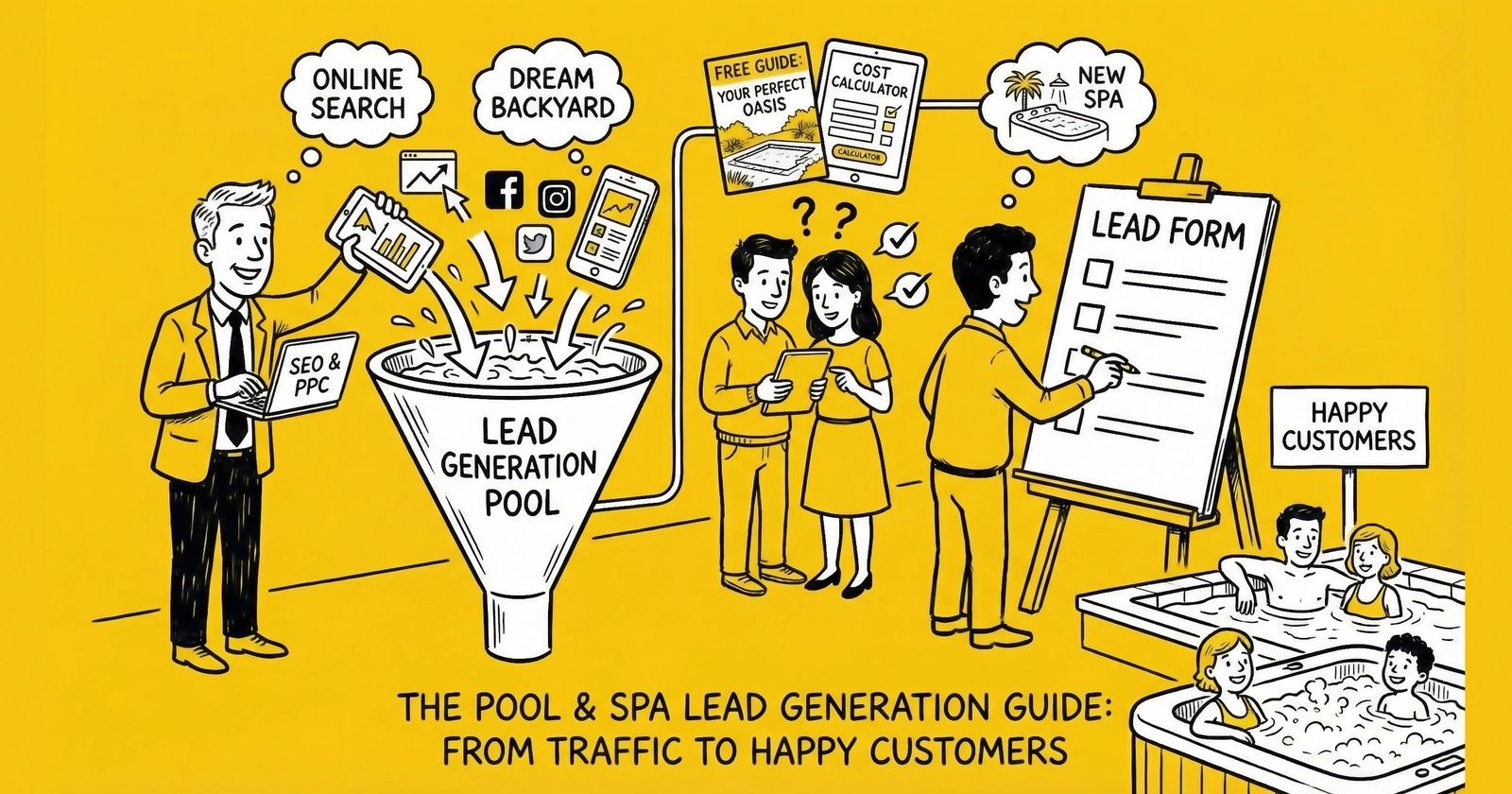
Seasonality, geographic concentration, and the recurring revenue models that separate profitable pool service operations from commodity lead churn. Everything you need to know about generating and selling leads in the pool and spa industry.
Pool and spa lead generation operates in a market defined by extreme geographic concentration and predictable seasonality. Approximately 10.7 million residential swimming pools exist in the United States, with California, Florida, Texas, and Arizona accounting for roughly 60% of that installed base. This concentration creates both opportunity and constraint: the money is there, but the competition for those specific ZIP codes is intense.
The pool and spa service industry generates approximately $5-6 billion annually in the United States, with the broader pool equipment and construction market adding another $10-12 billion. For lead generators, the accessible service market – weekly maintenance, repairs, equipment replacement, and seasonal openings and closings – represents the primary opportunity. New pool construction leads exist but operate on different economics with higher CPLs and longer sales cycles.
This comprehensive guide provides the complete framework for pool and spa lead generation: market dynamics, seasonal patterns, service type economics, geographic concentration strategies, recurring revenue lead models, contractor relationship building, and the operational considerations that determine profitability. Every number reflects current market conditions. Every recommendation comes from operational experience in home services lead generation.
Market Overview: The 2024-2026 Landscape
The pool and spa market experienced significant volatility during and after the pandemic. Pool construction boomed in 2020-2021 as homebound consumers invested in outdoor living spaces, with new pool installations increasing 30-40% above pre-pandemic levels. That surge created a downstream effect: every new pool becomes a recurring service customer within 2-3 years as homeowners realize the maintenance demands.
The construction boom has normalized, but the service opportunity continues expanding. Industry analysts estimate approximately 400,000-500,000 new pools were installed between 2020-2023, all of which now require ongoing maintenance. The pool service market grows by approximately 3-5% annually through natural expansion of the installed base.
Current Lead Pricing Benchmarks
Pool and spa lead pricing varies significantly by service type, urgency, and geographic market. The recurring nature of pool service creates unique economics where customer lifetime value far exceeds initial transaction value.
| Lead Type | Price Range | Typical Close Rate | Notes |
|---|---|---|---|
| Weekly maintenance | $15-$40 | 20-35% | Highest LTV, lower urgency |
| Pool repair (equipment) | $35-$75 | 15-25% | Pump, filter, heater issues |
| Pool repair (emergency) | $50-$100 | 25-40% | Leak detection, green pool |
| Pool opening/closing | $25-$50 | 25-35% | Seasonal, predictable timing |
| Pool renovation/resurfacing | $75-$150 | 10-18% | Large ticket, longer sales cycle |
| Spa/hot tub service | $25-$60 | 18-28% | Year-round opportunity |
| Equipment replacement | $50-$100 | 12-20% | Pump, heater, automation |
| New pool construction | $150-$400+ | 3-8% | Highest CPL, lowest close rate |
The math reveals why weekly maintenance leads deserve premium attention despite lower per-lead pricing. A weekly maintenance customer paying $150-$250 monthly represents $1,800-$3,000 in annual recurring revenue. Customer retention in pool service averages 85-90% annually, meaning a single customer acquired at $30 CPL can generate $10,000-$15,000 in lifetime value over a typical 5-7 year retention period.
Compare this to a one-time equipment repair lead at $60 that generates $400-$800 in revenue. The per-lead economics favor maintenance even at lower CPLs because the lifetime value difference is 10-20x.
Major Market Players
The pool service industry remains highly fragmented, presenting a market structure distinctly different from insurance, mortgage, or even other home services verticals. No single national player dominates pool service delivery, creating opportunities for lead generators who understand local market dynamics and can build regional contractor networks.
Pool Corp (POOL) operates as the largest wholesale distributor with approximately $6 billion in annual revenue, serving contractors rather than competing with them. Leslie’s Pool Supplies operates over 900 retail locations focused on consumer products rather than service delivery. Poolwerx and Pinch A Penny represent the largest franchise networks with 200+ locations each, but even these networks capture only a small fraction of total market volume.
Angi/HomeAdvisor, Thumbtack, and Yelp for Business serve the pool service market through their broader home services lead marketplaces. Pool service leads on these platforms typically range from $15-$50 depending on service type and geography. These platforms provide volume but typically deliver shared leads that convert at lower rates than exclusive lead programs.
The absence of dominant national players creates opportunity for lead generators willing to build local relationships. Unlike insurance or mortgage where large aggregators control significant market share, pool service remains fragmented, and local relationships create competitive advantages. A lead generator with strong contractor relationships in Phoenix or Tampa can command better terms than a national platform without local presence.
Geographic Concentration
The distribution of residential pools is highly uneven, with four states representing approximately 60% of opportunity:
California leads with approximately 1.8 million residential pools – roughly 17% of the national total. Year-round swimming in Southern California creates consistent demand; Northern California drives seasonal opening/closing business.
Florida follows closely with approximately 1.6 million pools. Year-round use, hurricane season, and high humidity create specific service challenges (algae growth, storm damage) that generate emergency repair demand.
Texas has approximately 1 million pools, concentrated in the Houston, Dallas-Fort Worth, Austin, and San Antonio metros. Stronger seasonality than Florida, with reduced winter demand but intense summer demand.
Arizona has approximately 600,000 pools. Extreme heat creates year-round demand, and the desert environment produces unique challenges (evaporation, mineral buildup).
Beyond these states, pool ownership drops significantly. Lead generators should focus initial efforts on the top four states before attempting national coverage.
Seasonal Patterns and Demand Cycles
Pool and spa lead generation exhibits pronounced seasonality that varies significantly by geography. Understanding these patterns enables budget optimization and proactive relationship management with service contractors.
Spring Surge (March-May)
Spring represents the highest-demand period for pool service leads in most markets. The combination of pool openings after winter, early warm weather creating usage desire, and pre-summer preparation drives substantial volume.
Demand Characteristics
Pool opening services peak in March-April for northern markets and arrive earlier in southern regions. Equipment repair demand spikes as systems restart after winter dormancy – pumps that sat idle for months reveal failures, and filters clogged with debris need attention. Chemical balance issues from winter neglect create service opportunities, as homeowners discover their water chemistry has drifted far from acceptable ranges. Perhaps most importantly, homeowners planning summer use begin investigating maintenance contracts, making spring the prime acquisition window for recurring service relationships.
Lead Pricing Dynamics
Spring pricing reflects heightened competition. Standard maintenance leads command $25-$40 CPL, elevated from off-season baselines. Pool opening leads run $30-$50, while repair leads reach $40-$75. Seasonal premiums of 20-30% above off-season rates are achievable for generators who established contractor relationships during slower months.
Operational Considerations
Contractor capacity fills quickly during spring, and the best relationships get priority allocation. Response time expectations increase as homeowners plan ahead rather than reacting to emergencies. Competition for leads intensifies across all channels, making quality differentiation – verified ownership, confirmed pool presence, accurate service categorization – more valuable than raw volume.
Spring is the optimal period for acquiring weekly maintenance customers. Homeowners who just opened their pools are primed to consider service contracts that eliminate ongoing hassle. Lead generators who capture spring demand with maintenance-focused traffic create recurring revenue streams for their contractor partners.
Summer Peak (June-August)
Summer brings the highest utilization of pools and spas, which creates steady repair and service demand. However, summer lead dynamics differ from spring in important ways.
Demand Characteristics
Emergency repair leads increase as heavy use stresses equipment – parties, daily swimming, and extended operating hours push pumps and filters to their limits. Green pool and algae issues peak during warm weather when bacteria thrive and chemical demands increase. Pump failures and heater problems generate urgent demand from homeowners who need their pools functional immediately. Meanwhile, scheduled maintenance leads decrease as most contracts are already established by summer, narrowing the acquisition window.
Lead Pricing Dynamics
Summer pricing reflects the emergency-heavy demand mix. Emergency repair CPL reaches $50-$100, with premium pricing justified by urgency and consumer willingness to pay. Standard repair CPL runs $40-$70. Maintenance CPL actually drops to $20-$35, lower than spring because the acquisition window has largely closed. Spa and hot tub service CPL settles at $30-$50 with a slight summer decrease as outdoor pools dominate attention.
Operational Considerations
Contractor capacity constraints become binding during summer months. The best contractors often stop buying leads by late June as their technician schedules fill completely. Response time expectations compress from days to hours – homeowners with a green pool or failed pump expect same-day attention. Return rates may increase as overwhelmed contractors cannot service all leads they receive.
Summer creates a trap for lead generators who chase volume without understanding contractor capacity. A contractor who accepts 50 leads per week in June may need to reduce to 30 by August as their technician schedules fill. Lead generators who monitor capacity signals and adjust delivery proactively maintain better relationships than those who blindly push volume.
Fall Transition (September-November)
Fall represents a secondary opportunity window, particularly in markets with distinct seasons. The transition from peak summer use to winterization creates specific service demands.
Demand Characteristics
Pool closing services begin in September for northern markets, with homeowners seeking professional winterization before freezing temperatures arrive. Equipment winterization and cover installation drive service calls, along with end-of-season repairs that homeowners postponed during summer use. Heater demand increases as temperatures drop but pool use continues – many homeowners extend their season with heated water and appreciate contractors who can maximize that window.
Lead Pricing Dynamics
Fall pricing reflects the transitional demand mix. Pool closing CPL runs $25-$45. Equipment service CPL reaches $35-$60. Maintenance CPL declines to $20-$30 as the season winds down. Heater service CPL rises to $40-$70 as demand increases from pool owners extending their swimming season.
Operational Considerations
Northern market contractors face compressed closing windows – they must service hundreds of pools before freeze dates, creating scheduling pressure. Southern market contractors see minimal seasonal change and continue normal operations. The fall season creates an opportunity to lock in spring maintenance contracts during closing service. Spa and hot tub demand increases as outdoor pool season ends, providing contractors with transitional revenue.
Fall pool closings represent a relationship opportunity often missed by lead generators. A homeowner who pays $200-$400 for pool closing service is a prime candidate for a spring opening contract and annual maintenance agreement. Lead generators who help contractors capture this conversion opportunity create additional value beyond the immediate lead transaction.
Winter Trough (December-February)
Winter presents the lowest demand period for outdoor pool services but creates opportunity in specific niches.
Demand Characteristics
Outdoor pool service demand drops 60-80% in northern markets where pools sit covered and dormant. Florida, Arizona, and Southern California maintain relatively steady demand as year-round climates keep pools in active use. Spa and hot tub service increases as cold weather drives indoor and outdoor hot tub use – the contrast of warm water against cold air appeals to homeowners. Equipment replacement and renovation planning occurs during the off-season as homeowners research spring projects.
Lead Pricing Dynamics
Winter pricing reflects reduced competition. Pool service CPL drops to $15-$30 as fewer generators chase available demand. Spa and hot tub CPL rises to $35-$60 with increased demand. Renovation and resurfacing leads run $60-$120 as planning-stage homeowners research spring projects. Equipment replacement CPL settles at $40-$80 for proactive replacements before the season begins.
Operational Considerations
Contractor competition for leads intensifies as demand drops – the same contractors who had excess demand in summer now actively seek any available volume. Winter provides an excellent period for relationship building and contract negotiation when contractors have time for conversations. Spa and hot tub focus provides year-round revenue streams that smooth seasonal volatility. Northern market contractors may welcome any lead volume to maintain cash flow and keep technicians employed.
Winter presents a counterintuitive opportunity for lead generators who understand contractor psychology. Pool service contractors in seasonal markets face cash flow challenges during winter. Lead generators who provide consistent winter volume – even at reduced levels – build loyalty that pays dividends during the competitive spring season when multiple generators compete for the same contractors.
Geographic Seasonal Variations
The seasonal patterns described above require geographic adjustment based on climate and pool ownership density.
Southern California experiences relatively stable year-round demand with only a 15-20% spring lift – there is no true off-season in markets like Los Angeles, San Diego, and Orange County. Northern California shows more pronounced seasonality similar to mid-Atlantic patterns, with March-October serving as the primary season.
Florida maintains year-round demand with a summer peak, though hurricane season creates repair surges that spike emergency lead volume unpredictably. Winter sees snowbird seasonal opening demand as part-time residents return and reactivate pools that sat dormant during their absence.
Texas exhibits strong seasonal swings with April-September as the primary season and June-August generating an emergency repair peak as extreme heat stresses equipment. Arizona maintains year-round demand with a summer peak – extreme heat increases both pool use and equipment stress, while winter remains active as temperatures stay comfortable for swimming.
Northern markets face compressed May-September seasons with concentrated opening and closing windows. Lead generators serving these markets must anticipate the compressed timeframes and build contractor relationships before the rush begins.
Service Type Economics
Pool and spa lead generation encompasses multiple distinct service categories, each with different CPLs, conversion rates, and lifetime value characteristics. Understanding these economics enables strategic traffic allocation and contractor relationship optimization.
Weekly Maintenance Leads
Weekly pool maintenance represents the foundation of pool service business economics. A homeowner who contracts for weekly service provides predictable recurring revenue that justifies premium customer acquisition costs.
Service Overview
Weekly maintenance involves regular visits – weekly or bi-weekly – for chemical testing and adjustment to keep water safe and balanced. Technicians perform skimming, brushing, and debris removal to maintain appearance, along with filter cleaning and equipment inspection to catch problems early. Typical pricing ranges from $100-$250 monthly depending on pool size, location, and service frequency.
Lead Economics
Maintenance lead CPL ranges from $15-$40, with conversion rates of 20-35%. The defining characteristic is longevity: average customer lifetime spans 5-7 years, creating customer lifetime values of $8,000-$15,000 or more. Effective CPA runs $50-$150 when factoring conversion rates against this lifetime value.
What Contractors Want
Contractors prioritize verified homeownership because renters cannot authorize ongoing service contracts – this is the single most important qualification criterion. Pool type confirmation matters because in-ground versus above-ground significantly affects pricing and service complexity. Current maintenance status reveals whether the homeowner is currently DIY, switching from a competitor, or owns a new pool – each scenario has different conversion dynamics. Credit qualification for ongoing billing ensures the customer can sustain the monthly commitment.
Weekly maintenance leads command lower per-lead CPLs than repair leads, but the lifetime value justifies the acquisition cost. Lead generators should emphasize maintenance traffic as the foundation of contractor relationships. A contractor who acquires 10 maintenance customers monthly through your leads builds a $100,000+ annual revenue stream within 12 months.
Equipment Repair Leads
Equipment failures create urgent service needs with moderate ticket sizes. Pump failures, filter problems, heater malfunctions, and automation issues require technical expertise and generate meaningful revenue per service call.
Service Overview
Equipment repair involves diagnostic and repair work for pool and spa equipment. Common issues include pump motors, filter cartridges, heater elements, and chlorinator cells. Typical ticket sizes range from $250-$800 for repairs, while equipment replacement runs $1,500-$5,000 depending on the component. Most repairs carry same-day or next-day service expectations, particularly when the pool is currently unusable.
Lead Economics
Equipment repair CPL ranges from $35-$75, with conversion rates of 15-25%. These are typically single transactions, though repair customers may convert to maintenance contracts if the contractor effectively upsells. Effective CPA runs $150-$400 when factoring conversion rates.
What Contractors Want
Contractors value specific equipment descriptions or symptom details that help them dispatch the right technician with appropriate parts. Equipment age affects repair-versus-replace recommendations and customer conversations. Urgency level – whether the pool is currently unusable versus the homeowner planning ahead – determines scheduling priority. Access confirmation including gate codes and scheduling flexibility ensures technicians can complete same-day service when promised.
Repair leads provide immediate revenue but lack the lifetime value of maintenance leads. Strategic lead generators use repair leads as relationship builders: a homeowner who receives excellent repair service is a prime prospect for ongoing maintenance. Contractors who understand this dynamic value repair leads for their conversion potential beyond the initial transaction.
Emergency and Urgent Repair Leads
Emergency pool situations – green pools, leaks, non-functioning systems during heat waves – command premium CPLs and convert at elevated rates.
Service Overview
Emergency services include green pool remediation where algae blooms require shock treatment and intensive cleaning, leak detection and repair where water loss threatens property or utility costs, equipment failure during peak usage periods when families need their pools functional immediately, and storm damage assessment and repair following severe weather events.
Lead Economics
Emergency lead CPL ranges from $50-$100, with conversion rates of 25-40% – significantly higher than standard repair leads because urgency motivates action. Consumers in distress accept premium pricing without extensive comparison shopping. Effective CPA runs $150-$350 when factoring conversion rates.
What Contractors Want
Contractors need verified contact information with immediate availability – emergency leads that go to voicemail lose most of their value. Problem descriptions should indicate genuine emergency rather than routine service requests. Willingness to pay premium rates for urgent service matters because contractors dispatch emergency calls outside normal routes at higher cost. Realistic timeline expectations – whether same-day or next-day – help contractors manage customer satisfaction.
Emergency leads require contractors with rapid response capability. Not all pool service operators can handle emergency work – some focus exclusively on scheduled maintenance routes. Lead generators should segment contractors by capability and route emergency leads only to operators with same-day dispatch capacity.
Pool Opening and Closing Leads
Seasonal opening and closing services create predictable demand windows in markets with distinct seasons. These leads are highly time-sensitive and require geographic targeting.
Service Overview
Pool opening involves removing the cover, equipment startup, initial chemical treatment, and debris removal to prepare the pool for summer use. Pool closing includes winterization of equipment, cover installation, and freeze protection to prevent damage during cold months. Typical pricing ranges from $200-$500 per service depending on pool size and complexity.
Lead Economics
Opening and closing lead CPL ranges from $25-$50, with conversion rates of 25-35%. Seasonal concentration creates capacity constraints as contractors must complete all openings or closings within narrow windows. The key opportunity lies in annual contract conversion – opening and closing services create natural touchpoints for maintenance relationship conversations.
What Contractors Want
Geographic proximity matters significantly for seasonal services because route efficiency determines profitability when contractors must visit dozens of pools in compressed timeframes. Pool type and size enable accurate quoting without site visits. Preferred timing within the seasonal window helps contractors schedule efficiently. Interest in ongoing maintenance represents the upsell opportunity that makes opening and closing leads valuable beyond their immediate transaction.
Opening and closing leads represent conversion opportunities beyond the immediate service. A homeowner who pays $400 for pool opening is a candidate for $150/month maintenance through the season. Lead generators who capture opening/closing traffic and help contractors convert to annual maintenance create compounding value.
Renovation and Resurfacing Leads
Pool renovation, resurfacing, and major equipment upgrades represent high-ticket transactions with longer sales cycles and lower conversion rates.
Service Overview
Renovation services span pool resurfacing with plaster, pebble, or tile finish replacement; deck renovation including coping, patio, and safety fencing; and major equipment upgrades such as variable speed pumps, heat pumps, and automation systems. Typical tickets range from $5,000-$25,000 or more depending on scope.
Lead Economics
Renovation lead CPL ranges from $75-$150, reflecting the high ticket value. Conversion rates run 10-18% – lower than service leads because homeowners make considered purchases, compare multiple contractors, and often arrange financing. Sales cycles stretch longer as homeowners gather quotes and make decisions. Effective CPA runs $500-$1,200 when factoring conversion rates, but per-project revenue justifies the acquisition cost.
What Contractors Want
Verified homeownership is essential for major improvements because contractors invest significant time in quotes and site visits. Project timeline – whether planning or ready to proceed – determines follow-up intensity and pipeline staging. Budget qualification or financing interest helps contractors prioritize leads likely to convert. Specific scope definition enables accurate proposals without multiple site visits.
Renovation leads require different handling than service leads. These homeowners are making considered purchases, comparing multiple contractors, and often financing the work. Lead generators serving the renovation segment should expect lower conversion rates and longer follow-up requirements. The payoff is higher revenue per converted lead.
Spa and Hot Tub Leads
Spa and hot tub service provides year-round opportunity, partially offsetting the seasonality of outdoor pool service.
Service Overview
Spa services include hot tub repair and maintenance, water chemistry management, jet, pump, and heater service, and cover replacement and accessory installation. The equipment differs from pool systems, requiring specialized knowledge and parts inventory.
Lead Economics
Spa lead CPL ranges from $25-$60, with conversion rates of 18-28%. Demand remains consistent year-round with a winter peak as cold weather drives hot tub use. Lifetime value runs lower than pool maintenance because hot tub service visits are typically less frequent, but the steadier seasonal distribution makes spa leads valuable for balancing annual revenue.
What Contractors Want
Spa brand and model information affects parts and expertise requirements – different manufacturers use proprietary components. Problem description or service type requested enables proper technician dispatch. Indoor versus outdoor installation matters for access considerations and scheduling. Service history – whether new customer or returning – indicates relationship potential.
Spa leads provide contractors with winter revenue that helps smooth seasonal cash flow. Lead generators who can provide consistent spa and hot tub leads year-round become more valuable partners than those offering only pool service traffic.
Lead Quality and Qualification
Pool and spa lead quality directly impacts contractor conversion rates and willingness to pay premium CPLs. Unlike some home services verticals, pool leads require specific qualification criteria tied to the unique characteristics of pool ownership and service delivery.
Homeownership Verification
The fundamental qualification question for pool service leads is whether the consumer owns the property with the pool. Renters cannot authorize ongoing service contracts or major repairs without landlord approval.
Verification Approaches
Property database matching through ATTOM, CoreLogic, or similar services provides automated ownership confirmation at scale. Self-reported ownership with verification follow-up catches most false claims through subsequent validation. Utility bill upload or account confirmation provides strong evidence of residency and billing responsibility. Address validation against known rental property databases filters obvious rental situations before delivery.
Property ownership verification costs $0.50-$2.00 per lead but can reduce return rates by 30-50% by filtering renters before delivery to contractors.
Pool Verification
Confirming that a pool actually exists at the reported address prevents fraud and improves conversion rates.
Verification Methods
Satellite imagery review through Google Earth, Nearmap, or specialized providers offers visual confirmation of pool presence. County property records in many jurisdictions include pool or improvement designations that confirm installation. Self-reported pool characteristics – in-ground, above-ground, pool type – create commitment and help filter casual browsers. Cross-reference with pool permit databases where available provides official documentation of permitted pool construction.
Satellite imagery verification adds cost but catches fraudulent leads where no pool exists at the address. Some lead generators perform manual imagery review for higher-value leads; others use automated services that analyze satellite photos for pool presence.
Geographic Qualification
Pool service is hyperlocal. Contractors operate within defined service areas based on route efficiency. A lead 30 miles outside the service area has no value regardless of other quality indicators.
Geographic Considerations
ZIP code-level targeting aligned with contractor service areas ensures leads route to appropriate buyers. Route density optimization matters because contractors prefer multiple customers in adjacent areas – a new customer near existing accounts is worth more than an isolated one. Travel time impacts service pricing and contractor interest, with distant leads often declined or priced at premiums that reduce conversion. Urban, suburban, and rural service areas have different economics, with rural pools harder to service profitably.
Lead generators should collect detailed geographic information and route leads based on contractor-specific service boundaries. A lead that matches one contractor’s core territory may be worthless to another contractor 15 miles away.
Service Intent Qualification
Understanding what service the homeowner needs enables proper routing and pricing.
Qualification Questions
Service type – maintenance, repair, opening/closing, or renovation – determines lead value and appropriate contractor matching. Urgency level, whether emergency (same-day), urgent (this week), or planned (scheduling ahead), affects both pricing and contractor capability requirements. Current provider status reveals whether the homeowner is a new customer, switching from a competitor, or handling DIY – each scenario has different conversion dynamics. Specific problem descriptions for repair leads enable proper technician dispatch and parts preparation.
Service intent affects lead value. A homeowner seeking weekly maintenance quotes has different lifetime value than one calling about a one-time pump repair. Lead generators who segment by service type can optimize pricing and routing.
Contact Verification
Pool service leads require reliable contact information for contractor follow-up.
Verification Requirements
Phone number validation confirms the number is active, identifies mobile versus landline, and screens for recycled VOIP numbers that indicate fraud risk. SMS confirmation at point of capture provides immediate verification that the number is reachable and the consumer engaged. Email verification reduces duplicate submissions and provides an alternate contact channel. Address standardization and deliverability confirmation ensures the service location is valid and accessible.
Real-time phone verification at form submission improves contact rates by 25-40%. Contractors report that contact rate – the percentage of leads that answer the phone – matters more than almost any other quality metric.
Recurring Revenue Lead Models
Pool service differs from many home services verticals because of the recurring revenue nature of maintenance contracts. This creates opportunities for lead generators to develop models beyond simple per-lead transactions.
Maintenance Contract Leads
Leads specifically seeking ongoing maintenance contracts command premium positioning because of their lifetime value to contractors.
Model Characteristics
Higher CPL is justified by lifetime value of $8,000-$15,000 per customer over typical retention periods. Homeowners typically have longer consideration periods as they compare multiple providers before committing to ongoing service relationships. Contract conversion requires follow-up and proposal processes beyond simple appointment booking. Higher quality requirements including verified ownership and credit qualification ensure leads can sustain ongoing commitments.
Lead generators can segment maintenance-seeking leads from general inquiries and price them accordingly. A lead explicitly requesting weekly service quotes has different value than a general pool service inquiry.
Customer Acquisition Programs
Some lead generators develop programs specifically focused on maintenance customer acquisition, combining leads with follow-up support.
Program Elements
These programs include leads filtered for maintenance interest, ensuring only homeowners actively seeking ongoing service enter the pipeline. Follow-up sequence support through email nurture and reminder calls helps contractors stay engaged with prospects through longer consideration periods. Proposal template assistance helps contractors present professional quotes that convert. Contract conversion tracking provides visibility into which leads become long-term customers.
These programs typically operate on higher CPLs or revenue-share arrangements, with lead generators taking partial responsibility for conversion support beyond lead delivery.
Lifetime Value Sharing
Advanced lead generator-contractor relationships may incorporate lifetime value sharing, where the lead generator receives ongoing compensation tied to customer retention.
Model Characteristics
Lower upfront CPL trades immediate revenue for ongoing revenue share tied to customer longevity. Typical arrangements provide 5-10% of first-year service revenue to the lead generator. This model requires contractor reporting and trust, making it suitable only for mature relationships. The payoff is long-term alignment between generator and contractor around customer quality.
Lifetime value sharing aligns incentives around customer quality rather than lead volume. Lead generators have motivation to deliver leads that convert to long-term customers rather than one-time transactions.
Referral Revenue Programs
Pool service customers provide referral opportunities to contractors. Some lead generators develop programs that capture and monetize referral traffic.
Model Characteristics
Existing customer referral capture works through service provider relationships, with satisfied customers recommending neighbors and friends. Lower CPL than direct acquisition reflects the reality that referrals convert at higher rates due to pre-existing trust. This model requires contractor participation in referral solicitation – active requests for referrals during service visits. Programs can be structured as co-branded or white-label depending on the relationship depth.
Referral programs work best with established contractor relationships where trust enables data sharing about existing customer bases.
Building Contractor Relationships
For lead generators working with pool and spa service contractors, relationship quality determines long-term success. The pool service industry is relationship-driven, and contractors who trust their lead sources become loyal long-term buyers.
Contractor Selection Criteria
Not all pool service contractors make good lead buyers. Selecting contractors who can convert leads effectively protects your reputation.
Key Requirements
Adequate staffing is essential – contractors need a minimum of 2-3 technicians to handle lead volume without bottlenecking on capacity. A CRM or lead management system ensures leads receive proper follow-up rather than falling through cracks. Established businesses with 2+ years of operation have proven their ability to survive and typically convert leads more consistently than startups. Positive Google reviews with 4.0+ average ratings and 50+ reviews indicate customer satisfaction and professional service delivery. Verified licensing and insurance protect both the contractor and the lead generator from liability exposure. Clear service territory definition with adequate pool density ensures leads can be monetized efficiently.
Relationship Management
Once contractors are onboarded, ongoing relationship management sustains performance.
Communication Cadence
Weekly check-ins during the first 90 days establish trust and catch issues early. Monthly reviews once established maintain alignment without overwhelming busy contractors. Seasonal planning conversations before demand shifts – typically February for spring surge and September for winter transition – enable proactive adjustment. Share lead quality metrics including contact rates and conversion rates, discuss return patterns to identify systematic issues, and provide competitive benchmarking where possible to demonstrate your value relative to alternatives.
Capacity Monitoring
Track response time trends because slowing response suggests contractor stress or overload. Monitor return rate changes because increasing returns suggest oversupply or quality issues. Adjust volume before contractors complain – proactive reduction preserves relationships better than reactive damage control. These signals enable lead generators to maintain contractor satisfaction even during high-demand periods when the temptation to push volume is strongest.
Pricing and Terms
Lead pricing structures should align incentives between generator and contractor.
Pricing Models
Per-lead pricing remains the simplest and most common model, with fixed costs per delivered lead regardless of conversion. Performance-based pricing offers lower base cost with bonus payments for leads that convert, creating alignment around quality. Revenue share arrangements are more complex but align incentives well for high-LTV services like maintenance contracts – typical arrangements share 5-10% of first-year revenue. Subscription or retainer models provide predictable costs for contractors and guaranteed volume for generators, smoothing cash flow for both parties.
Term Considerations
Minimum volume commitments protect generator investment in contractor relationships while ensuring contractors receive enough leads to evaluate quality. Exclusivity radius provides geographic territory protection that prevents price competition among contractors buying from the same generator. Return policies establish clear criteria for what constitutes a returnable lead and the timeframe for disputes. Payment terms balance generator cash flow needs against contractor payment preferences. Seasonal adjustments add 20-30% during peak spring season and provide volume incentives during winter trough when contractor demand exceeds supply.
Traffic Acquisition Strategies
Pool and spa lead generation requires traffic acquisition strategies tailored to the vertical’s geographic concentration and seasonal patterns.
Paid Search Strategy
Google Ads remains the primary traffic source due to high intent signals from consumers actively seeking pool service.
Keyword Categories
Maintenance terms like “pool service near me” and “weekly pool maintenance” capture homeowners seeking ongoing relationships. Repair terms including “pool pump repair” and “green pool treatment” target urgent needs with higher willingness to pay. Seasonal terms such as “pool opening service” and “pool winterization” concentrate in narrow windows but convert at high rates. Equipment terms like “pool heater repair” and “pool filter replacement” signal specific problems requiring immediate attention.
Bidding Strategy
Geographic targeting should align precisely with contractor service areas using city and ZIP code targeting to avoid wasted spend on leads outside service boundaries. Higher bids for emergency and repair terms are justified by higher intent and consumer urgency – these leads convert at premium rates. Moderate bids for maintenance terms reflect higher volume availability but lower per-lead transaction value, though lifetime value justifies investment. Seasonal bid adjustments increase spring spend to capture peak demand and decrease winter bids in seasonal markets where outdoor pool demand drops.
Local SEO and Google Business Profile
Local SEO provides cost-effective lead generation in a vertical where local relevance is paramount.
Google Business Profile Optimization
Complete profiles with all relevant service categories signal scope to both Google and consumers. Regular photo updates showing actual work, equipment, and team members build trust and engagement. Weekly posts about seasonal tips and promotions keep profiles active and provide content for searchers. Systematic review generation targeting 5-10 new reviews monthly builds social proof and improves local search ranking.
Local Landing Pages
City-specific landing pages for each service area provide geographic relevance signals to search engines. Unique content addressing local conditions – whether discussing Florida’s humidity challenges or Arizona’s mineral buildup issues – demonstrates expertise. Local trust signals including service area maps, local phone numbers, and community involvement references build credibility. Schema markup helps search engines understand service offerings and geographic focus.
Review Generation Strategy
Systematic post-service requests via SMS and email drive organic visibility. Timing review requests immediately after positive service experiences maximizes response rates. Providing direct links to review platforms reduces friction. Responding to all reviews – positive and negative – demonstrates engagement and professionalism.
Content Marketing and Marketplace Platforms
Content marketing and marketplace platforms provide complementary traffic sources beyond paid search.
Content Strategy
Seasonal guides like “Spring Pool Opening Checklist” capture search traffic during peak demand windows. Problem-solving content such as “Why Is My Pool Green?” targets consumers with immediate needs who are likely to convert. Educational content including “Pool Chemistry Basics” builds authority and captures homeowners earlier in their consideration journey. Content performs best when optimized for local search and updated seasonally to remain current.
Marketplace Platform Strategy
Platforms like Angi, HomeAdvisor, Thumbtack, and Yelp provide additional volume with shared leads typically costing $15-$40. First-to-call advantage is significant on shared lead platforms – contractors who respond within 5 minutes book at rates 3-5x higher than those who wait. Complete profiles with all service categories, service area definitions, and photo galleries improve lead quality. Rapid response systems including mobile notifications and automated initial responses maximize conversion. Systematic review solicitation on each platform builds the reputation signals that drive lead allocation.
Operational Considerations
Pool and spa lead generation involves operational complexities that affect profitability and contractor relationships.
Lead Delivery and Response Time
Pool service leads have time-sensitive value. Response time directly correlates with conversion rate.
Delivery Infrastructure
Real-time delivery via API or webhook ensures leads reach contractors immediately upon capture. SMS notification to contractor dispatch alerts technicians in the field who can respond during route breaks. After-hours routing for emergency leads sends urgent requests to contractors with 24/7 capability rather than sitting in queues until morning.
Response Time Benchmarks
Under 5 minutes represents optimal speed-to-lead response, delivering 3-5x conversion improvement over delayed contact. Five to thirty minutes remains acceptable but yields lower conversion than immediate response. Thirty to sixty minutes shows declining returns as consumer attention wanes and competitor response likelihood increases. Over one hour creates significant disadvantage as consumers often connect with faster responders and lose interest in additional quotes.
Return Rate Management
Understanding and minimizing return rates protects margins and maintains contractor relationships.
Common Return Reasons
Renter status leads to returns because tenants cannot authorize service contracts without landlord approval. No pool at address indicates fraud or data error – leads submitted for properties without pools. Outside service area occurs when geographic targeting fails to match contractor boundaries. Already has provider means the consumer already contracted with a competitor. Invalid contact information prevents contractor follow-up and immediate return requests.
Return Rate Benchmarks
Standard verification typically produces 10-15% return rates – acceptable for most operations but leaving margin on the table. Enhanced verification with ownership and pool confirmation reduces returns to 5-10%. Comprehensive verification with all elements achieves under 5% returns, though the additional cost per lead must be weighed against return savings.
Reduction Strategies
Homeownership verification filters renters before delivery. Pool presence confirmation via satellite imagery or property records eliminates no-pool returns. Geographic filtering aligned with contractor service areas prevents outside-territory returns. SMS contact verification before delivery confirms reachability and consumer engagement.
Seasonal Capacity Planning
Effective seasonal planning anticipates demand shifts rather than reacting to them.
Spring Surge Management
Increase contractor allocations before March to secure capacity ahead of competitor demand. Pre-negotiate peak pricing to avoid contentious mid-season rate discussions. Identify backup contractors who can absorb overflow when primary partners reach capacity. Building these relationships before the rush ensures access when demand peaks.
Summer Constraint Management
Monitor response times throughout summer because slowing response indicates contractor stress. Reduce volume proactively when signals suggest overload – protecting relationship health matters more than maximizing short-term revenue. Route emergency leads specifically to contractors with same-day dispatch capability rather than overwhelming maintenance-focused operators.
Winter Opportunity Management
Shift emphasis to spa and hot tub leads that maintain demand during pool off-season. Target year-round markets like Florida, Arizona, and Southern California where outdoor pools remain active. Use the low-demand period for relationship building, contract negotiation, and planning conversations that become impossible during busy seasons.
Technology Infrastructure for Pool Lead Operations
Successful pool and spa lead generation requires technology infrastructure tailored to the vertical’s unique characteristics: hyperlocal service areas, seasonal demand patterns, and the transition from transactional leads to recurring service relationships.
Lead Management Requirements
Pool service lead management differs from high-velocity verticals like insurance or mortgage. The lower volume per geographic area combined with higher relationship intensity means lead management systems must support contractor capacity tracking by day and week rather than just daily caps. Geographic routing precision at the ZIP code or neighborhood level matches lead value because contractor route efficiency determines profitability. Service type classification enables proper pricing and contractor matching since maintenance leads have different economics than emergency repair leads. Seasonal adjustment capabilities accommodate the dramatic demand swings that characterize pool service markets.
Standard lead distribution platforms designed for insurance or mortgage may require customization to handle pool-specific requirements effectively. Platforms like boberdoo and LeadsPedia offer the flexibility needed, while simpler solutions may require manual intervention during seasonal transitions.
Integration with Contractor Operations
The most effective pool lead programs integrate with contractor operations rather than simply delivering contact information. Integration patterns include real-time calendar integration that shows contractor availability and enables appointment booking at the point of lead delivery. Route optimization data identifies leads near existing service routes, enabling priority treatment for geographically efficient prospects. Customer history access surfaces information about previous service relationships, enabling contractors to reference past work during initial contact. Maintenance conversion tracking follows transactional leads through their lifecycle to identify which become recurring customers, providing feedback that improves lead scoring over time.
These integrations require contractor cooperation and technology capability that not all service providers possess. Lead generators should assess contractor technology readiness during onboarding and provide training or integration support where feasible.
Fraud Prevention and Quality Control
Pool and spa leads face distinct fraud risks that require layered prevention. The hyperlocal nature of pool service creates both vulnerabilities and detection opportunities that differ from national lead programs.
Fraud Types
Fake pool submissions involve leads for addresses where no pool exists – either intentional fraud or data entry errors that generate returns and damage buyer relationships. Renter fraud occurs when tenants submit leads for services they cannot authorize, wasting contractor time on unconvertible prospects who lack authority to sign service agreements. Competitor intelligence involves fake lead submissions designed to gather pricing information or waste competitor resources – a particularly common pattern in markets with aggressive local competition. Affiliate fraud encompasses fake submissions generated to earn payouts from lead generation affiliate programs, often involving synthetic identities or recycled contact information.
Verification Stack
Verification investments scale with lead value and fraud risk tolerance.
Tier 1 Verification ($0.25-$0.50 per lead)
Phone number validation confirms active numbers and screens obvious fraud. Email confirmation reduces duplicate submissions and verifies basic contact information. Address standardization ensures consistent formatting and catches obvious data entry errors.
Tier 2 Verification ($1.00-$2.00 per lead)
Homeownership database matching through services like ATTOM or CoreLogic filters renters before delivery. Pool presence confirmation via satellite imagery or property records eliminates no-pool fraud. TCPA consent documentation through TrustedForm or Jornaya provides compliance protection.
Tier 3 Verification ($2.00-$4.00 per lead)
Real-time SMS verification confirms active engagement and filters leads that fail to respond. Behavioral analysis identifies suspicious submission patterns indicating bot traffic or fraud rings. Comprehensive consent certification provides full audit trails for compliance and dispute resolution.
Verification ROI
The return on verification investment is straightforward to calculate. A $35 lead with 15% return rate has an effective cost of $41 when returns are factored in. With premium verification reducing returns to 5%, the effective cost drops to $37 while conversion rates improve from higher quality. The $2-4 verification investment more than pays for itself through reduced returns and improved contractor satisfaction.
Frequently Asked Questions
What is the average cost per lead for pool service in 2026?
Pool service CPL varies significantly by lead type and geography. Weekly maintenance leads typically range from $15-$40, with higher CPLs in competitive markets like Southern California. Repair leads run $35-$75, with emergency and urgent repairs commanding $50-$100. Pool renovation and resurfacing leads range from $75-$150 due to larger ticket sizes and longer sales cycles. Geographic concentration means that leads in California, Florida, Texas, and Arizona – where 60% of pools exist – face the most competition and highest CPLs. Less competitive markets may offer CPLs 30-40% below these ranges.
How does seasonality affect pool lead generation?
Pool lead generation exhibits pronounced seasonality in most markets. Spring (March-May) represents peak demand with 25-35% higher CPLs as homeowners open pools and seek maintenance contracts. Summer maintains strong demand with emergency repair leads peaking during heat waves. Fall sees declining demand except for closing services in seasonal markets. Winter drops 60-80% in northern markets but remains relatively steady in Florida, Arizona, and Southern California. Spa and hot tub leads partially offset winter outdoor pool decline, making year-round strategy important.
Which geographic markets offer the best pool lead opportunities?
California, Florida, Texas, and Arizona contain approximately 60% of the 10.7 million residential pools in the United States. California leads with roughly 1.8 million pools, followed by Florida at 1.6 million, Texas at 1 million, and Arizona at 600,000. These four states represent the primary opportunity for pool lead generation. Within these states, metropolitan areas with high homeownership rates and established pools (15+ years old requiring more service) offer the best unit economics. Markets outside these core states have pool service demand but at lower density, making lead generation less efficient.
How do I verify that a lead actually has a pool?
Pool verification uses multiple methods. Satellite imagery from Google Earth, Nearmap, or specialized providers can confirm pool presence at an address. County property records in many jurisdictions include pool improvements and permits. Self-reported pool characteristics (size, type, features) at point of capture create commitment and filter casual browsers. Property databases from services like CoreLogic sometimes include pool indicators. Automated satellite analysis services can verify pool presence at scale for $0.25-$0.50 per lookup. Manual imagery review is more accurate but cost-prohibitive for high-volume operations.
What makes maintenance leads more valuable than repair leads?
Weekly maintenance customers provide recurring revenue of $1,800-$3,000 annually with average retention of 5-7 years, creating lifetime values of $8,000-$15,000 or more. A maintenance lead at $30 CPL that converts at 25% has an effective CPA of $120 against $10,000+ lifetime value – an 80:1 return ratio. A repair lead at $50 CPL that converts at 20% has an effective CPA of $250 against $400-$800 single transaction revenue – a 2-3:1 return ratio. Contractors understand this math and prioritize maintenance customer acquisition, making maintenance leads strategically valuable for building contractor relationships.
How do I build relationships with pool service contractors?
Successful contractor relationships require understanding their business model. Focus on metrics that matter to them: contact rates above 70%, verified homeownership, accurate geographic targeting within their service areas, and honest lead type representation. Start with contractors in your strongest geographic markets rather than spreading thin. Deliver leads during business hours for maximum contact rates. Share performance data including contact rates, booking rates, and customer retention where available. Monitor capacity signals – slowing response times and increasing return rates indicate oversupply. Proactive volume adjustment before contractors complain builds trust that sustains relationships through competitive periods.
Should I focus on pool or spa leads?
The optimal strategy includes both. Outdoor pool leads dominate volume in warm months and represent the larger market, but spa and hot tub leads provide year-round demand with winter peaks. Contractors who service both pools and spas value lead sources that provide consistent year-round volume rather than seasonal feast-or-famine patterns. Spa leads also help contractors maintain technician employment during winter months when outdoor pool work declines. For lead generators, spa emphasis during winter months maintains contractor relationships and provides revenue when pool lead demand drops.
What return rate should I expect for pool leads?
Pool lead return rates depend on verification level and lead type. Standard leads with basic verification typically see 12-18% return rates. Enhanced verification (ownership confirmation, pool verification, phone validation) can reduce returns to 6-10%. Premium verification with all elements can achieve under 5% returns. Emergency leads tend to have lower return rates because urgency drives conversion, while renovation leads have higher returns due to longer consideration periods. Track returns by lead type, source, and verification level to identify patterns and improve quality over time.
How do marketplace platforms like Angi compare to direct lead generation?
Marketplace platforms (Angi, HomeAdvisor, Thumbtack, Yelp) provide volume without requiring marketing infrastructure but deliver shared leads that convert at lower rates. Typical pool service leads on these platforms cost $15-$50 and are shared with 3-4 contractors, resulting in 8-15% booking rates. First-to-call advantage is critical – contractors who respond within 5 minutes book at rates 3-5x higher than those who wait. Direct lead generation typically costs more per lead ($30-$80) but can deliver exclusive leads with 20-35% booking rates. Most successful operations use both: marketplace platforms for volume base and direct generation for exclusive high-quality leads.
What technology do I need for pool lead generation?
Minimum viable setup includes a lead capture form with phone and address validation, CRM for lead management, and contractor delivery system (API, email, or portal). Enhanced operations add satellite imagery verification for pool confirmation, property database integration for ownership verification, consent certification (TrustedForm or Jornaya), and real-time lead routing based on contractor capacity and geography. Enterprise operations include predictive lead scoring, automated pricing optimization, contractor performance analytics, and lifetime value tracking. Start simple, then add technology as volume and margins justify investment.
How do I price leads for different service types?
Lead pricing should reflect expected contractor lifetime value and conversion probability. Weekly maintenance leads justify $25-$40 CPL despite lower immediate transaction value because lifetime value is $8,000-$15,000. Emergency repair leads command $50-$100 CPL because urgency drives 25-40% conversion rates. Pool renovation leads at $75-$150 CPL reflect $5,000-$25,000 ticket sizes despite 10-18% conversion rates. Seasonal adjustment adds 20-30% to CPLs during spring peak demand and reduces CPLs 20-30% during winter trough. Geographic premiums apply in high-competition markets like Southern California. Price based on value delivered to contractors, not just cost to acquire.
Key Takeaways
-
Pool and spa lead generation operates in a geographically concentrated market where California, Florida, Texas, and Arizona contain approximately 60% of the 10.7 million residential pools in the United States. Focus initial efforts on these core markets before expanding to lower-density regions.
-
Weekly maintenance leads provide lifetime customer values of $8,000-$15,000 over typical 5-7 year retention periods, making them strategically more valuable than higher-CPL repair leads with single transaction value. Structure contractor relationships around maintenance customer acquisition.
-
Seasonality creates pronounced demand variation with spring peak (March-May), summer emergency demand (June-August), fall closing window (September-November), and winter trough (December-February). Spa and hot tub leads partially offset winter outdoor pool decline, enabling year-round contractor relationships.
-
Pool verification through satellite imagery, property records, and ownership databases reduces fraud and improves conversion rates. Investment of $1-4 per lead in verification typically reduces return rates from 15-20% to 5-10%, improving effective CPL despite higher upfront costs.
-
Contractor relationships determine long-term success in pool lead generation. Select contractors with adequate capacity, professional operations, and established reputations. Monitor capacity signals and adjust volume proactively before contractors complain. Build loyalty through winter lead provision when contractors need volume.
-
Response time directly correlates with conversion rate. Pool service leads contacted within 5 minutes convert at rates 3-5x higher than those contacted after an hour. Implement real-time delivery, SMS notifications, and contractor accountability for speed-to-contact.
-
Geographic precision matters more in pool service than most home services verticals. Contractors operate within defined service areas based on route efficiency. Leads outside service boundaries have zero value regardless of other quality indicators. Collect detailed location data and route leads to contractors whose territories match.
-
The recurring revenue nature of pool maintenance creates opportunities for lead models beyond simple per-lead transactions. Lifetime value sharing, customer acquisition programs, and referral revenue arrangements can align lead generator and contractor incentives around long-term customer value rather than transaction volume.
The pool and spa lead market rewards operators who understand geographic concentration, seasonal dynamics, and the lifetime value economics of recurring service relationships. Contractors who depend on you for maintenance customer acquisition become long-term partners who pay premium CPLs and remain loyal through competitive periods.