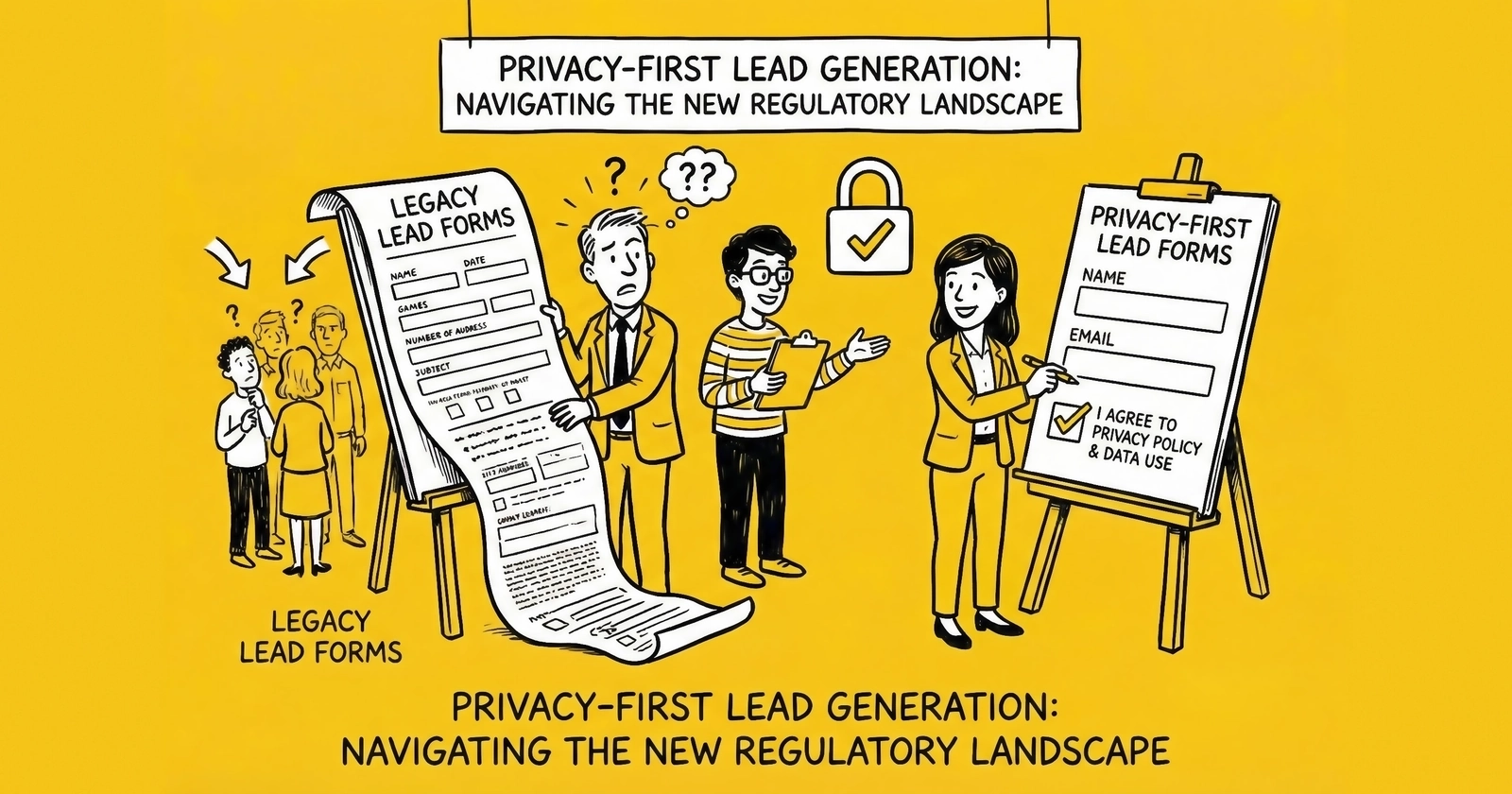
The surveillance infrastructure that powered lead generation for two decades is being dismantled piece by piece. Those who rebuild around privacy will capture the market. Those who cling to legacy approaches will find their businesses eroding beneath them.
The lead generation industry is experiencing its most significant regulatory transformation since the TCPA was enacted in 1991. Between January 2023 and late 2025, nineteen U.S. states enacted comprehensive privacy laws. GDPR enforcement has produced over 2,000 fines totaling more than 4.5 billion euros. TCPA class action filings increased 97% year-over-year through October 2025, with 1,807 class actions filed compared to 915 in the same period of 2024.
These numbers represent more than regulatory headaches. They signal a fundamental shift in how commercial relationships must operate in the digital economy.
For fifteen years, I watched operators build lead generation empires on third-party cookies, behavioral tracking, and consent mechanisms that would make any compliance attorney cringe. Many of those empires no longer exist. The survivors share one characteristic: they recognized early that privacy was not a constraint to manage but a competitive advantage to cultivate.
This article provides the strategic framework for adapting your lead generation operation to the privacy-first environment. Not the compliance minimum that keeps you out of court today. The privacy architecture that positions you for market leadership as regulations tighten and consumer expectations reset.
The Regulatory Landscape: What You Need to Know
Understanding the current regulatory environment requires examining multiple overlapping frameworks. The patchwork nature of privacy regulation creates compliance complexity for national operations, but it also creates strategic opportunity for operators who can navigate it effectively.
GDPR: The Global Standard
The General Data Protection Regulation, effective since May 2018, established the template that subsequent privacy laws have followed. While technically limited to EU residents, GDPR’s influence extends globally through several mechanisms.
Any lead generation operation that collects data from EU residents falls under GDPR jurisdiction regardless of where the company is located. Given that many lead forms cannot definitively exclude EU visitors, most practitioners face at least theoretical GDPR exposure.
GDPR’s core requirements for lead generation include:
Lawful basis for processing. You must have a legal basis for collecting and processing personal data. For lead generation, this typically means either explicit consent or legitimate interest. Consent must be freely given, specific, informed, and unambiguous. Pre-checked boxes do not satisfy this standard.
Data subject rights. Consumers have the right to access their data, request correction, demand deletion, and object to processing. Lead generators must have systems to honor these requests within specified timeframes (typically 30 days).
Data minimization. Collect only the data you actually need. That 47-field lead form might maximize data value, but it also maximizes compliance risk.
Purpose limitation. Data collected for one purpose cannot be used for incompatible purposes without additional consent. Selling leads to categories of buyers not disclosed at collection creates exposure.
Breach notification. Data breaches must be reported to supervisory authorities within 72 hours. Lead databases containing personal information trigger this requirement.
GDPR penalties can reach 20 million euros or 4% of global annual revenue, whichever is higher. Through 2024, regulators issued fines exceeding 4.5 billion euros across more than 2,000 enforcement actions. The largest fines have targeted technology companies, but smaller lead generation operations have not escaped attention.
CCPA/CPRA: The California Standard
California’s Consumer Privacy Act (2020) and its successor, the California Privacy Rights Act (2023), created the most comprehensive U.S. privacy framework and established the template for state-level regulation.
CCPA/CPRA applies to businesses that:
- Have annual gross revenue exceeding $25 million, OR
- Buy, sell, or share personal information of 100,000 or more California residents, OR
- Derive 50% or more of annual revenue from selling or sharing personal information
For lead generation operations, the third prong often triggers applicability even when the first two do not.
Key requirements include:
Right to know. Consumers can request disclosure of what personal information you collect, the categories of sources, the business purpose, and the categories of third parties with whom you share it.
Right to delete. Upon request, you must delete personal information, with limited exceptions for completing transactions or complying with legal obligations.
Right to opt-out. The critical provision for lead generation. Consumers can opt out of the “sale” of their personal information. CPRA expanded this to include “sharing” for cross-context behavioral advertising.
Right to limit sensitive personal information use. Consumers can restrict use of sensitive categories including precise geolocation, race, health information, and financial data.
The definition of “sale” under CCPA is broad. Sharing leads with buyers for monetary consideration constitutes a sale. Sharing lead data with ad platforms for retargeting may constitute a sale. Any transfer of personal information for valuable consideration triggers the sale provisions.
Enforcement comes through the California Attorney General and, since July 2024, the California Privacy Protection Agency. Violations can result in penalties up to $7,500 per intentional violation.
The State Privacy Law Explosion: 2023-2026
California blazed the trail, but by late 2025, nineteen states had enacted comprehensive privacy laws with more in legislative development. The patchwork creates significant compliance complexity for national lead generation operations.
Currently effective state privacy laws:
| State | Law | Effective Date | Key Threshold |
|---|---|---|---|
| California | CPRA | January 1, 2023 | $25M revenue OR 100K consumers |
| Virginia | VCDPA | January 1, 2023 | 100K consumers OR 25K + 50% data revenue |
| Colorado | CPA | July 1, 2023 | 100K consumers OR 25K + data revenue |
| Connecticut | CTDPA | July 1, 2023 | 100K consumers OR 25K + 25% data revenue |
| Utah | UCPA | December 31, 2023 | 100K consumers OR 25K + 50% data revenue |
| Texas | TDPSA | July 1, 2024 | Non-small business processing data |
| Oregon | OCPA | July 1, 2024 | 100K consumers OR 25K + 25% data revenue |
| Montana | MCDPA | October 1, 2024 | 50K consumers |
| Delaware | PDPA | January 1, 2026 | 35,000 consumers |
| New Hampshire | SB 255 | January 1, 2026 | 35,000 consumers |
| Iowa | ICDPA | January 1, 2026 | 100,000 consumers |
| New Jersey | NJDPA | January 1, 2026 | 100,000 consumers |
| Nebraska | NDPA | January 1, 2026 | Non-small business |
| Tennessee | TIPA | July 1, 2026 | 175,000 consumers |
| Minnesota | MCDPA | July 31, 2026 | 100,000 consumers |
| Maryland | MODPA | October 1, 2026 | 10K consumers + 20% data revenue |
Coming in 2026 and beyond:
Several additional states have enacted laws with future effective dates, and legislative activity continues across the country. The trajectory is clear: comprehensive privacy regulation is becoming the national norm through state-by-state adoption.
Maryland’s law deserves special attention for lead generators. Its “strictly necessary” standard for data processing is the most restrictive in the nation, potentially limiting lead collection beyond what other state laws permit.
TCPA: The Enforcement Surge
While GDPR and state privacy laws address data collection and use, the Telephone Consumer Protection Act governs how you contact leads after collection. The two frameworks intersect critically at the point of consent.
TCPA litigation reached unprecedented levels in 2024-2025:
- 2,788 TCPA cases filed in 2024, a 67% increase over 2023
- 507 class actions filed in Q1 2025 alone, a 112% increase over Q1 2024
- Nearly 80% of all TCPA lawsuits now filed as class actions
- Average settlements exceeding $6.6 million
For practitioners seeking litigation defense strategies, our guide on TCPA defense strategies covers the playbook that experienced counsel deploy.
The FCC’s April 2025 revocation rules added new compliance requirements:
- Companies must honor consent revocation within 10 business days
- Standard opt-out keywords (stop, quit, cancel, unsubscribe, etc.) must be immediately recognized
- Marketing texts must include clear opt-out instructions
The one-to-one consent rule, which would have required separate consent for each seller rather than blanket multi-seller consent, was vacated by the Eleventh Circuit in January 2025. However, many sophisticated practitioners continue implementing one-to-one practices for several reasons: stronger litigation defense, buyer preference, state-level requirements, and CMS regulations requiring one-to-one consent for Medicare marketing.
The Consent Intersection
Privacy laws and TCPA create overlapping consent requirements that operators must navigate simultaneously:
For data collection (privacy laws):
- Clear disclosure of data practices
- Affirmative consent mechanism (not pre-checked)
- Identification of categories of third parties receiving data
- Easy-to-access privacy policy
For contact (TCPA):
- Prior express written consent for telemarketing
- Clear identification of seller(s) authorized to call
- Disclosure that calls may use automated technology
- Consent not required as condition of purchase
For data sharing/sale (CCPA and similar):
- “Do Not Sell My Personal Information” link
- Opt-out mechanism that works
- Response to opt-out requests within required timeframes
- Verification procedures for consumer requests
The complexity compounds when a single lead form must satisfy all requirements simultaneously while maintaining conversion rates. This is where privacy-by-design principles become essential.
Privacy-By-Design: Building Compliance Into Your Foundation
Privacy-by-design is not a compliance checkbox. It is an architectural approach that embeds privacy considerations into every system, process, and decision from the outset rather than bolting on protections after the fact.
Those who embraced privacy-by-design early are now reaping competitive advantages. Their systems are built for compliance, which means lower legal costs, easier buyer relationships, and readiness for regulatory tightening. Their data practices create trust, which translates to higher conversion rates and better lead quality.
The Seven Principles Applied to Lead Generation
Dr. Ann Cavoukian’s original privacy-by-design framework translates directly to lead generation operations:
1. Proactive not reactive; preventive not remedial.
Design your lead capture and distribution systems to prevent privacy violations rather than responding to them after they occur.
In practice: Build consent verification into your lead flow before any lead enters your system. A lead without verified consent never reaches your database, eliminating downstream exposure.
2. Privacy as the default setting.
The maximum privacy protection applies automatically, without requiring consumer action.
In practice: Default to minimal data collection. Every field on your lead form should have a documented business justification. If you cannot articulate why you need a piece of data, do not collect it.
3. Privacy embedded into design.
Privacy is integral to system architecture, not an add-on feature.
In practice: Build consent documentation into your technology stack from the beginning. TrustedForm or Jornaya integration should be a launch requirement, not a future enhancement.
4. Full functionality: positive-sum, not zero-sum.
Privacy and business objectives can both be achieved without trade-offs.
In practice: A well-designed consent disclosure actually improves conversion rates by building trust. The perception that privacy and performance are opposed reflects poor design, not inherent conflict.
5. End-to-end security: full lifecycle protection.
Data is secured throughout its entire lifecycle, from collection through deletion.
In practice: Encryption in transit and at rest. Access controls. Audit logs. Data retention policies with automated deletion. Security is privacy infrastructure.
6. Visibility and transparency.
Business practices are visible and subject to verification.
In practice: Privacy policies that humans can actually read. Clear disclosure of data practices at the point of collection. Audit trails that prove what happened.
7. Respect for user privacy.
Keep the consumer’s interests paramount.
In practice: Make opt-out mechanisms work. Honor deletion requests. Treat privacy as a consumer right, not a regulatory burden.
Implementing Data Minimization
Data minimization is the principle that cuts most sharply against legacy lead generation practices. The instinct to capture maximum data conflicts with privacy-first design.
The economics of data minimization are not intuitive. More data fields do not necessarily mean more valuable leads. They mean:
- Higher form abandonment rates
- More compliance exposure per lead
- Greater breach impact if security fails
- More consumer requests to manage
The audit process:
- List every data point you collect on your lead forms.
- For each field, document the specific business use.
- Identify fields without clear business justification.
- Remove unjustified fields.
- Consider moving optional enrichment to post-consent stages.
many practitioners discover they collect data out of habit rather than necessity. Removing unused fields improves conversion rates while reducing compliance exposure.
Staged collection architecture:
Rather than capturing all data upfront, consider multi-stage approaches:
Stage 1: Essential intent signal (service interest, zip code) Stage 2: Contact information with consent Stage 3: Qualification data after consent is established
This architecture reduces abandonment at each stage and separates consent capture from detailed data collection.
Purpose Limitation in Practice
Under most privacy laws, data collected for one purpose cannot be used for incompatible purposes without additional consent. For lead generation, this creates specific requirements:
At collection, disclose:
- That leads may be sold or shared
- Categories of businesses that may receive leads
- That recipients may contact by phone, text, email
Build systems that enforce:
- Leads sold only to disclosed categories
- Contact methods limited to disclosed channels
- Data not used for purposes beyond disclosure
This requires discipline in buyer selection. A lead collected for “insurance quotes” cannot be sold to a timeshare company without additional consent. Building this constraint into your distribution logic prevents violations.
Consent Management: The Technical Foundation
Consent is the legal and technical foundation of privacy-first lead generation. Capturing consent is not enough. You must document it with evidence that survives litigation, manage it through its lifecycle, and honor revocation requests within regulatory timeframes.
What Valid Consent Requires
Under TCPA, prior express written consent for telemarketing requires:
- A written agreement (electronic signatures valid)
- Signed by the person called
- Clear authorization for the specific seller to deliver marketing using automated technology
- Identification of the specific phone number authorized
- Not a condition of purchase
- Clear and conspicuous disclosure
Under GDPR, valid consent requires:
- Freely given (not bundled with other consents)
- Specific (to identified processing purposes)
- Informed (consumer understands what they consent to)
- Unambiguous (affirmative act, not pre-checked box)
- Demonstrable (you can prove consent was given)
- Revocable (consumer can withdraw at any time)
Under state privacy laws, consent standards vary but generally align with either TCPA or GDPR principles.
Documentation Requirements
Proving consent requires documentation sufficient to withstand litigation discovery. For each lead, capture and retain:
Timestamp. Exact date and time consent was provided in an immutable format.
IP address. The IP from which consent was submitted, supporting authenticity.
Consent language displayed. The exact disclosure the consumer saw at the moment of consent.
Consumer action. Evidence of the affirmative act (checkbox click, signature, etc.).
Phone number provided. The specific number for which consent was granted.
Form URL and configuration. Where consent was captured and relevant settings.
Session recording. Visual evidence of the consumer’s interaction.
Third-party verification through TrustedForm or Jornaya provides independent documentation accepted by courts. A TrustedForm certificate costs $0.15 to $0.50 per lead depending on volume. Against potential TCPA exposure of $500 to $1,500 per violation, this is among the highest-ROI compliance investments available. Our TrustedForm vs Jornaya comparison helps operators choose the right platform for their needs.
The certificate documents what happened. It does not guarantee what happened was compliant. A TrustedForm certificate capturing a deficient disclosure simply documents non-compliance. The underlying consent language must satisfy regulatory requirements.
Consent Lifecycle Management
Consent is not a point-in-time event. It has a lifecycle that must be actively managed:
Capture. Initial consent with full documentation.
Verification. Validating that consent is genuine (not bot-generated, not fraudulent).
Distribution. Transmitting consent evidence with the lead to buyers.
Revocation. Processing withdrawal requests within required timeframes.
Expiration. Consent does not last forever. Industry practice treats consent as valid for 90 days to 12 months depending on vertical and lead type.
Deletion. When consent expires or is revoked, what happens to the associated data?
Each stage requires technical infrastructure:
Capture layer: Form builder with consent disclosure, signature capture, TrustedForm/Jornaya integration.
Verification layer: Bot detection, fraud screening, validation services.
Distribution layer: API that transmits consent certificates with lead data, buyer access to verification.
Revocation layer: Multi-channel opt-out handling (SMS keywords, email links, web forms, phone requests), 10-day processing window enforcement, synchronization across all systems that received the lead.
Deletion layer: Automated retention policies, deletion workflows, audit trails of destruction.
The Revocation Challenge
The FCC’s April 2025 rules require honoring consent revocation within 10 business days through any reasonable method. This creates significant operational challenges.
When a consumer texts “STOP” to one number in your system, that revocation must propagate to:
- Your lead database
- Every buyer who received the lead
- Every marketing system the lead data touched
- Every phone number associated with that consumer
If the consumer received leads from multiple campaigns, all campaigns must honor the revocation. If the consumer’s data was shared before the technology solution existed, you need processes to communicate revocation to historical recipients.
Building this infrastructure after-the-fact is painful. Building it from the beginning is straightforward. This is privacy-by-design in action.
First-Party Data Strategy: The Privacy-Proof Foundation
The collapse of third-party tracking infrastructure is accelerating. Safari and Firefox block third-party cookies by default. Chrome has enabled user controls that reduce third-party tracking. Ad blockers and privacy-focused browsers block 30% or more of client-side tracking. Understanding the distinction between first-party and third-party leads is crucial for building sustainable operations.
Those who survive this transition are building on first-party data: information collected directly from consumers through direct relationships.
First-Party vs. Third-Party Data
Third-party data is collected by entities with no direct relationship to the consumer. Behavioral data aggregated from browsing history across sites. Purchase propensity scores from data brokers. Cookie-based tracking from ad platforms.
Third-party data has powered lead generation for two decades. It enabled retargeting, lookalike audience building, and behavioral targeting at scale. It is also disappearing.
First-party data is collected directly from consumers through direct interactions. Form submissions on your own properties. Website behavior tracked with your own systems. CRM data from customer relationships.
First-party data is:
- More accurate (consumers provided it directly)
- More defensible (you control consent and documentation)
- More sustainable (not dependent on eroding third-party infrastructure)
- More valuable (buyers increasingly pay premium for verified first-party data)
Building First-Party Data Assets
The strategic shift requires investment in owned assets that generate first-party data:
Content properties. Websites, blogs, and resources that attract your target audience. When someone reads your content and submits a form, you have first-party data with documented consent.
Email lists. Subscribers who opted in to receive communications. This permission-based relationship supports ongoing engagement and remarketing.
User accounts. Authenticated relationships where consumers create accounts and log in. Authentication provides identity resolution that third-party tracking cannot match.
Progressive profiling. Collecting additional data over time as the relationship develops rather than demanding everything upfront.
The economics favor first-party strategies even beyond privacy considerations. Leads generated from owned properties typically convert at higher rates because the consumer chose to engage rather than being intercepted.
Server-Side Tracking: Recovering Lost Signal
Client-side tracking (JavaScript pixels in browsers) is failing at increasing rates. Server-side tracking sends data to your own server first, then forwards to ad platforms and analytics systems.
The benefits for privacy-first operations:
Signal recovery. Server-side tracking recovers 20-40% of conversion signals lost to ad blockers and browser restrictions.
Data control. You see all data before it goes anywhere else. You can filter, enrich, and control what gets shared.
Compliance management. Consent status can be verified before data transmission. No consent, no sharing.
First-party context. Data flows from your domain, leveraging first-party cookie persistence.
Implementation requires:
- Server infrastructure (cloud functions, dedicated servers, or managed platforms)
- Integration with lead forms and landing pages
- Connections to ad platforms through their server-side APIs (Facebook Conversions API, Google Enhanced Conversions, etc.)
- Consent management integration
The technical complexity is real but manageable. Several platforms offer managed server-side tracking solutions that reduce implementation burden.
Consent Architecture for Multi-Buyer Distribution
Lead generation’s fundamental economic model involves selling leads to multiple buyers. Privacy-first architecture must address how consent flows through multi-party relationships.
The Multi-Seller Disclosure Challenge
The now-vacated FCC one-to-one consent rule highlighted a real problem: blanket consent disclosures listing hundreds of potential buyers do not provide meaningful transparency.
Even without regulatory mandate, the industry is moving toward more specific seller identification for several reasons:
Litigation defense. When a buyer can demonstrate the consumer specifically saw their company name and consented to their contact, consent challenges become much harder.
Buyer requirements. Sophisticated lead buyers increasingly require documentation of seller-specific consent as a condition of purchase.
Conversion rates. Consumers who understand who will contact them have higher answer rates and better disposition toward the caller.
Technical Implementation Approaches
Dynamic consent disclosure. Real-time matching identifies likely buyers before consent is displayed. The consent disclosure shows specific seller names based on matching results.
Requirements:
- Integration between lead capture and distribution systems
- Real-time buyer matching at the form level
- Dynamic form rendering capability
- Consent verification capturing the displayed disclosure
Pre-defined seller lists. A smaller, fixed list of potential buyers displayed transparently. “By submitting, you consent to receive calls from Company A, Company B, and Company C.”
This works when buyer relationships are stable and the number of potential buyers is displayable. It becomes impractical with dozens of potential buyers.
Separate consent flows. Initial form captures interest. Subsequent flows present specific sellers and obtain individual consent for each.
This typically reduces conversion rates by adding steps but produces cleaner consent documentation.
Data Clean Rooms for Privacy-Preserving Collaboration
Data clean rooms enable buyers and sellers to analyze combined datasets without sharing raw personal data. Platforms like Snowflake, InfoSum, and AWS provide infrastructure for:
Account matching. Identifying overlapping audiences between buyer and seller without exposing individual records.
Aggregated analytics. Understanding combined data trends without personal data transfer.
Privacy-preserving activation. Building audience segments for targeting without exporting personal data.
For lead generation, data clean rooms enable:
- Matching buyer customer files against seller lead inventories to identify highest-value opportunities
- Analyzing conversion patterns across buyer-seller relationships
- Building lookalike audiences from conversion data without sharing personal information
This “non-movement of data” architecture supports partnership economics while maintaining privacy compliance.
Building Your Privacy Compliance Program
Sustainable privacy compliance requires systematic program infrastructure, not ad hoc responses to individual requirements.
Policy Development
Document policies covering:
Data collection standards. What data is collected, why, and through what mechanisms. Consent requirements and documentation. Form design standards.
Lead acceptance criteria. Requirements for leads acquired from third parties. Consent verification standards. Quality thresholds.
Data handling procedures. Storage, access controls, retention periods, deletion procedures.
Consumer rights procedures. How access requests are handled. Deletion request workflows. Opt-out processing.
Vendor requirements. Standards for third parties who generate leads or process data on your behalf.
Vendor Management
Third-party lead sources represent significant privacy exposure. Your compliance is only as strong as your weakest vendor.
Before engagement:
- Review vendor privacy policies and consent mechanisms
- Verify consent documentation practices
- Assess litigation history
- Confirm insurance coverage
- Negotiate contractual protections
Contractual requirements:
- Specific privacy and consent compliance obligations
- Consent documentation delivery with each lead
- Audit rights
- Indemnification for privacy violations
- Termination rights for compliance failures
Ongoing monitoring:
- Regular audits of vendor consent documentation
- Spot checks on consent certificate content
- Monitoring of complaints or litigation
- Periodic compliance recertification
Training Programs
Privacy compliance requires awareness across your organization:
Initial training. Before anyone handles leads or consumer data, they understand privacy requirements and company policies.
Role-specific training. Marketing personnel learn consent capture requirements. Operations staff learn data handling procedures. Customer service learns consumer rights response protocols.
Refresher training. Annual updates on regulatory changes and policy modifications.
Incident training. What to do when something goes wrong. Who to notify. How to respond.
Document all training with attendance records and content summaries. This documentation supports “reasonable practices” defenses and demonstrates compliance commitment.
Audit and Monitoring
Real-time monitoring:
- Consent verification status for all incoming leads
- Form rendering validation (is the disclosure actually displaying?)
- Opt-out keyword recognition and processing
- Consumer rights request tracking
Periodic audits:
- Sample consent certificate review
- Form disclosure accuracy verification
- Vendor compliance assessment
- Policy adherence verification
Documentation:
- Audit findings and remediation tracking
- Compliance metrics trending
- Incident logging and resolution
Technology Stack for Privacy-First Operations
Privacy-first lead generation requires specific technology capabilities integrated into your operational stack.
Consent Verification Services
TrustedForm (ActiveProspect). The industry standard for consent documentation. JavaScript deploys on lead forms, capturing session recordings that document exactly what consumers saw and did. Certificates must be claimed (retrieved and stored) to be useful. Retention available for up to five years.
Jornaya TCPA Guardian. Alternative consent documentation with additional behavioral intelligence. LeadiD provides unique lead identifiers tracking leads through their lifecycle. Evidence from Jornaya has been used successfully in litigation defense.
Both services are accepted by courts and buyers. Many sophisticated practitioners use both simultaneously for maximum documentation flexibility. Cost per lead ranges from $0.15 to $0.50 depending on volume and features.
Privacy Management Platforms
Consent management platforms (CMPs) help manage privacy preferences across your properties:
Cookie consent. Capturing and honoring visitor preferences for tracking technologies.
Preference centers. Allowing consumers to manage communication preferences and privacy settings.
Rights request management. Workflows for handling access, deletion, and opt-out requests.
Consent orchestration. Coordinating consent status across systems.
DNC and Suppression Services
DNCScrub (Contact Center Compliance). Comprehensive suppression including federal and state DNC registries, internal lists, and litigator databases.
DNC.com. Registry access and suppression services.
Litigator scrubbing. Databases of known serial TCPA plaintiffs. Not complete protection, but useful risk reduction.
Data Security Infrastructure
Privacy requires security. Key capabilities:
Encryption. Data encrypted in transit (TLS) and at rest (AES-256 or equivalent).
Access controls. Role-based access limiting who can view personal data.
Audit logging. Immutable logs of all data access and modifications.
Data loss prevention. Controls preventing unauthorized data exfiltration.
Incident response. Capabilities for detecting and responding to security events.
Measuring Privacy ROI
Privacy compliance requires investment. Measuring the return on that investment helps justify continued commitment and optimize allocation.
Direct Savings
Litigation avoidance. A single TCPA class action can generate settlements exceeding $6.6 million. Defense costs alone reach $40,000 to $50,000 for early resolution, potentially hundreds of thousands for cases proceeding through discovery. Every class action avoided represents direct savings.
Regulatory penalty avoidance. GDPR fines can reach 4% of global revenue. CCPA violations can cost $7,500 per intentional violation. Privacy programs that prevent violations deliver measurable value.
Reduced consumer rights costs. Efficient systems for handling access and deletion requests reduce operational costs. Manual handling of consumer requests is expensive. Automated workflows are not.
Indirect Benefits
Buyer premium. Leads with verified consent documentation command higher prices. Sophisticated buyers pay for reduced risk.
Conversion improvement. Transparent consent processes build trust, which improves answer rates and conversion rates. Privacy is not just compliance; it is performance optimization.
Competitive differentiation. As privacy requirements tighten, operators with established compliance programs have competitive advantages. They can serve buyers with strict requirements. They can enter new markets with different regulations.
Business valuation. Privacy compliance is increasingly a diligence requirement. Acquirers discount businesses with compliance exposure. Clean operations command premium valuations.
Metrics to Track
Consent rate. Percentage of form visitors who complete consent. Benchmark: 75-85% of form completions should include valid consent.
Consent verification rate. Percentage of leads with successfully verified consent documentation. Target: 100% of sold leads.
Consumer rights fulfillment time. Days to complete access, deletion, or opt-out requests. Requirement: 10 business days for opt-out; 30-45 days for access/deletion depending on jurisdiction.
Audit findings. Number and severity of issues identified in compliance audits. Trend should be declining.
Complaint rate. Consumer complaints related to privacy or contact. Benchmark against industry rates; trend should be declining.
Frequently Asked Questions
What is the difference between GDPR, CCPA, and TCPA for lead generation?
GDPR governs how you collect and process personal data of EU residents, requiring lawful basis (typically consent), data subject rights, and accountability measures. CCPA governs how you handle California residents’ personal information, including rights to know, delete, and opt out of sale. TCPA governs how you contact leads by phone and text, requiring prior express written consent for telemarketing using automated technology. For lead generation operations, all three frameworks apply simultaneously to different aspects of the same lead: GDPR/CCPA to data collection and sharing, TCPA to subsequent contact. Compliance requires satisfying all applicable frameworks.
Do state privacy laws apply if my business is not located in that state?
Yes. State privacy laws apply based on where consumers reside, not where businesses are located. If you collect leads from California residents, CCPA applies regardless of your location. If you collect leads from Virginia residents, VCDPA applies. For national lead generation operations, this means compliance with all state laws for residents of those states, creating a complex patchwork that often requires building to the most restrictive standard.
How long should I retain consent documentation?
The TCPA has a four-year statute of limitations, meaning class actions can be filed for violations occurring up to four years prior. Industry best practice is retaining consent documentation for at least five years after the last contact made pursuant to that consent. Some operations retain for seven years to account for delayed litigation and discovery periods. Balance retention against data minimization principles; retain what you need to prove compliance, but have clear policies for deletion when retention periods expire.
What constitutes valid consent under the new FCC rules?
Following the Eleventh Circuit’s vacatur of the one-to-one consent rule in January 2025, valid prior express written consent requires: a written agreement (electronic signatures valid), signed by the person called, clearly authorizing the seller to deliver marketing using automated technology, identifying the specific phone number, not required as a condition of purchase, and presented in a clear and conspicuous manner. While one-to-one consent is not federally required, many practitioners implement it voluntarily for stronger litigation defense and buyer preference.
How do I handle consent revocation under the 10-day rule?
The FCC’s April 2025 rules require honoring consent revocation within 10 business days of receipt through any reasonable method. This means recognizing standard opt-out keywords (stop, quit, cancel, etc.) immediately, processing requests within 10 business days regardless of the method used, synchronizing revocation across all systems and buyers who received the lead, and sending confirmation within five minutes if sending a confirmation message. Building automated revocation handling is essential; manual processes typically cannot meet the 10-day requirement at scale.
Can I sell leads to multiple buyers with a single consent?
Yes, under current federal rules following the one-to-one consent rule vacatur. However, best practice is transparent disclosure of the categories of buyers who may receive leads and, increasingly, specific buyer identification. Multi-seller consent remains legally valid if the disclosure clearly indicates that multiple parties may contact the consumer. However, buyer preference, litigation defense strength, and state-level requirements are pushing the industry toward more specific seller identification even without federal mandate.
What is the cost of implementing privacy-first lead generation?
Implementation costs vary significantly based on current infrastructure and scale. Key investments include consent verification services ($0.15-$0.50 per lead), consent management platforms ($500-$5,000+ monthly depending on scale), server-side tracking infrastructure ($1,000-$10,000+ for implementation plus ongoing hosting), compliance training (variable), and legal review ($10,000-$50,000+ for comprehensive program development). Against potential exposure from non-compliance (TCPA class actions averaging $6.6 million settlements, GDPR fines up to 4% of revenue), these investments typically deliver strong ROI. A single avoided class action pays for years of compliance infrastructure.
How do I verify that my lead vendors are privacy compliant?
Verification requires active diligence, not passive acceptance of vendor certifications. Request and review consent documentation for sample leads before purchasing. Audit TrustedForm certificates or Jornaya evidence to verify disclosure quality. Review vendor privacy policies for adequacy. Confirm vendor insurance coverage adequate for indemnification obligations. Include audit rights in contracts and exercise them. Monitor vendor litigation history for TCPA and privacy claims. Request regular recertification of compliance status.
What happens if I have a data breach involving lead data?
Breach response requirements vary by jurisdiction. GDPR requires notification to supervisory authorities within 72 hours and to affected individuals without undue delay if the breach poses high risk. State laws have varying notification requirements, typically 30-60 days to affected consumers. Steps include: contain the breach, assess scope, engage legal counsel, notify regulators and consumers as required, document response actions, and remediate vulnerabilities. Having an incident response plan before a breach occurs is essential for meeting tight notification deadlines.
How will AI and agentic commerce affect privacy-first lead generation?
The emergence of AI agents conducting research and commerce on behalf of consumers creates new privacy considerations. When an AI agent submits a form rather than a human, how is consent captured? When an agent queries an API rather than filling a form, traditional consent mechanisms do not apply. Forward-looking operators are preparing by ensuring data and pricing are machine-readable (Schema.org markup, APIs), building “algorithmic trust” through structured reputation signals, and developing consent frameworks for agent-mediated interactions. The timeline is 2026-2030 for mainstream adoption, but preparation should begin now.
Key Takeaways
-
Nineteen U.S. states have enacted comprehensive privacy laws through late 2025, with more in development. National lead generation operations must comply with all applicable state laws, creating a patchwork that often requires building to the most restrictive standard.
-
TCPA class action filings increased 97% year-over-year through October 2025, with nearly 80% filed as class actions and average settlements exceeding $6.6 million. Privacy-compliant consent documentation is your primary defense.
-
The FCC’s April 2025 revocation rules require honoring consent withdrawal within 10 business days through any reasonable method. Building automated revocation infrastructure is essential for compliance at scale.
-
Privacy-by-design is not a compliance checkbox but an architectural approach that embeds privacy into every system and decision. Practitioners who built on privacy-by-design principles are now reaping competitive advantages through lower legal costs, easier buyer relationships, and regulatory readiness.
-
First-party data collected directly from consumers through direct relationships is more accurate, more defensible, and more sustainable than third-party data dependent on eroding tracking infrastructure. Building first-party data assets is the strategic priority.
-
Consent verification through TrustedForm or Jornaya costs $0.15-$0.50 per lead but provides litigation defense against potential exposure of $500-$1,500 per TCPA violation. This is among the highest-ROI compliance investments available.
-
Server-side tracking recovers 20-40% of conversion signals lost to ad blockers and browser restrictions while providing data control that supports privacy compliance.
-
Privacy-first lead generation is not a constraint to manage but a competitive advantage to cultivate. Those who build around privacy will capture the market as regulations tighten and consumer expectations reset.
Regulatory information current as of late 2025. Privacy requirements evolve continuously. Consult qualified legal counsel for current compliance requirements specific to your operation and jurisdictions.
About The Lead Economy
The Lead Economy is the definitive guide to building, operating, and scaling lead generation businesses. Written for operators by operators, the book covers everything from foundational concepts to advanced distribution systems, compliance frameworks, and the transformation ahead as AI reshapes commercial engagement. Learn more at [theleadeconomy.com].