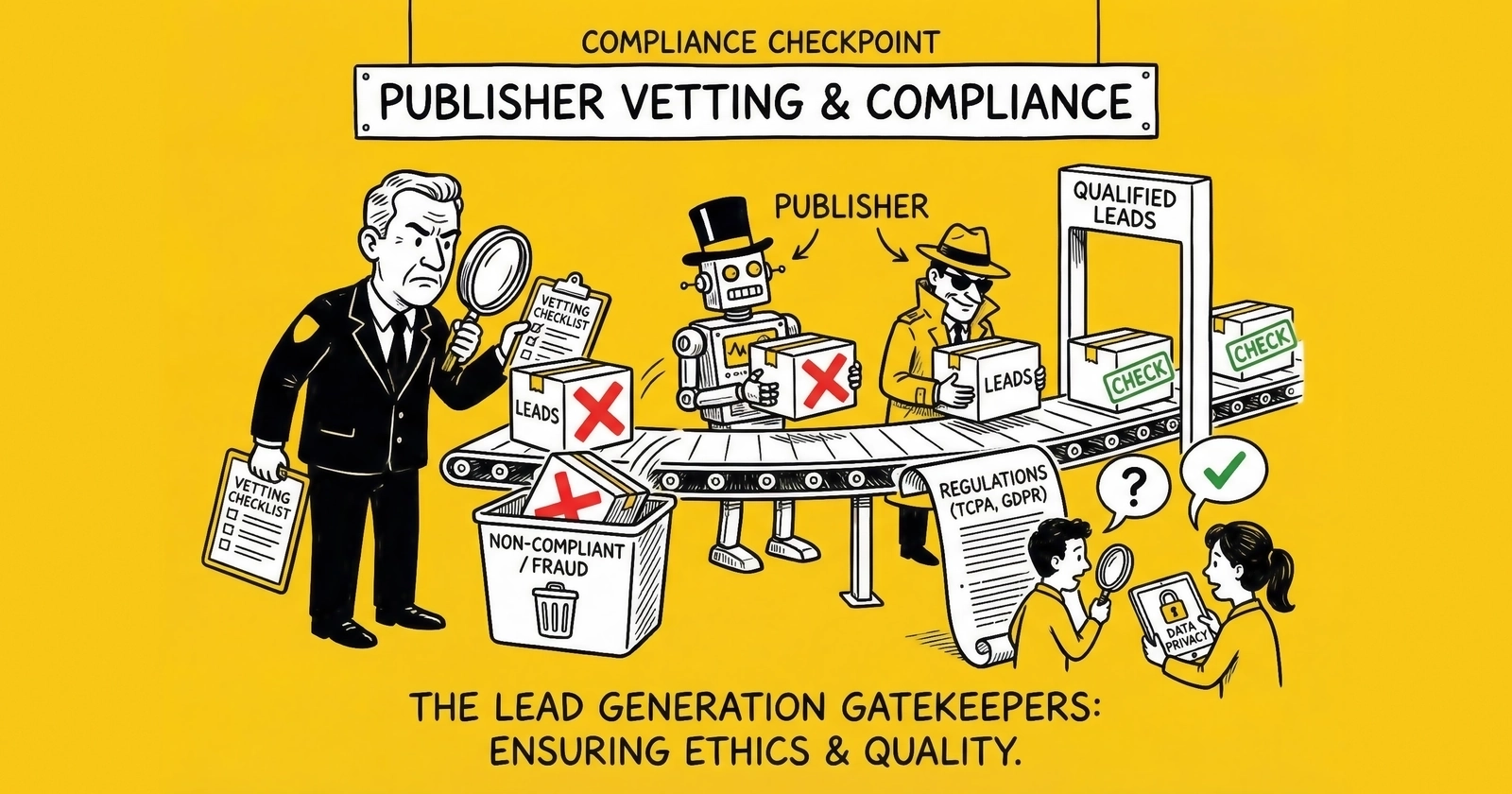
How to vet lead publishers and affiliates, implement compliance management systems, and avoid TCPA violations that can cost millions in penalties.
The lead generation industry operates in a regulatory environment where a single compliance failure can destroy a business. TCPA lawsuits surged 95% compared to the previous year according to 2024 litigation tracking, with class actions spiking 285% in September alone. Over 80% of TCPA cases now proceed as class actions, creating exposure that scales with every lead you’ve ever purchased.
The source of this exposure isn’t always obvious. Lead buyers often discover – too late – that their liability extends far beyond their own practices. When a publisher uses deceptive tactics to collect consent, when an affiliate network fails to audit its partners, when a lead seller recycles stale data without proper authorization, the companies that purchased those leads share the legal consequences.
This isn’t theoretical risk. In May 2025, Truist Bank agreed to a $4.1 million settlement for making prerecorded calls without proper consent. Clover Network LLC paid $15 million in 2024 for text messages sent without express authorization. Keller Williams faced fines reaching $40 million. U.S. home service contractors – an industry built on lead generation – lost an estimated $7 million in the first half of 2025 to TCPA violations alone.
The common thread in these cases isn’t reckless disregard for regulations. It’s insufficient control over the supply chain that generates leads. Publishers and affiliates operate at arm’s length from the companies that ultimately contact consumers. When those publishers cut corners on consent, the liability travels upstream to every buyer in the distribution chain.
Why Publisher Vetting Determines Regulatory Survival
The FTC’s Operation Stop Scam Calls enforcement sweep in July 2023 established precedent that continues to shape the industry. The agency targeted what it called “consent farms” – lead generators that used deceptive ads and dark patterns to trick consumers into providing consent for marketing contacts.
The resulting settlements didn’t just punish the lead generators. The FTC’s orders imposed extensive due diligence requirements on companies that purchase leads, effectively making buyers responsible for their publishers’ practices. According to legal analysis from Venable LLP, these requirements include:
Publisher monitoring obligations: Lead buyers must establish systems to review all marketing materials used by publishers before they’re publicly displayed. If a publisher promotes content that violates consent requirements, the buyer must immediately suspend the relationship and reject all future lead referrals.
Consent disclosure standards: Before collecting consumer information for lead sales, publishers must clearly and conspicuously disclose – separate from any privacy policy or terms of service – the specific purpose for which information is collected, the names of every person who will receive the data, and how consumers can withdraw consent.
Downstream accountability: Lead recipients must certify that they possess required business licenses, will not resell consumer information without disclosure, and will destroy data within two weeks of receiving a consumer’s deletion request.
These aren’t suggestions. They’re legally enforceable requirements that emerged from FTC enforcement actions, and they establish the standard of care that courts apply when evaluating whether lead buyers exercised appropriate due diligence.
The practical implication: if you can’t demonstrate that you verified your publishers’ consent practices before purchasing leads, you may share liability for their violations. For the foundational requirements that publishers must meet, see our TCPA compliance guide for lead generators.
The Affiliate Network Compliance Gap
Many lead buyers work with affiliate networks rather than individual publishers, assuming the network provides a compliance buffer. This assumption is dangerous.
LeadScale’s compliance analysis of affiliate network onboarding processes revealed a fundamental problem: most networks focus on volume rather than quality. The typical network onboarding process verifies that publishers have agreed to contractual terms and updated their privacy policies, but pays minimal attention to whether publishers actually comply with legal requirements for data collection.
As Nicholas Ng, who leads supplier onboarding at LeadScale, observes: networks often run a “stand-offish approach focused primarily on the quantities of Publishers they can onboard rather than on focusing on a handful of quality Publishers.”
This creates a structural blind spot. When you purchase leads from an affiliate network, you’re often buying from publishers you’ve never evaluated. The network’s contractual protections – indemnification clauses, compliance warranties, terms and conditions – may provide some legal cover, but they don’t prevent regulatory violations from occurring.
The deeper problem is visibility. Publishers control the core components of lead generation: the advertising channels used to attract consumers, the capture points where data is collected, the consent language presented at submission, and the privacy policies that govern data use. If the network doesn’t audit these elements, you have no way to verify that your lead supply meets legal requirements.
When regulators investigate a consent chain, they don’t accept “I bought from a network” as a defense. They ask: what did you do to verify that the leads you purchased were collected lawfully?
The Post-Duguid State Law Surge
The Supreme Court’s 2021 decision in Facebook v. Duguid narrowed the federal TCPA’s autodialer definition, reducing exposure for many telemarketing operations. But the relief was short-lived.
States responded by enacting “mini-TCPA” laws that reimpose – and often exceed – the restrictions the Supreme Court limited. According to Goodwin Law’s analysis of state telemarketing regulations, at least 15 states now enforce stricter requirements than federal law.
Florida’s Telephone Solicitation Act (effective July 2021) prohibits certain calls made with “an automated system for the selection or dialing of telephone numbers” – language that may capture technology exempted under federal law. Violations carry $500 penalties, trebled to $1,500 for knowing violations, with a private right of action.
Oklahoma’s Telephone Solicitation Act (effective November 2022) mirrors Florida’s approach, adding more than 20 category exemptions but retaining broad autodialer restrictions and per-violation penalties.
State calling time restrictions are uniformly stricter. While federal law permits calls until 9 PM, Florida, Oklahoma, Washington, and Maryland all prohibit calls after 8 PM in the consumer’s time zone.
Residency presumptions create jurisdictional exposure. Both Florida and Oklahoma presume that calls to in-state area codes are made to state residents, bringing local calls under state law even when the consumer has moved.
Call frequency limits in Florida and Oklahoma cap telephone solicitations to three calls per 24 hours on the same subject matter – regardless of whether the consumer has provided consent.
For lead generation operations, this fragmented regulatory environment creates multiplicative compliance requirements. A national calling operation must satisfy federal TCPA requirements, navigate state-specific restrictions for every jurisdiction where consumers are located, and track consent at a granularity that most legacy systems weren’t designed to handle.
The One-to-One Consent Question
The FCC’s proposed one-to-one consent rule – which would have required separate consent for each company that contacts a consumer – was struck down by the Eleventh Circuit Court of Appeals in January 2025, just days before it was scheduled to take effect.
The Insurance Marketing Coalition Ltd. v. FCC decision held that the FCC exceeded its authority by redefining “prior express consent” to prohibit consent for multiple marketing partners obtained through a single disclosure. The court found that ordinary consent principles allow consumers to authorize multiple companies simultaneously, and the FCC’s restrictions conflicted with this common law understanding.
But the ruling doesn’t eliminate one-to-one consent requirements. According to analysis from Troutman Pepper, several factors maintain pressure toward individualized consent:
Do Not Call Registry rules remain unchanged. The Telemarketing Sales Rule still requires that written permission for calls to DNC-registered numbers authorize calls “by or on behalf of a specific seller.” The FTC has already interpreted this to require one-to-one consent for DNC calls.
Carrier requirements persist. T-Mobile and other wireless carriers prohibit consent sharing in their network policies. Even without federal mandates, carriers can terminate routing for companies that violate these requirements.
State laws may impose stricter standards. Texas SB 140, effective September 1, 2025, expands telephone solicitation definitions and ties violations to treble damages under the Deceptive Trade Practices Act.
Plaintiff attorneys remain active. The Eleventh Circuit ruling reduces one avenue of attack, but TCPA litigation continues under other theories, including inadequate consent disclosures, failure to honor revocation requests, and state-law violations.
The practical guidance from compliance attorneys is consistent: even after the Eleventh Circuit ruling, lead buyers should implement systems that track consent at the individual seller level and can demonstrate that consumers understood who would contact them. For more on how this ruling affects lead operations, see our one-to-one consent rule explainer.
The Publisher Vetting Framework
Effective publisher vetting requires systematic evaluation across multiple dimensions. Fraudlogix, which provides fraud detection services for affiliate marketing, identifies ten key areas for publisher assessment:
1. Affiliate Program Participation
Publishers in good standing with established affiliate networks have already passed basic quality controls: age verification, tax compliance, FTC disclosure requirements, and privacy policy standards. Ask potential publishers about their other affiliate relationships and verify their standing with networks you trust.
2. Site Longevity
Brand-new domains should raise immediate questions. Legitimate publishers build authority over time through organic traffic growth and content development. Use domain age-checking tools (WhatsMyDNS, Dupli Checker, SE Ranking) to verify site history. Collections of recently registered domains suggest potential fraud.
3. Content Quality and Originality
Scraped or duplicate content indicates publishers taking shortcuts. Legitimate publishers invest in original content that engages their audience. Check for content originality and assess whether the publisher’s content naturally leads to the products or services for which they’re generating leads.
4. Site Functionality
Broken links, unfinished pages, missing images, and misleading navigation indicate either incompetence or intentional deception. Publishers who can’t maintain functional websites are unlikely to maintain compliant lead generation practices.
5. Social Media Presence
Active, engaged social media accounts suggest legitimate audience development. Examine post frequency, engagement quality, and alignment between social content and the publisher’s stated focus area. Dormant or bot-driven social accounts should trigger skepticism.
6. Publication Frequency
Stale content – nothing updated in months or years – suggests abandoned properties or lead generation shells rather than legitimate publishing operations. Use the Wayback Machine to review historical content patterns and verify consistent activity.
7. Professional References
Request references from other lead buyers and examples of previous campaigns. Publishers with legitimate track records can demonstrate prior successful relationships. Inability to provide references should disqualify potential partners.
8. Brand Value Alignment
Assess whether the publisher’s content aligns with your organization’s values and the regulatory requirements of your industry. Adult content, aggressive claims, or deceptive presentation tactics create liability regardless of whether the publisher’s leads technically meet consent requirements.
9. Marketing Tactics Transparency
Require detailed explanation of how publishers acquire traffic and generate leads. Banner farms, pop-unders, cookie stuffing, adware, and comment spamming indicate practices that violate most network terms and create legal exposure. Legitimate publishers explain their methodology because they want to work with quality-conscious partners.
10. Content Authenticity
Sites filled with RSS feeds and widgets but lacking original content are likely fraud vehicles. Genuine publishers invest in content that serves their audience; fraudulent publishers assemble the appearance of legitimacy without the substance.
The Ping-Post Compliance Advantage
The ping-post lead distribution model offers structural compliance benefits that traditional fixed-price lead buying lacks. Understanding these advantages – and their limitations – is essential for building compliant operations.
In ping-post distribution, when a consumer submits a request (for an insurance quote, for example), the lead seller “pings” partial information to potential buyers – geographic location, qualifying answers, and other non-identifying data. Buyers return bids based on this information. The winning buyer then receives the full lead “post,” including name, contact information, and other personal details.
According to Verisk Marketing Solutions’ analysis, this architecture offers several compliance benefits:
Limited PII exposure. Until you win a bid, you never see the consumer’s personal information. This reduces the scope of data you handle and limits your exposure if publishers are collecting data improperly.
Source transparency. Ping-post systems can track which publishers generate which leads, enabling performance analysis and rapid suspension of problematic sources.
Real-time quality filtering. You can set bidding rules that exclude leads from publishers with poor quality scores, excessive duplicates, or compliance concerns.
Documentation capability. Well-implemented ping-post systems maintain detailed records of every bid, every purchase, and every source – creating audit trails that support compliance verification.
But ping-post isn’t automatically compliant. Boberdoo, a leading ping-post software provider, emphasizes that the technology is only as good as the verification processes layered on top of it. Key considerations include:
Consent verification for every lead. Ping-post systems should integrate with consent documentation services that capture timestamp, consent language, and consumer IP address for every lead. Without this documentation, you can’t defend your consent chain in litigation. See our guide to consent documentation and retention for the specific elements required.
Source-level performance tracking. Monitor conversion rates, contact rates, and complaint rates by source. Degrading metrics often indicate consent or quality problems before they trigger regulatory attention.
Rapid suspension protocols. When you identify problematic sources, your system should enable immediate suspension that halts all purchases from that source. Delays create liability exposure.
Duplicate detection. Some lead sellers offer the same lead to multiple buyers or resell leads through multiple channels. Track duplicates across your purchase history and demand refunds or credits when duplicates exceed contractual limits.
Detecting Fake Leads Before They Create Liability
Fraudulent leads create two categories of damage. The obvious harm is wasted marketing spend on contacts that will never convert. The less visible harm is compliance documentation pollution.
When fake leads enter your system, they bring fraudulent consent records. If those leads – or any leads from the same source – later face legal scrutiny, the presence of fake consent documentation undermines your entire compliance posture. Fraudlogix identifies several categories of fake leads:
Bot-generated leads. Automated software fills out forms with fictitious details or real data harvested without consent. These leads create the appearance of consent where none exists.
Stolen credentials. Fraudsters submit actual names and contact information obtained through data breaches or other unauthorized means. The consumer never consented to contact, but the consent documentation looks legitimate.
Incentivized signups. Deceptive affiliates promise gifts, prizes, or benefits to induce form submissions. The consumer’s “consent” was obtained through fraud, even though they technically submitted the form.
Lead reselling. Leads sold multiple times through different channels create duplicate consent records that may misrepresent the scope or timing of authorization.
Detection requires systematic monitoring:
Implement fraud detection tools. Real-time IP validation, device fingerprinting, and behavioral analysis can identify suspicious submission patterns before leads enter your distribution system.
Monitor submission patterns. Multiple leads from single IP addresses, submissions at regular intervals, or suspiciously similar form entries indicate automated fraud.
Track conversion rates by source. Sudden drops in conversion rate may indicate that a source has shifted from legitimate generation to fraudulent practices.
Verify contact information. Phone and email verification services can identify invalid contact details before you attempt outreach.
Apply form-level protections. Data formatting requirements, required fields, and CAPTCHA challenges stop unsophisticated bot attacks.
Building Compliance Infrastructure
Reactive compliance – addressing violations after they occur – is vastly more expensive than proactive systems that prevent violations. Based on FTC enforcement orders and industry best practices, effective compliance infrastructure includes:
Publisher Onboarding Protocol
Every publisher relationship should begin with documented acknowledgment of compliance requirements. The FTC’s settlement orders require lead buyers to:
- Provide publishers with copies of relevant regulations and company compliance policies
- Obtain signed acknowledgment that publishers understand requirements and agree to comply
- Suspend all business with publishers who fail to provide acknowledgment within specified timeframes
Content Monitoring Systems
Manual review of publisher content doesn’t scale. Compliance requires automated monitoring that:
- Reviews all marketing materials before public display
- Checks publisher sites against compliance rules at regular intervals
- Flags violations for immediate review and response
- Documents monitoring activities for audit purposes
Tools like Fintel Check (designed for financial services but applicable more broadly) enable automated monitoring that applies custom rules to publisher content and quantifies the potential impact of violations.
Audit Trail Documentation
When regulators or plaintiffs examine your consent chain, documentation determines outcomes. Effective systems maintain:
- Timestamp and content records for every consent disclosure
- Screenshots of publisher capture points at regular intervals
- Bid, purchase, and distribution records for every lead
- Investigation and remediation records for compliance concerns
Performance-Based Suspension
Compliance systems should automatically respond to quality degradation:
- Suspend sources when conversion rates, contact rates, or complaint rates exceed thresholds
- Require investigation and remediation before resuming purchases
- Generate written reports documenting findings and corrective actions
- Permanently terminate relationships when patterns indicate intentional non-compliance
Staff Training and Updates
Regulations change constantly. The shift from 30-day to 10-day opt-out processing windows, new state law requirements, and evolving enforcement priorities require ongoing education. Compliance infrastructure includes regular updates to staff about regulatory changes and practice adjustments.
The Economics of Compliance Investment
Compliance infrastructure costs money – software platforms, legal counsel, monitoring staff, and the opportunity cost of rejecting non-compliant lead sources. But the math favors investment.
Consider the penalty structure: $500 per TCPA violation, trebled to $1,500 for knowing or willful violations. No cap on total damages. Four-year statute of limitations. Over 80% of cases proceeding as class actions.
A lead buyer purchasing 10,000 leads monthly for four years accumulates potential exposure on 480,000 leads. If even 10% of those leads involved consent violations, maximum TCPA penalties could exceed $720 million. More realistically, class action settlements routinely reach seven and eight figures.
Against this exposure, compliance infrastructure that costs tens or hundreds of thousands of dollars annually is unambiguously cost-effective. The question isn’t whether to invest in compliance, but how to invest efficiently.
The highest-return investments typically include:
Consent documentation services. Third-party consent verification (TrustedForm, Jornaya, and similar services) provides independent evidence of when and how consent was obtained. This documentation is increasingly essential for defending against consent challenges. The underlying legal standard is prior express written consent, which these tools help verify.
Source quality analytics. Systems that track performance metrics by source enable rapid identification of problematic publishers before violations accumulate.
Automated monitoring. Technology that reviews publisher content continuously costs far less than the legal exposure from a single undetected violation going viral.
Legal consultation. Regular review of compliance practices by attorneys specializing in TCPA and telemarketing law identifies gaps before regulators or plaintiffs discover them.
Key Takeaways
-
TCPA litigation increased 4.4% in 2024, with 1,210 lawsuits filed between January and August alone – and major settlements ranging from $4.1 million (Truist Bank) to $40 million (Keller Williams) demonstrate the financial stakes of non-compliance.
-
Publisher vetting is your first line of defense against regulatory exposure. The FTC’s 2023 enforcement actions established that lead buyers can be held liable for their publishers’ consent practices, making due diligence non-negotiable.
-
The FCC’s one-to-one consent rule was struck down by the Eleventh Circuit in January 2025, but wireless carriers like T-Mobile still ban consent sharing – meaning practical compliance requirements remain stringent regardless of federal rules.
-
State mini-TCPA laws are expanding rapidly, with at least 15 states now enforcing stricter telemarketing regulations than federal law. Florida and Oklahoma impose $500-$1,500 per-violation penalties with private rights of action.
-
Opt-out processing windows shrunk from 30 days to 10 business days under April 2025 regulations, requiring lead distribution systems to coordinate faster than ever before.
-
Affiliate networks create compliance blind spots because many don’t audit individual publishers. If you can’t see how your leads are generated, you can’t defend your consent chain in court.
-
Ping-post technology offers compliance advantages by minimizing PII exposure until purchase – but only if you verify consent documentation for every lead you acquire.
-
Fake leads damage more than conversion rates – they pollute your compliance documentation and create liability when fraudulent consent records face legal scrutiny.
-
The 10-question publisher audit framework covers site longevity, content quality, compliance infrastructure, marketing tactics, and reference verification – any red flags should trigger deeper investigation or relationship termination.
-
Compliance management systems must include: publisher acknowledgment of consent requirements, content monitoring automation, audit trail documentation, and performance-based suspension protocols.
Frequently Asked Questions
What is publisher vetting in lead generation?
Publisher vetting is the systematic evaluation of lead sources – websites, affiliates, and media partners – before purchasing leads from them. Effective vetting assesses site legitimacy, content quality, compliance infrastructure, consent practices, and marketing tactics to identify sources that create legal or quality risks. The goal is ensuring that every lead in your distribution system was collected through lawful, well-documented consent processes.
Why do lead buyers share liability for publisher violations?
FTC enforcement actions and court decisions have established that lead buyers can be held liable for their publishers’ consent practices under theories including “substantial assistance” to telemarketing violations, failure to exercise reasonable due diligence, and receiving benefits from fraudulent practices. The practical implication is that “I didn’t know” isn’t a defense – buyers must demonstrate that they took reasonable steps to verify publisher compliance.
What are the current TCPA penalties for violations?
The TCPA imposes $500 per-violation penalties for negligent violations and $1,500 per-violation for knowing or willful violations. There is no cap on total damages, meaning exposure scales with violation volume. Class actions are common, with major settlements reaching $15-40 million. State mini-TCPA laws in Florida, Oklahoma, and other jurisdictions impose similar or greater penalties.
How did the Eleventh Circuit’s January 2025 ruling affect consent requirements?
The Insurance Marketing Coalition v. FCC decision struck down the FCC’s proposed one-to-one consent rule, which would have required separate consent for each company that contacts a consumer. However, one-to-one consent may still be required for calls to DNC-registered numbers under the Telemarketing Sales Rule, and wireless carriers maintain consent-sharing prohibitions in their network policies. State laws may impose additional restrictions.
What is ping-post lead distribution?
Ping-post is a real-time, auction-based lead distribution method where sellers send partial lead information (geographic location, qualifying answers) to potential buyers, who return bids without seeing personal information. The winning buyer receives the complete lead with contact details. This architecture limits PII exposure and enables source tracking, but requires thorough consent verification to ensure compliance.
How do I identify fake leads in my lead flow?
Fake leads often exhibit patterns: multiple submissions from single IP addresses, regular timing intervals, suspiciously similar form entries, or contact information that fails verification. Implement real-time fraud detection tools, monitor conversion rates by source, verify contact information before outreach, and use form protections (data formatting requirements, CAPTCHA) to filter obvious fraud.
What are mini-TCPA laws and which states have them?
Mini-TCPA laws are state-level telemarketing regulations that impose stricter requirements than federal law. At least 15 states enforce such laws, with Florida, Oklahoma, Washington, and Maryland among the most active. Common provisions include expanded autodialer definitions, tighter calling hours (8 PM vs. 9 PM cutoffs), call frequency limits, and private rights of action with per-violation penalties.
What documentation should I maintain for compliance?
Effective compliance documentation includes: consent records (timestamp, disclosure language, consumer IP address) for every lead; publisher acknowledgment of compliance requirements; monitoring records showing regular review of publisher content; bid, purchase, and distribution records for all leads; investigation and remediation records for compliance concerns; and opt-out request handling records showing timely processing.
How quickly must I process opt-out requests?
Under April 2025 FCC regulations, opt-out requests must be processed within 10 business days, reduced from the previous 30-day standard. This accelerated timeline requires lead distribution systems to coordinate efficiently across all buyers and channels to ensure consumers are removed from contact lists within the compliance window.
What should I do if I discover a publisher is violating consent requirements?
Immediately suspend all lead purchases from the source and investigate the scope of potential violations. Generate a written report documenting findings. If violations are confirmed, permanently terminate the relationship, attempt to recover any payments made for non-compliant leads, and assess whether notification to affected consumers or regulators is required. Document all remediation actions for audit purposes.
How do affiliate networks affect compliance obligations?
Affiliate networks can create compliance blind spots because many don’t audit individual publishers for consent practices. When you purchase leads through a network, you may be buying from publishers you’ve never evaluated. Contractual indemnification from networks provides some legal protection but doesn’t prevent violations from occurring. Demand visibility into network publisher vetting processes and consider requiring direct publisher certification for high-volume relationships.
What is TrustedForm and why do lead buyers use it?
TrustedForm is a consent verification service that captures independent documentation of form submissions, including the consent language displayed, consumer interaction with the page, and timestamp information. This third-party documentation provides evidence that consent was obtained at a specific time through specific disclosures – evidence that’s more credible in litigation than self-generated records. Similar services include Jornaya’s LeadiD platform.
Sources
- FCC - Telephone Consumer Protection Act
- FTC - Telemarketing Sales Rule
- TrustedForm - Consent Documentation
- Verisk Marketing Solutions - Jornaya LeadiD
- Insurance Marketing Coalition v. FCC - Eleventh Circuit, January 2025
- boberdoo - Lead Distribution Technology
- LeadExec - Scalable, automated lead capture, validation, routing, and distribution platform