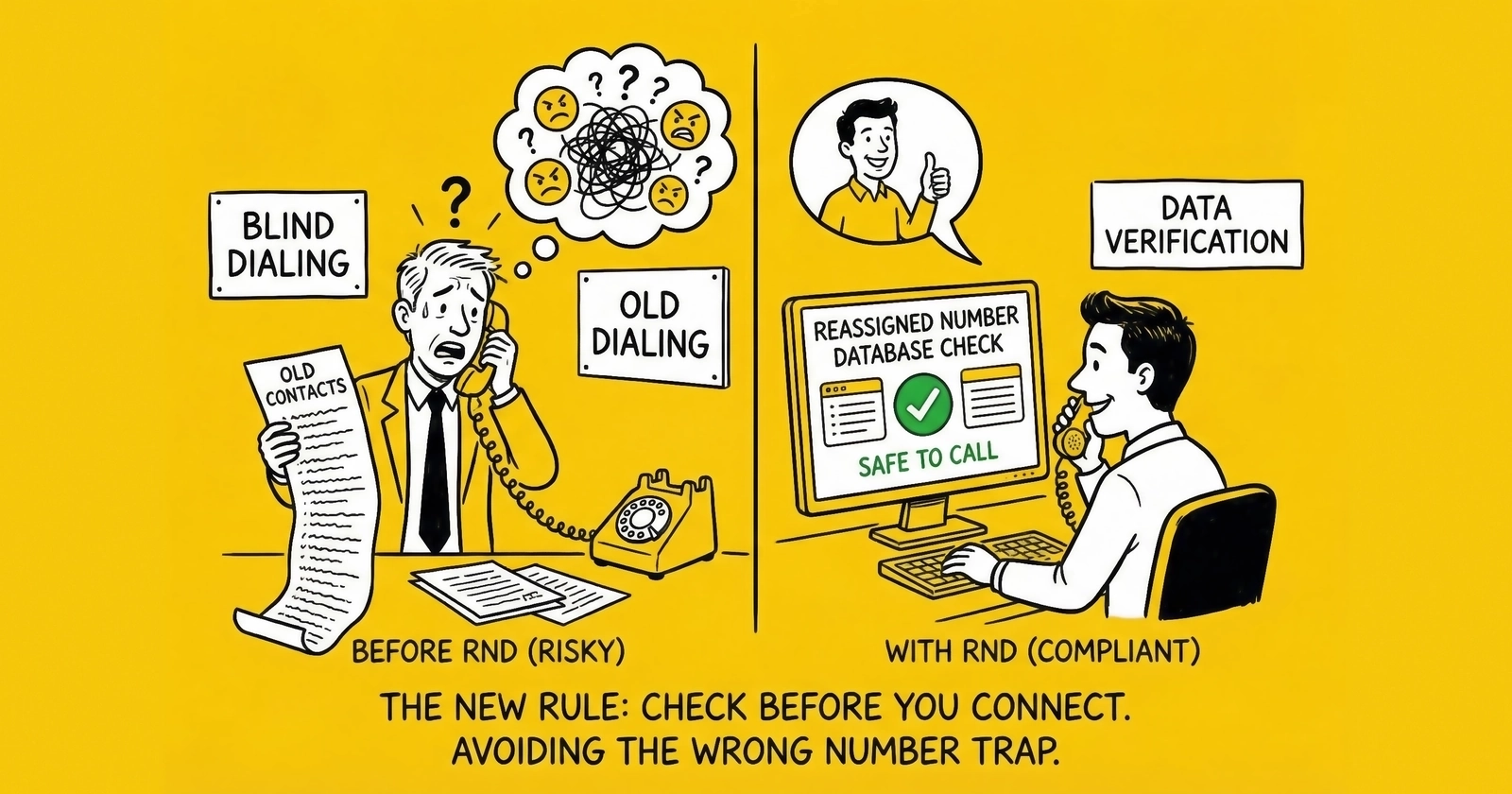
A comprehensive guide to the FCC Reassigned Numbers Database, safe harbor protection, implementation requirements, and compliance strategies for lead generators who need to avoid TCPA liability from calling numbers that have changed hands.
Introduction: The Hidden Liability in Every Phone Number
You had valid consent. The consumer filled out your form, checked the consent box, and you captured a TrustedForm certificate documenting everything. Your compliance team verified the lead before it entered your calling queue. By every measure, this was a clean, compliant lead.
Then you called the number, and someone else answered. This scenario highlights a critical gap in TCPA compliance.
The consumer who provided consent changed their phone number six months ago. The number was reassigned to a new owner who never heard of your company, never visited your website, and certainly never consented to receive your call. Now that new owner is a plaintiff in a TCPA lawsuit against your company, claiming $500 to $1,500 for a call they never authorized.
This is not a hypothetical. Reassigned number liability has become one of the most insidious compliance risks in the lead generation industry. Unlike consent deficiencies that result from your own errors, reassigned number liability can attach to calls that were entirely compliant at the moment the lead was captured. The consent was valid when given. The documentation was complete. But the underlying phone number changed hands without your knowledge, transforming a compliant contact into a TCPA violation.
The Federal Communications Commission recognized this problem and created a solution: the Reassigned Numbers Database. This database allows callers to check whether a phone number has been permanently disconnected and reassigned to a new owner since the date consent was obtained. Callers who query the database before calling receive a safe harbor from liability for the first call to a reassigned number.
But like most compliance tools, the Reassigned Numbers Database is only useful if you understand how it works, when to use it, and what its limitations are. Many practitioners have implemented the database incorrectly or incompletely, leaving themselves exposed to the very liability they thought they had eliminated.
This guide covers everything you need to know about the Reassigned Numbers Database in 2025: the regulatory background, how the database works, the safe harbor it provides, implementation requirements, limitations you must understand, and the operational strategies that make database integration actually effective.
Understanding Reassigned Number Liability
Before diving into the database itself, you need to understand the liability it addresses. Reassigned number liability is distinct from other TCPA risks, and the database is specifically designed to address this particular problem.
How Phone Numbers Get Reassigned
When a consumer cancels their phone service or switches carriers, their phone number typically becomes available for reassignment after a carrier-determined aging period. This period varies by carrier but is often 90 days or less. After the aging period, the number returns to the available pool and may be assigned to a new subscriber.
The volume of reassignment is substantial. The FCC estimated that approximately 35 million phone numbers are permanently disconnected and made available for reassignment each year in the United States. That represents roughly 10% of all active phone numbers churning annually.
For lead generators, this creates a compounding problem. If you capture a lead today and attempt to contact that lead periodically over the next year, there is a non-trivial probability that the phone number will have changed hands during that period. The probability increases for aged leads, long nurture sequences, and re-engagement campaigns targeting older lists.
The Liability Framework
Under the TCPA, consent to receive calls is tied to the individual who provided consent, not to the phone number itself. When a number is reassigned, the new owner has not consented to calls from parties who obtained consent from the prior owner. Any call made without valid consent from the current owner creates potential liability.
The statutory framework is unforgiving. Each call to a reassigned number without consent from the current owner constitutes a separate violation. Statutory damages of $500 per violation apply, increasing to $1,500 for willful or knowing violations. There is no cap on aggregate damages, meaning class actions involving large calling campaigns can create eight-figure exposure.
Prior to the Reassigned Numbers Database, callers had limited options for addressing this risk. They could verify that numbers were still active through line status checks, but line status does not indicate whether ownership has changed. A number can remain active while being reassigned. They could limit the duration between consent capture and calling, but this approach sacrifices the value of aged lead strategies and does nothing for long-term customer relationships.
The database provides what the industry needed: a mechanism to verify whether a specific number has been reassigned since a specific date, with legal protection for callers who use it properly.
Real-World Scenarios
Consider these scenarios where reassigned number liability arises:
Lead Aging: A consumer submits a lead for auto insurance in January. The lead is purchased and enters a nurture sequence. In April, the consumer changes carriers and their phone number is reassigned. In June, the lead buyer attempts a follow-up call and reaches the new owner.
Customer Re-engagement: An insurance agency contacts its existing book of business for renewal campaigns. A customer who purchased a policy three years ago changed numbers eighteen months ago. The agency’s CRM still contains the old number, which now belongs to someone else.
Lead Resale: A lead generated two years ago is sold as an aged lead to a new buyer. The original consent was valid, but the number was reassigned in the interim. The new buyer has no way to know the number changed hands.
Long Sales Cycles: A B2B lead for enterprise software enters a 12-month sales process. During that period, the decision-maker changes jobs and phone numbers. The number is reassigned to someone unrelated to the prospect.
In each scenario, the caller had valid consent from the original number owner. The consent documentation would likely survive litigation scrutiny. But the call still creates liability because the current owner never consented.
The FCC Reassigned Numbers Database
The FCC launched the Reassigned Numbers Database on November 1, 2021, following years of industry advocacy for a solution to reassigned number liability. The database represents a cooperative effort between the FCC, voice service providers, and the calling industry.
Database Structure and Operation
The database operates as a centralized repository of disconnection and reassignment information provided by voice service providers. When a subscriber permanently disconnects a phone number, the service provider reports that disconnection to the database. The database then tracks the aging period and eventual reassignment.
Importantly, the database does not contain a list of all reassigned numbers. Instead, it provides a query mechanism that answers a specific question: “Was this phone number permanently disconnected on or after a specific date?” The date you provide in the query represents the date you obtained consent from the person you believe owns the number.
Query Process:
- You submit a query containing the phone number and the consent date
- The database checks whether the number was permanently disconnected and reassigned after that date
- The database returns one of three responses: “No” (not reassigned after consent date), “Yes” (reassigned after consent date), or “No Information” (the database lacks data for that number)
The “No” response triggers safe harbor protection for your first call to that number. The “Yes” response indicates you should not call because the number has a new owner. The “No Information” response means the database cannot help, and you must make a risk-based decision.
Carrier Participation
The database depends on voice service providers reporting disconnection data. The FCC required facilities-based voice service providers to begin reporting data to the database as of the November 2021 launch. This includes major wireless carriers, wireline carriers, and VoIP providers.
However, participation is not universal and data completeness varies. Some smaller providers have been slower to integrate reporting. International numbers are not covered. The FCC continues to monitor participation and has taken enforcement action against providers who failed to meet reporting obligations.
As of late 2024, the database covers the substantial majority of U.S. phone numbers, including numbers from major carriers like Verizon, AT&T, T-Mobile, and most regional and VoIP providers. Coverage continues to improve as more providers integrate reporting.
Access and Fees
Access to the Reassigned Numbers Database is available through the database administrator, currently iconectiv, which won the FCC’s competitive contract to operate the database. Callers must register as Authorized Callers and pay applicable fees to query the database.
Fee Structure (as of 2024-2025):
The database uses a per-query pricing model with volume tiers:
| Monthly Query Volume | Price per Query |
|---|---|
| 1 - 100,000 | $0.004 |
| 100,001 - 250,000 | $0.003 |
| 250,001 - 500,000 | $0.0025 |
| 500,001 - 1,000,000 | $0.002 |
| 1,000,001+ | $0.0015 |
For high-volume operations, the per-query cost approaches the cost of basic phone validation. At $0.0015 per query and a lead cost of $30, the database query represents 0.005% of lead acquisition cost – essentially negligible.
Technical Integration
The database provides API access for integration with calling platforms, CRMs, and lead management systems. Technical requirements include:
Authentication: OAuth 2.0-based authentication for API access
Query Format: RESTful API accepting phone number and consent date parameters
Response Time: Sub-second response times for real-time integration into calling workflows
Batch Processing: Bulk query capability for processing large lists
Audit Logging: Transaction logging for compliance documentation
Most enterprise lead distribution platforms and dialing systems have pre-built integrations with the Reassigned Numbers Database. For custom implementations, iconectiv provides technical documentation and sandbox environments for development.
The Safe Harbor Explained
The safe harbor is the database’s primary value proposition. Understanding exactly what protection it provides – and what it does not – is essential for effective compliance.
What the Safe Harbor Covers
When you query the database before calling and receive a “No” response (indicating the number was not reassigned after your consent date), you receive protection from liability for the first call to that number.
The safe harbor applies when all of the following conditions are met:
1. You queried the database. The query must occur before the call is placed. Retrospective queries after a complaint provide no protection.
2. You received a “No” response. The database indicated the number was not permanently disconnected and reassigned after the consent date you provided.
3. The consent date you provided was accurate. The date must reflect when you actually obtained consent. Providing a false or inaccurate date invalidates the safe harbor.
4. The call is the first call after the query. Safe harbor applies to one call per query. Subsequent calls require new queries.
5. You had valid consent for the call type. The safe harbor addresses reassignment liability only. It does not cure consent deficiencies, DNC violations, time-of-day violations, or other TCPA issues.
When these conditions are met, you have an absolute defense to liability for calling a reassigned number. Even if the current owner sues, claiming they never consented, you can demonstrate that you queried the database, received authorization, and are protected by the safe harbor.
What the Safe Harbor Does Not Cover
The safe harbor is narrower than many practitioners realize. It provides protection only for reassignment liability, and only under specific conditions.
Not a General TCPA Defense: The safe harbor does not protect against consent deficiencies, DNC violations, time-of-day violations, revocation failures, or other TCPA claims. If your underlying consent was invalid, the safe harbor does not help.
Only the First Call: Each query provides safe harbor for one call. If you call, leave a voicemail, and call back the next day, the second call is not protected unless you query again.
Requires Accurate Consent Date: If you provide a consent date that is earlier than when consent was actually obtained, the safe harbor may not apply. The database will check against the date you provide, and if the number was reassigned between your stated date and the actual consent date, you lose protection.
“No Information” Responses Provide No Protection: When the database returns “No Information,” you have no safe harbor. This occurs when the carrier has not reported data for that number, or the number is not in the database’s coverage area.
Does Not Cover All Call Types: The safe harbor was designed primarily for calls to cell phones using automated dialing systems or artificial/prerecorded voices – the call types most affected by TCPA restrictions. The safe harbor’s application to other call types may be more limited.
The “No Information” Problem
The “No Information” response deserves special attention because it represents a significant gap in database coverage. When you receive “No Information,” the database is telling you it cannot help determine whether the number was reassigned. You must make a risk-based decision about whether to proceed.
Common scenarios producing “No Information” responses:
Carrier Non-Reporting: Some carriers have not integrated reporting with the database. Numbers served by these carriers will return “No Information.”
Recent Number Activation: Numbers activated after the database launch in November 2021 may lack historical data.
Number Porting Complications: Numbers that have ported between carriers may have incomplete records.
International Numbers: The database covers U.S. numbers only. International numbers return “No Information.”
Data Latency: There may be a lag between disconnection and database update. Numbers disconnected very recently may not yet be reflected.
For operations receiving significant “No Information” volumes, the database provides less protection than expected. You must implement supplementary controls for numbers the database cannot verify.
Implementation Strategy
Implementing the Reassigned Numbers Database effectively requires more than technical integration. You need a strategy that incorporates the database into your overall compliance workflow while accounting for its limitations.
Pre-Implementation Assessment
Before implementing, assess your current operations:
Call Volume and Type: How many outbound calls do you make? What percentage are to cell phones using automated systems? Higher volumes and higher-risk call types justify prioritizing implementation.
Lead Age Distribution: What is the distribution of time between consent capture and calling? Operations with significant aged lead activity face higher reassignment risk.
Current Consent Documentation: Do you accurately capture and retain consent dates? The database requires accurate consent dates to function properly.
Technical Infrastructure: Does your dialing platform support real-time API integration? Can you modify calling workflows to incorporate pre-call queries?
Query Cost Economics: Calculate expected query costs based on your volume. Compare to potential liability exposure to validate ROI.
Integration Architecture
Effective implementation integrates database queries into the calling workflow at the right point:
Option 1: Pre-Dial Query (Recommended)
Query the database immediately before each call attempt. This approach provides the most current data and ensures safe harbor applies to each call.
Workflow:
- Calling system selects next number from queue
- System queries Reassigned Numbers Database with phone number and consent date
- If response is “No,” proceed with call
- If response is “Yes,” remove number from queue and flag for suppression
- If response is “No Information,” apply business rules (proceed with caution or suppress)
- Place call if approved
- Log query response for compliance documentation
Advantages: Maximum protection, most current data, safe harbor applies to each call
Disadvantages: Latency added to dial flow, query costs scale with call attempts (not just unique numbers)
Option 2: List Scrubbing (Pre-Campaign)
Query all numbers on a calling list before the campaign begins. Flag reassigned numbers for suppression.
Workflow:
- Import calling list with consent dates
- Batch query all numbers against database
- Suppress numbers with “Yes” responses
- Apply business rules to “No Information” responses
- Proceed with campaign on approved numbers
Advantages: No per-call latency, efficient batch processing, campaign-level visibility into reassignment rates
Disadvantages: Data may become stale between scrub and call, safe harbor requires query “before the call” – campaigns lasting multiple days may need re-scrubbing
Option 3: Hybrid Approach
Combine list scrubbing with selective pre-dial queries for maximum protection.
Workflow:
- Batch scrub list before campaign
- Suppress “Yes” responses
- For “No” responses, proceed with calls but consider freshness of scrub
- For “No Information” responses, either suppress or flag for additional verification
- For high-value or high-risk contacts, implement pre-dial query as final check
This hybrid approach balances efficiency with protection, applying the most rigorous checks to the highest-risk contacts.
Consent Date Management
The safe harbor depends on providing accurate consent dates. This requires robust consent date capture and retention.
Capture Requirements:
- Record exact timestamp of consent (date and time)
- Store consent date with the lead record permanently
- Ensure consent date flows through all lead transfers and sales
- Preserve consent date accuracy when leads are processed through multiple systems
Common Consent Date Problems:
System Default Dates: Some systems default consent date to current date when importing leads. This overwrites the actual consent date and invalidates safe harbor protection.
Missing Consent Dates: Leads acquired before implementing consent date tracking lack the data needed for database queries.
Date Format Errors: Inconsistent date formats across systems can corrupt consent dates during data transfers.
Timezone Confusion: Consent captured in Pacific time stored as Eastern time shifts the effective date.
Audit your consent date capture and storage processes before implementing database integration. Inaccurate consent dates make the database useless and potentially harmful – you may believe you have safe harbor when you do not.
Handling Different Response Types
Develop clear business rules for each database response type:
“No” Response (Not Reassigned):
- Safe harbor applies for first call
- Proceed with call
- Log response with timestamp for documentation
- Consider re-querying before subsequent call attempts
“Yes” Response (Reassigned):
- Do not call this number
- Add to permanent suppression list
- Update lead status to reflect invalid contact information
- Consider attempting alternative contact methods (email, mail)
- Document response for compliance purposes
“No Information” Response:
- Database cannot confirm reassignment status
- Options based on risk tolerance:
- Conservative: Suppress and do not call
- Moderate: Proceed with manual dial only (no automated systems)
- Aggressive: Proceed with automated calling (no safe harbor)
- Document business rule applied and rationale
For most operations, a moderate approach to “No Information” responses balances risk and business need. Suppressing all “No Information” numbers may exclude too many valid contacts. Proceeding with full automation may create unacceptable risk.
Best Practices for Lead Generators
Lead generators face unique considerations because they typically capture consent and may call leads themselves while also selling to buyers who will make their own calls.
When Generating Leads
Capture Consent Dates Precisely:
Ensure your lead capture forms and systems record the exact timestamp of consent. This timestamp will be needed by you and every downstream buyer for database queries.
Best practice: Store consent timestamp in UTC format to eliminate timezone ambiguity.
Include Consent Date in Lead Data:
When delivering leads to buyers, include the consent date as a standard field. This enables buyers to query the database properly.
Schema example:
{
  "phone": "5551234567",
  "consent_timestamp": "2024-06-15T14:32:00Z",
  "consent_type": "PEWC",
  "consent_verification": "TF_cert_id_12345"
}
Query Before Your Own Calls:
If you make confirmation calls, nurture calls, or any other calls before selling the lead, query the database first. This protects you and validates the lead’s contactability for buyers.
Consider Fresh Lead Validation:
For leads you will call or sell quickly (within 24-48 hours of capture), the reassignment risk is low. For leads that will age before contact, factor database query timing into your workflow.
When Buying Leads
Require Consent Dates from Sellers:
Do not purchase leads without accurate consent dates. Without the consent date, you cannot query the database effectively.
Include consent date requirements in your lead purchase agreements:
- Consent timestamp must be provided with each lead
- Timestamp must reflect actual consent capture time
- Seller warrants accuracy of consent dates
Query Before Calling:
Query every lead before the first call attempt. This is non-negotiable for purchased leads where you have less visibility into consent quality.
Verify Aged Lead Consent Dates:
For aged leads, be especially careful about consent date accuracy. A lead aged 12 months has had 12 months for the number to be reassigned. Query the database and verify the consent date reflects the original capture, not a subsequent system date.
Document Query Results:
Maintain complete records of database queries and responses. In litigation, you will need to demonstrate that you queried the database, received authorization, and satisfied safe harbor requirements.
For Lead Distribution Platforms
Platforms that route leads between generators and buyers can add significant value by integrating database queries into the distribution workflow:
Pre-Distribution Validation:
Query leads against the database before routing to buyers. Suppress or flag leads with “Yes” responses before they reach buyers.
Consent Date Enforcement:
Validate that incoming leads include consent dates. Reject leads without proper consent date documentation.
Query Result Passthrough:
Include database query results in lead data delivered to buyers. This allows buyers to skip redundant queries for fresh leads.
Reporting and Analytics:
Provide reporting on reassignment rates by lead source. This helps buyers evaluate source quality and helps generators identify issues.
Limitations and Risk Mitigation
The Reassigned Numbers Database is a powerful tool, but it is not a complete solution. Understanding its limitations allows you to implement supplementary controls.
Coverage Gaps
Carrier Participation Variability:
Not all carriers report data consistently. Smaller regional carriers, some VoIP providers, and certain wireless MVNOs may have incomplete reporting.
Mitigation: Track “No Information” rates by carrier. If certain carriers consistently return “No Information,” implement additional verification for numbers from those carriers.
Data Latency:
There is a delay between number disconnection and database update. A number disconnected yesterday may not yet appear in the database.
Mitigation: For time-sensitive campaigns, combine database queries with real-time line status checks. Line status can indicate recent disconnection before the database updates.
Historical Data Limitations:
The database launched in November 2021. Numbers reassigned before that date may not have complete records.
Mitigation: For consent obtained before November 2021, consider the database unreliable and implement alternative verification.
International Numbers:
The database covers U.S. numbers only.
Mitigation: For international operations, implement country-specific verification mechanisms or accept the risk.
Operational Challenges
Query Volume and Cost:
High-volume operations may face significant query costs. At $0.0015 per query and 1 million queries per month, costs reach $1,500 monthly.
Mitigation: Implement intelligent query strategies – skip queries for very fresh leads, batch process where appropriate, cache results for short periods.
Integration Complexity:
Adding database queries to existing calling workflows requires technical changes. Legacy systems may not support real-time API integration.
Mitigation: Work with your platform vendor to understand integration options. Consider middleware solutions if direct integration is not feasible.
False Security:
The biggest risk is believing the database provides more protection than it does. Practitioners who implement the database but neglect other compliance requirements may actually increase risk.
Mitigation: Treat the database as one component of comprehensive compliance, not a substitute for it.
Supplementary Controls
Combine database queries with other verification layers:
Real-Time Line Status:
Check whether numbers are currently active and connected. Line status APIs can identify disconnected numbers before they appear in the database.
Validate phone numbers for format, type (mobile/landline), and carrier. Invalid or unusual numbers warrant additional scrutiny.
Contact Recency:
Track when you last successfully contacted each number. Numbers with recent successful contact are less likely to be reassigned.
Consumer Verification:
For high-value contacts, implement verification at the start of the call. “Am I speaking with [Name]?” confirms you have reached the intended recipient before proceeding.
Multi-Channel Confirmation:
For important leads, confirm via email or SMS before calling. If the consumer responds to email, you have some confidence the contact information is current.
Compliance Documentation
Proper documentation is essential for leveraging the safe harbor in litigation. You must be able to demonstrate that you queried the database, received authorization, and satisfied all safe harbor requirements.
Documentation Requirements
For each call covered by the safe harbor, maintain records of:
Query Details:
- Phone number queried
- Consent date provided in query
- Query timestamp
- Database response (“No,” “Yes,” or “No Information”)
- Transaction ID or reference number
Call Details:
- Phone number called
- Call timestamp
- Call outcome (answered, voicemail, no answer, etc.)
- Agent or system that placed call
Consent Documentation:
- Original consent record with timestamp
- Consent verification certificate (TrustedForm, Jornaya)
- Consent language displayed to consumer
Correlation:
- Link between query response and call record
- Evidence that query preceded call
- Evidence that call was first call after query
Retention Period
Retain documentation for at least five years from the date of the call. The TCPA has a four-year statute of limitations, but retaining records for an additional year provides margin for delayed filing and tolling situations.
Audit Trail Integrity
Documentation must be trustworthy. Systems should log query and call records in tamper-evident formats. If your records could be easily modified after the fact, their evidentiary value is diminished.
Best practices:
- Use write-once storage for compliance logs
- Include checksums or digital signatures on records
- Maintain chain of custody documentation
- Consider third-party retention services for critical records
Commercial Alternatives and Supplements
While the FCC’s Reassigned Numbers Database is the official source with safe harbor protection, several commercial services provide related capabilities that can supplement or simplify database usage.
Direct Database Access Providers
Several companies offer white-label access to the Reassigned Numbers Database with value-added features:
iconectiv (Database Administrator): Direct access through the official database administrator. Provides API access, batch processing, and basic reporting.
Neustar (TransUnion): Offers Reassigned Numbers Database access integrated with their broader phone intelligence platform. Combines reassignment checking with line type, carrier lookup, and other validation.
Transaction Network Services (TNS): Provides database access alongside call authentication and STIR/SHAKEN services.
These providers offer the same underlying data (from the FCC database) with different integration options, pricing structures, and bundled services.
Phone Intelligence Platforms
Broader phone validation platforms may include reassignment detection as part of comprehensive phone intelligence:
Trestle (formerly Payfone/Prove): Identity verification platform with phone intelligence including ownership verification. May detect reassignment through proprietary signals beyond the FCC database.
Melissa: Data quality platform with phone validation including activity scoring and potential reassignment indicators.
Experian: Consumer data platform with phone validation integrated into identity verification services.
These platforms may provide reassignment-related signals through methods other than the FCC database. However, only queries to the FCC database provide the official safe harbor. Proprietary reassignment detection may be useful for risk management but does not trigger safe harbor protection.
Integration with Compliance Platforms
Many lead distribution and compliance platforms have integrated the Reassigned Numbers Database:
Contact Center Compliance (DNCScrub): Integrates reassigned number checking alongside DNC suppression and litigator scrubbing.
TrustedForm (ActiveProspect): Consent verification platform exploring integration with reassigned number checking.
LeadConduit: Lead processing platform with ability to query the database as part of lead validation workflows.
When evaluating integrated solutions, verify:
- They query the official FCC database (for safe harbor protection)
- They properly pass consent dates in queries
- They return full response data for documentation
- They provide audit trails meeting compliance requirements
Frequently Asked Questions
1. What is the FCC Reassigned Numbers Database?
The FCC Reassigned Numbers Database is a centralized repository that tracks when U.S. phone numbers are permanently disconnected and reassigned to new subscribers. The database launched on November 1, 2021, and allows callers to query whether a specific phone number was reassigned after a specific date. Callers who query the database before calling and receive a “No” response (indicating the number was not reassigned after the consent date) receive safe harbor protection from TCPA liability for calling a reassigned number.
2. How does the safe harbor protection work?
The safe harbor protects callers from liability for calling a reassigned number when they query the database before calling, provide an accurate consent date, receive a “No” response, and make only one call per query. The protection applies to the first call after a qualifying query. If all conditions are met, the caller has an absolute defense to reassigned number liability even if the current owner claims they never consented. The safe harbor does not protect against other TCPA violations such as consent deficiencies, DNC violations, or time-of-day violations.
3. How much does it cost to use the Reassigned Numbers Database?
Database queries are priced on a per-query basis with volume tiers. As of 2024-2025, pricing ranges from $0.004 per query for volumes under 100,000 monthly to $0.0015 per query for volumes over 1 million monthly. For a typical lead generation operation making 500,000 queries monthly, costs would be approximately $1,000-$1,500 per month. Compared to potential TCPA liability of $500-$1,500 per violation, the database cost is negligible.
4. What does a “No Information” response mean?
A “No Information” response means the database lacks data to determine whether the number was reassigned. This typically occurs when the carrier serving that number has not integrated reporting with the database, the number was activated after the database launch, or the number has porting history that complicates record tracking. “No Information” responses provide no safe harbor protection. Callers must make a risk-based decision about whether to proceed, using supplementary verification methods or conservative suppression policies.
5. Do I need to query the database for every call?
The safe harbor applies to “the first call” after a query. For maximum protection, you should query before each call attempt to a number. However, practical considerations may lead to alternative approaches. Some operations query once per campaign and accept that safe harbor technically applies only to the first call. Others implement real-time pre-dial queries for every attempt. The right approach depends on your call patterns, risk tolerance, and technical capabilities. For highest-risk scenarios, such as aged leads or aggressive calling cadences, real-time per-call queries are recommended.
6. How do I access the Reassigned Numbers Database?
Access is available through iconectiv, the FCC-designated database administrator. You must register as an Authorized Caller, execute the required agreements, and integrate with their API. Many compliance platforms and dialing systems offer pre-built integrations that simplify access. Contact iconectiv directly or work with your existing compliance vendors to evaluate integration options. Registration and onboarding typically takes several weeks.
7. What happens if I call a reassigned number without querying the database?
If you call a reassigned number without querying the database, you have no safe harbor protection. The current owner of the number may bring a TCPA claim alleging you called without their consent. Your defense would depend on proving you had valid consent from the current owner through other means. If the current owner never consented (because consent was from the prior owner), you face potential liability of $500 to $1,500 per call, with no cap on aggregate damages in class actions.
8. Does the database cover all phone numbers?
The database covers most U.S. phone numbers served by facilities-based voice providers who are required to report disconnection data. Coverage includes major wireless carriers, wireline providers, and most VoIP services. However, coverage is not universal. Some smaller carriers have incomplete reporting, international numbers are not covered, and numbers with complex porting histories may have gaps. Estimate that 80-90% of U.S. numbers have meaningful coverage, with “No Information” responses indicating coverage gaps.
9. How does this relate to other phone validation like line status checks?
The Reassigned Numbers Database provides different information than line status checks. Line status tells you whether a number is currently active and connected. The Reassigned Numbers Database tells you whether a number changed ownership after a specific date. A number can be active (passing line status) but reassigned (failing reassigned number check). The database provides legal safe harbor that line status checks do not. Best practice combines both: line status to verify the number is callable, reassigned number check to verify ownership has not changed and trigger safe harbor.
10. What consent date should I provide when querying the database?
You must provide the actual date when consent was obtained from the person you believe owns the number. For leads you generated, this is the timestamp when the consumer submitted the form. For purchased leads, this is the consent date provided by the seller. Providing an inaccurate date – either intentionally or due to data errors – can invalidate the safe harbor. If you provide a date earlier than actual consent and the number was reassigned between your stated date and actual consent, you lose protection. Accurate consent date capture and preservation is essential for effective database use.
Key Takeaways
-
Reassigned number liability creates exposure even when consent was valid. A consumer who provided consent may change their phone number, and the new owner has not consented to your calls. This liability is distinct from consent deficiencies and requires specific protection.
-
The FCC Reassigned Numbers Database launched November 2021. The database tracks when numbers are permanently disconnected and reassigned. Query the database with a phone number and consent date to determine if reassignment occurred after consent was obtained.
-
Safe harbor requires specific conditions. You must query before calling, provide an accurate consent date, receive a “No” response, and make only one call per query. The safe harbor protects only the first call and only addresses reassignment liability – not other TCPA violations.
-
“No Information” responses provide no protection. When the database cannot determine reassignment status, you have no safe harbor. Implement supplementary verification or conservative suppression policies for these numbers.
-
Query costs are negligible compared to liability. At $0.0015-$0.004 per query, database costs represent a fraction of a percent of lead value. A single avoided TCPA violation ($500-$1,500) pays for thousands of queries.
-
Consent date accuracy is critical. The database checks whether reassignment occurred after the date you provide. Inaccurate consent dates invalidate safe harbor protection. Implement robust consent date capture and preservation across all systems.
-
Coverage is substantial but not universal. Approximately 80-90% of U.S. numbers have meaningful coverage. Track your “No Information” rates and implement supplementary controls for numbers the database cannot verify.
-
Documentation must support litigation defense. Maintain records of query details, responses, call records, and consent documentation. Retain records for at least five years. Ensure audit trail integrity with tamper-evident logging.
-
Combine database queries with comprehensive compliance. The database addresses one specific risk. It does not substitute for proper consent capture, DNC suppression, time-of-day compliance, revocation handling, or other TCPA requirements.
-
Implement based on your risk profile. High-volume operations calling aged leads need aggressive database integration. Operations calling only fresh leads with recent consent face lower reassignment risk. Match your implementation to your actual exposure.
Building Reassigned Number Protection Into Operations
The Reassigned Numbers Database represents an important tool in the TCPA compliance arsenal, but it is not magic. It will not make non-compliant operations compliant. It will not protect against consent deficiencies, DNC violations, or other TCPA exposure. It addresses one specific risk – calling numbers that have changed hands – and provides targeted protection for that risk.
Those who benefit most from the database are those who integrate it thoughtfully into comprehensive compliance programs. They capture accurate consent dates, query before calling, document responses, and understand the limitations of safe harbor protection. They do not treat the database as a substitute for proper consent or as a license to call numbers they should not call.
For lead generators specifically, the database creates both obligations and opportunities. You have an obligation to capture and transmit accurate consent dates so you and your buyers can query effectively. You have an opportunity to differentiate by providing leads with verified reassignment status, demonstrating commitment to compliance that sophisticated buyers value.
The math on database implementation is straightforward. Query costs are measured in fractions of a cent. TCPA liability is measured in hundreds of dollars per call. The return on investment for proper implementation is effectively infinite – you cannot calculate ROI when the denominator is zero, and that is what proper implementation makes your reassigned number liability.
Every lead you generate or purchase, every phone number you call, carries the possibility that it has changed hands since consent was obtained. The Reassigned Numbers Database gives you the ability to check before calling and the legal protection that comes from checking. Use it.
This article provides general information about the FCC Reassigned Numbers Database and TCPA compliance. It is not legal advice. Regulatory requirements evolve through FCC action, legislation, and court interpretation. Consult qualified legal counsel familiar with TCPA compliance for guidance on your specific situation.
Information current as of December 2025. Sources include FCC regulatory filings, iconectiv documentation, and industry compliance resources.