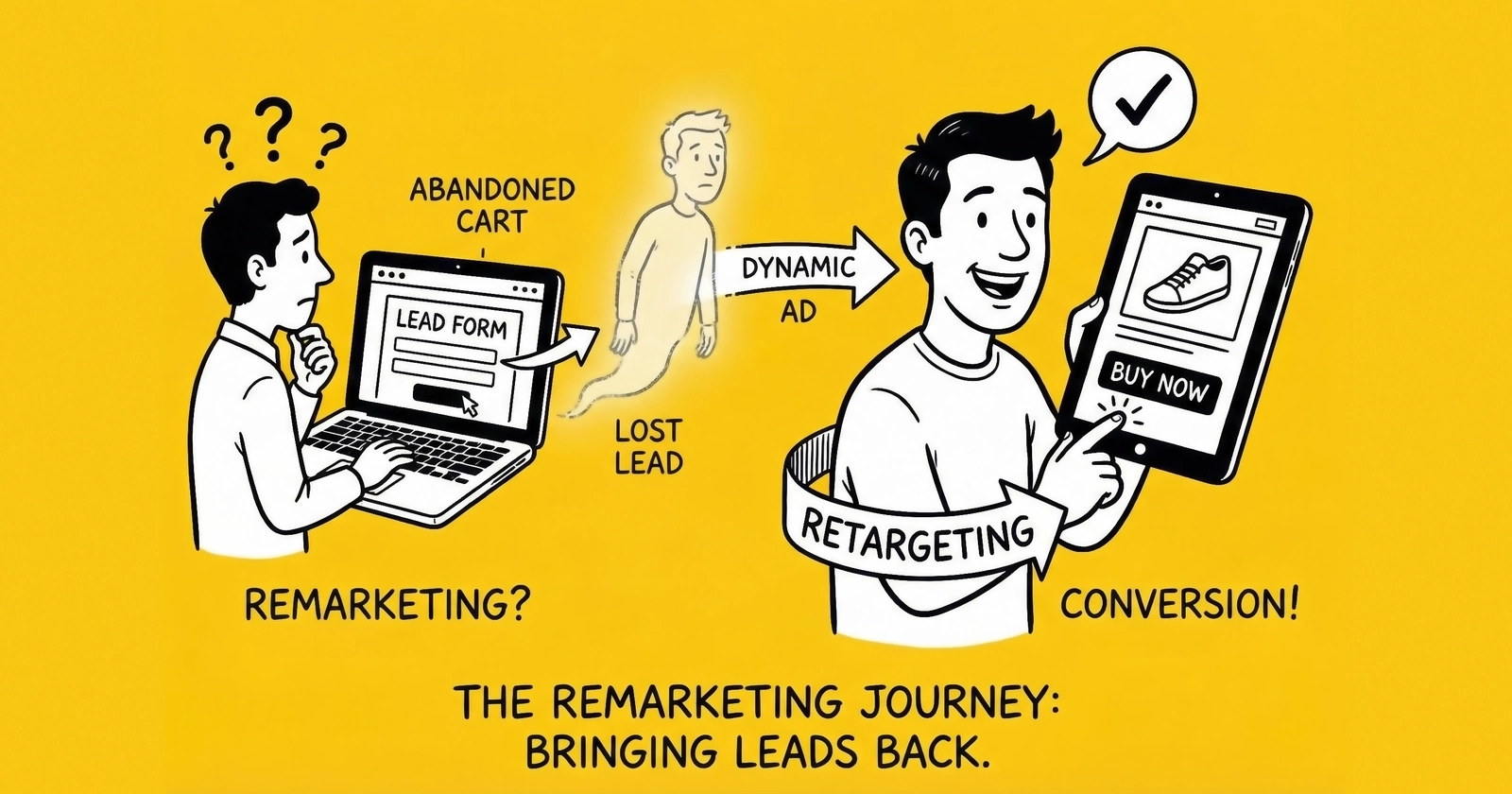
Website visitors who do not convert on their first visit represent the largest addressable audience for most lead generation operations. Remarketing recaptures these prospects, delivering 10x higher click-through rates than standard display advertising. But third-party cookie deprecation and privacy regulations have disrupted traditional retargeting, requiring new strategies built on first-party data and privacy-compliant approaches.
The Remarketing Opportunity in Lead Generation
Most website visitors leave without converting. Industry benchmarks show average landing page conversion rates of 2-5%, meaning 95-98% of visitors depart without taking desired actions. For lead generation operations investing significantly in traffic acquisition, this unconverted majority represents both the largest loss and the largest opportunity.
The mathematics of this opportunity deserve attention. An organization spending $50,000 monthly on traffic acquisition that achieves a 3% conversion rate generates 1,500 leads from 50,000 visitors. The 48,500 non-converting visitors represent invested capital producing no return. Even modest remarketing effectiveness – converting an additional 1% of these visitors – would generate 485 additional leads from audience already acquired. The incremental cost of those leads, coming from remarketing rather than new traffic acquisition, typically runs 30-50% lower than original acquisition costs.
This economic foundation explains why remarketing has become central to sophisticated lead generation operations. The strategy does not replace traffic acquisition but rather extracts additional value from acquisition investments already made. Organizations that master remarketing effectively reduce their customer acquisition costs by treating the conversion funnel as a recoverable resource rather than a one-chance opportunity.
Remarketing – also called retargeting – addresses this opportunity by maintaining visibility with visitors after they leave, serving targeted ads that remind them of their initial interest and encourage return and conversion. The technique has delivered exceptional results since its widespread adoption in the early 2010s. Criteo research indicates remarketed visitors are 70% more likely to convert than first-time visitors. Google reports that remarketing click-through rates average 10x higher than standard display advertising.
The economics favor remarketing significantly. These prospects have already demonstrated interest by visiting. They understand the offering at some level. The awareness and consideration phases of their journey have at least begun. Remarketing does not build awareness from scratch – it reactivates existing awareness, a fundamentally more efficient task.
For lead generation specifically, remarketing serves distinct purposes at different funnel stages. Top-of-funnel remarketing keeps brand visible during research phases that may span weeks or months. Mid-funnel remarketing addresses specific objections or questions that prevented initial conversion. Bottom-funnel remarketing delivers urgency and incentives to prospects who reached form pages but did not submit.
However, the remarketing landscape has changed dramatically. Third-party cookie deprecation, privacy regulations, and browser tracking prevention have disrupted the technical infrastructure that traditional remarketing relied upon. Apple’s Safari and Mozilla’s Firefox have blocked third-party cookies for years. Google Chrome, representing 65% of browser market share according to StatCounter, began phasing out third-party cookies in early 2024.
This analysis examines remarketing strategies for lead generation that work in the current privacy-constrained environment, with particular focus on first-party data approaches, contextual targeting alternatives, and privacy-compliant technical implementations that maintain remarketing effectiveness while respecting evolving privacy norms.
Understanding the Privacy-First Landscape
The End of Third-Party Cookie Tracking
Third-party cookies enabled the remarketing ecosystem for over a decade. When visitors landed on websites, advertising platforms placed cookies that tracked their subsequent browsing, enabling ads to follow them across the internet. This tracking operated largely without visitor awareness or explicit consent. For a comprehensive analysis of how these changes affect lead generation strategy, see our guide on third-party cookie deprecation impact on lead generation.
The technical mechanics are straightforward. A visitor arrives at a lead generation landing page. The page loads tracking pixels from advertising platforms like Google, Facebook, and others. These pixels place cookies identifying the visitor’s browser. When the visitor later browses partner sites in these ad networks, the cookies enable recognition and targeted ad delivery.
This system faced mounting challenges on multiple fronts. Privacy regulations including GDPR in Europe and CCPA in California required disclosure and consent for tracking. Browser vendors implemented tracking prevention features. Consumer awareness of tracking increased, generating backlash. Apple’s App Tracking Transparency reduced mobile tracking dramatically.
The cumulative impact has been severe. Meta reported advertising revenue declines tied to Apple’s iOS 14.5 changes. Remarketing audiences shrank as cookies were blocked or users opted out. Match rates between platforms and websites declined.
Google’s timeline for Chrome cookie deprecation has extended several times, with full deprecation expected to complete by late 2024 or 2025. Regardless of exact timing, the direction is clear – third-party cookies as a tracking mechanism are ending, and strategies dependent on them are increasingly unreliable.
Privacy Regulation Impact on Remarketing
Privacy regulations create compliance requirements that affect remarketing implementation.
GDPR Requirements
The General Data Protection Regulation governs remarketing for European visitors and any organization targeting EU residents. Key requirements include:
- Explicit consent before tracking
- Clear disclosure of tracking purposes
- Data subject access and deletion rights
- Legal basis requirements for data processing
For remarketing, GDPR means cookie consent banners that actually obtain meaningful consent before tracking initiates, not just notification. Consent must be specific, informed, and freely given. Pre-checked consent boxes do not satisfy requirements.
CCPA and State Privacy Laws
California Consumer Privacy Act and similar state laws require disclosure of data collection practices, opt-out mechanisms for sale of personal information, and response to consumer deletion requests.
The “sale” definition under CCPA has been interpreted broadly, potentially covering data sharing with advertising platforms for remarketing. Organizations must provide clear opt-out mechanisms and honor consumer preferences.
ePrivacy Directive and Cookie Law
European ePrivacy Directive specifically governs cookie usage, requiring consent before non-essential cookies. Remarketing cookies are considered non-essential, requiring affirmative consent before placement.
Compliant Remarketing in the Current Environment
Operating compliant remarketing requires balancing effectiveness with legal and ethical obligations.
Consent Management Fundamentals
Consent management platforms (CMPs) enable compliant cookie usage by:
- Presenting clear consent choices before tracking initiates
- Recording consent decisions for documentation
- Blocking tracking scripts until consent is obtained
- Respecting user preferences across sessions
Leading CMPs include OneTrust, Cookiebot, Quantcast Choice, and TrustArc. These platforms integrate with advertising pixels to prevent unauthorized tracking and maintain consent records for compliance documentation.
Privacy-Respecting Implementation
Beyond legal compliance, privacy-respecting remarketing considers user experience and expectation. Frequency capping prevents ad fatigue and perception of surveillance. Ad content acknowledges the remarketing context appropriately. Easy opt-out mechanisms honor user preferences. Data retention limits prevent indefinite tracking.
Organizations pursuing privacy-respecting approaches often find that thoughtful implementation improves remarketing performance by reducing negative associations and focusing resources on genuinely interested prospects.
First-Party Data Remarketing Strategies
The First-Party Data Advantage
First-party data – information collected directly from prospects through owned channels – provides the foundation for privacy-compliant remarketing. Unlike third-party cookies, first-party data comes with inherent consent through the direct relationship.
First-party data for remarketing includes email addresses from form submissions and newsletter signups, phone numbers from contact forms and inquiries, authenticated user data from logins and accounts, and behavioral data from website activity with consent.
The strategic value of first-party data extends beyond privacy compliance. This data is higher quality, more accurate, and proprietary to the organization. Competitors cannot purchase it. Platform changes cannot eliminate it. The investment in first-party data collection compounds over time as data assets grow.
For lead generation, first-party data remarketing requires building data collection into the conversion funnel rather than relying on passive tracking. Micro-conversions that capture contact information enable remarketing to non-converted prospects. Progressive profiling adds data points over multiple interactions.
Email-Based Remarketing
Email addresses provide the most durable identifier for cross-platform remarketing. All major advertising platforms accept hashed email uploads for audience matching.
Customer Match and Custom Audiences
Google Customer Match, Meta Custom Audiences, LinkedIn Matched Audiences, and similar features match uploaded email lists against platform user databases. Matched users can receive targeted advertising within these platforms.
Match rates vary by platform and list quality. Google typically matches 30-50% of B2C email lists and 20-40% of B2B lists. Meta matches 50-70% for B2C and 30-50% for B2B. LinkedIn matches 40-60% for professional emails.
The process involves exporting email lists from CRM or lead management systems, hashing emails using SHA-256 (most platforms accept pre-hashed data), uploading to advertising platforms, and allowing 24-48 hours for matching and audience building.
Email Remarketing Audience Strategies
Different email segments warrant different remarketing approaches.
| Audience Segment | Remarketing Goal | Recommended Approach |
|---|---|---|
| Form abandoners | Complete submission | Urgency, incentive, objection addressing |
| Content downloaders | Move to conversion | Case studies, consultation offers |
| Newsletter subscribers | Build consideration | Educational content, social proof |
| Past inquiries (unconverted) | Re-engage | New offers, updated capabilities |
| Lapsed customers | Win back | Special offers, new features |
Email Collection for Remarketing
Building remarketing-capable email lists requires intentional data collection strategy. Content offers such as guides, tools, and research exchange value for email capture. Newsletter subscriptions build lists of engaged prospects. Exit intent offers capture departing visitors. Chat and chatbot conversations collect emails during engagement.
The key is capturing emails from visitors who have not yet converted on primary goals. These partially-converted visitors represent the remarketing audience – interested enough to exchange email for value, not yet ready for primary conversion.
Phone Number Remarketing
Phone numbers provide alternative matching identifier for platforms supporting this data type.
SMS Remarketing Considerations
Direct SMS remarketing requires TCPA consent separate from advertising consent. However, phone numbers can be used for platform audience matching similar to email, enabling advertising without SMS messaging.
Platform support varies. Meta and Google accept phone numbers for custom audience creation. Match rates are typically lower than email – 20-40% for most lists.
Call Tracking for Remarketing Integration
Call tracking platforms like CallRail and CallTrackingMetrics can capture caller identity and integrate with advertising platforms. This enables remarketing to callers who did not convert.
The workflow captures caller phone number and call recording, determines call outcome through conversation intelligence, syncs unconverted caller data to advertising platforms, and delivers remarketing ads encouraging callback or form submission.
Server-Side Tracking for First-Party Data
Server-side tracking maintains first-party data collection despite browser restrictions by moving tracking from client browsers to server infrastructure.
How Server-Side Tracking Works
Traditional tracking relies on JavaScript tags executing in visitor browsers, subject to browser privacy features, ad blockers, and script failures. Server-side tracking routes data through organization-controlled servers.
The flow proceeds from visitor interaction through first-party cookie or identifier creation on the server to server sending data to advertising platforms via API. Browser restrictions do not block server-to-server communication.
Server-Side Implementation Options
Google Tag Manager Server-Side provides Google-hosted server container processing tags server-side. Facebook Conversions API sends conversion data directly to Meta without browser pixels. Self-hosted solutions using tools like Segment, Rudderstack, or custom implementations provide maximum control.
Implementation complexity varies. Google Tag Manager Server-Side requires moderate technical capability. Self-hosted solutions require significant development resources. The investment yields more reliable data collection in privacy-restricted environments.
Benefits for Remarketing
Server-side tracking provides several remarketing advantages. Improved data capture continues working when browser tracking fails. Better attribution accuracy reduces gaps from blocked pixels. Enhanced compliance controls what data reaches third parties. Future-proofing reduces dependence on browser-side mechanisms.
Organizations investing in server-side infrastructure report 15-30% improvement in attributed conversions according to Meta case studies, directly translating to larger and more accurate remarketing audiences.
Platform-Specific Remarketing Strategies
Google Ads Remarketing in the Privacy Era
Google Ads remarketing operates across Search, Display, YouTube, and Discovery inventory. Privacy changes have prompted Google to develop alternative targeting approaches.
Current Google Remarketing Options
Standard remarketing using Google Ads tag and cookies continues functioning where cookies are available. Customer Match using first-party data as described above operates independently of cookies. Similar Audiences were deprecated in 2023, replaced by audience expansion features. Enhanced Conversions improve attribution by sending hashed first-party data alongside conversion signals.
Performance Max and Automated Audiences
Google’s Performance Max campaigns use machine learning to find audiences across all Google properties. While not traditional remarketing, Performance Max incorporates remarketing signals into automated optimization.
For lead generation, Performance Max requires careful goal configuration to optimize toward qualified leads rather than raw form submissions. Conversion value assignment helps the algorithm prioritize higher-quality prospects.
Google Privacy Sandbox Alternatives
Google is developing Privacy Sandbox technologies to enable some targeting functionality without individual tracking. Topics API infers interests from browsing history without identifying individuals. Protected Audiences enables some remarketing functionality without cross-site tracking.
These technologies are still evolving, with adoption uncertain. Organizations should monitor development while not depending on specific implementations.
Meta Remarketing (Facebook and Instagram)
Meta’s advertising platforms offer sophisticated remarketing despite significant impact from Apple’s iOS privacy changes.
Meta Pixel and Conversions API
The Meta Pixel continues enabling website remarketing where tracking functions. Conversions API provides server-side data transmission, improving match rates and attribution. For a detailed implementation guide, see our Facebook CAPI lead generation implementation walkthrough.
Best practice implements both – pixel for immediate browser-side data, Conversions API for redundant server-side transmission. Meta deduplicates events to prevent double-counting.
Custom Audiences and Lookalike Audiences
Custom Audiences built from customer lists, website visitors, and app users form remarketing foundation. Lookalike Audiences extend reach to users similar to existing audiences.
iOS 14.5 changes reduced audience sizes and targeting precision. Workarounds include:
- Larger seed audiences for lookalikes with minimum 1,000+ sources
- Broader geographic and demographic targeting
- First-party data emphasis through Customer Match approaches
Advantage+ Audience Targeting
Meta’s Advantage+ features use AI to optimize targeting automatically, incorporating remarketing signals without explicit audience configuration. These features can supplement traditional remarketing approaches.
LinkedIn Remarketing for B2B
LinkedIn’s professional data makes it particularly valuable for B2B lead generation remarketing.
LinkedIn Insight Tag
LinkedIn Insight Tag enables website remarketing similar to other platforms. First-party cookie usage provides some resilience to third-party cookie changes.
Company and Contact Targeting
LinkedIn’s unique capability is account-based targeting. Upload target company lists to reach decision-makers at specific organizations. Combine with website remarketing for account-based remarketing strategies.
Matched Audiences
LinkedIn Matched Audiences include website retargeting, contact targeting using email uploads, and account targeting using company lists. Match rates for professional email addresses often exceed consumer platforms.
Conversation Ads
LinkedIn Conversation Ads deliver message-based engagement with interactive elements. For remarketing, these enable personalized outreach to previously engaged prospects with consultative positioning.
Cross-Platform Remarketing Coordination
Prospects interact across multiple platforms, requiring coordinated remarketing strategy.
Unified Audience Strategy
Maintain consistent audience definitions across platforms. Website visitors segment similarly on Google, Meta, and LinkedIn. First-party data syncs to all platforms. This ensures consistent messaging and prevents conflicting experiences.
Frequency Management Across Platforms
Prospects seeing remarketing ads on Google, Facebook, Instagram, and LinkedIn simultaneously may experience overwhelming exposure. While perfect cross-platform frequency capping is technically challenging, strategies include staggered campaign timing, different creative approaches by platform, and overall spend management to limit total exposure.
Attribution Across Platforms
Cross-platform remarketing complicates attribution. A prospect might see Google display ads, click Facebook ads, and convert through LinkedIn. Multi-touch attribution or platform-specific tracking with acknowledgment of limitations helps understand cross-platform contribution.
Contextual Targeting as Remarketing Alternative
The Contextual Targeting Renaissance
Contextual targeting – placing ads based on page content rather than user tracking – has experienced renewed interest as cookie-based targeting declines. While not remarketing in the traditional sense, contextual targeting can capture similar audiences without individual tracking.
The logic is straightforward. Prospects researching a topic visit pages about that topic. Advertising on those pages reaches in-market audiences. A prospect researching insurance quotes who later reads insurance-related content remains reachable through contextual placement on those content pages.
Research from IAS indicates contextual targeting can achieve performance comparable to behavioral targeting for many use cases. GumGum research suggests contextual ads generate 43% higher neural engagement than non-contextual placements.
Modern Contextual Targeting Capabilities
Contextual targeting has evolved beyond simple keyword matching to sophisticated content analysis.
Content Category Targeting
Platforms offer category hierarchies for contextual placement. Google Display Network includes thousands of content categories. Programmatic platforms offer similar granularity. Categories can be combined with exclusions for precise contextual targeting.
For lead generation, category selection should match prospect research behavior. Insurance lead generators target finance and insurance content. Home improvement leads target home and garden content. B2B targeting emphasizes business and industry publications.
Semantic and AI-Powered Contextual
Advanced contextual targeting uses natural language processing to understand page meaning beyond keywords. Semantic analysis captures topical relevance, sentiment, and context that keyword matching misses.
Providers like GumGum, Oracle Contextual Intelligence, and Proximic offer AI-powered contextual targeting with claimed improvements over basic category targeting.
Custom Contextual Segments
Some platforms allow custom contextual segment creation using keyword lists, URL patterns, or content analysis criteria. Custom segments enable targeting of specific topics or content characteristics not captured in standard categories.
Contextual Strategy for Lead Generation
Effective contextual targeting for lead generation requires understanding prospect research behavior and content consumption patterns.
Mapping the Research Journey
Identify content categories prospects visit during research phases. For B2B software, this might include technology publications, industry blogs, review sites, and comparison content. For consumer services, research might span educational content, review sites, and local information.
Content mapping informs contextual targeting strategy, ensuring ads appear where prospects conduct research.
Complementing Remarketing with Contextual
Contextual targeting can extend remarketing reach. Remarketing reaches known visitors who accept cookies. Contextual reaches similar prospects who blocked tracking or visited competitor sites.
Budget allocation between remarketing and contextual depends on remarketing audience size and cookie acceptance rates. As remarketing audiences shrink due to privacy restrictions, contextual allocation may increase.
| Targeting Approach | Audience Type | Privacy Compliance | Relative Cost | Best Use Case |
|---|---|---|---|---|
| First-party remarketing | Known visitors | High | Low-Medium | Core remarketing |
| Third-party remarketing | Cookie-accepting visitors | Medium | Low | Supplemental reach |
| Custom audience match | Email/phone provided | High | Medium | CRM retargeting |
| Contextual targeting | Topic-interested users | High | Medium-High | Privacy-compliant reach |
| Lookalike/similar | Modeled audiences | Medium-High | Medium | Prospecting expansion |
For prospects who engage with remarketing but need additional nurturing, email drip campaigns provide a complementary channel for sustained engagement.
Advanced Remarketing Techniques
Dynamic Remarketing for Lead Generation
Dynamic remarketing automatically customizes ad creative based on visitor behavior, typically showing specific products visitors viewed. For lead generation without traditional products, dynamic approaches require adaptation.
Service-Based Dynamic Remarketing
Lead generation operations can implement dynamic remarketing showing specific services or offers visitors expressed interest in. A visitor viewing auto insurance content receives auto-focused remarketing. A visitor viewing life insurance receives life-focused creative.
Implementation requires product feed equivalent listing service categories, website tagging capturing category interest signals, and dynamic creative templates pulling from feed based on visitor behavior.
Form Field Dynamic Remarketing
For partially completed forms, dynamic remarketing can reference captured data. A visitor who entered zip code but did not complete receives localized messaging. A visitor who indicated specific needs receives relevant content.
This approach requires careful privacy consideration – using captured data in remarketing must align with disclosed purposes and consent.
Sequential Remarketing Campaigns
Sequential remarketing delivers different messages based on remarketing journey stage, moving prospects through consideration rather than repeating the same message.
Sequence Design for Lead Generation
A typical sequence might proceed through stages. Stage one in days one through three delivers educational content building awareness and credibility. Stage two in days four through seven delivers social proof including testimonials and case studies. Stage three in days eight through fourteen delivers incentive or urgency with limited offers and consultation booking.
Each stage addresses different prospect states. Early stages assume low commitment and focus on value delivery. Later stages assume increased interest and introduce conversion pressure.
Implementation Approaches
Platform-native sequential remarketing is limited. Workarounds include separate campaigns with different audience exclusions, using email integration to trigger campaign stage changes, and manual campaign management adjusting delivery over time.
Sophisticated implementation requires marketing automation platforms integrating with advertising platforms, enabling email behavior to trigger remarketing campaign changes. Our marketing automation guide covers platform selection and integration approaches.
Predictive Remarketing with Machine Learning
Machine learning can optimize remarketing by predicting which visitors are most likely to convert and prioritizing remarketing spend accordingly.
Predictive Scoring for Remarketing
ML models analyze visitor behavior patterns to predict conversion probability. High-probability visitors receive higher bid multipliers or priority in audience targeting. Low-probability visitors receive reduced investment or exclusion.
Scoring factors might include pages visited, time on site, scroll depth, device type, traffic source, and demographic signals.
Implementation Requirements
Predictive remarketing requires sufficient conversion volume for model training – typically 1,000+ conversions minimum. Data infrastructure must capture relevant behavioral signals. Integration between prediction scores and advertising platforms enables bid adjustment.
Platforms like Google Ads offer some predictive optimization natively through automated bidding. Custom ML approaches provide more control but require significant technical investment.
Cross-Device Remarketing
Prospects use multiple devices throughout their journey. Cross-device remarketing maintains continuity across devices.
Deterministic Cross-Device
When prospects authenticate or provide identifiers on multiple devices, deterministic matching connects those devices. Email login on desktop and mobile enables connected remarketing.
First-party data strategies naturally support cross-device through authentication. The email address used on mobile matches the desktop visitor, enabling unified remarketing.
Probabilistic Cross-Device
Without explicit authentication, probabilistic methods infer device connections through shared IP addresses, behavioral patterns, and other signals. Accuracy varies, and privacy regulations increasingly restrict probabilistic approaches.
Platform capabilities differ. Google’s cross-device remarketing relies heavily on Google account authentication. Meta uses Facebook login signals. Logged-out cross-device matching has become less reliable.
Remarketing Creative and Messaging
Creative Principles for Remarketing Success
Remarketing creative differs from prospecting creative in important ways. Prospects have already encountered the brand – creative should acknowledge this context and provide reasons to return.
Progression, Not Repetition
Remarketing creative should advance the conversation, not repeat it. Showing the same ad repeatedly produces diminishing returns and negative associations. Sequential creative with different messages maintains engagement.
Addressing Abandonment Reasons
Understanding why visitors did not convert enables targeted messaging. Common abandonment reasons and creative responses include price concerns addressed with value messaging or offers, trust issues addressed with testimonials and credibility signals, timing concerns addressed with low-commitment next steps, and information needs addressed with educational content offers.
Survey data, session recordings, and form analytics help identify abandonment reasons for specific audiences.
Clear Value Proposition
Remarketing creative must communicate value quickly. Visitors who left once need compelling reasons to return. Generic brand messaging is insufficient. Specific benefits, offers, or value must be immediately apparent.
Creative Formats for Lead Generation Remarketing
Different formats serve different purposes in remarketing sequences.
Static Image Ads
Single images with clear messaging work across platforms. Best practices include strong visual with clear subject, concise headline communicating primary benefit, visible call-to-action, and brand consistency with landing page.
Static images are easy to produce and test, making them foundation of most remarketing programs.
Video Ads
Video enables more detailed messaging and emotional engagement. For remarketing, video can deliver testimonials, demonstrate products or services, or explain benefits in depth.
Video remarketing typically fits mid-funnel sequences when prospects need more information to progress. Production investment should be justified by audience size and value.
Carousel and Collection Formats
Multi-image formats enable showcasing multiple services, features, or proof points. For lead generation, carousels might show different service options, multiple testimonials, or feature highlights.
These formats work well on Meta platforms and Google Discovery. They encourage engagement and exploration.
Testing and Optimization
Remarketing creative requires ongoing testing to maintain performance.
What to Test
Headline variations testing different value propositions, benefit emphasis, and urgency levels. Image variations testing different visual approaches, colors, and subjects. CTA variations testing different action language and button treatment. Offer variations testing different incentives, discounts, and value-adds.
Testing Framework
Maintain 2-3 active variants per audience segment. Allow sufficient impressions for statistical significance – typically 1,000+ impressions per variant minimum. Rotate winners and introduce new challengers continuously.
Performance Benchmarks
Remarketing typically achieves CTR of 0.5-1.5% on display networks, compared to 0.1-0.3% for standard display. Conversion rates should significantly exceed prospecting campaigns given audience quality. Monitor these benchmarks to identify underperformance.
Measuring Remarketing Effectiveness
Attribution Challenges in Remarketing
Remarketing attribution presents unique challenges because remarketing audiences would have potentially converted without remarketing exposure.
Incrementality Question
The fundamental question is whether remarketing causes conversions or merely tags visitors who would have converted anyway. A visitor who saw remarketing ads and converted might have converted regardless. The remarketing ad claimed credit for a conversion it did not cause.
This incrementality problem is inherent to remarketing. Some portion of remarketing-attributed conversions would have occurred without remarketing. The question is what portion, and whether remarketing investment returns value above that baseline.
View-Through Attribution Concerns
Platforms often attribute conversions to ad views even without clicks. A visitor who saw a remarketing ad, did not click, but later converted organically generates view-through attribution credit for remarketing.
View-through windows should be relatively short for remarketing – 1-7 days is typical. Longer windows increasingly credit conversions that remarketing did not influence.
Measuring True Remarketing Impact
Several approaches help isolate genuine remarketing contribution.
Holdout Testing
The gold standard for incrementality measurement is holdout testing. A portion of the remarketing audience is excluded from ad exposure, creating a control group. Comparison of conversion rates between exposed and holdout groups reveals true lift.
Holdout testing requires sufficient audience size for statistical validity, platform capability to create holdout segments, and willingness to sacrifice some remarketing reach for measurement accuracy.
Typical remarketing holdout tests show 10-40% incrementality – meaning remarketing generates that much additional conversion above what would have occurred without it. Some tests show higher lift; others show remarketing primarily accelerates rather than causes conversions.
Lift Studies
Platform-provided lift studies measure incrementality using their methodologies. Google Brand Lift, Meta Conversion Lift, and similar tools provide incrementality measurement without custom holdout management.
These tools offer convenience but less control than custom holdout tests. Results depend on platform methodology, which may favor the platform.
Time-Based Analysis
Comparing conversion rates during remarketing-active periods versus remarketing-paused periods provides directional incrementality signal. This approach lacks the precision of holdout testing but requires less setup.
Confounding factors including seasonality, other marketing changes, and competitive dynamics complicate time-based analysis. Use cautiously as directional input rather than definitive measurement.
Key Remarketing Metrics
Beyond standard advertising metrics, remarketing programs should track specific KPIs.
Remarketing-Specific Metrics
Audience size and composition tracks remarketing pool volume and segmentation. Audience growth rate measures whether remarketing audiences are growing or shrinking. Audience match rates for first-party data track what percentage of uploaded data matches platform users. Frequency metrics measure average exposures per user to identify fatigue. View-through versus click-through ratio indicates engagement quality.
Efficiency Metrics
Remarketing cost per conversion should be significantly lower than prospecting cost per conversion given audience quality. Remarketing ROAS or ROI should exceed prospecting returns. Incrementality-adjusted metrics account for conversions that would have occurred without remarketing.
Business Impact Metrics
Lead quality from remarketing measures whether remarketing-attributed leads convert to customers at expected rates. Time to conversion measures whether remarketing accelerates sales cycles. Lifetime value of remarketing-sourced customers compared to other sources assesses long-term impact.
The RECLAIM Framework: Remarketing Audience Recovery and Optimization
As privacy restrictions reduce traditional remarketing audience sizes, lead generation operations must implement systematic approaches to recover lost reach and maximize the value of remaining addressable audiences. The RECLAIM framework provides a methodology for auditing current remarketing performance, identifying recovery opportunities, and building sustainable audience acquisition systems.
R – Reach Erosion Analysis
Before implementing recovery strategies, operations must quantify how much remarketing capability has been lost and identify the primary causes of erosion.
Reach Erosion Diagnostic Matrix:
| Erosion Source | Typical Impact | Detection Method | Recovery Potential |
|---|---|---|---|
| Safari/Firefox cookie blocking | 20-30% of traffic | Browser analytics segmentation | High (server-side tracking) |
| iOS App Tracking Transparency | 15-25% of mobile | Device type analytics | Medium (first-party focus) |
| Ad blocker usage | 25-35% of tech audiences | Script blocking detection | Low (minimal recovery) |
| Consent opt-outs (GDPR/CCPA) | 30-50% in applicable regions | CMP analytics | Medium (value exchange) |
| Cookie expiration/clearing | 10-20% monthly churn | Repeat visitor analysis | High (re-engagement) |
Audience Size Trend Benchmarks:
Track remarketing audience sizes over time to identify erosion patterns:
| Metric | Healthy Trend | Concern Zone | Action Required |
|---|---|---|---|
| Weekly audience growth | +2-5% | 0% to -2% | Below -2% weekly |
| 30-day audience retention | 70-85% | 50-70% | Below 50% |
| Match rate (email uploads) | 40-60% | 25-40% | Below 25% |
| Cross-device identification | 25-40% | 15-25% | Below 15% |
| New visitor to remarketing pool | 60-80% | 40-60% | Below 40% |
Erosion Impact Calculation:
Estimated annual revenue impact = (Lost audience size × Historical conversion rate × Average order value × 12 months) × Remarketing contribution margin
Example: If cookie blocking removed 25% of a 100,000-person remarketing audience, and that audience historically converted at 2% with $200 average lead value:
Impact = (25,000 × 0.02 × $200 × 12) × 0.15 contribution margin = $180,000 annual revenue at risk
E – Email Capture Acceleration System
Email addresses provide the most durable cross-platform remarketing identifier. Accelerating email capture from non-converting visitors recovers remarketing capability lost to cookie restrictions.
Email Capture Opportunity Benchmarks:
| Capture Method | Typical Conversion Rate | Best Practice Conversion | Implementation Effort |
|---|---|---|---|
| Exit intent popup | 1-3% | 4-6% | Low |
| Embedded content offers | 2-5% | 6-10% | Medium |
| Chat/chatbot interactions | 5-10% | 12-18% | Medium-High |
| Multi-step forms (progressive) | 15-25% | 30-40% | Medium |
| Account creation incentive | 8-15% | 20-30% | High |
| Quiz/calculator tools | 10-20% | 25-35% | High |
Email Capture Optimization Formula:
Email capture rate = (Visitor engagement score × Offer relevance × Friction reduction) × Trust signals
Where:
- Engagement score = Pages viewed × Time on site coefficient
- Offer relevance = Match between content consumed and offer presented
- Friction reduction = 1 - (Form fields × 0.05)
- Trust signals = Privacy assurance + Brand credibility indicators
Progressive Profiling Implementation:
Stage email capture across multiple interactions to maximize both capture rate and data completeness:
| Interaction Stage | Data Captured | Experience Provided | Remarketing Enabled |
|---|---|---|---|
| Stage 1: Initial capture | Email only | Access to basic resource | Email list + Custom Audiences |
| Stage 2: Return visit | Name, phone | Enhanced resource access | Full remarketing + phone match |
| Stage 3: Qualification | Intent signals | Personalized recommendations | Segmented remarketing |
| Stage 4: Conversion | Complete profile | Quote/consultation | Full funnel remarketing |
C – Consent Value Exchange Optimization
Privacy-conscious visitors require compelling value propositions to provide consent for remarketing. The consent exchange must benefit both parties.
Value Exchange Hierarchy:
| Value Tier | What Visitor Receives | Consent Obtained | Remarketing Value |
|---|---|---|---|
| Tier 1: Basic content | Blog access, general information | Necessary cookies only | Minimal |
| Tier 2: Enhanced experience | Personalization, saved preferences | Performance cookies | Limited |
| Tier 3: Premium content | Guides, tools, calculators | Marketing cookies | Standard remarketing |
| Tier 4: Direct value | Discounts, early access, exclusive offers | Full consent + email | Full remarketing + CRM |
Consent Rate Benchmarks by Region and Industry:
| Region/Context | Typical Consent Rate | Optimized Consent Rate | Gap Opportunity |
|---|---|---|---|
| US (CCPA applicable) | 60-75% | 80-90% | 15-20% improvement |
| EU (GDPR applicable) | 35-50% | 55-70% | 15-25% improvement |
| Financial services | 40-55% | 60-75% | 15-20% improvement |
| Healthcare | 30-45% | 50-65% | 15-20% improvement |
| Insurance | 45-60% | 65-80% | 15-20% improvement |
L – Lookalike Audience Development Protocol
As remarketing audiences shrink, lookalike audiences extend reach to similar prospects without direct tracking requirements.
Seed Audience Quality Benchmarks:
| Seed Audience Type | Minimum Size | Optimal Size | Expected Lookalike Quality |
|---|---|---|---|
| Converters (customers) | 1,000 | 5,000+ | Highest |
| High-engagement visitors | 2,500 | 10,000+ | High |
| Email subscribers | 5,000 | 25,000+ | Medium-High |
| All website visitors | 10,000 | 50,000+ | Medium |
| Content consumers | 5,000 | 20,000+ | Medium |
Lookalike Expansion Ladder:
| Lookalike Size | Audience Expansion | Expected Quality | Cost Efficiency |
|---|---|---|---|
| 1% | ~2M users (US) | Highest match | Lowest reach |
| 2-3% | ~4-6M users | High match | Balanced |
| 5% | ~10M users | Medium match | Good reach |
| 10% | ~20M users | Lower match | Maximum reach |
A – Attribution Architecture Refinement
Privacy restrictions require updated attribution approaches that account for reduced visibility while maintaining optimization capability.
Attribution Model Comparison for Privacy Era:
| Model Type | Privacy Impact Resistance | Implementation Complexity | Accuracy Post-Privacy |
|---|---|---|---|
| Last-click | Low (highly affected) | Low | Declining |
| First-click | Low (highly affected) | Low | Declining |
| Linear | Medium | Medium | Moderate |
| Time-decay | Medium | Medium | Moderate |
| Data-driven (platform) | Medium-High | Low | Variable |
| Incrementality testing | High | High | Best available |
| Marketing mix modeling | High | Very High | Good for trends |
Attribution Gap Estimation:
Calculate the “dark funnel” percentage – conversions that cannot be attributed to specific touchpoints:
Dark funnel % = 1 - (Sum of attributed conversions ÷ Total conversions)
| Dark Funnel % | Interpretation | Action Required |
|---|---|---|
| Under 20% | Healthy attribution | Maintenance mode |
| 20-35% | Moderate gaps | Enhanced measurement investment |
| 35-50% | Significant gaps | Attribution overhaul needed |
| Over 50% | Critical blind spots | Fundamental methodology change |
I – Integration Infrastructure Modernization
Server-side tracking and first-party data infrastructure form the foundation for privacy-compliant remarketing at scale.
Server-Side Implementation ROI Benchmarks:
| Metric | Pre-Implementation | Post-Implementation | Expected Improvement |
|---|---|---|---|
| Conversion tracking accuracy | 60-75% | 85-95% | +15-25% |
| Attribution coverage | 50-70% | 75-90% | +15-25% |
| Match rate (email/phone) | 40-55% | 55-75% | +15-25% |
| Remarketing audience size | Baseline | +10-20% | Recovered reach |
Implementation Cost Benchmarks:
| Implementation Scope | Setup Cost | Monthly Operating Cost | Time to Value |
|---|---|---|---|
| Google Tag Manager Server | $2,000-5,000 | $100-500 | 2-4 weeks |
| Meta Conversions API | $3,000-8,000 | $200-800 | 3-6 weeks |
| Full server-side stack | $10,000-30,000 | $500-2,000 | 6-12 weeks |
| Enterprise CDP integration | $50,000-200,000 | $2,000-10,000 | 3-6 months |
M – Multi-Platform Coordination System
Remarketing across platforms requires coordinated strategy to maximize reach while managing frequency and message consistency.
Platform Coverage Matrix:
| Platform | US Adult Reach | Remarketing Capability | Privacy Resistance |
|---|---|---|---|
| Google Display Network | 90%+ | Full | Medium |
| YouTube | 75%+ | Full | Medium |
| Meta (FB/IG) | 70%+ | Reduced (iOS impact) | Lower |
| 25-30% | Good | Higher | |
| TikTok | 35-45% | Growing | Medium |
Cross-Platform Frequency Management:
| Total Weekly Impressions | User Experience | Performance Impact | Recommendation |
|---|---|---|---|
| Under 10 | Under-exposure | Below potential | Increase budget |
| 10-20 | Optimal range | Best performance | Maintain |
| 20-35 | Moderate saturation | Declining efficiency | Monitor closely |
| Over 35 | Over-exposure | Negative brand impact | Reduce immediately |
Budget Allocation Framework by Platform:
| Platform | Recommended Share | Primary Strength | Best For |
|---|---|---|---|
| Google Display/YouTube | 35-45% | Reach, targeting options | Awareness, consideration |
| Meta | 25-35% | Engagement, conversion | Mid-funnel, conversion |
| 10-20% | B2B precision | B2B lead generation | |
| Programmatic | 10-20% | Scale, flexibility | Reach extension |
Building a Privacy-Compliant Remarketing Program
Strategic Framework for Modern Remarketing
Building remarketing programs in the privacy-first era requires strategic planning that anticipates continued privacy restrictions while maximizing current capabilities.
First-Party Foundation
Prioritize first-party data collection and activation. Every email capture, phone number collection, and account creation builds remarketing capability that privacy changes cannot eliminate. Invest in progressive profiling, content offers, and micro-conversions that capture identifiers.
Server-Side Infrastructure
Implement server-side tracking to maintain data collection as browser-side tracking degrades. The investment pays dividends through improved data accuracy, better attribution, and future-proofing against additional privacy restrictions.
Privacy-Compliant Operations
Build consent management into remarketing infrastructure from the start. Compliant operations are sustainable operations. Cutting corners on consent creates regulatory risk and erodes consumer trust.
Platform Diversification
Reliance on single platforms creates vulnerability. Distribute remarketing across Google, Meta, LinkedIn, and programmatic channels. Each platform has different tracking capabilities and privacy posture. Diversification hedges against platform-specific changes.
Implementation Roadmap
A phased approach to building privacy-compliant remarketing manages risk while capturing opportunity.
Phase 1: Foundation (Months 1-2)
Audit current remarketing setup and compliance status. Implement consent management platform if lacking. Establish first-party data collection processes. Deploy server-side tracking infrastructure.
Phase 2: First-Party Activation (Months 2-4)
Build email remarketing audiences across platforms. Implement customer match and custom audiences. Create audience segments based on behavior and engagement. Launch first-party remarketing campaigns.
Phase 3: Advanced Tactics (Months 4-6)
Implement sequential remarketing with staged messaging. Deploy dynamic remarketing for service personalization. Test contextual targeting as remarketing complement. Establish holdout testing for incrementality measurement.
Phase 4: Optimization (Ongoing)
Continuous creative testing and rotation. Audience refinement based on performance data. Platform capability monitoring and adaptation. Attribution model refinement based on incrementality findings.
Organizational Requirements
Effective remarketing programs require organizational capabilities beyond technology.
Cross-Functional Coordination
Remarketing touches multiple functions. Marketing generates traffic and manages campaigns. Sales uses leads and provides quality feedback. Technology implements tracking and data infrastructure. Legal ensures compliance. Finance funds investment and measures returns.
Coordinate across functions through regular reviews, shared metrics, and clear ownership of components.
Data Management Discipline
First-party data remarketing requires clean, organized data. CRM hygiene, duplicate management, and consistent data capture enable effective audience building. Poor data management limits remarketing capability regardless of technology investment.
Creative Resources
Remarketing requires ongoing creative production for testing and sequence updates. Plan creative resources for sustained production rather than one-time campaign launches.
Key Takeaways
-
Third-party cookie deprecation and privacy regulations have disrupted traditional remarketing, but first-party data strategies, server-side tracking, and contextual targeting provide privacy-compliant alternatives that maintain remarketing effectiveness.
-
First-party data is the foundation of sustainable remarketing – email addresses, phone numbers, and authenticated user data enable cross-platform remarketing that privacy changes cannot eliminate, making data collection investment strategically critical.
-
Server-side tracking improves data collection reliability by routing tracking through organization-controlled infrastructure rather than browser-side pixels, with organizations reporting 15-30% improvement in attributed conversions.
-
Email-based remarketing through Customer Match and Custom Audiences achieves 20-70% match rates depending on platform and list quality, providing durable remarketing capability independent of cookie availability.
-
Contextual targeting complements remarketing by reaching in-market audiences through content placement rather than individual tracking, with research suggesting performance comparable to behavioral targeting for many use cases.
-
Sequential remarketing with staged messaging moves prospects through consideration more effectively than repeated identical ads, with typical sequences progressing from education to social proof to conversion incentives.
-
Remarketing incrementality should be measured through holdout testing to understand true lift above conversions that would have occurred anyway, with typical tests showing 10-40% incremental contribution.
-
Platform diversification reduces vulnerability to individual platform changes, with remarketing distributed across Google, Meta, LinkedIn, and programmatic channels hedging against platform-specific privacy restrictions.
-
Creative should acknowledge the remarketing context rather than repeating prospecting messages, addressing specific abandonment reasons and providing compelling reasons to return and convert.
-
Compliance is foundational, not optional – consent management platforms, privacy-respecting implementation, and legal review protect against regulatory risk while building sustainable remarketing capability.
Frequently Asked Questions
What is the difference between remarketing and retargeting?
The terms remarketing and retargeting are often used interchangeably, though subtle distinctions exist in some contexts. Generally, retargeting refers to serving ads to website visitors who did not convert, typically through display advertising networks. Remarketing sometimes refers more specifically to re-engaging existing customers or leads through email and other owned channels. Google uses “remarketing” as their product terminology, while the industry generally uses “retargeting” for the same concept. For practical purposes, both terms describe the strategy of maintaining advertising visibility with people who have previously interacted with a brand, whether through website visits, email engagement, or other touchpoints. The strategic principles and implementation approaches are essentially identical regardless of terminology used.
How does remarketing work without third-party cookies?
Remarketing without third-party cookies relies on alternative identification methods. First-party data provides the primary alternative – email addresses, phone numbers, and authenticated user identifiers enable remarketing through platform Custom Audiences without cookies. Server-side tracking captures conversion data through direct server communication rather than browser cookies. Contextual targeting places ads based on page content rather than user tracking, reaching similar audiences without individual identification. First-party cookies remain functional for recognizing returning visitors within a single website domain. Platform-specific login data such as Google accounts and Facebook logins enable cross-site remarketing for authenticated users. While third-party cookie deprecation reduces some remarketing capabilities, organizations with strong first-party data strategies maintain effective remarketing programs.
What are the best platforms for remarketing in lead generation?
Platform selection depends on target audience and campaign objectives. Google Ads provides broad reach across Search, Display, YouTube, and Discovery inventory, making it essential for most programs. Meta platforms including Facebook and Instagram offer sophisticated targeting and large audiences, particularly strong for B2C. LinkedIn provides unique professional targeting for B2B lead generation, enabling job title, company, and industry targeting unavailable elsewhere. Programmatic platforms like The Trade Desk and Amazon DSP offer cross-site reach through multiple publishers. For most lead generation operations, Google and Meta form the core remarketing program, with LinkedIn essential for B2B targeting and programmatic adding reach. Platform selection should also consider where first-party data match rates are highest for your audience.
How do I build remarketing audiences with privacy compliance?
Privacy-compliant remarketing audience building starts with proper consent management. Implement a consent management platform that obtains explicit consent before tracking and allows users to manage preferences. For first-party data remarketing, collect emails and phone numbers through legitimate opt-in mechanisms with clear disclosure of marketing use. Use platform Customer Match features with properly consented data rather than purchased lists. Implement server-side tracking that gives you control over data transmission. Respect opt-out requests and data deletion requests promptly. Provide clear privacy policies explaining remarketing practices. Work with legal counsel to ensure compliance with applicable regulations including GDPR, CCPA, and ePrivacy requirements for your geographic scope. Compliant practices build sustainable remarketing capability while avoiding regulatory risk.
What remarketing frequency is optimal for lead generation?
Optimal remarketing frequency balances visibility with ad fatigue. Research suggests diminishing returns above 15-20 impressions per user per month, with negative brand impact possible at higher frequencies. For lead generation, recommended starting frequency caps are 3-5 impressions daily and 15-25 impressions weekly. Adjust based on performance data – if click-through rates decline sharply after specific impression counts, reduce frequency. Higher-value leads may tolerate slightly higher frequency given consideration depth. Sequential remarketing with varied creative can sustain engagement at higher frequencies than repeated identical ads. Monitor frequency reports in advertising platforms and correlate with conversion rates to identify optimal levels for your specific audience. When in doubt, err toward lower frequency to avoid negative associations.
How long should remarketing windows be?
Remarketing window length should align with typical purchase consideration timelines for your offering. Simple consumer lead generation such as quote requests might use 7-30 day windows, as interest fades quickly without action. Complex B2B purchases with extended sales cycles might justify 90-180 day windows. Standard starting points are 30 days for general remarketing, 7-14 days for bottom-funnel form abandonment, and 60-90 days for B2B consideration. Create separate audiences for different window lengths to apply different strategies – aggressive remarketing for recent visitors, lighter touch for older audiences. View-through attribution windows should be shorter than click-through windows, typically 1-7 days to avoid overclaiming credit for conversions remarketing did not influence.
How do I measure if remarketing is actually working?
Measuring remarketing effectiveness requires understanding incrementality – whether remarketing causes conversions or just claims credit for conversions that would have happened anyway. The gold standard is holdout testing, where a portion of the remarketing audience is excluded from ads and conversion rates are compared. Typical incrementality ranges from 10-40%. Platform lift studies provide automated incrementality measurement. Time-based analysis comparing conversion rates during remarketing-on versus remarketing-off periods offers directional insight. Beyond incrementality, track remarketing-specific metrics including audience size trends, frequency distribution, view-through versus click-through ratio, and cost efficiency compared to prospecting. Compare lead quality from remarketing against other sources to ensure remarketing attracts genuine prospects rather than just easy attributions.
What should remarketing ads say differently than prospecting ads?
Remarketing ads should acknowledge the prospect’s existing familiarity and provide specific reasons to return. Prospecting ads introduce the brand and create awareness – remarketing ads can skip introduction and focus on conversion motivation. Address likely objections that prevented initial conversion such as price, trust, or timing concerns. Include social proof like testimonials and customer counts to build credibility. Offer incentives or urgency for prospects needing final motivation. Use sequential messaging that progresses through educational content, social proof, and conversion offers rather than repeating identical messages. Reference the previous interaction when appropriate, such as “Still comparing insurance rates?” Remarketing creative should advance the conversation rather than restart it, respecting that the prospect already knows who you are.
How does iOS 14.5 and App Tracking Transparency affect remarketing?
Apple’s App Tracking Transparency (ATT) introduced in iOS 14.5 requires apps to request permission before tracking users across apps and websites. Opt-in rates have been approximately 25-35%, meaning most iOS users cannot be tracked using traditional methods. Impact on remarketing includes significantly reduced iOS remarketing audiences on affected platforms, decreased match rates for Custom Audiences, and reduced signal quality affecting optimization algorithms. Mitigation strategies include emphasis on first-party data collection reducing dependence on pixel tracking, server-side implementations through Meta Conversions API improving data capture, aggregated event measurement using platform solutions like Meta’s Aggregated Event Measurement, and accepting some iOS targeting limitation while focusing resources on Android and desktop where tracking remains more functional. ATT impact varies by audience iOS composition – B2B audiences with more desktop usage are less affected than mobile-heavy B2C audiences.
Can I do remarketing with a small budget?
Remarketing is often more efficient for small budgets than prospecting because of higher conversion rates and more precise targeting. Starting remarketing programs work with budgets of $500-1,500 monthly for single platforms. Prioritize platforms where your audience is most concentrated – Google for broad reach, LinkedIn for B2B professionals, Meta for consumer audiences. Focus on high-intent audiences such as form abandoners and bottom-funnel page visitors rather than all website visitors. Use aggressive frequency caps to maximize reach within budget. Implement email remarketing through Customer Match which improves efficiency at any budget level. Start with single platform proficiency before expanding. Small budgets require careful measurement – ensure conversion tracking is accurate so optimization signals are reliable. As results prove out, expand budget and platform coverage incrementally.
How do I coordinate remarketing across multiple platforms?
Cross-platform remarketing coordination prevents overwhelming prospects while ensuring consistent messaging. Maintain unified audience definitions across platforms – website visitor segments should match, first-party data should sync to all platforms. Use different creative approaches by platform to provide varied experience rather than identical ads everywhere. Stagger campaign timing so platforms are not all serving at peak simultaneously. Monitor aggregate frequency where possible, though perfect cross-platform frequency management is technically challenging. Maintain consistent offers and messaging themes while adapting format to platform norms. Use attribution carefully – the same conversion may be claimed by multiple platforms, so avoid simply summing platform-reported conversions. Consider incrementality testing by platform to understand each platform’s unique contribution. Regular cross-platform performance reviews identify optimization opportunities across the remarketing program.
The evolution from third-party cookie dependence to first-party data strategies represents a fundamental shift in how remarketing operates, but the underlying value proposition remains unchanged. Visitors who expressed interest but did not convert remain the highest-value audience available for continued engagement. The mechanisms for reaching them have changed; the strategic imperative has not.
Organizations that invested early in first-party data infrastructure now find themselves advantaged as competitors scramble to adapt to privacy restrictions they did not anticipate. The lesson for lead generation operations is clear: building remarketing capability on owned data assets rather than borrowed tracking infrastructure creates durability that platform-dependent approaches cannot match.
Remarketing in the privacy-first era requires new strategies built on first-party data, server-side infrastructure, and compliant practices. Organizations that adapt to these changes maintain remarketing effectiveness while building sustainable competitive advantage. Those clinging to deprecated approaches face declining audience reach and increasing compliance risk. The transition demands investment, but the alternative – loss of remarketing capability entirely – makes that investment strategically essential.