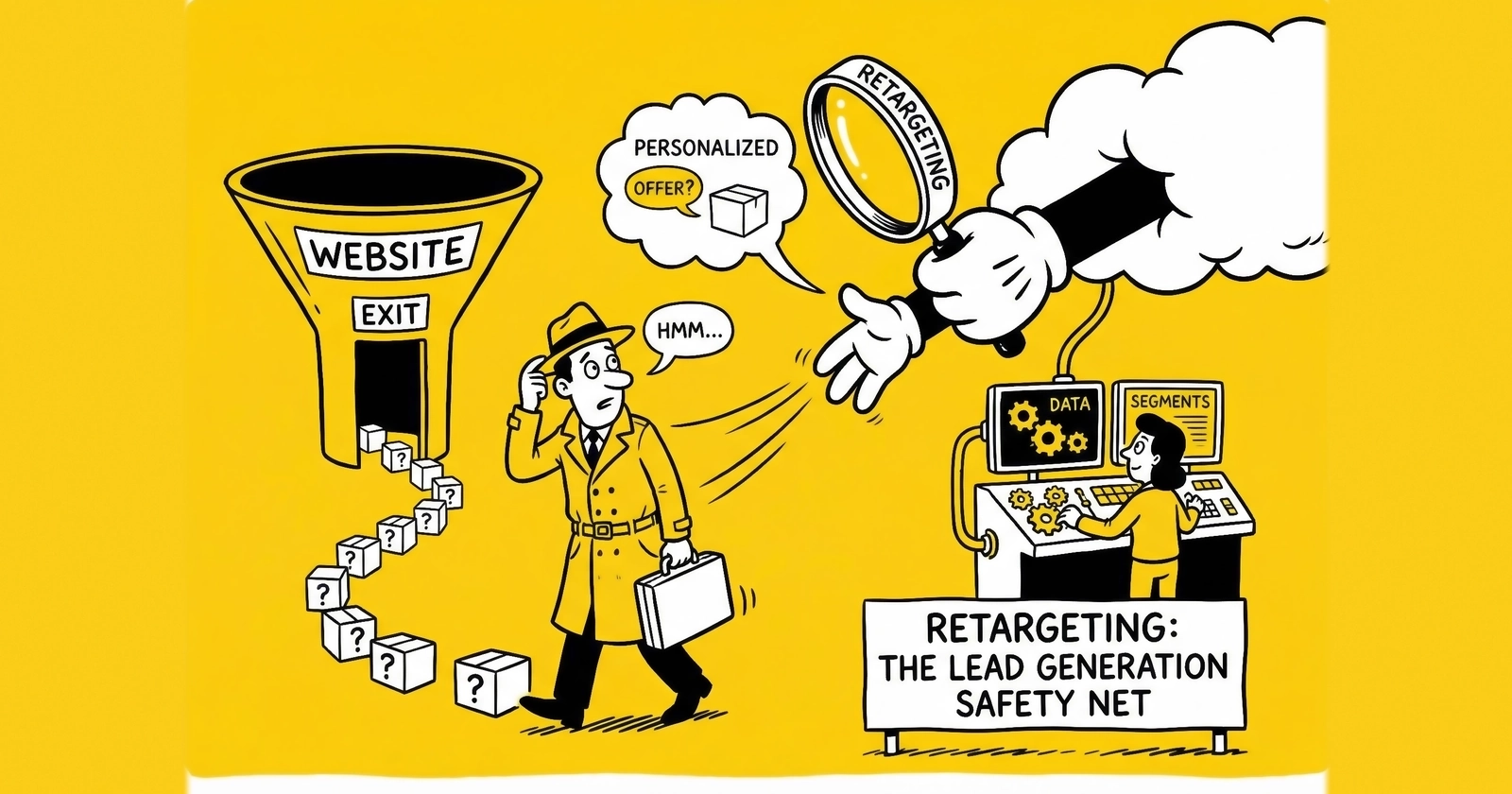
Recover the 96% of visitors who leave without converting by implementing sophisticated retargeting campaigns that bring qualified prospects back to your lead forms.
The average lead generation landing page converts at 2-4%. Run the numbers: for every 100 visitors you paid to acquire, 96-98 leave without filling out your form. Those visitors cost you money. They demonstrated intent by clicking your ad. And they walked away.
That is not a leak in your funnel. That is a hemorrhage.
Retargeting exists to stop the bleeding. It transforms those 96 abandoned visitors from sunk costs into future conversions. The technology has matured, the tactics have evolved, and the privacy landscape has shifted fundamentally since 2020. What worked in 2019 no longer applies. What works in 2026 requires a different approach.
This guide covers exactly how to build retargeting campaigns that recover lost visitors, increase form submissions, and improve your cost per acquired lead without increasing traffic spend.
How Retargeting Works in 2026
Retargeting places your ads in front of people who have already visited your website or interacted with your content. The visitor lands on your site, a tracking mechanism records their visit, and you show them ads as they browse other websites, scroll social media, or watch videos.
The tracking mechanisms fall into three categories in 2026:
Browser-Based Pixel Tracking
The original retargeting method. A JavaScript pixel fires when someone visits your page, dropping a cookie in their browser. When they visit sites in your ad network’s inventory, that cookie triggers your ads.
Browser-based tracking faces significant limitations today. Safari blocks third-party cookies by default, affecting 18% of US desktop traffic and 27% of mobile. Firefox blocks third-party cookies by default as well, though with smaller market share at 3-4%. Chrome delayed full deprecation but introduced Privacy Sandbox features that change how tracking operates. Overall, 30-40% of visitors now use browsers or extensions that block tracking entirely.
Despite these limitations, pixel-based retargeting still works for Chrome desktop users, which represents the majority of B2B traffic and a significant portion of B2C. The approach requires adaptation, not abandonment.
First-Party Data and List-Based Retargeting
Upload email addresses, phone numbers, or customer IDs to advertising platforms. The platform matches those identifiers against their user database. When matches occur, those users see your ads.
This method bypasses browser restrictions entirely. The consumer provided their email on your form – even a partial submission captured before abandonment. That email becomes your retargeting asset.
Match rates vary by platform and list quality. Facebook and Meta achieve 60-80% match rates for US consumer emails, while Google matches at 50-70%. LinkedIn delivers the highest match rates at 80-90% for business emails, making it particularly effective for B2B retargeting. TikTok matches at 40-60%, lower than established platforms but improving.
First-party data retargeting has become the primary method for sophisticated lead generation operations in 2026.
Server-Side Tracking
Your server sends event data directly to advertising platforms via API, bypassing browser restrictions entirely. When a visitor lands on your page, your server captures the visit and transmits it to Facebook’s Conversions API or Google’s Enhanced Conversions endpoint. Server-side tracking for lead generation covers the technical implementation in detail.
Server-side tracking recovers 15-35% of the signals lost to browser privacy features. For retargeting, this means larger audience pools and more complete conversion attribution.
Implementation requires development resources – typically 20-40 hours for a complete setup across major platforms – but the signal recovery justifies the investment for any lead generation operation spending over $10,000 monthly on paid traffic.
Retargeting Platforms for Lead Generation
Each platform offers different strengths for reaching abandoned visitors. Your mix depends on where your audience spends time and what stage of consideration they reached before leaving.
Google Display Network
Google’s display network reaches over 90% of internet users across 2+ million websites. For lead generation retargeting, GDN excels at broad reach with lower CPMs.
Key Capabilities
The platform offers standard remarketing lists based on website visitors, customer match functionality that lets you upload emails and phone numbers, similar audiences that expand reach based on your existing lists, and responsive display ads that automatically optimize creative combinations.
Performance Expectations
Typical CPMs range from $2-8 depending on audience and competition. Click-through rates run 0.3-0.6%, lower than social platforms but with higher intent per click. View-through attribution windows are configurable from 1-30 days. Minimum audience sizes start at 100 users for display and 1,000 for search remarketing.
Google’s Demand Gen campaigns combine YouTube, Gmail, and Discover inventory for higher-impact placements at higher CPMs ($8-20). For lead generation, test both standard display and Demand Gen to identify which drives lower cost per lead for your vertical.
Facebook and Meta
Meta’s platforms – Facebook, Instagram, Messenger, WhatsApp in limited markets – offer the most sophisticated retargeting targeting for consumer-facing lead generation.
Audience Types and Advantages
Meta supports website custom audiences through pixel-based tracking enhanced by the Conversions API, customer file audiences from list uploads, engagement audiences capturing video viewers, page engagers, and form interactors, plus lead form retargeting specific to Meta’s native lead forms.
For lead generation specifically, native lead forms allow retargeting of partial completions, which captures high-intent abandoners. This complements programmatic display strategies for comprehensive reach. Engagement audiences let you reach video viewers who never visited your site directly. Instagram Stories and Reels placements perform strongly for under-45 demographics. Lead form ads reduce friction compared to landing page conversion flows.
Costs and Requirements
CPMs range from $8-25 depending on audience size and competition. Cost per lead typically runs 30-50% lower than cold traffic when retargeting is properly optimized. View-through windows have compressed to 1-7 days under Meta’s current attribution model. Minimum audience size is 100 for retargeting, though 1,000 is recommended for effective optimization.
The Conversions API is now mandatory for accurate retargeting. Operations relying solely on pixel data typically see 30-40% smaller retargeting audiences than those using server-side implementation.
Programmatic DSPs
Demand-side platforms like The Trade Desk, DV360, StackAdapt, and AdRoll access inventory across thousands of publishers through real-time bidding.
Advantages Over Walled Gardens
DSPs enable cross-device targeting to reach the same person on phone, tablet, and desktop. They unlock connected TV retargeting to show ads on streaming services and audio retargeting through Spotify and podcasts. Premium publisher inventory becomes accessible at scale with unified frequency capping across all inventory sources.
When Programmatic Makes Sense
Consider DSPs when monthly retargeting budgets exceed $20,000, when you need cross-device reach that walled gardens cannot provide, when brand safety concerns require premium inventory control, or when your audience skews toward cord-cutters and streaming users.
Cost Structure
Display CPMs range from $5-15, while connected TV runs $25-50. Platform fees typically consume 10-20% of spend, varying by platform and contract terms. Managed service often requires minimum monthly spend of $10,000-25,000.
For most lead generation operations under $50,000/month in total ad spend, Google and Meta provide sufficient reach. DSPs become valuable when you exhaust those platforms or need specific inventory types.
Audience Segmentation for Retargeting
Treating all retargeting audiences identically wastes budget and degrades performance. A visitor who bounced after 3 seconds has different intent than one who spent 4 minutes on your page and reached the second step of your form.
Segment your audiences based on behavior depth:
Segment 1: Visited but Did Not Start Form
These visitors landed on your page, possibly read content or pricing, but never initiated form completion. They showed interest through the click but did not reach the commitment stage. This segment typically represents 60-80% of your retargeting pool.
Behavioral Signals
Their departure without form interaction suggests several possibilities: comparison shopping across competitors, price sensitivity that caused them to leave when they saw cost signals, timing mismatch where they are not ready to purchase yet, or technical friction from page load issues, mobile formatting problems, or trust concerns.
Messaging Strategy
The retargeting goal is moving them to form initiation. Effective messaging reinforces your core value proposition, addresses common objections directly, incorporates social proof and trust signals, and offers an incentive for taking action such as a quote comparison or free consultation. Allocate 30-40% of retargeting spend to this segment.
Segment 2: Started Form but Abandoned
These visitors initiated your form, entered some data, then left without completing. They demonstrated higher intent – they began the commitment action – but something stopped them. This segment typically comprises 10-25% of your retargeting pool.
Behavioral Signals
Form abandonment after initiation typically indicates technical friction from forms that are too long, validation errors, or mobile rendering issues. It may also signal privacy concerns when the form requested information they did not want to provide. Sometimes abandonment reflects simple time constraints where they were interrupted and planned to return. Other times it indicates competitive comparison – they moved to another provider’s form to compare.
Messaging Strategy
The goal is returning them to complete what they started. Effective messaging acknowledges that they began the process, emphasizes simplicity with messaging like “only 2 minutes to complete,” incorporates urgency elements such as limited time offers or rate changes, and reinforces trust by explaining what happens with their data. This highest-intent segment warrants 40-50% of retargeting spend.
Segment 3: Completed Form but Lead Rejected
These visitors completed your form, but the lead was rejected by your validation system (bad phone number, unserviceable area, non-qualifying criteria) or by your buyers (duplicate, outside buying parameters). This segment typically represents 5-15% of your retargeting pool.
Behavioral Signals
Rejection after completion often indicates data entry errors they could correct with another attempt. It may reflect misunderstanding of qualifying criteria that clearer messaging could address. Circumstance changes may now qualify them for products they previously did not match.
Messaging Strategy
The goal is qualifying them for different products or capturing corrected information. Effective messaging promotes alternative product offers without referencing the rejection, announces updated availability, requests information verification, or presents different vertical offers if you operate across multiple industries. Allocate 10-20% of retargeting spend to this segment.
Implementation Requirements
Tracking each segment requires proper event configuration. For the “visited but did not start” segment, track page views minus form interaction events – most platforms support exclusion targeting to create this audience automatically.
For the “started but abandoned” segment, fire events on form field focus or progression. Facebook’s Microdata API captures partial form submissions on native lead forms. For landing pages, fire custom events on field interactions to capture partial completions.
For the “completed but rejected” segment, pass rejection status back to advertising platforms via server-side integration. This requires connecting your lead validation and distribution systems to your ad platform APIs.
Creative Strategies by Segment
Retargeting creative differs from cold traffic creative. These people know your brand. They visited your page. Generic awareness messaging wastes the relationship you have begun. Understanding landing page optimization helps you identify why visitors abandoned in the first place.
Creative for “Visited but Did Not Start” Segment
The message framework centers on Remind, Differentiate, Incentivize. Effective creative elements include dynamic creative showing the specific product they viewed, competitive differentiation points, quote or comparison incentives like “See your personalized rate,” and testimonial content with specific results.
For format, static images with clear CTAs work well for broad display networks. Carousel ads showing multiple value propositions perform on Meta platforms. Short videos of 6-15 seconds suit Instagram and YouTube placements.
Strong headline examples include “Still comparing options?”, “Your personalized quote is waiting,” and “See how much you could save.”
Creative for “Started but Abandoned” Segment
The message framework focuses on Acknowledge, Simplify, Urgency. Effective creative elements include recognition that they started with messaging like “Finish what you started,” time-to-complete messaging such as “Only 60 seconds left,” and time-sensitive offers like “Rates lock in 24 hours.”
For format, dynamic creative is critical – show what they were looking at. Single-image ads with direct CTAs outperform multi-element creative for this segment.
Strong headline examples include “You’re 60 seconds from your quote,” “Pick up where you left off,” and “Your application is waiting.”
Creative for “Completed but Rejected” Segment
The message framework emphasizes Redirect, Alternative, Timing. Effective creative elements include alternative product offers without referencing the rejection, “good news” framing like “New options available in your area,” and cross-vertical offers if applicable to your business.
For format, treat these users as warm leads for adjacent products. Lead with value rather than urgency since they already converted once.
Strong headline examples include “New options in your area,” “Have you checked your rate recently?”, and “Something changed – see updated options.”
Frequency Capping: How Much Is Too Much
Retargeting without frequency capping degrades brand perception, wastes budget, and annoys potential customers into permanent avoidance of your brand.
The data provides clear guidance.
Optimal Frequency Ranges by Platform
| Platform | Recommended Frequency Cap | Timeframe |
|---|---|---|
| Google Display | 3-5 impressions | Per day |
| Google Display | 10-15 impressions | Per week |
| Meta/Facebook | 2-3 impressions | Per day |
| Meta/Facebook | 8-12 impressions | Per week |
| Programmatic Display | 3-5 impressions | Per day |
| Connected TV | 2-3 impressions | Per week |
Signs of Over-Frequency
Watch for CTR declining week-over-week, CPM increasing without competition changes due to ad fatigue scoring, comment sentiment turning negative, or direct traffic and branded search declining which indicates brand damage.
Frequency by Segment
Higher-intent segments tolerate higher frequency. A visitor who spent 4 minutes on your page and started your form will accept more reminders than someone who bounced in 3 seconds. For visitors who did not start the form, cap at 8-12 impressions per week maximum. For those who started but abandoned, 12-18 impressions per week is acceptable given their demonstrated intent. For completed but rejected leads, limit to 4-6 impressions per week maximum.
Duration Limits
Retargeting audience membership should expire based on purchase cycle. Insurance quotes warrant 14-30 days because the shopping cycle spans weeks. Solar leads require 30-60 days given longer consideration periods. Home services need only 7-14 days since needs are typically urgent. B2B and enterprise products extend to 60-90 days to accommodate long sales cycles.
After audience membership expires, move users to suppression lists to avoid showing them conversion-focused retargeting. Brand awareness campaigns can continue at reduced frequency.
Privacy Changes Impact on Retargeting
The retargeting landscape shifted fundamentally between 2020 and 2026. Understanding these changes is required for building strategies that work today.
What Changed
Browser Privacy Features
Safari’s Intelligent Tracking Prevention blocks third-party cookies and limits first-party cookie duration. Firefox Enhanced Tracking Protection blocks known trackers by default. Chrome Privacy Sandbox introduces Topics API and Protected Audience API as cookie replacements. Brave and DuckDuckGo browsers block most tracking entirely.
Platform Measurement Changes
iOS 14.5+ App Tracking Transparency reduced Meta’s tracked user base by 30-40%. Meta’s modeled conversions replaced deterministic tracking for many events. Google’s enhanced conversions require first-party data matching. Attribution windows have compressed significantly, with Meta’s default dropping from 28 to 7 days.
Regulatory Environment
GDPR enforcement intensified, with Meta fined over $1.2B in 2023 alone. CCPA and CPRA require opt-out mechanisms for California consumers. State privacy laws continue expanding, with Virginia, Colorado, Connecticut, and Utah already enacted. The FTC is actively targeting data brokers and consent practices.
Impact on Retargeting Audiences
Lead generation operations report 25-40% smaller retargeting audiences compared to 2019 when using pixel-only tracking. This represents a substantial loss of reachable users.
Attribution challenges compound the problem. Conversion data is incomplete, meaning a lead that converted may not attribute to the retargeting campaign that influenced it due to tracking gaps. Cross-device targeting gaps further complicate measurement – reaching the same person across devices now requires deterministic matching through logged-in users rather than probabilistic methods.
Adaptation Requirements
Effective retargeting in 2026 requires five mandatory capabilities. First, implement server-side tracking through Conversions API and Enhanced Conversions. Second, develop a first-party data collection strategy. Third, capture email and phone before form abandonment. Fourth, integrate a consent management platform. Fifth, establish privacy-compliant data handling policies.
Server-side tracking recovers 15-35% of lost conversions, depending on implementation quality and match rates.
First-Party Data Retargeting
First-party data – information consumers provide directly to you – has become the foundation of effective retargeting in 2026. This data bypasses browser restrictions and provides deterministic matching.
Building Your First-Party Data Asset
Email Capture Strategies
Deploy exit-intent popups on landing pages to capture emails before abandonment. Structure multi-step forms to capture email first, before other qualifying questions. Use quote comparison tools that require email to view results. Offer newsletter or content subscriptions for top-of-funnel visitors. Enable chatbot interactions that capture email during conversation.
Phone Number Capture
SMS opt-in for quote delivery provides both a phone number and permission to message. Click-to-call tracking captures incoming caller ID for retargeting. Two-factor verification flows collect phone numbers with explicit consent. Callback request forms gather phone numbers from users who prefer to receive calls.
Progressive Profiling
Capture additional data points over multiple interactions rather than demanding everything upfront. Each interaction adds to the customer record, building a richer profile without creating friction.
Platform-Specific First-Party Strategies
Meta Custom Audiences
Upload customer files containing email, phone, name, and location for matching. Use the Conversions API to pass events in real-time for immediate audience updates. Create lookalike audiences from your first-party lists to expand reach. For optimal matching, hash data before upload using SHA-256, include multiple identifiers per record, format phone numbers in E.164 standard, and update lists weekly.
Google Customer Match
Upload emails, phones, and addresses to reach users across Search, Shopping, YouTube, Gmail, and Display inventory. Google requires good policy compliance, 90-day account age, and $50,000 lifetime spend to access Customer Match.
LinkedIn Matched Audiences
Match rates exceed 80% for business emails, making LinkedIn effective for B2B retargeting despite higher CPMs. The platform excels at reaching professional audiences with work email addresses.
Data Hygiene Requirements
Retargeting list quality directly impacts performance: remove bounced emails immediately, suppress converted leads, update phone numbers monthly, segment by engagement recency, and remove users who opted out. Poor data hygiene results in wasted impressions and compliance violations.
Measuring Retargeting ROI
Retargeting attribution presents unique challenges. These users already visited your site – they might convert anyway. Measuring true incremental value requires disciplined methodology.
The Incrementality Problem
Not every conversion from a retargeting campaign represents value you would not have captured otherwise. Some portion of retargeted users would return and convert without seeing another ad.
Studies consistently show 30-60% of retargeting conversions would occur without the ad exposure. This means your apparent retargeting ROAS overstates true value by 40-70%. Real-time versus batch analytics explores the measurement challenges inherent in attribution.
Measuring True Incrementality
Holdout Testing Methodology
Randomly split your retargeting audience with 90% receiving ads and 10% held out as a control group. Run the test for 2-4 weeks minimum to achieve statistical significance. Compare conversion rates between exposed and holdout groups. The difference represents true incremental lift.
Most platforms support audience splitting through experiments. Facebook offers an A/B test tool with holdout configuration. Google provides experiments at campaign or audience level. DSPs typically include native incrementality testing features.
Calculating Incremental Value
Work through the math with real numbers. If your exposed group achieves a 4.2% conversion rate while your holdout group converts at 2.8%, the incremental lift is 1.4 percentage points, representing 50% relative lift. True incremental conversions equal 1.4% of your retargeted audience. Adjust your ROAS calculations accordingly to reflect actual value generated.
Key Metrics for Retargeting Campaigns
Primary Metrics
Focus on incremental cost per lead that factors in holdout results, incremental ROAS reflecting true value generated, and contribution to total lead volume as a percentage of leads from retargeting.
Secondary Metrics
Track frequency per converted user to understand optimal exposure levels. Monitor time to conversion from first exposure to optimize duration settings. Analyze cross-device conversion patterns to understand user journeys. Compare view-through versus click-through ratio to assess creative impact.
Diagnostic Metrics
Watch audience size trends to determine whether pools are growing or shrinking. Monitor match rates for list-based audiences to optimize data quality. Track creative fatigue indicators through CTR decline over time.
Attribution Model Considerations
Last-click attribution undercounts retargeting value – users often see retargeting ads, later search for your brand, and convert on a branded search click. Multi-touch attribution provides a more accurate view but requires sophisticated implementation. For most operations, use incrementality testing as the source of truth and calculate blended CPA across cold traffic and retargeting.
Common Retargeting Mistakes
Retargeting fails more often from operational errors than strategic ones. These mistakes waste budget and damage campaign performance:
Mistake 1: Showing Ads to Converted Leads
When someone completes your form, showing them more lead capture ads wastes impressions and damages brand perception. Solution: Real-time suppression list updates via server-side integration, daily batch uploads at minimum, and product-specific suppression.
Mistake 2: Identical Creative Across All Segments
Treating all retargeting audiences the same ignores the behavioral signals that differentiate them. Solution: Minimum three creative sets (one per segment), dynamic creative personalizing based on pages viewed, and A/B testing within each segment.
Mistake 3: No Frequency Caps
Running retargeting without impression limits burns budget and annoys potential customers. Solution: Implement platform-level frequency caps and monitor effective frequency reports weekly.
Mistake 4: Retargeting Duration Too Long
Showing ads to someone who visited 90 days ago wastes impressions – they bought elsewhere or are no longer in-market. Solution: Set audience membership duration to match purchase cycle and bid higher for recent visitors.
Mistake 5: Ignoring Mobile Experience
Retargeting drives traffic. If your landing page does not load properly on mobile, you waste that traffic. Solution: Test landing pages on actual devices and monitor bounce rates by device.
Mistake 6: Relying Solely on Pixel-Based Tracking
In 2026, pixel-only tracking misses 30-40% of your audience. Solution: Implement server-side tracking and use Customer Match/Custom Audiences from uploaded lists.
Mistake 7: Poor Attribution Setup
Without proper conversion tracking, you cannot optimize retargeting or measure results. Solution: Configure conversion events correctly, implement Enhanced Conversions and Conversions API, and run incrementality tests.
Mistake 8: Neglecting Creative Refresh
Retargeting creative fatigues faster than cold traffic creative. Solution: Refresh creative every 2-3 weeks, rotate variants, and monitor CTR trends as fatigue indicator.
Frequently Asked Questions
What is the average cost per lead for retargeting campaigns?
Retargeting typically delivers leads at 30-50% lower cost than cold traffic. For insurance leads where cold CPL runs $35-75, retargeting achieves $20-45 CPL. For solar leads with $100-200 cold CPL, retargeting ranges $60-130. These ranges assume proper segmentation and frequency management.
How long should I retarget someone after they visit my site?
Match duration to your product’s purchase cycle: insurance 14-30 days, solar 30-60 days, B2B 60-90 days, home services 7-14 days. Beyond these windows, impressions are better spent on fresher audiences.
What is the difference between retargeting and remarketing?
These terms are used interchangeably. In strict usage, remarketing refers to email re-engagement while retargeting refers to display/social advertising. Google uses “remarketing” for what Meta calls “retargeting.” Treat them as synonyms.
How do I retarget users who started but did not complete my form?
Fire a custom event when users interact with form fields. Create an audience who triggered this event but not your completion event. Target them with messaging acknowledging they started and encouraging completion.
What is a good CTR for retargeting ads?
Display retargeting achieves 0.4-0.8% CTR (2-3x cold traffic). Social retargeting on Meta ranges 0.8-1.5%. Focus on cost per lead rather than CTR as your optimization metric.
How much budget should I allocate to retargeting vs. cold traffic?
Allocate 15-25% of paid media budget to retargeting. If frequency exceeds limits, you are over-allocated. If retargeting CPL equals cold traffic CPL, you are under-allocated.
Does retargeting still work with cookie deprecation?
Yes. Server-side tracking recovers 15-35% of lost signals. First-party data retargeting bypasses browser restrictions entirely. Pixel-only still works for Chrome users but produces smaller audiences.
How do I measure if retargeting is actually driving incremental leads?
Run a holdout test: split your audience randomly (90% ads, 10% holdout), run 2-4 weeks, compare conversion rates. The difference represents true incremental lift.
What creative format works best for retargeting?
Single-image static ads with clear CTAs consistently perform. Video works for “visited but did not start” segments. Dynamic creative personalizing based on viewed content outperforms generic messaging.
Should I use different retargeting strategies for mobile vs. desktop visitors?
Yes. Mobile abandoners may have faced usability issues – optimize mobile experience before retargeting them. Desktop visitors often convert on mobile later. Cross-device retargeting through first-party data captures users across devices.
Key Takeaways
-
Retargeting recovers the 96% of visitors who leave without converting. For every 100 clicks you pay for, 96-98 leave without filling out your form. Retargeting brings them back at 30-50% lower cost per lead than cold traffic.
-
Segment audiences by behavior depth. Visitors who bounced need different messaging than those who started your form. Create minimum three segments: visited without starting, started without completing, and completed but rejected.
-
Server-side tracking is mandatory in 2026. Browser privacy features block 30-40% of pixel-based tracking. Implement Conversions API and Enhanced Conversions to recover lost signals and maintain audience sizes.
-
First-party data has become the retargeting foundation. Capture email and phone before form abandonment. Upload lists to create Custom Audiences and Customer Match targeting that bypasses browser restrictions.
-
Frequency capping prevents audience burnout. Limit impressions to 10-15 per week on display, 8-12 on social. Higher-intent segments tolerate slightly higher frequency. Without caps, you waste budget and damage brand perception.
-
Measure incrementality, not raw ROAS. Run holdout tests to determine true lift. 30-60% of retargeting conversions would occur without ad exposure – adjust your ROI calculations accordingly.
-
Suppress converted leads in real-time. Showing lead capture ads to people who already converted wastes impressions and annoys potential customers.
-
Refresh creative every 2-3 weeks. Retargeting creative fatigues faster than cold traffic creative because the same audience sees it repeatedly. Monitor CTR trends and rotate variants.
-
Match retargeting duration to purchase cycle. Insurance: 14-30 days. Solar: 30-60 days. Home services: 7-14 days. Beyond these windows, move users to suppression.
-
Allocate 15-25% of paid media budget to retargeting. This ratio captures abandoners efficiently without exhausting your audience pool.
Understanding retargeting mechanics is essential for lead generation economics. For deeper exploration of paid traffic strategies and attribution modeling, see the comprehensive frameworks in The Lead Economy covering traffic acquisition, conversion optimization, and campaign measurement.