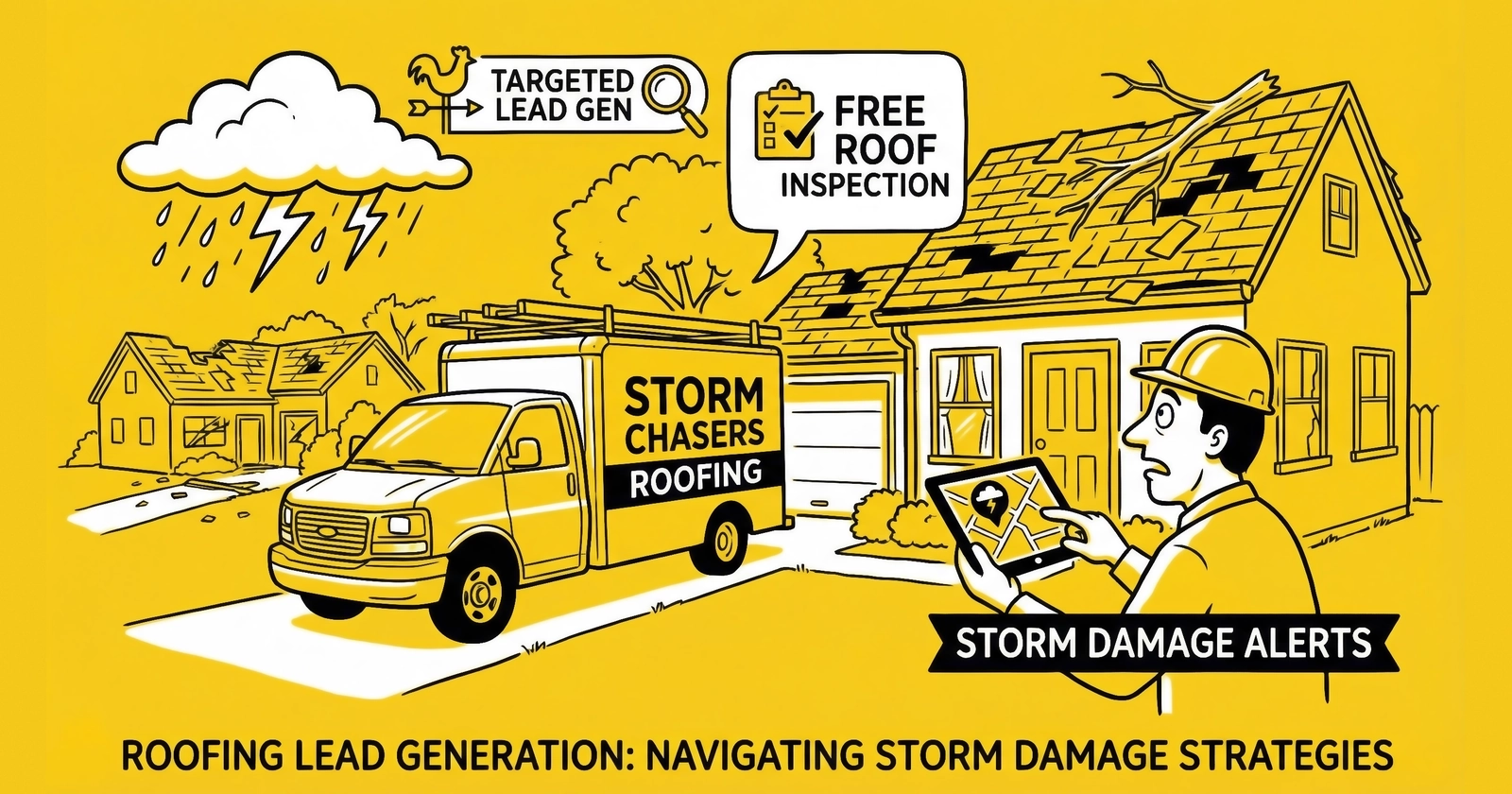
Storm damage creates concentrated demand for roofing services that transforms the lead generation landscape within affected areas. A single significant weather event can generate more roofing inquiries in 48 hours than a market would normally produce in months, creating both opportunity and operational challenge for lead generators and roofing contractors alike. The organizations that succeed in storm damage lead generation combine preparation, speed, and ethical practices in ways that serve homeowners genuinely while capturing legitimate business opportunity.
This analysis examines the specific strategies, systems, and considerations that differentiate effective storm damage lead generation from ineffective or problematic approaches. The framework addresses weather monitoring and market identification, rapid response operational requirements, compliance considerations specific to storm-affected areas, and the infrastructure needed to scale response when events occur. For lead generators serving the roofing vertical and contractors building their own lead generation capabilities, storm damage represents a specialized discipline that rewards preparation and punishes improvisation.
The Storm Damage Opportunity: Understanding Market Dynamics
Storm damage lead generation operates under different dynamics than standard roofing replacement marketing. Understanding these differences provides the foundation for effective strategy.
The fundamental distinction lies in the nature of demand. Standard roofing replacement marketing addresses discretionary decisions – homeowners choosing to replace aging roofs on their own timelines. Storm damage creates urgent, non-discretionary demand where homeowners must address damage regardless of whether replacement was on their radar. This urgency concentrates what would normally be months of market activity into days or weeks, creating opportunity for prepared organizations and chaos for those caught unprepared.
Industry veterans describe storm damage lead generation as fundamentally different from steady-state roofing marketing. The skills, systems, and relationships that enable success during normal periods may prove insufficient when demand spikes dramatically. For strategies that work across both storm and year-round conditions, see our guide on roofing lead generation balancing storm chasing and steady-state marketing. Conversely, organizations optimized for storm response may struggle with the different demands of competitive steady-state markets. This specialization explains why some lead generators focus exclusively on storm markets while others avoid them entirely.
Weather Event Impact on Roofing Demand
Significant weather events create immediate, concentrated demand spikes that dwarf normal market activity. The intensity and duration of these spikes depend on event characteristics and market factors.
Hail events represent the primary storm damage opportunity for roofing lead generation. The Insurance Institute for Business & Home Safety estimates that hail causes over $1 billion in crop and property damage annually in the United States, with roofing claims representing the largest category of property damage. A single significant hail event affecting a metropolitan area can generate thousands of roof replacement projects within a concentrated timeframe.
Wind damage from hurricanes, tornadoes, and severe thunderstorms creates similar demand concentration. Wind damage patterns differ from hail – affecting exposed edges and loose materials rather than entire roof surfaces – but generate comparable inquiry volume in affected areas. Storm events also frequently cause interior damage; for related strategies, see our water damage restoration emergency leads guide.
Post-event timing follows predictable patterns. Initial inquiries spike within 24-72 hours as homeowners discover damage. A secondary wave occurs over the following 2-4 weeks as insurance adjusters complete inspections and claims are approved. A longer tail extends 6-12 months as homeowners who delayed action finally proceed.
| Event Type | Initial Spike | Peak Duration | Extended Tail | Typical Project Value |
|---|---|---|---|---|
| Significant Hail | 48-72 hours | 2-3 weeks | 6-12 months | $8,000-$15,000 |
| Hurricane/Major Wind | 24-48 hours | 4-6 weeks | 12-18 months | $12,000-$25,000+ |
| Tornado (localized) | 24-48 hours | 2-4 weeks | 6-9 months | $15,000-$35,000+ |
| Severe Thunderstorm | 72-96 hours | 1-2 weeks | 3-6 months | $6,000-$12,000 |
Source: National Roofing Contractors Association industry surveys, insurance industry claims data
Competition Dynamics in Storm Markets
Storm events attract intense competition from both local and out-of-area contractors, creating market dynamics that affect lead generation strategy.
-
Storm chasers – contractors who travel to affected areas specifically to capture storm work – arrive within days of significant events. These competitors often operate with lower overhead and aggressive sales tactics, creating both competitive pressure and reputation challenges for the category. Lead generators must understand storm chaser dynamics to serve local contractors effectively.
-
Insurance restoration specialists maintain networks that activate for storm response, deploying resources from unaffected areas to serve concentrated demand. These organizations have sophisticated storm monitoring and rapid deployment capabilities that create formidable competition.
-
Local contractor capacity constraints become acute when events generate demand exceeding normal capacity by 5-10x. Contractors face decisions about how much storm work to pursue given crew limitations and service quality considerations. Lead generation strategies must account for buyer capacity constraints.
-
Pricing dynamics shift during storm events. While some contractors maintain standard pricing, others increase prices reflecting demand surge and reduced competition sensitivity. Insurance claim-based pricing may follow different patterns than out-of-pocket pricing. Lead generators should understand these dynamics when qualifying and routing leads.
Geographic and Demographic Factors
Storm damage lead generation performance varies significantly based on market characteristics beyond weather event severity.
-
Housing stock age and quality affects damage probability and homeowner response. Older roofs sustain damage more easily; homeowners with recent installations may find minimal damage even from significant events. Markets with aging housing stock produce more replacement opportunities than those with newer construction.
-
Insurance market characteristics influence homeowner behavior. Markets with high deductibles or claim-averse insurers see different homeowner response patterns than those with lower barriers to filing claims. Understanding local insurance market dynamics informs targeting and messaging.
-
Income and home value demographics correlate with project value and decision-making patterns. Affluent areas may have higher average project values but potentially more price-shopping behavior; modest-income areas may have more cost-sensitive decisions but potentially faster commitment once insurance coverage is confirmed.
-
Contractor market density affects competition and capacity. Markets with many roofing contractors may see lower lead prices and more buyer choice; markets with fewer contractors may command premium pricing but also face capacity constraints during major events.
Weather Monitoring and Market Identification Systems
Effective storm damage lead generation requires systematic weather monitoring that identifies opportunities before or as they develop. Organizations that react after events are established compete at disadvantage against those who anticipated and prepared.
Weather Data Sources and Integration
Multiple weather data sources provide the information needed to identify storm damage opportunities, each with different strengths and appropriate applications.
-
National Weather Service (NWS) data provides official storm reports, damage assessments, and warning information. The NWS Storm Events Database documents significant weather events with location, timing, and damage indicators. This free, authoritative source provides foundation-level storm identification.
-
Commercial weather services including Weather Underground, AccuWeather, and DTN offer enhanced data products with higher resolution, predictive analytics, and custom alerting capabilities. These services typically cost $500-$5,000 annually depending on features and coverage. For organizations with significant storm damage revenue, the investment typically proves worthwhile.
-
Specialized storm tracking services focus specifically on hail and wind events relevant to property damage. Services like HailStrike, HailWatch, and WeatherFusion provide detailed hail swath mapping, stone size estimates, and damage probability assessments that general weather services don’t offer. Annual subscriptions typically run $1,000-$3,000.
-
Insurance claims data from sources like Verisk (formerly ISO) provides historical claims patterns and predictive models for storm damage probability. While not real-time storm tracking, this data helps identify markets with consistent storm damage patterns that warrant ongoing attention.
| Data Source | Cost | Best For | Limitations |
|---|---|---|---|
| NWS Storm Events | Free | Official confirmation, historical data | Delayed reporting, limited detail |
| Commercial Weather | $500-5,000/year | Real-time alerts, forecasting | General purpose, not damage-specific |
| Specialized Hail Services | $1,000-3,000/year | Hail swath mapping, damage probability | Hail-focused, limited other events |
| Insurance Claims Data | $2,000-10,000/year | Historical patterns, market identification | Historical not real-time |
Alert and Notification Systems
Weather monitoring creates value only when it triggers appropriate action. Alert systems must surface relevant information to decision-makers quickly.
-
Automated alert configuration should match organization response capabilities. Alerts that trigger faster than the organization can respond waste attention; alerts that arrive too late miss the opportunity window. Calibrating alert thresholds to actual response capability prevents alert fatigue while ensuring timely action.
-
Geographic scope should match operational capability. National lead generators need monitoring across broad areas; regional operators need deeper coverage of specific territories. Alert systems should reflect where the organization can actually respond, not aspirational coverage.
-
Event significance thresholds filter minor events from genuine opportunities. A brief thunderstorm with quarter-inch hail creates different opportunity than a sustained storm with golf-ball hail. Threshold configuration should reflect damage probability and market potential.
-
Integration with operational systems enables faster response. When weather alerts automatically trigger campaign activation, landing page updates, and buyer notification, response time decreases compared to manual processing of alerts.
Predictive Versus Reactive Positioning
The most sophisticated storm damage lead generation combines predictive preparation with reactive execution.
-
Seasonal preparation recognizes that storm probability varies predictably by region and time of year. Spring hail season in Texas, hurricane season in Florida, and severe thunderstorm season in the Midwest all follow patterns that enable advance preparation. Understanding seasonal trends across lead generation verticals helps operators anticipate these cycles and position resources accordingly. Organizations should have campaigns, landing pages, and buyer relationships in place before peak seasons.
-
Multi-day forecasting enables preparation before specific events. When forecasts indicate high probability of significant weather 48-72 hours out, organizations can pre-position resources, alert buyers, and prepare campaigns for rapid activation.
-
Real-time response activates prepared resources when events occur. The goal is reducing time from event confirmation to campaign launch, from hours to minutes where possible.
-
Post-event assessment confirms damage scope and refines targeting. Satellite imagery, local news reports, and claims data that emerge in days following events enable targeting refinement that improves efficiency.
Rapid Response Operational Requirements
Storm damage lead generation rewards speed. Organizations that launch campaigns hours after events capture share from those who launch days later. Building rapid response capability requires advance preparation of systems and processes.
Campaign Pre-Positioning Strategy
Effective rapid response depends on having campaign elements prepared before events occur, enabling assembly and launch rather than creation under time pressure.
Landing page templates specific to storm damage should be ready for rapid customization. Templates should include:
- Storm-specific messaging acknowledging recent weather
- Geographic customization placeholders (city/region names, local references)
- Free inspection offer common to storm damage marketing
- Emergency/urgency messaging appropriate to the situation
- Insurance claim guidance content
- Photo upload capability for damage documentation
Ad creative libraries should include storm damage messaging variants ready for deployment:
- Search ads targeting “storm damage roof repair,” “hail damage contractor,” etc.
- Display ads with storm damage imagery and messaging
- Social media ads for rapid deployment
- Local service ads optimized for storm damage searches
Keyword lists and targeting specifications for storm damage campaigns enable faster setup:
- Core storm damage keywords by event type
- Geographic modifiers for rapid localization
- Negative keyword lists to exclude irrelevant traffic
- Audience targeting specifications for display and social
Buyer relationships should be established before events occur. Negotiating agreements, establishing technical integration, and verifying buyer capability after a storm wastes critical response time. Lead generators should have storm damage buyers in place across markets likely to experience events.
Launch Speed Optimization
Reducing time from event confirmation to campaign launch creates competitive advantage that directly impacts lead volume and cost.
-
Defined activation triggers should specify what event characteristics warrant campaign launch:
- Hail stone size thresholds (typically 1 inch or greater for significant damage)
- Affected population density thresholds
- Insurance claim probability indicators
- Market-specific factors
-
Streamlined approval processes for storm campaigns recognize the time-sensitive nature. Rather than standard multi-day review cycles, storm campaigns should have expedited approval paths that enable launch within hours of events.
-
Automated campaign activation where possible reduces human latency. When weather monitoring systems can trigger campaign launch without manual intervention, response time improves. Automated systems should still have human oversight for unusual situations.
-
Geographic precision in targeting should match event impact areas. Storms affect specific areas, not entire markets. Targeting should be refined to affected zip codes or neighborhoods rather than broad metro areas, both for relevance and cost efficiency.
Scaling Response Capacity
Storm events create demand spikes that may exceed normal operational capacity. Scaling capability enables capturing opportunity that capacity constraints would otherwise forfeit.
-
Media budget flexibility should allow rapid spending increases when events create opportunity. Organizations with fixed weekly budgets cannot capitalize on concentrated opportunities. Pre-approved budget expansion for storm events enables appropriate response.
-
Call center capacity must scale with lead volume increases. Storm events may increase inquiry volume 10x or more in affected areas. Partnerships with overflow call centers, flexible staffing arrangements, or technology-enabled handling (chat, form completion) address capacity constraints.
-
Buyer capacity coordination ensures lead delivery doesn’t exceed buyer absorption capability. Communication with buyers before and during events establishes appropriate volume expectations and identifies when additional buyers are needed.
-
Quality control at scale maintains standards despite volume pressure. Storm events create temptation to sacrifice quality for volume; systems should maintain verification, compliance, and quality standards even at improved volumes.
Ethical Considerations and Best Practices
Storm damage creates vulnerable situations where homeowners face unexpected expenses and decisions under time pressure. Ethical considerations should guide strategy development and execution.
Avoiding Predatory Practices
The roofing industry’s reputation includes problematic practices that responsible lead generators should actively avoid and help buyers avoid.
Insurance fraud facilitation represents the most serious ethical and legal concern. Some contractors engage in practices including:
- Inflating damage claims beyond actual damage
- Waiving deductibles as sales incentives (illegal in many states)
- Performing unnecessary work billed to insurance
- Misrepresenting damage cause or extent
Lead generators should not work with contractors engaged in these practices and should structure agreements to distance from fraud exposure.
High-pressure sales tactics exploit homeowner stress during storm aftermath. Tactics like claiming damage will worsen without immediate action, requiring same-day signatures, or disparaging competitor inspections create consumer harm. Lead qualification should screen for legitimate intent rather than panic-driven decisions.
Misrepresentation of urgency – claiming repairs must happen immediately when they don’t – creates false pressure. While some situations do require urgent attention, many storm damage repairs can proceed on normal timelines. Messaging should reflect actual urgency rather than manufactured pressure.
Storm chaser risks should be communicated to homeowners. Out-of-area contractors may provide legitimate service but also present risks: limited accountability, potential warranty issues, and variable quality. Lead generators serving primarily storm chasers should consider whether that business model serves homeowner interests.
Homeowner-Centered Messaging
Ethical storm damage marketing focuses on genuinely serving homeowner needs rather than exploiting vulnerability.
-
Educational content about the insurance claims process, damage assessment, and contractor selection serves homeowner interests while building trust. Providing genuine value before asking for business creates legitimate relationships.
-
Realistic timeline messaging helps homeowners understand that most storm damage doesn’t require emergency repair. Communicating that careful contractor selection matters more than immediate action serves homeowners better than urgency-based messaging.
-
Warning signs of problematic contractors – requests for large deposits, pressure for immediate signing, reluctance to provide references or verification – can be communicated to help homeowners avoid problems.
-
Insurance process guidance helps homeowners understand their coverage, deductibles, and claim procedures. This educational approach provides value while establishing expertise.
Compliance Considerations
Storm damage lead generation faces standard lead generation compliance requirements plus additional considerations specific to the context.
-
State-specific insurance solicitation rules may affect marketing to homeowners about insurance claims. Some states regulate who can discuss insurance claims with consumers and how. Understanding state-specific requirements prevents compliance exposure.
-
Contractor licensing requirements vary by state and locality. Lead generators should verify that buyers maintain appropriate licensing for the areas where they receive leads. Delivering leads to unlicensed contractors creates liability exposure.
-
Home improvement contract requirements in many states mandate specific disclosures, cancellation rights, and contract provisions. While these obligations fall on contractors rather than lead generators, understanding them informs buyer qualification and agreement structure.
-
TCPA compliance applies to storm damage marketing as to other lead generation. The temptation to rapid-fire outbound contact to storm-affected areas doesn’t override consent requirements. Speed should come from efficient systems, not compliance shortcuts.
Traffic Acquisition Strategies for Storm Markets
Storm damage events create temporary but intense demand that requires adapted traffic acquisition strategies.
Search Campaign Optimization
Search remains the primary channel for storm damage lead generation given high intent signals from consumers actively seeking roofing help.
Keyword strategy should capture storm-specific intent:
Core storm damage keywords:
- “storm damage roof repair [location]”
- “hail damage roof [location]”
- “roof damage from storm [location]”
- “wind damage roof repair [location]”
- “roof inspection after storm [location]”
Insurance-related keywords:
- “insurance roof claim [location]”
- “file roof insurance claim [location]”
- “roof damage insurance [location]”
- “roof claim adjuster [location]”
Urgency-intent keywords:
- “emergency roof repair [location]”
- “roof leak after storm [location]”
- “roof damage today [location]”
- “immediate roof inspection [location]”
Bid strategy should reflect event timing. Immediately after events, when search volume spikes and competition may lag, aggressive bidding captures early volume. As competition increases, bid optimization should target sustainable cost per lead rather than maximum volume.
Ad copy should acknowledge the storm event specifically. Generic roofing ads underperform storm-specific messaging. Ad copy that references “recent storm damage” or “yesterday’s hail storm” demonstrates relevance.
Landing page alignment ensures that storm-specific ads lead to storm-specific landing pages, not generic roofing pages. The messaging consistency improves conversion rate and quality score.
Local Services Ads Optimization
Google Local Services Ads (LSA) provide valuable exposure during storm events, with placement above standard search ads.
-
Rapid responsiveness to inquiries through LSA directly affects ranking. Organizations that respond within minutes maintain better positioning than those responding in hours. For more on why speed to lead drives conversion rates, see our response optimization guide.
-
Review management becomes more critical during high-volume periods. Encouraging satisfied customers from storm work to leave reviews builds the profile strength that maintains LSA position.
-
Service area optimization should focus on affected areas. LSA allows service area specification; during storm events, concentrating service areas on affected zones improves relevance.
Display and Social Media Strategies
While search captures active intent, display and social can generate additional volume from homeowners who haven’t yet searched.
-
Geotargeting precision becomes essential for storm campaigns. Display targeting should focus on affected zip codes or neighborhoods rather than broad geographic areas. This precision reduces waste from impressions served to unaffected consumers.
-
Facebook and Instagram targeting can combine geographic precision with interest-based targeting (homeownership, home improvement interests) to reach affected homeowners. Creative should acknowledge the storm event specifically.
-
Retargeting pool building during storm events creates audiences for extended follow-up. Consumers who engage with storm content but don’t convert immediately may convert in the extended tail period.
-
Local news and weather site placements position messaging where storm-affected consumers are paying attention. Direct placement agreements or programmatic targeting of local news properties can be effective during events.
Content and SEO Considerations
While paid acquisition drives most storm-period volume, content strategy supports both immediate and long-term performance.
-
Localized storm content – articles addressing the specific event, damage patterns, and local considerations – can capture organic traffic during extended recovery periods. This content also demonstrates expertise to visitors from paid channels.
-
FAQ content about insurance claims, damage assessment, and contractor selection serves homeowner needs while capturing search traffic. This evergreen content remains valuable beyond individual events.
-
Image and video content documenting local storm damage (with appropriate permissions) provides proof of local presence and expertise. This content supports both paid creative and organic visibility.
Lead Qualification for Storm Damage
Storm damage leads require qualification approaches that address the specific characteristics of storm-initiated inquiries.
Damage Verification Considerations
Not every inquiry following a storm represents legitimate roofing need. Qualification should assess actual damage probability.
-
Storm impact verification confirms that the consumer’s address falls within the affected area. Address-level matching against storm swath data identifies leads from unaffected areas that likely won’t result in projects.
-
Homeownership verification confirms the consumer can authorize roofing work. Renters may inquire about storm damage but cannot contract for roof replacement.
-
Visible damage indicators such as photo uploads showing damage, specific descriptions of damage observed, or prior inspection results all suggest legitimate need. Generic inquiries without damage indicators may represent lower intent.
-
Insurance status qualification assesses whether the consumer has filed or intends to file a claim. Insurance-backed projects proceed differently than out-of-pocket decisions.
Intent and Timeline Assessment
Storm damage leads span from immediate urgency to speculative inquiry. Qualification should assess timeline and commitment level.
-
Urgency indicators such as active leaks, visible structural damage, or insurance adjuster appointments suggest near-term decisions. These leads typically command premium value.
-
Exploration indicators such as “just want to know if there’s damage” or “getting estimates for reference” suggest earlier-stage inquiry that may or may not result in projects.
-
Competitor engagement status – whether the consumer is already working with a contractor or has received estimates – affects lead value and appropriate routing.
-
Decision authority confirmation ensures the consumer can make or significantly influence the purchase decision. In multi-person households, reaching the decision-maker affects conversion probability.
Lead Routing Optimization
Storm damage leads should route to buyers best positioned to serve them, which may differ from standard routing logic.
-
Geographic specialization matters when storm damage concentrates in specific areas. Contractors with crews already working in affected neighborhoods can respond faster than those crossing town.
-
Insurance claim expertise affects buyer suitability for insurance-backed projects. Contractors experienced with insurance processes serve these leads better than those unfamiliar with claims procedures.
-
Capacity availability determines whether buyers can actually serve additional leads. Routing to capacity-constrained buyers results in slow response and lower conversion. Real-time capacity awareness improves routing decisions.
-
Exclusivity versus shared routing decisions may differ for storm leads. Premium storm leads with strong damage indicators and immediate timeline may warrant exclusive delivery; more speculative inquiries may suit shared routing.
Data Integration for Storm Targeting
Integrating weather data, property data, and targeting systems enables precision that improves both efficiency and relevance.
Weather Data Integration
Weather monitoring data can inform targeting in real-time when properly integrated.
-
Storm swath mapping to targeting systems enables rapid geographic precision. When hail tracking services provide polygons or zip code lists for affected areas, integrating this data into advertising platforms enables immediate targeting refinement.
-
Severity-based prioritization focuses resources on the most significantly affected areas. Larger hail, higher wind speeds, or longer event duration all correlate with greater damage probability. Targeting can weight toward most-affected areas.
-
Multi-event tracking maintains awareness across simultaneous or sequential events. Storm season may produce multiple events in different markets; tracking systems should maintain separate awareness for each.
Property Data Enhancement
Property characteristics affect storm damage relevance and project value.
-
Roof age data from property records helps identify homes with older roofs more likely to need replacement. Targeting homeowners with 15+ year old roofs in affected areas focuses on highest-probability projects.
-
Property value data helps estimate project value and appropriate buyer routing. Higher-value homes typically have larger, more complex roofs commanding higher project values.
-
Construction type and material indicators affect damage probability. Certain roof materials sustain damage more easily than others; property data that indicates roof type enables relevance refinement.
-
Prior claim history from insurance data sources might indicate homes with previous storm damage, suggesting either ongoing vulnerability or recent repair that makes additional damage less likely.
Predictive Targeting Applications
Combining weather forecasting with property data enables predictive targeting before events occur.
-
Pre-storm awareness campaigns in areas with high probability of significant weather prepare homeowners and establish brand presence before events. These campaigns acknowledge forecast conditions and offer resources for post-storm assessment.
-
Seasonal preparation targeting reaches homeowners in storm-prone areas before peak seasons. Content about storm readiness, inspection recommendations, and contractor selection can generate leads before damage occurs.
-
Historical pattern-based targeting identifies areas with consistent storm damage history for ongoing marketing investment. Markets with reliable annual storm activity warrant sustained presence rather than purely reactive response.
Buyer Relationship Management for Storm Markets
Storm damage lead generation requires buyer relationships that accommodate the unique characteristics of storm work.
Capacity Planning and Communication
Storm events create demand spikes that exceed normal buyer capacity. Managing this dynamic requires advance planning and real-time communication.
-
Pre-season capacity discussions with buyers establish expectations for potential storm events. Understanding how much volume buyers can absorb during events enables appropriate volume allocation.
-
Real-time capacity tracking during events prevents overwhelming buyers with more leads than they can serve. Lead generators should monitor buyer response times and conversion rates as indicators of capacity constraints.
-
Overflow buyer relationships provide additional capacity when primary buyers reach limits. Having secondary buyers ready to receive storm leads enables capturing volume that would otherwise exceed capacity.
-
Lead pacing capabilities match delivery rate to buyer absorption capability. Delivering 100 leads in an hour to a buyer who can handle 20 produces poor outcomes; pacing delivery to actual capacity improves results for both parties.
Pricing Dynamics During Events
Storm events may warrant adjusted pricing that reflects supply-demand dynamics and lead quality characteristics.
-
Premium pricing for high-value storm leads – verified damage, immediate timeline, insurance-backed – may be appropriate given superior conversion probability and project value. Buyers may accept higher lead costs for leads with stronger indicators.
-
Volume-based adjustments might discount leads when volumes exceed expectations, maintaining buyer economics despite improved volume. Alternatively, pricing might increase as competition intensifies.
-
Quality tiering during events can differentiate leads by strength of indicators. First-tier leads with strong damage verification, decision-maker confirmation, and immediate timeline command premium pricing; lower-tier leads with weaker indicators are discounted accordingly.
Performance Monitoring and Adjustment
Storm periods require more intensive monitoring than normal operations given improved volume and changed dynamics.
-
Daily or more frequent performance reviews during storm periods enable rapid identification of issues. Conversion rates, return rates, and buyer feedback should be tracked in near-real-time.
-
Source-level performance tracking identifies which traffic sources perform during storm events. Performance may differ from non-storm periods; data should inform rapid optimization.
-
Buyer-level performance comparison reveals which buyers convert storm leads effectively. Routing optimization during events should favor buyers demonstrating strong storm lead performance.
Key Takeaways
-
Storm damage creates concentrated demand that rewards preparation and speed. A single significant weather event can generate more roofing inquiries in 48 hours than a market produces in months. Organizations with systems prepared for rapid response capture disproportionate share.
-
Weather monitoring infrastructure should combine multiple data sources including NWS official reports, commercial weather services, and specialized hail tracking services. The investment in data access typically pays returns through better event identification and targeting precision.
-
Campaign pre-positioning enables rapid response. Landing page templates, ad creative libraries, keyword lists, and buyer relationships should all be established before events occur, enabling assembly and launch rather than creation under time pressure.
-
Ethical considerations should guide storm damage strategy. Avoiding insurance fraud facilitation, high-pressure tactics, and misrepresented urgency serves both homeowner interests and long-term business sustainability. Responsible lead generators actively distance from problematic practices.
-
Geographic precision in targeting reduces waste and improves relevance. Storm damage affects specific areas; targeting entire metros wastes budget on unaffected consumers. Integrating storm swath data with advertising platforms enables precision that improves economics.
-
Lead qualification should address storm-specific factors including damage verification, homeownership confirmation, insurance status, and timeline assessment. Storm leads range from urgent need to speculative inquiry; qualification should differentiate appropriately.
-
Buyer capacity management becomes critical during storm events. Demand spikes may exceed normal capacity by 10x or more. Pre-event capacity planning, real-time monitoring, and overflow buyer relationships prevent lead delivery that exceeds buyer absorption capability.
-
Property data integration enhances targeting precision. Roof age, property value, and construction type all affect damage probability and project value. Integrating property data with targeting enables focus on highest-probability, highest-value prospects.
Frequently Asked Questions
What weather conditions create the best opportunities for storm damage lead generation?
Hail events with stone sizes of one inch or greater create the strongest roofing lead generation opportunities, as this threshold commonly triggers insurance claims and roof replacement needs. Wind events exceeding 60-70 mph similarly create damage patterns that generate significant lead volume. The combination of event severity and affected population density determines opportunity magnitude – a significant hail event affecting a major metropolitan area creates more opportunity than a more severe event affecting a rural area. Events during peak storm seasons (spring in much of the central US, hurricane season on coasts) often occur when consumers are already primed to expect storm damage.
How quickly should lead generators respond to storm events?
The fastest responders capture disproportionate market share. Best-in-class storm response involves launching campaigns within hours of event confirmation, not days. Search volume spikes immediately after events while competition may take longer to respond, creating a window where early advertisers achieve better positioning at lower costs. Organizations should target campaign launch within 2-4 hours of confirmed significant events in prepared markets. This speed requires pre-positioned campaign elements that can be assembled and customized rapidly rather than created from scratch.
What are the most important weather data sources for storm tracking?
A combination of sources provides the most complete picture. The National Weather Service Storm Events Database provides free, authoritative event confirmation and historical data. Commercial weather services like AccuWeather or DTN provide real-time alerts and forecasting capabilities. Specialized hail tracking services like HailStrike or HailWatch provide detailed swath mapping and stone size estimates that general weather services don’t offer. For serious storm damage lead generation, investing $2,000-5,000 annually in weather data services typically proves worthwhile given the opportunity identification and targeting precision these tools enable.
How should storm damage leads be priced differently than standard roofing leads?
Storm damage leads often command premium pricing due to higher conversion rates, larger average project values, and concentrated demand. Insurance-backed projects typically close at higher rates than out-of-pocket decisions, justifying higher lead costs. Premium pricing is most justified for leads with verified damage, confirmed decision-maker contact, and immediate timeline. However, pricing should also consider capacity dynamics – when lead volume exceeds buyer capacity, excessive pricing may result in leads that go unworked. Tiered pricing based on qualification strength allows differentiation between premium leads and more speculative inquiries.
What ethical concerns should storm damage lead generators address?
The primary ethical concerns involve avoiding practices that exploit vulnerable homeowners. Insurance fraud facilitation – working with contractors who inflate claims, waive deductibles illegally, or misrepresent damage – creates legal exposure and consumer harm. High-pressure sales tactics that manufacture urgency exploit homeowner stress. Misrepresentation of damage severity or repair necessity misleads consumers. Storm chaser practices that prioritize volume over quality outcomes leave homeowners with substandard work and warranty issues. Responsible lead generators should screen buyer practices, avoid urgency manipulation in messaging, and provide educational content that serves homeowner interests.
How can lead generators verify that leads are from storm-affected areas?
Address-level matching against storm impact data provides the most reliable verification. Specialized storm tracking services provide polygon data or zip code lists defining affected areas; leads can be validated against these boundaries. Self-reported damage descriptions – photos uploaded, specific damage observed – provide consumer verification of impact. Insurance claim status inquiries identify homeowners who have filed or plan to file claims, suggesting they’ve confirmed damage. Property data cross-reference with roof age can further validate that homes have older roofs more likely to sustain damage requiring replacement.
What capacity considerations should lead generators manage during storm events?
Storm events create demand spikes that commonly exceed normal buyer capacity by 5-10x or more. Lead generators should establish pre-event capacity understanding with buyers, including how much volume they can absorb and how that capacity might expand during events. Real-time monitoring of buyer response times and conversion rates reveals when capacity constraints are affecting performance. Overflow buyer relationships provide additional capacity when primary buyers reach limits. Lead pacing systems match delivery rate to actual buyer capability rather than simply maximizing volume. Without capacity management, lead generators may deliver leads that go unworked, harming both buyer relationships and consumer experience.
How does insurance claim status affect lead qualification and routing?
Insurance-backed projects proceed differently than out-of-pocket decisions and typically have different buyer suitability requirements. Leads with filed or intended insurance claims often convert at higher rates because the financial barrier is addressed. However, these projects require contractor expertise in insurance processes – documenting damage to insurance specifications, working with adjusters, understanding claim supplementation. Lead routing should favor buyers with demonstrated insurance claim expertise for these leads. Qualification should assess claim status to enable appropriate routing and set buyer expectations about project type.
What role should content marketing play in storm damage lead generation?
Content marketing supports storm damage lead generation in multiple ways. Educational content about insurance claims processes, damage assessment, and contractor selection provides genuine value that builds trust with homeowners while establishing expertise. Local storm-specific content covering recent events, damage patterns, and recovery resources can capture organic traffic during extended recovery periods. Evergreen content about storm preparedness generates leads before events occur. Content also supports paid acquisition by providing landing page substance beyond lead capture forms. Organizations should maintain content libraries that can be rapidly localized and published when events occur.
How do storm damage lead generation strategies differ by event type?
Different storm types create different damage patterns and homeowner behaviors. Hail events often affect entire roof surfaces, making full replacement more common. Wind events typically damage exposed edges and loose materials, potentially creating repair rather than replacement opportunities. Hurricane impacts may include water intrusion that expands project scope beyond roofing. Tornado damage may be severe but highly localized. Messaging, qualification criteria, and buyer routing should reflect these differences. Hail-focused messaging emphasizes inspection to identify hidden damage; wind messaging may emphasize emergency repairs and tarping; hurricane messaging addresses comprehensive restoration needs.
Conclusion
Storm damage lead generation represents a specialized discipline within the roofing vertical that rewards organizations who approach it systematically rather than opportunistically. The concentrated demand that weather events create transforms markets for brief periods, creating opportunity for those prepared to respond and competitive disadvantage for those who improvise.
The distinction between prepared and opportunistic response shapes outcomes more dramatically in storm markets than in most lead generation contexts. When demand concentrates into narrow time windows, the advantage of preparation compounds. Organizations with systems ready can capture market share while competitors scramble to build capability after events occur. This window of advantage closes as competitors catch up, making the early hours and days disproportionately valuable.
The industry continues to evolve as weather data becomes more precise, targeting technologies enable greater geographic accuracy, and both ethical standards and regulatory scrutiny increase. Organizations that invest in building genuine storm response capability – integrating weather intelligence, operational readiness, ethical practices, and buyer relationships – position themselves to capture value sustainably across the storm events that will inevitably occur.
The foundation of effective storm damage lead generation rests on preparation – weather monitoring systems that identify opportunities, pre-positioned campaign elements that enable rapid launch, buyer relationships that provide capacity for volume absorption, and operational systems that scale with demand spikes. Organizations that must create these elements after events occur compete at structural disadvantage against those who prepared in advance.
Ethical considerations deserve prominence in storm damage strategy. The industry’s reputation includes problematic practices that responsible lead generators should actively avoid and help clients avoid. Insurance fraud facilitation, high-pressure tactics, and manufactured urgency create consumer harm that ultimately damages the industry and invites regulatory response. Building sustainable storm damage lead generation capability requires commitment to practices that genuinely serve homeowner interests.
The technical elements – weather data integration, geographic targeting precision, property data enhancement – all enable effectiveness, but they serve a strategic purpose: being ready to deliver relevant, high-quality leads to appropriate buyers when weather events create concentrated demand. Organizations that master both the strategic preparation and technical execution capture value that less prepared competitors forfeit.
Storm damage lead generation will remain an important capability for the roofing vertical as long as weather creates property damage. The organizations that invest in building genuine capability – not just reactive response, but prepared, ethical, effective systems – will continue to capture disproportionate share of the opportunity that storms create.