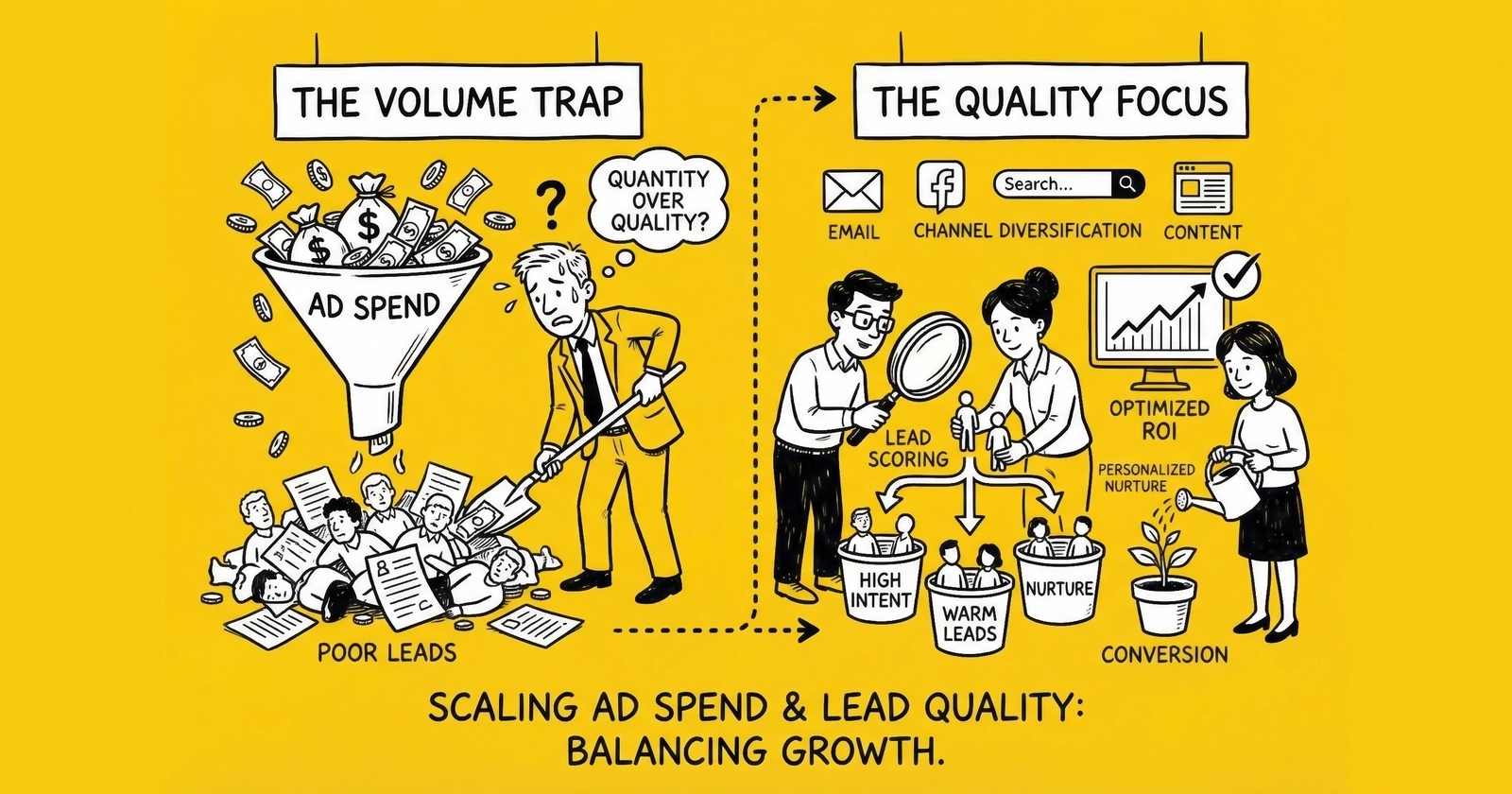
The complete operational framework for expanding from $25K to $250K monthly ad spend while maintaining the quality metrics that keep buyers paying premium prices and relationships intact.
Introduction: The Scaling Paradox Every Operator Faces
You doubled your ad spend last quarter. Lead volume increased 85%. Your revenue dashboard shows record numbers.
Then your buyer calls. Contact rates dropped from 64% to 47%. Conversion rates fell by a third. Your “record month” generated more refund requests than closed deals. The buyer wants to renegotiate pricing or reduce volume. Possibly both.
This is the scaling paradox: the same strategies that grow lead volume systematically degrade lead quality. The platforms designed to maximize your conversions optimize for quantity over quality. The algorithms that find you cheap clicks find them by expanding into audiences less likely to convert. Every dollar you add to campaigns gets spent on incrementally worse traffic.
The solution is not to avoid scaling. The lead generation businesses that thrive are those that scale aggressively. The difference is how they scale. Sustainable growth requires systems that catch quality degradation before buyers notice, diversification strategies that limit exposure to any single source, and the discipline to pause when metrics breach thresholds.
This guide provides the complete framework for scaling ad spend from $25,000 to $250,000 monthly and beyond while maintaining the quality standards that determine long-term profitability. The tactics here come from operators who have executed these transitions successfully and from the lessons learned when scaling went wrong.
Understanding Why Quality Degrades at Scale
Quality degradation during scaling follows predictable patterns. Understanding these patterns is the first step toward preventing them.
The Platform Incentive Problem
Advertising platforms optimize for their objectives, not yours. When you tell Google or Meta to maximize conversions, the algorithm interprets this as “find the cheapest conversions available.” At low spend levels, cheap conversions often align with quality conversions because the platform shows ads to your ideal audience. At high spend levels, the platform exhausts ideal audiences and expands to whoever will convert at any cost.
This creates a fundamental tension. Your objective is profitable leads that convert to customers. The platform’s objective is maximizing reported conversions within your budget. These objectives align at small scale and diverge at large scale.
The Three Mechanisms of Quality Erosion
Audience Expansion Without Consent. At $100 per day, your Facebook campaign reaches your carefully defined audience: homeowners aged 35-55 in specific geographic areas with relevant interests. At $500 per day, the platform exhausts this audience and activates Advantage+ expansion, reaching lookalike audiences, broader demographics, and users outside your geographic targets. The 2024-2025 advertising landscape has accelerated this problem. Meta’s Advantage+ campaigns, Google’s Performance Max, and TikTok’s smart optimization all default to broad targeting that expands automatically as budgets increase. These AI-driven campaign types can produce volume but strip away the precision targeting that generated quality leads at lower spend levels.
Placement Dilution Across Networks. Your Google Search campaign starts with high-intent keywords on Google.com. As budget increases, Google allocates spend to Search Partners, Display Network placements, YouTube inventory, and Discovery surfaces. Each expansion brings cheaper clicks and lower intent. The data is clear: Google Search average CPC runs $4.66 with conversion rates around 7.52% in 2025. Display Network clicks cost $0.50-$1.00 but convert at 0.5-1%. The blended metrics look acceptable while actual lead quality craters. Performance Max campaigns exacerbate this problem by design. These campaigns distribute spend across all Google inventory with limited transparency into placement. Many lead generators discover that 40-60% of Performance Max spend goes to low-converting Display and YouTube placements they never intended to target.
Temporal Expansion Into Low-Intent Hours. Your highest-quality leads likely arrive during specific windows: weekday business hours when motivated buyers actively research. As daily budgets increase, platforms spread impressions across all 24 hours to hit volume targets. A mortgage lead captured at 10 AM on Tuesday represents different intent than one captured at 2 AM on Saturday. The platform reports both as conversions. Your buyer’s sales team experiences them very differently.
The Quality-Volume Curve: 2025 Benchmarks
The relationship between ad spend and lead quality follows a predictable curve with distinct phases. During Phase One, which covers the initial 0-50% budget increase, quality typically holds steady. The platform finds more of your existing audience at similar efficiency. CPL increases modestly in the 5-15% range, but conversion rates and contact rates remain stable. Contact rates may decline 1-3%, but nothing alarming appears in the data. This phase creates dangerous confidence because operators assume quality will persist at any scale.
Phase Two, the friction zone covering 50-150% budget increases, is where quality begins eroding measurably. The platform exhausts core audiences and expands into secondary segments. CPL increases accelerate to 20-40% above baseline. Contact rates decline 8-15%. Return rates increase 3-8 percentage points. Most scaling failures occur here because operators see volume growing and accept quality decline as acceptable cost of growth.
Phase Three hits at 150% or greater budget increases, and this is where quality collapses. The platform relies heavily on expanded audiences, low-quality placements, and off-peak delivery. CPL may stabilize or even decline as cheap inventory dominates. But downstream metrics crater: contact rates drop 20-35%, conversion rates fall 30-50%, and return rates spike to 20-30%. Buyer relationships enter crisis.
The Compounding Effect of Multiple Declines
Quality degradation compounds rather than adds. Consider the math when you have a 15% contact rate decline, a 20% conversion rate decline on contacted leads, and a 25% increase in return rate on delivered leads. The combined effect is devastating: leads that should generate 100 customers now generate approximately 51 (0.85 x 0.80 x 0.75 = 0.51). Your effective customer acquisition cost has nearly doubled while your dashboard shows only modest increases in individual metrics.
The Incremental Scaling Protocol
Sustainable scaling requires disciplined incrementalism. The goal is maintaining quality visibility at every stage while allowing meaningful growth velocity.
The 15-20% Weekly Increment
Increase ad spend by 15-20% per week maximum. This pace provides sufficient data for quality monitoring while achieving meaningful scale over time. At 15% weekly compounding, you double spend in approximately seven weeks. At 20% weekly, you double in six weeks. These timelines allow quality metrics to surface, buyer feedback to arrive, and algorithm learning phases to complete before each subsequent increase.
Faster scaling creates blind spots. A 50% weekly increase produces quality degradation that takes two to three weeks to appear in buyer data. By the time you see the problem, you have already committed significant budget to traffic that damages relationships.
The Weekly Scaling Cycle
Day 1: Implement Budget Increase. Raise daily budgets by 15-20% across campaigns. Document current CPL, conversion rate, and quality baselines. Review platform notifications for automatic audience expansion or placement changes triggered by the increase.
Days 2-4: Monitor Leading Indicators. Leading indicators predict quality problems before they appear in buyer data. CPL trending upward often precedes quality decline. Declining form completion rates suggest lower-intent visitors arriving at your pages. Validation pass rate drops, where phone and email validation failures increase, signal lower-quality traffic entering your funnel. Session duration and pages per visit decline before conversion metrics do, serving as an early warning system. Check these metrics daily during active scaling and establish alert thresholds that trigger investigation before buyer impact materializes.
Days 5-7: Evaluate Lagging Indicators. Lagging indicators confirm quality through buyer experience: contact rate (the percentage of leads reached on first contact attempt, which runs 45-55% for insurance, 30-40% for mortgage, and 20-35% for solar), qualification rate (the percentage of contacted leads that qualify for the product), return rate (leads rejected by buyer after delivery, with a healthy baseline of 8-12%), and conversion rate (leads that become customers). These metrics require buyer feedback, which typically arrives 5-14 days after lead delivery. Establish reporting cadences with buyers that provide this data weekly.
Day 8: Make Scaling Decision. Evaluate the week against established thresholds. If all metrics are green, proceed with another 15-20% increase. If one or two metrics are yellow, running within 90-95% of threshold, hold current spend for one additional week. If any metric breaches threshold into red territory, reduce spend 20-30%, diagnose the cause, and do not resume scaling until metrics stabilize for one full week.
The 72-Hour Stabilization Rule
After any budget change, allow 72 hours before evaluating performance. Platform algorithms require 48-72 hours to optimize delivery patterns around new budget levels. Day-one metrics after a budget change are unreliable. This means Monday budget increases should not be evaluated until Thursday. Friday increases show distorted weekend traffic patterns and require Monday-Tuesday data for valid assessment.
Source Diversification Strategy
Single-source scaling hits diminishing returns faster than diversified scaling. The platform-level audience exhaustion that causes quality degradation at high spend on one platform can be mitigated by spreading budget across multiple platforms.
The Multi-Platform Scaling Framework
Rather than scaling Google Ads from $25K to $100K monthly, consider a diversified progression. Starting at $25K monthly with 100% on Google Search, the first phase to $50K shifts to $35K on Google Search (a 40% increase on primary) while adding $15K on Meta Ads as a new source test. Phase two from $50K to $80K grows Google Search to $45K (29% increase), Meta to $25K (67% increase), and introduces Microsoft Ads at $10K. Phase three from $80K to $120K pushes Google Search to $50K (11% increase), Meta to $35K (40% increase), Microsoft to $20K (100% increase), and adds Native advertising through Taboola or Outbrain at $15K. Phase four from $120K to $160K grows Google Search to $55K (10% increase), Meta to $45K (29% increase), Microsoft to $25K (25% increase), Native to $20K (33% increase), and introduces TikTok or YouTube at $15K.
This approach caps individual platform scaling at lower percentages while achieving 100% overall growth per phase. No single platform exceeds 40% of total spend by Phase 3.
2025 Source-Specific Quality Characteristics
Google Search remains the highest-intent traffic source. Current 2025 benchmarks show average CPL of $70.11 (up 5% year-over-year from $66.69 in 2024) with conversion rates averaging 7.52%. Someone searching “auto insurance quotes” has declared purchase intent. The quality degradation curve is steep. Search exhausts high-intent audiences quickly and expands to Display and YouTube placements with different intent profiles. Monitor placement reports weekly and exclude low-performing inventory categories.
Meta (Facebook/Instagram) delivers moderate intent with visual targeting capabilities. CPL averages $27.66 in 2025 (up 20% year-over-year), roughly 60% cheaper than Google. But intent differs: someone scrolling Facebook who clicks your ad has mild curiosity, not declared purchase intent. Quality degradation manifests as audience fatigue rather than placement dilution. Watch frequency metrics carefully. When average frequency exceeds 2.5-3.0, creative fatigue sets in and quality declines. Plan to refresh creative every two to four weeks during active scaling.
Microsoft/Bing offers a lower volume ceiling but often higher quality per lead. Bing audiences skew older with higher incomes. CPL runs 15-25% lower than Google with comparable or better conversion rates in many verticals. Quality holds better at scale because audience size limits extreme expansion, making it a strong source for quality-focused scaling when Google hits diminishing returns.
Native Advertising (Taboola, Outbrain) presents highly variable quality depending on publisher selection. The global native advertising market reached $104.63 billion in 2024 and projects to $346.88 billion by 2033 at 13.9% CAGR. Premium publishers like major news sites deliver quality comparable to search, while programmatic expansion to long-tail sites produces volume with poor intent. Start with premium packages or whitelist-only campaigns. Taboola CPC ranges $0.30-$0.60 with CTRs of 0.2-0.5%, while Outbrain shows slightly higher CTRs of 0.3-0.6% at higher costs. Allow programmatic expansion only after establishing baseline quality metrics you can monitor.
TikTok reaches younger demographics with high engagement. CPMs run 30-47% cheaper than Meta, with January 2025 data showing $4.20 average CPM and $0.74 cost per link click. But conversion patterns differ significantly from other platforms. Quality concerns center on user intent: TikTok is entertainment-first. Users clicking ads are often curious, not shopping. Test extensively before scaling and monitor downstream conversion rates closely. Note the platform faces ongoing U.S. regulatory uncertainty, with ad reach declining 12.2 million users between early 2024 and early 2025.
The 60/30/10 Diversification Rule
For sustainable scaling, target this budget distribution: 60% on your primary proven source with the highest historical quality, 30% on secondary sources with established quality baselines, and 10% on testing new sources. This limits catastrophic damage from any single source degradation while maintaining efficiency from proven channels.
Quality Threshold Management
Quality thresholds are the guardrails that prevent scaling from destroying buyer relationships. Define these thresholds before scaling, monitor them continuously, and treat breaches as mandatory scaling stops.
Establishing Baseline Metrics
Before scaling, document a 30-day baseline for each quality metric during stable operations. Capture the average value for each metric, the standard deviation representing normal variance range, day-of-week patterns, traffic source breakdown, and seasonal factors if applicable. This baseline becomes your comparison point for all scaling decisions. Without documented baselines, you cannot objectively identify degradation. You will rely on buyer complaints, which arrive too late.
Essential Quality Metrics and Thresholds
Tier 1: Leading Indicators require daily monitoring. Cost Per Lead, calculated as total cost divided by leads generated, should never exceed 30% above baseline. Form Completion Rate, measured as form starts divided by form completions, must stay at minimum 85% of baseline. Validation Pass Rate for leads passing phone and email validation must remain at minimum 90% of baseline. Duplicate Rate for leads matching your existing database should stay below 15%, though this varies by vertical.
Tier 2: Quality Indicators require weekly monitoring. Contact Rate, the percentage of leads reached divided by total leads delivered, must stay at minimum 90% of buyer baseline. Qualification Rate, measuring leads qualifying for product divided by leads contacted, should not drop below 85% of buyer baseline. Return Rate, leads returned divided by leads delivered, cannot exceed baseline plus 5 percentage points.
Tier 3: Conversion Indicators require monthly monitoring. Lead-to-Sale Rate, calculated as customers divided by leads delivered, must remain at minimum 80% of buyer baseline. Revenue Per Lead, total buyer revenue divided by leads delivered, should stay at minimum 85% of baseline. Buyer Satisfaction through qualitative feedback assessment should show no negative trending.
Threshold Breach Response Protocol
Yellow Flag triggers when a single metric hits 90-95% of threshold. Continue monitoring but increase measurement frequency to daily. Prepare intervention options. No spend reduction required yet, but heightened attention is warranted.
Orange Flag triggers when a single metric hits 95-100% of threshold, or when two metrics reach Yellow status. Pause scaling immediately. Hold current spend level. Investigate root cause. Implement targeted corrections. Require two consecutive days within threshold before resuming scaling.
Red Flag triggers when any metric breaches its threshold. Reduce spend by 20-30% immediately. Isolate the source of quality degradation. Communicate proactively with affected buyers before they call you. Do not resume scaling until all metrics stabilize within thresholds for one full week.
Building Buyer Capacity Before Scaling Traffic
The most common scaling failure has nothing to do with traffic quality. It happens when generators scale lead volume beyond buyer absorption capacity.
Understanding Buyer Constraints
Every buyer operates within three capacity constraints. Contact Capacity determines how many leads their sales team can reach within acceptable timeframes. A 10-person sales team making 20 dials per hour has approximately 200 leads per day contact capacity, assuming no other lead sources. Research shows leads contacted within five minutes convert at 391% higher rates than those contacted at 30 minutes, underscoring the importance of speed-to-lead. Buyers who cannot maintain speed-to-lead will see declining conversion rates regardless of lead quality.
Absorption Capacity determines how many leads they can profitably convert per week or month. This depends on close rates, product margins, operational throughput, and downstream capacity including underwriters, service providers, and fulfillment teams.
Financial Capacity determines how much they can spend on leads while maintaining cash flow. A buyer paying net-30 on $50 leads has different capacity than one paying weekly on $30 leads. The 60-day float rule applies here: you need approximately 60 days of working capital to operate safely as payment timing gaps create significant capital requirements.
The Capacity-First Protocol
Before increasing ad spend, verify buyer capacity. First, confirm your primary buyer can absorb increased volume in writing, with email as the minimum and contract amendment preferred. Specify the volume increase amount and timeline, and clarify any quality threshold adjustments.
Second, establish secondary buyers for overflow with at least two backup buyers under contract. Test delivery and payment processes with small volume before relying on them. Understand the pricing differential, which typically runs 15-30% lower for secondary and overflow buyers.
Third, verify your own float capacity supports the increase. Calculate new daily spend multiplied by 45-60 days of float. Confirm cash reserves or credit line availability before committing to the increase.
Building Buyer Pipeline During Stable Operations
The worst time to find new buyers is when you need them urgently. Build buyer relationships continuously by testing three to five new potential buyers quarterly with 50-100 leads each. Evaluate payment reliability, return patterns, and communication quality during these tests. Promote top performers to secondary buyer status with contracted minimums. Maintain relationships even when not actively sending volume. This continuous development ensures capacity exists when scaling opportunities arise.
Attribution and Tracking During Scale
Quality management during scaling requires granular attribution. You need to identify degradation sources quickly enough to intervene before damage compounds.
Lead-Level Attribution Requirements
Every lead must carry attribution data through the entire lifecycle. Capture the traffic source (Google, Meta, Microsoft, Native, etc.), the specific campaign and ad group with identifiers, the creative variant showing which ad or landing page generated the lead, geographic origin at state-level minimum and ideally city or DMA, capture timestamp with exact time of form submission, and device type distinguishing mobile, desktop, and tablet.
Generic attribution stating “this lead came from paid traffic” is insufficient for scaling optimization. You need specificity to identify which sources, campaigns, or creatives cause quality problems.
The Importance of Server-Side Tracking
Browser-based tracking faces increasing restrictions in 2025. Safari’s Intelligent Tracking Prevention and ad blockers can eliminate 20-40% of conversion data. Server-side tracking, implemented through Google Tag Manager Server or direct API integration, recovers most of this lost signal. According to industry data, companies implementing proper server-side tracking recover 20-40% of signals lost to client-side blocking. This infrastructure investment is no longer optional for serious lead generators scaling beyond $50K monthly.
Building Real-Time Quality Dashboards
During active scaling, build dashboards that surface quality by dimension. The Source-Level View should show CPL by source with daily trending, validation pass rate by source, return rate by source on a rolling 7-day basis, and volume by source. The Campaign-Level View displays performance by campaign within each source, creative performance comparison, landing page conversion rates, and quality indicators by campaign. The Temporal View reveals hour-of-day performance patterns, day-of-week quality variations, and week-over-week trending for key metrics. The Buyer View tracks acceptance rate by buyer, return rate by buyer, payment status, and quality feedback by buyer.
Feedback Loop Requirements
Quality tracking depends on buyer data. Establish systematic feedback loops: daily for delivery confirmations and immediate return notifications, weekly for contact rate and qualification rate reports, monthly for conversion rate and revenue-per-lead analysis, and quarterly for relationship reviews and forward planning.
Those who scale successfully receive buyer feedback in days, not weeks. When feedback loops lag, quality problems compound before detection.
Case Study: Scaling from $50K to $200K Monthly
This case study follows a home services lead generation operation covering HVAC and plumbing scaling from $50,000 to $200,000 monthly ad spend over 10 months.
Starting Position
At Month 0, the baseline showed $50,000 monthly ad spend distributed 80% Google Search and 20% Meta. The primary buyer was a regional HVAC company taking 65% of volume, with a plumbing contractor as secondary buyer handling 35%. Blended CPL ran $48 producing 1,042 monthly leads. Contact rate stood at 63%, return rate at 11%, and lead-to-sale conversion at 9%.
Phase 1: Foundation and Diversification (Months 1-3)
The operation established baseline documentation for all quality metrics and contracted a third buyer for general home services at 20% lower pricing. They tested Microsoft Ads with $5,000 monthly spend, built a daily quality monitoring dashboard, and implemented weekly buyer quality calls.
By Month 3, monthly spend reached $72,000 distributed 65% Google, 20% Meta, 10% Microsoft, and 5% Native testing. Monthly leads grew to 1,440 with blended CPL at $50, representing a 4% increase within threshold. Contact rate declined to 61%, a 3% drop requiring close monitoring. Return rate rose to 12%, one point above baseline but within threshold.
Phase 2: Controlled Scaling (Months 4-6)
Month 4 revealed that Google Performance Max testing showed 25% higher return rates than Search. The team paused Performance Max and reallocated budget to Search only. Month 5 saw Meta frequency exceed 3.0, leading to contact rate decline. They refreshed the creative suite and expanded audience testing. Month 6 brought the primary buyer to capacity at 1,100 leads monthly, requiring a fourth buyer to absorb overflow.
By Month 6, monthly spend reached $115,000 distributed 55% Google, 22% Meta, 13% Microsoft, and 10% Native. Monthly leads grew to 2,156 with blended CPL at $53, 11% above original baseline. Contact rate dropped to 58%, 8% below baseline and approaching threshold. Return rate held at 13%, two points above baseline but within threshold.
Phase 3: Threshold Management (Months 7-8)
Month 7 brought a threshold breach when contact rate dropped to 54%. Investigation revealed Meta audience expansion had activated without consent, reaching users outside target geography. The response was immediate: disable Advantage+ audience expansion, tighten targeting, and hold Meta spend flat while increasing Microsoft.
Month 8 saw native advertising return rates spike to 22%. Investigation identified two low-quality publishers accounting for 60% of native volume. The response was to pause underperforming publishers, reduce native spend by 40%, and shift budget to proven sources.
By Month 8, monthly spend reached $145,000 distributed 52% Google, 20% Meta, 18% Microsoft, 5% Native, and 5% TikTok testing. Monthly leads grew to 2,650 with blended CPL at $55. Contact rate recovered to 59%, with close monitoring continuing. Return rate stabilized at 13%.
Phase 4: Scale Completion (Months 9-10)
The final push secured a fifth buyer to ensure capacity for target volume. Google Search increased 20% with quality stable. Microsoft expanded significantly given strong quality performance. TikTok testing showed promise in younger homeowner demographics.
At Month 10, monthly spend reached $198,000 distributed 48% Google, 18% Meta, 22% Microsoft, 4% Native, and 8% TikTok. Monthly leads reached 3,520 with blended CPL at $56, 17% above original baseline. Contact rate settled at 57%, 10% below baseline but stable. Return rate held at 14%, three points above baseline but within buyer tolerance. Lead-to-sale conversion dropped to 8.2%, a 9% decline with buyers informed throughout.
Key Lessons
Source diversification preserved quality. No single source exceeded 52% of spend, limiting exposure to platform-specific degradation. Early intervention on threshold breaches prevented buyer damage. The contact rate breach in Month 7 was caught and corrected before buyers escalated concerns. Performance Max and Advantage+ require careful management. AI-driven campaign types expanded into low-quality inventory without explicit controls. Buyer capacity required parallel development. Five buyers were necessary to absorb 3,520 monthly leads, and this capacity took 10 months to build. Quality declined but remained profitable. Contact rate dropped 10% from baseline, but the operation remained profitable because thresholds were set conservatively and buyers were informed throughout.
Platform-Specific Scaling Considerations
Each advertising platform presents unique challenges during scaling. Understanding platform-specific dynamics enables more targeted quality management.
Google Ads Scaling Tactics
Resist Performance Max at Scale. Performance Max campaigns often produce volume but lower quality. The lack of placement transparency means you cannot identify which inventory causes quality problems. If you test Performance Max, run it as a separate campaign for controlled comparison. Monitor return rates and contact rates separately from Search campaigns. Be prepared to pause quickly if downstream metrics decline.
Manage Search Partner Network. As budgets increase, Google allocates more spend to Search Partner sites. Partner traffic often converts differently than Google.com traffic. Review placement reports monthly and exclude partners showing significantly higher CPL or return rates.
Geographic Bid Adjustments. Not all geographies perform equally. As you scale, some regions exhaust quality inventory before others. Implement state-level or DMA-level bid adjustments based on downstream quality data. Reduce bids in regions showing elevated return rates.
Dayparting Based on Quality Data. If buyer data shows contact rates decline 30% during evening hours, reduce bids during those periods. Scale by increasing spend during high-quality hours rather than spreading budget across all 24 hours.
Meta Ads Scaling Tactics
Control Advantage+ Expansion. Meta’s Advantage+ features automatically expand targeting when you scale budgets. Disable Advantage+ audience expansion if you want to maintain precise targeting. Accept some efficiency loss for quality preservation.
Frequency Management. Ad fatigue occurs at scale. Monitor frequency metrics and set caps, typically 2.5-3.0 over seven days. When frequency exceeds caps, audiences see ads too often, engagement declines, and lead quality suffers.
Creative Refresh Cadence. Plan to replace 30-40% of creative assets every two to four weeks during active scaling. Creative fatigue compounds with audience fatigue to degrade quality.
Lead Ads vs. Landing Pages. Facebook Lead Ads generate higher volume at lower CPL but often lower quality. The friction-free submission process attracts casual interest rather than serious intent. During scaling, consider increasing landing page traffic even at higher CPL if quality thresholds are at risk.
Microsoft Ads Scaling Tactics
Microsoft often provides a quality-friendly scaling path because audience size limits extreme expansion, user demographics skew toward higher-income older consumers, and the platform employs less aggressive AI-driven expansion than Google or Meta. Scale Microsoft more aggressively with 30-40% increments when Google and Meta show quality pressure. The volume ceiling is lower, but quality often holds better.
Frequently Asked Questions
What is the maximum rate I can safely scale ad spend without destroying lead quality?
The 15-20% weekly increment represents the maximum sustainable rate for most operations. This pace allows algorithm stabilization requiring 48-72 hours minimum, quality metric collection needing 5-7 days for lagging indicators, and buyer feedback loops to function. At this rate, you can double spend in six to eight weeks while maintaining quality visibility. Scaling faster than 20% weekly consistently produces quality degradation that outpaces your measurement capability, leading to problems becoming visible only after significant damage has occurred.
Should I scale vertically into one platform or diversify across multiple platforms?
Diversification beats depth. Single-platform scaling hits diminishing returns faster because you exhaust quality inventory on that platform. A $100K monthly Google Ads budget produces lower average quality than $50K Google plus $30K Meta plus $20K Microsoft. The 40% maximum concentration rule provides operational guidance: no single platform should exceed 40% of total spend during active scaling. This creates natural portfolio effects where strong sources offset weak sources and limits catastrophic damage from any single platform’s algorithm changes or account issues.
How do I distinguish temporary algorithm noise from genuine quality degradation?
Apply the 72-hour stabilization rule and the two-period confirmation rule. Quality fluctuations within 72 hours of a budget change are often algorithm noise. Wait before acting. If quality metrics decline in two consecutive measurement periods, typically weekly, treat it as a real problem requiring intervention. Single-period fluctuations within normal variance ranges do not warrant response. Documented baseline variance helps distinguish signal from noise.
My buyer says quality is declining but my dashboard metrics look acceptable. Who should I believe?
Your buyer is right. Always. Buyers experience quality through their sales team’s daily reality. If their experience diverges from your metrics, your metrics are measuring the wrong things. Common disconnects include: your validation passes leads that buyers cannot contact, your conversion tracking counts submissions that do not become qualified opportunities, or your quality metrics are lagging while buyer experience is real-time. Align your tracking to buyer experience rather than defending your dashboard.
What percentage quality decline is acceptable during scaling?
Most operations can sustain 10-15% decline in contact and conversion rates while remaining profitable. Beyond 15%, unit economics erode quickly and buyer relationships come under stress. Set thresholds at 85-90% of baseline metrics, providing room for normal scaling friction while preventing serious degradation. The specific threshold depends on your margin structure. High-margin operations can absorb more quality decline than thin-margin operations.
How should I handle buyer capacity constraints when I can generate more leads than they can absorb?
Build secondary and tertiary buyer relationships before hitting capacity constraints, not after. Secondary buyers typically pay 15-30% less than primary buyers, which changes unit economics but maintains revenue. The worst outcome is generating leads you cannot sell. Leads warehoused for more than 24-48 hours lose 50% or more of their value. The capacity-first scaling protocol requires confirming buyer capacity in writing before committing to spend increases.
What should I do if I scaled too fast and quality has already degraded?
Cut spend by 30-50% immediately, not incrementally. Return to a spend level where quality was previously stable. Quality degradation that has already occurred will not reverse by modest pullbacks. The audiences available at $80K monthly are fundamentally different from those at $40K monthly. After resetting to a stable baseline, which typically takes one to two weeks, restart the 15-20% weekly protocol with tighter controls and more frequent monitoring.
How do I communicate scaling-related quality changes to buyers proactively?
Inform buyers before scaling begins: “We are increasing volume over the next 10 weeks. We anticipate slight quality normalization as we expand sources. Our target is maintaining contact rates above X% and return rates below Y%. We will provide weekly updates.” Weekly communication prevents surprises. Buyers who are informed tolerate modest quality variance. Buyers surprised by complaints from their sales teams lose trust rapidly.
What is the relationship between CPL increases and quality degradation during scaling?
CPL and quality degradation are related but not identical. CPL typically increases 20-40% during the friction zone of scaling as platforms access more expensive marginal inventory. However, CPL can decrease during quality collapse if platforms find very cheap low-quality conversions. Low CPL is not a quality indicator. Monitor quality metrics directly including contact rates, conversion rates, and return rates rather than using CPL as a proxy for quality.
How long does it realistically take to scale from $50K to $200K monthly spend sustainably?
Using the 15-20% weekly protocol with appropriate pauses for threshold management, most operations require 9-12 months to complete this scale sustainably. The case study in this guide shows a 10-month timeline. Attempts to compress this to three to four months consistently produce quality collapses requiring significant pullbacks, often resulting in longer total timelines than patient scaling would have required. Factor in time for buyer capacity development, which often proves to be the binding constraint rather than traffic availability.
Key Takeaways
Quality degradation during scaling is predictable, not random. Advertising platforms expand to lower-quality inventory as budgets increase because cheaper conversions are easier to find. The 15-20% weekly scaling protocol gives you visibility into this degradation before it damages buyer relationships.
Diversification beats concentration. Four traffic sources at $40K each produce higher average quality than one source at $160K. No single platform should exceed 40% of total spend during active scaling. Platform-level audience exhaustion causes quality problems that multi-source strategies avoid.
Buyer capacity must scale before lead volume. The constraint on most operations is not traffic availability; it is buyer absorption capacity. Build buyer relationships during stable periods so capacity exists when you need it. Leads you cannot sell are worse than leads you do not generate.
Thresholds are stop signs, not suggestions. Define quality thresholds before scaling begins. When metrics breach thresholds, reduce spend immediately. Continuing to scale through quality problems compounds damage exponentially. The cost of pausing is days of growth. The cost of not pausing is buyer relationships.
Platform AI features require active management. Performance Max, Advantage+, and similar AI-driven campaign types expand into low-quality inventory by default. Disable automatic expansion features when quality is a priority. Accept some efficiency loss for quality preservation.
Twelve months beats twelve weeks. Sustainable scaling from $50K to $200K monthly typically requires 9-12 months of disciplined execution. Attempts to compress this timeline consistently produce quality collapses that force partial or complete pullbacks. Patience compounds. Impatience destroys.
Your buyer’s experience is the only metric that matters. Dashboards can show green while buyers experience red. When buyer feedback diverges from your data, your data is wrong. Build measurement systems that track what buyers care about: contact rates, qualification rates, and leads that become customers.
Conclusion: The Discipline of Sustainable Growth
The lead generation businesses that build lasting value are not those that scale fastest. They are those that scale sustainably while maintaining the quality relationships that produce premium pricing and reliable revenue.
Every operator who has scaled successfully shares common disciplines: they establish baselines before expanding, they diversify across sources rather than concentrating on convenience, they build buyer capacity before testing capacity limits, they monitor metrics that predict problems rather than waiting for complaints, and they pause when thresholds breach regardless of pressure to grow.
The platforms will always optimize for their objectives. Buyers will always prioritize their sales teams’ productivity. The successful operator builds systems that align all incentives: quality leads that platforms can deliver profitably, that buyers can convert efficiently, and that generate margins supporting continued growth.
Scale like your buyer relationships depend on it. They do.
This article is part of The Lead Economy series on building and scaling lead generation businesses. Statistics current as of December 2025.