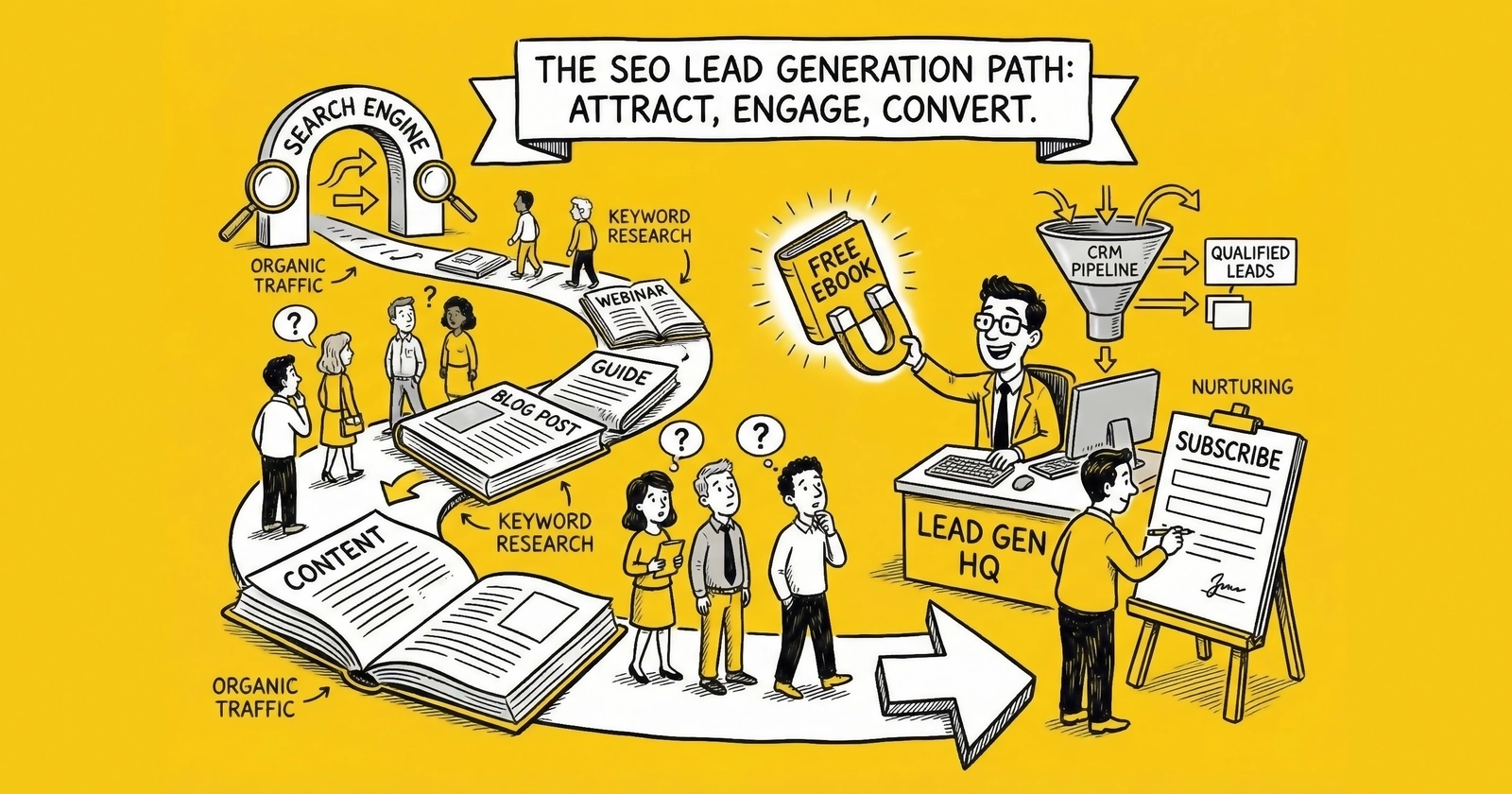
Learn how to build sustainable organic traffic for lead generation websites, from keyword research to local SEO, with specific strategies that produce qualified leads instead of vanity metrics.
A single comparison article ranking on page one for “best home warranty companies” generates 400-600 leads per month at zero marginal acquisition cost. The same traffic volume from paid search costs $35,000-50,000 monthly in ad spend.
That math explains why serious lead generation operators treat SEO as infrastructure, not marketing. Paid traffic buys speed. Organic traffic buys compounding returns that grow every month you hold rankings.
This guide covers everything you need to build organic traffic that converts: keyword strategy, content types, technical requirements, link building, and the timeline you should expect. No fluff about “creating valuable content.” Specific tactics that produce leads.
SEO vs Paid for Lead Generation: The Real Trade-Offs
Before investing in SEO, understand what you are trading.
The Case for Paid Traffic
Paid traffic wins on three dimensions:
-
Speed to market: Launch a campaign today, generate leads tomorrow. SEO takes 6-12 months to produce meaningful volume.
-
Precise control: Target specific geographies, demographics, and intent signals. Scale up or down instantly based on buyer demand.
-
Predictable economics: Calculate your CPA, multiply by volume, know your monthly spend. SEO costs are disconnected from results in unpredictable ways.
For practitioners who need leads this week, paid traffic is the only option. A new entrant in mortgage leads cannot wait 18 months for organic rankings while competitors capture market share.
The Case for Organic Traffic
Organic traffic wins on three different dimensions:
-
Marginal economics: Once ranked, additional traffic costs nothing. A page generating 500 leads monthly at $0 incremental cost changes your unit economics completely.
-
Compounding value: Unlike paid where stopping spend stops leads, organic assets appreciate. Content ranking today still ranks in two years with maintenance.
-
Buyer trust signals: Organic search results carry implicit credibility that paid placements lack. Conversion rates on organic traffic often run 20-40% higher than paid for the same keywords.
The Real Decision Framework
Most successful lead generation businesses run both channels with different strategic roles. Paid traffic handles new vertical entry, volume scaling, and testing demand. Organic traffic handles established verticals, margin optimization, and long-term asset building.
Those who struggle treat SEO as a cheaper alternative to paid. It is not cheaper – it requires different investment with different payoff curves.
AI Overviews: The New SEO Challenge (2025)
Google’s AI Overviews have fundamentally changed organic search economics for lead generation. Understanding this shift is critical before investing in SEO strategy.
The Click-Through Rate Impact
AI Overviews now appear on approximately 25-30% of US desktop searches. When they do, the impact on organic click-through rates is severe:
Average CTR drop when AI Overview is present: 61%
For informational queries, AI Overviews often provide complete answers without requiring a click. For commercial queries relevant to lead generation, the impact varies:
| Query Type | AI Overview Frequency | CTR Impact |
|---|---|---|
| ”What is [product]” (informational) | 60-80% | -70% to -85% |
| “Best [product] companies” (comparison) | 30-50% | -40% to -60% |
| “[Product] cost” (research) | 40-60% | -50% to -65% |
| “[Product] quotes near me” (transactional) | 10-20% | -20% to -30% |
Strategic Implications for Lead Generation
Transactional keywords retain value. Queries with explicit purchase intent (“quotes,” “buy,” “hire,” “near me”) see lower AI Overview frequency and less CTR erosion. These are your money keywords – protect and prioritize them.
Informational content becomes brand building, not traffic driving. Content that previously generated thousands of monthly visits may now generate hundreds as AI Overviews answer questions directly. Measure informational content by brand awareness and link acquisition, not traffic.
Featured snippets evolve. AI Overviews often pull from featured snippet content. Optimizing for Position Zero remains valuable – but the return is brand visibility within the AI Overview rather than direct clicks.
Long-tail complexity matters. AI Overviews struggle with highly specific, multi-factor queries. “Best auto insurance for 25-year-old with DUI in Phoenix” is less likely to trigger an AI Overview than “best auto insurance.” Target complexity that AI cannot easily summarize.
Adaptation Strategy
- Audit AI Overview impact: Use SEO tools to identify which ranking keywords now show AI Overviews and track CTR changes
- Shift keyword targeting: Prioritize transactional and local intent queries where AI Overviews are less common
- Protect high-converting pages: Focus technical SEO and link building on pages that drive actual leads, not informational traffic
- Develop AI-resistant content: Complex comparison tools, interactive calculators, and localized databases provide value AI cannot replicate
- Measure revenue, not rankings: A #1 ranking that generates no clicks due to AI Overviews is worth nothing
The SEO landscape is not dying – it is changing. Practitioners who adapt their strategy to the AI Overview reality will capture disproportionate value as competitors continue optimizing for metrics that no longer matter.
Keyword Research for Lead Generation
Keyword research for lead generation differs from e-commerce or informational sites. You are not optimizing for traffic volume. You are optimizing for conversion potential weighted by ranking difficulty.
High-Intent Commercial Keywords
These are the money keywords – terms that signal a consumer actively shopping for a product or service. Examples:
- “auto insurance quotes [city]”
- “best mortgage lenders for first time buyers”
- “solar panel installation cost 2025”
- “personal injury lawyer near me”
Characteristics of high-intent keywords:
| Signal | Why It Matters |
|---|---|
| Commercial modifier (“buy,” “cost,” “quote,” “hire”) | Indicates shopping mode, not research mode |
| Local qualifier (city, state, “near me”) | Signals immediate purchase intent |
| Specific product/service | Bypassed the awareness stage |
| Comparison intent (“best,” “top,” “vs”) | Ready to decide, not just browsing |
The volume trap: High-intent keywords often have lower search volume than informational terms. “What is term life insurance” gets 10x the searches of “term life insurance quotes online.” The second term produces 50x more leads per visitor. Optimize for lead potential, not traffic volume.
Comparison and “Best” Keywords
Comparison keywords represent the highest-converting traffic in lead generation. A searcher typing “Progressive vs Geico auto insurance” has already decided to buy – they are choosing between options.
High-value comparison patterns: “[Brand A] vs [Brand B],” “best [product/service] for [use case],” “top [number] [product/service] companies 2025,” and “[product] reviews.”
Keyword difficulty reality check: These terms are competitive. A page ranking for “best home insurance companies” can generate $50,000+ monthly in lead revenue. Expect to invest $5,000-15,000 in content and links to rank for competitive comparison terms.
Question Keywords
Question keywords capture consumers early in the buying journey – lower conversion rates but also lower competition and useful for building topical authority.
Effective patterns: “How much does [service] cost?”, “Is [product] worth it?”, “When should I [action]?”, “What [product type] do I need for [situation]?”
Strategy: Build content clusters where question articles link to comparison articles and landing pages. Question content earns links; commercial content converts.
Long-Tail Keyword Mining
Long-tail keywords (4+ words, specific intent) often convert better than broad terms because they match precise user needs.
Long-tail discovery sources:
- Google Search Console: Find terms you rank positions 5-20 where content improvements could push you to page one
- Competitor content gaps: Use Ahrefs or Semrush to find keywords competitors rank for that you do not
- Answer the Public / AlsoAsked: Generate question variations around seed keywords
- Reddit and forums: Find the exact language consumers use when discussing purchases
- Customer service logs: Questions leads ask before converting are keyword opportunities
Content Types That Generate Leads
Not all content performs equally for lead generation. Focus on formats with proven conversion pathways.
Comparison Articles
Comparison content converts because it meets searchers at the decision point. Someone searching “LendingTree vs Rocket Mortgage” is ready to apply – they need to decide where.
Comparison article structure that converts:
- Summary table above the fold: Winner, pricing, key differentiators visible without scrolling
- Quick verdict: One paragraph stating which option suits which user
- Detailed comparison sections: Feature-by-feature breakdown
- Embedded lead forms: One after the summary, one mid-article, one after conclusion
- Decision framework: “Choose A if [criteria], choose B if [criteria]”
Conversion rate benchmarks: Well-optimized comparison articles convert 8-15% of visitors into form submissions. Articles without embedded forms or clear next steps convert 1-3%.
Content depth requirement: To rank for competitive comparison terms, expect to write 3,000-5,000 words. Google rewards comprehensive coverage. A 500-word comparison will not outrank established pages.
Calculators and Interactive Tools
Calculators convert because they deliver personalized value before asking for information. A mortgage payment calculator gives the user something useful – then asks for contact details to “get actual quotes.”
High-converting calculator types by vertical:
| Vertical | Calculator Type | Typical Conversion Rate |
|---|---|---|
| Mortgage | Payment calculator, affordability calculator | 15-25% |
| Insurance | Quote estimator, coverage calculator | 12-20% |
| Solar | Savings calculator, payback period calculator | 18-30% |
| Home Services | Project cost estimator | 10-18% |
| Legal | Settlement calculator, case value estimator | 8-15% |
Build vs. embed decision: Building custom calculators requires development investment ($3,000-15,000) but provides ownership and differentiation. Embedding third-party calculators (like Zillow mortgage widgets) requires no investment but limits lead capture options.
SEO benefit: Calculators earn links naturally. Personal finance sites link to useful tools. This link equity flows to your domain, lifting rankings across all pages.
Comprehensive Guides and Resources
Pillar content establishes topical authority and creates internal linking structure that distributes ranking power across your site.
Effective guide formats: Buyer’s guides, process explainers (“How [Process] Works”), cost guides, and checklist content (“[Number] Questions to Ask Before [Purchase]”).
Internal linking structure: Guide content should link to comparison articles and landing pages, distributing authority from linkable guides to converting pages.
Word count benchmarks: Comprehensive guides that rank typically run 4,000-8,000 words. Content under 2,000 words rarely ranks for competitive queries.
Local Landing Pages
For lead generation in service businesses, local pages capture geographic-specific search intent.
Local landing page elements: Geographic-specific H1, local proof elements (reviews, credentials), NAP consistency matching Google Business Profile, local schema markup, embedded map, and local pricing context.
Scale strategy: Build local pages for every service area, but each page needs unique, substantive content – not just city-name swaps. Google penalizes doorway pages.
Minimum viable local page: 800-1,200 words of unique content, 3-5 local proof elements, embedded contact form, local schema markup.
On-Page Optimization for Conversions
Ranking means nothing if visitors do not convert. On-page optimization for lead generation balances SEO requirements with conversion elements.
Title Tags That Drive Clicks and Conversions
Title tags must accomplish two objectives: rank for target keywords and generate clicks from search results.
Title tag formula for lead generation:
[Primary Keyword] - [Value Proposition or Differentiator] | [Brand]Examples:
- “Compare Auto Insurance Quotes - Get 5+ Rates in 2 Minutes | QuoteCompare”
- “Best Mortgage Lenders 2025 - Side-by-Side Comparison | RateWatch”
- “Solar Installation Cost Calculator - See Your Savings | SolarLeads”
Click-through rate impact: Moving from a generic title to a benefit-driven title can increase CTR by 20-30%. Higher CTR sends positive signals to Google, potentially improving rankings.
Meta Descriptions That Pre-Qualify
Meta descriptions do not directly affect rankings but dramatically influence which visitors click through.
Meta description strategy for lead generation:
- Include the primary keyword (Google bolds matching terms)
- State the value proposition (what the user gets)
- Pre-qualify with specifics (filter out non-leads)
- Include a call to action (tell them what to do next)
Example: “Compare auto insurance rates from 8+ carriers in 2 minutes. See which company offers the lowest rates for your driving record. Get your free quotes online now.”
Heading Structure for User Experience and SEO
Heading structure (H1, H2, H3) organizes content for both search engines and users. For lead generation pages, headings should follow the user’s decision journey: primary keyword + value proposition (H1), then benefit categories, how it works, comparison/options, pricing, FAQ, and CTA sections (H2s).
Form Placement and Optimization
Form placement directly affects conversion rate. SEO-optimized pages need forms integrated naturally within content.
Form placement best practices:
| Position | Purpose | Typical Conversion Contribution |
|---|---|---|
| Above the fold | Capture high-intent visitors immediately | 40-50% of conversions |
| Mid-content | Capture visitors who need more information | 20-30% of conversions |
| End of content | Capture visitors who read everything | 15-25% of conversions |
| Sticky sidebar/footer | Persistent visibility during scroll | 10-15% of conversions |
Form length tradeoff: Shorter forms (3-4 fields) convert more visitors. Longer forms (8-12 fields) qualify leads better. Test to find the balance for your buyer requirements.
Internal Linking for Lead Flow
Internal links distribute ranking authority and guide users toward conversion pages. Link from informational content to commercial content, use descriptive anchor text (“compare auto insurance quotes” not “click here”), create content hubs around pillar pages, and ensure your highest-converting pages receive the most internal links.
Technical SEO Requirements
Technical SEO ensures search engines can crawl, index, and understand your content. For lead generation sites, several technical factors directly impact conversion.
Core Web Vitals and Page Speed
Google uses Core Web Vitals as ranking factors. Slow pages also kill conversion rates – every second of load time costs 7% conversion rate.
Core Web Vitals targets:
| Metric | Target | Lead Gen Impact |
|---|---|---|
| Largest Contentful Paint (LCP) | < 2.5 seconds | First impression speed |
| First Input Delay (FID) | < 100 milliseconds | Form responsiveness |
| Cumulative Layout Shift (CLS) | < 0.1 | Form stability during load |
Speed optimization priorities: Optimize images (WebP, compression, lazy loading), minimize render-blocking resources, use a CDN, ensure forms render before other elements, and reduce third-party scripts.
Mobile Optimization
Google indexes mobile versions first. Ensure form usability (thumb-sized fields, auto-fill enabled), adequate click targets (48x48 pixels minimum), content parity with desktop, and click-to-call functionality for phone numbers.
Schema Markup for Rich Results
Schema markup helps search engines understand your content and can generate rich results (stars, pricing, FAQ) in search listings.
Schema types relevant to lead generation:
| Schema Type | Use Case | Rich Result Potential |
|---|---|---|
| FAQ | FAQ sections on pages | FAQ accordion in search results |
| HowTo | Process/step content | How-to rich snippets |
| Review/AggregateRating | Reviews of services | Star ratings in results |
| LocalBusiness | Local service pages | Local pack features |
| Product | Comparison of products | Product information panels |
Implementation approach: Use JSON-LD format in the page head. Test with Google’s Rich Results Test before deploying.
Crawlability and Indexation
Ensure search engines can access and index all important pages. Check that robots.txt is not blocking important pages, XML sitemap includes all indexable pages, canonical tags are correct, noindex directives only apply to pages that should not rank, and every important page is reachable within 3-4 clicks from homepage.
Link Building for Lead Generation Sites
Links remain a primary ranking factor. For competitive lead generation terms, quality backlinks are non-negotiable for page one rankings.
Link-Worthy Content Assets
Before building links, create content worth linking to. Lead generation pages rarely earn links naturally – you need linkable assets.
Linkable content types for lead gen sites:
- Original research: Survey consumers, analyze data, publish findings
- Comprehensive guides: The definitive resource on a topic attracts citation links
- Free tools and calculators: Useful tools earn links from bloggers and journalists
- Data visualizations: Original charts and infographics get embedded with attribution
- Expert quotes and contributions: Commentary to journalists results in citation links
Outreach Strategies That Work
Link building requires systematic outreach. Random requests to strangers rarely succeed.
Effective outreach approaches:
| Strategy | Description | Typical Success Rate |
|---|---|---|
| Broken link building | Find broken links on relevant sites, offer your content as replacement | 5-10% |
| Resource page outreach | Find “resources” or “tools” pages, pitch your content for inclusion | 3-8% |
| Guest posting | Write content for other sites with contextual links back | 15-25% (for quality sites) |
| HARO/journalist queries | Respond to journalist requests for expert sources | 2-5% (but high-value links) |
| Unlinked mentions | Find brand mentions without links, request link addition | 20-40% |
Outreach volume reality: Expect 5-15% positive response rates from cold outreach. Building 20 quality links requires 200-400 outreach emails. Plan resources accordingly.
Link Quality Over Quantity
Not all links are equal. One link from a DR70 news site provides more ranking power than 50 links from DR10 blogs. Focus on domain authority, topical relevance, editorial placement within content, and descriptive anchor text.
Link building investment benchmarks: Expect to invest $200-500 per quality link through agency or freelancer costs. DIY link building requires 2-5 hours per link.
Local SEO for Service Area Leads
For lead generation businesses serving specific geographies, local SEO captures high-intent local traffic.
Google Business Profile Optimization
Google Business Profile (GBP) controls visibility in local pack results – the map listings appearing above organic results.
GBP optimization checklist:
- Complete all fields: Business name, address, phone, hours, category, services, description
- Category selection: Most specific primary category plus all applicable secondary categories
- Photos: Minimum 10 photos including exterior, interior, team, and work examples
- Reviews: Actively solicit reviews (10+ minimum for competitive visibility)
- Q&A and Posts: Populate Q&A section; post weekly to signal active business
- Services/products: List all services with descriptions and pricing
Local Citation Building
Citations (mentions of your business name, address, phone on other websites) support local rankings.
Core citation sources:
- Aggregators: Data Axle, Localeze, Foursquare – feed data to hundreds of directories
- Industry directories: Vertical-specific directories (Avvo for legal, Healthgrades for medical)
- Local directories: Chamber of commerce, local business associations
- General directories: Yelp, Yellow Pages, BBB
Citation consistency requirement: NAP (Name, Address, Phone) must be identical across all citations. Inconsistencies confuse Google and hurt local rankings.
Reviews and Reputation
Reviews directly impact local rankings and conversion rates. Pages with reviews convert 270% better than pages without.
Review generation strategy: Ask after positive service completion, make it easy with direct links to Google review form, follow up via automated email/SMS 24-48 hours after service, and respond to all reviews (positive and negative).
Minimum review velocity: Aim for 5-10 new reviews monthly. Review velocity matters more than total count.
Measuring SEO ROI for Lead Generation
SEO investment requires measurement to justify continued spending and guide optimization decisions.
Key Metrics for Lead Generation SEO
Track metrics that connect to business outcomes, not vanity metrics.
Primary metrics:
| Metric | Definition | Target |
|---|---|---|
| Organic leads | Form submissions from organic traffic | Monthly growth |
| Organic lead conversion rate | Leads / organic sessions | 3-8% (varies by vertical) |
| Cost per organic lead | Total SEO investment / organic leads | Lower than paid CPL |
| Organic revenue attribution | Revenue from organic-sourced leads | Monthly growth |
Secondary metrics:
| Metric | Definition | Purpose |
|---|---|---|
| Keyword rankings | Position for target keywords | Leading indicator of traffic |
| Organic traffic | Sessions from organic search | Leading indicator of leads |
| Pages indexed | Number of pages in Google’s index | Content coverage |
| Referring domains | Unique sites linking to you | Authority indicator |
Attribution Challenges
SEO attribution is complicated by multi-touch journeys. A user might discover you through organic search, leave, return through paid search, and convert.
Practical recommendation: Use first-touch attribution for measuring organic lead generation effectiveness. This captures SEO’s role in introducing new prospects, even when users convert on later visits from different channels.
Calculating SEO ROI
ROI formula: (Revenue from Organic - SEO Investment) / SEO Investment x 100
Example: $8,000 monthly investment produces 400 organic leads. At 15% lead-to-customer rate and $500 average value, monthly organic revenue = $30,000. Monthly ROI = 275%.
Time horizon consideration: First-year ROI may be negative. Year two and beyond, the compounding effect produces outsized returns as content benefits from established authority.
Timeline: When to Expect Results
SEO timelines frustrate operators accustomed to paid traffic’s instant feedback. Setting realistic expectations prevents premature abandonment of strategies that need time to compound.
The Reality of SEO Timelines
Typical timeline by objective:
| Objective | Timeline | Dependencies |
|---|---|---|
| Technical issues resolved | 1-4 weeks | Size of site, crawl frequency |
| New content indexed | 1-7 days | Site authority, content quality |
| Ranking improvements for new content | 3-6 months | Competition, content quality, links |
| Top 3 rankings for competitive terms | 12-24 months | Link building, content depth |
| Meaningful organic traffic | 6-12 months | Content volume, keyword selection |
| Organic leads at scale | 12-18 months | Conversion optimization, traffic volume |
Factors That Impact Timeline
Accelerators: Existing domain authority, topical relevance to current site themes, quality link acquisition, comprehensive content, and fast technical infrastructure all speed results.
Delays: New domains (12-18 months to build authority), competitive keywords, thin content, technical crawl issues, and inconsistent investment all slow results.
The critical insight: Budget SEO as a 12-24 month program, not a 3-month test. Practitioners who abandon SEO at month 6 often quit right before the compounding begins.
FAQ: SEO for Lead Generation
How much should I budget for SEO?
Budget $3,000-10,000 monthly for competitive lead generation verticals. This covers content creation ($1,500-4,000), link building ($1,000-3,000), and technical optimization ($500-1,500). Below $3,000 monthly, you will struggle to compete against better-funded competitors. Above $10,000, you are likely in an extremely competitive vertical (insurance, mortgage, legal) where those investments are justified.
How long does SEO take to generate leads?
Expect 6-12 months before organic traffic contributes meaningful lead volume. Initial rankings may appear in 3-4 months, but the traffic volume needed for consistent leads takes longer to build. Sites with existing authority may see results faster. New domains take 12-18 months.
Can I do SEO myself or do I need an agency?
You can execute basic SEO yourself if you have 10-15 hours weekly to dedicate. Content creation, technical audits, and outreach are learnable skills. However, link building at scale and technical optimization often justify agency investment. A common hybrid approach: create content in-house, outsource link building.
What keywords should lead generation sites target first?
Start with long-tail, lower-competition keywords that still indicate buying intent. “Best auto insurance for young drivers 2025” is easier to rank than “auto insurance quotes.” Build traffic and authority on easier terms before targeting head terms. Use keyword difficulty metrics in Ahrefs or Semrush to identify achievable targets.
How do I rank for local lead generation keywords?
Optimize Google Business Profile completely, build consistent local citations, generate reviews continuously, and create location-specific landing pages with unique content. Local SEO requires both traditional SEO signals and local-specific signals (GBP, citations, reviews).
Should I focus on SEO or paid traffic first?
Start with paid traffic if you need leads immediately or are testing a new vertical. Once you have proven demand and have cash flow, invest in SEO for long-term margin improvement. Running both simultaneously is optimal – paid for immediate results, SEO for compounding returns.
How many backlinks do I need to rank?
There is no universal number. Study your competitors for target keywords. If top 3 results have 50-100 referring domains, you need similar link profiles. Focus on quality over quantity – 10 links from high-authority relevant sites outperform 100 low-quality links.
Do I need to update old content for SEO?
Yes. Content decay is real – rankings decline as content ages and competitors publish newer content. Audit top-performing pages annually. Update statistics, add new sections, refresh examples, and re-promote for additional links. Updating existing content often produces faster results than creating new content.
What is the biggest SEO mistake lead generation sites make?
Optimizing for traffic instead of leads. High-traffic informational keywords feel successful but generate few conversions. Focus on commercial and comparison keywords that attract buyers, not researchers. A page with 1,000 monthly visitors and 8% conversion rate beats a page with 10,000 visitors and 0.5% conversion rate.
How do I track organic leads accurately?
Implement proper UTM parameters and set up goal tracking in Google Analytics. Segment organic traffic in your CRM to track lead source through the sales funnel. Use first-touch attribution to credit organic search for leads that entered through organic, even if they converted on a later visit from a different channel.
Key Takeaways
-
SEO compounds while paid depletes: Organic traffic builds asset value over time. Paid traffic stops when spending stops. Treat SEO as infrastructure investment, not marketing expense.
-
Target conversion potential, not traffic volume: High-intent commercial keywords convert 5-10x better than informational keywords. Optimize for leads generated, not sessions counted.
-
Comparison content converts best: Visitors searching “[Brand A] vs [Brand B]” or “best [product] for [use case]” are ready to buy. Build your content strategy around decision-stage keywords.
-
Local SEO requires specific investments: Google Business Profile optimization, citation building, and review generation are separate workstreams from traditional SEO. Service-area businesses need both.
-
Budget for 12-24 months: SEO timelines do not match paid traffic’s instant feedback. Expect 6-12 months before meaningful lead flow. Practitioners who quit at month 6 often quit right before compounding begins.
-
Measure what matters: Track organic leads and cost per organic lead, not rankings or traffic as primary metrics. Connect SEO investment to revenue attribution for true ROI calculation.
Last updated: December 2024