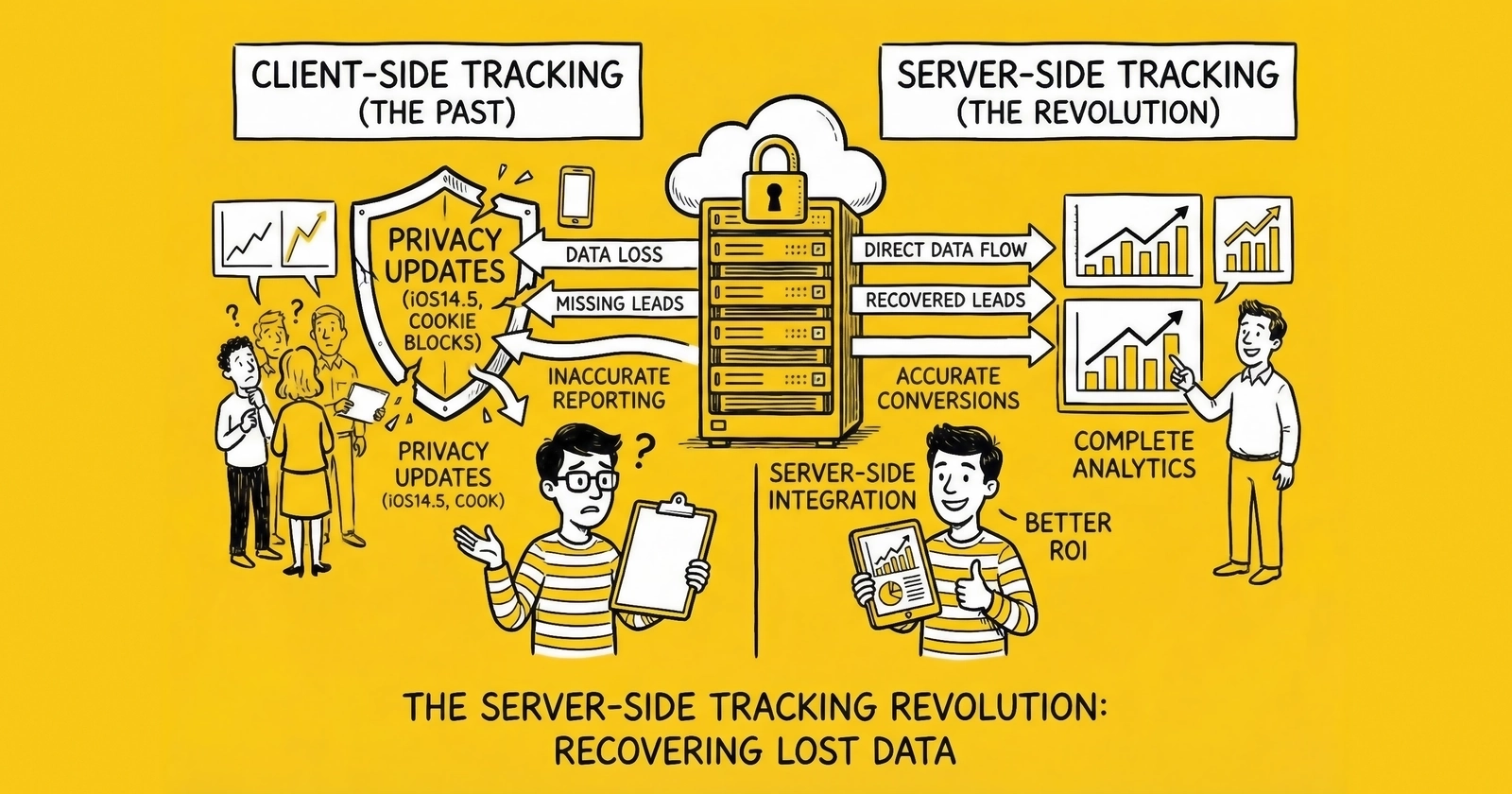
Your measurement infrastructure is hemorrhaging 30-40% of conversion signals. Server-side tracking stops the bleeding and restores the visibility your lead generation economics demand.
The numbers in your dashboard are wrong. Not slightly off. Fundamentally, systematically wrong in ways that compound into catastrophic budget decisions.
Every quarter, the gap widens. Browser privacy features tighten. Ad blockers proliferate. iOS restrictions expand. And the conversion data that should guide your traffic optimization decisions vanishes somewhere between the consumer’s click and your attribution model.
This is not a future threat to prepare for. This is current reality. Over 31% of internet users worldwide now employ ad blockers. Safari restricts cookies to seven days, or just 24 hours for traffic arriving from platforms classified as trackers (Google and Meta are on that list). Approximately 75% of iOS users have opted out of tracking since App Tracking Transparency launched. The cumulative effect: client-side tracking captures only 60-70% of actual conversions in typical lead generation scenarios.
Server-side tracking represents the most significant infrastructure shift in digital marketing measurement since the pixel was invented. By routing conversion data through your own servers before sending it to ad platforms, you bypass the browser restrictions that destroy signal. The result: 20-40% recovery of previously lost conversions, campaigns that optimize toward reality rather than a distorted subset of your actual performance, and unit economics that finally reflect what is actually happening.
This guide covers the architecture, implementation approaches, hybrid strategies, and signal recovery benchmarks that lead generators need to understand. Whether you are evaluating server-side tracking for the first time or optimizing an existing implementation, the frameworks here will help you recover the data that browser restrictions are stealing.
The Measurement Crisis in Lead Generation
Before diving into server-side implementation, you need to understand exactly what is breaking and why. The tracking crisis affects lead generation more severely than most digital marketing verticals because the business model depends entirely on attribution accuracy.
Why Lead Generation is Uniquely Vulnerable
Lead generation is traffic arbitrage. You buy clicks at one price and sell leads at another. The entire margin depends on knowing true cost per lead by source. When 30-40% of conversion signals vanish, your CPL calculations are not just imprecise. They are systematically biased in ways that destroy budget optimization.
Consider the mechanics. A consumer clicks your Google ad on Monday, lands on your landing page, but does not convert. They return Wednesday via a TikTok retargeting ad and still do not convert. Friday, they come back through a branded Google search and finally submit the lead form.
In a functioning attribution system, all three touchpoints receive appropriate credit. The initial Google ad gets first-touch credit. The TikTok retargeting gets assist credit. The branded search gets last-touch credit. Budget flows accordingly.
In reality, here is what happens:
- The Monday session’s cookie may have expired (Safari limits to 7 days, or 24 hours for link-decorated traffic)
- The TikTok touchpoint likely never tracked at all (mobile user, ATT opt-out, ad blocker)
- Only the Friday branded search receives any credit
Your dashboard shows Google branded search crushing it while TikTok appears to drive nothing. Budget shifts accordingly. You defund the awareness campaign that initiated the conversion while over-investing in the search campaign that merely captured already-aware consumers.
This is not hypothetical. This is the default state of client-side tracking in 2025.
The Three Layers of Signal Loss
Signal loss compounds across multiple mechanisms:
Layer 1: Browser Privacy Features
Safari’s Intelligent Tracking Prevention (ITP) has evolved through multiple versions since 2017:
- ITP 2.1 reduced first-party cookies to 7 days when set via JavaScript
- ITP 2.2 shortened cookies to 24 hours for traffic arriving with link decoration (gclid, fbclid parameters) from classified tracking domains
- ITP 2.3 extended restrictions to localStorage, eliminating developer workarounds
Firefox Enhanced Tracking Protection (ETP) operates similarly, blocking known tracking domains and restricting cookie access. Edge implements comparable protections.
Safari represents approximately 18% of US desktop traffic and 27% of mobile traffic. Among iOS users, Safari’s share dominates. These are often your highest-value prospects: higher income brackets, newer devices, stronger purchase intent. And they are increasingly invisible to your tracking.
Layer 2: Ad Blockers
Ad blocker usage reached 912 million users globally as of 2024. In the United States, 32.2% of internet users employ ad blockers. Among ages 18-34, the demographic most valuable for insurance, solar, financial services, and education leads, adoption rises to 42%.
Ad blockers do not just block ads. They block tracking scripts. When your Meta Pixel or Google tag cannot load, no conversion data reaches the platform regardless of browser policy.
Layer 3: iOS App Tracking Transparency
Apple’s ATT framework, launched in April 2021, presented users with an explicit choice: allow tracking or do not allow. Approximately 75% chose not to allow.
The impact extends beyond mobile apps. iOS users represent approximately 60% of US smartphone market share. They skew toward higher income. They are disproportionately represented among your best prospects. When three-quarters of this audience opts out, your attribution model systematically misses your highest-value conversions.
The Compounding Problem
These three layers do not just add together. They compound. An iOS user visiting via Safari with ad blocker enabled faces triple restriction. Your tracking sees nothing from this person. Not the ad click. Not the page visit. Not the conversion.
Research suggests client-side tracking now captures only 60-70% of actual conversions in many lead generation scenarios. The missing 30-40% is not random. It systematically over-represents:
- Younger users (higher ad blocker usage)
- Mobile users (ATT restrictions)
- Multi-device journeys (cookie isolation)
- Multi-day conversions (cookie expiration)
- Privacy-conscious users (often higher income, better credit)
Your attribution model does not just undercount. It undercounts specifically the segments you most want to reach.
Server-Side Tracking Architecture
Server-side tracking fundamentally restructures how conversion data flows from your website to advertising platforms. Understanding the architecture helps you evaluate implementation options and optimize for signal recovery.
Client-Side vs Server-Side: The Core Difference
In client-side tracking, the user’s browser executes JavaScript that fires tracking pixels directly to ad platforms. This creates a direct line from browser to Google, Meta, TikTok, or whatever platform you are measuring. Every failure point we discussed, ad blockers, ITP, ETP, ATT, exists along this path.
Server-side tracking inserts your server into the middle of this flow:
- User submits lead form on your website
- Form data goes to your server (this always works, no browser restrictions apply)
- Your server retrieves stored click identifiers from first-party cookies
- Your server fires API calls directly to ad platforms
- Conversion data reaches platforms via server-to-server connection
To the browser, this looks like a standard form submission to your own domain. There is no third-party request for ad blockers to intercept. Your cookies are genuinely first-party, set by your domain, on your domain, for your domain. Browser privacy features treat them more permissively than third-party tracking infrastructure.
First-Party Data Advantage
The reason server-side tracking survives browser restrictions comes down to first-party versus third-party classification.
Third-party tracking involves one domain (an ad platform) tracking user behavior across other domains (your website). This is exactly what privacy features target. Browsers have legitimate reasons to restrict cross-site surveillance.
First-party tracking involves your domain tracking behavior on your domain. Browsers cannot meaningfully restrict this without breaking the web. A website must be able to remember its own visitors.
When you capture a click identifier (gclid, fbclid, ttclid) on landing page arrival and store it in a cookie on your domain, that cookie is first-party. When the user converts and your server retrieves that identifier, you are accessing your own data on your own domain. When your server then fires an API call to Google or Meta, that is a server-to-server request that no browser policy affects.
The signal recovery comes from restructuring the data flow to use mechanisms browsers cannot restrict.
The Hybrid Approach: Client + Server
Best practice is running client-side and server-side tracking together, not replacing one with the other.
Client-side tracking still captures real-time signals: page views, button clicks, scroll depth, video plays. These micro-conversions inform platform optimization even when macro-conversions (lead submissions) are not visible.
Server-side tracking ensures the lead submission itself gets recorded even when client-side fails. The two systems complement each other.
The critical implementation detail is deduplication. When both systems record the same conversion, you need a mechanism to prevent double-counting. The solution is a shared event identifier: generate a unique event_id when the conversion happens, include it in both the client-side pixel fire and the server-side API call. Platforms recognize matching event_ids as duplicates and count once.
Meta’s documentation is explicit about this. Google supports similar deduplication. Any hybrid implementation must handle this correctly or your conversion counts will inflate.
Google Server-Side GTM Implementation
Google Tag Manager Server-Side (sGTM) provides the most accessible entry point for server-side tracking. If you already use GTM for client-side tagging, the server-side extension uses familiar concepts and interfaces.
Architecture Overview
sGTM deploys a server container, a separate GTM environment running on cloud infrastructure that receives events from your web container. The server container processes data and forwards it to ad platforms via their APIs.
The flow works like this:
- Web container (your existing GTM) fires tags that send data to your server container
- Server container runs on your subdomain (e.g., tracking.yourdomain.com)
- Because it is your subdomain, requests and cookies are first-party
- Server container processes events and fires to Google Ads, Google Analytics 4, Meta, and other platforms via server-side tags
The server container acts as an intermediary that sanitizes data flow and extends cookie lifespans.
Hosting Options and Costs
You have three primary hosting approaches:
Google Cloud Platform (GCP): The native option. Cloud Run hosts your server container. Costs run $120-300 monthly for production volumes typical of lead generation operations. Google provides $100/month credit for first 12 months, reducing initial investment.
Specialized Hosting Providers: Companies like Stape.io, Addingwell, and Taggrs optimize infrastructure specifically for sGTM. Pricing starts at $20/month for up to 500,000 requests, scaling to $100-200/month for higher volumes. These providers handle infrastructure management, making implementation simpler.
Self-Hosted on Other Clouds: You can deploy on AWS, Azure, or any cloud provider capable of running Node.js containers. This offers maximum control but requires more DevOps capability.
For most lead generation operations, specialized hosting providers offer the best balance of cost, simplicity, and capability.
Implementation Timeline
A basic sGTM implementation can be operational in 1-2 weeks:
Week 1: Setup and Configuration
- Provision server container (GCP or specialized host)
- Configure custom subdomain (critical for first-party status)
- Deploy basic tags (Google Ads conversion tracking, GA4)
- Test data flow in preview mode
Week 2: Enhancement and Validation
- Add Meta Conversions API integration
- Configure event deduplication
- Implement click ID persistence
- Validate against known conversion volume
Ongoing: Optimization
- Monitor Event Match Quality scores
- Add additional platform integrations as needed
- Tune cookie durations for your conversion window
Click ID Persistence
The most critical element of any sGTM implementation is persisting click identifiers.
When a user lands on your page from a paid ad, the platform appends a unique identifier:
- Google: gclid
- Meta: fbclid
- TikTok: ttclid
- Microsoft: msclkid
These identifiers exist only in the landing page URL. If the user navigates away, converts on a different page, or returns days later, the identifier is gone unless you captured and stored it.
Your server container should:
- Extract click identifiers from URL parameters on every page load
- Store them in first-party cookies on your domain
- Retrieve them when conversions fire
- Include them in server-side API calls
Additionally, pass click identifiers into hidden form fields so they persist directly with the lead record. This provides redundancy if cookies are cleared between landing and conversion.
iOS 26 Resilience
Apple’s Link Tracking Protection, expanding with iOS 26, strips known click identifiers (gclid, fbclid) in Private Browsing and increasingly in regular browsing contexts.
The resilience strategy: use custom parameter names not on Apple’s known list. Instead of passing gclid directly, your ad might use aclid or a similar custom parameter. Your server container then translates aclid back to gclid before forwarding to Google.
This is not circumvention of privacy features. It is maintaining attribution through first-party infrastructure rather than browser-level surveillance.
Meta Conversions API Deep Dive
Meta’s Conversions API (CAPI) is the platform’s server-side tracking solution. While it can run independently, it works best alongside the Meta Pixel in a hybrid configuration.
Event Match Quality: The Key Metric
Meta evaluates your CAPI implementation through Event Match Quality (EMQ), a score from 0-10 reflecting how well your customer data matches actual Meta users.
Industry benchmarks show average EMQ scores between 4-6. Top-performing campaigns maintain scores of 8-10. The difference matters:
- EMQ improvements of 2-3 points typically correlate with 15-25% better ROAS
- Poor EMQ (below 4) can increase customer acquisition costs by 40-60%
Meta’s algorithm weights high-EMQ events more heavily in optimization. Better matching means better signal, which means better campaign performance.
Maximizing EMQ Through Complete Data
EMQ depends on the identifiers you send with each conversion event:
High-Value Identifiers (Deterministic)
- Hashed email address (SHA-256)
- Hashed phone number
- Meta’s _fbp cookie value (browser identifier)
- Meta’s _fbc value (derived from fbclid parameter)
- External ID (your customer ID, hashed)
Lower-Value Identifiers (Probabilistic)
- IP address
- User agent string
- Browser ID
For lead generation, capturing email and phone during form submission provides the deterministic identifiers that drive high EMQ. Send both whenever available. Include first name and last name (hashed) for additional matching signal.
The _fbp and _fbc cookies are critical but often overlooked. Forward these browser identifiers alongside customer data. They provide the link between the server-side event and Meta’s existing browser data.
Deduplication Implementation
When running Pixel and CAPI together (Meta’s recommended approach), deduplication prevents double-counting.
The mechanism:
- When conversion happens, generate a unique event_id
- Include this event_id in the Pixel fire (client-side)
- Include the same event_id in the CAPI call (server-side)
- Meta recognizes matching event_ids as the same event
Implementation approaches vary:
- JavaScript generates event_id on form submission, passes to both Pixel and server
- Server generates event_id, returns to page for Pixel fire
- Some platforms handle this automatically through integrated solutions
Test deduplication before production deployment. Run both systems in parallel for a week and compare:
- Total events from Pixel only
- Total events from CAPI only
- Deduplicated total
The deduplicated total should be close to your actual conversion volume. If it is significantly higher than your CRM shows, deduplication is failing.
Performance Benchmarks
Meta’s published data shows advertisers using CAPI alongside Pixel achieve:
- 13% lower cost per result
- 19% additional attributed events
- Improved optimization from higher signal volume
The additional attributed events represent conversions that Pixel alone would miss due to ad blockers, browser restrictions, and ATT opt-outs. The lower cost per result comes from better optimization driven by more complete data.
For lead generation operations, 19% additional attributed events can dramatically shift understanding of which traffic sources actually perform.
Beyond Google and Meta: Platform-Specific APIs
While Google sGTM and Meta CAPI receive the most attention, other platforms offer server-side capabilities that serious lead generators should implement.
TikTok Events API
TikTok’s Events API enables server-side event transmission similar to Meta CAPI. Given TikTok’s audience skews young and mobile, the populations with highest blocking rates, server-side tracking is particularly valuable.
Implementation follows familiar patterns:
- Capture ttclid on landing
- Store in first-party cookie
- Fire server-side events via API
- Include user data for matching
TikTok’s matching algorithm uses similar logic to Meta: hashed email and phone provide strongest signal.
Microsoft Conversions API
Microsoft Advertising supports server-side tracking through Universal Event Tracking (UET) for server-side and Offline Conversions API. The msclkid parameter works like gclid for Microsoft Ads traffic.
For lead generators running Microsoft Ads alongside Google, implementing server-side for both platforms ensures consistent attribution across paid search inventory.
LinkedIn Conversions API
LinkedIn’s Conversions API enables server-side event tracking for B2B lead generation. Given LinkedIn’s first-party login data, match rates tend to be high when providing hashed email addresses.
For B2B verticals (commercial insurance, business services, enterprise software), LinkedIn server-side tracking ensures high-value conversions are properly attributed.
Unified Implementation Approach
Rather than implementing each platform separately, consider unified approaches:
GTM Server-Side: Configure your server container to fire to multiple platforms from a single event stream. One conversion triggers Google Ads, Google Analytics, Meta, and TikTok in parallel.
Customer Data Platforms: Tools like Segment, RudderStack, or Hightouch can route server-side events to multiple destinations from centralized data infrastructure.
Lead Distribution Platforms: Modern platforms like boberdoo, LeadsPedia, and Phonexa increasingly offer native conversion API integrations. When a lead processes through your distribution system, the platform can fire server-side events automatically.
The unified approach reduces implementation complexity and ensures consistent data across platforms.
Signal Recovery Benchmarks
Understanding realistic signal recovery expectations helps set proper goals and evaluate implementation success.
Recovery Rates by Audience Composition
Signal recovery depends heavily on your audience profile:
Mobile-Heavy, Young Demographics (Solar, Home Services, Education)
- Expected recovery: 25-35%
- These audiences have highest blocking rates: ATT opt-outs, ad blockers, multi-device journeys
- Server-side impact is most dramatic
Mixed Desktop/Mobile (Insurance, Mortgage)
- Expected recovery: 15-25%
- Desktop users already tracked reasonably well
- Gains come from mobile segment and multi-day conversions
B2B Desktop-Heavy (Commercial Services, Enterprise)
- Expected recovery: 10-15%
- Desktop, single-session conversions track well client-side
- Gains from ad blocker circumvention and extended cookie duration
These ranges reflect industry measurements, but your specific results depend on traffic source mix, conversion window length, and geographic distribution.
Campaign Performance Improvements
Beyond raw conversion recovery, server-side tracking improves campaign performance through better algorithm training:
Better Optimization: Ad platforms optimize toward the signals they receive. When 30% of conversions are invisible, algorithms optimize toward a distorted subset. Server-side tracking feeds algorithms complete data, improving their ability to find converting audiences.
More Accurate Smart Bidding: Google’s Target CPA and Target ROAS strategies depend on accurate conversion data. Missing conversions cause these strategies to underbid, missing opportunities. Complete data enables aggressive but accurate bidding.
Improved Lookalike/Similar Audiences: Audience models built on incomplete data produce incomplete targeting. Server-side tracking ensures your seed audiences reflect actual converters, not just the subset browsers allowed you to track.
One study documented 23% average ROAS lift after implementing server-side tracking with enhanced conversions. The improvement came not from strategy changes but from feeding better data into existing campaigns.
ROI Calculation
Server-side tracking typically pays for itself within 30 days. The math:
Costs
- Hosting: $20-300/month depending on approach
- Implementation: 20-80 hours depending on complexity
- Ongoing maintenance: 2-5 hours/month
Value
- Recovered conversions enable proper attribution
- Proper attribution enables correct budget allocation
- Correct allocation improves overall ROAS
- Additionally: improved optimization from better algorithm training
If you spend $50,000/month on paid traffic and recover 20% more attribution signal, your apparent CPL drops proportionally. A $50 CPL becoming $41.67 CPL on the same spend represents $8,333 in perceived efficiency gains monthly. Against $100-300/month hosting cost, ROI is substantial.
The harder-to-quantify value is correct budget allocation. If server-side tracking reveals that TikTok actually outperforms Google (because you were missing 60% of TikTok conversions versus 10% of Google conversions), the budget reallocation benefits compound over time.
Implementation Strategies for Lead Generators
Lead generation has specific requirements that generic server-side guidance often misses. These strategies address lead-specific concerns.
Integration with Lead Distribution
Your lead distribution platform is the source of truth for actual conversions. Integrating server-side tracking with distribution infrastructure creates closed-loop attribution.
Conversion on Lead Acceptance: When your distribution platform accepts a lead (versus rejecting as duplicate/invalid), fire a conversion event. This is the true conversion moment, not the form submission.
Revenue Events on Lead Sale: When a lead sells to a buyer, fire a purchase or revenue event with actual sale value. This enables optimization toward leads that generate revenue, not just leads that pass validation.
Return Events: When buyers return leads, consider firing negative adjustments. Some platforms support conversion value modification to reflect post-sale outcomes.
Modern distribution platforms increasingly support these integrations natively. Check whether your platform offers conversion API connectors before building custom solutions.
Multi-Buyer Attribution
Lead generation uniquely sells the same lead to multiple buyers (shared leads) or the same consumer across different campaigns. Server-side infrastructure should handle this complexity.
For shared leads sold to three buyers, fire separate conversion events to each platform that drove the initial click. Use attribution windows that reflect your business model: a lead captured Monday might sell Wednesday and again Friday.
For consumers who submit leads across multiple campaigns (shopping auto insurance this month, home insurance next month), unified identity resolution links these conversions to their originating traffic. Server-side infrastructure persists identifiers across sessions to enable this matching.
Downstream Conversion Integration
The most sophisticated implementations extend beyond lead capture to track buyer outcomes.
When a buyer contacts a lead, schedules an appointment, or closes a sale, that outcome should flow back to your advertising platforms. Server-side infrastructure can receive webhooks from buyers when downstream events occur and fire corresponding conversion events.
This enables optimization toward leads that actually convert for buyers, not just leads that look good at capture. The result: better lead quality, higher buyer satisfaction, and premium pricing justified by documented performance.
Consent Documentation
Server-side tracking does not bypass consent requirements. You must still obtain appropriate consent before tracking users and sharing data with platforms.
What server-side tracking does is provide a central enforcement point. Your server can verify consent status before firing any events. This is actually stronger compliance than client-side tracking, where JavaScript might fire before consent systems fully load.
Integrate consent management with your server-side infrastructure. Check consent status on every event. Log consent alongside conversion data. This documentation protects you if consent practices are ever questioned.
Frequently Asked Questions
What exactly is server-side tracking and how does it differ from traditional tracking?
Server-side tracking routes conversion data through your own servers before sending it to advertising platforms like Google and Meta. Traditional client-side tracking uses JavaScript in the browser to send data directly to ad platforms. The fundamental difference: server-side requests originate from your servers using direct API calls, while client-side requests originate from the user’s browser using pixels. Server-side requests cannot be blocked by ad blockers, are not affected by Safari’s Intelligent Tracking Prevention or Firefox’s Enhanced Tracking Protection, and use genuinely first-party cookies that persist longer. This architecture recovers 20-40% of conversion signals that client-side tracking loses to browser privacy restrictions.
How much conversion signal can I realistically recover with server-side tracking?
Recovery rates depend on your audience composition. Operations targeting younger, mobile-heavy audiences (solar, education, home services) typically see 25-35% signal recovery because these users have the highest blocking rates from ATT opt-outs, ad blockers, and multi-device journeys. Mixed desktop/mobile audiences (insurance, mortgage) see 15-25% recovery. B2B operations with desktop-heavy traffic see 10-15% recovery. These percentages represent conversions that were actually happening but invisible to client-side tracking. Recovering them does not increase actual conversions but restores visibility into conversions you were already generating.
What does server-side tracking implementation cost?
Infrastructure costs range from $20 to $300 per month depending on approach and volume. Specialized hosting providers like Stape.io offer plans starting at $20/month for up to 500,000 requests. Google Cloud Platform’s Cloud Run runs $120-300/month for typical production volumes, with a $100/month credit for the first year. Self-hosted solutions on AWS or other clouds vary based on infrastructure choices. Implementation time ranges from 20 to 80 hours depending on complexity and existing infrastructure. For operations spending over $10,000 monthly on advertising, the investment typically pays for itself within 30 days through improved campaign efficiency and recovered attribution signal.
Do I still need browser-side tracking if I implement server-side?
Yes, best practice is running both systems together in a hybrid configuration. Client-side tracking captures real-time user engagement signals: page views, scroll depth, button clicks, video plays. These micro-conversion signals inform platform optimization even when final conversions are not visible. Server-side tracking ensures the lead submission itself gets recorded when client-side fails. Meta explicitly recommends running Pixel and Conversions API together. The critical requirement is implementing event deduplication to prevent double-counting when both systems record the same conversion.
What is Event Match Quality and why does it matter for Meta Conversions API?
Event Match Quality (EMQ) is Meta’s score from 0-10 measuring how well the customer data you send matches actual Meta users. Higher EMQ means Meta can more confidently attribute conversions to specific ad interactions. Industry averages run 4-6, while top performers achieve 8-10. The performance impact is significant: EMQ improvements of 2-3 points typically correlate with 15-25% better ROAS, while poor EMQ scores (below 4) can increase customer acquisition costs by 40-60%. Improve your EMQ by sending complete customer data with each event: hashed email, hashed phone number, first and last name, and Meta’s browser identifiers (_fbp and _fbc cookies).
How do I handle click ID persistence when cookies are blocked or users return days later?
Implement a multi-layer persistence strategy. First, capture click identifiers (gclid, fbclid, ttclid, msclkid) on landing page arrival and store them in first-party cookies with appropriate duration (30-90 days typical). Second, populate hidden form fields with these identifiers when forms render. The hidden field approach ensures click IDs persist with the lead record even if cookies are cleared between landing and conversion. For iOS 26 resilience, use custom parameter names not on Apple’s known tracking parameter list, then translate back to native names in your server-side container before forwarding to platforms.
How long does a typical server-side tracking implementation take?
Timeline depends on approach and complexity. A basic Google Tag Manager Server-Side implementation can be operational in 1-2 weeks: one week for setup, configuration, and basic tag deployment; one week for enhancement, validation, and Meta CAPI integration. Direct API integrations built into your backend typically take 2-4 weeks for a single platform, longer for multiple platforms. If your lead distribution platform already supports native conversion API connectors, implementation may be as fast as configuration changes. Plan for 2-4 weeks of parallel testing before fully relying on server-side data, ensuring deduplication works correctly and recovered signal volume matches expectations.
Can server-side tracking help with cross-device attribution?
Yes, when combined with enhanced conversions using hashed customer data. When you send hashed email addresses or phone numbers with conversion events, ad platforms can match conversions across devices where users are logged in. A user who clicks an ad on mobile but converts on desktop gets properly attributed because the hashed email matches across both sessions. This deterministic matching is impossible with cookie-only tracking because each device maintains separate identifiers. Server-side tracking with enhanced conversions is currently the most effective approach to cross-device attribution in a post-cookie environment.
What platforms besides Google and Meta support server-side tracking?
All major advertising platforms now offer server-side options. TikTok provides Events API for server-side event transmission. Microsoft Advertising supports Universal Event Tracking for server-side and Offline Conversions API. LinkedIn offers Conversions API for B2B lead generation. Pinterest, Snapchat, and Twitter/X have similar capabilities. For lead generators, the most efficient approach is implementing a unified solution (through GTM Server-Side, a customer data platform, or lead distribution platform integrations) that can route conversion events to multiple destinations from a single data stream rather than maintaining separate implementations for each platform.
Does server-side tracking require changes to my landing pages or forms?
Minimal changes are typically required. You need JavaScript on your landing pages to capture click identifiers from URL parameters and store them in cookies or localStorage. This often involves adding a small script or modifying existing GTM configuration. Your forms need hidden fields to persist click identifiers with lead data. The form submission process requires modification to fire both client-side and server-side events with matching event IDs for deduplication. The most significant implementation work happens on the server side: setting up the server container or API integrations, configuring data transformation, and establishing connections to advertising platforms.
Key Takeaways
-
The measurement crisis is current reality, not future threat. Over 31% of internet users employ ad blockers, 75% of iOS users opt out via ATT, and Safari restricts cookies to 7 days (24 hours for ad traffic). Client-side tracking now captures only 60-70% of actual conversions.
-
Signal loss is systematically biased, not random. Missing conversions over-represent younger users, mobile users, multi-device journeys, and privacy-conscious consumers. Your attribution model does not just undercount; it undercounts specifically the segments you most want to reach.
-
Server-side tracking recovers 20-40% of lost conversion signals by routing data through your servers via direct API calls. Server-to-server connections bypass every browser restriction that destroys client-side tracking.
-
The hybrid approach is best practice. Run browser-side and server-side tracking together with proper event deduplication. Client-side captures micro-conversions and real-time signals; server-side ensures lead submissions are recorded when client-side fails.
-
Meta’s Event Match Quality determines Conversions API effectiveness. Target EMQ scores of 8+ by sending complete customer data: hashed email, hashed phone, Meta’s browser identifiers. Poor EMQ (below 4) can increase acquisition costs by 40-60%.
-
Click ID persistence is foundational. Capture gclid, fbclid, ttclid, and msclkid on landing page arrival. Store in first-party cookies and hidden form fields. Without the click ID, conversions cannot attribute to their source campaigns.
-
Infrastructure investment is modest relative to value. Hosting costs $20-300/month. Implementation takes 1-4 weeks depending on approach. For operations spending $10,000+ monthly on advertising, ROI is typically measured in weeks.
-
Lead distribution platform integration unlocks advanced attribution. Fire conversion events on lead acceptance, revenue events on lead sale, and adjustment events on returns. This enables optimization toward leads that actually generate buyer value.
-
Server-side tracking improves platform optimization, not just measurement. More complete conversion data means better algorithm training, more accurate smart bidding, and higher-quality lookalike audiences. The 23% average ROAS lift documented in studies comes from better data, not strategy changes.
-
The competitive advantage window is closing. As server-side tracking becomes table stakes, the advantage shifts from “better data than competitors” to “not worse than competitors.” Operators who delay implementation will optimize against distorted data while their market shifts around them.
This article is part of The Lead Economy blog series on lead generation technology and performance optimization. For comprehensive coverage of attribution, platform selection, and campaign optimization, explore the related articles on cookie deprecation, first-party data strategies, and conversion API implementation.