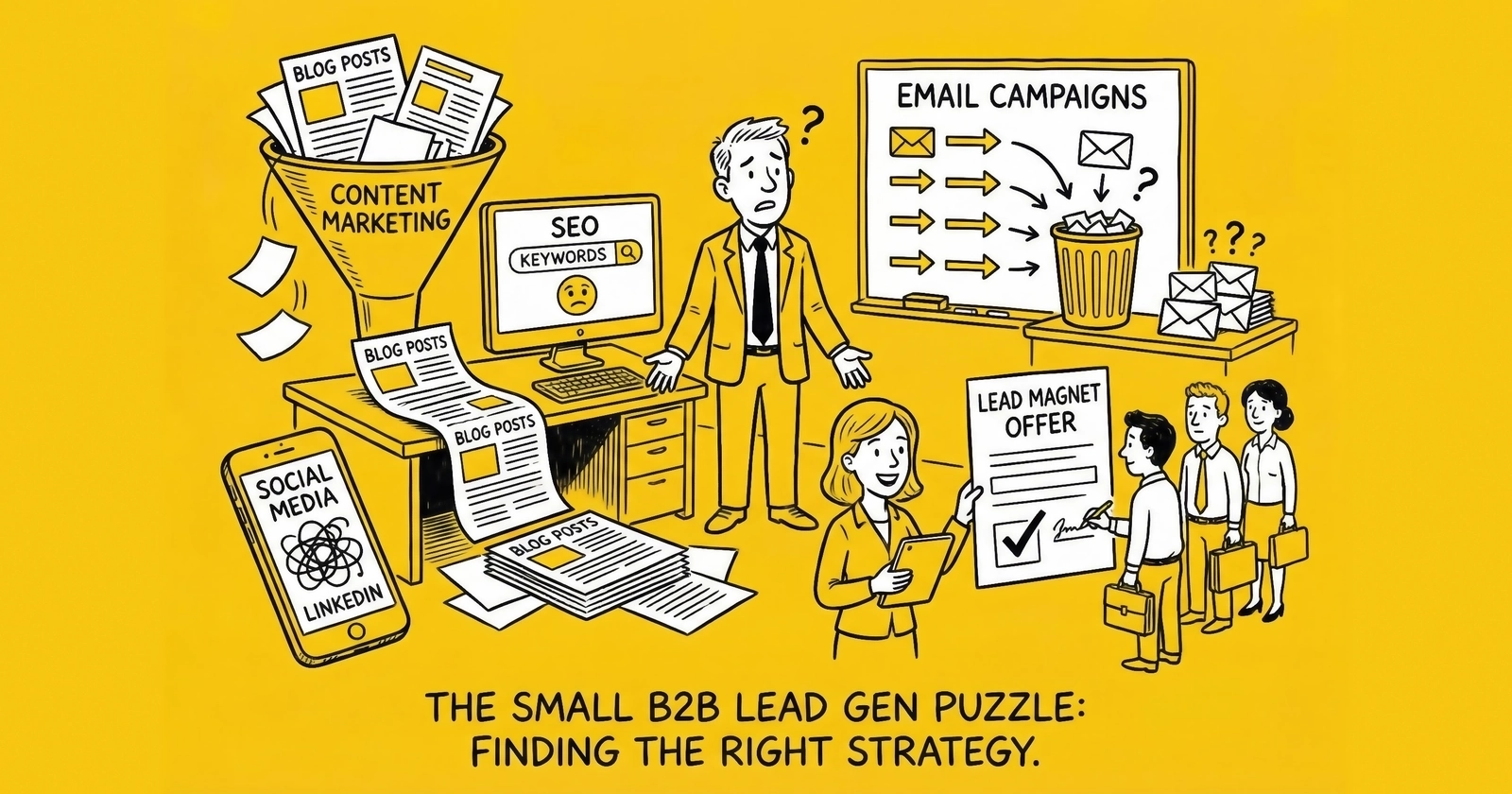
Small businesses competing for B2B leads face a structural disadvantage against enterprise competitors with dedicated marketing teams and seven-figure budgets. Yet the most effective B2B lead generation strategies often outperform enterprise approaches by applying agility, specialization, and relationship depth that larger organizations cannot replicate.
The Small Business B2B Lead Generation Landscape
The B2B lead generation market reached $3.2 billion in 2024, with enterprise companies capturing the majority of attention from vendors, consultants, and marketing platforms. Small businesses with fewer than 100 employees represent 98% of B2B companies according to Census Bureau data, yet most lead generation guidance assumes resources and infrastructure that small businesses simply do not possess.
This disconnect creates real consequences. Small business owners report spending an average of $8,400 annually on lead generation tools and services according to Clutch’s 2024 Small Business Survey, while generating 40% fewer qualified leads than they need to meet growth targets. The problem is not effort or spending – it is strategy alignment.
B2B lead generation for small businesses requires fundamentally different approaches than enterprise programs. The constraints are real: limited budgets, smaller teams, shorter sales cycles in some verticals and longer ones in others, and the need for rapid return on investment. But these constraints also create opportunities. Small businesses can target niches too small for enterprise attention, build genuine relationships impossible at scale, and pivot strategy faster than competitors managing complex approval processes.
The most successful small business B2B lead generation programs share common characteristics. They focus resources on channels with proven ROI rather than experimenting broadly. They build systems that compound over time rather than relying on constant spending. They capitalize on the business owner’s industry expertise as a competitive advantage that cannot be replicated by larger competitors.
This analysis examines B2B lead generation strategies specifically designed for small business realities, with detailed breakdowns by industry vertical where approaches differ substantially. The tactics that work for a manufacturing supplier differ from those effective for a professional services firm or a SaaS company targeting small business buyers.
Understanding B2B Buyer Behavior at Small Business Scale
How B2B Purchase Decisions Actually Work
B2B lead generation effectiveness depends on understanding how businesses actually make purchasing decisions. The process differs fundamentally from consumer purchases and varies significantly by deal size, industry, and company structure.
Research from Gartner indicates that B2B buyers spend only 17% of their purchase journey meeting with potential suppliers. The remaining 83% involves independent research, internal discussions, and evaluation activities where vendors have limited visibility. For small businesses selling to other small businesses, this research phase is often compressed but equally important.
The B2B buying committee – the group of people influencing purchase decisions – averages 6-10 stakeholders for enterprise purchases according to Gartner data. Small business purchases typically involve 2-4 decision makers, but each carries proportionally more influence. Understanding who these stakeholders are and what concerns they prioritize determines lead generation messaging effectiveness.
Small business B2B purchases break into distinct categories with different dynamics. Operational purchases under $5,000 typically involve a single decision maker and can close within days. Strategic purchases from $5,000-$50,000 involve multiple stakeholders and evaluation periods of 2-8 weeks. Major investments above $50,000 extend evaluation to months and require executive approval even in small organizations.
The Trust Gap and How Small Businesses Bridge It
Enterprise vendors benefit from brand recognition that provides default credibility. Small businesses must build trust through other mechanisms. The trust gap represents both the primary challenge and the primary opportunity for small business B2B lead generation.
Buyers evaluating small business vendors consistently cite specific concerns according to TrustRadius B2B Buyer Research from 2024. Financial stability concerns whether the vendor will remain in business. Capability questions whether a smaller team can deliver at the required scale. Support worries whether problems will receive prompt attention without enterprise-level resources.
Effective small business lead generation addresses these concerns proactively rather than defensively. Case studies demonstrating successful delivery for similar clients build capability credibility. Client testimonials from recognized companies provide social proof. Clear service level commitments documented in proposals address support concerns. Financial stability can be demonstrated through longevity, growth metrics, or backing from reputable investors.
The relationship advantage small businesses hold over enterprise vendors is substantial when properly applied. Buyers working with small business vendors gain direct access to principals and decision makers unavailable at larger organizations. This access enables customization, faster problem resolution, and genuine partnership that enterprise account structures cannot match.
Industry-Specific Buyer Behavior Patterns
B2B buyer behavior varies significantly across industries, requiring different lead generation approaches.
| Industry | Typical Decision Makers | Average Sales Cycle | Primary Trust Factors | Research Channels |
|---|---|---|---|---|
| Professional Services | Owner/Partner, CFO | 2-6 weeks | Credentials, referrals | Peer networks, LinkedIn |
| Manufacturing | Operations Manager, Purchasing | 4-12 weeks | Quality certifications, samples | Trade publications, shows |
| Technology/SaaS | IT Lead, Department Head | 4-8 weeks | Security, integration capability | Review sites, demos |
| Wholesale/Distribution | Buyer, Category Manager | 2-4 weeks | Price, reliability, minimums | Supplier databases, trade shows |
| Construction/Trades | Owner, Project Manager | 1-4 weeks | Licensing, insurance, references | Referrals, local search |
Understanding these patterns enables small businesses to allocate lead generation resources effectively. A professional services firm investing heavily in trade show presence likely misallocates resources better deployed on LinkedIn content and referral development. A manufacturing supplier ignoring industry trade shows may miss primary buyer research channels for their sector.
Content Marketing for Small Business B2B Lead Generation
Why Content Marketing Works for Resource-Constrained Businesses
Content marketing delivers the highest ROI for small business B2B lead generation when executed consistently. The Content Marketing Institute reports that content marketing generates three times more leads than outbound marketing while costing 62% less. For small businesses with limited budgets, this efficiency differential is decisive.
The compound nature of content creates sustained advantage. A blog post ranking for relevant search terms generates leads for years without additional spending. An educational guide used in email nurture campaigns continues working long after creation. Content assets accumulate, with each new piece strengthening the overall library and cross-linking opportunities.
Small businesses hold content advantages that larger competitors cannot easily replicate. The founder or principal typically possesses deep industry expertise developed over years or decades. This expertise translates directly into content authority when properly captured and distributed. An enterprise marketing team producing content by committee cannot match the depth and authenticity of a practitioner sharing genuine insights.
The key constraint for small business content marketing is not budget but time. Content requires consistent production over months and years before compounding effects become visible. Small businesses that treat content as a campaign rather than an ongoing program fail to achieve sustainable results.
Content Strategy by B2B Vertical
Different B2B verticals require different content approaches based on buyer behavior and competitive dynamics.
Professional Services Content Strategy
Professional services buyers seek evidence of expertise before initial conversations. Content demonstrating analytical capability and industry understanding shortens sales cycles by pre-qualifying prospects and building trust before proposals.
Effective content types for professional services include detailed case studies showing methodology and results, industry analysis demonstrating current knowledge, and educational content answering common prospect questions. A forensic accounting firm publishing analysis of fraud detection methods positions itself as expert while educating potential clients on the value of professional services.
Content distribution for professional services emphasizes LinkedIn, where decision makers conduct professional research, and email newsletters maintaining relationships with past clients and referral sources. Search optimization matters for informational queries but typically produces lower-quality leads than relationship-driven distribution.
Manufacturing and Industrial Content Strategy
Manufacturing buyers prioritize technical specifications, quality evidence, and reliability documentation. Content for this sector emphasizes precision over personality.
Effective content types include technical specification guides, quality certification documentation, process explanations demonstrating capability, and case studies emphasizing delivery performance. A precision machining company publishing tolerance capability guides attracts prospects with specific requirements who self-qualify based on technical fit.
Content distribution for manufacturing emphasizes industry-specific platforms, trade publication syndication, and search optimization for technical queries. LinkedIn matters less than in professional services, while industry forums and directories carry more weight.
SaaS and Technology Content Strategy
Technology buyers conduct extensive self-directed research, with G2 reporting that 67% of B2B software purchases involve no sales contact before shortlist creation. Content must capture attention during this research phase to generate viable leads.
Effective content types include comparison guides positioning against alternatives, implementation guides demonstrating ease of adoption, integration documentation proving ecosystem compatibility, and ROI calculators enabling self-qualification. A project management SaaS for contractors publishing workflow templates attracts prospects actively seeking solutions.
Content distribution emphasizes review platforms where prospects compare options, search optimization for product category queries, and community presence in channels where target buyers gather. Paid content amplification often generates positive ROI given high customer lifetime values.
Wholesale and Distribution Content Strategy
Wholesale buyers prioritize efficiency, pricing, and reliability information. Content serves transactional rather than educational purposes.
Effective content types include digital catalogs enabling product discovery, inventory and availability resources, pricing guides and volume discount information, and logistics and fulfillment documentation. A specialty food distributor publishing seasonal availability calendars attracts restaurant buyers planning menus.
Content distribution focuses on search optimization for product-specific queries, industry directories and B2B marketplaces, and email communication with existing customer bases regarding new products or promotions.
Building a Sustainable Content Production System
Small businesses cannot sustain content marketing through heroic individual effort. Sustainable production requires systems that make content creation routine rather than exceptional.
A minimum viable content system for small business B2B lead generation includes monthly cornerstone content of 1,500-3,000 words providing substantial value on key topics, weekly shorter content of 500-800 words maintaining publishing consistency, and quarterly deep-dive content of 3,000+ words establishing authority on critical subjects.
This schedule produces approximately 60 content pieces annually – sufficient to build meaningful organic presence while remaining achievable for small teams. The time investment approximates 4-6 hours weekly when systems are established, with additional time required during the initial process development phase.
Production efficiency comes from content repurposing. A single cornerstone piece can generate multiple derivative assets: social media excerpts, email newsletter content, slide deck presentations, and video script foundations. Building repurposing into the initial creation process maximizes return on content investment.
Content calendars prevent the common failure pattern of inconsistent publishing. Planning content topics 90 days in advance enables research, reduces decision fatigue, and creates accountability for consistent production. Monthly review adjusts calendars based on performance data and emerging opportunities.
LinkedIn Strategies for Small Business B2B Lead Generation
Why LinkedIn Dominates Small Business B2B Prospecting
LinkedIn delivers disproportionate returns for small business B2B lead generation because decision makers actively use the platform for professional purposes. The platform reports 930 million members with over 65 million being decision makers at their organizations.
For small businesses, LinkedIn provides capabilities previously available only to organizations with dedicated sales teams. Search filters enable identification of prospects by company size, industry, job function, and geography. Content distribution reaches targeted professional audiences without advertising spend. Direct messaging enables personalized outreach at scale.
The relationship-building potential of LinkedIn aligns with small business strengths. Personal profiles of founders and principals attract engagement that company pages cannot achieve. Authentic expertise sharing builds credibility faster than polished corporate marketing. Direct connections with prospects create relationship foundations that enterprise competitors cannot replicate.
Optimizing LinkedIn Presence for Lead Generation
Effective LinkedIn lead generation begins with profile optimization that positions for discovery and conversion.
Personal profiles of founders and key employees should function as landing pages for prospective clients. This requires headline optimization beyond job title to communicate value proposition – “Helping manufacturers reduce quality defects 40% through precision measurement systems” performs better than “President at ABC Measurement.” The About section should articulate the problem solved, the approach taken, and the evidence of results. Featured content should highlight case studies, testimonials, and valuable resources.
Company pages provide credibility verification but generate minimal direct engagement. Optimization priorities include complete information, regular posting for activity signals, and employee profile linking. The primary value of company pages is supporting personal profile credibility rather than driving direct lead generation.
Content strategy on LinkedIn should prioritize expertise demonstration over promotional messages. The platform’s algorithm rewards engagement, and promotional content generates minimal interaction. Posts sharing industry insights, lessons learned, and useful information for the target audience build visibility and credibility simultaneously.
| Content Type | Engagement Rate | Lead Generation Potential | Production Effort |
|---|---|---|---|
| Industry insights | High | Medium | Medium |
| Lessons learned/failures | Very High | Low | Low |
| How-to/educational | Medium | High | High |
| Case study excerpts | Medium | Very High | Medium |
| Promotional announcements | Low | Low | Low |
| Curated industry news | Low | Low | Very Low |
The posting frequency that maintains visibility without overwhelming followers ranges from 3-5 posts weekly. Consistency matters more than volume – irregular posting defeats algorithm visibility while producing minimal relationship value.
LinkedIn Outreach That Actually Works
Cold outreach on LinkedIn generates leads when executed properly but destroys credibility when done poorly. The difference lies in personalization, relevance, and value orientation.
Effective LinkedIn outreach begins with connection requests that demonstrate genuine interest. Generic connection requests receive sub-10% acceptance rates according to LinkedIn data, while personalized requests mentioning specific reasons for connecting achieve 30-40% acceptance. The personalization need not be elaborate – referencing a post, mutual connection, or specific company achievement suffices.
Post-connection messaging should provide value before requesting anything. A sequence that builds relationship before pitching outperforms immediate sales messages by 5-7x according to Sales Navigator data. An effective sequence might include:
- A thank-you message with a useful resource
- A value-add message sharing relevant content after one week
- A conversation-starting question exploring potential fit after two weeks
- A meeting request for qualified prospects only
The volume sustainable without appearing spammy varies by network size and activity level. Small businesses typically sustain 20-50 new connection requests weekly and 10-20 substantive messages to existing connections. Higher volumes risk platform restrictions and reputation damage.
Sales Navigator provides advanced features that justify the $99/month cost for serious B2B prospecting. Lead recommendations surface potential prospects based on ideal customer profiles. InMail credits enable messages to non-connections. Saved searches and alerts notify when new prospects matching criteria appear.
Email Marketing for B2B Lead Nurturing
The Role of Email in Small Business B2B Sales
Email marketing serves different purposes in B2B lead generation than in consumer marketing. B2B email focuses on nurturing relationships over extended sales cycles rather than driving immediate transactions. For small businesses, email maintains visibility during prospect evaluation periods when direct contact would be excessive. For detailed implementation guidance, see our email drip campaigns guide for lead nurturing.
The economics of B2B email favor small businesses. Campaign Monitor reports average B2B email ROI of $36 per dollar spent, driven by near-zero marginal cost once systems are established. Small businesses with carefully built lists of qualified prospects outperform larger competitors blasting purchased lists with generic messages.
Email effectiveness in B2B lead generation depends on list quality rather than list size. A list of 500 qualified prospects who opted in through content engagement generates more business than 50,000 purchased contacts with no relationship foundation. Building a qualified list slowly through content offers, event registration, and direct opt-ins produces superior long-term results.
Email Sequence Design for B2B Nurturing
B2B email nurturing sequences guide prospects through awareness, evaluation, and decision stages with appropriate content at each phase. Small businesses with limited content libraries should prioritize sequences for common prospect scenarios rather than attempting personalization across numerous segments.
New Subscriber Welcome Sequence (5-7 emails over 14 days)
New subscribers represent warm prospects who have taken action indicating interest. The welcome sequence should introduce the company, deliver the promised value from opt-in, and establish expertise credibility. Emails might include:
- Delivery of the lead magnet promised
- Introduction to company and approach
- Educational content demonstrating expertise
- Case study highlighting results
- Invitation to next step such as consultation or demo
Educational Nurture Sequence (ongoing, bi-weekly to monthly)
Prospects not ready for sales conversations require ongoing nurture to maintain visibility and build credibility. Educational sequences share useful content without sales pressure. The goal is remaining top-of-mind when needs become acute. Content should address common questions, industry trends, and problems the business solves.
Re-engagement Sequence (3-4 emails for inactive subscribers)
Subscribers who have not engaged in 90+ days require re-engagement attempts before list removal. Sequences should acknowledge the lapse, offer compelling content, and ultimately confirm continued interest or remove unresponsive contacts. List hygiene maintains deliverability and provides accurate performance metrics.
Email Performance Benchmarks for B2B
Small businesses should measure email performance against B2B benchmarks rather than overall email statistics that include consumer campaigns with different dynamics.
| Metric | B2B Average | Good Performance | Excellent Performance |
|---|---|---|---|
| Open Rate | 15-25% | 25-35% | 35%+ |
| Click-Through Rate | 2-4% | 4-6% | 6%+ |
| Unsubscribe Rate | 0.2-0.5% | Under 0.2% | Under 0.1% |
| Bounce Rate | Under 2% | Under 1% | Under 0.5% |
| Reply Rate | 0.5-2% | 2-5% | 5%+ |
Source: Mailchimp, Campaign Monitor, HubSpot 2024 Email Benchmarks
Performance below these benchmarks indicates strategic or execution problems requiring diagnosis. Low open rates suggest subject line or sender reputation issues. Low click-through rates indicate content relevance problems. High unsubscribe rates signal excessive frequency or misaligned messaging.
Paid Advertising Strategies for Small Business B2B
Where Paid Advertising Fits in Small Business Budgets
Paid advertising accelerates lead generation but requires careful management to avoid wasting limited budgets. Small businesses with monthly marketing budgets under $5,000 should treat paid advertising as amplification for proven organic approaches rather than a primary lead source.
The economics of B2B paid advertising favor businesses with higher deal values and conversion rates. A SaaS company with $2,400 annual contract value can sustain $200 cost per lead and remain profitable. A professional services firm with $50,000 average engagement can absorb $500+ cost per lead. A manufacturer selling $5,000 average orders needs cost per lead under $50 to maintain margins.
Before investing in paid advertising, small businesses should validate lead generation fundamentals. Website conversion rates should exceed 2% for advertising traffic. Sales processes should convert qualified leads at predictable rates. Customer acquisition economics should support sustainable cost per lead targets.
LinkedIn Advertising for B2B
LinkedIn advertising offers unmatched B2B targeting but at premium prices. Average cost per click ranges from $5-12, with cost per lead typically $50-200+ depending on targeting and offer. These economics work for high-value B2B offerings but preclude experimentation-heavy approaches.
Targeting capabilities that justify LinkedIn’s premium include:
- Job title, function, and seniority filters
- Company industry and size parameters
- Geographic targeting by region or specific companies
- Matched audience capabilities using first-party data
Effective LinkedIn ad formats for lead generation include:
- Lead Gen Forms that capture information within LinkedIn and reduce friction
- Single image ads driving to landing pages for complex offers
- Video ads for awareness building with warmer audiences
Campaign structure should minimize budget waste through tight targeting. Broad campaigns testing multiple audience segments burn budget on learning. Start with narrow targeting matching ideal customer profiles, prove economics, then expand carefully.
Realistic expectations for small business LinkedIn advertising: minimum monthly budget of $1,000-2,000 to generate statistical significance, 3-6 month optimization period to reach efficient performance, and cost per qualified lead of $75-200 for most B2B offerings.
Google Ads for B2B Lead Generation
Google Ads captures demand from prospects actively searching for solutions – high-intent traffic that converts at higher rates than interruptive advertising. For small businesses, Search campaigns should precede Display or Video investments.
B2B Google Ads strategy differs from consumer campaigns in keyword selection, bidding approach, and conversion tracking.
Keyword strategy should focus on buyer-intent terms rather than informational queries. “Manufacturing ERP software pricing” indicates purchase intent while “what is ERP” indicates research. The former converts at 5-10x the rate of the latter. Limited budgets should prioritize high-intent keywords even at higher cost per click.
Bidding strategy for small businesses should prioritize profitability over volume. Manual CPC bidding or Target CPA strategies with conservative targets prevent budget waste during learning periods. Automated strategies require 30-50 conversions monthly to optimize effectively – volume many small businesses cannot sustain.
Conversion tracking must capture lead quality signals, not just form submissions. Integrating CRM data enables optimization toward qualified leads or revenue rather than raw lead volume. Google’s offline conversion import enables this integration for sophisticated advertisers.
Negative keywords prevent budget waste on irrelevant traffic. B2B campaigns should exclude consumer terms (free, DIY, cheap), job seeker terms (careers, jobs, salary), and informational terms (what is, how to, definition).
Retargeting for Small Business B2B
Retargeting converts website visitors who did not initially take action. For B2B with longer sales cycles, retargeting maintains visibility during extended evaluation periods.
Retargeting platforms accessible to small businesses include:
- Google Display Network covering 90%+ of internet users
- LinkedIn Audience Network extending LinkedIn targeting to partner sites
- Meta platforms for prospects active on Facebook and Instagram
- Native retargeting through Taboola and Outbrain for content-heavy strategies
Effective B2B retargeting segments audiences by engagement depth. Visitors who viewed specific product or service pages receive targeted messages about those offerings. Visitors who engaged with content receive nurture-focused retargeting. Visitors who started but did not complete conversion actions receive urgency and reminder messaging.
Frequency caps prevent ad fatigue and brand damage. B2B retargeting should limit impressions to 3-5 daily per user, with weekly caps of 15-25 impressions. Higher frequencies generate diminishing returns and negative brand associations.
Industry-Specific B2B Lead Generation Playbooks
Professional Services Lead Generation
Professional services firms – accounting, consulting, legal, engineering, marketing agencies – generate leads primarily through reputation and relationships. The path to new business typically flows through referrals, content-driven inbound, and targeted outreach.
Referral System Development
Referrals generate the highest-quality leads for professional services, with referred prospects converting at 3-5x rates of other sources according to Hinge Research. Systematizing referrals transforms occasional windfalls into predictable pipeline.
Effective referral programs include explicit asks to satisfied clients at project completion, referral incentives aligned with client values and professional norms, reciprocal referral relationships with complementary service providers, and alumni relationship maintenance with former employees and clients.
The referral request timing matters significantly. Research from Texas Tech indicates that 83% of satisfied clients are willing to provide referrals but only 29% actually do – the gap is failure to ask. Systematic referral requests at positive moments such as project completion, positive feedback, and milestone achievement capture available opportunity.
Content-Driven Inbound
Professional services content should demonstrate the thinking process that clients purchase. Case studies showing analytical approach, industry research demonstrating current knowledge, and educational content addressing common challenges all build expertise credibility.
Content distribution through LinkedIn and email newsletters reaches decision makers efficiently. Speaking opportunities at industry events provide valuable exposure while building direct relationships. Guest contributions to industry publications extend reach to new audiences.
Targeted Outreach Campaigns
Professional services outreach succeeds when providing genuine value rather than pitch delivery. Research-based outreach identifying specific challenges at target companies, introductions facilitated through mutual connections, and response to visible triggers such as regulatory changes, management transitions, and growth announcements generate conversations that generic outreach cannot achieve.
Manufacturing and Industrial Lead Generation
Manufacturing lead generation combines digital presence with physical relationship building. Trade shows, distributor relationships, and industry certifications remain important alongside modern digital tactics.
Trade Show Strategy
Trade shows represent concentrated access to qualified buyers but require strategic execution to justify significant investment. Pre-show outreach to registered attendees, targeted meeting scheduling with priority prospects, and systematic lead capture and follow-up maximize trade show ROI.
Trade show lead follow-up timing matters critically. Research from CEIR indicates that 80% of trade show leads receive no follow-up or delayed follow-up beyond two weeks. Immediate post-show communication while recall is fresh captures competitive advantage.
Distributor and Channel Development
For manufacturers selling through distribution, lead generation often means distributor enablement. Providing sales tools, training, and lead sharing programs increases channel partner effectiveness. Joint marketing programs with key distributors extend reach to their established customer bases.
Quality and Certification Marketing
Manufacturing buyers prioritize reliability and quality assurance. ISO certifications, quality control documentation, and process transparency address core buyer concerns. Content highlighting quality capabilities and certifications builds credibility with technical evaluators.
SaaS and Technology Lead Generation
SaaS lead generation for small businesses targets the mid-market and SMB segments where enterprise vendors under-serve and individual procurement is possible.
Product-Led Growth Elements
Free trials, freemium tiers, and self-service demos reduce friction in the evaluation process. Small business SaaS should enable prospects to experience value before sales contact. Product-led approaches generate higher-quality leads as users self-select based on actual product fit.
Review Platform Presence
G2, Capterra, and TrustRadius influence B2B software purchase decisions significantly. Proactive review solicitation from satisfied customers, response to reviews demonstrating engagement, and category listing optimization build presence where buyers conduct research. For emerging B2B platforms, consider our Reddit B2B lead generation guide for community-based prospecting strategies.
Integration Partner Ecosystem
Technology integrations expand addressable market and provide lead generation channels. Partner directories, co-marketing programs, and technical partnerships with complementary solutions generate leads from established user bases.
Wholesale and Distribution Lead Generation
Wholesale lead generation focuses on efficiency, reliability demonstration, and volume economics communication.
Digital Catalog and Ordering
Modern B2B buyers expect e-commerce functionality. Online catalogs with real-time availability, electronic ordering capabilities, and account management features meet buyer expectations while reducing sales friction.
Vertical Specialization
Wholesale distributors serving specific verticals can build expertise-based positioning. A food service distributor specializing in organic and sustainable products differentiates from broad-line competitors through category expertise and curated selection.
Credit and Terms Marketing
For wholesale buyers, payment terms significantly influence vendor selection. Clear communication of credit availability, early payment discounts, and volume pricing structures addresses primary buyer concerns.
Measuring B2B Lead Generation Performance
Metrics That Matter for Small Business B2B
Small businesses should focus measurement on metrics that directly connect to business outcomes rather than vanity metrics that feel good but do not predict success.
Primary Metrics
Cost per qualified lead measures efficiency of lead generation investment. This differs from cost per lead by excluding leads that fail qualification criteria. For most small businesses, qualification requires budget authority, decision timeline, and genuine need.
Lead to opportunity conversion rate indicates lead quality and sales process effectiveness. B2B benchmarks range from 10-25% depending on lead source and qualification standards.
Opportunity to customer conversion rate measures sales process effectiveness with qualified prospects. B2B benchmarks range from 15-30% for inbound-generated opportunities.
Customer acquisition cost combines marketing and sales expenses divided by new customers acquired. This comprehensive metric enables profitability analysis and budget allocation decisions.
Secondary Metrics
Pipeline velocity measures how quickly leads progress through sales stages. Slow velocity indicates process friction or qualification issues.
Marketing qualified lead to sales qualified lead conversion indicates alignment between marketing lead generation and sales requirements. Misalignment wastes resources on leads sales cannot convert.
Source attribution tracks which channels and campaigns generate qualified leads and customers. Attribution data enables budget optimization toward highest-performing sources.
Building a Small Business Lead Generation Dashboard
Effective measurement requires accessible dashboards that surface key metrics without requiring manual data compilation. Small businesses should prioritize simplicity over sophistication.
A minimum viable dashboard includes:
- Weekly new leads by source
- Monthly qualified leads by source
- Pipeline value and stage distribution
- Conversion rates at each pipeline stage
- Customer acquisition cost by channel
Dashboard tools accessible to small businesses include:
- HubSpot free CRM with built-in reporting
- Google Looker Studio with CRM and advertising integrations
- Spreadsheet-based dashboards for businesses with limited tool investment
- Databox aggregating data from multiple sources
For guidance on selecting and implementing these platforms, see our marketing automation guide.
Attribution Challenges in B2B Lead Generation
B2B sales cycles involving multiple touchpoints across extended timeframes complicate attribution. The prospect who converts after a sales call may have discovered the business through content six months earlier. Attributing the win solely to the sales touchpoint misrepresents the customer acquisition path.
Small businesses should implement attribution appropriate to their complexity and data capabilities. Last-touch attribution provides simplicity but over-credits closing activities while under-crediting awareness and nurture. First-touch attribution provides simplicity but over-credits discovery channels while ignoring nurture contribution. Linear attribution distributes credit equally across touchpoints, providing balance but assuming equal contribution that rarely reflects reality. Time-decay attribution weights recent touchpoints more heavily, balancing recency with multi-touch acknowledgment. For a deeper exploration of attribution approaches, see our multi-touch attribution guide for lead generation.
For most small businesses, last-touch or first-touch attribution with qualitative understanding of the full customer journey provides actionable insights without excessive complexity. Perfect attribution is less important than consistent measurement enabling trend identification.
The SCALE Framework: Small Business Lead Generation Capacity Building
Most small business B2B lead generation advice assumes resources and capabilities that small operations simply do not possess. The SCALE framework provides a progression model for building lead generation capacity incrementally, matching investment to actual business stage and available resources.
S – Stage Assessment and Resource Reality Check
Before implementing any lead generation strategy, small businesses must honestly assess their current stage and available resources. Mismatched ambition and capacity produces failure.
Small Business Stage Classification:
| Stage | Annual Revenue | Marketing Budget | Team Capacity | Lead Gen Focus |
|---|---|---|---|---|
| Startup | Under $250K | Under $10K | Founder only | Manual outreach |
| Early Growth | $250K-$750K | $10K-$30K | 1 part-time marketer | Systematized outreach + content |
| Scaling | $750K-$2M | $30K-$75K | 1-2 marketers | Multi-channel with automation |
| Established Small | $2M-$5M | $75K-$150K | 2-4 marketers | Full funnel with demand gen |
Resource Reality Assessment Matrix:
| Resource Category | Minimum Viable | Growth Ready | Scale Ready |
|---|---|---|---|
| Weekly marketing hours | 5-10 hours | 20-30 hours | 40+ hours |
| Content production capacity | 1 piece/month | 2-4 pieces/month | 8+ pieces/month |
| Technology stack | CRM + email only | CRM + marketing automation | Full martech stack |
| Sales bandwidth for follow-up | 5-10 leads/week | 20-40 leads/week | 50+ leads/week |
| Budget for paid channels | $0-500/month | $500-2,000/month | $2,000+/month |
Stage-Appropriate Lead Generation Tactics:
| Stage | Primary Tactics | Secondary Tactics | Avoid |
|---|---|---|---|
| Startup | LinkedIn outreach, referrals, partnerships | Basic content, local networking | Paid ads, complex automation |
| Early Growth | Content + SEO, email nurture | LinkedIn ads, webinars | Multi-channel paid, ABM |
| Scaling | Inbound + outbound coordination | Paid search, social ads | Enterprise ABM, complex tech |
| Established Small | Full inbound engine | ABM for key accounts | Expensive enterprise tools |
C – Channel Selection and Prioritization Protocol
Small businesses cannot compete across all channels simultaneously. Strategic channel selection concentrates limited resources for maximum impact.
B2B Channel Effectiveness by Small Business Stage:
| Channel | Startup Fit | Early Growth Fit | Scaling Fit | Investment Required |
|---|---|---|---|---|
| LinkedIn organic | Excellent | Good | Moderate | Time heavy |
| LinkedIn Sales Navigator | Excellent | Excellent | Good | $100-150/month |
| Content/SEO | Poor (slow) | Good | Excellent | 6-18 months to ROI |
| Email outreach | Good | Good | Moderate | $50-200/month tools |
| Google Ads | Poor (expensive) | Moderate | Good | $1,500+/month minimum |
| LinkedIn Ads | Poor (expensive) | Moderate | Good | $1,000+/month minimum |
| Referral programs | Excellent | Excellent | Good | Relationship time |
| Webinars | Moderate | Good | Excellent | Content + promotion |
| Trade shows/events | Moderate | Good | Good | $2,000-10,000/event |
Channel Prioritization Scoring:
Rate each channel 1-5 across these dimensions:
| Dimension | Weight | Calculation Method |
|---|---|---|
| Audience presence | 2.0x | Where do your buyers actually spend time? |
| Competition intensity | 1.5x | Lower competition = higher score |
| Resource match | 2.0x | Does channel fit your available resources? |
| Speed to results | 1.0x | How quickly can this channel produce leads? |
| Scalability | 1.0x | Can this channel grow with your business? |
Prioritization Formula:
Channel priority score = (Audience × 2) + (Competition inverse × 1.5) + (Resource match × 2) + (Speed × 1) + (Scale × 1)
Focus on top 2-3 channels until they are optimized before adding additional channels.
A – Acquisition Cost Benchmarking and Optimization
Small businesses operating with constrained budgets require precise understanding of acquisition economics. Benchmark data enables rational investment decisions.
B2B Customer Acquisition Cost Benchmarks by Segment:
| Business Type | Low CAC | Median CAC | High CAC | Acceptable Range |
|---|---|---|---|---|
| Professional services | $150 | $400 | $800 | Up to 10% of first-year value |
| SaaS (SMB focus) | $200 | $500 | $1,200 | Up to 1/3 of first-year ACV |
| Manufacturing/industrial | $300 | $750 | $1,500 | Up to 8% of first order |
| Technology services | $250 | $600 | $1,000 | Up to 12% of first contract |
| Business consulting | $200 | $500 | $900 | Up to 15% of engagement value |
Lead Cost Benchmarks by Channel:
| Channel | Cost per Lead (Low) | Cost per Lead (Median) | Cost per Lead (High) |
|---|---|---|---|
| LinkedIn organic | $0 (time only) | $15-25 (time valued) | $50 (time valued) |
| LinkedIn ads | $50 | $100-150 | $250+ |
| Google Ads B2B | $75 | $150-200 | $350+ |
| Content/SEO | $10-20 | $30-50 | $75+ |
| Email outreach | $15 | $40-60 | $100+ |
| Referrals | $0-25 | $50-100 | $150 |
| Webinars | $30 | $75-100 | $150+ |
| Trade shows | $100 | $200-400 | $800+ |
Unit Economics Calculation for Small Business:
Required LTV:CAC ratio by stage:
| Stage | Minimum Ratio | Target Ratio | Stretch Goal |
|---|---|---|---|
| Startup (cash constrained) | 3:1 | 5:1 | 7:1 |
| Early Growth | 2.5:1 | 4:1 | 6:1 |
| Scaling (reinvesting) | 2:1 | 3:1 | 5:1 |
| Established | 2:1 | 3:1 | 4:1 |
CAC Payback Period Targets:
| Business Model | Maximum Acceptable | Target Payback | Optimal |
|---|---|---|---|
| Monthly subscription | 12 months | 8 months | 5 months |
| Annual contract | 18 months | 12 months | 8 months |
| Project-based | Immediate | First project | First project |
| Retainer model | 6 months | 4 months | 3 months |
L – Lead Quality Qualification Standards
Small businesses cannot afford to waste sales time on unqualified leads. Rigorous qualification standards ensure resource efficiency.
Small Business BANT+ Qualification Criteria:
| Criterion | Minimum Qualification | Strong Qualification | Premium Lead |
|---|---|---|---|
| Budget | Has budget for category | Budget matches your pricing | Budget pre-approved |
| Authority | Influences decision | Decision maker | Final decision maker |
| Need | Acknowledged pain point | Active solution search | Urgent requirement |
| Timeline | Within 12 months | Within 6 months | Within 90 days |
| Fit | Basic service match | Strong service match | Ideal client profile |
Lead Scoring Model for Small Business:
| Behavior/Attribute | Points | Rationale |
|---|---|---|
| Downloaded pricing guide | +25 | Strong purchase intent |
| Requested consultation | +30 | Direct sales interest |
| Visited pricing page (2+ times) | +15 | Comparing options |
| Company size match | +20 | Ideal customer profile |
| Industry match | +15 | Relevant experience |
| Email engagement (3+ opens) | +10 | Active interest |
| Content download | +5 | Research stage |
| Website visit only | +2 | Awareness only |
Qualification Threshold Standards:
| Lead Score | Classification | Sales Action | Response Time |
|---|---|---|---|
| 70+ | Hot lead | Immediate outreach | Same day |
| 50-69 | Warm lead | Prioritized outreach | 1-2 days |
| 30-49 | Marketing qualified | Nurture sequence | Automated |
| Under 30 | Cold lead | Long-term nurture | Monthly touchpoint |
Disqualification Criteria (Negative Scoring):
| Disqualifier | Points | Action |
|---|---|---|
| Competitor | -100 | Remove from pipeline |
| Student/job seeker | -75 | Remove from pipeline |
| Wrong geography | -50 | Deprioritize or remove |
| Budget mismatch (too low) | -40 | Nurture for future |
| Company size mismatch | -30 | Evaluate fit carefully |
E – Execution Rhythm and Consistency System
Sporadic lead generation produces inconsistent results. Small businesses require sustainable execution rhythms that produce compound returns over time.
Weekly Lead Generation Cadence by Stage:
Startup Stage (5-10 hours/week):
| Day | Activity | Time | Expected Output |
|---|---|---|---|
| Monday | LinkedIn outreach (20 connections) | 1.5 hours | 20 new connections |
| Tuesday | Follow-up messages | 1 hour | 5-10 conversations |
| Wednesday | Content creation | 2 hours | 1 post or article section |
| Thursday | Engagement and comments | 1 hour | 15-20 meaningful interactions |
| Friday | Partner/referral outreach | 1 hour | 3-5 conversations |
| Ongoing | Lead response | 1-2 hours | As needed |
Early Growth Stage (15-20 hours/week):
| Activity Category | Weekly Hours | Expected Output |
|---|---|---|
| Content creation | 4-6 hours | 1-2 pieces published |
| LinkedIn outreach + engagement | 3-4 hours | 30-40 new connections |
| Email outreach campaigns | 2-3 hours | 50-100 emails sent |
| Lead nurturing | 2-3 hours | 10-15 touchpoints |
| Measurement and optimization | 1-2 hours | Weekly reporting |
| Sales coordination | 1-2 hours | Pipeline alignment |
Monthly Lead Generation Benchmarks by Stage:
| Stage | Monthly Lead Target | Qualified Lead Target | Expected Opportunities |
|---|---|---|---|
| Startup | 10-25 | 5-10 | 2-5 |
| Early Growth | 30-75 | 15-30 | 5-15 |
| Scaling | 75-200 | 35-80 | 15-35 |
| Established Small | 150-400 | 70-150 | 30-70 |
Consistency Tracking Metrics:
| Metric | Weekly Target | Monthly Target | Warning Sign |
|---|---|---|---|
| Activities completed vs planned | 80%+ | 85%+ | Under 70% |
| Content published | Per plan | Per plan | Missed 2+ weeks |
| Outreach volume | Consistent | ±20% variance | +50% variance |
| Lead response time | Same day | Same day | Multi-day delays |
Building Sustainable Lead Generation Systems
The Compound Effect in B2B Lead Generation
Sustainable B2B lead generation creates systems that compound over time rather than requiring constant equivalent effort and spending. Content libraries grow, relationships deepen, and reputation builds – each making subsequent lead generation more effective.
The compound effect manifests in several forms. Content marketing returns increase as libraries grow and domain authority strengthens. Referral rates increase as client base expands and relationships mature. Brand recognition improves as market presence accumulates. Conversion rates improve as trust signals multiply.
Small businesses that invest in compound systems outperform those relying on transactional approaches over multi-year horizons. The business that builds a content library, nurtures relationships, and develops expertise positioning generates leads more efficiently in year three than year one. The business relying solely on paid advertising faces equivalent costs regardless of tenure.
Resource Allocation for Small Business B2B Lead Generation
Small businesses must allocate limited resources across lead generation activities that compete for attention and budget. Strategic allocation maximizes returns within constraints.
Time Allocation Framework
For a business owner or single marketer handling B2B lead generation, weekly time allocation might include content creation and distribution consuming 4-6 hours, LinkedIn engagement and outreach consuming 2-3 hours, email marketing management consuming 1-2 hours, paid advertising management if applicable consuming 1-2 hours, and measurement and optimization consuming 1-2 hours.
This totals 9-15 hours weekly – substantial but achievable alongside other responsibilities when systems are established. Initial setup requires additional time investment that decreases as processes become routine.
Budget Allocation Framework
Small business B2B lead generation budgets should weight toward high-ROI channels with proven performance rather than experimentation. A reasonable allocation for a business with $3,000 monthly marketing budget might include content tools and distribution at $500 monthly representing 17%, email marketing platform at $100 monthly representing 3%, LinkedIn Sales Navigator at $100 monthly representing 3%, paid advertising at $1,500 monthly representing 50%, and tools and miscellaneous at $300 monthly representing 10%, while reserving testing budget at $500 monthly representing 17%.
This allocation prioritizes paid advertising while maintaining foundational capabilities and reserving funds for testing new channels or tactics.
Avoiding Common Small Business B2B Lead Generation Mistakes
Small businesses make predictable mistakes in B2B lead generation that waste resources and delay results.
Mistake: Copying Enterprise Strategies
Enterprise B2B marketing involves account-based programs, sophisticated marketing automation, and multi-channel attribution that small businesses cannot sustain. Attempting to replicate these approaches with limited resources produces poor results. Small businesses should adapt principles while implementing simpler executions appropriate to their scale.
Mistake: Inconsistent Effort
Lead generation requires sustained effort across months and years to produce compound returns. The common pattern of intense effort followed by neglect followed by renewed effort fails to build momentum. Consistent moderate effort outperforms sporadic intensive effort.
Mistake: Chasing Vanity Metrics
Website traffic, social media followers, and email list size feel satisfying but do not guarantee business results. Focus on qualified leads, pipeline value, and customer acquisition rather than intermediate metrics that may not correlate with outcomes.
Mistake: Neglecting Sales Process
Lead generation without effective sales follow-up wastes marketing investment. Before scaling lead generation, ensure sales processes can convert the leads generated. A business converting 5% of leads might benefit more from sales process improvement than from lead generation expansion.
Mistake: Ignoring Existing Customers
Existing customers represent the highest-quality lead source for most B2B businesses through referrals, expansion, and case study content. Lead generation strategies that ignore existing customer relationships miss substantial opportunity.
Key Takeaways
-
B2B lead generation for small businesses requires different strategies than enterprise approaches, with emphasis on relationship depth, niche focus, and resource efficiency rather than broad reach and sophisticated automation.
-
Content marketing delivers the highest long-term ROI for small business B2B lead generation when executed consistently, with compound returns as content libraries grow and domain authority strengthens over 18-36 months.
-
LinkedIn provides disproportionate value for small business B2B prospecting through direct access to decision makers, content distribution capabilities, and relationship building that enterprise marketing cannot replicate.
-
Industry vertical significantly influences optimal lead generation tactics, with professional services emphasizing referrals and expertise content, manufacturing prioritizing trade shows and quality certifications, SaaS focusing on product-led growth and review platforms, and wholesale concentrating on digital catalogs and terms marketing.
-
Paid advertising accelerates lead generation but requires validated fundamentals first, including website conversion rates exceeding 2%, proven sales processes, and customer acquisition economics that support sustainable cost per lead targets.
-
Email marketing serves nurturing rather than acquisition purposes in B2B, maintaining visibility during extended sales cycles with content-focused sequences rather than promotional messaging.
-
Measurement should focus on qualified leads and customer acquisition rather than vanity metrics, with attribution approaches appropriate to business complexity rather than attempting enterprise-level sophistication.
-
Sustainable lead generation builds systems that compound over time through content accumulation, relationship deepening, and reputation building rather than requiring constant equivalent effort and spending.
-
Common mistakes include copying enterprise strategies inappropriate for small business scale, inconsistent effort that fails to build momentum, and neglecting existing customers who represent the highest-quality lead source through referrals.
-
Resource allocation should prioritize proven high-ROI channels while maintaining foundational capabilities and reserving budget for testing, with typical small business time investment of 10-15 hours weekly across all lead generation activities.
Frequently Asked Questions
What is B2B lead generation and how does it differ from B2C lead generation?
B2B lead generation involves identifying and attracting potential business customers who may purchase products or services for their organizations. The process differs from B2C lead generation in several fundamental ways. B2B sales cycles typically extend from weeks to months rather than minutes to days. Purchase decisions involve multiple stakeholders rather than individual consumers. Transaction values are generally higher, justifying greater customer acquisition investment. Relationships carry more weight, with repeat business and referrals contributing substantially to lifetime value. These differences require different tactics: B2B emphasizes content demonstrating expertise, relationship building through direct engagement, and nurturing campaigns spanning extended evaluation periods.
How much should a small business budget for B2B lead generation?
B2B lead generation budgets for small businesses typically range from 5-15% of revenue for growth-focused companies, with established businesses often allocating 3-7%. In dollar terms, small businesses commonly spend $2,000-10,000 monthly on lead generation including tools, advertising, and content production. The appropriate budget depends on customer acquisition economics – specifically, what customer lifetime value supports in acquisition cost. A business with $50,000 average customer lifetime value can invest more per lead than one with $5,000. Start with conservative budgets proving channel economics before scaling investment. Budget allocation should weight toward proven channels with measurable ROI rather than experimental spending.
Which lead generation channels work best for small business B2B?
Channel effectiveness varies by industry, target customer, and specific business circumstances. However, patterns emerge across small business B2B lead generation. LinkedIn consistently delivers strong results for businesses targeting professional decision makers, combining organic content distribution with targeted advertising and direct outreach capabilities. Content marketing through blogs and downloadable resources generates qualified inbound leads when sustained over 12+ months. Email marketing nurtures prospects through extended sales cycles at minimal cost. Referral programs build on existing relationships to generate highest-quality leads. Paid search captures demand from actively searching prospects. Trade shows remain important for manufacturing and industrial businesses. Most successful small businesses combine 2-3 primary channels rather than spreading resources across many.
How long does it take to see results from B2B lead generation efforts?
B2B lead generation timelines vary by channel and approach. Paid advertising generates leads within days but requires optimization over 3-6 months to achieve efficient performance. LinkedIn outreach produces conversations within weeks when executed properly. Email nurturing sequences generate sales opportunities over 1-3 month cycles. Content marketing requires 6-18 months to build sufficient library and authority for meaningful organic traffic. Referral programs take 3-6 months to systematize and scale. Overall, small businesses should expect 6-12 months to establish sustainable lead generation producing consistent qualified opportunities. Businesses seeking immediate results should prioritize paid advertising and direct outreach while building longer-term content and referral systems.
How do I measure the ROI of B2B lead generation?
B2B lead generation ROI measurement requires tracking costs and outcomes across the full customer acquisition path. Key metrics include cost per qualified lead calculated as total marketing spend divided by leads meeting qualification criteria, customer acquisition cost calculated as total marketing and sales expense divided by new customers acquired, and marketing ROI calculated as revenue from marketing-attributed customers minus marketing investment divided by marketing investment. Attribution presents challenges in B2B where multiple touchpoints influence purchases over extended periods. Simple approaches like last-touch or first-touch attribution provide actionable data for most small businesses. Connect CRM data with marketing platform data to enable accurate source tracking. Measure consistently over time to identify trends rather than optimizing based on short-term fluctuations.
What tools do small businesses need for B2B lead generation?
Essential B2B lead generation tools for small businesses include CRM systems such as HubSpot CRM which is free, Pipedrive costing $15+ per user monthly, or Salesforce Essentials costing $25 per user monthly to manage leads and track pipeline. Email marketing platforms like Mailchimp with a free tier, ConvertKit starting at $9 monthly, or ActiveCampaign starting at $29 monthly enable automated nurture campaigns. LinkedIn Sales Navigator costing $99 monthly enhances prospecting and outreach capabilities. Website analytics through Google Analytics which is free track visitor behavior and conversion. Landing page builders like Carrd costing $19 yearly, Leadpages starting at $37 monthly, or Unbounce starting at $74 monthly create conversion-focused pages. Form tools such as Typeform with a free tier or Jotform with a free tier capture lead information. Additional tools depend on specific strategies – content businesses may add SEO tools while advertising-focused businesses need campaign management platforms.
How can small businesses compete with larger competitors for B2B leads?
Small businesses hold structural advantages over larger competitors that enable effective competition when properly applied. Specialization allows small businesses to focus on niches too small for enterprise attention, developing deeper expertise and more relevant offerings. Relationships provide direct access to principals and decision makers unavailable at larger organizations, enabling customization and partnership impossible through enterprise account structures. Agility enables faster response to market changes, customer needs, and competitive opportunities without bureaucratic approval processes. Authenticity allows genuine expertise sharing and transparent communication that corporate marketing cannot replicate. Price flexibility permits custom pricing and terms that enterprise structures prohibit. Small businesses competing successfully emphasize these advantages rather than attempting to match enterprise capabilities in areas where they cannot win.
What is the best way to qualify B2B leads?
B2B lead qualification ensures sales resources focus on prospects likely to convert. Effective qualification examines budget capability determining whether the prospect can afford the solution, authority confirming involvement in purchase decisions, need verifying genuine problems the offering addresses, and timeline assessing when purchase decisions will occur. This BANT framework provides qualification structure, though specific criteria vary by business. Qualification can occur through progressive profiling across multiple form submissions, discovery calls with prospects meeting initial criteria, automated scoring based on demographic fit and engagement behavior, and content consumption patterns indicating problem awareness. The appropriate qualification level depends on sales capacity – businesses with limited sales resources need stricter qualification than those with available capacity.
How do I generate B2B leads with a limited budget?
Budget-constrained B2B lead generation prioritizes high-ROI activities with low or no direct cost. LinkedIn organic engagement through content posting, commenting, and direct outreach generates leads without advertising spend. Content marketing through blog posts, guides, and case studies builds inbound traffic over time. Email marketing to opted-in lists nurtures prospects at minimal marginal cost. Referral requests systematized with existing clients generate highest-quality leads. Speaking and guest contributions to industry publications extend reach through established audiences. Partnership and co-marketing arrangements with complementary businesses share lead generation costs. These approaches require time investment rather than budget, making them suitable for owner-operators willing to invest personal effort. As revenue allows, reinvest in paid amplification of proven organic approaches rather than starting with paid channels.
How often should I contact B2B leads?
B2B lead contact frequency balances staying visible against becoming annoying. Initial follow-up should occur within 24 hours of lead capture when interest is highest. Subsequent contact frequency depends on lead stage and engagement. Active opportunities in sales conversations may warrant weekly or more frequent contact. Nurturing leads not ready for sales discussion should receive bi-weekly or monthly touch points through email content. Dormant leads showing no engagement should receive quarterly re-engagement attempts. Contact should provide value through useful information, relevant resources, or genuine assistance rather than repetitive sales pitches. If prospects request less frequent contact, honor those preferences. For outreach campaigns, 3-5 touchpoints over 2-4 weeks represents typical cadence before assuming lack of interest.
What content types work best for B2B lead generation?
B2B content effectiveness varies by buyer stage and industry context. Top-of-funnel content attracting new prospects includes blog posts addressing common questions and challenges, industry reports and original research, and educational guides and how-to resources. Middle-of-funnel content nurturing consideration includes comparison guides evaluating options, case studies demonstrating results, and webinars providing deeper education. Bottom-of-funnel content supporting decisions includes ROI calculators and assessment tools, detailed implementation guides, and pricing and proposal templates. Gated content requiring contact information for access generates identifiable leads, while ungated content builds broader traffic and credibility. The optimal mix depends on sales cycle length and target audience preferences. Professional services and technology buyers consume more content than wholesale or manufacturing buyers, requiring different content investment levels.
B2B lead generation for small businesses succeeds when strategies align with resource constraints and competitive advantages rather than mimicking enterprise approaches. The businesses achieving sustainable growth combine consistent effort across proven channels with systems that compound returns over time, building lead generation capabilities that strengthen rather than deplete with each passing year.