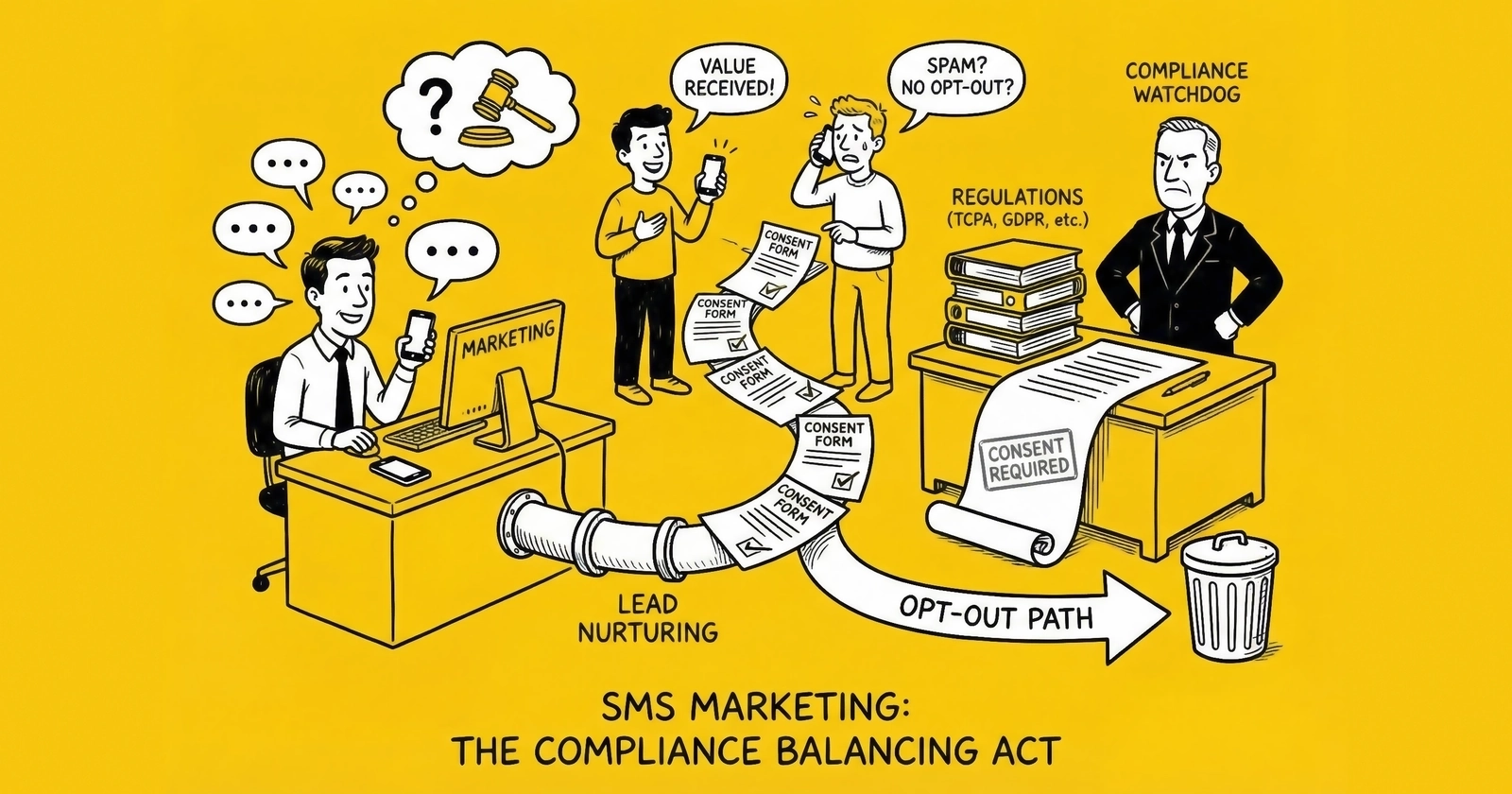
A comprehensive guide to SMS marketing for lead generation professionals, covering TCPA consent requirements, 10DLC registration, carrier filtering, message templates, and compliance frameworks that protect your business while maximizing engagement.
Introduction: The 98% Open Rate Channel That Can Destroy Your Business
SMS achieves what no other marketing channel can: 98% open rates, 90% of messages read within three minutes, and response rates that dwarf email by a factor of seven. For lead nurturing, where speed determines conversion and engagement decides outcomes, SMS is the highest-impact channel available.
It is also the most dangerous.
Every text message you send without proper consent creates $500 to $1,500 in statutory liability. At scale, the math becomes existential. A lead generator sending 50,000 messages monthly with a 1% consent defect rate accumulates 24,000 potentially non-compliant messages over the four-year statute of limitations. That is $12 million to $36 million in exposure before attorneys fees.
In the first quarter of 2025 alone, 507 TCPA class actions were filed, a 112% increase over the same period in 2024. Text message cases now represent a growing share of this TCPA litigation, particularly targeting time-of-day violations and consent defects. South Florida plaintiff firms filed over 100 SMS-related lawsuits in a single month in early 2025.
This guide covers everything required to build SMS nurturing programs that convert leads without creating liability. Those who master this balance achieve the best of both worlds: the engagement advantage of SMS with the protection of bulletproof compliance infrastructure.
Why SMS Dominates Lead Nurturing Metrics
The Engagement Advantage
The numbers tell the story. SMS outperforms every other digital channel on the metrics that matter for lead conversion.
98% open rate. Virtually every SMS message is opened. Email averages 20% open rates, meaning four out of five nurturing messages go unseen. The visibility difference alone justifies SMS investment.
90% read within three minutes. The average SMS is read within 90 seconds of delivery. Lead value decays approximately 10% per hour after submission. SMS delivers your message while the lead is still warm.
45% response rate. SMS response rates range from 30% to 45% depending on industry and message quality. Email response rates average 6%. For lead qualification, appointment confirmation, and re-engagement, this response differential compounds across every touchpoint.
391% higher conversion at one-minute response. Research shows leads contacted within one minute of submission convert at 391% higher rates. SMS enables sub-minute acknowledgment at scale. The five-minute rule documents this decay curve in detail.
The Lead Nurturing Application
Consider a standard seven-touch nurturing sequence applied to 1,000 leads.
| Metric | Email Only | SMS Only | Combined |
|---|---|---|---|
| Messages Seen | 1,400 (20%) | 6,860 (98%) | 4,130 |
| Responses Received | 420 (6%) | 2,800 (40%) | 1,610 |
| Appointments Set (20% of responses) | 84 | 560 | 322 |
SMS-only nurturing delivers nearly seven times more appointments than email-only. Combined approaches capture the strengths of each channel: SMS for immediate engagement, email for detailed content delivery.
Channel Preference by Demographic
Preference data shapes channel strategy by vertical.
18-34 years old: 75% prefer SMS over phone calls for business communication. Lead generation in solar, education, personal loans, and debt relief skews heavily into this demographic.
35-54 years old: 52% prefer SMS, 28% prefer phone, 20% prefer email. Insurance and mortgage leads distribute across this range.
55+ years old: 38% prefer phone, 35% prefer email, 27% prefer SMS. Medicare, final expense, and retirement verticals require balanced multi-channel approaches.
The preference data does not mean you should avoid SMS for older demographics. It means messaging should acknowledge preference and offer alternatives: “Reply CALL if you prefer a phone conversation.”
TCPA Consent Requirements for SMS Marketing
The Telephone Consumer Protection Act applies fully to text messages. Courts have consistently held that SMS messages constitute “calls” under the statute, triggering all consent requirements that apply to phone communication.
SMS Triggers TCPA Liability
Every compliance requirement for automated calling applies equally to text messaging:
Prior express written consent required for marketing messages. Any SMS promoting goods or services requires PEWC, the highest consent standard under the TCPA.
Time-of-day restrictions apply. Federal law prohibits texts before 8:00 a.m. or after 9:00 p.m. in the recipient’s local time zone. Florida and Maryland restrict to 8:00 a.m. to 8:00 p.m. See our complete guide to telemarketing calling hours by state for state-specific requirements.
Opt-out requests must be honored immediately. The FCC’s April 2025 rules require processing revocations within ten business days, but for SMS, best practice is real-time processing.
Seller identification required. The consent must clearly identify who will be sending messages.
Elements of Valid SMS Consent
Valid prior express written consent for SMS marketing requires six specific elements under 47 CFR 64.1200(f)(9).
Written agreement. The consent must be documented in writing. Electronic signatures satisfying the E-SIGN Act qualify, but the intersection of TCPA and E-SIGN creates additional requirements for electronic consent.
Signature of the person receiving messages. The individual to whom messages will be sent must have signed the consent. For electronic consent, this typically means checking a box, typing a name, or similar affirmative action.
Clear authorization for the specific sender. The consent language must explicitly authorize the company sending messages to deliver marketing communications via SMS. Generic “contact me” language is insufficient.
Identification of the phone number. The consent must identify the specific phone number authorized for contact.
Not a condition of purchase. Consent cannot be required to complete a transaction. Buried consent in mandatory terms of service does not satisfy this requirement.
Clear and conspicuous disclosure. The consent language must be apparent to a reasonable consumer, not hidden in fine print or accessible only through hyperlinks.
Sample Compliant SMS Consent Language
By clicking “Get My Quote,” I provide my electronic signature and give prior express written consent to receive marketing text messages from [Company Name] at the phone number provided. Messages may be sent using automated technology. Message and data rates may apply. I understand this consent is not required to purchase any goods or services. Reply STOP at any time to opt out.
This language addresses each required element: written agreement (electronic signature), identified sender, explicit SMS authorization, phone number reference, non-purchase-condition statement, and opt-out disclosure.
E-SIGN Overlay for Electronic Consent
When SMS consent is captured electronically, which is standard in lead generation, the federal Electronic Signatures in Global and National Commerce Act creates additional requirements.
Courts have increasingly held that because TCPA requires “written” consent with specific disclosures, obtaining that consent electronically triggers E-SIGN consumer disclosure and consent requirements. Under Bradley v. Dentalplans.com (D. Md. 2024), this means:
E-SIGN consumer disclosure. Before obtaining electronic consent, consumers must receive disclosure about electronic records and signatures.
E-SIGN consent. Consumers must consent to receive required disclosures electronically, separate from their TCPA consent.
Hardware and software disclosure. Consumers must be informed of requirements to access electronic records.
The practical implication is significant. Electronic TCPA consent captured without E-SIGN compliance may be unenforceable. Lead forms should address both TCPA and E-SIGN requirements in their consent flow design. The one-to-one consent rule adds further complexity to consent capture.
10DLC Registration: The Carrier Compliance Layer
TCPA compliance addresses federal law. 10DLC registration addresses carrier requirements. Both are mandatory for SMS marketing at scale.
What Is 10DLC?
10DLC stands for “10-Digit Long Code,” referring to standard 10-digit phone numbers used for Application-to-Person (A2P) messaging. Starting in 2021, major carriers (AT&T, Verizon, T-Mobile) implemented 10DLC registration requirements for businesses sending text messages to consumers.
10DLC replaced the Wild West era of SMS marketing where businesses could acquire phone numbers and begin messaging immediately. The system requires brand and campaign registration through The Campaign Registry (TCR), with carrier vetting before messages can be sent.
Why 10DLC Matters for Lead Generation
Unregistered 10DLC campaigns face immediate consequences:
Message filtering. Carriers actively filter unregistered traffic. Delivery rates for unregistered numbers have dropped to 60-70% in many cases, compared to 97%+ for registered campaigns.
Message blocking. Carriers may block messages entirely from unregistered sources, with no delivery notification to the sender.
Number suspension. Continued unregistered sending can result in phone number suspension, requiring new numbers and new registration.
Throughput limits. Unregistered numbers face severe rate limits, often 1-3 messages per second compared to 100+ messages per second for registered, vetted campaigns.
For lead nurturing, where time-sensitive delivery matters, unregistered sending destroys the channel’s value.
The 10DLC Registration Process
Registration occurs through The Campaign Registry and involves two phases.
Phase 1: Brand Registration
Brand registration establishes your company’s identity with the carriers. Required information includes:
- Legal business name and DBA
- Business type (sole proprietor, LLC, corporation, etc.)
- EIN or Tax ID
- Business address
- Business category and vertical
- Contact information
- Website URL
Brand registration typically costs $4-15 one-time, depending on your messaging platform.
Phase 2: Campaign Registration
Campaign registration describes your specific messaging use case. Each brand can register multiple campaigns for different purposes. Required information includes:
- Campaign description (what messages you will send)
- Use case category (marketing, notifications, polling, etc.)
- Sample messages (minimum 2)
- Message volume estimates
- Consumer opt-in mechanism description
- Opt-out handling description
Campaign registration costs approximately $10-15 one-time plus $10/month ongoing per campaign.
Vetting and Approval Timeline
Registration does not equal approval. After submission, campaigns undergo carrier vetting that typically takes 2-8 weeks. Factors affecting approval include:
Business verification. Carriers verify your business exists, is registered with the state, and matches provided information.
Use case review. High-risk use cases (cannabis, gambling, adult content, firearms) face additional scrutiny or outright rejection.
Throughput classification. Based on verification results, carriers assign throughput tiers that determine how many messages per second your campaign can send.
Trust score assignment. TCR assigns trust scores that affect filtering. Higher scores mean better deliverability.
Plan for 4-6 weeks minimum from registration to full campaign launch. Starting the registration process before you need to send is essential.
10DLC Trust Scores and Throughput Tiers
Carriers assign trust scores based on brand and campaign information. These scores determine throughput limits and filtering behavior.
| Trust Score | Typical Throughput | Filtering Risk | Suitable For |
|---|---|---|---|
| High | 100+ msg/sec | Low | Enterprise, established brands |
| Medium-High | 40-100 msg/sec | Low-Medium | Mid-market, verified businesses |
| Medium | 10-40 msg/sec | Medium | SMB, newer businesses |
| Low | 1-10 msg/sec | High | Unvetted, sole proprietors |
Lead generation operations typically land in Medium to Medium-High tiers after proper registration and vetting. This is sufficient for most nurturing campaigns.
Common 10DLC Registration Mistakes
Mistake 1: Generic campaign descriptions. Vague descriptions like “marketing messages” invite rejection. Specific descriptions like “Insurance quote follow-up messages for consumers who requested quotes through our website” pass review more easily.
Mistake 2: Sample messages that do not match use case. If you register for “notifications” but submit sample messages that are clearly marketing, carriers will reject or flag the campaign.
Mistake 3: Missing opt-in description. You must describe how consumers opt in to receive messages. “They check a box on our lead form” is insufficient. Provide the actual consent language and describe the form.
Mistake 4: Skipping business verification. Sole proprietors and unverified businesses receive the lowest trust scores. Completing business verification, including EIN registration and website verification, significantly improves throughput allocation.
Mistake 5: Waiting until you need to send. The 2-8 week vetting period means you cannot register today and send tomorrow. Register campaigns well before launch.
Short Codes vs. 10DLC: Choosing Your SMS Infrastructure
Not all SMS sending numbers are equal. The choice between short codes and 10DLC affects cost, throughput, and compliance.
Short Codes
Short codes are 5-6 digit numbers (like 12345) used for high-volume A2P messaging. They predate 10DLC and remain the gold standard for massive-scale campaigns.
Advantages:
- Highest throughput (100+ messages per second standard)
- Best deliverability and lowest filtering
- Carrier pre-approval reduces delivery issues
- Brand recognition and legitimacy
Disadvantages:
- High cost: $500-1,000+ per month for shared codes, $1,000-1,500+ for dedicated codes
- Long provisioning time: 8-12 weeks for dedicated codes
- Not available for all use cases
- Cannot receive voice calls
Best for: High-volume broadcast campaigns, enterprise operations, established brands with predictable messaging patterns.
10DLC (10-Digit Long Codes)
10DLC uses standard 10-digit phone numbers with carrier registration for A2P messaging.
Advantages:
- Lower cost: $10-25/month for registration plus per-message rates
- Faster provisioning: 2-8 weeks
- Can receive voice calls on same number
- Local area codes available for regional presence
- Multiple campaigns per brand
Disadvantages:
- Lower throughput than short codes (typically 10-100 msg/sec depending on trust score)
- Requires registration and ongoing compliance
- Filtering possible during traffic spikes
Best for: Most lead generation operations, small-to-medium volume nurturing, local or regional campaigns, two-way conversational messaging.
The Decision Framework
For most lead generation operations, 10DLC is the appropriate choice. Consider short codes only if:
- You send 100,000+ messages per month consistently
- Throughput requirements exceed 10DLC capabilities
- Brand recognition from short code matters for your vertical
- You can justify $1,000+/month in fixed costs
The vast majority of lead nurturing campaigns work well within 10DLC constraints. Register properly, complete business verification, and you will achieve deliverability comparable to short codes at a fraction of the cost.
Carrier Filtering: Why Messages Disappear
Even with TCPA compliance and 10DLC registration, messages can fail to reach recipients. Carrier filtering represents the final layer between your SMS platform and the consumer’s phone.
How Carrier Filtering Works
Carriers (AT&T, Verizon, T-Mobile, and others) operate spam detection systems that evaluate every A2P message. These systems consider:
Content patterns. Messages containing spam trigger words, excessive caps, or suspicious URLs may be filtered.
Volume patterns. Sudden spikes in sending volume trigger review and potential filtering.
Complaint rates. If recipients report your messages as spam, your numbers face increased filtering.
Trust scores. 10DLC registration trust scores influence filtering decisions.
Industry reputation. Some industries (lending, insurance, legal) face heightened scrutiny.
Common Filtering Triggers
Spam trigger words. “FREE,” “WINNER,” “GUARANTEED,” “URGENT,” “ACT NOW” all increase filtering risk. The words themselves are not prohibited, but their presence in commercial context triggers spam detection.
URL shorteners. Bit.ly, tinyurl, and similar services are often blocked or filtered because they obscure destinations. Use full URLs or branded short domains.
Identical message content. Sending the exact same message to thousands of recipients signals spam. Personalize messages with recipient names and relevant details.
Rapid volume increases. Jumping from 100 messages daily to 10,000 triggers review. Scale gradually over days or weeks.
Message rate exceeded. Sending faster than your throughput tier allows results in throttling or blocking.
Avoiding Carrier Filtering
Use personalization. Include first names and relevant details in every message. Personalization reduces filtering and improves response rates.
Avoid spam vocabulary. Instead of “FREE quote,” try “Your quote is ready.” Instead of “ACT NOW,” try “Reply YES to confirm.”
Use legitimate URLs. Full domain URLs (yourcompany.com/quote) or properly branded short domains pass filtering better than generic shorteners.
Scale gradually. Increase sending volume incrementally. A 10-20% daily increase is generally safe.
Monitor deliverability. Track delivery rates by carrier. If one carrier shows declining rates, investigate content or pattern issues.
Maintain low complaint rates. If complaint rates exceed 0.3%, carriers will increase filtering. Ensure opt-out is easy and messages are relevant.
Deliverability Monitoring
Track these metrics to identify filtering issues early.
| Metric | Target | Warning Sign | Action |
|---|---|---|---|
| Overall Delivery Rate | 97%+ | Below 95% | Investigate carrier-specific issues |
| Carrier-Specific Rate | 96%+ each | 5%+ variance between carriers | Review content for carrier-specific triggers |
| Opt-Out Rate | Under 2% | Above 3% | Reduce frequency, improve relevance |
| Complaint Rate | Under 0.1% | Above 0.3% | Audit consent quality, message content |
Revocation Handling: The 10-Day Requirement
The FCC’s April 2025 revocation rules fundamentally changed how companies must handle opt-out requests. For SMS, this creates specific operational requirements.
The Legal Framework
Consumers may revoke consent through “any reasonable manner that clearly expresses a desire not to receive further calls or text messages.” Companies may not designate an exclusive means of revocation that precludes other reasonable methods.
The FCC identified specific keywords that constitute definitive revocation when received via text message: “stop,” “quit,” “revoke,” “opt out,” “cancel,” “unsubscribe,” and “end.” These terms trigger immediate revocation obligations regardless of other language in the message.
The ten-business-day requirement means you must honor revocation requests within ten business days of receipt. For SMS, where the next message could go out in minutes, this effectively requires real-time processing.
Building Compliant Opt-Out Processing
Real-time keyword detection. Your SMS platform must recognize opt-out keywords immediately upon receipt and prevent any further messages to that number.
Any reasonable expression. Beyond standard keywords, messages like “no more texts,” “stop texting me,” “remove me from your list,” and similar expressions constitute revocation. When in doubt, treat ambiguous messages as opt-outs.
Cross-channel synchronization. An SMS opt-out must propagate to all contact channels within ten business days. The same consumer should not receive emails or phone calls if they opted out via text.
Confirmation message requirements. You may send a one-time confirmation of the opt-out, but strict conditions apply:
- Must be sent within five minutes of the opt-out request
- Cannot include any marketing content
- If the consumer consented to multiple message categories, may request clarification about which to discontinue
- If no response to clarification, opt-out applies to all categories
Sample Opt-Out Confirmation
You have been unsubscribed from [Company Name] messages. Reply JOIN to resubscribe. For help, reply HELP or call [Phone Number].
This confirmation is brief, non-marketing, and provides resubscription option without pressure.
Opt-Out Rate Benchmarks
Monitor opt-out rates as a health indicator.
| Rate | Interpretation | Action |
|---|---|---|
| Under 1% | Healthy engagement | Continue current approach |
| 1-2% | Normal for marketing SMS | Monitor for trends |
| 2-3% | Elevated, investigate | Review frequency and relevance |
| Above 3% | Problem indicated | Reduce frequency, audit consent quality |
Rising opt-out rates often indicate frequency fatigue, irrelevant content, or consent quality issues at the lead source. Improving lead quality at the source can help reduce opt-out rates.
SMS Message Templates for Lead Nurturing
Effective SMS copy differs from email: shorter, more direct, action-oriented. Every word must earn its place.
Immediate Post-Submission Acknowledgment
The highest-value SMS touchpoint comes within seconds of lead submission.
Thanks [First Name]. Your insurance quote request is in. An agent will call within 10 minutes. Reply YES to confirm this number.
This message accomplishes three objectives: confirms receipt, sets expectations, and validates the phone number. The validation step (Reply YES) also creates an additional engagement touchpoint.
Appointment Reminders
No-show rates for phone appointments average 25-35%. SMS reminders reduce no-shows by 38% on average.
24 hours before:
Reminder: Your insurance consultation is tomorrow at [Time] with [Agent Name]. Reply C to confirm or R to reschedule.
2 hours before:
Your appointment is in 2 hours. Questions before we call? Reply to this text.
Post-missed-call:
We just tried calling about your quote. When is a good time to reach you? Reply with a time or CALL for immediate callback.
Re-Engagement for Aged Leads
Leads that did not convert immediately still hold value. SMS re-engagement outperforms email for reactivation.
Hi [First Name]. You requested home insurance quotes 3 weeks ago. Rates have changed. Want us to run updated numbers? Reply YES.
The specificity (3 weeks, rates changed) demonstrates relevance. The simple response option (Reply YES) minimizes friction.
Lead Qualification
Use SMS to gather qualifying information before transferring to sales.
Message 1:
Quick question: Are you currently insured? Reply YES or NO.
Message 2 (if YES):
Thanks. Are you happy with your current coverage or looking for better rates?
Message 2 (if NO):
Got it. We can help. What type of coverage are you looking for?
This qualification reduces time spent on unqualified leads while warming qualified leads before the sales call.
Copy Best Practices
Lead with value or context. The first words should establish why the consumer should care.
Use first names. Personalization improves response rates 15-25% and reduces filtering.
One clear call-to-action. Every message should have exactly one action you want the consumer to take.
Keep under 160 characters when possible. Single-segment messages avoid carrier concatenation issues and feel less like spam.
Include opt-out option in marketing messages. “Reply STOP to opt out” at the end of marketing messages is best practice.
Avoid spam trigger words. Instead of “FREE quote,” use “Your quote is ready.” Instead of “WINNER,” use specific value propositions.
Timing and Frequency Optimization
When you send matters as much as what you send. Timing optimization can improve response rates by 30% or more.
Optimal Send Times by Vertical
Insurance: Peak response 10-11 a.m. and 2-4 p.m. local time. Best days: Tuesday through Thursday. Avoid Monday mornings and Friday afternoons.
Mortgage: Peak response 9-11 a.m. and 3-5 p.m. Saturday morning works well for refinance leads who cannot talk during work hours.
Solar: Peak response 10 a.m.-12 p.m. and 5-7 p.m. Weekend afternoons perform well when homeowners are home and can evaluate their property.
Home Services: Peak response 5-7 p.m. local time when homeowners are back from work and thinking about home projects.
Frequency Limits
No statutory limit exists for SMS frequency, but consumer tolerance and spam filtering create practical limits.
- Maximum 2-4 marketing messages per week per consumer
- Maximum 8-12 messages total in any nurturing sequence
- Space messages at least 24 hours apart
- Reduce frequency after 7 days without engagement
Exceeding these limits increases opt-outs, triggers carrier filtering, and reduces the effectiveness of remaining messages.
Time Zone Compliance
Time-of-day restrictions require sending within permitted hours in the recipient’s time zone.
Federal requirement: 8:00 a.m. to 9:00 p.m. recipient local time Florida/Maryland: 8:00 a.m. to 8:00 p.m. recipient local time
Build compliance infrastructure.
-
Capture location data at lead submission. ZIP code provides timezone information.
-
Map to timezone in your SMS platform. Do not rely on area code alone, mobile numbers often do not match geographic location.
-
Schedule sends based on recipient local time. A message scheduled for 9:00 a.m. should deliver at 9:00 a.m. in the recipient’s timezone, not your timezone.
-
Build suppression windows. Hard stops preventing any message before 8:00 a.m. or after 8:00 p.m. (or stricter state limits) in recipient local time.
Area code assumptions are dangerous. A mobile number with a New York area code may belong to someone living in California. Use IP-based geolocation at form submission, explicit ZIP code capture, or timezone lookup services for accuracy.
Multi-Channel Orchestration
SMS performs best as part of a coordinated multi-channel sequence, not as a standalone channel.
Optimal Sequence for a New Lead
| Timing | Channel | Purpose |
|---|---|---|
| 0-30 seconds | SMS | Instant acknowledgment, phone validation |
| 30-90 seconds | Phone | First contact attempt |
| 2 minutes | Detailed information, resources | |
| 1 hour | SMS | ”Just tried calling. When is good?“ |
| 24 hours | Educational content, value reinforcement | |
| 48 hours | Phone | Second attempt |
| 72 hours | SMS | Simple re-engagement question |
| 7 days | Value reminder, new offer |
This sequence layers channels for maximum coverage. SMS provides immediate engagement and re-engagement. Phone attempts conversion. Email delivers depth. Each channel complements the others.
Coordination Rules
Avoid channel collision. Do not send SMS and email within the same hour. Multiple simultaneous touches feel like spam.
Create consistent messaging. A consumer should experience a coherent conversation across channels, not disconnected messages.
Honor channel preferences. If a consumer responds to SMS but ignores email, shift toward SMS. If they answer phone calls, prioritize phone.
Implement unified suppression. Opt-out on any channel must propagate to all channels. Cross-channel suppression is required by the April 2025 FCC rules (though this specific provision was delayed until April 2025).
Measuring SMS Campaign Performance
Core Metrics
Delivery Rate Target: 97%+ Warning: Below 95% Below 95% indicates carrier filtering, number quality issues, or unregistered 10DLC status.
Response Rate by Message Type
- Confirmation requests: 40-60%
- Qualification questions: 25-40%
- Appointment reminders: 30-50%
- Re-engagement: 8-15%
- Broadcast marketing: 5-10%
Opt-Out Rate Target: Under 2% Warning: Above 3% Rising opt-out rates signal frequency fatigue, relevance problems, or consent quality issues.
Cost Per Conversion Calculate: Total SMS spend divided by SMS-attributed conversions. Compare against other channel CPAs to validate SMS investment.
ROI Calculation Example
Consider a lead generator running SMS nurturing.
| Metric | Value |
|---|---|
| Monthly SMS platform cost | $300 |
| Message costs (30,000 messages at $0.01) | $300 |
| Total monthly SMS cost | $600 |
| Leads in SMS nurturing | 3,000 |
| Conversion rate with SMS | 14% |
| Conversion rate without SMS (email only) | 9% |
| Incremental conversions | 150 |
| Average conversion value | $120 |
| Incremental revenue | $18,000 |
| SMS ROI | 2,900% |
Even conservative assumptions produce compelling ROI. The engagement differential between SMS and other channels creates substantial incremental value.
Common SMS Compliance Mistakes
Mistake 1: Assuming Form Consent Covers SMS
Generic contact consent does not satisfy TCPA requirements for SMS marketing. “I agree to be contacted” is insufficient. Consent language must explicitly authorize text messages using automated technology.
What to do: Audit your consent language against the six PEWC requirements. If SMS is not explicitly mentioned, update your forms.
Mistake 2: Ignoring Time Zone Differences
Sending at 9:15 p.m. in the recipient’s time zone violates federal law, even if it is 6:15 p.m. at your office. Mobile numbers compound this risk because area codes do not reliably indicate location.
What to do: Implement timezone lookup services, capture ZIP codes at form submission, and build hard stops in your SMS platform.
Mistake 3: Delayed Opt-Out Processing
Sending a message after receiving a STOP request creates immediate liability. Batch processing that checks opt-outs daily is insufficient.
What to do: Implement real-time opt-out detection that prevents any message from sending to opted-out numbers.
Mistake 4: Re-Engaging Opted-Out Consumers
Once opted out, you need fresh consent before texting again. Opt-outs do not expire. “It has been six months, they probably forgot they opted out” is not a defense.
What to do: Maintain permanent suppression lists. Never import leads without checking against opt-out history.
Mistake 5: Skipping 10DLC Registration
Unregistered campaigns face carrier filtering that can reduce delivery rates to 60-70%. Poor deliverability negates SMS’s engagement advantage.
What to do: Register before you need to send. Allow 4-8 weeks for registration and vetting.
Mistake 6: Inadequate Record Retention
TCPA claims have a four-year statute of limitations. If you cannot prove consent existed at the time of the message, courts presume non-compliance.
What to do: Retain consent records for minimum five years: timestamp, IP address, consent language shown, phone number captured. Use TrustedForm or Jornaya for third-party verification. Learn more about proper consent documentation requirements.
Mistake 7: Purchasing Leads Without Consent Verification
A TrustedForm certificate does not mean the lead is compliant. It documents what happened on the form. If the form itself was non-compliant, the certificate documents your liability.
What to do: Retrieve and review certificates before contact. Verify your company was specifically named in the disclosure. Audit lead sources regularly.
Frequently Asked Questions
1. Do I need prior express written consent for every text message I send?
Marketing messages promoting goods or services require prior express written consent (PEWC) with specific elements: written agreement, consumer signature, clear authorization for the sender, identified phone number, not a purchase condition, and clear and conspicuous disclosure. Purely informational messages (appointment reminders, delivery notifications) may require only prior express consent, which has lower requirements. However, lead nurturing messages almost always qualify as marketing, making PEWC the standard for lead generation operations.
2. What is the difference between 10DLC and short codes?
10DLC (10-Digit Long Codes) uses standard 10-digit phone numbers with carrier registration for business messaging. Short codes are 5-6 digit numbers designed for high-volume messaging. 10DLC costs $10-25/month for registration plus per-message rates and provides 10-100 messages per second throughput. Short codes cost $500-1,500+/month but offer 100+ messages per second throughput with the best deliverability. Most lead generation operations use 10DLC; short codes make sense only for very high-volume senders who can justify the cost.
3. How long does 10DLC registration take?
Brand registration typically takes 1-3 days. Campaign registration and carrier vetting take 2-8 weeks depending on your business type, use case, and verification status. Sole proprietors and unverified businesses face longer review times. Plan for 4-6 weeks minimum from registration start to full campaign launch. Do not wait until you need to send to begin registration.
4. What happens if I send SMS messages without 10DLC registration?
Unregistered A2P messages face carrier filtering that can reduce delivery rates to 60-70%. Carriers may block messages entirely, and continued unregistered sending can result in phone number suspension. Throughput limits for unregistered numbers are severe, often 1-3 messages per second compared to 100+ for registered, vetted campaigns. The engagement advantage of SMS disappears if messages do not reach recipients.
5. How quickly must I process opt-out requests?
The FCC’s April 2025 rules require honoring revocation requests within ten business days. However, for SMS, best practice is real-time processing. Any message sent after an opt-out request creates $500-1,500 potential liability. Implement automated keyword detection that immediately prevents further messages to opted-out numbers.
6. What opt-out keywords must I recognize?
The FCC identified specific definitive revocation keywords: “stop,” “quit,” “revoke,” “opt out,” “cancel,” “unsubscribe,” and “end.” However, the rule requires honoring “any reasonable manner” of expressing desire to stop receiving messages. Phrases like “no more texts,” “remove me,” and “stop texting me” also constitute revocation even if not in the specific keyword list. When in doubt, treat ambiguous messages as opt-outs.
7. Can I text leads purchased from a third party?
Only if the consent explicitly covered your company by name. Generic consent to receive messages from “partners” or a list of dozens of potential callers is increasingly risky. Sophisticated lead buyers now require one-to-one consent or dynamic disclosure that specifically identifies them at the moment of consent capture. The safest approach is to ensure your company name appeared in the consent disclosure the consumer saw, documented by TrustedForm or similar verification.
8. What are state mini-TCPA requirements for SMS?
Several states have enacted telemarketing laws with stricter requirements than federal TCPA. Florida’s Telephone Solicitation Act (FTSA) restricts calling hours to 8 a.m. to 8 p.m. and imposes enhanced penalties. Oklahoma’s Telephone Solicitation Act (OTSA) includes call frequency limits and stricter consent requirements. Maryland uses 8 a.m. to 8 p.m. calling hours with a broader autodialer definition. For a detailed breakdown of these requirements, see our guide to state mini-TCPA laws including FTSA and OTSA. For national SMS campaigns, apply the most restrictive applicable standard, which generally means 8 a.m. to 8 p.m. recipient local time.
9. How can I avoid carrier filtering of my SMS messages?
Register properly for 10DLC and complete business verification for higher trust scores. Personalize messages with recipient names and relevant details. Avoid spam trigger words like “FREE,” “WINNER,” “URGENT.” Use full domain URLs rather than generic URL shorteners. Scale sending volume gradually rather than spiking suddenly. Monitor delivery rates by carrier and investigate drops. Maintain opt-out rates below 2% and complaint rates below 0.1%.
10. What records should I retain for SMS compliance?
Retain consent documentation for minimum five years (one year beyond the four-year TCPA statute of limitations). Essential records include: timestamp of consent, IP address of form submission, exact consent language displayed, phone number captured, form URL and configuration, and consumer affirmative action (checkbox click, signature). Use third-party verification services (TrustedForm, Jornaya) to provide independent documentation that can be presented in litigation. Retain message logs showing delivery status, timestamps, and content for all messages sent.
Key Takeaways
-
SMS achieves 98% open rates and 45% response rates. For time-sensitive lead nurturing, no other channel delivers comparable engagement. But the same reach that makes SMS effective makes non-compliance catastrophic.
-
TCPA applies fully to text messages. Prior express written consent requires six specific elements: written agreement, signature, explicit SMS authorization, identified phone number, not a purchase condition, and clear disclosure. Missing any element creates $500-1,500 liability per message.
-
10DLC registration is mandatory for business SMS. Unregistered campaigns face carrier filtering that can reduce delivery rates to 60-70%. Register 4-8 weeks before you need to send. Complete business verification for higher trust scores and throughput.
-
Carrier filtering operates independently of TCPA compliance. Even compliant messages can be filtered. Personalize content, avoid spam trigger words, use full URLs, scale gradually, and monitor delivery rates by carrier.
-
The April 2025 FCC rules require ten-day opt-out processing. For SMS, implement real-time processing. Any message after an opt-out creates immediate liability. Recognize all standard keywords plus any reasonable expression of desire to stop receiving messages.
-
Time zone compliance is non-negotiable. Federal law prohibits messages before 8 a.m. or after 9 p.m. recipient local time. Florida and Maryland use 8 a.m. to 8 p.m. Do not rely on area codes; use ZIP codes or timezone lookup services.
-
Multi-channel orchestration multiplies SMS impact. Use SMS for immediate acknowledgment, appointment reminders, re-engagement, and qualification. Layer with phone and email for a complete nurturing sequence.
-
Documentation determines litigation survival. Retain consent records with timestamp, IP address, and exact language shown for five years minimum. Use TrustedForm or Jornaya for third-party verification. Retrieve and review certificates before contact.
-
Start with compliance infrastructure, then optimize for performance. No SMS ROI justifies the liability of non-compliant messaging. Build the infrastructure first. The engagement advantage of SMS is real only when every message you send is defensible.
SMS marketing delivers the highest engagement rates of any digital channel for lead nurturing. Combined with proper consent infrastructure, 10DLC registration, carrier compliance, and multi-channel orchestration, it becomes a conversion multiplier that justifies investment many times over. Those who master both the opportunity and the risk build sustainable competitive advantage in an increasingly regulated environment.
This article provides general information about SMS marketing compliance. It is not legal advice. TCPA requirements and carrier policies change frequently. Consult qualified legal counsel and your SMS platform provider for guidance on your specific situation.
Statistics current as of late 2025. Sources: FCC regulatory filings, WebRecon TCPA litigation data, The Campaign Registry documentation, carrier policy updates.