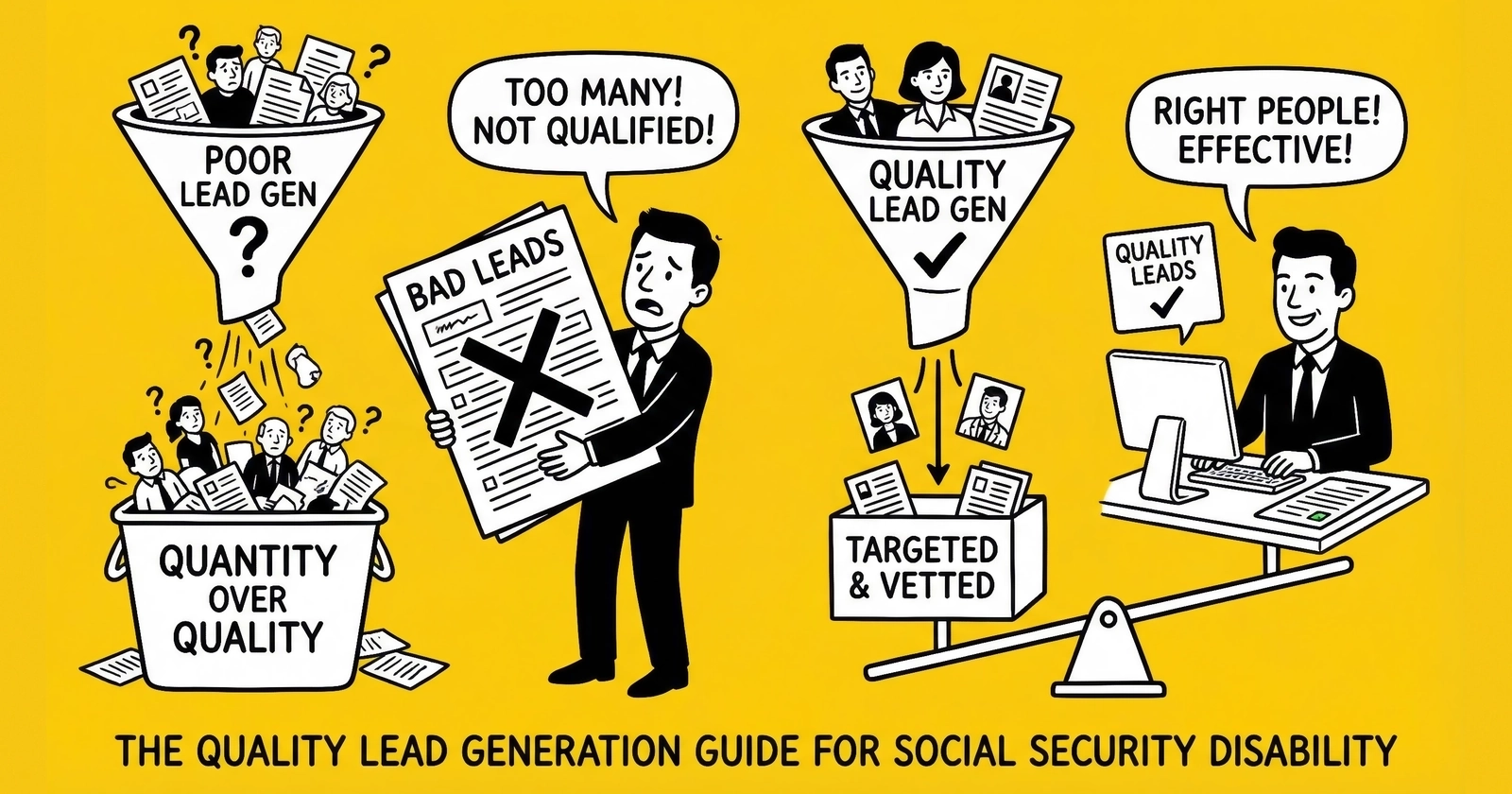
Master the $2 billion+ SSD claims market where 2.8 million annual applications create consistent demand for qualified leads. Learn qualification criteria, compliance requirements, and channel strategies that separate profitable operators from those drowning in returns.
Every year, approximately 2.8 million Americans apply for Social Security Disability Insurance or Supplemental Security Income benefits. Nearly 70% of initial applications are denied. This creates a market where disability attorneys and claims representatives pursue qualified applicants who need professional help navigating a system designed to say no.
The Social Security Disability lead vertical sits at the intersection of genuine consumer need and substantial economic opportunity. Unlike personal injury where case values can reach millions, SSD cases operate on contingency fees capped by Social Security Administration regulations at 25% of back benefits or $7,200, whichever is less (as of 2024). This creates a different economic model than personal injury lead generation, with lower CPLs but higher volume requirements and specific qualification challenges.
Understanding SSD lead generation requires grasping the claims process that creates lead demand, the qualification criteria that determine lead value, the compliance landscape that shapes operations, and the buyer ecosystem that monetizes leads. This guide covers all four dimensions with the operational specifics needed to build a sustainable SSD lead business.
Understanding the SSD Market Opportunity
The Social Security Disability market operates at scale that dwarfs most lead generation verticals. More than 67 million Americans receive some form of Social Security benefit, with approximately 8.5 million receiving SSDI (Social Security Disability Insurance) and 7.5 million receiving SSI (Supplemental Security Income) as of 2024. The ongoing flow of new applicants – averaging 230,000-250,000 monthly – creates consistent lead demand regardless of economic conditions.
The Claims Volume Reality
The Social Security Administration processes disability claims through a multi-stage system that creates demand at each level:
| Stage | Denial Rate | Timeline | Lead Opportunity |
|---|---|---|---|
| Initial Application | 65-70% | 3-6 months | Pre-application and denied applicants |
| Reconsideration | 85-90% | 3-6 months | Denied initial applicants |
| ALJ Hearing | 40-55% (varies by region) | 12-18 months | Reconsideration denials |
| Appeals Council | 85%+ | 6-18 months | ALJ denials |
| Federal Court | Varies | 12-24 months | Appeals Council denials |
The denial rates at initial and reconsideration stages create the primary lead market. When 65-70% of initial applications are denied, followed by 85-90% denial at reconsideration, the population of consumers needing professional representation grows continuously.
Approximately 800,000-900,000 hearings are requested annually, representing consumers who have been denied twice and need legal representation to proceed. This hearing-level population represents the highest-value lead segment because professional representation demonstrably improves outcomes.
Why Representation Matters
SSA data consistently shows that claimants with representation win at higher rates than those representing themselves. At the ALJ hearing level, represented claimants historically win 45-55% of cases compared to 25-35% for unrepresented claimants. This differential creates the economic justification for professional fees and the lead acquisition investment that funds attorney operations.
The representation advantage stems from several factors: proper medical evidence compilation, strategic hearing preparation, understanding of SSA evaluation criteria, and experience navigating administrative procedures. Consumers increasingly recognize this advantage, driving demand for qualified representation.
Economic Model Fundamentals
Unlike personal injury where contingency fees can reach 33-40% of settlements potentially exceeding $100,000, SSD fee structures are regulated and capped:
SSDI Fee Structure
The fee structure for SSDI cases is tightly regulated. Representatives can charge a maximum of 25% of past-due benefits, with a dollar cap of $7,200 (as of 2024, subject to periodic adjustment). The Social Security Administration pays fees directly from back benefits at the time of approval, eliminating collection risk for representatives. Future benefits are not subject to fee claims – the contingency applies only to accumulated past-due amounts.
Average Case Economics
Average back benefits awards typically range from $15,000 to $40,000, producing fees of $3,750 to $7,200 at the 25% rate (though the $7,200 cap limits fees on larger awards). Case duration from initial filing to award runs 18 to 36 months, creating extended timelines between lead acquisition and fee realization.
This fee structure determines lead acquisition economics. An attorney earning an average of $5,500 per successful case with a 50% win rate needs two cases to generate one fee – meaning each lead that converts to a signed case costs half the eventual fee in acquisition and processing.
The economics work at scale. A disability practice handling 50 cases monthly with $5,500 average fees and 50% win rates generates $137,500 in monthly fee revenue. Allocating 20-25% of revenue to lead acquisition supports $27,500-$34,000 in monthly lead investment, or approximately $550-$680 per case signed.
Qualification Criteria: What Makes an SSD Lead Valuable
SSD lead quality depends on capturing information that enables rapid case evaluation. The SSA uses specific criteria to evaluate disability claims, and leads must provide data points that map to those criteria.
Essential Qualification Elements
Medical Condition Information
The SSA evaluates disability based on whether a medical condition prevents substantial gainful activity, so lead forms must capture sufficient clinical context for rapid case assessment. At minimum, forms need the primary medical condition or conditions, the date of disability onset or when work stopped, and current treatment status including whether the applicant is receiving care and taking medications. Hospitalizations or surgeries related to the condition strengthen cases significantly, and mental health conditions often accompany physical disabilities – capturing both dimensions improves qualification accuracy.
Work History Status
SSDI eligibility requires sufficient work credits earned through payroll tax contributions, while SSI has no work history requirement but imposes strict income and asset limits. Lead forms should capture current employment status (working, not working, or reduced hours), the date the applicant last worked full-time, their reason for stopping work, any current income from employment, and previous occupation types. This work history data enables rapid eligibility determination and helps representatives assess case strength.
Application Status
The claims stage determines both case value and appropriate routing. Pre-application leads target consumers who have never applied. Applicants who have filed and are waiting for decisions represent moderate opportunity. Initial application denials generate the highest volume of leads. Reconsideration denials represent high-value leads ready for hearing representation. ALJ hearing denials involve complex appellate cases. Some leads come from claimants currently receiving benefits but facing continuing disability reviews that threaten termination.
Representation Status
Leads already represented by attorneys generate immediate returns and have no value. Forms must screen for current attorney or representative relationships, previous work with representatives on the same claim, and any signed fee agreements. A single question about current representation eliminates the most common return category.
Disqualifying Factors to Screen
Building disqualification screening into forms reduces return rates and improves buyer relationships. Several categories should trigger immediate exclusion or specialized routing.
Any lead indicating current representation must be excluded immediately – soliciting represented claimants violates professional conduct rules. The substantial gainful activity threshold creates another hard disqualifier: for 2024, that threshold is $1,550 per month ($2,590 for blind individuals). Leads earning above SGA generally cannot qualify for disability benefits, though exceptions exist for trial work periods and self-employment situations.
The SSA requires that conditions be expected to last 12 months or result in death, so temporary injuries or conditions expected to resolve within a year generally do not qualify. Child SSI cases have different evaluation criteria and require specialized handling – general SSD lead forms targeting adult SSDI often fail to capture necessary information for child cases. Finally, individuals who have reached full retirement age (67 for those born in 1960 or later) are no longer eligible for SSDI because benefits automatically convert to retirement at that threshold.
Lead Quality Tiers and Pricing
SSD leads price based on qualification depth and claims stage. Basic inquiry leads with minimal qualification – just condition and contact information – price at $15-30. Qualified leads capturing denial status, work history, and condition detail range from $30-55. Premium qualified leads with detailed medical information, recent denial, and confirmed no representation command $55-85. Live transfers with pre-qualification and warm handoff price at $75-150, while signed retainers representing complete intake and executed fee agreements sell for $200-400 or more.
Claims stage significantly affects pricing. Post-reconsideration leads (denied twice, ready for hearing) command 25-50% premiums because they are further in the process with clearer case viability. A $45 qualified lead at initial denial might price at $60-70 for a reconsideration denial. Pre-application leads price lowest because conversion to signed cases requires the additional step of filing an initial application, and many pre-application inquiries never actually file.
The SSD Claims Process and Lead Timing
Understanding the claims process enables strategic lead generation that aligns with consumer decision points.
Stage 1: Initial Application
Consumers can file initial disability applications online at ssa.gov, by phone, or in person at Social Security offices. The initial application involves detailed work history for the past 15 years, medical provider information and treatment history, an activities of daily living questionnaire, and authorization for SSA to obtain medical records.
The lead opportunity at this stage splits between pre-application leads targeting consumers considering filing who want guidance, and post-denial leads targeting the 65-70% denied. Initial decisions take 3-6 months, and the optimal window for lead capture is immediately after denial when frustration peaks and consumers actively seek help.
Stage 2: Reconsideration
Claimants denied at the initial level have 60 days to request reconsideration. This is a paper review by a different examiner who reviews the same evidence, often with similar results – denial rates at reconsideration run 85-90%.
Post-reconsideration leads represent consumers who have been denied twice and typically need representation to proceed to hearing. Reconsideration decisions take 3-6 months, and the 60-day appeal deadline after denial creates genuine urgency for lead capture.
Stage 3: Administrative Law Judge Hearing
After reconsideration denial, claimants have 60 days to request a hearing before an Administrative Law Judge. This is the stage where professional representation provides the most value. Hearings are in-person or video proceedings where claimants can present testimony and evidence, medical and vocational experts may testify, and representatives can cross-examine witnesses. Win rates improve significantly with representation – the differential between represented and unrepresented claimants is most pronounced at this stage.
This is the highest-value lead stage. Consumers requesting hearings understand they need help and are ready to engage representation. Wait times for ALJ hearings average 12-18 months depending on region, though the 60-day request deadline creates immediate urgency for lead capture.
Stage 4: Appeals Council and Federal Court
Claimants denied at ALJ hearing can request Appeals Council review and subsequently file in federal court. These stages involve legal complexity that requires attorney involvement but represent smaller volume.
Deadline Sensitivity
SSD leads are deadline-sensitive. The 60-day appeal windows at each stage create genuine urgency. Leads captured just after denial have 60 days to act before their appeal rights expire. Leads discovered after deadline expiration may need to restart the entire process, significantly reducing case value.
Forms should capture denial dates to enable deadline calculation. Leads with expired deadlines require different handling and typically price lower or may be unsellable.
Traffic Sources and Channel Strategies
SSD lead generation uses channels common across legal lead verticals, with specific considerations for the disability audience.
Paid Search
Google Ads remains the primary SSD lead acquisition channel, with high-intent keywords signaling consumers actively seeking help with disability claims.
Keyword Categories
High-intent decision-stage keywords include “disability lawyer near me,” “social security disability attorney,” “denied disability appeal help,” and “SSD hearing lawyer.” Mid-funnel research-stage keywords capture consumers earlier in their journey: “social security disability denied what to do,” “how to appeal disability denial,” “disability reconsideration process,” and “ALJ hearing preparation.” Lower-intent awareness keywords like “do I qualify for disability,” “social security disability requirements,” and “how long does disability take” cast wider nets at lower costs.
CPCs and Competition
SSD keywords run significantly lower than personal injury due to capped fee structures. High-intent attorney terms typically cost $15-45 per click, appeal and denial terms run $8-25, and qualification and process terms price at $3-12. Compare to personal injury where CPCs routinely exceed $100-250 for competitive terms. The lower CPCs enable broader keyword coverage but require volume to compensate for lower case values.
Geographic Considerations
SSD demand exists nationwide, but processing times and ALJ approval rates vary by region. The Social Security Administration publishes hearing office statistics showing regional variation in wait times and approval rates. Some operators adjust geographic targeting based on these patterns, though ethical considerations apply.
Facebook and Meta Platforms
Facebook provides effective SSD lead acquisition, particularly for reaching consumers who may not be actively searching but experience qualifying conditions.
Targeting Approaches
Condition-based targeting reaches users with interests indicating health challenges, including chronic pain management pages, disability advocacy groups, specific condition communities like fibromyalgia and COPD, and mental health support groups. Life-situation targeting identifies potential need through signals like recent unemployment, job seeking after employment gaps, early retirement considerations, and caregiver communities. Lookalike audiences built from converted leads or signed cases can identify similar consumers not yet in-market.
Creative Considerations
SSD Facebook advertising requires sensitivity to the disability audience. Effective creative acknowledges the difficulty of the situation without exploitation, focuses on process complexity rather than promising outcomes, avoids before/after imagery or success guarantees, and maintains compliance with Facebook’s prohibition on implying user characteristics.
Lead Form vs. Landing Page
Facebook Lead Ads (native forms) generate higher volume but lower quality for SSD. The qualification depth needed for valuable SSD leads often exceeds what native forms effectively capture. Landing page conversions with multi-step forms typically deliver better qualified leads despite lower volume.
Programmatic Display
Display advertising reaches SSD audiences through contextual and behavioral targeting across the open web. Contextual targeting places ads on health and medical content sites, disability-focused publications, government benefits information sites, and legal information resources. Behavioral targeting identifies users researching disability topics, visitors to SSA.gov or related government sites, those exhibiting health condition research patterns, and users showing legal services research behavior.
Display CPMs run significantly lower than search CPCs, but conversion rates are correspondingly lower. Cost per lead from display typically runs $25-50 for basic leads, competitive with search when optimized.
SEO and Content Marketing
Organic search provides sustainable lead flow for operators investing in content development. High-value content topics include condition-specific disability guides (“Is fibromyalgia a disability?”), process explanations (“What happens after disability denial”), regional content (“Disability hearing wait times in [state]”), and calculator tools like back benefits estimators.
The SEO competitive landscape presents challenges for new entrants. Major disability law firms and legal directories dominate competitive SSD keywords, and newcomers face 12-24 month timelines to rank for high-intent terms. Long-tail and condition-specific keywords offer faster ranking opportunities.
Television and Radio
Traditional media remains significant in SSD lead generation due to audience demographics. SSD applicants skew older with conditions that may limit digital engagement, making traditional channels particularly effective. Daytime television reaches unemployed and disabled audiences directly, AM radio maintains strong reach in older demographics, and cable news reaches older news-consuming audiences.
Major SSD law firms invest heavily in television advertising. Lead generators typically compete by generating leads for regional firms rather than attempting national television campaigns requiring multi-million-dollar budgets.
Compliance Framework for SSD Lead Generation
SSD lead generation operates within compliance frameworks covering attorney advertising, consumer protection, and lead generation practices.
Attorney Advertising Rules
Bar association rules governing attorney advertising apply to SSD lead generation as they do in personal injury. State bar rules typically impose three categories of requirements.
Truthfulness requirements prohibit false or misleading claims about outcomes, guarantees of results, inaccurate representation of services, and advertising that fails to clearly identify itself as such. Disclosure requirements mandate attorney advertising labels where required by state, identification of attorneys or firms receiving leads, and clear explanation of how consumer information will be used. Solicitation prohibitions prevent direct contact with known claimants without consent, in-person solicitation for commercial purposes, and violations of state-specific contact rules.
FTC and Consumer Protection
Federal Trade Commission guidelines apply to lead generation advertising with requirements in two key areas.
Clear and conspicuous disclosure rules require that material terms be clearly stated, consent language be understandable to average consumers, and privacy policies accurately describe how consumer data will be used. Prohibited practices include deceptive earnings or outcome claims, fake testimonials or reviews, misleading urgency claims (“Only 3 spots left”), and bait-and-switch tactics.
TCPA Compliance
Standard TCPA requirements apply to SSD lead generation across three areas.
Consent requirements mandate prior express written consent for autodialed calls and clear consent language meeting current regulatory standards. Though the FCC’s one-to-one consent rule was vacated in January 2025, many sophisticated buyers require consent that specifically identifies the callers receiving permission. For detailed guidance on consent capture, see our guide to consent documentation for TCPA compliance. Call time restrictions limit contact to 8 AM through 9 PM local time under federal rules, with state-specific restrictions that may be stricter. Do-not-call compliance requires entity-specific DNC list maintenance, checking against the National DNC registry, and processing internal DNC lists from consumer opt-out requests.
State-Specific Considerations
Certain states have additional requirements affecting SSD lead generation. California’s CCPA and CPRA impose privacy rights requiring specific disclosures and consumer control over data use. State mini-TCPA laws in Florida, Washington, Oklahoma, and other jurisdictions impose telemarketing regulations exceeding federal requirements. Attorney advertising rules vary significantly by state, with Texas, Florida, and New York among those with specific requirements that affect lead generation operations serving attorneys in those jurisdictions.
Working with SSD Attorneys and Representative Firms
The SSD lead buyer landscape includes law firms, non-attorney representatives, and national disability organizations.
Types of SSD Lead Buyers
Disability law firms represent the core buyer category – dedicated disability practices handling high volumes of SSD cases. These buyers typically want consistent volume with predictable quality, geographic targeting matching their practice areas, exclusive or semi-exclusive leads, and real-time delivery.
Non-attorney representatives also purchase leads at significant volume. SSA allows non-attorney representatives to handle disability cases provided they receive SSA approval and comply with fee regulations. They typically handle similar volumes to law firms but may have different qualification requirements.
National disability organizations operate at scale across multiple states, handling thousands of cases monthly. They represent the highest-volume buyers but often demand lower CPLs given their scale. Examples include national disability networks and integrated organizations combining legal and medical services.
Regional and solo practices round out the buyer ecosystem. These smaller operations handling 20-50 cases monthly may pay premium CPLs for quality leads but have limited capacity for volume.
Building Buyer Relationships
Successful SSD lead operations develop diversified buyer portfolios across three tiers.
Primary buyers typically absorb 50-60% of volume through established relationships with national or large regional operations. These relationships provide consistent demand, predictable pricing, and reliable payment – they anchor the operation. Secondary buyers handle 25-35% of volume through mid-size firms and regional practices that absorb overflow, fill geographic gaps, and provide pricing benchmarks. Multiple relationships at this tier prevent single-buyer dependency. Backup and specialty buyers take 10-20% of volume through smaller practices, specialty case buyers focused on child SSI or mental health conditions, and backup relationships for leads that do not fit primary distribution.
Buyer Expectations and Requirements
SSD lead buyers expect consistent operational standards across four dimensions.
For lead delivery, buyers require real-time or near-real-time transmission, API integration or portal access, consistent field formatting, and duplicate checking against recent inventory. Quality standards typically demand contact rates above 50-60%, qualification accuracy above 85%, return rates below 15-20%, and zero tolerance for already-represented leads. Compliance documentation must include consent record access, advertising material samples, source identification, and evidence of TCPA-compliant processes.
Payment terms typically run net 15-30, though larger buyers may negotiate net 45. Return windows range from 72 hours to 7 days depending on buyer and lead type.
Lead Monetization Models
SSD lead generators operate across several monetization models with different economics.
Cost Per Lead (CPL)
The standard model involves generating leads and selling them to buyers at fixed or tiered prices. Typical acquisition costs run $12-35 per lead with sale prices of $30-75, producing gross margins of $15-40 per lead. After accounting for return rate impact of 10-20%, net margins typically fall to $10-35 per lead.
The CPL model offers predictable unit economics, lower operational complexity, faster revenue recognition, and scalability with traffic. However, operators face commodity pricing pressure, quality/volume tradeoffs, buyer concentration risk, and limited relationship depth compared to more integrated models.
Pay Per Call
SSD lends itself to pay-per-call models due to the demographic’s comfort with phone communication. Call acquisition costs typically run $20-50, with billable call prices of $50-125. Calls must meet duration thresholds of 90-120+ seconds and pass qualification criteria to bill, with qualification rates running 40-60%.
The pay-per-call model delivers higher revenue per engagement, builds quality into billing criteria, fits the SSD demographic’s communication preferences, and enables premium positioning. The challenges include call center requirements, IVR and routing complexity, duration billing disputes, and higher per-lead investment.
Signed Retainer Model
Operators handling intake and signing processes capture more value but assume more operational complexity. Lead acquisition costs run $25-45, with lead-to-sign conversion rates of 15-30% producing costs per signed case of $85-300. Signed retainers sell for $200-450, generating gross margins of $100-200 per signed case.
This model delivers the highest revenue capture, stronger buyer relationships, quality control through intake, and competitive differentiation. The challenges include intake staffing and training, compliance complexity, longer conversion cycles, and higher operational overhead.
Hybrid Models
many practitioners combine models based on lead quality and buyer preferences. Premium leads sell as signed retainers for maximum revenue capture, mid-tier leads sell CPL to volume buyers, lower-tier leads go to aged lead buyers at discounted prices, and overflow routes through affiliate networks when primary capacity fills. This approach maximizes revenue across the lead quality spectrum while maintaining operational flexibility.
Quality Management and Return Reduction
SSD lead quality determines relationship sustainability. Buyers track source-level performance and shift volume to high-performing generators.
Quality Metrics to Track
Four metrics determine lead quality performance. Contact rate measures the percentage of leads that answer when called, with targets of 55-70% – below 50% indicates data quality problems or aged lead issues. Qualification rate tracks the percentage of contacted leads meeting buyer criteria, targeting 75-85%; below 65% indicates form qualification gaps. Return rate measures delivered leads returned for refund, targeting under 15%; above 20% triggers buyer concern. For retainer-model operators, sign rate tracks the percentage of leads that sign fee agreements, targeting 20-35%; below 15% indicates qualification or intake issues.
Common Quality Problems
Several issues drive returns and damage buyer relationships. Leads with existing representation generate immediate returns – screen aggressively with clear form questions and validation follow-up. Duplicate submissions occur frequently as consumers submit to multiple sites; real-time duplicate checking against recent inventory reduces buyer-side duplicates. Fake or fraudulent data requires phone validation, email verification, and fraud scoring to reduce synthetic lead delivery.
Misqualified claims stage creates expectation mismatches when leads claiming reconsideration denial are actually at initial stage – verification questions help confirm claims status. Deadline-expired leads with passed 60-day appeal windows have reduced value; capture denial dates and calculate deadlines before routing.
Quality Improvement Tactics
Form optimization adds qualification questions that surface disqualifiers early, with multi-step forms using progressive qualification to reduce wasted leads. Real-time validation through phone validation, address verification, and email confirmation at point of capture improves contact rates substantially.
Source analysis tracks quality metrics by traffic source and eliminates sources with below-threshold performance regardless of volume. Speed to delivery matters significantly because SSD leads decay in value – same-day delivery outperforms next-day delivery, and real-time delivery to call centers optimizes contact rates. Buyer feedback integration through regular quality reviews identifies emerging issues before they damage relationships, with disposition data helping tune qualification criteria.
Technology and Operations Infrastructure
SSD lead generation requires technology infrastructure supporting capture, routing, and delivery at scale.
Form and Landing Page Technology
Effective SSD lead capture requires specific form capabilities: multi-step functionality for progressive qualification, conditional logic based on responses, real-time validation of phone and email, consent capture with documentation, and mobile optimization for the increasingly mobile audience.
Landing page optimization focuses on clear value proposition for representation services, trust indicators like attorney credentials and success metrics, multiple conversion paths including form, phone, and chat, and speed optimization for performance marketing where page load time affects quality scores and costs.
Lead Distribution Systems
Purpose-built lead distribution platforms handle real-time routing to multiple buyers, ping/post auctions for competitive pricing, filter-based routing by qualification criteria, duplicate management, return processing, and reporting and analytics. Major platforms serving the legal lead vertical include LeadsPedia, Phonexa, boberdoo, and others offering legal-specific routing logic.
CRM and Intake Systems
For signed retainer operations, intake systems must handle lead assignment to intake specialists, call scheduling and tracking, document generation and e-signature, fee agreement processing, status tracking through signing, and integration with case management systems.
Compliance Documentation
Technology must support compliance requirements including consent record storage with timestamps, call recording where permitted, advertising creative archival, audit trail maintenance, and data retention policy enforcement.
Seasonal Patterns and Market Dynamics
SSD lead generation shows less seasonality than enrollment-driven verticals like Medicare but exhibits meaningful patterns.
Monthly Patterns
Seasonal patterns affect lead performance throughout the year. January and February see post-holiday activity as consumers address delayed decisions, producing moderate demand increases. March and April bring tax season awareness of benefit programs, with SSA outreach increasing visibility.
Summer months show slightly lower conversion rates as vacations and activities compete for attention, with lead prices potentially softening 5-15%. September and October often coincide with decision-making for those managing health alongside family responsibilities as the back-to-school period refocuses priorities. November and December bring holiday-period reductions in contact rates and conversion activity, with many buyers reducing volume.
Economic Sensitivity
SSD lead demand shows inverse correlation with economic conditions. During economic downturns, layoffs push workers with disabilities toward SSDI claims, reduced employer accommodations increase disability applications, healthcare access limitations drive benefit-seeking, and lead demand and pricing typically increase.
During economic expansion, employment opportunities reduce new claims as workers find positions that accommodate their conditions. Employers accommodate disabilities to retain workers in tight labor markets, lead supply may exceed demand, and pricing pressure increases.
ALJ Backlog Impact
Social Security Administration hearing backlogs affect market dynamics in several ways. Longer wait times of 18-24+ months may reduce urgency for representation as claimants face extended timelines regardless. Backlog reduction initiatives periodically accelerate decisions, affecting case flow. Regional variations in backlogs affect geographic lead value as wait times vary significantly by hearing office.
Monitor SSA hearing office statistics for shifts affecting lead strategy.
Frequently Asked Questions
1. What is the average CPL for Social Security Disability leads?
SSD lead pricing varies based on qualification depth, claims stage, and delivery method. Basic inquiry leads with minimal qualification price at $15-30. Qualified leads with denial status, work history, and condition detail range $30-55. Premium qualified leads with detailed medical information and recent denial range $55-85. Live transfers price at $75-150. Signed retainers sell for $200-400+. Post-reconsideration leads (denied twice) command 25-50% premiums over initial-denial leads. Geographic pricing remains relatively consistent nationwide compared to verticals like personal injury.
2. What qualifies someone for Social Security Disability benefits?
SSDI eligibility requires: (1) a medical condition that prevents substantial gainful activity, (2) the condition is expected to last at least 12 months or result in death, (3) sufficient work credits earned through Social Security taxes (typically 40 credits with 20 in the last 10 years, though younger workers need fewer), and (4) current earnings below the substantial gainful activity threshold ($1,550/month in 2024; $2,590 for blind individuals). SSI has different eligibility based on limited income and assets rather than work history. Lead qualification should capture condition type, work history, current employment status, and earnings to enable rapid eligibility assessment.
3. What is the denial rate for Social Security Disability claims?
Initial applications are denied at rates of 65-70%. Reconsideration (the first appeal level) denies 85-90% of cases. ALJ hearings have historically approved 40-55% of claims, though rates vary significantly by hearing office and have declined in recent years. Appeals Council approval rates run under 15%, and federal court outcomes vary. These denial rates create the market for professional representation – consumers who have been denied once or twice need help navigating subsequent appeal stages.
4. How does the fee structure affect lead acquisition economics?
SSA-regulated fee structures cap representative fees at 25% of past-due benefits or $7,200 (as of 2024), whichever is less. This means maximum fees are typically $3,750-$7,200 per successful case, with average fees around $5,000-$5,500. Unlike personal injury where case values reach hundreds of thousands of dollars, SSD case economics require volume to generate meaningful revenue. Attorneys typically allocate 15-25% of fee revenue to lead acquisition, supporting $30-55 per lead or $150-350 per signed case depending on conversion rates.
5. What stage of the claims process generates the highest-value leads?
Post-reconsideration leads (claimants denied at both initial and reconsideration levels) command premium pricing because: (1) the claimant has demonstrated persistence through two denials, (2) the next step (ALJ hearing) requires representation for optimal outcomes, (3) the 60-day deadline creates genuine urgency, and (4) win rates at hearing level justify professional investment. These leads price 25-50% above initial-denial leads. Pre-hearing leads may command additional premiums when hearing dates are already scheduled.
6. What compliance requirements apply to SSD lead generation?
SSD lead generation faces attorney advertising rules (state bar requirements on truthfulness, disclosures, and solicitation prohibitions), TCPA consent requirements (prior express written consent for autodialed calls, one-to-one consent identification, call time restrictions), FTC consumer protection requirements (truthful advertising, clear disclosure, no deceptive practices), and state privacy laws (CCPA/CPRA in California, similar state requirements). Lead generators must avoid soliciting represented claimants, making outcome guarantees, or using deceptive tactics that could expose attorney clients to bar discipline.
7. Should I focus on SSDI or SSI leads?
Most lead generation operations focus on SSDI because it has simpler eligibility based on work history and medical condition, higher average back benefits (supporting higher fees), and clearer qualification criteria. SSI involves income and asset limitations that complicate qualification and often produces lower back benefits and correspondingly lower fees. Many practices handle both programs, but SSDI represents the primary demand. Child SSI is a specialized segment requiring different qualification approaches and typically sells to specialty practices.
8. How do live transfers compare to data leads for SSD?
Live transfers typically cost 2-3x data leads ($75-150 vs. $30-55) but often deliver better cost-per-signed-case economics. A $100 live transfer converting at 25% yields $400 cost per signed case. A $45 data lead converting at 12% yields $375 cost per signed case – comparable despite lower per-lead cost. Live transfers fit the SSD demographic’s preference for phone communication and reduce the contact rate challenges that affect data lead performance. Operations with strong intake capabilities may prefer data leads for cost efficiency; operations prioritizing conversion rate may prefer transfers.
9. What are the most effective traffic sources for SSD leads?
Paid search remains the primary SSD acquisition channel with CPCs of $15-45 for high-intent terms and $3-12 for informational keywords. Facebook provides strong volume for condition-based and life-situation targeting, though lead quality requires careful qualification. Television remains significant for reaching older and less digitally-engaged audiences, though costs limit access to larger operators. SEO and content marketing provide long-term sustainable flow for operators investing in 12-24 month content development. Display and programmatic reach SSD audiences contextually but require optimization to achieve competitive cost per lead.
10. How do I reduce return rates on SSD leads?
Return rates stem primarily from: already-represented leads (screen aggressively with clear form questions), duplicates (real-time checking against recent inventory), uncontactable leads (phone validation at capture, speed to delivery), misqualified claims stage (verification questions confirming denial status and timing), and deadline-expired leads (capture denial dates, calculate 60-day windows). Target return rates under 15%. Rates above 20% indicate systemic issues requiring form redesign, source audit, or validation improvement. Regular buyer feedback reveals emerging quality issues before they damage relationships.
Key Takeaways
-
The SSD market operates at massive scale. With 2.8 million annual applications and 65-70% denial rates, demand for qualified leads remains consistent regardless of economic conditions. Approximately 800,000-900,000 hearing requests annually represent consumers who need professional representation.
-
Fee structures shape lead economics. SSA-regulated caps of 25% of back benefits or $7,200 maximum limit case revenue compared to personal injury. This creates a volume-dependent business where consistent lead quality matters more than premium pricing.
-
Qualification depth determines lead value. Claims stage (initial denial vs. reconsideration vs. hearing), work history, medical conditions, and representation status all affect pricing. Post-reconsideration leads command 25-50% premiums. Deadline-expired leads lose significant value.
-
The 60-day appeal windows create urgency. Claimants have 60 days to appeal at each stage. Leads captured immediately after denial have genuine urgency; leads approaching deadline expiration require different handling.
-
Multiple buyer types create diversification opportunities. National disability organizations, regional law firms, non-attorney representatives, and specialty practices all purchase SSD leads with different volume requirements and pricing tolerance.
-
Compliance spans attorney advertising, TCPA, and consumer protection. State bar rules, consent requirements, and FTC guidelines all affect operations. Already-represented leads are strictly prohibited and generate immediate returns.
-
Quality metrics drive relationship sustainability. Contact rates, qualification rates, return rates, and sign rates determine buyer retention. Buyers track source-level performance and shift volume to consistent performers.
-
Technology infrastructure supports scale. Lead distribution platforms, intake systems, and compliance documentation tools are essential for operations beyond startup volume.
Conclusion
Social Security Disability lead generation operates in a market defined by genuine consumer need and consistent demand. The 2.8 million annual applications, high denial rates, and documented value of professional representation create sustainable opportunity for operators who understand the vertical’s specific requirements.
The economics differ from higher-value legal verticals like personal injury. Capped fees require volume-focused operations rather than premium CPL strategies. But the volume exists – hundreds of thousands of consumers every year need help navigating a system that initially denies seven out of ten applications.
Success requires proper qualification that captures claims stage, work history, medical conditions, and representation status. It requires compliance infrastructure addressing attorney advertising rules, TCPA requirements, and consumer protection obligations. It requires buyer relationships across national organizations, regional practices, and specialty operations to maximize lead monetization. And it requires quality management that maintains return rates below thresholds that damage buyer relationships.
Those who build these capabilities find a market with consistent demand, reasonable competition intensity, and meaningful economic opportunity. For those considering entering this vertical, our guide on starting a lead generation agency provides foundational frameworks. The consumers who need representation continue to need representation regardless of economic cycles or seasonal patterns. That consistency makes SSD lead generation a foundation vertical for legal lead operations.
Statistics and regulatory information current as of late 2024/early 2025. SSA policies, fee structures, and denial rates change periodically. State bar rules vary by jurisdiction. This article provides general information and does not constitute legal advice. Consult with attorneys specializing in disability law and advertising ethics for jurisdiction-specific guidance.