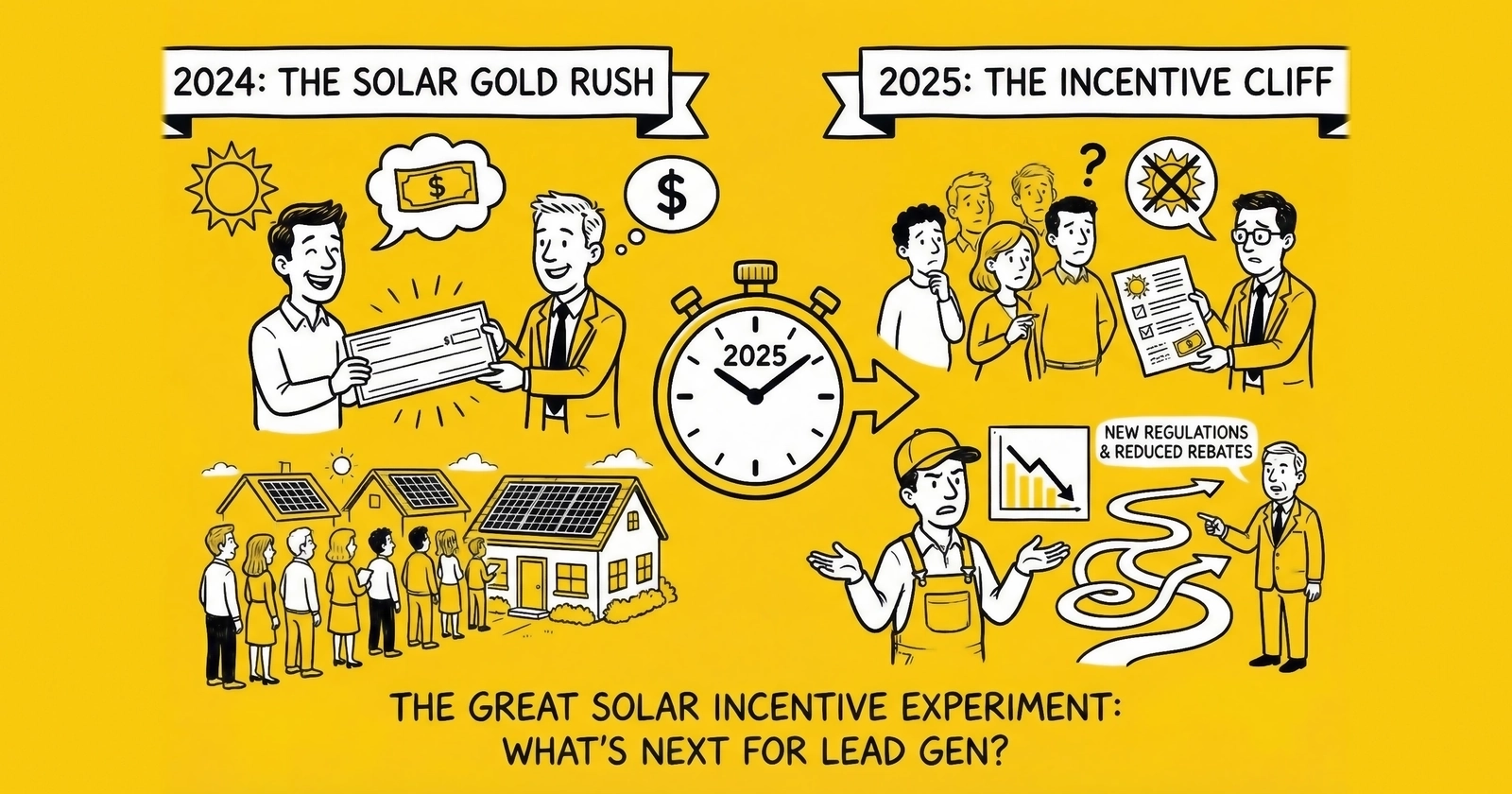
How federal ITC elimination, state policy shifts, and net metering reforms are reshaping solar lead economics. What every lead generator needs to know about messaging, pricing, and strategic positioning in a post-subsidy market.
The solar lead generation landscape transformed fundamentally in 2025. The One Big Beautiful Bill Act eliminated the residential Investment Tax Credit after December 31, 2025, removing the 30% federal subsidy that drove demand for two decades. California’s NEM 3.0 already contracted that state’s residential market by 40% in 2024. For detailed analysis of California versus emerging markets, see our guide on solar geographic arbitrage. Fixed charge approvals, net metering reductions, and shifting state incentive programs create a patchwork of opportunity and challenge that requires constant monitoring.
For lead generators, these changes demand strategic adaptation. The messaging that converted prospects in 2024 no longer works. The geographic arbitrage opportunities have shifted. The buyer relationships that sustained your operation may be under stress as installers face margin compression and capacity adjustments.
This comprehensive guide maps the current incentive landscape, analyzes the impact on lead generation economics, and provides actionable frameworks for marketing messaging and strategic positioning. Every operator in the solar lead space needs to understand these dynamics to survive and thrive in the post-ITC environment.
The Federal Investment Tax Credit: What Changed and Why It Matters
The Investment Tax Credit represented the single most important demand driver in residential solar since its inception in 2005. Understanding what changed and the timeline of changes is essential for any solar lead operation.
Historical Context
The federal ITC originally provided a 30% tax credit for residential solar installations, allowing homeowners to reduce their federal tax liability by 30% of the total system cost. On a $25,000 installation, this meant $7,500 in direct tax savings, effectively reducing the net cost to $17,500.
The Inflation Reduction Act of 2022 extended the residential ITC at 30% through 2032, with gradual step-downs through 2034. This extension created what the industry believed would be a decade of policy stability, supporting billions in investment, installer expansion, and lead generation infrastructure.
The 2025 Policy Shift
The One Big Beautiful Bill Act, signed on July 4, 2025, fundamentally altered this trajectory. Key provisions affecting solar lead generation include:
Residential Solar Tax Credit Elimination: Section 25D credits for residential solar terminate after December 31, 2025. Systems must be installed and operational by year-end to qualify for the 30% credit. There is no phase-down period. The credit drops from 30% to zero.
Commercial Solar Credit Timeline: The Section 48E credit for commercial installations follows a different schedule. Projects begun by July 4, 2026 remain eligible for the full credit if placed in service within four years. This creates a potential pivot opportunity for lead generators.
Battery Storage Treatment: Standalone battery storage that was previously eligible for the ITC faces the same elimination timeline for residential applications, though commercial storage maintains different provisions.
Impact on Consumer Economics
The ITC elimination fundamentally changes the value proposition for residential solar:
| Metric | With 30% ITC | Without ITC | Change |
|---|---|---|---|
| System Cost (25kW) | $25,000 | $25,000 | No change |
| Federal Credit | $7,500 | $0 | -$7,500 |
| Net Consumer Cost | $17,500 | $25,000 | +43% |
| Typical Payback Period | 7 years | 9-10 years | +30-40% |
| Monthly Payment (7-year loan) | ~$235 | ~$340 | +$105/month |
These numbers translate directly into lead conversion challenges. A prospect who would have converted at a $235 monthly payment may balk at $340. A homeowner comfortable with a 7-year payback may find 10 years unacceptable.
Timeline Implications for Lead Generators
The December 31, 2025 deadline created specific market dynamics:
Q4 2025: Extreme lead demand as installers raced to fill year-end installation capacity. Lead prices spiked 20-40% above annual averages. Installers accepted lower qualification standards to maximize pipeline.
Q1 2026: Market correction as the ITC cliff took effect. Volume dropped 30-50% depending on geography. Lead prices compressed as installer margins tightened.
2026 Full Year (Projected): Market stabilization at new equilibrium. Smaller market size but potentially more stable without subsidy-driven urgency cycles.
Lead generators who anticipated this timeline adjusted their strategies accordingly. Those who maintained 2024 approaches through 2025 faced painful transitions.
State Incentive Programs: The New Patchwork
With federal support eliminated, state incentive programs become the primary policy lever differentiating markets. Understanding this patchwork is essential for geographic targeting and messaging.
Tier 1: Strong State Incentive Markets
Several states maintain robust incentive programs that partially offset the federal ITC loss:
New York offers a 25% state tax credit up to $5,000 for residential solar installations. Combined with the NY-Sun incentive program providing per-watt rebates, New York maintains one of the strongest state-level support structures. The state’s high electricity rates ($0.20+/kWh average) create compelling economics even post-federal-ITC.
Massachusetts operates the SMART (Solar Massachusetts Renewable Target) program, providing per-kWh incentive payments over 10-20 years based on system size and characteristics. While SMART rates have declined as the program matures, it still provides meaningful incremental value. Massachusetts also benefits from some of the highest electricity rates in the continental U.S.
New Jersey provides SREC (Solar Renewable Energy Certificate) incentives, though the program structure has evolved. The TI (Transition Incentive) program and its successors provide ongoing value for system production.
Maryland offers a state tax credit of up to $1,000 for residential solar, plus significant property tax exemptions for solar equipment value.
Rhode Island provides a state tax credit of up to $1,000 and has strong net metering provisions.
Tier 2: Moderate State Support
These states provide meaningful but smaller incentives:
Connecticut: Residential Solar Investment Program provides per-watt rebates, though at reduced levels from historical peaks.
Vermont: Net metering and modest incentive programs support a small but active market.
Delaware: Green Energy Program provides rebates up to $3,500 for solar installations.
Illinois: Illinois Shines program provides incentives for residential solar, though primarily focused on community solar development.
Tier 3: Minimal or No State Incentives
Most states fall into this category, offering little beyond property tax exemptions:
Texas: Despite being the largest solar installation market by capacity, Texas offers no state tax credit or meaningful incentive program. Market growth is driven by electricity costs, energy independence sentiment, and competitive installer pricing.
Florida: No state tax credit. The Florida solar market relies entirely on federal incentives (now eliminated) and the state’s strong sunshine and hurricane-related backup power interest.
Arizona: Following net metering reductions in 2016, Arizona offers minimal state support. Market viability depends on high electricity usage and declining installation costs.
Most Midwest and Mountain States: No meaningful state incentive programs exist.
State Incentive Volatility
State programs can change rapidly, creating both opportunity and risk:
Program Funding Exhaustion: Some incentive programs have fixed budgets that exhaust, ending incentives mid-year. Massachusetts SMART has experienced capacity block exhaustion. California’s former rebate programs had similar patterns.
Legislative Changes: State legislatures can modify or eliminate programs with limited notice. Budget pressures may accelerate cuts.
Regulatory Proceedings: Utility commission decisions on rates and net metering can shift state attractiveness within months.
Lead generators must monitor state policy developments with the same intensity they previously applied to federal policy tracking.
Net Metering: The Policy That Makes or Breaks Markets
Net metering policy – how utilities compensate solar customers for electricity exported to the grid – often has larger economic impact than tax incentives. California’s NEM 3.0 provides the cautionary template.
Understanding Net Metering Economics
Traditional net metering allows solar customers to receive retail-rate credit for electricity exported to the grid. If a customer pays $0.25/kWh for electricity and exports 100 kWh, they receive $25 in credit against their bill.
This arrangement creates the foundation for solar economics. A system producing 120% of household consumption can offset the entire electric bill in retail-rate net metering states.
California NEM 3.0: The Market-Altering Precedent
California’s Net Billing Tariff (commonly called NEM 3.0) took effect for new interconnection applications on April 15, 2023. Its provisions fundamentally altered the California market:
Export Rate Reduction: Export compensation dropped from approximately $0.30/kWh (retail rate) to approximately $0.05-$0.08/kWh (wholesale-adjacent rates) during peak production hours. This represented a 75% reduction in export value.
Time-of-Export Pricing: Export values vary by hour, with highest compensation in early evening hours when solar production is minimal.
Grid Participation Charge: A monthly fee applies regardless of consumption levels.
Impact on Payback Periods: Systems that provided 5-6 year payback under NEM 2.0 now require 12-15 years under NEM 3.0 without battery storage.
Market Impact Data
California’s NEM 3.0 implementation provides hard data on net metering policy impact:
- Residential solar installations in California declined 41% in 2024 compared to 2023
- The California Solar and Storage Association reported sales drops of 66-83% compared to 2022
- Battery attachment rates soared from approximately 10% to 79% as storage became essential for economic viability
- Lead prices initially held as installers cleared backlog, then compressed significantly as reality set in
- Several major California-focused installers exited the market or filed for bankruptcy
The California experience provides a template for understanding net metering risk in other states.
States at Risk for Net Metering Changes
Utilities in multiple states are pursuing net metering reforms similar to California’s approach:
Arizona: Already implemented net metering reductions in 2016 through the Arizona Corporation Commission. Further changes remain possible.
Nevada: Underwent net metering changes in 2015-2017 that significantly contracted the market before partial restoration.
Arkansas: Net metering modifications have been implemented and continue evolving.
Hawaii: Has moved toward more complex time-of-use and self-consumption frameworks.
North Carolina: Duke Energy has pursued net metering modifications through regulatory proceedings.
South Carolina: Net metering reform proceedings are ongoing.
Any state with significant solar penetration and an investor-owned utility will face utility pressure to modify net metering. Utilities argue that net metering creates cost-shifting from solar to non-solar customers, though this claim is contested.
Fixed Charges: The Emerging Threat
Beyond net metering rate changes, fixed charges represent an emerging threat to solar economics:
California approved monthly fixed charges up to $24.15 for solar customers in May 2024, applying even to those with $0 usage bills. This creates a floor on utility costs that solar cannot eliminate.
Impact Calculation: $24.15/month over 25-year system life = $7,245 in additional costs that previous projections did not anticipate.
Other states may follow California’s fixed charge model, further eroding solar economics.
Marketing Messaging in the Post-ITC Environment
The elimination of the federal tax credit requires fundamental messaging strategy changes. The approaches that worked in 2024 will underperform or fail entirely in 2026 and beyond.
Messages That No Longer Work
“Save 30% with the federal tax credit”: Obviously obsolete after December 31, 2025. Any marketing continuing to mention federal tax credits will face compliance issues and consumer backlash.
“Go solar for $0 down”: While technically still possible through loans, the monthly payment reality is now 40%+ higher. Leading with this claim creates sticker shock during sales conversations.
“Typical 5-7 year payback”: Payback periods have extended to 8-12 years in most markets. Claims of short payback will not survive installer quote conversations.
“Lock in savings before incentives expire”: No longer creates urgency once incentives have already expired.
Messaging Frameworks That Work Post-ITC
Lead generators must pivot to messaging frameworks built on fundamentals that persist regardless of policy:
Energy Independence and Resilience
This framework emphasizes control over energy costs and protection from utility rate increases rather than immediate payback:
- “Stop renting electricity from the utility company”
- “Own your power source for the next 25 years”
- “Protection from rising utility rates”
- “Energy independence for your home”
The energy independence message resonates particularly in markets with recent grid reliability issues, hurricane exposure, or strong anti-corporate sentiment. Texas, Florida, and California all have demographic segments responsive to this framing.
Rate Hedge Against Utility Inflation
This framework positions solar as a financial hedge rather than an investment with short-term returns:
- “Lock in your electricity cost for 25 years”
- “Utility rates increased 15% in the past two years. What will they cost in ten?”
- “Fixed energy costs while neighbors see annual increases”
Historical data supports this message: residential electricity rates have increased an average of 3-4% annually over the past decade, with some markets seeing 10-15% increases in recent years. Projecting these trends creates compelling long-term economics even without incentives.
Backup Power and Storage Value
As battery attachment rates approach 70-80% in mature markets, the value proposition has shifted toward resilience:
- “Power through outages while the grid fails”
- “Keep your lights on when everyone else goes dark”
- “Home energy security for your family”
This framework is particularly powerful in markets with frequent outages (California fire-related PSPS events, Texas winter storms, Florida hurricanes) or aging infrastructure (Northeast grid stress during heat waves).
Environmental and Values-Based Messaging
For certain demographic segments, environmental impact remains a primary motivator regardless of financial payback:
- “Clean energy for your home”
- “Reduce your carbon footprint”
- “Leave a better planet for your children”
This message should be tested carefully by geography and audience. It resonates strongly with specific demographics but can alienate others. A/B testing is essential before committing budget.
State-Specific Messaging Opportunities
Where state incentives remain, messaging should emphasize the remaining support:
New York: “Claim your 25% state tax credit – up to $5,000 back”
Massachusetts: “Earn ongoing payments through the SMART program”
New Jersey: “Generate income from your solar production”
States with strong net metering: “Get full credit for every kWh you produce”
Accurate, verifiable state incentive claims can differentiate your leads in markets where incentives persist.
Messaging Compliance Considerations
Post-ITC messaging carries compliance risks that lead generators must manage:
Accuracy Requirements: Any claims about savings, payback periods, or financial benefits must be accurate and verifiable. FTC guidelines on advertising substantiation apply.
State Consumer Protection Laws: States like California have enhanced deceptive advertising provisions that can result in significant penalties.
Installer Liability Concerns: Leads generated with misleading messaging create downstream liability issues for installer buyers, damaging relationships.
Consent Language Precision: TCPA consent disclosures must accurately reflect the services being offered. If your landing page promises “federal tax credit savings” that no longer exist, the consent may be challenged.
Best practice: Have legal counsel review all marketing materials before deploying post-ITC campaigns. The compliance landscape has shifted.
Adjusting Lead Pricing for the New Reality
The ITC elimination affects lead pricing throughout the value chain. Understanding these dynamics helps lead generators maintain relationships and margins.
How Installer Economics Changed
The ITC elimination compressed installer margins in several ways:
Reduced Closing Rates: Prospects who would have converted at post-ITC pricing are now declining. Industry data suggests conversion rates have declined 15-25% in comparable traffic.
Extended Sales Cycles: Without deadline urgency, prospects take longer to decide. Sales cycle extension reduces installer capacity utilization.
Smaller Average System Size: Economically marginal prospects who would have installed 8-10kW systems are now installing smaller systems or not installing at all.
Increased Customer Acquisition Cost Sensitivity: With tighter margins, installers cannot absorb the same acquisition costs. CPL willingness has declined proportionally.
Lead Price Adjustments by Tier
Post-ITC lead pricing has adjusted across market tiers:
Tier 1 Markets (CA, HI, MA, NY)
- Pre-ITC exclusive lead pricing: $150-$200+
- Post-ITC exclusive lead pricing: $100-$150
- Price compression: 25-35%
Tier 2 Markets (TX, FL, AZ, NJ, CO)
- Pre-ITC exclusive lead pricing: $100-$150
- Post-ITC exclusive lead pricing: $65-$100
- Price compression: 25-35%
Tier 3 Markets (NV, UT, IL, VA, GA, NC, SC)
- Pre-ITC exclusive lead pricing: $50-$100
- Post-ITC exclusive lead pricing: $35-$65
- Price compression: 30-35%
Tier 4-5 Markets
- Many previously marginal markets are now unprofitable for lead generation
- Buyer demand has contracted significantly
- Some markets no longer have active lead buyers
Maintaining Margins Through Quality Differentiation
In a compressed-margin environment, quality differentiation becomes the primary path to maintaining pricing:
Enhanced Qualification Standards: Leads that would have been acceptable in 2024 may not convert in 2026. Tightening qualification criteria – higher electric bills, verified ownership, confirmed roof suitability – justifies premium pricing.
Battery Storage Qualification: In markets where storage is essential for economic viability (California, Hawaii, high-TOU-rate territories), qualifying for storage interest dramatically improves lead value.
Pre-Verified Utility Data: Bill upload verification, utility account confirmation, and accurate rate plan information reduce installer quoting time and improve close rates.
Contact Rate Optimization: Real-time delivery, verified phone numbers, and immediate engagement confirmation improve the metrics buyers care about most. See our guide on speed-to-lead optimization for detailed response strategies.
Lead generators who invested in quality infrastructure during the high-margin years can maintain premium pricing. Those who competed primarily on volume face difficult adjustments.
Renegotiating Buyer Relationships
The ITC elimination provides an occasion for relationship recalibration:
Proactive Communication: Contact major buyers before they contact you. Acknowledge the market change. Demonstrate you understand their new constraints.
Volume-for-Price Discussions: Buyers under margin pressure may accept lower prices in exchange for guaranteed volume. Exclusive arrangements at reduced CPLs may preserve relationship value.
Quality Guarantee Enhancements: Offering stronger return policies, contact rate guarantees, or qualification verification may justify maintaining higher CPLs.
Geographic Rebalancing: Buyers may want to shift geographic focus. Practitioners who can provide flexibility maintain relationships.
Relationships that survive market transitions become more valuable. Buyers who trust your adaptability become long-term partners.
Geographic Strategy Shifts
The incentive landscape changes have reshuffled geographic opportunity. Markets that were marginal became attractive while former premium markets face challenges.
Declining Markets
California: NEM 3.0 already contracted this market 40%. The ITC elimination compounds the challenge. California remains viable only for solar-plus-storage leads targeting high-bill customers. Pure solar leads without storage qualification have minimal value.
Markets Without State Incentives: States that relied entirely on federal ITC support – most of the Midwest, Mountain West, and parts of the Southeast – face the steepest declines. Without offsetting state support, these markets may contract 50%+ in 2026.
Low-Electricity-Rate Markets: Markets where electricity rates below $0.12/kWh made solar economics marginal with ITC support are likely no longer viable without it. North Dakota, South Dakota, Wyoming, and parts of Appalachia fall into this category.
Stable or Growing Markets
High-Electricity-Rate Markets: Markets with average residential rates above $0.20/kWh maintain compelling economics even without incentives. These include Hawaii, Massachusetts, Connecticut, New York (Long Island particularly), California (despite NEM 3.0 for high-use customers with storage), and parts of New England.
Strong State Incentive Markets: New York, Massachusetts, New Jersey, and Maryland maintain state programs that partially offset ITC loss. These markets see smaller declines than states without support.
Energy Independence Markets: Texas, despite no state incentives, maintains demand driven by energy independence sentiment, grid reliability concerns post-Winter Storm Uri, and strong population growth. Florida has similar dynamics driven by hurricane resilience interest.
Emerging Opportunity Areas
Commercial Solar Pivot: The commercial ITC follows different timelines, maintaining eligibility for projects begun by July 4, 2026. Lead generators with capability to serve commercial buyers – property managers, business owners, municipalities – have a pivot opportunity.
Battery Storage Focus: Pure battery storage leads (without solar) have emerged as a category. Customers with existing solar systems can add storage. Customers in high-outage areas want backup power regardless of solar interest.
Community Solar Markets: States with strong community solar programs – New York, Massachusetts, Illinois, New Jersey, Maryland – offer lead opportunities for customers who cannot install rooftop solar.
Geographic Portfolio Rebalancing
Practical steps for geographic adjustment:
-
Audit Current Geographic Mix: Calculate profitability by state and metro. Identify markets that are now unprofitable.
-
Exit Unviable Markets: Quickly reduce or eliminate spend in markets where unit economics no longer work. Do not wait for buyer relationships to deteriorate.
-
Increase Allocation to Viable Markets: Shift budget to markets with favorable state incentives, high electricity rates, or strong buyer demand persistence.
-
Test Commercial Traffic: Evaluate capability to generate commercial solar leads. Different landing pages, different qualification, different buyer relationships.
-
Monitor State Policy Developments: New state incentive programs could create opportunity. Policy degradation in viable markets could require quick exits.
The IRA and Commercial Solar: A Pivot Opportunity
While residential incentives terminated, the Inflation Reduction Act provisions for commercial solar followed different timelines. Understanding these provisions creates potential pivot opportunities.
Commercial ITC Provisions (Section 48E)
Key provisions for commercial solar:
Eligible Projects: Commercial, industrial, and non-residential solar installations qualify for the Investment Tax Credit.
Credit Amount: Base credit of 6%, increasing to 30% for projects meeting prevailing wage and apprenticeship requirements (which most commercial projects do).
Timeline: Projects must begin construction by July 4, 2026 to qualify for the full credit. “Begin construction” can be satisfied by the 5% safe harbor (5% of total project cost incurred) or physical work test.
Placed in Service Window: Projects that begin construction before the deadline have four years to complete installation.
This timeline creates a window for commercial solar lead generation extending well into 2026.
Commercial Lead Generation Differences
Commercial solar lead generation differs substantially from residential:
Longer Sales Cycles: Commercial decisions involve multiple stakeholders, budget approvals, and operational considerations. 6-18 month sales cycles are common.
Different Qualification Criteria: Roof ownership/lease terms, building square footage, electrical service capacity, corporate credit, and decision-maker access matter more than residential criteria.
Higher Lead Values: Commercial deals range from $50,000 to $500,000+, supporting higher CPLs. Commercial leads can command $200-$500 in appropriate markets.
Different Buyer Relationships: Commercial installers differ from residential-focused companies. Building new buyer relationships requires time and credibility establishment.
B2B Marketing Channels: LinkedIn, trade publications, business email marketing, and industry events replace consumer-focused Facebook and display advertising.
Assessing Commercial Pivot Viability
Questions to evaluate commercial solar pivot potential:
-
Do you have B2B marketing capability? Commercial lead generation requires different creative, channels, and targeting. Consumer marketers may struggle with B2B messaging.
-
Can you qualify commercial prospects? Understanding commercial roof ownership, lease terms, utility arrangements, and decision-making authority requires different form design and verification.
-
Do you have commercial buyer relationships? Or can you develop them? Commercial installers may not overlap with your residential buyer base.
-
What is your timeline tolerance? Commercial leads take longer to close. Cash flow timing differs from residential leads.
-
Can you compete with established commercial lead providers? EnergySage, SolarReviews, and specialized commercial platforms have commercial market presence.
For some residential-focused lead generators, the commercial pivot is viable. For others, the capability gap is too large to bridge profitably.
Building Policy Monitoring Systems
In a policy-driven market, intelligence about upcoming changes provides competitive advantage. Building systematic policy monitoring prevents being surprised by changes that shift market economics.
Federal Policy Tracking
Monitor these federal developments:
Congressional Activity: Solar-related legislation, budget reconciliation provisions, and tax code amendments. Subscribe to Congressional tracking services or industry association legislative alerts.
Treasury Department Guidance: IRS and Treasury guidance on ITC implementation affects commercial credit eligibility and timing requirements.
Department of Energy Programs: DOE announcements on grants, loan programs, and research initiatives can signal policy direction.
State Policy Monitoring
State-level monitoring requires attention to:
Utility Commission Proceedings: State public utility commissions (PUC, PSC, CPUC) control net metering, rate design, and interconnection rules. These proceedings are public. Subscribe to dockets in your key states.
State Legislative Sessions: Solar-related bills can emerge quickly during legislative sessions. Industry associations track relevant bills.
Utility Rate Cases: General rate cases affect electricity prices that drive solar economics. Major rate increases create opportunity; rate decreases reduce it.
Incentive Program Updates: State solar programs announce capacity availability, rate changes, and enrollment periods. Track programs in your active markets.
Industry Intelligence Sources
Build relationships with intelligence sources:
Solar Energy Industries Association (SEIA): The national trade association publishes policy updates, market data, and advocacy alerts.
State Solar Associations: California Solar and Storage Association, Texas Solar Power Association, and similar state groups provide state-specific intelligence.
Utility Newsletters: Major utilities publish customer newsletters that announce rate and policy changes before they take effect.
Industry Conferences: LeadsCon, Lead Generation World, and solar industry events provide networking and intelligence gathering opportunities.
Operationalizing Intelligence
Convert intelligence into operational advantage:
Weekly Policy Review: Assign someone to review policy alerts weekly and flag relevant changes.
Trigger Response Plans: Pre-define actions to take when specific policy changes occur. “If California implements additional fixed charges, reduce California budget by X% within two weeks.”
Buyer Communication Protocol: Establish how quickly you communicate policy changes to buyers and what information you share.
Geographic Shift Capability: Maintain capability to redirect traffic between geographies within days of policy changes.
Lead generators who anticipated California NEM 3.0 by redirecting traffic in late 2022 preserved profitability. Those who waited until implementation absorbed losses. Building anticipatory capability provides similar advantages for future policy shifts.
Frequently Asked Questions
How does the federal ITC elimination affect solar lead pricing?
The federal ITC elimination compressed solar lead pricing by 25-35% across most markets. Tier 1 markets that previously commanded $150-$200+ for exclusive leads now see $100-$150 pricing. The compression results from installer margin pressure – without the 30% tax credit boosting consumer economics, close rates declined 15-25%, forcing installers to reduce customer acquisition spending proportionally. Lead generators maintaining pre-ITC pricing face buyer pushback and relationship strain.
What marketing messages work for solar leads after the tax credit ended?
Post-ITC messaging must shift from savings-focused claims to value frameworks that persist regardless of policy. Energy independence messaging (“Own your power source for 25 years”) resonates in markets with grid reliability concerns. Rate hedge messaging (“Lock in electricity costs while utility rates climb”) addresses long-term economic value. Backup power and storage messaging works in markets with frequent outages. Environmental messaging reaches specific demographic segments. State-specific incentive claims work where state programs remain strong. Any messaging referencing expired federal credits should be immediately discontinued.
Which states have the strongest solar incentives in 2025?
New York offers the strongest combination of state tax credit (25% up to $5,000) and ongoing incentive programs (NY-Sun). Massachusetts provides long-term production incentives through SMART, combined with high electricity rates. New Jersey maintains SREC and successor programs providing ongoing production value. Maryland offers tax credits up to $1,000 plus property tax exemptions. These states saw smaller volume declines post-federal-ITC than states without state support. However, state programs can change, and monitoring is essential.
How did California NEM 3.0 affect the solar lead market?
California NEM 3.0 reduced export compensation by approximately 75%, extending payback periods from 5-6 years to 12-15 years without battery storage. The California residential market contracted 41% in 2024, with some installers reporting 66-83% sales declines versus 2022. Lead prices compressed significantly after initial backlog clearing. Battery attachment rates increased from approximately 10% to 79% as storage became essential for economic viability. California leads without storage qualification now have limited value. The California experience provides a template for understanding net metering policy risk in other states.
Should lead generators pivot to commercial solar?
Commercial solar maintains ITC eligibility for projects begun by July 4, 2026, creating a potential pivot opportunity. However, commercial lead generation differs substantially from residential: longer sales cycles (6-18 months), different qualification criteria (roof ownership, corporate credit, decision-maker access), higher lead values ($200-$500), different buyer relationships, and B2B marketing channels. Lead generators with B2B capability, commercial buyer relationships, and longer cash flow tolerance should evaluate the pivot. Those without these capabilities may find the transition too difficult to execute profitably.
What happens to solar leads in states without incentives?
States without meaningful state incentives face the steepest post-ITC declines. Markets that relied entirely on federal support – most Midwest, Mountain West, and parts of Southeast states – may see 50%+ volume contractions. Markets with electricity rates below $0.12/kWh are likely no longer economically viable for solar installation, eliminating lead demand regardless of generation capability. Lead generators should evaluate each state’s viability based on electricity rates, state incentives, and active buyer presence. Quick exit from non-viable markets preserves capital for markets that work.
How can lead generators maintain margins after incentive changes?
Quality differentiation provides the primary path to margin maintenance. Enhanced qualification standards justify premium pricing – higher electric bills, verified ownership, confirmed roof suitability, and battery storage interest in applicable markets. Pre-verified utility data reduces installer quoting time. Contact rate optimization through real-time delivery and phone verification improves buyer-side metrics. Lead generators who invested in quality infrastructure can maintain premium pricing; those who competed on volume face more difficult adjustments. Renegotiating buyer relationships with volume-for-price discussions or enhanced guarantees can preserve relationship value.
What policy changes should solar lead generators monitor?
Federal monitoring should track Congressional solar legislation, Treasury Department ITC guidance, and Department of Energy program announcements. State monitoring requires attention to utility commission proceedings (net metering, rate design), state legislative sessions (incentive programs), utility rate cases (electricity pricing), and incentive program capacity updates. Industry intelligence from SEIA, state solar associations, and utility communications provides early warning of changes. Lead value can shift 30% within 90 days of policy changes – early detection enables proactive response rather than reactive loss absorption.
Is solar lead generation still viable without the federal tax credit?
Yes, but in a smaller and more geographically concentrated market. High-electricity-rate markets (Hawaii, Massachusetts, Connecticut, New York, California for high-use customers with storage) maintain compelling economics based on fundamentals. Strong state incentive markets (NY, MA, NJ, MD) partially offset federal losses. Energy independence and backup power value propositions drive demand in markets with grid reliability concerns (Texas, Florida, California). The post-ITC market is smaller but potentially more stable, with customers making genuine economic decisions rather than chasing subsidies. Lead generators who adapt to the new landscape can build sustainable operations.
How should lead forms and landing pages change after the ITC?
Landing pages must remove all federal tax credit references immediately – continuing to claim expired incentives creates compliance and credibility issues. Qualification criteria should tighten: higher minimum electric bill thresholds ($175+ monthly versus previous $100+), battery storage interest qualification in applicable markets, and stricter homeownership verification. Messaging should shift to energy independence, rate lock, backup power, and state-specific incentive claims where applicable. Form length may increase to ensure lead quality justifies compressed pricing. A/B test new messaging frameworks against control groups before full deployment.
Key Takeaways
-
The federal ITC elimination after December 31, 2025 fundamentally altered solar lead economics. Consumer costs increased 43% ($7,500 on typical installation), payback periods extended 30-40%, and lead pricing compressed 25-35% across most markets. Lead generators must adjust pricing expectations and buyer relationship management accordingly.
-
State incentive programs now determine market attractiveness. New York (25% tax credit), Massachusetts (SMART program), New Jersey (SREC programs), and Maryland maintain strong support. States without meaningful state incentives face 50%+ volume declines. Geographic strategy must account for this new patchwork reality.
-
Net metering policy has larger economic impact than many realize. California NEM 3.0 reduced export compensation 75% and contracted the market 41%. States with utilities pursuing similar reforms – Arizona, Nevada, Arkansas, Hawaii, North Carolina, South Carolina – face comparable risk. Monitor utility commission proceedings in active markets.
-
Marketing messaging must shift from savings claims to value frameworks. Energy independence, rate hedge against utility inflation, backup power resilience, and environmental values provide messaging foundations that persist regardless of policy. State-specific incentive claims work where programs remain strong. Any federal credit references must be immediately discontinued.
-
Quality differentiation provides the path to margin maintenance. Enhanced qualification, battery storage interest, pre-verified utility data, and contact rate optimization justify premium pricing in a compressed market. Volume-focused competitors face more difficult adjustments.
-
Commercial solar maintains ITC eligibility through July 2026. Lead generators with B2B capability should evaluate the commercial pivot. Different qualification criteria, longer sales cycles, and new buyer relationships make this transition challenging but potentially viable.
-
Policy monitoring provides competitive advantage. Lead value can shift 30% within 90 days of policy changes. Build systematic monitoring of federal legislation, state utility commissions, and industry intelligence sources. Pre-defined response plans enable quick adaptation when changes occur.
-
The post-ITC market is smaller but potentially more stable. Electricity rates continue rising. Energy independence has mainstream appeal. Battery storage provides backup value beyond bill savings. Practitioners who adapt to fundamentals-based economics rather than subsidy-driven cycles can build sustainable operations in the new environment.
Policy information current as of December 2025. Solar incentive programs, tax provisions, and regulatory rules change frequently. Verify all claims with current sources and consult qualified tax and legal professionals before making business decisions based on policy information.