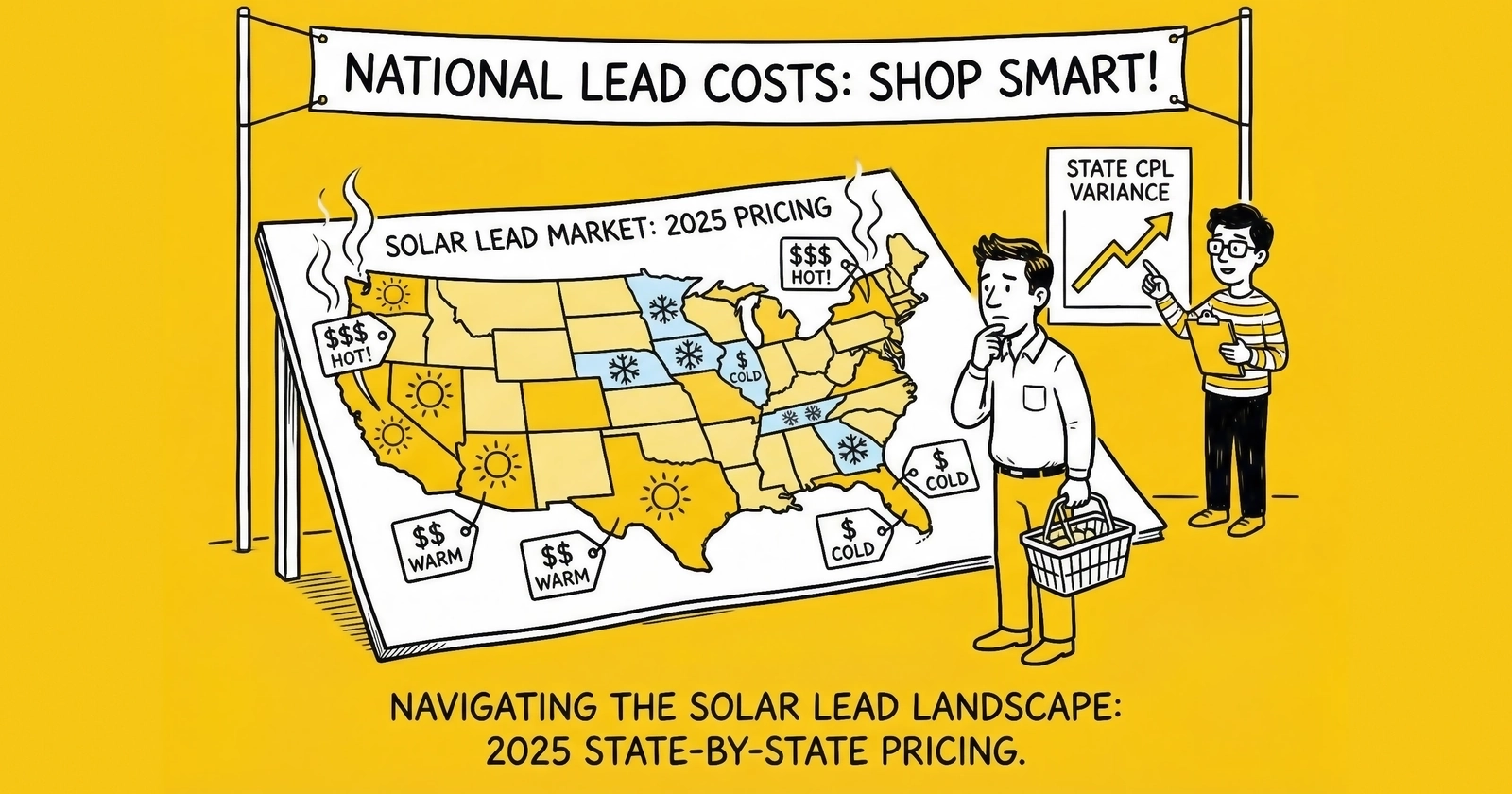
Geographic arbitrage in solar lead generation creates an 8.5x pricing spread between the highest and lowest value markets. Understanding state-by-state economics determines whether your operation profits or bleeds money. This comprehensive analysis maps CPL benchmarks, incentive impacts, and market dynamics across all 50 states.
The Geographic Reality of Solar Lead Economics
The solar lead vertical exhibits pricing variation unlike any other in lead generation. A lead that generates $1,929 in customer value in California might yield $225 in North Dakota. That 8.5x differential is not an anomaly or a data error. It reflects fundamental economic differences driven by electricity rates, state incentives, net metering policies, installer density, and customer sophistication.
most practitioners miss this reality. They treat solar leads as a national market, pricing uniformly and wondering why certain traffic sources lose money while others print profits. Those who understand state-by-state dynamics consistently outperform those running national campaigns with blended CPL targets. For strategies on exploiting these geographic differences, see our guide to solar geographic arbitrage.
This analysis provides the complete picture: current CPL benchmarks by state, the factors driving those prices, how incentive changes shift markets overnight, and where to focus your 2025 budget for maximum return. Every number comes from current market data. Every recommendation comes from operational experience in a market simultaneously blessed with trillion-dollar tailwinds and cursed with unprecedented policy uncertainty.
Current Solar CPL Benchmarks by State Tier
States cluster into five distinct tiers based on lead value, market maturity, and installer economics. Understanding these tiers determines traffic acquisition strategy, buyer relationships, and realistic margin expectations.
Tier 1: Premium Markets ($150-$300+ per Lead)
| State | CPL Range | Customer Value | Key Drivers |
|---|---|---|---|
| California | $175-$300+ | $1,500-$1,929 | High rates, storage requirement, NEM 3.0 |
| Hawaii | $200-$350+ | $1,800-$2,200 | Highest electricity rates nationally |
| Massachusetts | $150-$275 | $1,200-$1,600 | SMART incentives, high rates |
| New York | $150-$250 | $1,100-$1,500 | 25% state credit, dense population |
These markets justify premium lead pricing because the underlying transaction economics support high customer acquisition costs. Installers in California can pay $3,000 to acquire a customer and still profit on a $25,000 installation with 30% gross margin.
California complexity. NEM 3.0 reduced export compensation by approximately 75% when it took effect for new interconnection applications on April 15, 2023. Payback periods extended from 5-6 years to 14-15 years without battery storage. The residential market contracted 38-50% in 2024. Yet California remains Tier 1 because battery attachment rates soared to 79%, shifting the value proposition from grid export to self-consumption. A solar-only California lead has limited value. A solar-plus-storage lead with verified high electric bills remains premium.
Hawaii economics. The state maintains the highest average residential electricity rates in the nation, exceeding $0.35 per kWh in some utility territories. This makes solar economics compelling despite limited installer competition and logistical challenges. CPL reflects the straightforward value proposition: homeowners with $400+ monthly electric bills have obvious motivation to explore alternatives.
Massachusetts advantages. The SMART (Solar Massachusetts Renewable Target) incentive program provides ongoing production-based payments that improve solar economics significantly. Combined with electricity rates above $0.22 per kWh and dense population creating installer competition, Massachusetts sustains premium lead pricing.
New York structure. The state offers a 25% tax credit up to $5,000 on top of the federal credit (while it remains available). Combined with high electricity rates in the NYC metro area and strong environmental consciousness, New York supports lead prices that would be unsustainable in most markets.
Tier 2: Strong Markets ($75-$150 per Lead)
| State | CPL Range | Customer Value | Key Drivers |
|---|---|---|---|
| Texas | $100-$175 | $750-$1,200 | Growing market, high summer bills |
| Florida | $100-$175 | $900-$1,400 | Sunshine, retirees with owned homes |
| Arizona | $80-$150 | $650-$1,000 | Strong irradiance, utility challenges |
| New Jersey | $100-$175 | $1,000-$1,400 | High density, strong incentives |
| Colorado | $90-$160 | $800-$1,200 | Environmental consciousness |
| Connecticut | $100-$175 | $1,000-$1,400 | High rates, state programs |
Texas installed the most solar capacity of any state in H1 2025 at 3.8 GW, though most was utility-scale rather than residential. The residential market grows but faces headwinds from utility resistance to net metering. However, rising electricity prices and a freedom-oriented consumer base create strong demand for energy independence. The lack of state income tax simplifies the value proposition since the federal credit provides the primary incentive.
Florida recovered from previous policy challenges and offers strong fundamentals. High electricity rates in summer, abundant sunshine, and a growing population of retirees with paid-off homes create ideal solar customer demographics. Homeowners with no mortgage own their roofs free and clear and have stable income to support installation financing.
Arizona offers exceptional solar irradiance but reduced net metering since 2016 changes affected economics. Intense installer competition creates downward price pressure. The market works for operators who understand the nuances of utility territory differences within the state.
New Jersey combines high population density with ongoing state incentives. The small geographic footprint means installers can operate efficiently, reducing customer acquisition cost tolerance but maintaining healthy lead pricing.
Tier 3: Developing Markets ($40-$75 per Lead)
| State | CPL Range | Customer Value | Key Drivers |
|---|---|---|---|
| Nevada | $50-$90 | $500-$800 | Recovering from net metering changes |
| Utah | $45-$80 | $450-$750 | Growing market, solar-friendly |
| New Mexico | $45-$85 | $450-$800 | Strong irradiance, limited installer base |
| Illinois | $50-$90 | $500-$850 | Renewable portfolio standards |
| Virginia | $50-$90 | $500-$850 | Emerging market, policy improving |
| Georgia | $45-$85 | $400-$750 | Growing population, limited incentives |
| North Carolina | $50-$95 | $500-$900 | Duke Energy territory complexities |
| South Carolina | $45-$85 | $400-$750 | Emerging market |
These states represent growth opportunities with developing infrastructure. Less competition means lower lead costs, but installers also have lower close rates and less sophisticated operations. Lead generators serving these markets often need to provide more education-focused content and longer nurture sequences. The sales cycle extends because consumers have less familiarity with solar economics.
Nevada recovery. The state dramatically reduced net metering compensation in 2016, devastating the residential market. Partial restoration of more favorable terms has enabled gradual recovery, though the market remains significantly smaller than its potential given strong solar irradiance.
Illinois development. Renewable portfolio standards and the Climate and Equitable Jobs Act are driving solar growth. The state offers rebates and incentive programs that improve economics. Lead volume is growing, attracting more installer competition.
North Carolina nuances. Duke Energy territory covers most of the state with specific net metering and interconnection requirements. Understanding Duke’s procedures and rates is essential for qualifying leads properly.
Tier 4: Emerging Markets ($25-$50 per Lead)
| State | CPL Range | Customer Value | Key Drivers |
|---|---|---|---|
| Ohio | $30-$55 | $300-$500 | Moderate rates, limited incentives |
| Michigan | $30-$55 | $300-$500 | Climate challenges, growing interest |
| Minnesota | $35-$60 | $350-$550 | Strong renewable interest, climate |
| Wisconsin | $30-$55 | $300-$500 | Emerging market |
| Pennsylvania | $35-$60 | $350-$600 | SREC program, mixed utility support |
| Indiana | $25-$50 | $250-$450 | Low electricity rates, limited support |
| Missouri | $25-$50 | $250-$450 | Limited incentives |
| Oregon | $45-$75 | $400-$700 | Environmental consciousness, moderate rates |
| Washington | $40-$70 | $350-$650 | Limited sunshine, environmental interest |
Low electricity rates and minimal policy support make solar economics challenging in these markets. Lead volume is limited, and buyers are price-sensitive. Success requires extremely low traffic acquisition costs.
Midwest reality. Electricity rates in the $0.10-$0.14 per kWh range extend payback periods significantly. Without state incentives to accelerate return on investment, the sales conversation becomes more difficult. Lead generators targeting these markets need to emphasize energy independence and hedge-against-rate-increases messaging rather than immediate savings.
Pacific Northwest paradox. Oregon and Washington have strong environmental consciousness but limited sunshine compared to southwestern states. The markets work for installers focused on eco-conscious customers rather than pure economics buyers.
Tier 5: Minimal Markets (Generally Unprofitable)
| State | CPL Range | Customer Value | Notes |
|---|---|---|---|
| North Dakota | $15-$35 | $200-$300 | Lowest value nationally |
| South Dakota | $15-$35 | $200-$300 | Minimal installer presence |
| Wyoming | $20-$40 | $200-$350 | Sparse population |
| West Virginia | $20-$40 | $200-$350 | Low rates, coal economy |
| Montana | $25-$45 | $250-$400 | Sparse population |
| Idaho | $25-$50 | $250-$450 | Limited incentives |
Low electricity rates, minimal sunshine in some regions, sparse population, and no policy support make these markets generally unprofitable for lead generation. Even if leads are nearly free to generate, installer appetite is minimal. Few buyers operate in these territories, and those who do have strict volume limits.
The North Dakota floor. At $225 customer value compared to California’s $1,929, North Dakota represents the absolute floor of the solar lead market. The 8.5x spread illustrates why geographic intelligence is the core solar lead strategy. Generating leads in North Dakota at the same cost as California leads destroys profitability.
State-by-State CPL Analysis: The Complete Reference
The following comprehensive table provides current CPL benchmarks for all 50 states, enabling precise budget allocation and geographic targeting decisions.
Northeast Region
| State | CPL Range | Avg CPL | Electricity Rate | Net Metering | Notes |
|---|---|---|---|---|---|
| Connecticut | $100-$175 | $135 | $0.24/kWh | Full retail | Strong economics |
| Maine | $75-$125 | $95 | $0.19/kWh | Full retail | Growing market |
| Massachusetts | $150-$275 | $200 | $0.25/kWh | Full retail + SMART | Premium market |
| New Hampshire | $75-$130 | $100 | $0.21/kWh | Partial | Moderate |
| New Jersey | $100-$175 | $135 | $0.17/kWh | Full retail | Dense population |
| New York | $150-$250 | $175 | $0.20/kWh | Full retail + credits | 25% state credit |
| Pennsylvania | $50-$90 | $70 | $0.15/kWh | Full retail (varies) | SREC program |
| Rhode Island | $90-$150 | $115 | $0.22/kWh | Full retail | Small but strong |
| Vermont | $75-$125 | $95 | $0.18/kWh | Full retail | Strong green interest |
Southeast Region
| State | CPL Range | Avg CPL | Electricity Rate | Net Metering | Notes |
|---|---|---|---|---|---|
| Alabama | $30-$60 | $45 | $0.13/kWh | Limited | Minimal market |
| Florida | $100-$175 | $135 | $0.14/kWh | Full retail | Strong fundamentals |
| Georgia | $45-$85 | $65 | $0.12/kWh | None | Emerging |
| Kentucky | $25-$50 | $35 | $0.11/kWh | Limited | Low rates |
| Louisiana | $35-$65 | $50 | $0.11/kWh | Limited | Emerging |
| Mississippi | $25-$50 | $35 | $0.12/kWh | None | Minimal |
| North Carolina | $50-$95 | $70 | $0.12/kWh | Full retail (Duke) | Duke territory |
| South Carolina | $45-$85 | $60 | $0.13/kWh | Varies by utility | Emerging |
| Tennessee | $30-$60 | $45 | $0.11/kWh | TVA restrictions | Limited |
| Virginia | $50-$90 | $70 | $0.13/kWh | Full retail | Growing |
| West Virginia | $20-$40 | $30 | $0.10/kWh | Limited | Coal economy |
Midwest Region
| State | CPL Range | Avg CPL | Electricity Rate | Net Metering | Notes |
|---|---|---|---|---|---|
| Illinois | $50-$90 | $70 | $0.13/kWh | Full retail | RPS support |
| Indiana | $25-$50 | $40 | $0.12/kWh | Reduced | Limited |
| Iowa | $30-$60 | $45 | $0.13/kWh | Full retail | Growing |
| Kansas | $30-$55 | $40 | $0.12/kWh | Partial | Wind dominant |
| Michigan | $35-$65 | $50 | $0.16/kWh | Full retail | Moderate |
| Minnesota | $40-$70 | $55 | $0.14/kWh | Full retail | Strong interest |
| Missouri | $25-$55 | $40 | $0.11/kWh | Partial | Limited |
| Nebraska | $25-$50 | $35 | $0.10/kWh | Limited | Minimal |
| North Dakota | $15-$35 | $25 | $0.10/kWh | Limited | Lowest nationally |
| Ohio | $35-$65 | $50 | $0.13/kWh | Full retail | Emerging |
| South Dakota | $15-$35 | $25 | $0.11/kWh | Limited | Minimal |
| Wisconsin | $35-$60 | $45 | $0.14/kWh | Varies | Moderate |
Southwest Region
| State | CPL Range | Avg CPL | Electricity Rate | Net Metering | Notes |
|---|---|---|---|---|---|
| Arizona | $80-$150 | $110 | $0.13/kWh | Reduced (2016) | Strong irradiance |
| Colorado | $90-$160 | $120 | $0.14/kWh | Full retail | Environmental base |
| Nevada | $50-$90 | $70 | $0.13/kWh | Restored (partial) | Recovering |
| New Mexico | $45-$85 | $65 | $0.13/kWh | Full retail | Limited base |
| Oklahoma | $30-$60 | $45 | $0.11/kWh | None | Minimal |
| Texas | $100-$175 | $130 | $0.12/kWh | Varies by utility | Largest growth |
| Utah | $45-$80 | $60 | $0.11/kWh | Reduced | Growing |
West Region
| State | CPL Range | Avg CPL | Electricity Rate | Net Metering | Notes |
|---|---|---|---|---|---|
| California | $175-$300+ | $225 | $0.27/kWh | NEM 3.0 | Storage required |
| Hawaii | $200-$350+ | $275 | $0.35/kWh | Modified | Highest rates |
| Oregon | $45-$75 | $60 | $0.12/kWh | Full retail | Environmental base |
| Washington | $40-$70 | $55 | $0.10/kWh | Full retail | Limited sunshine |
| Alaska | $40-$80 | $60 | $0.22/kWh | Varies | Unique challenges |
| Idaho | $25-$50 | $35 | $0.10/kWh | Net billing | Limited |
| Montana | $30-$55 | $40 | $0.11/kWh | Net billing | Sparse population |
| Wyoming | $20-$40 | $30 | $0.11/kWh | Limited | Minimal |
How State Incentives Impact CPL
State incentives create the most significant variation in solar lead value. A policy change can shift markets between tiers within months. Understanding incentive structures enables operators to anticipate market movements rather than react to them.
The Incentive Stack Structure
Solar economics depend on layered incentives that compound to reduce customer cost:
Federal Investment Tax Credit (ITC). The 30% federal tax credit has been the primary demand driver since 2005. Under the Inflation Reduction Act of 2022, this was extended through 2032 with gradual step-downs through 2034. However, the One Big Beautiful Bill Act, signed in mid-2025, eliminated the residential solar tax credit (Section 25D) for new installations after December 31, 2025. This creates fundamental market restructuring.
State Tax Credits. States with their own tax credits provide additional savings:
- New York: 25% state credit up to $5,000
- Arizona: 25% credit up to $1,000
- Massachusetts: 15% credit up to $1,000
- South Carolina: 25% credit up to $3,500
Rebate Programs. Direct cash rebates from states or utilities reduce upfront cost:
- California: Previous rebate programs now replaced by alternative programs
- New York: Various utility-specific rebates available
- Oregon: Energy Trust of Oregon rebates
Production-Based Incentives. Ongoing payments based on electricity generated:
- Massachusetts SMART: Performance-based payments over 10-20 years
- SRECs (Solar Renewable Energy Certificates): Tradeable credits in some states
Net Metering. Compensation for excess electricity exported to the grid:
- Full retail rate: Customer receives full retail price for exports
- Avoided cost: Customer receives wholesale rate only
- Time-of-use: Compensation varies by time of export
Incentive Impact on CPL
The relationship between incentives and CPL follows predictable patterns:
| Incentive Level | Typical CPL Premium | Customer Value Impact |
|---|---|---|
| Strong state credit + net metering | +50-100% | +$500-$1,000 |
| Moderate incentives | +20-40% | +$200-$500 |
| Federal ITC only | Baseline | Baseline |
| Below-market net metering | -20-30% | -$200-$400 |
| No meaningful incentives | -40-60% | -$400-$800 |
California NEM 3.0 case study. When NEM 3.0 reduced export compensation by 75%, lead value initially held because installer demand remained high while clearing backlog. Within months, as reality set in, lead prices dropped 25-40%. The California Solar and Storage Association reported sales drops of 66-83% compared to 2022. Yet battery attachment rates soared to 79%, creating a different kind of lead: solar-plus-storage with distinct qualification requirements.
States with the Strongest Incentive Stacks
| State | Federal ITC | State Credit | Net Metering | Other | Total Reduction |
|---|---|---|---|---|---|
| Massachusetts | 30% | 15% (capped) | Full retail | SMART | 45-55% |
| New York | 30% | 25% (capped) | Full retail | Rebates | 40-50% |
| Rhode Island | 30% | - | Full retail | RECs | 35-40% |
| New Jersey | 30% | - | Full retail | SRECs | 35-40% |
| California | 30% | - | NEM 3.0 | Various | 30-35% (with storage) |
States Most Vulnerable to Policy Changes
Net metering faces utility pressure in every state where retail-rate compensation exists. Utilities argue solar customers shift costs to non-solar ratepayers. Watch these states for potential changes:
- Florida: Strong utility lobby has attempted net metering changes
- Utah: Already reduced compensation, further changes possible
- Indiana: Recent reductions, additional cuts proposed
- Nevada: Recovered partially from 2016 cuts, remains volatile
- Georgia: No current net metering, unlikely to implement
The Post-ITC Market: What Changes in 2026
The elimination of the residential Investment Tax Credit after December 31, 2025 fundamentally alters solar lead economics. Our guide on solar incentive changes for 2025 covers the full implications of this shift. Understanding this transition is essential for budget planning.
Economic Impact Analysis
Without the 30% ITC, unit economics shift dramatically:
| Metric | With ITC (2025) | Without ITC (2026) | Change |
|---|---|---|---|
| Typical system cost | $25,000 | $25,000 | - |
| Federal credit | $7,500 | $0 | -$7,500 |
| Net cost to customer | $17,500 | $25,000 | +43% |
| Average payback period | 7 years | 9-10 years | +30-40% |
| Expected conversion rate | 10-15% | 6-10% | -30-40% |
CPL Projections by Tier for 2026
| Tier | 2025 CPL | Projected 2026 CPL | Change |
|---|---|---|---|
| Tier 1 (CA, MA, NY) | $150-$275 | $100-$200 | -25-35% |
| Tier 2 (TX, FL, AZ) | $75-$150 | $50-$110 | -25-30% |
| Tier 3 (NV, IL, NC) | $40-$75 | $30-$55 | -20-30% |
| Tier 4 (OH, MI, PA) | $25-$50 | $15-$35 | -30-40% |
| Tier 5 (ND, SD, WY) | $15-$35 | Generally unprofitable | N/A |
Volume Impact Projections
Industry analysts project 30-50% volume decline in 2026 as the residential market adjusts to post-ITC economics. This creates both challenge and opportunity:
The challenge. Total addressable market shrinks. Installers reduce lead buying budgets. Competition among lead generators intensifies for remaining volume.
The opportunity. Weaker operators exit the market. Survivors with strong geographic intelligence and quality infrastructure capture market share. The post-subsidy market may be smaller but more stable, with buyers making genuine economic decisions rather than chasing subsidies.
States Most Resilient to ITC Loss
States with the highest electricity rates will weather the ITC loss best because the fundamental value proposition (hedge against rising rates) remains strong:
| State | Electricity Rate | Post-ITC Viability | Rationale |
|---|---|---|---|
| Hawaii | $0.35+/kWh | Strong | Rates so high solar remains compelling |
| California | $0.27/kWh | Moderate (with storage) | High rates, storage required |
| Massachusetts | $0.25/kWh | Moderate | High rates + SMART program |
| Connecticut | $0.24/kWh | Moderate | High rates |
| Alaska | $0.22/kWh | Unique | High rates, logistics challenges |
States Facing Greatest Challenge
Low-rate states dependent on the ITC face significant market contraction:
| State | Electricity Rate | Post-ITC Outlook | Notes |
|---|---|---|---|
| Idaho | $0.10/kWh | Poor | Extended payback makes economics marginal |
| North Dakota | $0.10/kWh | Very poor | Already minimal market |
| Washington | $0.10/kWh | Challenging | Low rates despite environmental interest |
| Nebraska | $0.10/kWh | Very poor | No state support |
Lead Quality Requirements by State
Quality requirements vary significantly by market maturity and buyer sophistication. Tier 1 markets demand rigorous verification. Emerging markets accept lower verification standards but pay accordingly.
Tier 1 Market Quality Standards
California, Massachusetts, and New York buyers expect:
| Requirement | Standard | Verification Method |
|---|---|---|
| Homeownership | Verified | Property database (ATTOM/CoreLogic) |
| Electric bill | $150+ monthly | Bill upload or utility account access |
| Roof condition | Less than 15 years old | Self-report + satellite review |
| Credit qualification | 650+ FICO | Self-attestation, sometimes soft pull |
| Storage interest | Required (CA) | Explicit opt-in question |
| Utility territory | Accurate | ZIP-to-utility mapping |
Cost of verification stack: $3-$8 per lead
Tier 2 Market Quality Standards
Texas, Florida, and Arizona buyers accept:
| Requirement | Standard | Verification Method |
|---|---|---|
| Homeownership | Self-reported with phone verify | SMS/phone callback |
| Electric bill | $125+ monthly | Self-report |
| Roof condition | Less than 20 years old | Self-report |
| Credit qualification | 620+ FICO | Self-attestation |
| Contact rate | 70%+ | Immediate delivery during business hours |
Cost of verification stack: $1-$3 per lead
Tier 3-4 Market Quality Standards
Developing markets accept higher variance:
| Requirement | Standard | Notes |
|---|---|---|
| Homeownership | Self-reported | Higher return tolerance |
| Electric bill | $100+ monthly | Lower threshold |
| Roof condition | Self-report only | Less scrutiny |
| Credit | Self-report | Higher tolerance |
Cost of verification stack: $0.50-$1.50 per lead
Return Rate Benchmarks by State Tier
| Tier | Average Return Rate | Acceptable Range | Warning Level |
|---|---|---|---|
| Tier 1 | 8-12% | 5-15% | 18%+ |
| Tier 2 | 12-18% | 10-20% | 25%+ |
| Tier 3 | 15-22% | 12-25% | 30%+ |
| Tier 4 | 18-28% | 15-30% | 35%+ |
Higher return rates in lower tiers reflect less rigorous verification and more price-sensitive buyers who reject marginal leads.
Seasonal CPL Patterns by Region
Solar leads exhibit predictable seasonal patterns that vary by geography. Understanding these patterns enables traffic acquisition optimization and inventory management.
National Seasonal Overview
| Season | CPL Index | Volume Index | Notes |
|---|---|---|---|
| Spring (Mar-May) | 110-120 | 120-130 | Peak demand period |
| Summer (Jun-Aug) | 100-110 | 110-120 | Strong with capacity constraints |
| Fall (Sep-Nov) | 95-105 | 90-100 | Year-end installation rush |
| Winter (Dec-Feb) | 80-90 | 70-85 | Low season in most markets |
Regional Seasonal Variations
California. Relatively stable year-round with Q1-Q2 peak. NEM 3.0 shifted demand toward spring when high solar production enables maximum self-consumption value. Battery storage leads see elevated demand through summer.
Northeast (MA, NY, NJ). Strong seasonal swing with April-October primary season. CPL peaks in April and May as homeowners emerge from winter with tax refunds and summer electricity bill memories. November through February sees 30-40% CPL reduction but limited volume.
Florida/Texas. Inverted pattern with strong winter demand as northern installers redirect capacity south. December through February CPL runs stable or elevated while northern markets slow. Summer sees AC-driven electricity bill spikes that motivate solar interest.
Mountain West (CO, AZ, NM). Compressed season with June-September primary window. Spring comes later than coastal markets. Fall sees rapid slowdown as installers prepare for winter.
Seasonal Budget Allocation Strategy
| Quarter | Recommended Budget % | Focus Markets |
|---|---|---|
| Q1 | 20-25% | FL, TX, AZ, Southern CA |
| Q2 | 30-35% | All markets, peak opportunity |
| Q3 | 25-30% | All markets, capacity management |
| Q4 | 15-20% | Year-end push, Southern markets |
Utility-Level Targeting: Beyond State Averages
State-level CPL averages obscure significant variation within states. California alone has three major investor-owned utilities with distinct economics. Utility-level targeting captures this value variation.
California Utility Territories
| Utility | Avg Rate | NEM 3.0 Impact | CPL Premium | Notes |
|---|---|---|---|---|
| PG&E | $0.29/kWh | High | +15-25% | Largest territory |
| SCE | $0.26/kWh | High | +10-20% | Southern CA |
| SDG&E | $0.35/kWh | Very high | +25-35% | San Diego area |
| SMUD | $0.14/kWh | Lower | -20-30% | Sacramento municipal |
| LADWP | $0.18/kWh | Lower | -15-25% | Los Angeles municipal |
SDG&E territory commands the highest California CPL due to the highest electricity rates in the state. A San Diego lead is worth 30-50% more than a Sacramento lead despite both being in California.
Texas Utility Considerations
| Utility Type | Avg Rate | Net Metering | CPL Impact |
|---|---|---|---|
| Competitive retail (ERCOT) | Variable | Varies by retailer | Standard |
| Municipal utilities | $0.10-$0.14 | Often limited | -15-25% |
| Cooperative utilities | $0.11-$0.15 | Often limited | -20-30% |
The ERCOT deregulated market covers most of Texas’s major metros. Municipal and cooperative territories often have weaker solar economics due to limited net metering and lower rates.
Implementing Utility-Level Routing
Technical requirements for utility-level targeting:
-
ZIP-to-utility mapping database. Maintain current mapping of ZIP codes to utility territories. Third-party services provide this data, or build from utility territory maps.
-
Dynamic pricing matrices. Set CPL targets and buyer routing by utility territory rather than state. Refresh monthly as buyer economics change.
-
Form-level utility capture. Include utility provider as a form field or auto-populate based on address. Verify against database before routing.
-
Buyer territory preferences. Some installers have strong performance in specific utility territories. Route leads to buyers with demonstrated conversion in each territory.
Traffic Acquisition Strategy by State Tier
Traffic acquisition approach should match market characteristics. What works in California fails in North Dakota.
Tier 1: Premium Market Strategy
| Channel | Recommended | CPL Potential | Notes |
|---|---|---|---|
| Google Search | High | $100-$200 | High intent, high competition |
| Facebook/Instagram | Moderate | $60-$125 | Requires storage angle |
| YouTube | Moderate | $75-$150 | Education-focused |
| Native Ads | Low | Variable | Quality concerns |
| SEO | High | $40-$80 | Long-term investment |
Premium markets support premium traffic costs. Google Search captures high-intent consumers who have already decided to explore solar. The competition is fierce, but the conversion rates justify the CPL.
California-specific. Storage-focused messaging is essential. Ads emphasizing “battery backup,” “power outage protection,” and “energy independence” outperform traditional “save money on bills” messaging since NEM 3.0 changed the value proposition.
Tier 2: Strong Market Strategy
| Channel | Recommended | CPL Potential | Notes |
|---|---|---|---|
| Google Search | High | $60-$120 | Strong intent |
| Facebook/Instagram | High | $35-$75 | Good economics |
| YouTube | Moderate | $50-$100 | Education works |
| Native Ads | Moderate | $40-$80 | Test carefully |
| SEO | High | $25-$50 | Essential |
Strong markets support diversified channel mix. Facebook economics work better in Tier 2 than Tier 1 because CPL ceilings are lower relative to conversion quality.
Texas-specific. Energy independence and “control your power” messaging resonates with the Texas consumer base. Emphasize freedom from utility control rather than environmental benefits.
Florida-specific. Target retirees with owned homes. Facebook demographic targeting works well for this audience. Emphasize fixed income protection and inflation hedge.
Tier 3-4: Developing Market Strategy
| Channel | Recommended | CPL Potential | Notes |
|---|---|---|---|
| Google Search | Moderate | $30-$60 | Limited volume |
| Facebook/Instagram | High | $20-$45 | Best economics |
| Native Ads | High | $25-$50 | Volume available |
| SEO | Essential | $15-$35 | Critical for margins |
| Content Marketing | High | $10-$25 | Education needed |
Developing markets require different economics. Low CPL ceilings mean paid search rarely works profitably. Facebook and native advertising provide necessary scale at acceptable costs.
Content strategy. Education-focused content marketing works exceptionally well in developing markets. Consumers lack familiarity with solar economics and need more information before converting. Build content assets that rank organically and capture traffic at near-zero marginal cost.
Tier 5: Minimal Market Strategy
Generally avoid paid traffic in Tier 5 markets. If you must operate:
| Channel | Approach | Notes |
|---|---|---|
| SEO | Only viable | Build organic presence |
| Referral | Partner with existing customers | Low volume but qualified |
| Content | Extremely targeted | Focus on specific buyer personas |
The unit economics in Tier 5 markets rarely support paid acquisition. Focus resources on higher-tier markets unless you have specific buyer relationships that require Tier 5 inventory.
Building Your Geographic Portfolio
Optimal solar lead operations diversify across geographies to mitigate policy risk while concentrating on highest-margin opportunities.
Portfolio Allocation Framework
| Strategy | Tier 1 Allocation | Tier 2 Allocation | Tier 3-4 Allocation |
|---|---|---|---|
| Aggressive | 60-70% | 20-30% | 10-15% |
| Balanced | 40-50% | 35-45% | 15-20% |
| Conservative | 25-35% | 40-50% | 20-30% |
Aggressive strategy. Maximum margin focus. Requires strong Tier 1 buyer relationships and premium traffic sources. Vulnerable to policy changes in concentrated markets.
Balanced strategy. Recommended for most operations. Captures Tier 1 margins while maintaining volume and diversification through Tier 2. Tier 3-4 provides buffer against regional downturns.
Conservative strategy. Prioritizes stability over margin. Lower average CPL but more resilient to any single state’s policy changes. Appropriate for operations with capital constraints or limited buyer relationships.
Policy Monitoring Requirements
Those who moved early on NEM 3.0 preserved profitability. Those who maintained California-heavy portfolios suffered margin compression and buyer churn. Build monitoring systems for:
| Source | Information Type | Check Frequency |
|---|---|---|
| State utility commissions | Net metering proceedings | Weekly |
| SEIA (Solar Energy Industries Association) | Policy updates | Weekly |
| State solar associations | Local intelligence | Monthly |
| Utility integrated resource plans | Future rate structures | Quarterly |
| Legislative tracking | Proposed bills | Weekly during session |
Lead value can shift 30% in 90 days based on policy changes. Early warning enables proactive portfolio rebalancing before prices adjust. Understanding seasonal patterns in solar lead generation also helps optimize budget allocation.
Buyer Relationship Distribution
Match buyer relationships to geographic portfolio:
| Buyer Type | Best For | Relationship Strategy |
|---|---|---|
| National installers (Sunrun, Freedom Forever) | Multi-state volume | Meet volume caps, accept lower CPL |
| Regional installers | Tier 1-2 exclusivity | Build deep relationships, premium pricing |
| Local installers | Tier 3-4 markets | High-touch, quality focus |
Regional installers in Tier 1-2 markets often pay premium CPL for exclusive leads in their core territories. Building 3-5 strong regional relationships creates pricing power that national buyers cannot match.
Frequently Asked Questions
What is the average cost per lead for solar in 2025?
Solar CPL varies dramatically by geography. The national average runs approximately $80-$120 for a standard qualified lead, but this average obscures the 8.5x spread between markets. California exclusive leads run $175-$300+, while North Dakota leads may not justify any meaningful acquisition cost. State-level and utility-level targeting is essential for profitability. A “national average CPL” for solar is almost meaningless for planning purposes.
Which states have the highest solar lead CPL?
California ($175-$300+), Hawaii ($200-$350+), Massachusetts ($150-$275), and New York ($150-$250) command the highest CPL nationally. These premium prices reflect high electricity rates, strong state incentives (while available), and mature installer infrastructure willing to pay for customer acquisition. California remains premium despite NEM 3.0 challenges because storage-qualified leads maintain high value for installers targeting the battery market.
How does net metering policy affect solar lead value?
Net metering policy directly determines the economic value of solar to homeowners. Full retail rate net metering (where customers receive full retail price for exported electricity) supports the strongest solar economics and highest lead values. Reduced net metering (as in California post-NEM 3.0) extends payback periods significantly, reducing lead value by 25-40% unless battery storage is included. States with no net metering or minimal compensation rates represent the lowest value markets regardless of sunshine levels.
What happens to solar CPL after the federal tax credit expires?
The residential ITC expires for new installations after December 31, 2025. CPL will decline 25-35% in Tier 1 markets and 30-40% in lower tiers as customer economics worsen and installer acquisition budgets contract. Volume will decline 30-50% nationally. The market will not disappear, but it will become smaller and more concentrated in high-electricity-rate markets where the fundamental value proposition (hedge against rate increases) remains compelling without incentive support.
How should I allocate budget across states for solar leads?
Budget allocation depends on your buyer relationships and risk tolerance. A balanced approach allocates 40-50% to Tier 1 markets (CA, MA, NY, HI) for margin, 35-45% to Tier 2 markets (TX, FL, AZ, NJ, CO) for volume and growth, and 15-20% to Tier 3-4 markets for diversification and emerging opportunity. Adjust based on where you have the strongest buyer relationships and highest close rate data.
What makes California solar leads different from other states?
California’s NEM 3.0 policy (effective April 2023) reduced export compensation by 75%, fundamentally changing solar economics. Battery storage became essential for viable solar investments, driving battery attachment rates to 79%. California leads now require explicit storage interest qualification to maintain premium value. A solar-only California lead has limited buyer appeal. California also approved fixed charges up to $24.15 monthly for solar customers, creating additional economic headwinds. Despite these challenges, California remains Tier 1 due to the highest electricity rates on the mainland ($0.27+ average) and strong environmental consciousness.
What qualification data should I collect for solar leads by state tier?
Tier 1 markets require homeownership verification (property database), utility bill amount verification ($150+ preferred), roof age and condition assessment, credit qualification (650+ FICO), storage interest (required for California), and accurate utility territory identification. Tier 2 markets need similar data but accept self-reported homeownership with phone verification and $125+ bill threshold. Tier 3-4 markets accept self-reported data with basic phone verification. Higher verification standards reduce return rates and command premium pricing.
How do seasonal patterns affect solar CPL by state?
Solar CPL peaks nationally in spring (March-May) when demand is highest. Regional variations exist: California is relatively stable year-round but peaks Q1-Q2. Northeast markets (MA, NY, NJ) see strong seasonal swing with April-October primary season. Florida and Texas show inverted patterns with strong winter demand as northern installers redirect capacity south. Budget should shift seasonally: 30-35% in Q2, 25-30% in Q3, 20-25% in Q1, and 15-20% in Q4, with emphasis shifting to southern markets during winter months.
What return rates should I expect by state tier?
Return rates increase as you move down market tiers. Tier 1 markets (CA, MA, NY) average 8-12% returns with acceptable range of 5-15%. Tier 2 markets (TX, FL, AZ) average 12-18% returns. Tier 3 markets average 15-22% returns. Tier 4 markets may see 18-28% returns. Higher return rates in lower tiers reflect less rigorous verification standards and more price-sensitive buyers. Target return rates at or below tier averages by implementing appropriate verification stacks and responsive delivery systems.
How do I target leads at the utility level rather than just state level?
Utility-level targeting requires three components: ZIP-to-utility mapping database (maintained current with territory changes), dynamic pricing matrices by utility rather than state, and form-level utility capture through address lookup or explicit question. California provides the clearest example: SDG&E territory commands 25-35% CPL premium over SMUD territory despite both being California. Route leads to buyers with demonstrated conversion in specific utility territories. Update pricing matrices monthly as buyer economics shift with rate changes.
Key Takeaways
-
Geographic arbitrage is the core solar lead strategy. The 8.5x pricing spread from California ($1,929 customer value) to North Dakota ($225) exists because of electricity rates, state incentives, and net metering policies. State-level and utility-level pricing captures true value variation that national averaging destroys.
-
State tier determines strategy, not just pricing. Tier 1 markets (CA, MA, NY, HI) support $150-$300+ CPL and premium verification requirements. Tier 4-5 markets rarely support profitable paid acquisition. Match traffic acquisition approach to tier economics.
-
The ITC expiration after December 2025 reshapes the market. Expect 25-35% CPL decline in premium markets and 30-50% volume contraction nationally. High-electricity-rate states remain viable. Low-rate states dependent on incentives face significant challenges.
-
California leads now require storage qualification. NEM 3.0 reduced export compensation 75%, making battery storage essential for economic viability. California remains premium but only for solar-plus-storage leads with verified high electric bills. Solar-only California leads have limited value.
-
Utility-level targeting captures hidden value. Within California alone, SDG&E territory commands 25-35% premium over municipal utilities. ZIP-to-utility mapping and dynamic pricing matrices by territory maximize margin.
-
Policy monitoring provides competitive advantage. Lead value can shift 30% in 90 days based on regulatory changes. Subscribe to utility commission filings, SEIA updates, and state legislative tracking. Those who anticipated NEM 3.0 preserved profitability; those who waited suffered.
-
Quality standards vary by tier. Tier 1 markets demand verified homeownership, utility bill validation, and credit qualification. Tier 3-4 markets accept self-reported data. Match verification investment to market requirements and buyer expectations.
-
Seasonal patterns enable budget optimization. Concentrate budget in Q2 (30-35%) when demand peaks nationally. Shift to southern markets (FL, TX, AZ) during winter when northern markets slow. Build spring inventory for summer demand.
-
Portfolio diversification mitigates policy risk. Balanced allocation of 40-50% Tier 1, 35-45% Tier 2, and 15-20% Tier 3-4 captures premium margins while maintaining resilience against any single state’s policy changes.
-
The post-ITC market will be smaller but more stable. Operators who build high-rate market specialization, develop commercial solar capability, and maintain strong geographic intelligence will find opportunities in the transformed market. Those dependent on subsidy-driven volume face challenging years ahead.
Market data current as of December 2025. Policy information reflects the post-One Big Beautiful Bill environment. All CPL ranges represent typical market conditions and will vary based on lead quality, verification level, buyer relationships, and market timing. Verify current regulatory and policy conditions before making significant investment decisions.