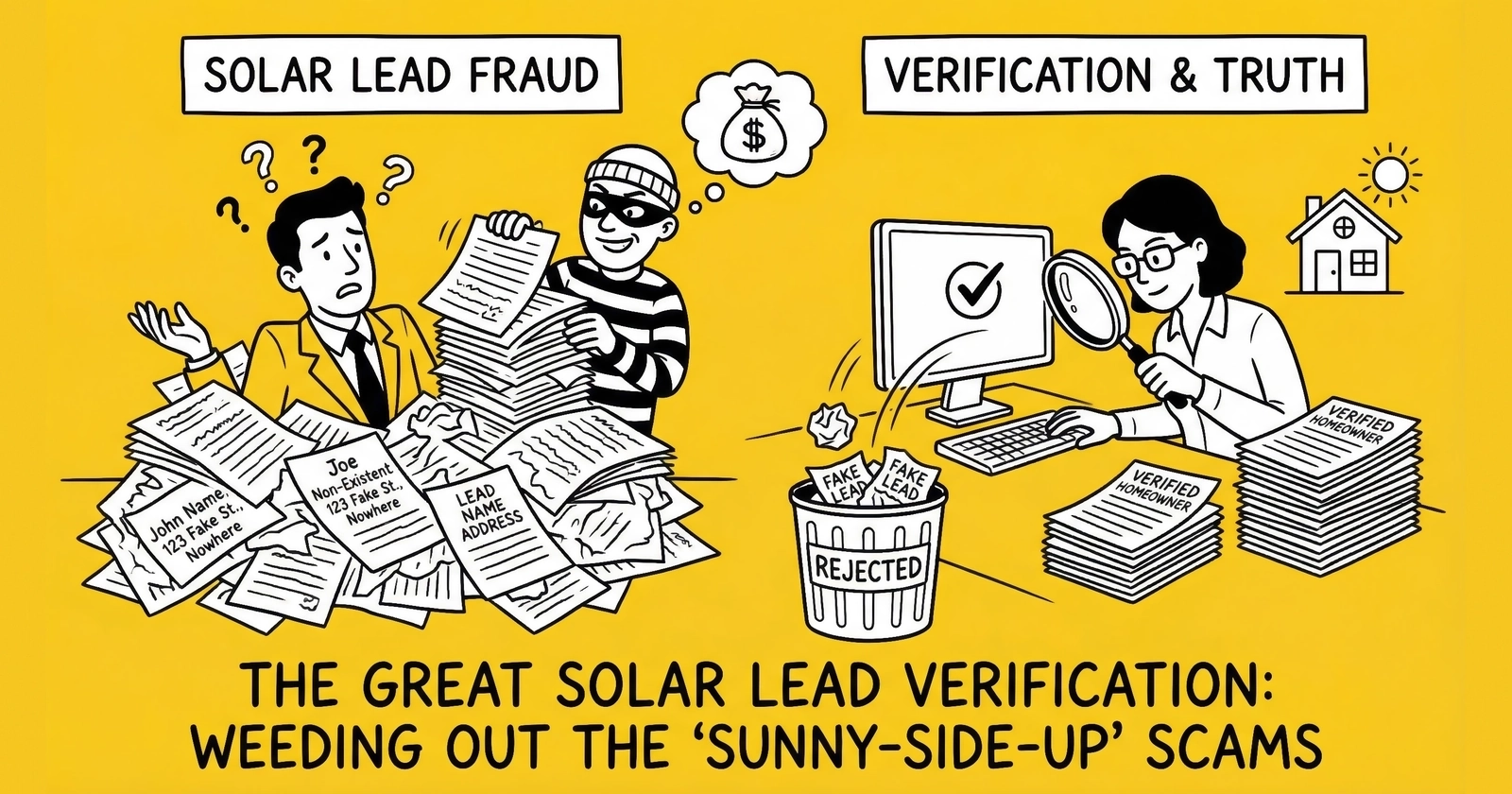
Fraud rates of 25-35% plague the solar lead industry. Most of that fraud involves fake homeownership claims and invalid addresses. Here is how to detect it, prevent it, and protect your margins from the schemes that cost operators millions annually.
The solar lead vertical attracts fraudsters like few other industries. High CPLs ranging from $100 to $300 per exclusive lead create irresistible incentive for bad actors. Complex qualification requirements involving homeownership, property characteristics, and utility data provide multiple vectors for fabrication. Commission-driven sales models throughout the supply chain reward volume over verification.
The result: industry estimates suggest fraud rates of 25-35% for third-party solar leads. When you pay $150 for a lead and one in four is fraudulent, you lose $37.50 on every batch of leads before accounting for the downstream waste of installer time, buyer relationship damage, and operational chaos.
Two fraud categories dominate solar lead generation: fake homeownership claims and address fraud. A renter who claims to own their home cannot authorize installation. An address that does not exist or belongs to someone else generates a lead that will never convert. These two fraud types account for approximately 60-70% of all solar lead fraud, making them the primary targets for any quality verification program.
This guide provides the complete framework for detecting and preventing homeownership fraud and address manipulation in solar leads. Every technique described has been battle-tested in operations processing hundreds of thousands of solar leads. The economics favor aggressive verification: spending $3-$8 per lead on verification typically returns 10x or more through reduced fraud losses, lower return rates, and premium pricing from buyers who trust your data.
Understanding Solar Lead Fraud Economics
Before diving into detection methods, understanding why solar lead fraud is so prevalent helps calibrate appropriate responses. The economics create both the incentive for fraud and the justification for prevention investment.
Why Solar Attracts Fraudsters
Solar leads command premium pricing because the underlying transaction is substantial. A typical residential installation costs $20,000 to $30,000, with installers earning margins that justify customer acquisition costs ranging from $1,500 to $3,000 per closed sale. This creates room for lead prices that would be absurd in other verticals. Exclusive, qualified leads sell for $100-$200 or more, creating fraud profit potential of $100-$200 per fake lead. Shared leads going to 2-3 buyers command $35-$125, meaning fraudsters can pocket $70-$375 total by selling the same fake lead multiple times. Set appointments fetch $150-$200, and even aged leads over 30 days old still generate $5-$30 per recycled submission.
A fraudster who generates 100 fake exclusive leads at $150 each earns $15,000. The cost to produce those leads using bots, fake identities, or incentivized form fills might be $500-$1,000. The profit margin on fraud exceeds most legitimate business operations.
The asymmetry of information compounds the problem. The generator knows exactly how a lead was produced. The buyer knows only what appears on their screen. This information gap means fraud often goes undetected until conversion data reveals problems days, weeks, or months later. By then, the fraudster has been paid.
The True Cost of Solar Lead Fraud
Beyond the obvious loss of paying for worthless leads, fraud carries cascading costs throughout the ecosystem.
Direct Financial Loss
The most visible cost appears in your margin calculations. At a 25% fraud rate on 10,000 leads at $150 CPL, you lose $375,000 annually on leads that never had conversion potential. That figure alone justifies substantial verification investment.
Buyer Chargebacks and Returns
When buyers identify fraudulent leads, they demand credits. Standard return rates of 15-25% on third-party leads indicate significant fraud or quality issues. Each return represents lost revenue plus the administrative cost of processing refunds, creating a double hit to profitability.
Relationship Damage
Buyers receiving consistently fraudulent leads reduce spend, demand price reductions, or terminate relationships entirely. The lifetime value of a buyer relationship lost to quality problems far exceeds any single batch of leads. A buyer who paid you $50,000 monthly for two years represents $1.2 million in lost revenue when they leave over quality concerns.
Compliance Exposure
Delivering leads with fabricated consent creates TCPA liability for the buyer who calls them. If the consumer never consented, every call constitutes a potential violation at $500-$1,500 per call. Lead generators can face indemnification claims under their buyer contracts when these violations come to light.
Operational Waste
Every installer sales rep who spends 8-15 minutes attempting to contact a fake lead wastes time that could have generated revenue. At $30-$50 per hour for trained solar sales staff, each fraudulent lead costs $4-$12 in wasted labor beyond the lead cost itself. Multiply that across hundreds or thousands of fraudulent leads, and the downstream waste dwarfs the original lead cost.
Data Pollution
Marketing teams that optimize campaigns based on fraudulent conversion signals make systematically wrong decisions. A traffic source that appears to convert well because of form-fill fraud will receive increased budget, amplifying losses. The feedback loop corrupts your entire optimization strategy until you detect and correct for fraudulent signals.
The Fraud-Prevention ROI
The economics strongly favor aggressive fraud prevention. Verification costs of $3-$8 per lead are trivial compared to potential fraud losses.
Consider an operation processing 5,000 leads monthly at $150 average CPL with a 25% pre-detection fraud rate. At $5.00 per lead for detection that catches 80% of fraud, the math becomes compelling.
Without fraud prevention, the 25% fraud rate means 1,250 fraudulent leads costing $187,500 in losses monthly. With fraud prevention, the system catches 1,000 of those fraudulent leads, leaving only 250 undetected. The undetected fraud costs $37,500, and the detection system costs $25,000 for all 5,000 leads. Net savings: $187,500 minus $37,500 minus $25,000 equals $125,000.
The verification investment of $25,000 returns $125,000 in fraud prevention, a 500% ROI. Even with conservative assumptions about fraud rates and detection accuracy, the math overwhelmingly favors prevention.
Fake Homeownership: The Fundamental Solar Fraud
The single most important qualification question in solar lead generation is whether the prospect owns their home and has authority to authorize installation. Renters cannot install solar on property they do not own. Yet self-reported homeownership is remarkably unreliable.
Why Homeownership Fraud Is So Common
Multiple factors drive fake homeownership claims in solar forms, ranging from deliberate deception to honest confusion.
Intentional Fraud
Some individuals who know they are renters claim homeownership to receive information, compare options, or complete forms for incentive payments. Certain lead generation schemes specifically target renters because they form a larger addressable population for fake form submissions. The fraudster knows exactly what they are doing.
Genuine Confusion
Consumers living in properties with unclear ownership often submit incorrect information without malicious intent. Adult children living in parent-owned homes may consider themselves homeowners. Renters in rent-to-own agreements believe they have ownership interest. Domestic partners of homeowners may not understand they lack authority for major home improvements like solar installation.
Aspirational Responses
Renters who plan to buy soon sometimes answer as if their future state were current. A renter planning to purchase in six months might check “homeowner” because that aligns with their self-image and near-term plans. These leads will not convert on the current timeline regardless of their future intent.
Incentivized Form Fraud
Fraudulent lead generators use incentives like gift cards, sweepstakes entries, and cash payments to motivate form completion. The incentivized respondent has no stake in accuracy and checks whatever box seems most likely to complete the form successfully. This approach systematically generates false homeownership claims at scale.
Homeownership Fraud Indicators
Certain patterns suggest homeownership fraud even before formal verification.
Property type mismatches occur when claimed ownership conflicts with property reality. A form listing a large apartment complex address as a single-family owned home indicates fraud. Properties with 50+ units do not have individual rooftop solar potential, so any claim of ownership at such addresses warrants immediate rejection.
Tenure inconsistencies emerge in questioning. A claimed homeowner who does not know their monthly mortgage payment, property tax amount, or basic home characteristics likely does not own the property. Real homeowners know their mortgage payment within a few dollars.
Age and income mismatches flag implausible claims. A 22-year-old claiming to own a $500,000 home in a premium market warrants additional verification. Not impossible, but statistically unlikely enough to trigger enhanced scrutiny.
Geographic patterns indicate systematic fraud. When multiple leads from the same IP address claim homeownership in different states within hours, fraud is certain. No legitimate consumer owns homes in Texas, Florida, and California simultaneously while filling out solar forms from a single device.
Form completion behavior reveals fraud intent. Legitimate homeowners complete property information thoughtfully, pausing to recall details and occasionally correcting entries. Fraudulent submissions show rapid completion, skipped optional fields, and uniform patterns across multiple submissions.
Homeownership Verification Methods
Multiple verification approaches exist, each with different cost, accuracy, and friction characteristics. Sophisticated operations layer multiple methods to achieve high confidence.
Property Database Matching
Services like ATTOM, CoreLogic, Black Knight, and DataTree maintain comprehensive property ownership records compiled from public tax assessor data, deed recordings, and mortgage filings. These databases enable real-time matching of name-to-address ownership claims.
The verification service receives name and address, then checks whether that name appears as owner of record for that property. Results include match/no-match determination plus additional context like ownership date and property characteristics. Accuracy reaches 92-97% for name-to-property matching in states with good recording practices, though some rural areas with delayed recording or incomplete digitization show lower accuracy.
Cost ranges from $0.50 to $2.00 per lookup depending on volume and data depth. Enterprise agreements can reduce costs to $0.25-$0.50 at scale, making this verification economical even for high-volume operations.
Several limitations affect property database matching. Database latency means recent purchases may not appear for 30-90 days. Name variations including middle initials, maiden names, and trusts create false negatives. Multi-owner properties may not list all authorized parties. Implementation can process in real-time at 200-500ms or in batch. Real-time verification at form submission provides the best user experience but highest cost, while batch processing before lead delivery reduces per-lookup costs through volume pricing.
Utility Bill Verification
Requiring consumers to upload or verify their electric bill simultaneously confirms homeownership (the bill arrives at that address in their name), validates address, verifies electricity usage, and demonstrates serious purchase intent.
The form includes a utility bill upload field or integrates with utility account verification services. The consumer provides bill data which is then validated against expected patterns. Accuracy runs very high for legitimate submissions because a utility bill in the consumer’s name at the claimed address with residential rates strongly suggests legitimate homeownership or authorized tenancy.
Cost depends on implementation approach. Simple upload review requires only internal staff time. Automated utility verification services cost $1-$3 per verification but eliminate manual review requirements.
The primary limitation is friction. Requiring utility bill upload reduces completion rates by 15-30%, a significant trade-off for lead generators prioritizing volume. Additionally, renters in some markets have utility bills in their names despite non-ownership, and the method does not definitively prove ownership in all utility markets. Implementation must occur during form completion because you cannot batch-process utility verification after initial submission without losing the consumer’s participation.
Credit-Based Verification
Soft credit pulls can indicate homeownership through mortgage tradelines and property tax records appearing in credit files.
The verification service performs a soft credit inquiry that does not affect the consumer’s credit score and analyzes tradelines for mortgage accounts at the claimed address. Finding a mortgage tradeline at the claimed address strongly indicates ownership, though the method cannot confirm ownership of homes purchased with cash or where the mortgage is paid off. Cost runs $2-$5 per inquiry depending on data depth and volume.
Privacy concerns may deter some legitimate consumers from participating, and the method requires consumer consent along with an appropriate compliance framework. Implementation typically occurs in real-time with the consumer present to provide consent, which adds friction but ensures the consumer actively participates in verification.
Third-Party Authentication
Services like TrustedForm and Jornaya capture behavioral data and video playback of form completion. While not directly verifying ownership, they provide fraud signals and consent documentation.
JavaScript embedded in forms captures session data including keystrokes, mouse movements, timing, and video of form completion. This data is analyzed for fraud patterns and stored for compliance documentation. The method does not directly verify ownership but provides strong fraud signals because bots and automated form fills show distinctive behavioral patterns that human reviewers can identify.
Cost runs $0.15-$0.50 per lead for basic services, with premium services including enhanced fraud scoring at $0.50-$1.50. This makes behavioral capture one of the most cost-effective verification layers available.
The key limitation is that behavioral capture determines how a form was completed, not whether the content is accurate. A human fraudster filling forms manually may pass behavioral analysis while submitting entirely false information. Implementation must occur at the form level during consumer interaction; you cannot add this verification after the fact.
Building a Homeownership Verification Stack
The most effective approach layers multiple verification methods based on lead value and fraud risk.
Tier 1: Basic Verification for All Leads
Every lead should receive self-attestation with fraud-warning language, basic form validation for address and phone format, IP geolocation comparison to claimed address, and TrustedForm or similar behavioral capture. This baseline costs $0.20-$0.50 per lead and catches the most obvious fraud attempts.
Tier 2: Standard Verification for Mainstream Leads
Building on Tier 1, mainstream leads should add property database matching through ATTOM or CoreLogic, phone ownership verification, and email age and reputation checks. This level catches fake homeownership claims and invalid contact information. Total cost reaches $1.50-$3.00 per lead.
Tier 3: Enhanced Verification for Premium Leads
Premium leads justify additional scrutiny through utility bill upload or verification services, property enrichment data including ownership tenure and estimated value, and credit-based verification where permitted. This tier confirms not just ownership but property characteristics relevant to solar installation. Cost reaches $3.00-$5.00 per lead.
Tier 4: Maximum Verification for Exclusive High-CPL Leads
The highest-value leads warrant live callback verification before delivery, full identity verification, and manual review of any flagged submissions. This level catches fraud that automated systems miss and provides the documentation buyers need for premium pricing. Cost reaches $5.00-$8.00 per lead but is justified for leads selling at $150-$300.
The appropriate tier depends on lead value, buyer requirements, and fraud exposure from specific traffic sources. A $200 exclusive lead justifies $5-$8 in verification. A $40 shared lead justifies $1-$2.
Address Fraud: Invalid Locations and Geographic Manipulation
Address fraud in solar leads takes multiple forms, from completely fabricated addresses to legitimate addresses belonging to different people. Each form requires different detection approaches.
Types of Address Fraud in Solar
Address fraud in solar takes several distinct forms, each requiring different detection approaches.
Non-existent addresses represent the most basic fraud: addresses that do not correspond to any real delivery point. These include invented street numbers, fictional street names, and combinations that appear plausible but do not exist. USPS validation catches most of these immediately.
Vacant addresses are real addresses where no one currently lives. A fraudster might use a known vacant property because it passes basic validation. The consumer claiming to live at a vacant address is providing false information regardless of whether they know the property is vacant.
Commercial addresses presented as residential indicate fraud or confusion. A lead claiming residential solar interest at a commercial strip mall address is invalid for obvious reasons. Property type verification catches this fraud type.
CMRA addresses from Commercial Mail Receiving Agencies like UPS Store or Mailboxes Etc. indicate the consumer is using a mail-forwarding location rather than their residence. While not always fraud, CMRA addresses warrant additional scrutiny for residential solar leads.
Address-name mismatches occur when the claimed address is real and occupied, but by someone other than the lead. This might indicate synthetic identity fraud, recycled contact information, or simple errors in form completion.
Geographic manipulation involves real addresses in incorrect or manipulated geographic contexts. A fraudster might claim a North Carolina address while submitting from a California IP to access different buyer pools or avoid detection. IP-to-address distance analysis catches this pattern.
Address Validation Technologies
Modern address validation combines USPS data, geocoding, property databases, and fraud signals to assess address legitimacy.
USPS Address Standardization and DPV
The United States Postal Service maintains authoritative databases of all deliverable addresses. CASS-certified (Coding Accuracy Support System) validation confirms addresses exist as recognized delivery points.
The ZIP+4 File contains all valid ZIP+4 ranges with associated address information. Updated monthly with approximately 42 million records covering every deliverable U.S. address, this database forms the foundation of address validation.
Delivery Point Validation goes beyond ZIP+4 to confirm whether specific addresses are actually deliverable. A valid ZIP+4 does not guarantee deliverability; DPV confirmation does. This distinction matters because fraudsters often generate addresses that fall within valid ZIP+4 ranges but do not correspond to actual delivery points.
The Residential Delivery Indicator distinguishes residential from commercial addresses. This flag is essential for solar lead filtering because commercial addresses are invalid for residential solar programs.
The Vacant Address Indicator flags addresses where mail has gone uncollected for 90+ days. A lead claiming to live at a vacant address is either fraudulent or erroneous and should be rejected or flagged for enhanced review.
The CMRA Flag identifies Commercial Mail Receiving Agencies like UPS Store mailboxes. Leads with CMRA addresses require additional verification or rejection because they indicate mail forwarding rather than actual residence.
Cost runs $0.01-$0.04 per address for basic validation and $0.03-$0.08 for comprehensive validation including all flags. Accuracy reaches 98.5% or higher on USPS test files for CASS-certified providers, with real-world accuracy of 95-98% for consumer-submitted data.
Geocoding and Location Analysis
Geocoding converts validated addresses into latitude/longitude coordinates, enabling geographic analysis and fraud detection.
Rooftop-level geocoding provides coordinates representing the actual building location with accuracy within 10-50 meters. This precision enables property-level analysis and satellite imagery matching to verify that a real structure exists at the claimed address.
Several geographic fraud signals emerge from geocoding analysis. An IP address location differing significantly from the claimed address suggests VPN use or geographic fraud. Multiple leads from the same geocoordinates with different addresses indicate fake data being submitted from a single location. Address coordinates placing property in water, commercial zones, or uninhabited areas flag impossible claims. Geocoding costs typically bundle with address validation at $0.02-$0.05 per address.
Property Data Enrichment
Once an address validates and geocodes, property databases provide enrichment that enables qualification beyond basic address validity.
Property enrichment data includes property type (single-family, condo, multi-family, mobile home), square footage for both building and lot, year built, number of rooms and bathrooms, roof type and approximate age, owner names and mailing address, owner-occupied versus rental status, purchase date and price, estimated current value, and mortgage presence with approximate balance. This comprehensive profile enables sophisticated lead qualification.
For solar leads specifically, a validated address enriching to single-family, owner-occupied, 2,200 square feet with asphalt shingle roof built in 2005 represents a qualified opportunity. The same address enriching to condo, renter-occupied with HOA present indicates likely rejection regardless of what the consumer claimed on the form.
Property data that contradicts form responses flags fraud. When a consumer claims homeownership but property records show rental tenancy, the lead is invalid. When a consumer claims a single-family home but the property is actually multi-unit, something is wrong. When a consumer claims 3,000 square feet but the property measures 1,200 square feet, the mismatch indicates fabrication or confusion. Cost for property enrichment runs $0.05-$0.30 per record depending on data depth and vendor.
Address Validation Vendors and Pricing
Multiple vendors provide address validation services with varying depth and pricing.
Smarty (formerly SmartyStreets) offers CASS-certified validation with geocoding and property enrichment. Basic validation runs $0.00425-$0.01 per lookup depending on volume, while validation with geocoding and enrichment costs $0.02-$0.05 per lookup. A free tier of 250 lookups monthly enables testing before commitment.
Melissa Data provides enterprise-grade data quality including address validation, standardization, and enrichment. Enterprise contracts are required, with typical costs of $0.01-$0.05 per lookup depending on services selected. Strong international coverage makes this vendor suitable for global operations.
Loqate (GBG) specializes in form autocomplete and real-time validation. US validation costs $0.04-$0.05 per lookup at standard volume. Strong autocomplete functionality reduces errors at capture by helping consumers enter valid addresses. Coverage extends to more than 250 countries.
ATTOM and CoreLogic provide property-centric validation with deep enrichment. Their property data focus includes ownership verification, making them ideal for combined address and homeownership validation. Typical costs run $0.10-$0.30 per record, higher than pure address validation but justified by the depth of property data returned.
Implementing Address Fraud Detection
Effective address fraud detection combines validation with scoring and response protocols.
Real-Time Form Validation
Validate addresses as consumers complete forms. Invalid addresses trigger immediate feedback, allowing correction before submission.
The implementation begins with address autocomplete that suggests validated addresses as users type. On field blur or submission, the system validates the complete address and displays correction suggestions for standardization errors. Clearly invalid addresses block submission entirely, while suspicious patterns like vacant or CMRA addresses receive flags for additional verification downstream.
Real-time validation adds 100-300ms latency to form submission and may reject legitimate addresses with validation database gaps. This approach works best for publishers prioritizing quality over volume, where the slight friction trade-off is justified by cleaner data at capture.
Batch Validation Before Delivery
Process leads in bulk after capture but before routing to buyers.
This approach captures leads with minimal client-side validation, then queues them for batch processing. The system validates and standardizes addresses in bulk, rejecting or flagging invalid leads before distribution and enriching valid leads with geocodes and property data.
Batch validation offers lower per-lookup costs through volume pricing and eliminates form latency entirely. However, invalid leads enter your system before filtering, and consumers cannot correct errors after they have already moved on from the form. This approach suits operations prioritizing volume and cost efficiency over immediate data quality.
Fraud Scoring with Address Signals
Combine address validation results with other signals to create composite fraud scores.
Address-based signals contribute different point values to overall fraud scores. A non-existent address adds 30-40 points, effectively flagging the lead as high risk immediately. Vacant addresses add 15-25 points, while CMRA addresses add 10-15 points as lower-severity concerns. IP-to-address mismatch exceeding 500 miles adds 15-20 points. Property type mismatch between form claims and reality adds 20-30 points. Owner name mismatch adds 25-35 points, one of the strongest fraud indicators. Duplicate addresses appearing within 30 days add 25-35 points. Address and phone area code mismatch adds 10-15 points as a secondary signal.
Interpret composite scores in tiers. Scores from 0-30 indicate low risk warranting standard processing. Scores from 31-60 indicate medium risk requiring enhanced verification. Scores from 61-80 indicate high risk requiring manual review before any delivery. Scores above 81 indicate very high risk that should result in rejection in most cases.
Solar-Specific Fraud Patterns
Beyond general homeownership and address fraud, solar leads face industry-specific fraud patterns that require specialized detection.
Property Suitability Fraud
Consumers or fraudsters misrepresent property characteristics to appear qualified for solar installation.
Roof Condition Misrepresentation
A roof requiring replacement before solar installation adds $10,000-$25,000 to project cost, making many prospects non-viable. Consumers may underreport roof age or condition to progress further in the sales process, hoping to sort out details later.
Detection relies on multiple data sources. Property data enrichment provides building age, which correlates with roof condition. Satellite imagery analysis through specialized services can assess visible roof condition. Follow-up questions about recent roof work during qualification calls filter misrepresentation before installer site visits.
Shade Concealment
Heavy shading from trees or adjacent buildings reduces solar production 25-50%, potentially making systems non-economic. Consumers may not mention or may minimize shading issues because they want to proceed with consultation.
Detection through satellite imagery review using services like Google Project Sunroof or Aurora Solar pre-assesses shading before lead delivery. For more on these qualification factors, see our guide to solar lead qualification for roof ownership and shading. Property location analysis identifies heavily wooded areas or urban canyons where shading problems are likely.
HOA Complications
Approximately 25% of U.S. single-family homes are in HOA communities. HOA approval for solar adds 30-60 days to sales cycles and results in denial approximately 10-15% of the time, making HOA status important for lead qualification.
Property data can indicate HOA presence. Explicit form questions about HOA requirements filter prospects who have not considered approval requirements, improving lead quality for installers who need to factor approval timelines into their sales process.
Utility Account Fraud
Fraudsters manipulate or fabricate utility information to appear qualified.
Inflated Bill Amounts
Self-reported electric bills are frequently wrong. Consumers may inflate bills believing it makes them better prospects, or fraudsters may enter high amounts to pass qualification filters that screen out low-usage households.
Utility bill upload verification eliminates inflation by requiring documentation. Statistical analysis can flag bills implausibly high for property size or geographic area, identifying outliers that warrant additional scrutiny.
Wrong Utility Selection
Forms typically include utility dropdown menus for rate analysis. Fraudsters may select random utilities without knowledge of actual utility territories, creating mismatches that indicate fabrication.
Validation that the claimed utility serves the claimed ZIP code catches this fraud type. Utility territory lookup by address confirms alignment between the consumer’s location and their stated utility provider.
Commercial Accounts Presented as Residential
Business owners may attempt to use commercial utility accounts for residential solar quotes. Commercial and residential solar have different economics, installation requirements, and buyer pools, making this mismatch problematic for both lead generators and installers.
Utility bill verification distinguishes residential from commercial rate classes. Property enrichment identifies commercial versus residential properties, flagging mismatches for rejection or rerouting to commercial solar buyers.
Credit Qualification Fraud
Solar financing typically requires FICO scores above 650. Fraudsters generate leads from credit-unqualified populations knowing they will not convert but will generate affiliate commissions.
Several patterns indicate credit fraud. Traffic sources with normal lead volume but near-zero financing approval rates suggest systematic qualification fraud. Demographics suggesting limited credit history, such as very young applicants or recent immigrants, warrant additional scrutiny. Self-reported “poor credit” accompanied by claims of 800+ FICO scores reveals obvious fabrication. Leads clustered in ZIP codes with significantly below-average credit profiles indicate targeted fraud against qualification filters.
Detection starts with soft credit pre-qualification before delivery to confirm financing eligibility. Statistical analysis of approval rates by source identifies problematic traffic patterns that pure lead-level analysis might miss. Demographic scoring flags implausible combinations that warrant rejection or enhanced review.
Timeline Manipulation
Consumers misrepresent purchase timelines to access multiple quotes without purchase intent.
Information-Only Seekers
Some form completers want solar information for future reference without current purchase intent. These leads convert at near-zero rates but appear qualified on paper, wasting installer time and damaging buyer relationships.
Follow-up questions about purchase drivers and timeline help identify these leads. Responses indicating vague timelines or information-seeking language should route leads to lower-value pools where expectations match actual conversion probability.
Comparison Shoppers Gaming Exclusivity
Some consumers submit multiple forms to receive quotes from multiple installers while each installer believes they have an exclusive lead. This behavior defrauds buyers who paid premium prices for exclusivity.
Cross-publisher deduplication identifies consumers appearing in multiple lead flows. Phone and email matching across industry databases flags serial form-fillers who have requested quotes from numerous sources within short timeframes.
Building Your Solar Lead Fraud Prevention System
Implementing comprehensive fraud prevention requires systematic process, appropriate technology investment, and ongoing optimization based on results.
Technology Stack Requirements
A complete solar lead fraud prevention system spans four layers of the lead lifecycle.
Form-Level Components
At the form itself, you need address autocomplete to reduce errors and improve user experience. Phone verification through SMS confirmation and line type detection confirms real mobile numbers. Email verification checks deliverability, age, and reputation. Behavioral capture through TrustedForm or Jornaya documents consent and detects automation. Basic fraud scoring analyzes IP patterns and velocity to catch obvious fraud at submission.
Post-Capture Verification
After form submission but before delivery, the system applies USPS address validation including DPV, RDI, and vacancy flags. Geocoding enables geographic analysis comparing claimed location to IP location. Property database enrichment provides ownership and property characteristic data. Homeownership verification confirms the consumer actually owns the property. Utility territory validation ensures the claimed utility serves the claimed address.
Pre-Delivery Screening
Before releasing leads to buyers, composite fraud scoring combines all signals into actionable decisions. Deduplication checks both internal databases and cross-publisher services. Credit pre-qualification confirms financing eligibility where applicable. A manual review queue handles flagged leads that automated systems cannot definitively classify.
Post-Delivery Monitoring
After delivery, buyer feedback integration captures contact outcomes and dispositions. Conversion tracking by source identifies problematic traffic patterns. Return rate analysis flags sources with excessive quality issues. Pattern detection identifies emerging fraud types before they cause significant damage.
Vendor Selection Considerations
Choose vendors based on accuracy, cost, integration complexity, and support quality.
For address validation, Smarty offers excellent developer experience and competitive pricing. Melissa Data provides enterprise capabilities for larger operations. Loqate excels at international coverage for companies operating beyond the US.
For property data, ATTOM and CoreLogic provide the most comprehensive U.S. property databases. DataTree from First American offers competitive alternatives with different pricing structures.
For identity verification, Ekata (now part of Mastercard) combines phone, email, and address signals into unified identity confidence scores. Plaid provides credit-adjacent verification for financing qualification. Alloy offers comprehensive KYC capabilities for operations requiring deeper identity verification.
For behavioral analysis, TrustedForm dominates lead generation with industry-standard consent documentation that buyers recognize and accept. Jornaya provides alternative coverage with different buyer preferences, making multi-vendor support worthwhile.
Many lead distribution platforms including LeadConduit, Boberdoo, and Lead Prosper include verification integrations. Using platform-native integrations simplifies implementation but may limit vendor choice or increase costs compared to direct vendor relationships.
Process Design
Document clear processes for each verification scenario.
Lead Intake Process
The intake process captures leads with all form data, then applies form-level validation for format, phone, and email. Based on form signals, the system assigns an initial fraud score. Low-risk leads route to standard verification while high-risk leads route to enhanced verification. Leads exceeding flag thresholds but not rejection thresholds queue for manual review.
Verification Process
Verification begins with USPS address validation including DPV and RDI flags. The system geocodes the address and compares it to IP location for geographic consistency. Property data enrichment adds ownership and characteristic information. Homeownership verification confirms the consumer against property records. Utility territory validation checks alignment between claimed utility and address. All signals combine into a composite fraud score that drives the disposition decision to accept, reject, or route to review.
Manual Review Process
Manual reviewers examine all available signals for flagged leads. They check the property against satellite imagery to verify physical characteristics. Phone ownership verification confirms contact information if automated checks were inconclusive. Reviewers make accept/reject decisions with documentation explaining their reasoning. These decisions feed back to the scoring model to improve future automated decisions.
Buyer Delivery Process
Before delivery, the system applies final fraud score thresholds. Leads match to buyers based on geography, capacity, and stated preferences. Delivery includes appropriate verification documentation supporting the lead quality claims. The system tracks delivery timestamp and buyer response for downstream analysis.
Feedback Integration Process
Buyer contact and disposition data flows back into the system. Source-level quality scores update based on actual outcomes. Analysis identifies pattern changes requiring investigation. Fraud scoring weights adjust based on which signals predicted actual outcomes. Sources with persistent quality issues receive volume reductions or termination.
Performance Metrics
Track these metrics to assess fraud prevention effectiveness.
Pre-Delivery Metrics
Pre-delivery metrics measure what happens before leads reach buyers. Raw fraud detection rate shows the percentage of leads blocked as fraudulent. False positive rate reveals valid leads incorrectly blocked, a critical efficiency measure. Manual review rate indicates leads requiring human decision, which drives staffing needs. Verification cost per lead tracks operational efficiency. Time from capture to verified status measures processing speed.
Post-Delivery Metrics
Post-delivery metrics measure actual quality outcomes. Buyer return rate shows leads rejected by buyers after delivery. Contact rate measures how often buyers successfully reach leads. Appointment rate tracks leads converting to installer appointments. Close rate shows leads ultimately converting to installations. Source-level quality variance identifies which traffic sources produce consistent versus inconsistent results.
Economic Metrics
Economic metrics tie fraud prevention to business outcomes. Fraud loss prevented equals blocked leads multiplied by CPL. Verification cost as percentage of CPL shows operational overhead. Net fraud prevention ROI combines savings and costs. Quality-adjusted revenue per lead accounts for downstream conversion probability.
Target these benchmarks as starting goals: fraud detection rate of 80-90% of actual fraud, false positive rate under 2% of legitimate leads, return rate under 10% for verified leads, and contact rate above 70% for real-time delivery.
Responding to Fraud Discoveries
When systematic fraud is identified, structured response protocols minimize damage and prevent recurrence.
Immediate Response Protocol
Step 1: Quarantine
Pause lead routing from the suspected source immediately. Hold pending deliveries for review rather than releasing potentially fraudulent leads. Preserve all session data, logs, and verification records before any cleanup processes run. Document the time and nature of discovery to establish a timeline for subsequent investigation.
Step 2: Quantify
Determine how many leads are affected by the discovered fraud pattern. Identify the time period of exposure from first suspicious lead to discovery. List which buyers received fraudulent leads during that window. Calculate total financial exposure including lead costs, potential chargebacks, and relationship damage.
Step 3: Evidence Collection
Pull IP logs and geographic analysis showing submission patterns. Retrieve device fingerprint data identifying whether multiple leads came from the same devices. Document form completion timing records that might show automation. Compile conversion data showing the fraudulent pattern compared to baseline performance. Select specific lead examples with full context to use in partner discussions and potential legal action.
Partner Communication
Communicating with Traffic Sources
Present evidence factually without accusations. A professional approach might be: “We observed specific patterns in leads from your source between these dates. Here is the evidence. We need to understand what happened and how to prevent recurrence.”
Good partners investigate and remediate. Bad partners deflect and disappear. Their response determines whether the relationship continues. Require documentation of corrective actions before resuming traffic. If explanations are implausible or fraud repeats, terminate permanently.
Communicating with Buyers
Proactive disclosure builds trust. Lead with the problem and solution: “We identified a quality issue affecting X leads delivered between these dates. We are crediting your account and have terminated the responsible source.”
Buyers appreciate honesty. They despise discovering fraud themselves and then learning you knew but did not disclose. Provide credit or refund without requiring extensive documentation. The goal is preserving the relationship, not winning the dispute.
Financial Resolution
Chargeback Policies
Chargeback policies should be established before fraud occurs. Document what evidence triggers chargeback rights, what time window applies (typically 24-72 hours), what percentage is refundable, and how disputes are resolved when parties disagree.
Standard terms allow 24-72 hour review windows with 100% refund for demonstrable fraud such as disconnected numbers, wrong-person confirmations, or duplicate leads. Partial credits may apply for lower-certainty issues where fraud is suspected but not proven.
Source Recovery
Source recovery attempts to recoup losses from fraudulent traffic sources. Invoice sources for fraudulent lead costs documented through your investigation. Withhold pending payments until resolution. Consider pursuing legal action for significant fraud, though this is rarely cost-effective for amounts under $50,000. Document all fraud for potential pattern evidence if others experience similar issues and industry coordination becomes relevant.
Post-Incident Improvement
Every fraud incident provides learning opportunities.
Update detection models with new fraud indicators identified during investigation. The patterns that revealed this fraud should become automated detection rules for future prevention.
Strengthen verification in areas where fraud penetrated existing controls. If homeownership verification missed these leads, add additional verification layers for similar profiles.
Review source onboarding to identify how fraudulent sources passed initial vetting. Tighten onboarding criteria to catch similar sources before they deliver fraudulent volume.
Document lessons learned for team training and process improvement. Ensure the entire organization understands what happened and how to prevent recurrence.
Consider additional verification layers if the fraud type was not previously addressed. New fraud patterns may require new detection capabilities.
Frequently Asked Questions
What percentage of solar leads contain homeownership or address fraud?
Industry estimates suggest 25-35% of third-party solar leads contain some form of fraud or quality issue. Homeownership misrepresentation and address problems account for approximately 60-70% of that fraud, meaning 15-25% of all third-party solar leads have homeownership or address issues specifically. First-party leads generated on owned properties typically show 5-10% fraud rates. Premium networks with strict quality controls achieve 10-15%. Your actual rate depends heavily on traffic sources, verification practices, and buyer feedback integration.
How much should I spend on homeownership and address verification per lead?
For standard solar leads selling at $75-$150, allocate $2-$5 per lead for verification including property database matching, address validation, and behavioral analysis. For premium exclusive leads at $150-$250, invest $5-$8 to include enhanced verification like utility bill validation or credit-based confirmation. If verification costs exceed 3-5% of CPL, you are either over-investing or operating with unusually fraud-prone traffic. The ROI calculation should target at least 5:1 return on verification investment through fraud prevention.
Can property database verification confirm homeownership definitively?
Property database matching through services like ATTOM or CoreLogic achieves 92-97% accuracy for name-to-property matching in states with good recording practices. However, limitations exist: database latency means recent purchases may not appear for 30-90 days; name variations (maiden names, middle initials, trusts) create false negatives; and multi-owner properties may not list all authorized parties. Property database matching is the strongest single verification method but should be combined with other signals for highest confidence.
What is the best way to verify homeownership without creating excessive form friction?
Property database matching occurs after form submission without consumer awareness, creating zero additional friction. For higher-value leads where friction is acceptable, utility bill upload provides strong verification while simultaneously confirming address, electricity usage, and purchase seriousness. The key is matching verification level to lead value: high-friction verification is justified for $150+ exclusive leads but counterproductive for $40 shared leads where volume matters more.
How do I handle leads where homeownership verification fails?
Do not automatically reject all verification failures. Property database gaps, name variations, and recent purchases create legitimate false negatives. Implement tiered handling: clear fraud (non-existent addresses, obvious mismatches) receives immediate rejection; uncertain results receive enhanced verification or manual review; marginal failures receive lower fraud scores and route to appropriate buyer pools. Track false positive rates to ensure legitimate leads are not lost to over-aggressive filtering. Target under 2% false positive rates.
Should I validate addresses in real-time or after form submission?
Both approaches have merits. Real-time validation catches errors while consumers can correct them, preventing bad data from entering your system. But it adds 100-300ms latency, may reject legitimate addresses with database gaps, and increases form abandonment by 3-7%. Post-submission batch validation costs less per lookup through volume pricing, has no form latency impact, and can retry temporary failures. Most sophisticated operations use hybrid approaches: lightweight real-time checks (format validation, autocomplete) plus comprehensive batch validation before delivery.
What address validation signals indicate highest fraud probability?
The strongest fraud signals in order of predictive power: (1) Address non-existent in USPS databases - nearly certain fraud or significant error; (2) Property owner name mismatch with form name - strong indicator of wrong person or synthetic identity; (3) Address flagged as vacant - no legitimate resident; (4) IP geolocation more than 500 miles from claimed address without VPN explanation; (5) CMRA (mail forwarding) address presented as residence; (6) Duplicate address appearing within 30-90 day window with different names. A single strong signal warrants investigation. Multiple signals warrant rejection.
How do I verify that a solar lead address is suitable for installation?
Address validation confirms an address exists and is deliverable. Property suitability requires additional enrichment: property type (single-family, condo, multi-family), square footage, year built, and roof characteristics. Services like ATTOM, CoreLogic, and specialized solar tools like Aurora Solar provide property enrichment. Google Project Sunroof offers free solar potential estimates for many addresses. For high-value leads, satellite imagery review identifies obvious disqualifiers like heavy shading, north-facing orientation, or commercial property type before delivery to installers.
What happens when a buyer disputes a lead as fraudulent?
Treat every complaint as valid until investigated. Pull all available data: form submission details, verification results, session recording, IP analysis, and any prior history with that phone/email/address. If fraud indicators exist that your verification missed, credit the buyer immediately and investigate why detection failed. If the lead appears legitimate based on available evidence, provide documentation to the buyer and discuss. Persistent disputes from specific buyers may indicate buyer-side issues (poor follow-up, inadequate sales process) rather than lead fraud. Track dispute patterns by buyer to distinguish between legitimate quality concerns and systematic over-returns.
How do I prevent the same fraudulent leads from being sold multiple times?
Implement multi-layer deduplication. Phone number matching with 90-180 day windows catches obvious recycling. Email matching provides additional coverage. Address matching identifies same-household duplicates. Device fingerprinting through behavioral capture tools identifies the same device submitting across multiple properties. Cross-publisher deduplication services (LeadId/Jornaya, TrustedForm) identify leads appearing in multiple lead flows industry-wide. For exclusive leads, provide buyers with deduplication certificates or guarantees with financial backing.
What legal risks exist from delivering fraudulent solar leads?
Primary risks include: (1) TCPA liability if fraudulent leads include fabricated consent - buyers calling these leads face $500-$1,500 per call penalties and may pursue indemnification claims against lead generators; (2) Contract breach claims from buyers who purchased leads with quality representations; (3) FTC scrutiny for deceptive trade practices if systematic fraud is ignored; (4) State consumer protection violations for leads used in fraud schemes. Mitigation requires thorough verification, clear contract terms with appropriate representations, rapid response to discovered fraud, and documentation of prevention efforts demonstrating good faith compliance.
Key Takeaways
-
Solar lead fraud runs 25-35% for third-party leads, with homeownership and address fraud comprising 60-70% of that total. The high CPLs of $100-$300 per exclusive lead create irresistible incentive for fraudsters, making aggressive prevention essential for profitability.
-
Property database matching is the strongest single verification method for homeownership, achieving 92-97% accuracy at $0.50-$2.00 per lookup. Services like ATTOM and CoreLogic compare claimed ownership against public records. Combine with utility bill verification for highest confidence.
-
USPS CASS-certified address validation catches 95-98% of address fraud including non-existent addresses, vacant properties, and commercial addresses presented as residential. Cost of $0.01-$0.04 per lookup makes this essential baseline verification.
-
Verification investment of $3-$8 per lead typically returns 500% or more through fraud prevention, lower return rates, and premium pricing from quality-conscious buyers. The economics overwhelmingly favor aggressive verification over accepting higher fraud rates.
-
Layer verification methods based on lead value: basic validation for all leads, property database matching for mainstream leads, utility bill verification for premium leads, and full identity verification for exclusive high-CPL leads. Match investment to lead value.
-
Address signals extend beyond existence to geographic consistency: IP-to-address distance, utility territory alignment, and property characteristics that match form responses. Composite fraud scoring combining multiple signals outperforms single-signal detection.
-
Solar-specific fraud patterns include property suitability misrepresentation, utility account fraud, and credit qualification fraud. Detection requires industry-specific knowledge about roof requirements, utility territories, and financing qualification beyond general lead verification.
-
Response protocols for discovered fraud should be documented before incidents occur: quarantine procedures, evidence collection requirements, partner communication templates, and financial resolution policies. Rapid, professional response preserves buyer relationships.
-
Track verification performance through return rates, contact rates, and source-level quality scores. Target under 10% return rates for verified leads and over 70% contact rates. Use buyer feedback to continuously improve detection models.
-
Geographic variation affects fraud patterns: certain markets attract more fraud due to higher lead values. California, New York, and Massachusetts leads command premium prices (see our solar CPL by state guide) and therefore attract more sophisticated fraud attempts requiring enhanced verification.
Verification methods and vendor pricing current as of December 2025. Fraud patterns evolve continuously; monitor industry sources and buyer feedback for emerging threats. All verification recommendations should be implemented with appropriate legal review for compliance with applicable privacy and consumer protection regulations.