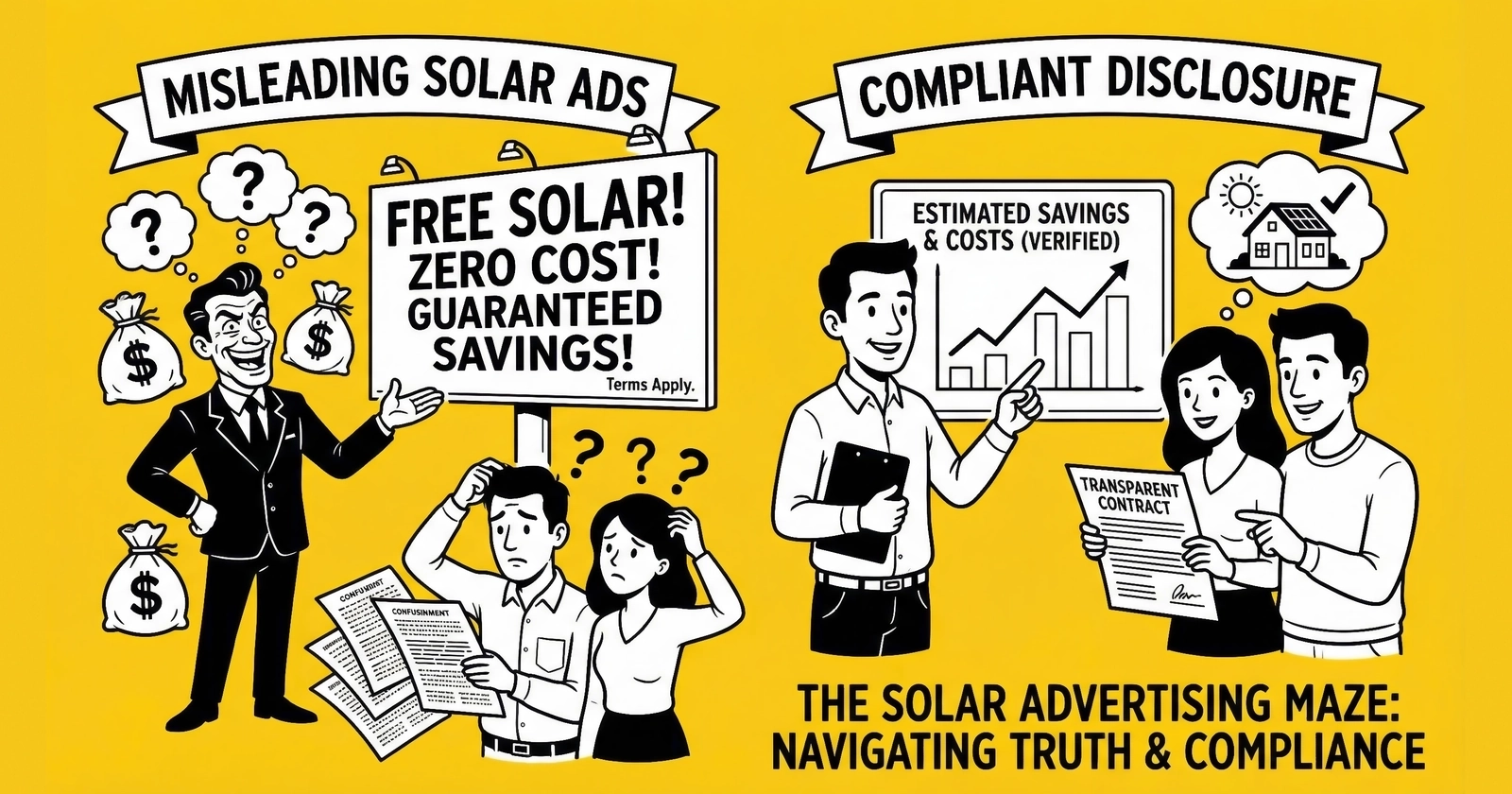
Efficiency claims, savings projections, and performance warranties under FTC guidelines. What lead generators and solar marketers need to know to stay compliant while maximizing conversion rates.
The solar industry has a credibility problem that threatens every legitimate operator in the market.
NPR reported in August 2024 that “rooftop solar has a fraud problem,” documenting forged contracts, loan stacking, and misleading tax credit claims. Florida’s Attorney General reported a 700% increase in solar-related consumer complaints in 2024. The FTC and CFPB have issued explicit warnings about deceptive solar sales practices. State attorneys general across the nation are investigating installation companies and the marketing networks that feed them leads.
This crackdown affects everyone generating, buying, or selling solar leads. When installers face enforcement actions for misleading claims, they scrutinize their lead sources. When consumers file complaints about exaggerated savings projections, regulators trace the marketing chain back to its origin. When a class action targets deceptive advertising, every entity in the marketing funnel becomes a potential defendant.
Those who understand solar advertising compliance build sustainable businesses with premium buyer relationships. Those who chase conversions through aggressive claims find themselves defending lawsuits, losing buyer accounts, and watching competitors absorb their market share while they deal with regulatory fallout. For the complete picture on generating compliant solar leads, see our solar lead generation guide.
This guide covers the complete framework for solar panel technology claims compliance: FTC advertising standards, efficiency and performance claims, savings projections, warranty representations, state-specific requirements, and the documentation practices that protect your operation when regulators come asking questions.
The Regulatory Landscape for Solar Marketing
Solar panel advertising falls under multiple overlapping regulatory frameworks. Understanding which agencies care about your claims, and why, shapes how you build compliant marketing materials.
FTC Authority Over Solar Advertising
The Federal Trade Commission’s authority over solar advertising derives from Section 5 of the FTC Act, which prohibits “unfair or deceptive acts or practices in or affecting commerce.” This broad mandate applies to any commercial claims made to consumers, including:
- Advertising materials on websites, landing pages, and social media
- Sales scripts used by lead generation call centers
- Email marketing sequences promoting solar installation
- Testimonials and reviews displayed to prospective customers
- Performance projections and savings estimates
- Efficiency claims and technology comparisons
The FTC evaluates advertising under its substantiation doctrine: advertisers must possess “reasonable basis” for objective claims before making them. For scientific or performance claims about solar technology, this typically means competent and reliable evidence, usually controlled testing or engineering analysis conducted under conditions that reflect actual consumer use.
The Commission’s Green Guides provide specific guidance on environmental marketing claims, including renewable energy representations. While the Green Guides don’t carry the force of law, they represent the FTC’s interpretation of Section 5 as applied to environmental claims. Deviating from Green Guides recommendations creates significant enforcement risk.
State Consumer Protection Authorities
Beyond federal regulation, state attorneys general maintain independent authority to pursue deceptive solar advertising under state consumer protection statutes. These state UDAP (Unfair and Deceptive Acts and Practices) laws often provide more aggressive remedies than federal enforcement:
California enforces solar marketing claims under the California Consumer Protection Act and the False Advertising Law. The California Public Utilities Commission maintains additional jurisdiction over solar installations and marketing through its oversight of investor-owned utilities and net metering programs. California’s enforcement history includes actions against solar companies for misrepresenting savings, overstating efficiency, and making unsubstantiated environmental claims.
Florida has pursued aggressive enforcement against solar marketing fraud through the Attorney General’s consumer protection division. The state’s Deceptive and Unfair Trade Practices Act (FDUTPA) allows for per-violation penalties up to $10,000 for initial violations and $50,000 for repeat offenses. Florida’s 700% increase in solar complaints has triggered systematic review of solar marketing practices across the state.
Texas regulates solar marketing through the Texas Deceptive Trade Practices Act (DTPA), which provides consumers with private rights of action including treble damages for knowing violations. The Texas Attorney General has issued consumer alerts specifically addressing solar marketing fraud and maintains an active consumer complaint database.
New York enforces solar claims under General Business Law Section 349 (deceptive practices) and Section 350 (false advertising). The state’s Consumer Protection Division has investigated solar financing misrepresentations and installation company marketing practices.
Consumer Financial Protection Bureau
The CFPB has regulatory authority over solar financing products, creating additional compliance obligations for marketing that touches on solar loans, leases, or power purchase agreements. CFPB enforcement actions have targeted solar companies for:
- Misrepresenting monthly payment amounts
- Failing to disclose financing terms clearly
- Overstating tax credit benefits
- Making misleading comparisons between solar financing and utility costs
Solar lead generators whose forms collect financing preferences or discuss financing options operate in CFPB-regulated territory. Marketing claims about “replacing your electric bill” with solar payments, or suggestions that solar financing costs less than current utility bills, trigger Truth in Lending Act disclosure requirements and CFPB scrutiny.
Efficiency Claims: What You Can and Cannot Say
Solar panel efficiency claims represent the most technical, and most frequently abused, category of solar marketing. Understanding what efficiency actually means, how to represent it accurately, and where marketers consistently get in trouble helps you build compliant campaigns.
Understanding Solar Panel Efficiency
Solar panel efficiency measures the percentage of sunlight hitting a panel that converts to usable electricity. Current commercial solar panels typically achieve efficiency ratings between 15% and 23%, with premium panels from manufacturers like SunPower and Maxeon reaching up to 22.8% efficiency under standard test conditions.
The key phrase is “standard test conditions” (STC). Laboratory efficiency ratings assume:
- Solar irradiance of 1,000 watts per square meter
- Cell temperature of 25 degrees Celsius (77 degrees Fahrenheit)
- Air mass of 1.5 (representing the atmosphere’s effect on sunlight)
Real-world conditions rarely match laboratory conditions. Actual panel performance varies based on:
Temperature effects: Panel efficiency decreases as temperature increases. Most panels lose 0.3% to 0.5% efficiency per degree Celsius above 25C. In Arizona, where summer roof temperatures can exceed 70C (158F), panels may operate 15-20% below their rated efficiency during peak sun hours.
Irradiance variation: Sunlight intensity varies by location, season, time of day, and weather. Standard test conditions assume optimal irradiance that many installations never experience consistently.
Installation factors: Roof orientation, tilt angle, and shading from trees, chimneys, or neighboring structures all reduce effective system performance below rated efficiency.
System losses: Beyond panel efficiency, real installations experience losses from inverter conversion (typically 2-5%), wiring resistance, soiling (dust and debris), and degradation over time (typically 0.5-0.8% annually).
Compliant Efficiency Claim Practices
Legitimate efficiency claims require careful qualification and context:
Do state specific efficiency ratings with proper attribution: “These panels achieve 21.5% efficiency under standard test conditions per manufacturer specifications.”
Do explain what efficiency means for the consumer: “Higher efficiency means more electricity production per square foot of roof space, allowing homeowners with limited roof area to maximize their solar generation.”
Do acknowledge real-world variation: “Actual system performance varies based on your location, roof characteristics, and installation factors. Your installation estimate includes site-specific production projections.”
Do not claim efficiency improvements without substantiation: Avoid claims like “50% more efficient than standard panels” without specific comparison data from controlled testing.
Do not confuse efficiency with production: A 22% efficient panel on a shaded roof may produce less electricity than a 19% efficient panel with full sun exposure.
Do not imply efficiency guarantees production levels: Efficiency is an input characteristic, not an output guarantee.
Common Efficiency Claim Violations
Enforcement actions and consumer complaints reveal consistent patterns of problematic efficiency claims:
Unqualified superlative claims: Statements like “the most efficient solar technology available” require proof that no other technology achieves higher efficiency, which changes as new products enter the market. Even if true at one moment, such claims become false when competitors release improved products.
Misleading efficiency comparisons: Comparing new premium panels to outdated technology creates a false impression of relative performance. Claims that panels are “40% more efficient than traditional solar” may compare against 1990s technology rather than current market offerings.
Efficiency-to-savings conflation: Marketing that implies 22% efficient panels will produce 22% more savings than 18% efficient panels ignores the diminishing returns of efficiency improvements and the relative contribution of efficiency versus other system factors.
Misattributed efficiency ratings: Using manufacturer efficiency ratings for individual cells rather than complete panels, or using laboratory results rather than real-world performance data, overstates the efficiency consumers will actually experience.
Savings Projections: The Highest-Risk Claim Category
Savings projections generate more solar marketing enforcement actions than any other claim category. The complexity of calculating actual solar savings creates opportunity for both unintentional errors and deliberate manipulation. Regulators have developed sophisticated frameworks for evaluating savings claims, and the standard for substantiation is high.
The Mathematics of Solar Savings
Accurate savings projections require modeling multiple variables:
Current electricity costs: The consumer’s existing utility rate structure, including tiered rates, time-of-use rates, demand charges, and fixed monthly charges.
System production: Expected electricity generation based on system size, panel efficiency, inverter performance, installation orientation, shading analysis, and local irradiance data.
Net metering treatment: How the utility credits excess generation, which varies dramatically by state and utility. California’s NEM 3.0 reduced export compensation by approximately 75% compared to previous net metering rules.
Rate escalation assumptions: Projected future utility rate increases, which affect long-term savings calculations. Historical utility rate increases have averaged 2-3% annually, but future increases are uncertain.
System degradation: Panel performance typically decreases 0.5-0.8% annually over a 25-year lifespan.
Financing costs: For financed systems, monthly loan payments, interest rates, and total financing costs affect net savings calculations.
Tax credit treatment: The federal Investment Tax Credit (ITC) reduces system cost, but the value depends on the consumer’s tax liability. The residential ITC expires after December 31, 2025, fundamentally changing future savings calculations.
Maintenance and repair costs: While solar systems have minimal maintenance requirements, inverter replacement (typically needed after 10-15 years) and potential repair costs affect lifetime savings.
FTC Standards for Savings Claims
The FTC requires that savings claims be substantiated by competent and reliable evidence and accurately represent the typical consumer experience. This standard creates specific requirements for solar savings projections:
Representative assumptions: Savings projections must use assumptions representative of the typical customer, not best-case scenarios. Using optimal installation conditions, highest utility rates, and maximum production estimates creates misleading projections.
Clear disclosure of assumptions: Marketing materials should disclose the assumptions underlying savings calculations, including utility rate assumptions, production estimates, and financing terms.
Qualified claims: Absolute savings claims (“Save $30,000 over 25 years”) are harder to substantiate than qualified claims (“Typical customers save $1,000-$1,500 annually based on current utility rates”).
Comparison accuracy: Claims comparing solar costs to utility costs must use accurate utility rate data and properly account for net metering treatment, fixed charges, and the difference between solar production timing and consumption timing.
Post-ITC Savings Claim Considerations
The elimination of the residential Investment Tax Credit after December 31, 2025 fundamentally changes solar economics and savings claim compliance.
Prior to January 2026, savings claims could legitimately include the 30% federal tax credit value. A $25,000 system effectively cost consumers $17,500 after the credit, significantly improving payback periods and savings projections.
For systems installed after 2025, savings claims must reflect full system costs without federal incentive reductions. Payback periods extend by approximately 30%. Marketing materials created before the ITC expiration that continue circulating after 2025 create compliance risk if they reference obsolete tax benefits.
Lead generators should:
- Update all marketing materials to remove ITC references for campaigns running after January 1, 2026
- Implement dynamic content that adjusts tax credit messaging based on installation timing
- Review archived landing pages and ensure outdated claims aren’t still accessible
- Coordinate with buyer partners on messaging transitions
State-Specific Savings Claim Requirements
Several states impose additional requirements on solar savings claims beyond federal standards:
California requires that savings projections incorporate NEM 3.0 export compensation rates for new installations. Marketing that uses legacy net metering assumptions overstates savings for systems installing under current rules. The California Public Utilities Commission has investigated solar companies using outdated savings projections.
Nevada regulates solar savings claims through the Bureau of Consumer Protection, which has pursued enforcement actions against installers making unsubstantiated savings promises. Nevada’s net metering changes in 2016 and subsequent modifications require careful attention to current export compensation rates.
Arizona utilities have largely eliminated retail-rate net metering, making savings claims based on historical net metering economics inaccurate for new installations. Arizona Corporation Commission decisions affect how solar savings should be calculated and represented.
Performance and Production Warranties: Representing Guarantees Accurately
Solar manufacturers provide two types of warranties that marketers frequently misrepresent: product warranties (covering defects and failures) and performance warranties (guaranteeing minimum production levels). Understanding the distinction and representing warranties accurately protects against compliance violations.
Product Warranty Representations
Product warranties typically cover manufacturing defects, material failures, and workmanship issues. Standard product warranty periods range from 10 to 25 years depending on manufacturer and panel quality. Premium manufacturers like SunPower offer 25-year product warranties; budget manufacturers may offer 10-12 year coverage.
Compliant product warranty claims:
- State the actual warranty duration accurately
- Identify the warrantor (manufacturer, not installer, unless the installer provides additional warranty)
- Disclose limitations and exclusions (most warranties exclude damage from improper installation, extreme weather events, or unauthorized modifications)
- Clarify what warranty covers (replacement only, or replacement plus labor)
Common product warranty claim violations:
- Implying installer warranty extends beyond manufacturer warranty
- Failing to distinguish between manufacturer warranty and installer workmanship warranty
- Overstating warranty coverage by omitting exclusions
- Claiming “lifetime warranty” without defining the applicable lifespan
Performance Warranty Representations
Performance warranties guarantee minimum production levels, typically expressed as a percentage of original rated output over time. Standard performance warranties guarantee 80-90% of rated output after 25 years, reflecting expected degradation of 0.5-0.8% annually.
These warranties are frequently misrepresented in solar marketing.
Compliant performance warranty claims:
- “Panels are warranted to produce at least 85% of rated output after 25 years”
- “Manufacturer guarantees maximum degradation of 0.5% annually”
- “If production falls below warranted levels, the manufacturer will repair, replace, or compensate for the difference”
Non-compliant performance warranty claims:
- “Guaranteed to produce electricity for 25 years” (implies 100% production, not degraded performance)
- “25-year performance guarantee” without specifying guaranteed performance level
- “Panels produce the same amount of electricity for 25 years” (ignores documented degradation)
Warranty Substantiation Requirements
Marketing claims about warranties must be substantiated by actual warranty documentation. Lead generators should:
- Obtain and review warranty documentation from manufacturers whose products are promoted
- Ensure marketing claims accurately reflect warranty terms, duration, and limitations
- Update marketing materials when manufacturers modify warranty terms
- Avoid making warranty claims for products where specific warranty documentation is unavailable
When promoting multiple installer partners who may use different panel manufacturers, marketing claims about warranties should either:
- Reference specific manufacturer warranties with attribution, or
- Use qualified language like “leading manufacturers typically offer 25-year product warranties and 85% production guarantees”
Environmental Claims: Green Guides Compliance
Solar marketing frequently incorporates environmental claims: carbon reduction, emissions savings, clean energy production, and environmental impact. The FTC’s Green Guides provide specific guidance on environmental marketing claims that solar marketers must understand.
Carbon Offset and Emissions Claims
Claims about carbon reduction or emissions savings require substantiation through life-cycle analysis. Accurate carbon claims must account for:
Manufacturing emissions: Solar panel production creates carbon emissions through silicon purification, cell manufacturing, and transportation. A typical solar panel has a “carbon payback period” of 1-4 years, after which its clean energy production outweighs manufacturing emissions.
Baseline calculations: Claims about emissions reduction must specify the baseline being compared. “Reduces carbon emissions by 80%” requires clarity about what emissions are being reduced and compared to what alternative.
Scope limitations: Carbon reduction claims should be limited to the electricity consumption they actually offset. A solar system that provides 80% of household electricity cannot claim to make the entire household “carbon neutral.”
Third-party certification: Environmental claims gain credibility through third-party verification. Using generic environmental claims without substantiation creates enforcement risk.
”Clean Energy” and “Green” Claims
The FTC Green Guides address general environmental claims like “clean,” “green,” and “environmentally friendly.” These claims must be qualified to avoid implying benefits that don’t exist:
Compliant environmental claims:
- “Solar energy produces electricity without direct carbon emissions”
- “Reduces reliance on fossil fuel-generated electricity”
- “Clean energy generated from sunlight”
Non-compliant environmental claims:
- “Zero environmental impact” (ignores manufacturing footprint)
- “100% green energy” (requires definition and substantiation)
- Unqualified “eco-friendly” claims (too vague to substantiate)
Renewable Energy Certificate Considerations
Some solar marketing involves Renewable Energy Certificates (RECs), which represent the environmental attributes of renewable energy generation. Marketing claims about RECs require careful treatment:
- If a consumer’s solar system generates RECs that are sold separately, the consumer may not be able to claim the environmental benefits of their solar generation
- Claims about supporting renewable energy through REC purchases must accurately describe what RECs represent
- Marketing should not imply that REC purchases directly reduce emissions at the consumer’s location
Lead Generation Compliance: Protecting Your Operation
Solar lead generators face direct liability for marketing claims regardless of whether they operate the installation companies receiving their leads. Understanding TCPA compliance requirements is essential for any marketing operation. The marketing chain extends liability throughout, and regulators have demonstrated willingness to pursue lead generators for deceptive claims.
Liability Chain in Solar Marketing
When a consumer files a complaint about misleading solar marketing, regulatory investigation typically follows the marketing chain:
- Consumer complaint targets the installer
- Installer provides marketing source documentation
- Regulators identify lead generation source
- Lead generator’s marketing materials face scrutiny
- Enforcement actions may name multiple parties
Lead generators cannot insulate themselves by claiming they only generate inquiries, not sales. If your landing page makes efficiency claims, savings projections, or warranty representations, you own those claims regardless of what happens downstream.
Documentation Requirements
Build documentation practices that protect your operation:
Archive all marketing materials. Maintain timestamped copies of every landing page, ad creative, email template, and script version. Include the date range each version was active. When regulators request marketing materials from a specific period, you must be able to produce exactly what was displayed during that timeframe.
Document substantiation. For every objective claim in your marketing, maintain documentation of the evidence supporting that claim. If you claim specific efficiency ratings, retain manufacturer specifications. If you reference savings ranges, document the methodology used to calculate those ranges.
Track claim sources. Know where your marketing claims originate. If you’re using manufacturer-provided claims, document that attribution. If claims come from third-party testing, retain the test reports.
Implement version control. Marketing claims evolve as products, regulations, and market conditions change. Maintain clear records of what claims were active during which periods.
Buyer Due Diligence
Solar lead generators should conduct due diligence on their buyer partners. Selling leads to installers who make fraudulent claims exposes you to reputational damage and potential enforcement action:
Review installer marketing practices. Before partnering with new buyers, review their consumer-facing marketing materials. If their claims are more aggressive than yours, ask questions about substantiation.
Monitor consumer complaints. Track BBB complaints, state attorney general consumer complaint databases, and industry news for complaints against your buyers. Patterns of consumer complaints signal elevated regulatory risk.
Include compliance provisions in contracts. Buyer agreements should include representations about marketing compliance and indemnification provisions for claims arising from buyer misconduct.
Terminate problematic relationships. When buyers develop compliance problems, the lead supply relationship creates liability exposure. Cutting ties with problematic buyers protects your operation.
Real-Time Claim Management
Digital marketing creates compliance complexity through real-time claim generation. Ensure your systems maintain compliance across:
Dynamic content. If landing pages include dynamic content (personalized savings estimates, location-specific claims), ensure the dynamic generation follows compliant methodologies.
User-generated content. Reviews, testimonials, and community content displayed on your properties must meet FTC endorsement guidelines. Material connections must be disclosed, and claims within testimonials must be representative of typical experiences.
Third-party integrations. Widgets, calculators, and tools provided by partners display on your properties under your responsibility. Review third-party content for compliance before integration.
State-Specific Requirements for Solar Marketing
Beyond federal standards, state regulations impose additional requirements that solar marketers must navigate. The following states have particularly active solar marketing regulation:
California Solar Marketing Requirements
California maintains comprehensive solar marketing regulation through multiple agencies:
California Solar Consumer Protection Guide: The California Public Utilities Commission requires installers to provide consumers with standardized disclosure documents before contract signing. Marketing claims that conflict with required disclosures create compliance exposure.
NEM 3.0 impact disclosure: Marketing materials referencing savings projections must reflect current net metering compensation rates, not legacy rates. The dramatic reduction in export compensation under NEM 3.0 makes historical savings claims inaccurate for new installations.
CSLB licensing verification: The Contractors State License Board requires solar installers to maintain appropriate contractor licenses. Marketing that promotes unlicensed installers violates California law.
Battery storage integration: With battery attachment rates at 79% in California, marketing that addresses solar without discussing storage considerations may create incomplete or misleading impressions.
Florida Solar Marketing Requirements
Florida’s solar complaint surge has triggered enhanced regulatory scrutiny:
FDUTPA compliance: The Florida Deceptive and Unfair Trade Practices Act applies to solar marketing claims. The Attorney General’s office has pursued enforcement against solar companies for misrepresented savings, deceptive financing terms, and installation quality claims.
Solar Rights Act provisions: Florida’s Solar Rights Act protects homeowner rights to install solar, but marketing claims about HOA restrictions or permitting ease must be accurate.
Hurricane and insurance considerations: Marketing claims about solar system resilience, insurance impacts, or hurricane resistance require substantiation specific to Florida conditions.
Texas Solar Marketing Requirements
Texas solar marketing faces regulatory attention through:
DTPA private right of action: Texas consumers can pursue solar marketing fraud claims directly under the Deceptive Trade Practices Act, with potential treble damages for knowing violations. This private litigation risk exceeds regulatory enforcement risk in many cases.
Utility territory variation: Texas has multiple utility territories with different interconnection requirements and compensation structures. Marketing claims must be accurate for the specific utility territories targeted.
Property tax implications: Texas offers solar property tax exemptions, but marketing claims about tax benefits must accurately reflect eligibility requirements and application processes.
New York Solar Marketing Requirements
New York maintains active solar marketing enforcement:
GBL Section 349/350: New York’s consumer protection statutes apply to solar marketing claims. The Attorney General has investigated solar companies for misleading savings projections and financing misrepresentations.
NYSERDA program requirements: Marketing for systems eligible for NYSERDA incentives must comply with program requirements, including accurate representation of incentive availability and value.
Con Edison and utility-specific rules: New York utility territories maintain different net metering and interconnection requirements affecting marketing claim accuracy.
Building a Compliance Program for Solar Marketing
Systematic compliance programs protect solar marketers better than reactive claim-by-claim review. Building compliance infrastructure creates competitive advantage while managing regulatory risk.
Marketing Review Process
Implement structured review for all consumer-facing claims:
Pre-launch review. Every new landing page, ad creative, email template, and script should undergo compliance review before deployment. Reviewers should verify:
- Substantiation exists for all objective claims
- Claims use qualified language where appropriate
- Required disclosures are present and prominent
- State-specific requirements are addressed
Periodic audit. Active marketing materials should be audited quarterly for continued accuracy. Circumstances that trigger re-review:
- Manufacturer specification changes
- Utility rate or net metering changes
- Tax credit or incentive modifications
- Regulatory guidance updates
Claim substantiation file. Maintain a centralized file linking each marketing claim to its supporting evidence. When asked to substantiate a claim, you should be able to produce documentation immediately.
Staff Training
Marketing compliance requires trained personnel:
Claim identification: Staff should recognize what constitutes a marketing claim requiring substantiation versus general promotional language.
Red flag recognition: Train staff to identify potentially problematic claims: superlatives (“best,” “most efficient”), specific numbers (savings amounts, efficiency percentages), guarantees and warranties, and environmental claims.
Escalation procedures: When staff identify potentially problematic claims, clear escalation paths ensure appropriate review before publication.
Vendor and Partner Management
Your compliance program extends to parties creating marketing materials on your behalf:
Agency oversight. If advertising agencies create your marketing materials, your contract should require compliance with advertising standards and approval rights before deployment.
Affiliate marketing. Solar lead generation often involves affiliate publishers. Affiliate agreements should prohibit non-compliant claims and require approval of marketing materials. Monitor affiliate marketing for compliance violations.
Technology partners. Tools that generate dynamic content (savings calculators, efficiency comparisons) should be evaluated for claim accuracy before deployment.
Frequently Asked Questions
What efficiency claims can I make for solar panels without special substantiation?
You can make efficiency claims that accurately reflect manufacturer specifications, provided you attribute the claim to the manufacturer and clarify that ratings reflect standard test conditions. Stating “These panels achieve 21% efficiency under standard test conditions according to manufacturer specifications” is substantiable if the manufacturer’s documentation supports that rating. Avoid comparative claims (“50% more efficient than competitors”) without controlled testing data, and don’t imply that efficiency ratings directly translate to proportional production increases.
How do I make compliant savings claims after the ITC expiration?
Post-2025 savings claims must reflect system economics without the federal tax credit. Use qualified language acknowledging that savings vary based on individual circumstances: “Based on current utility rates and system production estimates, typical customers save between $X and $Y annually. Actual savings depend on your electricity usage, utility rates, and system performance.” Avoid absolute savings claims without qualification. Document the methodology behind any savings estimates, including utility rate assumptions, production estimates, and comparison methodology.
Can I use customer testimonials that mention specific savings amounts?
Testimonials can reference specific savings if those savings are substantiated and representative of typical customer experience. The FTC requires that testimonials reflect “honest opinions, findings, beliefs, or experience” and that results claims represent typical outcomes. If one customer saved $2,000 annually but typical customers save $1,200, featuring only the $2,000 testimonial without context is potentially deceptive. Include disclaimers when necessary: “Individual results vary based on electricity usage, utility rates, and system size. This customer’s savings may not be typical.”
What environmental claims are safe for solar marketing?
Safe environmental claims are specific, accurate, and qualified. “Generates electricity without direct carbon emissions” is accurate. “Reduces reliance on fossil fuel-generated electricity” is accurate with appropriate context. “Clean energy from sunlight” is generally safe. Avoid claims implying zero environmental impact (manufacturing has environmental footprint), unqualified “green” or “eco-friendly” claims without specification, and comparisons to other energy sources without substantiation. If making carbon reduction claims, ensure you have life-cycle analysis supporting the specific reduction claimed.
How should I handle warranty claims when promoting multiple installer partners?
When promoting multiple installers who may use different manufacturers, use qualified warranty language: “Leading solar manufacturers typically offer 25-year product warranties and production guarantees of 80-90% rated output after 25 years. Specific warranty terms vary by manufacturer and system. Ask your installer for complete warranty documentation.” This approach avoids making specific warranty claims you cannot substantiate across all potential product combinations. If your landing pages promote specific equipment, ensure your warranty claims match the actual warranty documentation for that equipment.
What documentation should I retain for solar marketing compliance?
Retain timestamped archives of all marketing materials (landing pages, ad creatives, emails, scripts) with records of active date ranges. Maintain substantiation files linking each objective claim to supporting evidence. Document your review and approval process for marketing materials. Keep records of any consumer complaints and your responses. Retain manufacturer specifications, warranty documents, and efficiency ratings for products promoted. Maintain training records demonstrating staff compliance education. Store documentation for at least five years after the marketing materials stop being used, or longer if required by state regulations.
Can I make claims about solar panel lifespan and durability?
Lifespan claims should reflect documented manufacturer specifications and industry standards. Most solar panels are designed for 25-30 year lifespans, and this claim is generally substantiable. However, avoid implying that lifespan means unchanged performance: panels degrade 0.5-0.8% annually. “Designed for 25+ years of operation” is accurate. “Produces the same electricity for 25 years” is not. Durability claims regarding weather, hail, or environmental factors require substantiation through testing standards (IEC 61215 for crystalline silicon panels, for example). If promoting specific durability features, reference the testing standards that verify those features.
How do NEM 3.0 and net metering changes affect marketing compliance?
Net metering changes fundamentally alter solar economics in affected territories, making historical savings claims inaccurate for new installations. California’s NEM 3.0 reduced export compensation by approximately 75%, extending payback periods from 5-6 years to 14-15 years without battery storage. Marketing materials must reflect current net metering treatment for the territories where you generate leads. Review all savings claims, payback period estimates, and utility cost comparisons to ensure they reflect current net metering compensation rates. Consider implementing geographic targeting to ensure territory-specific claims reach only consumers in applicable areas.
What are the consequences of non-compliant solar marketing claims?
Consequences vary by enforcement source and violation severity. FTC enforcement can result in cease and desist orders, civil penalties up to $50,120 per violation, and consumer redress requirements. State attorney general actions under UDAP statutes can impose per-violation penalties ranging from $1,000 to $50,000 depending on the state and whether violations are initial or repeat. Private litigation under state consumer protection laws (particularly Texas DTPA) can result in actual damages, treble damages for knowing violations, and attorney’s fees. Beyond formal enforcement, non-compliant marketing creates buyer relationship damage, reputational harm, and potential loss of advertising platform access.
Key Takeaways
-
FTC substantiation doctrine requires competent and reliable evidence for objective claims before making them. Efficiency claims must reflect actual manufacturer specifications under standard test conditions with appropriate qualifications. Savings projections require documented methodology accounting for current utility rates, net metering treatment, and system-specific factors.
-
The residential Investment Tax Credit expiration after December 31, 2025 invalidates savings claims based on pre-expiration economics. Update all marketing materials to remove ITC references for post-2025 campaigns. Payback periods extend approximately 30% without the tax credit.
-
State net metering changes require territory-specific savings claim accuracy. California NEM 3.0 reduced export compensation 75%, making historical savings claims misleading for new installations. Arizona, Nevada, and other states have similarly modified net metering treatment.
-
Warranty representations must distinguish between product warranties (covering defects) and performance warranties (guaranteeing production levels). Most performance warranties guarantee 80-90% of rated output after 25 years, not unchanged production throughout the warranty period.
-
Environmental claims fall under FTC Green Guides requirements. Avoid unqualified claims like “zero environmental impact” or generic “green” labels. Specific, substantiated claims about carbon reduction require life-cycle analysis support.
-
Lead generators bear direct liability for marketing claims regardless of downstream installer conduct. Regulators trace marketing chains back to origin. Document all claims, retain substantiation evidence, and archive marketing materials with date ranges.
-
State-specific requirements in California, Florida, Texas, and New York create additional compliance obligations beyond federal standards. Territory-specific claim accuracy is essential for multi-state operations.
-
Build systematic compliance infrastructure: pre-launch review processes, periodic audits, claim substantiation files, staff training, and vendor oversight. Reactive compliance fails; proactive systems protect.
Regulatory information current as of December 2025. Solar marketing regulations evolve with policy changes, enforcement priorities, and market conditions. Consult legal counsel for specific compliance guidance.