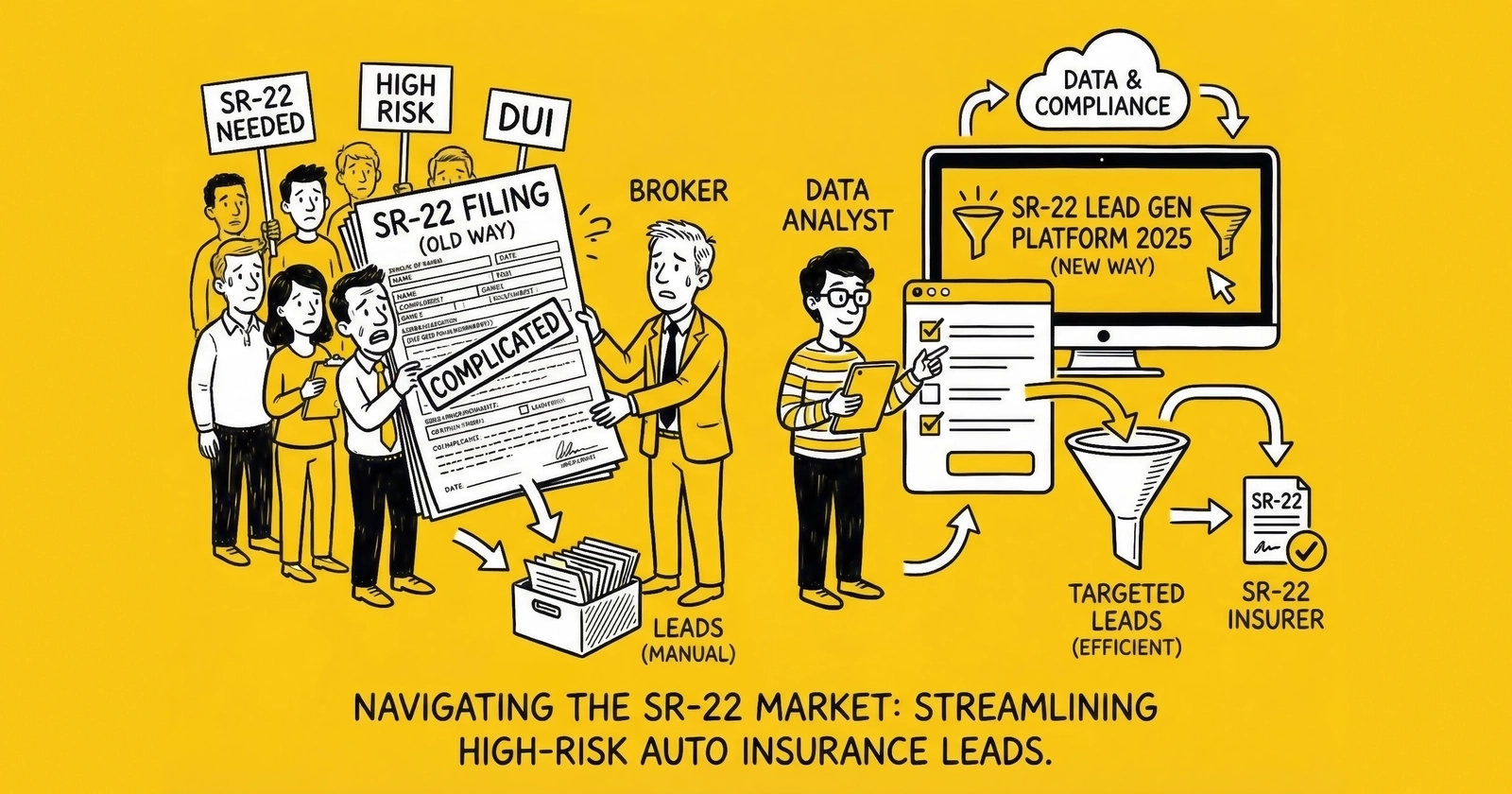
Master the non-standard auto insurance market with real CPL benchmarks, targeting strategies, and conversion tactics. This guide covers SR-22 requirements by state, DUI/DWI lead economics, high-risk driver demographics, and the specialized compliance considerations that determine success in this underserved but highly profitable vertical.
A driver walks out of court with a DUI conviction. Within 72 hours, they need an SR-22 filing or their license gets suspended. They pull out their phone and search “SR-22 insurance near me.” That search represents one of the highest-intent, highest-value leads in the entire auto insurance ecosystem.
The SR-22 and high-risk auto insurance market operates in a parallel universe from standard auto. While GEICO and Progressive fight for preferred drivers with 800 credit scores and clean records, a specialized network of carriers and agents serves the 15-20% of American drivers who cannot qualify for standard coverage. These are drivers with DUIs, multiple at-fault accidents, license suspensions, and lapsed coverage. They pay 2-4x standard rates. They have limited carrier options. And they search with urgency that standard shoppers rarely exhibit.
For lead generators, this creates a distinct opportunity. The non-standard auto market generates an estimated $45-55 billion in annual premiums in the United States, representing roughly 15-18% of the total personal auto insurance market. Yet the lead generation infrastructure serving this segment remains fragmented and underoptimized compared to standard auto.
This guide provides everything you need to understand, generate, and monetize SR-22 and high-risk auto insurance leads: the regulatory framework that creates the demand, the CPL benchmarks that govern economics, the targeting strategies that reach these consumers, and the compliance requirements that protect your operation.
Understanding the SR-22 Market: Regulatory Foundation
SR-22 is not insurance. It is a certificate of financial responsibility that insurers file with state DMVs to prove a high-risk driver maintains the required minimum liability coverage. The name comes from the form number used by most states for this filing.
Understanding the regulatory mechanics helps you target effectively and qualify leads appropriately.
What Triggers SR-22 Requirements
State laws vary, but SR-22 filings are typically required following specific violations and circumstances. DUI and DWI convictions represent the most common trigger, with all 50 states requiring proof of financial responsibility following alcohol or drug-related driving offenses. First-time DUI offenders typically need SR-22 coverage for 3 years, while repeat offenders may face 5-10 year requirements or permanent high-risk classification.
Serious traffic violations also trigger requirements in many states. Reckless driving, excessive speeding (typically 25+ mph over limit), leaving the scene of an accident, or vehicular assault and manslaughter can mandate SR-22 filings depending on state law. Drivers involved in at-fault accidents while uninsured often face SR-22 requirements as a condition of license reinstatement, even without other violations.
License suspension or revocation frequently requires SR-22 filing as well. Many states mandate the certificate as a condition of reinstating suspended or revoked licenses, regardless of the original cause of suspension. Courts in civil or criminal proceedings may also order SR-22 filing as part of sentencing or settlement terms. Some states trigger SR-22 requirements when drivers accumulate excessive points on their driving records, even without a single major violation.
SR-22 Requirements by State
SR-22 requirements vary significantly by state. Three states do not use SR-22 forms at all: Delaware uses an SR-22A form with similar function, Kentucky uses no SR-22 equivalent with insurance verification handled differently, and New Mexico requires proof of financial responsibility through other means without an SR-22 form.
Virginia and Ohio use FR-44 forms for DUI convictions, which require higher liability limits than standard SR-22. Virginia mandates $50,000 bodily injury per person and $100,000 per accident, while Ohio requirements vary based on circumstances.
Most states require SR-22 filing for 3 years following the triggering event. However, this ranges from 1 year in some states to 5+ years for serious or repeat offenses.
Filing Duration by Common Triggers
| Trigger | Typical Duration | Notes |
|---|---|---|
| First DUI | 3 years | Most common requirement |
| Second DUI | 3-5 years | State variation significant |
| Third+ DUI | 5-10 years | Some states permanent |
| Driving uninsured (accident) | 3 years | Standard in most states |
| Reckless driving | 2-3 years | Varies by severity |
| License reinstatement | 1-3 years | Depends on cause |
The multi-year requirement creates ongoing demand. A driver who needs SR-22 coverage in 2026 will need it through 2028 at minimum, creating a customer retention opportunity that exceeds standard auto.
The Non-Standard Auto Market Structure
The broader non-standard or high-risk auto market includes SR-22 drivers plus other consumers who cannot obtain standard coverage. Young drivers under 25 with less than 3 years of experience often get quoted into non-standard carriers regardless of driving record. Senior drivers aged 75 and older with any accidents or violations may face non-standard placement as well.
Multiple violations create placement challenges regardless of severity. Drivers with 3 or more violations in 3 years often cannot qualify for standard coverage. Coverage lapses matter too: consumers who let coverage lapse for 30 or more days face non-standard pricing when re-entering the market.
Non-standard vehicles present another category. High-performance vehicles, salvage titles, and commercial-use personal vehicles may require specialty placement. In states allowing insurance scoring, consumers with poor credit may be placed in non-standard programs even with clean driving records.
This broader market represents approximately 15-18% of all personal auto insurance policies, translating to roughly 30-40 million vehicles insured through non-standard programs.
Market Size and Economics
The non-standard auto insurance market generates substantial premium volume with concentrated demand among specialized carriers.
Non-Standard Auto Market Size
Industry estimates place the U.S. non-standard auto insurance market at $45-55 billion in annual written premium, representing approximately 15-18% of the total $300+ billion personal auto market. This estimate includes SR-22 and FR-44 required policies, high-risk drivers without filing requirements, young and senior driver specialty programs, lapsed coverage recovery policies, and state-assigned risk pool participants.
The SR-22 specific segment represents roughly $8-12 billion of this total, based on DUI conviction rates, filing requirements, and average premium differentials.
Premium Differentials: The Economic Driver
High-risk drivers pay dramatically more for coverage, which drives both lead value and carrier economics:
| Driver Profile | Annual Premium Range | vs. Standard |
|---|---|---|
| Standard driver (clean record) | $1,200-1,800 | Baseline |
| First DUI, SR-22 required | $2,800-4,500 | +130-150% |
| Multiple DUIs, SR-22 | $4,500-8,000 | +250-350% |
| Young driver + violation | $3,000-5,500 | +150-200% |
| Coverage lapse + incident | $2,200-3,800 | +80-110% |
A single DUI conviction can increase annual premium by $2,000-4,000 depending on state, carrier, and coverage levels. This premium differential explains why carriers accept the higher risk: the math works at appropriate pricing.
Carrier Landscape: Who Writes High-Risk
The non-standard market is served by specialized carriers and specialty divisions of major insurers.
Specialty non-standard carriers dominate this space. Bristol West (owned by Farmers), Dairyland (owned by Sentry), The General (owned by PGC Holdings), SafeAuto (independent), Acceptance Insurance (owned by Acceptance Insurance Holdings), National General (owned by Allstate), and Infinity Insurance (owned by Kemper) focus specifically on high-risk drivers.
Major carriers participate with varying appetites. Progressive maintains a significant non-standard book. GEICO offers limited non-standard capacity. Allstate serves the market through its National General subsidiary. State Farm maintains very limited non-standard appetite.
Every state maintains an assigned risk mechanism for drivers who cannot obtain coverage in the voluntary market. These pools assign policies proportionally to all insurers writing auto in the state.
The carrier concentration creates opportunity for lead generators. Building relationships with 8-12 specialty carriers can provide placement capability for nearly any risk profile, while standard auto requires relationships with dozens of carriers to achieve similar coverage.
CPL Benchmarks: High-Risk Auto Lead Pricing
SR-22 and high-risk auto leads command premium pricing relative to standard auto, reflecting the premium differentials and concentrated carrier appetite.
Current CPL Benchmarks (2026)
| Lead Type | CPL Range | Typical CPL | Premium Tier |
|---|---|---|---|
| SR-22 Required (verified) | $45-120 | $65-85 | $120+ |
| DUI/DWI specific | $55-140 | $80-100 | $140+ |
| High-risk (no SR-22) | $35-90 | $50-70 | $90+ |
| Coverage lapse recovery | $30-75 | $45-60 | $75+ |
| Young driver high-risk | $40-95 | $55-75 | $95+ |
Several factors drive pricing within these ranges. Verification level matters significantly: leads with verified SR-22 requirement (court documents referenced, violation confirmed) command 20-40% premium over self-reported. Recency of trigger affects value as well, with recent DUI (within 30 days) indicating immediate need and commanding higher pricing. Geographic factors play a role since states with higher premium rates (Michigan, Florida, Louisiana) support higher CPL. Distribution model creates the largest spread, with exclusive high-risk leads running 80-120% higher than shared.
Comparison to Standard Auto
| Lead Category | Standard Auto CPL | High-Risk CPL | Premium |
|---|---|---|---|
| Exclusive | $40-100 | $65-140 | +60-80% |
| Shared | $15-35 | $30-65 | +85-100% |
| Live transfer | $100-200 | $150-300 | +50-75% |
The premium reflects three factors: higher customer lifetime value (larger premiums), lower competition (fewer generators serve the vertical), and higher intent (these consumers need coverage immediately, not eventually).
Live Transfer Pricing: The Premium Channel
Live transfers for SR-22 leads command exceptional pricing due to urgency and conversion rates:
| Transfer Type | Price Range | Connect Rate | Conversion |
|---|---|---|---|
| SR-22 verified, warm | $150-250 | 85-92% | 25-35% |
| DUI within 30 days | $175-300 | 88-95% | 30-40% |
| High-risk general | $125-200 | 80-88% | 20-30% |
Conversion rates for live transfers in high-risk auto exceed standard auto significantly. A consumer who just received a DUI and needs coverage immediately converts at 30-40%, compared to 15-25% for standard auto shoppers who have time to compare.
Targeting Strategies: Reaching High-Risk Consumers
Reaching SR-22 and high-risk consumers requires different strategies than standard auto marketing. These consumers are in different life situations, use different search behaviors, and respond to different messaging.
Search Intent: High-Value Keywords
High-risk consumers search with specific, intent-revealing queries. Understanding keyword clusters helps allocate budget effectively.
SR-22 Specific Keywords
| Keyword Cluster | Monthly Volume | CPC Range | Intent Level |
|---|---|---|---|
| ”sr22 insurance” | 110,000 | $8-15 | Very high |
| ”sr22 insurance near me” | 45,000 | $10-18 | Very high |
| ”cheap sr22 insurance” | 35,000 | $7-12 | High |
| ”sr22 insurance cost” | 28,000 | $5-10 | Research |
| ”sr22 filing” | 22,000 | $6-12 | High |
| ”how to get sr22” | 18,000 | $4-8 | Research |
DUI-Related Keywords
| Keyword Cluster | Monthly Volume | CPC Range | Intent Level |
|---|---|---|---|
| ”insurance after dui” | 32,000 | $10-18 | Very high |
| ”dui insurance” | 25,000 | $12-20 | Very high |
| ”car insurance after dui” | 18,000 | $10-16 | Very high |
| ”how much does insurance go up after dui” | 15,000 | $5-10 | Research |
High-Risk General
| Keyword Cluster | Monthly Volume | CPC Range | Intent Level |
|---|---|---|---|
| ”high risk auto insurance” | 22,000 | $8-14 | High |
| ”non-standard auto insurance” | 8,000 | $6-12 | High |
| ”insurance with bad driving record” | 12,000 | $7-13 | High |
| ”cheap insurance for bad drivers” | 9,000 | $6-11 | High |
The “near me” modifier indicates immediate local need and converts at higher rates despite higher CPC.
Audience Targeting Beyond Keywords
Search captures active shoppers, but many high-risk consumers can be reached through demographic and behavioral targeting.
Life event targeting offers powerful opportunities. Where legally accessible through public records, DUI court date records provide direct targeting. License reinstatement searches indicate active need. Ignition interlock device searches indicate DUI conviction. Interest in alcohol treatment or counseling often indicates recent DUI circumstances.
Demographic indicators help identify likely high-risk consumers. Males aged 21-35 represent the highest DUI demographic. Single adults in urban and suburban areas show higher incident rates. Interest in nightlife, bars, and entertainment venues correlates with DUI risk. Previous auto insurance searchers with coverage gaps indicate potential high-risk status.
Retargeting strategies extend reach to in-market consumers. Court website visitors (public court records portals), DMV website visitors, DUI attorney website visitors, and bail bond website visitors all represent potential high-risk insurance shoppers.
The ethical considerations here are important. These consumers are in difficult situations, often facing financial strain and legal consequences. Messaging should be helpful and non-judgmental, not predatory.
Geographic Targeting Optimization
SR-22 and high-risk demand concentrates in specific markets. Understanding state-level opportunity helps allocate resources effectively.
High-Value States for SR-22 Leads
| State | DUI Arrests (Annual) | SR-22 Duration | Premium Index | Lead Opportunity |
|---|---|---|---|---|
| California | 155,000+ | 3 years | 130 | Very high |
| Texas | 90,000+ | 2 years | 110 | Very high |
| Florida | 45,000+ | 3 years | 140 | High |
| Michigan | 28,000+ | 3 years | 150 | High |
| Arizona | 28,000+ | 3 years | 105 | High |
| Wisconsin | 25,000+ | 3 years | 95 | Moderate |
| Ohio | 35,000+ | 3 years (FR-44) | 100 | High |
| Illinois | 27,000+ | 3 years | 115 | High |
States with longer filing requirements and higher base premiums create more valuable lead opportunities.
Lower-value markets include states with no SR-22 requirement (Kentucky, New Mexico as noted), states with shorter filing periods (some at 1-2 years), and states with strong assigned risk pools that compete with the voluntary market.
Content Marketing for High-Risk Auto
High-risk consumers research extensively before purchasing. Content that answers their questions builds trust and captures organic traffic.
High-performing content topics include state-specific guides like “How long does a DUI stay on your insurance record in [State]” and “How to get your license back after a DUI in [State].” Educational content addressing “What is an SR-22 and how much does it cost” performs well. Comparison content like “Best insurance companies for DUI drivers in 2026” and “SR-22 insurance requirements by state comparison” attracts research-phase traffic. Problem-solution content such as “Can you get insurance without an SR-22 if you had a DUI” and “What happens if you cancel SR-22 insurance early” captures consumers with specific concerns.
These informational queries have lower competition than transactional keywords and build organic traffic that converts over time.
Lead Qualification: What Makes a High-Risk Lead Valuable
Not all high-risk leads are equal. Qualification criteria determine lead value and conversion probability.
Essential Qualification Fields
Basic qualification requires several core fields. Violation type matters because DUI versus reckless versus accidents affects carrier appetite differently. Violation date determines urgency: recent violations indicate immediate need while older violations may qualify for lower rates. SR-22 required (yes or no) confirms filing requirement and urgency level. Current insurance status (lapsed versus never insured versus currently insured) affects placement options. License status (suspended, revoked, or valid) affects immediate bindability. State determines filing requirements and carrier options.
Premium qualification fields add significant value. Number of violations affects placement options, with single violations opening more doors than multiple. Blood alcohol level for DUI cases may limit carrier options at high levels. Court date or deadline creates urgency that increases conversion probability. Prior SR-22 history indicates repeat SR-22 drivers with different economics. Vehicle ownership (owned versus financed) affects coverage requirements.
Lead Quality Tiers
Tier 1 leads with verified immediate need command $80-120+ CPL. These leads have SR-22 requirement confirmed through court documents or DMV notice, deadline within 30 days, license currently suspended pending filing, verified contact information, and full violation history provided.
Tier 2 leads with confirmed high-risk status run $55-80 CPL. These include self-reported DUI/DWI within the past year, SR-22 likely required based on violation type, currently shopping for coverage, verified contact information, and partial violation history.
Tier 3 general high-risk leads sell for $35-55 CPL. These feature multiple violations self-reported, may or may not require SR-22, unclear shopping timeline, basic contact information, and minimal qualification data.
The 2-3x pricing spread between tiers reflects conversion probability and placement difficulty differences.
Red Flags and Disqualification Criteria
Certain leads require rejection or significant price adjustment. Commercial driver’s license (CDL) with violations represents an entirely different market. Out-of-state violations requiring SR-22 in a different state than residence create complex filing situations. Felony DUI charges pending may make the consumer uninsurable until resolved. Multiple SR-22 requirements across states create complex placement challenges. Vehicles with salvage titles requiring high-risk placement compound the difficulty substantially.
Conversion Optimization: Selling High-Risk Leads
High-risk consumers have different psychology than standard shoppers. Conversion optimization requires understanding their situation and urgency.
The High-Risk Consumer Mindset
These consumers typically experience several emotional and practical states simultaneously. Urgency dominates their thinking because they need coverage now, not eventually. License reinstatement, court deadlines, or immediate transportation needs drive action. Anxiety accompanies the process as many deal with legal consequences, financial strain, and shame. They expect judgment and are relieved by professional, non-judgmental treatment.
Price sensitivity exists but with low optionality. These consumers know they will pay more but want to minimize the damage. However, their limited carrier options reduce effective price shopping. Information seeking characterizes their research behavior. They want to understand their situation: how long will this last, how much will it cost, will rates go down over time.
Landing Page Optimization for High-Risk
Effective landing pages for high-risk consumers share several characteristics. Lead with empathy rather than judgment: “Everyone makes mistakes. Let us help you get back on the road” works better than “Made bad choices? We can help.” Address urgency directly with messaging like “Need SR-22 today? We can file within 24 hours.” Clarify the process since many consumers do not understand SR-22 requirements, and simple explanation builds trust. Show carrier logos to indicate you work with carriers who accept high-risk drivers. Provide educational content through FAQs addressing common questions, which improves engagement and time-on-page. Optimize for mobile because many high-risk searches happen on mobile devices, often in stressful situations.
Certain elements harm conversion and should be avoided. Imagery of crashes, police, or court triggers negative emotions. Language that reinforces shame (“bad driver,” “risky driver”) alienates consumers. Generic auto insurance messaging that ignores their specific situation fails to resonate. Complex forms create abandonment before completion.
Form Structure for High-Risk Leads
Multi-step forms work exceptionally well for high-risk leads. The first step identifies the situation: What brings you here today? (DUI, accident, lapse, other) Do you need SR-22 filing? What state requires the filing?
The second step captures violation details: When did the incident occur? What type of violation? Is your license currently suspended?
The third step gathers basic quote information: Vehicle year, make, model. Zip code. Current coverage (if any).
The fourth step collects contact information: Name, phone, email. Best time to call. Deadline for coverage (if any).
This progressive disclosure keeps initial commitment low while qualifying deeply before collecting contact information.
Speed-to-Contact: Critical for High-Risk
Speed matters even more in high-risk than standard auto:
| Response Time | Contact Rate | Conversion Impact |
|---|---|---|
| Under 1 minute | 65-75% | Optimal |
| 1-5 minutes | 55-65% | Good |
| 5-15 minutes | 40-50% | Acceptable |
| 15-60 minutes | 30-40% | Marginal |
| 60+ minutes | Under 30% | Poor |
The urgency of high-risk consumers means many will continue searching until they reach someone. If you do not call immediately, they may complete another form and bind with the first agent who reaches them. For comprehensive guidance on optimizing response times, see our speed-to-lead guide.
Same-day binding represents a significant opportunity. Many SR-22 consumers can and will bind coverage on the first call if the agent can quote competitively and file immediately. This single-call close rate can reach 35-45% for properly qualified, rapidly contacted leads.
Working with Carriers and Agents
The buyer ecosystem for high-risk leads differs from standard auto.
Carrier Direct Relationships
Specialty non-standard carriers actively purchase leads and may offer direct relationships to qualified generators. These carriers want verified SR-22 requirement (which reduces quote-to-bind friction), complete violation history (enabling accurate quoting), real-time delivery (supporting speed-to-contact), documented consent (TCPA compliance essential), and state-level targeting (since carrier appetite varies by state).
Typical carrier terms include lead pricing of $35-75 for shared and $65-120 for exclusive, 48-72 hour return windows for invalid contact, volume requirements of 500+ leads monthly for direct relationships, and quality thresholds of 12-15% maximum return rate.
Independent Agent Networks
Independent agents specializing in high-risk auto represent strong buyers. These agents typically maintain appointments with 8-15 non-standard carriers, have experience with SR-22 filings, often operate call centers optimized for volume, and pay premium for exclusive leads.
Agent economics support premium lead pricing. Commission on non-standard policies runs 12-18% of premium. With average SR-22 premium at $3,500 annually, commission per sale reaches $420-630. Acceptable cost per sale ranges from $150-350. This math supports $60-100 exclusive lead pricing at 25-35% conversion rates.
High-Risk Specialty Agencies
Some agencies focus exclusively on high-risk auto. They maintain multiple carrier appointments specifically for non-standard risks, offer filing capability in most states, operate optimized workflows for SR-22 processing, and are often willing to pay premium for verified leads. These specialty buyers may pay 20-30% above market for leads that match their specific appetite (particular violations, specific states, certain demographics).
Compliance Considerations
High-risk auto lead generation involves standard TCPA compliance plus additional considerations.
TCPA Compliance
All standard TCPA requirements apply: prior express written consent required before autodialed calls, clear disclosure of parties authorized to contact, consent documentation through TrustedForm or Jornaya, and DNC compliance.
Sensitive Data Handling
High-risk leads contain sensitive information about criminal history and violations. Data protection requirements include appropriate security measures for violation details, compliance with state regulations governing collection and use of driving record information, and CCPA and state privacy law compliance for this sensitive data category.
Best practices include minimizing collection of unnecessary sensitive details, providing clear disclosure about data use and sharing, ensuring secure transmission and storage, and maintaining defined retention and deletion policies.
State Insurance Regulations
Some states regulate how insurance leads can be marketed. Advertising claims about SR-22 rates require accuracy. Some states restrict “guaranteed approval” claims. Filing capability claims should be accurate since not all carriers file in all states.
Carrier Compliance Requirements
Non-standard carriers often impose additional requirements including specific consent language mentioning SR-22/high-risk coverage, disclosure that rates will be higher than standard, and accurate representation of carrier capabilities. Review buyer agreements for specific compliance requirements that exceed regulatory minimums.
Building a High-Risk Auto Lead Business
The high-risk auto vertical offers attractive characteristics for lead generators willing to specialize.
Why High-Risk Auto Works
Sustainable demand exists independent of economic cycles. DUI arrests in the United States total approximately 1 million annually. Combined with other high-risk triggers, the market generates continuous demand regardless of broader conditions.
Limited competition benefits specialists. Most lead generators focus on standard auto due to higher volume. The specialized requirements of high-risk reduce competition for those willing to develop expertise.
Premium pricing improves unit economics. Higher CPL and conversion rates improve unit economics relative to standard auto margins.
Sticky customers create retention opportunity. SR-22 requirements lasting 3+ years mean a customer acquired in 2026 generates value through 2028.
Carrier relationships are achievable at depth. Fewer carriers writing high-risk means deeper relationships are achievable with 10-15 carriers versus 50+ for standard auto.
Entry Requirements
Traffic acquisition requires paid search on SR-22 and high-risk keywords, content marketing for informational queries, social media targeting life events and demographics, and retargeting from related websites.
Landing page infrastructure needs include high-risk specific messaging and forms, educational content integration, mobile-optimized experience, and multi-step qualification flows.
Distribution relationships require 8-12 specialty carrier relationships, independent agent network access, and ping/post platform integration (if operating at scale).
Compliance infrastructure demands TrustedForm or Jornaya implementation, appropriate data security measures, state-specific consent language, and return handling processes.
Unit Economics Example
At moderate scale with pure paid acquisition, the economics prove challenging:
| Metric | Value |
|---|---|
| Media spend | $25,000 |
| Leads generated | 350 |
| Dashboard CPL | $71.43 |
| True CPL (with returns, compliance) | $92 |
| Average lead sale price | $75 |
| Sell-through rate | 88% |
| Effective revenue per lead | $66 |
| Gross margin | -28% (loss) |
Wait. That math does not work. Let me recalculate with realistic high-risk pricing.
| Metric | Value |
|---|---|
| Media spend | $25,000 |
| Leads generated | 300 |
| Dashboard CPL | $83.33 |
| True CPL (with returns, compliance) | $105 |
| Average lead sale price (high-risk) | $85 |
| Premium lead tier (40%) | $110 |
| Standard tier (60%) | $70 |
| Blended price | $86 |
| Sell-through rate | 90% |
| Effective revenue per lead | $77.40 |
| Gross margin | -26% (still loss) |
The math reveals the challenge: high-risk leads cost more to generate due to competitive keywords, and pricing does not always compensate.
How Operators Make It Work
Successful operators employ several strategies to achieve profitability. Organic traffic blend dramatically improves economics when operators with strong SEO generate 30-40% of volume at near-zero marginal cost. Live transfer premium helps when converting 20% of leads to live transfers at $175-250 improves blended revenue substantially. Volume efficiency reduces operational costs per lead significantly at scale (1,000+ leads monthly). Exclusive focus at $100-120 CPL with 92% sell-through can achieve positive margins.
A profitable model example demonstrates achievable economics:
| Metric | Value |
|---|---|
| Total leads | 1,000 |
| Organic (30%) | 300 at $15 CPL |
| Paid (70%) | 700 at $90 CPL |
| Blended CPL | $67.50 |
| True CPL (with costs) | $82 |
| Exclusive sales (60%) | 600 at $95 |
| Live transfers (15%) | 150 at $185 |
| Shared sales (25%) | 250 at $45 |
| Blended revenue | $96.25 |
| Sell-through | 92% |
| Effective revenue | $88.55 |
| Gross margin | 8% |
Modest, but viable. Scale, efficiency, and traffic mix determine whether high-risk auto works for a specific operator.
Technology and Platform Considerations
High-risk auto lead operations benefit from specialized technology.
Lead Distribution Platforms
Major platforms support high-risk auto with specific capabilities. boberdoo offers full ping/post support with custom fields for violation data. LeadsPedia provides real-time distribution with carrier integrations. Phonexa delivers call tracking and distribution with live transfer support. CAKE handles attribution and routing, though with more affiliate focus.
Platform selection depends on distribution model (direct to carrier versus through networks), volume, and technical requirements.
Validation Services
Standard validation applies plus high-risk specific considerations: phone validation (carrier lookup, line type), email verification, address validation, and duplicate checking against high-risk specific databases.
Some operators validate driving record claims against public records where legally accessible, though this adds cost and complexity.
CRM Requirements
High-risk specific CRM needs include violation tracking fields, SR-22 filing status tracking, court deadline management, multi-state filing capability tracking, and carrier appointment status by state. Generic auto CRM systems may require customization for high-risk specific workflows.
Seasonal Patterns and Timing
High-risk auto demand follows patterns distinct from standard auto.
DUI Arrest Patterns
DUI arrests concentrate during specific periods:
| Period | DUI Index | Notes |
|---|---|---|
| New Year’s Eve/Day | 180-220 | Highest single period |
| Super Bowl weekend | 130-150 | Significant spike |
| St. Patrick’s Day | 140-160 | Notable increase |
| Memorial Day weekend | 125-140 | Holiday travel |
| July 4th | 135-155 | Holiday celebration |
| Labor Day weekend | 125-140 | Holiday travel |
| Thanksgiving | 130-145 | Holiday travel |
| Christmas/New Year | 150-180 | Extended holiday period |
Lead volume spikes 2-4 weeks after major DUI periods as court processing completes and SR-22 requirements are issued.
Court Processing Timing
Typical timeline from arrest to SR-22 requirement shows predictable lag:
| Stage | Timeline |
|---|---|
| Arrest | Day 0 |
| Arraignment | 1-4 weeks |
| Plea/trial | 1-3 months |
| Sentencing with SR-22 order | 1-4 months |
| License suspension takes effect | Varies by state |
| SR-22 shopping begins | 1-7 days before deadline |
The 1-4 month lag between DUI arrest peaks and SR-22 demand peaks creates planning opportunities.
Budget Allocation by Quarter
| Quarter | Demand Index | Recommended Spend Index |
|---|---|---|
| Q1 | 115 | 120 |
| Q2 | 95 | 90 |
| Q3 | 100 | 100 |
| Q4 | 110 | 110 |
Q1 captures the wave from holiday DUIs. Q2 represents lowest demand. Q3-Q4 build toward year-end holidays.
Frequently Asked Questions
What is an SR-22 and why do people need it?
An SR-22 is a certificate of financial responsibility filed by an insurance company with the state DMV. It proves a high-risk driver maintains required minimum liability coverage. Drivers typically need SR-22 after DUI/DWI convictions, driving without insurance, serious traffic violations, or license suspensions. The filing requirement usually lasts 3 years but can extend to 5-10 years for repeat offenses.
How much do SR-22 insurance leads cost in 2026?
SR-22 and high-risk auto leads range from $35-140 depending on qualification level and distribution model. Verified SR-22 required leads typically run $65-120 for exclusive and $35-65 for shared. DUI-specific leads with court documentation command premium pricing of $80-140. Live transfers for SR-22 consumers range from $150-300.
What conversion rates should I expect from high-risk auto leads?
High-risk auto leads convert at higher rates than standard due to urgency. Expect 20-35% conversion rates for exclusive leads contacted within 5 minutes, compared to 12-15% for standard auto. Live transfers convert at 25-40% for SR-22 leads. Contact rates are also higher because these consumers need coverage immediately and answer calls.
Which states have the highest demand for SR-22 leads?
California generates the highest volume with over 155,000 annual DUI arrests. Texas, Florida, Arizona, and Ohio follow with significant volume. States with longer filing requirements (3+ years), higher base insurance rates, and larger populations create the most opportunity. Kentucky, New Mexico, and Delaware have different filing systems that reduce standard SR-22 demand.
How do I target SR-22 consumers effectively?
Search advertising on SR-22 and DUI-related keywords captures high-intent consumers. Keywords like “sr22 insurance,” “insurance after dui,” and “sr22 near me” indicate immediate need. Content marketing answering questions about SR-22 requirements, costs, and processes builds organic traffic. Retargeting visitors from court websites, DMV sites, and DUI attorney sites can reach consumers in the decision process.
What carrier relationships do I need for high-risk auto?
Specialty non-standard carriers including Bristol West, Dairyland, The General, SafeAuto, and National General handle most high-risk volume. Progressive writes significant non-standard business. Building relationships with 8-12 specialty carriers provides placement capability for most risk profiles. Assigned risk pools exist in every state for drivers who cannot obtain voluntary coverage.
How is high-risk auto lead compliance different from standard auto?
Standard TCPA compliance applies: prior express written consent, clear disclosure of authorized parties, and consent documentation. Additional considerations include handling sensitive violation data appropriately, complying with state privacy laws regarding driving records, and ensuring advertising claims about SR-22 rates and approval are accurate. Some carriers require specific consent language mentioning high-risk coverage.
What makes a high-risk auto lead high quality?
High-quality SR-22 leads include verified filing requirement (confirmed through court documents or DMV notice), complete violation history, verified contact information, and deadline urgency. Premium leads include specific violation dates, blood alcohol levels for DUI cases, and current license status. The difference between self-reported “I think I need SR-22” and documented “court ordered SR-22 filing by March 15” justifies 40-60% pricing premium.
How does seasonality affect high-risk auto leads?
DUI arrests spike during holidays: New Year’s, July 4th, Thanksgiving, and the December holiday period. Lead volume peaks 1-4 months after these periods as court processing completes and SR-22 requirements are issued. Q1 typically sees 15% above average demand capturing holiday DUI processing. Summer months see lowest demand. Plan budgets and inventory around these predictable patterns.
Can I generate high-risk auto leads profitably?
Profitability requires traffic mix optimization, premium pricing for qualified leads, and operational efficiency at scale. Operators generating 30-40% of leads through organic/content channels dramatically improve blended CPL. Converting 15-20% of volume to live transfers at $175-250 improves revenue. At scale (1,000+ leads monthly), gross margins of 8-15% are achievable. Small-scale operations struggle with the economics unless focused exclusively on premium segments.
Key Takeaways
-
The SR-22 and high-risk auto market represents $45-55 billion in annual premium, approximately 15-18% of total personal auto. The SR-22 specific segment generates $8-12 billion, creating substantial lead generation opportunity.
-
SR-22 leads command 60-100% premium over standard auto, with exclusive leads at $65-120 and live transfers at $150-300. Premium pricing reflects higher customer lifetime value (2-4x standard premiums) and concentrated carrier demand.
-
Urgency drives exceptional conversion rates. SR-22 consumers facing license suspension deadlines convert at 25-40% on live transfers versus 15-25% for standard auto. Speed-to-contact matters even more than in standard auto.
-
Targeting requires specialized approach. SR-22 keywords (“sr22 insurance,” “insurance after dui”) indicate high intent. Content marketing answering SR-22 questions builds organic traffic. Life event and demographic targeting reaches consumers before they search.
-
Qualification separates lead tiers. Verified SR-22 requirement with court documentation commands $80-120+ while self-reported high-risk without verification runs $35-55. Invest in qualification to justify premium pricing.
-
Seasonal patterns follow DUI enforcement. Holiday periods (New Year’s, July 4th, Thanksgiving, Christmas) spike DUI arrests. Lead demand peaks 1-4 months later as court processing completes. Q1 represents highest demand.
-
Profitability requires traffic mix and scale. Pure paid acquisition struggles with economics. Successful operators blend 30-40% organic traffic, convert 15-20% to live transfers, and operate at 1,000+ leads monthly to achieve positive margins.
-
Carrier relationships are concentrated. Ten to twelve specialty non-standard carriers handle most high-risk volume. Building deep relationships with this focused group is more achievable than standard auto’s fragmented carrier landscape.
Statistics and benchmarks current as of 2025. SR-22 requirements, carrier appetite, and market conditions vary by state and change over time. Verify current requirements and pricing before making significant investment decisions. This guide does not constitute legal advice regarding compliance requirements.